The American Crossword Puzzle Tournament: Rising Stars and Familiar Names

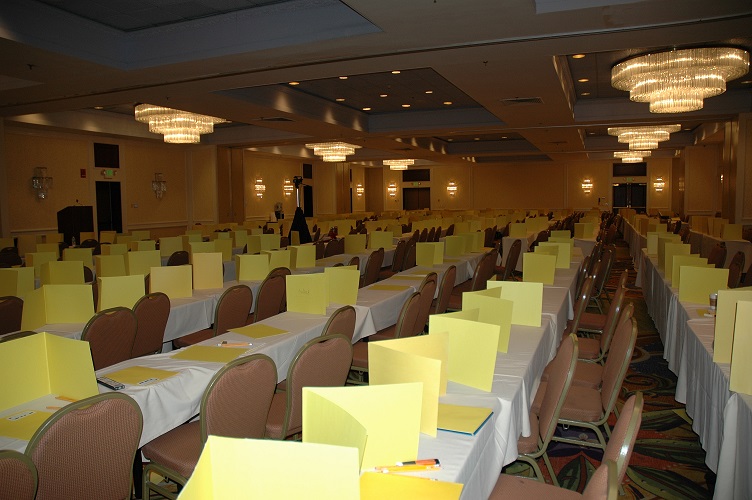
The American Crossword Puzzle Tournament was this past weekend, and unfortunately I wasn’t able to attend. I did my best to keep up with the event through social media, enjoying everyone’s observations, jokes, highlights, victories, trials and tribulations.

One message in particular stuck out to me, though.

I can’t remember if it was posting the results after the sixth or the seventh puzzle, but they remarked that they were excited to see some new blood in the top ten.

I couldn’t help but laugh, because all the names were pretty familiar to me.

Paolo Pasco won the tournament for the second year in a row, dominating the final puzzle with a record-breaking time of 3 minutes and 45 seconds. (Solver Paul Edward did the math on Facebook and calculated that Paolo spent less than 34 minutes across the 8 puzzles that weekend. WOW.)

Will Nediger and former champ Dan Feyer duked it out for second place, with Will edging out Dan by ONE SECOND, solving the puzzle in 4 minutes and 38 seconds. What a nailbiter!

The next day, after the tournament was over, I still had that message lurking in my brainspace.

Now, anyone who reads this blog can tell that I’m a nerd for many things. I’m a nerd for puzzles, games, and RPGs. I’m a nerd for trivia.

And I am absolutely a nerd for statistics. I love numbers and analysis and compiling data.

If you’ve ever perused the website for the American Crossword Puzzle Tournament, you’ll find it to be a treasure trove of data just waiting for analysis.

So I read through the full results available for each tournament going back years, focusing on the top ten from this year’s tournament and reflecting on their ACPT careers. I had to see if that “new blood” message had any merit or not, and I figured this was the best way to find out.

Let’s see, shall we?


  1. Emily O’Neill

Emily has been competing since 2005 (unless there’s a name change involved, which is possible), and has been in the top ten twice. She has been in the top 30 ten times!

  1. Glen Ryan

Glen has been competing since 2013 (where he placed 3rd in Division B), and has been in the top ten five times. He has been in the top 30 ten times!

  1. Al Sanders

Al has been competing since 1999 (where he placed in the top three), and has been in the top ten TWENTY times. He has been second place twice and in the top 3 seven times. He has never ranked lower than 21!

  1. Stella Zawistowski

Stella has been competing since 2001, and has been in the top ten THIRTEEN times. She has been in the top 30 nineteen times!

  1. Andy Kravis

Andy has been competing since 2011, and has been in the top ten six times. He has been in the top 30 ten times!

  1. Tyler Hinman

Tyler has been competing since 2001 and is a seven-time champion! He has been in the top ten NINETEEN times (including five times in a row at second place and fourteen times in the top three). He was the Division B winner in his second appearance.

  1. David Plotkin

David has been competing since 2010, and has been in the top ten TWELVE times. He has been in the top 3 six times and has never ranked lower than 28th!

  1. Dan Feyer

Dan has been competing since 2008 and is a nine-time champion! He has been in the top ten SIXTEEN times (literally every time except his first tournament appearance).

[It’s not until the final two names that we really get anyone who qualifies as new blood.]

  1. Will Nediger

Will has been competing since 2021 and has been in the top 3 twice. He has been in the top ten three times (meaning every time he’s competed).

  1. Paolo Pasco

Paolo has been competing since 2021 and is a two-time champion! He has been in the top ten five times (every time he’s competed). He was also the Division B winner in 2022.

You have to go back to the year 1998 to find a tournament that didn’t feature one of these ten people as a solver. That’s amazing!


Originally, I was just going to focus on the top ten solvers from this year’s tournament and their many accomplishments.

But as I was going through the rankings year by year, I was struck by how many names I recognized, and how many times I got to see those names. I got to experience the tournament community as a microcosm across literal decades.

I watched the changing of the guard as some names slowly slipped out of the top ten and were replaced by others. Names like Anne Erdmann and Trip Payne and Jon Delfin and Ellen Ripstein and Douglas Hoylman. I was more familiar with some than others.

The slow evolution of solvers really struck both the puzzle nerd in me and the history nerd in me. I ventured back before my own career in puzzles started (back in 2003).

I’ve never competed at the ACPT, but I attended the event for several years, working the Penny Press / Puzzlenation table in the common area, and I grew familiar with a lot of attendees. Puzzle people are genuinely nice folks, and so many of them were happy to visit for a bit, introducing themselves, checking out our magazines, and taking advantage of our pencil sharpeners.

Everyone was so friendly, sharing their excitement for the event and letting me know their thoughts on each puzzle as the tournament went on. It really is a delight.

(Just don’t start a conversation about which pencils are the best for solving and you’ll be fine!)

New blood or not, the crossword scene is clearly thriving, and I can’t wait to see what next year’s tournament brings.

Happy puzzling, everyone!

What’s a Shortz Number?

While I was researching Salomon Numbers for last week’s post, I discovered another crossword-centric number system with an S-name attached.

The Shortz Number.

Actually, I found several of them.

Allow me to elucidate.


XWordInfo lists a constructor’s Shortz Number as a reflection of when that constructor was first published in a daily puzzle during the Shortz Era of The New York Times crossword.

For instance, Jacob Reed debuts in today’s puzzle, and his Shortz Number is 1373.

Peter Gordon is 1. Merl Reagle is 26. Bernice Gordon is 77. Matt Gaffney is 97. Nancy Salomon is 143. Patrick Berry is 257. Deb Amlen is 378. Doug Peterson is 431. Patti Varol is 1000.

It’s an incredible insight into an ever-evolving roster of constructors.

According to a cursory Google Search, this seems to be the most legitimate definition of a Shortz Number.

But there are others.


The second and most specious definition seems to be a Shortzian take on the Salomon Number, connecting constructors to Shortz through a Kevin Bacon-like system of collaborations.

I only found a few references to this interpretation, so it seems more like a coincidence than actual cultural permeation.

But that still leaves one more version of a Shortz Number, and it’s my favorite one.


This version is actually referenced on Wikipedia under Humorous Units of Measurement and apparently originated as a Reddit post.

But in this instance, a Shortz is a unit of measurement for fame. More specifically, it’s the number of times a person’s name has appeared in The New York Times crossword as either a clue or a solution.

The brief post then goes on to state that Shortz himself is 1 Shortz famous. (I was unable to verify this through XWordInfo, either through SHORTZ, WILLSHORTZ, or WILL as grid entries.)

But as someone who enjoys weird statistics, I was definitely intrigued by this one. What’s the Shortz Number for common crosswordese and frequent fill?

I mean, RIPTORN only has a 6, but that’s an impressive number of times to get your first AND last name in a crossword.

So let’s dig in.


First things first, I’m jettisoning the clue aspect of the definition. Let’s stick to grid entries.

I’m also doing my best to eliminate shared names or ones with multiple definitions. ETTA has 241 uses in the Shortz Era, but I don’t want to parse between James and Jones. Same for ELLA (249), ANA (342), and ALOU (150).

Second, let’s stick to real people. It’s cool that SMEE has 114, ODIE 145, and ASTA a staggering 183. But the Bacon, Erdos, and Salomon Numbers rely on real people, so our Shortz Number will too.

So allow me to present the people with the 8 highest Shortz Numbers I could find:

#8 ENYA – 149
#7 ALDA – 152
#6 UMA – 162
#5 OTT – 188
#4 ONO – 196 (minus a half-dozen or so fish references)
#3 ESAU – 226 (hard to stat out other biblical figures like Adam, Eve, Enos, because of other uses)
#2 ASHE – 264

and, as you might expect…

#1 ENO – 268!

It’s certainly a close race, and one that could easily change in the future!


Let’s add one more wrinkle before we go.

Because it’s interesting to track all the Shortz Era uses… but there are decades of puzzles before that, and XWordInfo has stats on them too.

So do the rankings change when you factor those puzzles in?

Absolutely.

Let’s call these Farrar Numbers and see how things shake out.

I mentioned ETTA earlier. The pre-Shortz puzzles cause their Farrar Number to be more than double, vaulting up to 516. Similarly, ELLA leaps to 688 and ANA to 758!

Some of our fictional friends also prosper, with SMEE moving from 114 to 332 and ASTA rocketing from 183 to 533! But ODIE only adds a handful more, moving from 145 to 156.

So how did our top 8 do?

ENYA (149) stayed in the exact same place. There were NO pre-Shortzian references.

UMA (167) drops from 6th to 7th, only gaining 5 more references. She swaps places with ALDA (270), who adds a lot of references (discounting the hundred or so mentioning his father or opera star Frances Alda).

Sadly, ENO (280) plummets from the #1 spot all the way to 5th, only adding another dozen or so references to make his Farrar Number.

ONO (390) stays in 4th despite nearly doubling the number of references, while OTT (432) leapfrogs over ONO, going from 5th to 3rd with an impressive pre-Shortzian showing.

ASHE (560) stays in 2nd despite more than doubling his references (and obviously disappearing from the pre-Shortzian rankings in the early 1960s).

This means ESAU (609) goes from 3rd to 1st in the Farrar Number rankings!


So, whether you prefer your Shortz Number to be chronological, Baconian, or grid-centric, you’ve got plenty of options.

But personally, I think the Farrar Number is gonna take the world by storm!

Okay… maybe not. But it’s certainly fun to think about.

Happy puzzling, everyone!

Speed and Stats in Solving: The Pros and Cons of Streaks

Even before the advent of puzzle apps, stats and record-keeping in puzzle-solving was a thing.

Plenty of solvers keep track of their solving times — here at PuzzleNation we share ours during our Daily POP posts across social media each morning — and it can be for any number of reasons. Maybe they like to keep in tournament-solving shape, maybe they enjoy a bit of friendly competition with fellow solvers, or maybe they simply like testing themselves against their own previous times.

Whether it’s a thread on Reddit’s r/crossword forum or in a conversation with another puzzler regarding how look it took to complete that devious Saturday stumper, these numbers matter to many solvers.

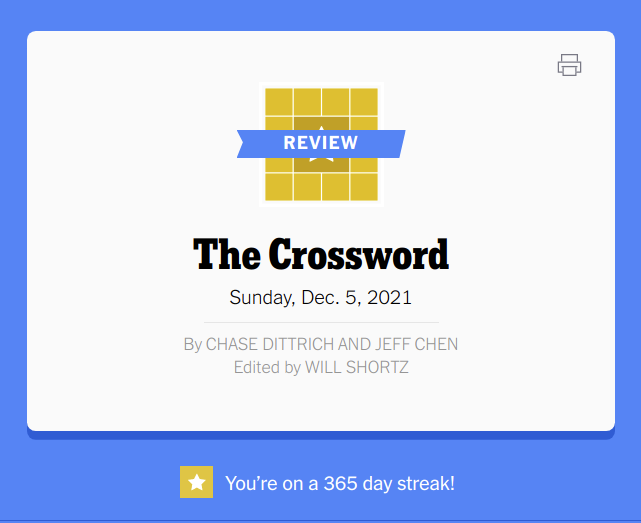
streak 1

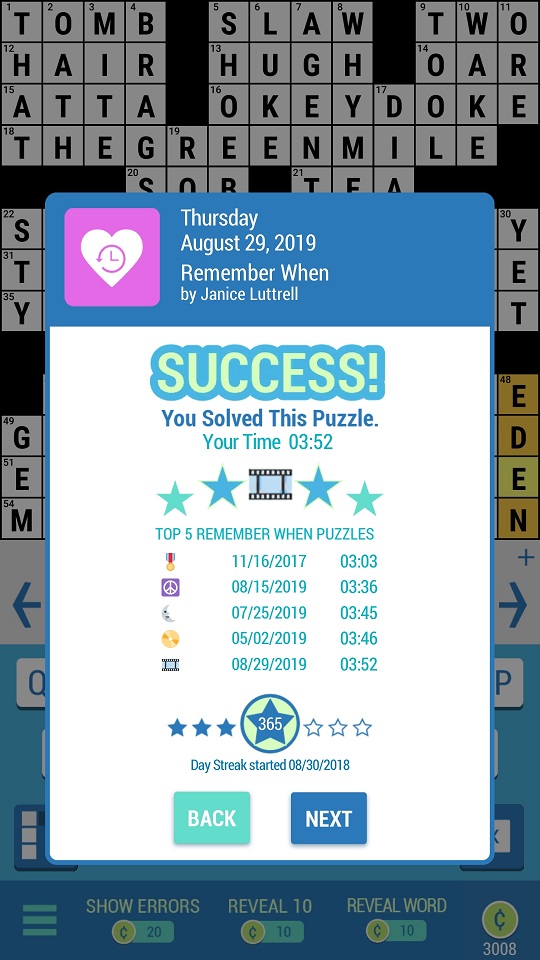
When you factor in the stat-keeping of puzzle apps, that numeral awareness increases. Take Daily POP Crosswords, for instance. It tracks your best times across the seven different daily categories, as well as the number of days in a row you’ve solved the daily puzzle.

And these streaks — unbroken chains of solved puzzles across days, weeks, and even months — are prized achievements for some solvers.

I get it. During my best run of daily solving, I managed 150 days or so in a row until I slipped and missed a day one weekend. We even celebrated a friend of the blog hitting a one-year streak back in 2019!

365screenshot

But sometimes, it seems like streak hunting is becoming too much of a priority for some solvers. I see posts where people lament “ruining” a potential month of clean solves by missing a day.

I mean, if you enjoyed solving the puzzles, missing a day can’t wipe away the good time you had solving those other 30 puzzles that month. Right?

Focusing just on time and statistics can mean you’re not taking the opportunity to really drink in all that puzzle has to offer.

We should be taking the time to appreciate the clues and solving experience, even if we’re looking to top our best Tuesday time or hoping to complete week three of a month-long run of success solves.

Heck, one of our own constructors suggested we slow down and smell the roses after posting a time he claimed was too fast for him to fill the grid… and he designed the grid!

streak 2

To be fair, I always go back and read through the clues once I’ve solved a puzzle, in case I’ve missed any choice cluing by zipping through the grid. But that doesn’t mean our constructor’s argument lacks merit.

Hopefully, avid solvers can strike a solid balance and get the most out of each and every solve.

Now, if you’ll excuse me, I’m hoping for a sub-4 minute solve on this Daily POP Plus puzzle.

What do you think, fellow solvers? Are you a streak hunter? Do you track your times? Do you find yourself taking more time on paper or through an app? Let us know in the comments section below! We’d love to hear from you.


   dailypopwsicon

Treat yourself to some delightful deals on puzzles. You can find them on the Home Screen for Daily POP Crosswords and Daily POP Word Search! Check them out!

Thanks for visiting PuzzleNation Blog today! Be sure to sign up for our newsletter to stay up-to-date on everything PuzzleNation!

Winning Monopoly With Math!

I’m always on the hunt for tips to make myself a better puzzler and gamer. Sometimes you stumble across those tips in unexpected places.

For instance, I was reading, of all things, a book about mathematics and Christmas — The Indisputable Existence of Santa Claus: The Mathematics of Christmas — and inside, I found a statistical analysis of the best strategy for winning a game of Monopoly.

Yes, we’ve discussed this topic before, but even that previous deep-dive into the mechanics of the game wasn’t as thorough or as revealing as the work by Dr. Hannah Fry and Dr. Thomas Oleron Evans in this Christmas-fueled tome of facts and figures.

They started with a breakdown of how your first turn could go, based on dice rolls. This is the same breakdown as in our previous post, but with some important differences. For instance, they also considered the chances of going to jail after multiple doubles rolls.

Also, they covered the statistical impact of how landing on card spaces can affect where you land on your first turn. The Community Chest is a curveball, because of the possible sixteen cards, three will send you somewhere on the board: Go, Mediterranean Ave, and Jail.

A simple statistical analysis is complicated even further by the Chance cards — nearly half of the sixteen cards send you elsewhere: Go, Income Tax, St. Charles Place, Pennsylvania Railroad, Illinois Ave., Jail, and Boardwalk.

If you extrapolate forward from this point, you uncover some interesting patterns:

The orange property set benefits from all the ex-cons leaving their cells, and after their next turn the reformed criminals will likely end up somewhere between the reds and yellows… Illinois Avenue, with its own dedicated Chance card directing people to it, gets an extra boost, making it the second most visited square on the board.

The property that is visited least frequently is Park Place, where players spend just 2.1% of their time.

Check out this graph. This shows potential earnings from each complete color set, with the dotted line marking the point where your purchase of the property is canceled out by how much the property has earned in rent thus far. Everything above that is profit.

As you can see, blue and brown properties start close to the dotted line, because they’re affordable to buy and build on. The standouts on this graph are New York Avenue (which earns $30 a roll up through thirty rolls statistically) and Boardwalk, which is an expensive investment, but pays off handsomely down the line, remaining the top earning spot past thirty rolls.

Of course, that’s only single properties, and you can’t build on single properties. Let’s look at a chart for full color set revenue:

Some of our previous findings change radically. Boardwalk’s rating drops significantly, because of Park Place’s relative infrequency of being landed on (as we mentioned above).

So which properties should you nab to give yourself the best chance of winning? Well, that depends on how long the game lasts.

The average game of Monopoly takes approximately thirty turns per player, so the larger the number of players, the longer the game will last.

So, for a two-player game, your best bet is to go after the light blue or orange sets, since they’re better in the short term, and the odds are in your favor if the game stays short.

In a three- or four-player game, the orange and red sets are better, because the game is likely to last a while.

And if five or more people are playing, you’re really playing the long game, so the green set becomes your best chance for success.

What about building on those properties? Well, Fry and Evans considered that as well. If you’re playing against multiple opponents and know you’ll be in for a long game, then you definitely want to buy and place houses. But don’t fear if the first house takes a long time to start paying for itself.

As it turns out, your best strategy is to put three houses on your properties as quickly as possible, because the third house is the fastest to recoup on investment. So once the three houses are in place on each property, you can rest for a bit and regenerate your bank before investing further.

And there you have it. Better gaming through mathematics! The only thing better would be, well, playing practically any other game.

Kidding! (But not really.)


Thanks for visiting PuzzleNation Blog today! Be sure to sign up for our newsletter to stay up-to-date on everything PuzzleNation!

You can also share your pictures with us on Instagram, friend us on Facebook, check us out on TwitterPinterest, and Tumblr, and explore the always-expanding library of PuzzleNation apps and games on our website!

Better Gaming With Math and Statistics!

[Image courtesy of ThreeSixtyOne.gr.]

Statistical analysis is changing the world. The wealth of available data on the Internet these days, combining with our ever-increasing ability to comb through that data efficiently using computers, has spawned something of a golden age in data mining.

You don’t need to look any further than the discovery of Timothy Parker’s plagiaristic shenanigans for USA Today and Universal Uclick to see how impactful solid analysis can be.

But it’s also having an impact on how we play games. Statistical analysis is taking some of the mystery out of games you’d never expect, making players more efficient and capable than ever.

We discussed this previously with the game Monopoly — specifically how some spaces are far more likely to be landed on than others — and today, we’re looking at two more examples: Guess Who? and Hangman.

Guess Who? gives you a field of 24 possible characters, and you have to figure out which character your opponent has before she figures out the identity of your character. Usually, if you end up with a woman or someone with glasses, your odds of winning are low, because some aspects are simply less common than others.

But is there an optimal way to pare down the options? Absolutely.

Mathematician Rafael Prieto Curiel has devised a strategy for playing Guess Who?, based on an analysis of the notable features of each character, breaking it down into 22 possible questions to ask your opponent:

Based on this data, he has even created a flowchart of questions to ask to maximize your chances of victory. The first question? “Does your person have a big mouth?”

Yes, not exactly a great first-date question, but one that yields the best possible starting point for you to narrow down your opponent’s character.

It’s certainly better than my first instinct, which is always to ask, “Does your person look like a total goon?”

Now, when it comes to Hangman, the name of the game is letter frequency. Just like a round of Wheel of Fortune, you’re playing the odds at first to find some anchor letters to help you spell out the entire answer.

But, as it turns out, letter frequency is not the same across all word lengths. For instance, E is the most common letter in the English language, but it is NOT the most common letter in five-letter words. That honor belongs to the letter S.

In four-letter words, the most common letter is A, not E. And it can change, depending on the presence — or lack thereof — of other letters.

From How to Win Games and Beat People by Tom Whipple:

“E might be the most common letter in six-letter words, and S the second most common, but what if you guess E and E is not in it?” In six-letter words without an E, S is no longer the next best letter to try. It is A.

In fact, Facebook data scientist Nick Berry has created a chart with an optimal calling order based on the length of the blank word.

For one-letter words through 4-letter words, start with A. For five-letter words, start with S. For six-letter words through twelve-letter words, use E. And for words thirteen letters and above, start I.

Of course, if you’re the one posing the word to be guessed, “jazz” is statistically the least-likely word to be guessed using this data. And your opponent will surely hate you for choosing it.


Thanks for visiting PuzzleNation Blog today! Be sure to sign up for our newsletter to stay up-to-date on everything PuzzleNation!

You can also share your pictures with us on Instagram, friend us on Facebook, check us out on TwitterPinterest, and Tumblr, and explore the always-expanding library of PuzzleNation apps and games on our website!

Let’s Make a Deal!

It’s a scenario every game show fan knows well. You’ve got three doors to choose from, and one of those doors will open to reveal a fabulous prize.

After you’ve made your choice (let’s say Door #2), our affable host Monty Hall plays Devil’s Advocate by opening one of the doors you didn’t choose (let’s say Door #1), revealing a goat or other lackluster result.

And then, Monty offers you a chance to change your mind. Will you stick with the door you initially chose, or will you switch to the other unopened door (Door #3)?

The average player sees two choices, Door #2 and Door #3, which on the surface sounds like a 50/50 shot, a coin flip. So would it surprise you to learn that people who switched from one door to the other doubled their chances to win the fabulous prize?

This is known as the Monty Hall Problem, an example of how statistics aren’t always what they seem, and it has puzzled people for decades.

It’s counterintuitive, isn’t it? I mean, you have two choices, so the odds should be 50/50. But you’re forgetting that third door that Monty eliminated. That third door makes all the difference, statistically speaking.

Let’s break it down. Your initial choice is between 3 doors, meaning you have a 1 in 3 chance of picking the correct door, and a 2 in 3 chance of picking the wrong one.

When Monty opens that other door, the odds haven’t changed. Only the number of options available has changed. Your door is still a 1 in 3 chance of being correct and a 2 in 3 chance of being wrong. But the remaining door now has a 2 in 3 chance of being correct!

So what appeared to be a coin flip between sticking with your choice and switching is now heavily weighted toward switching!

There have been several real-world tests of the Monty Hall Problem, and all of them have consistently shown that the people who switch were twice as likely to open the winning door!

The real puzzle here is how we fool ourselves. We take the numbers at face value — 3 doors become 2 doors, so a 1 in 3 chance becomes a 1 in 2 chance — and actually hurt our chances with those seemingly simple assumptions.

Being able to reconsider your assumptions is a major tool in the puzzler’s solving kit. Plenty of tricky crossword clues depend on you associating the clue with one thing, when the answer is something quite different.

After all, if you saw the clue “Unlocked” for a four-letter entry, you’d probably try OPEN before you tried BALD. Clever constructors are counting on that.

So be sure to remember Monty Hall and his three-door conundrum the next time you’re stumped on a puzzle. Maybe the answer is as simple as trying another door.

Thanks for visiting the PuzzleNation blog today! You can like us on Facebook, follow us on Twitter, cruise our boards on Pinterest, check out our Classic Word Search iBook (recently featured by Apple in the Made for iBooks category!), play our games at PuzzleNation.com, or contact us here at the blog!