The Results from the 14th ORCAS Awards!

The ORCAS are the Oscars of the crossword community, dedicated to celebrating excellence in crosswords, and that was certainly the case during last night’s awards ceremony!

Clocking in at just under an hour, this was an event at breakneck speed, opening as all online award shows should: with technical difficulties.

David Kwong offered some anagram suggestions for other award shows and then passed the mic to Rich Proulx, whose bowtie game was ON POINT.
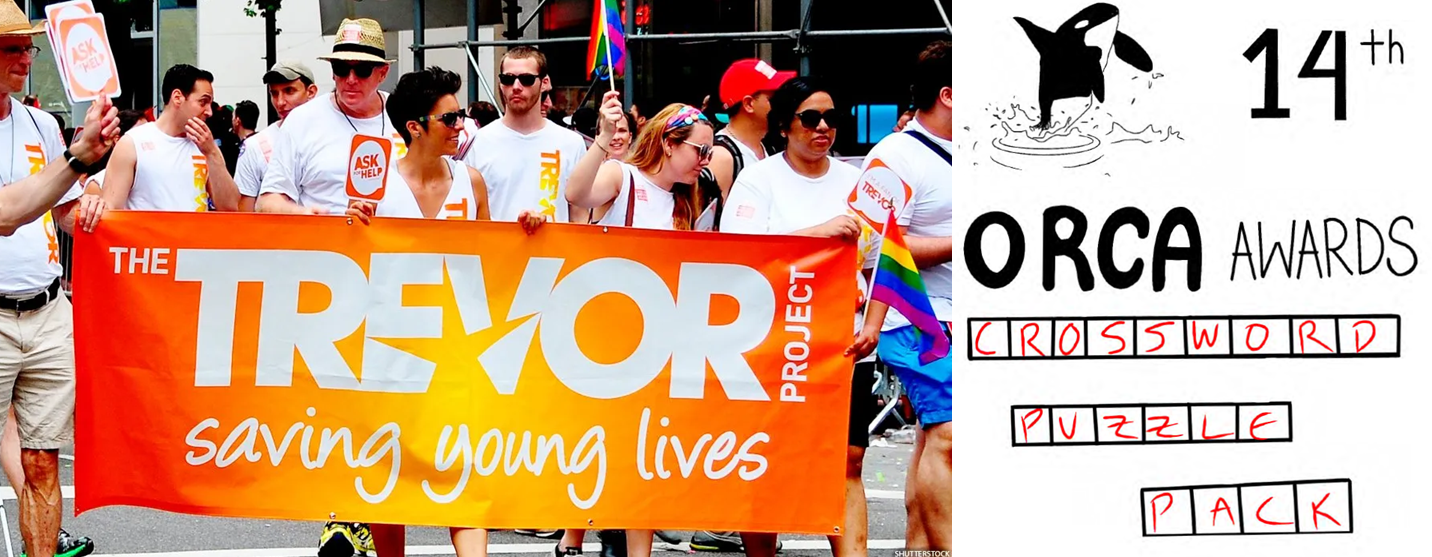
Rich’s intro was delightful, particularly when he shared that over $15,000 had been raised for the Trevor Project through the ORCAS puzzle packet!

With 97 people in attendance — including many nominees and puzzle luminaries in the chat — the first award was preceded by a tough trivia puzzle celebrating all of this year’s presenters:
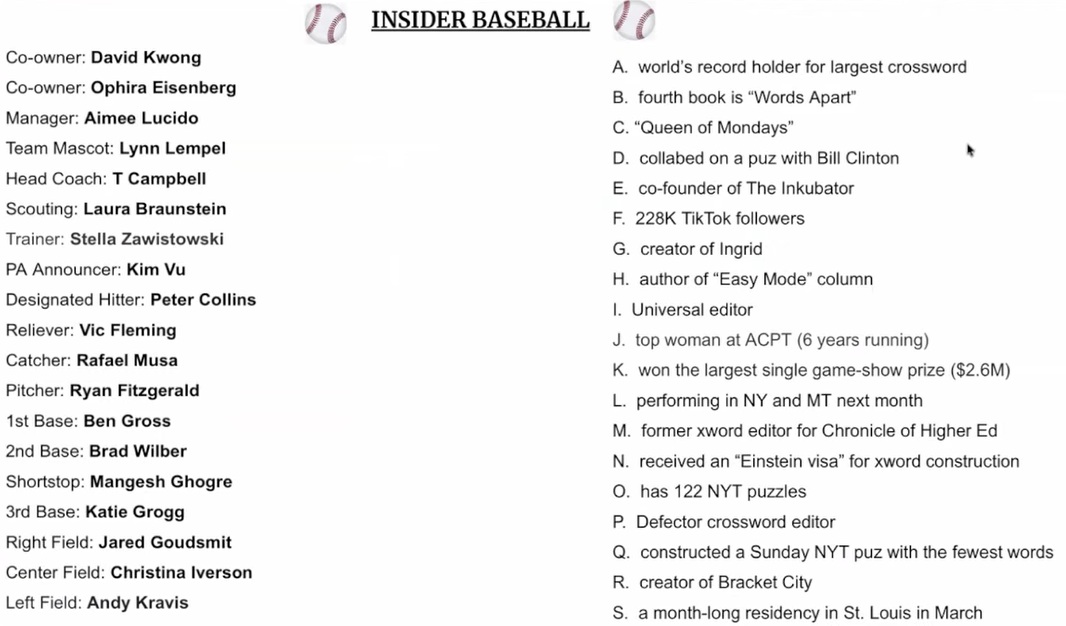
After the solution was revealed, Ophira Eisenberg joined David in the hosting duties before inviting our first two guest presenters to handle BEST META CROSSWORD and BEST EASY CROSSWORD.

Aimee Lucido (author of Words Apart) read out the nominees for BEST META CROSSWORD.

I must confess that meta crosswords aren’t always my bag, but there’s no denying the skill and craftiness it takes to construct an effective meta. I ended up voting for “Blind Stitch” by Hanh Huynh because it felt like such a solidly constructed introduction to the concept of meta crosswords. It’s a great solve.

WINNER: Evan Birnholz for “Flying Colors”

“Queen of the Mondays” Lynn Lempel then read out the nominees for BEST EASY CROSSWORD.

Making easy crosswords is way tougher than it looks, and making easy crosswords that are still surprising and engaging is even harder. Despite that, this was a stacked category.

My vote went to Nate Cardin’s Untitled puzzle from the LA Times on February 25. Managing to find five phrases/compound words (OVERDRAFT, BODY WASH) where both parts could be followed by the word BOARD was an impressive feat of cruciverbalism.

WINNER: Jess Shulman for “Clear Up to Here?” (Lynn was the first presenter of the evening to do the “opening the envelope” gimmick for the winner.)
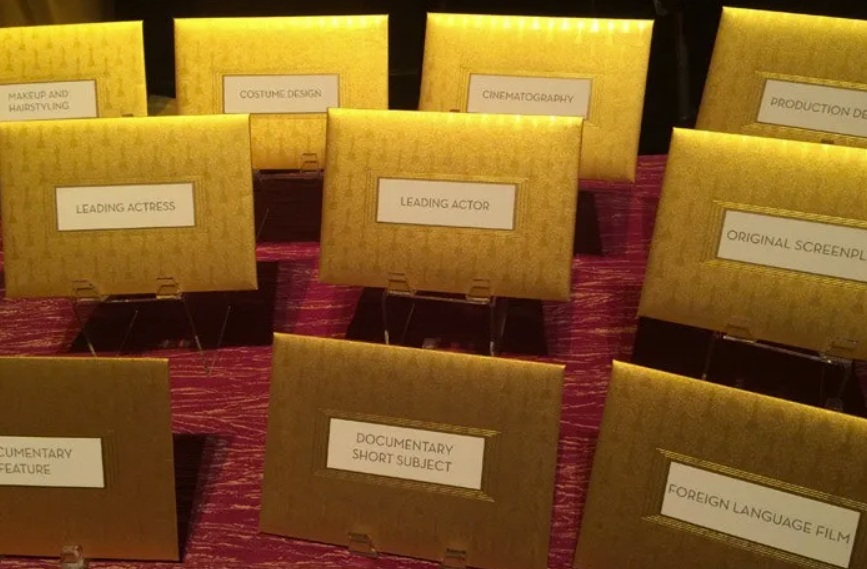
T Campbell and Laura Braunstein joined to present the next two categories.

Laura, one of the minds behind The Inkubator crossword, presented the EMERGING CONSTRUCTOR AWARD.

I sadly wasn’t familiar with all of the nominees in this category, so I had to go with someone whose puzzles I felt I’d had a good sampling of. My vote went to Carina da Rosa, whose work in Puzzmo and LilAVCX I’d enjoyed throughout the year.

And it turns out I wasn’t alone in my assessment!

WINNER: Carina da Rosa

T Campbell did a wonderful introduction about what separates BEST SUNDAY-SIZED CROSSWORD from the usual crossword fare before reading the nominees.

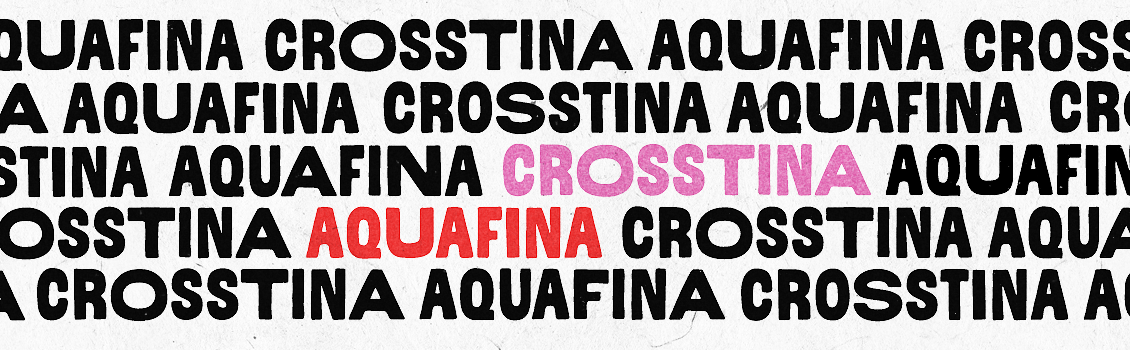
Despite the sheer ambition of “Just One Clue 2” and its crowd-sourced cluing, my vote came down to either the grid shape wordplay of Jonathan Raksin and Jeff Chen’s “Self-Starters” and the diabolic vocabulary in crosstina Aquafina and erik agard’s “themeless no. 36.”

I mean, we got SATAN WORSHIP and TWO CHEEKS OF THE SAME ASS, neither of which I’ve ever encountered in a grid. That being said, my deep affection for visual gimmicks in crosswords won out here.

WINNER: crosstina Aquafina and erik agard’s “themeless no. 36.”
Stella Zawistowski and Kim Vu were the next two guest presenters, with Stella handling BEST VARIETY CROSSWORD.

I love variety crosswords, because there are so many ways you can play with the traditional crossword formula to make something new and exciting. Rows Garden and Marching Bands puzzles are deviously designed masterpieces when constructed well, and this category showed off skill and cleverness in equal measure.

My vote went to a puzzle style I’d never seen before, as Ryan Faley’s “Nonplussed 4” combined across and down cluing with a non-traditional grid and a Rows Garden-style interior shape (pluses instead of blooms). I loved the construction and creativity, and the revealer was the cherry on top. Terrific stuff.

WINNER: joon pahk’s Two Outta Three Ain’t Bad

“joooooooooooooooooooooooooon” calls rang out both over the stream and in the chat to celebrate joon’s win.

Kim then read the nominees for BEST TOURNAMENT CROSSWORD.

Tournament puzzles are invariably bangers because they can push the difficulty AND creative envelopes, and this category was LOADED with heaps of cool ideas and challenges. (Last year’s Lollapuzzoola alone could have filled this entire category.)

The two puzzles that stuck with me the most were David Steinberg’s Westwords puzzle and Kareem Ayas’s Wild Discoveries puzzle from Lollapuzzoola. They were both wildly inventive, challenging, and above all else, memorable. This was the toughest choice of the entire ballot.

In the end, Kareem got my vote. And again, I wasn’t the only one impressed by his playful puzzling.

WINNER: Kareem Ayas for “Wild Discoveries”


A brief In Memoriam played next, offering tongue-in-cheek farewells to Deb Amlen (for ending her tenure with The New York Times), the Browser Crossword, and the free version of The New York Times Mini Crossword.

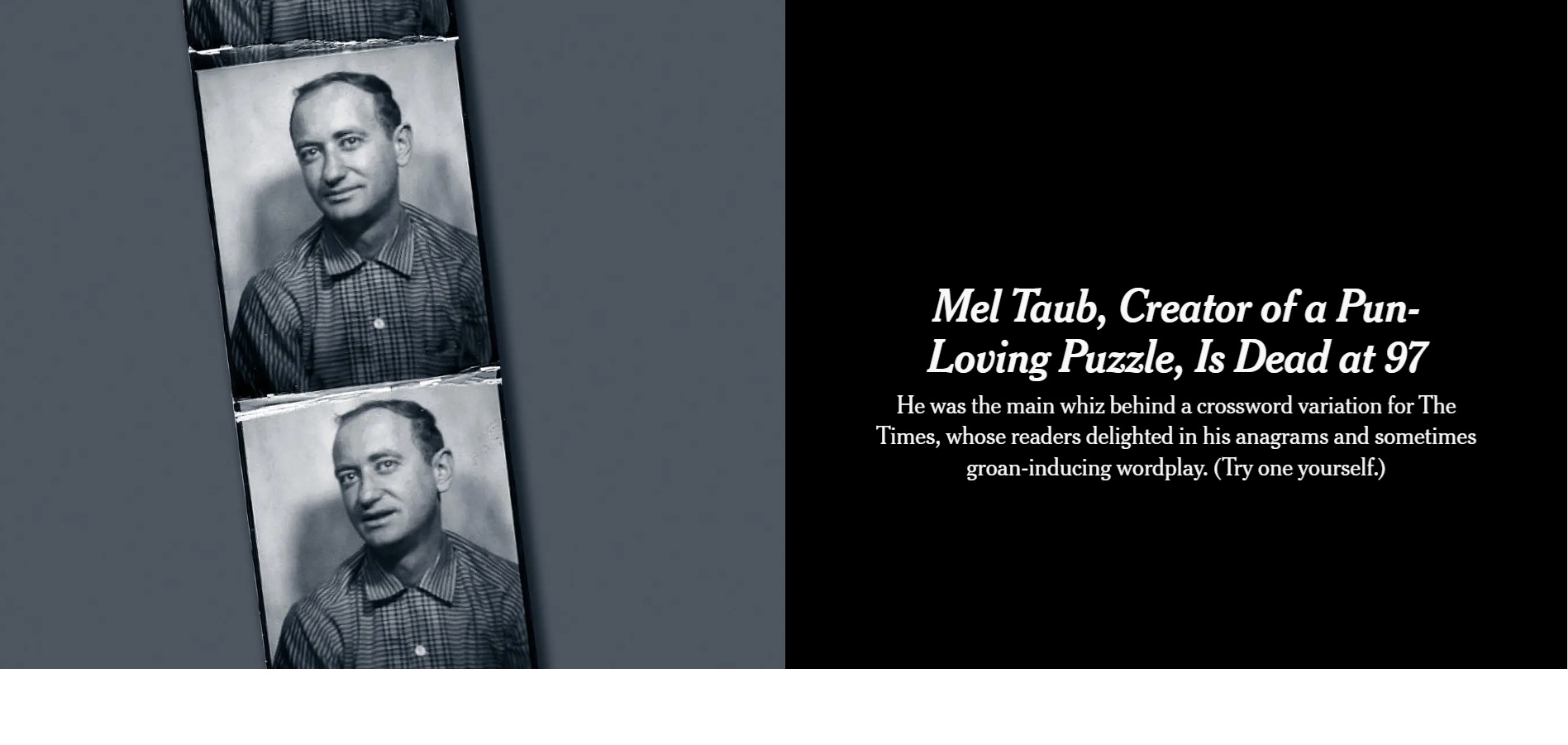
We then got a sincere send-off for influential creator and puzzle icon Mel Taub.
Our next two guest presenters were Peter Collins and Vic Fleming. They had a great little gimmick involving a swear jar and a virtual handover of $10 to celebrate the eventual winner of BEST CLUE (and my favorite of the nominated clues):

WINNER: [They might have “fuck you” money] for SWEAR JARS by Amie Walker and Amanda Rafkin, AVCX, April 18th

They next presented BEST THEMED CROSSWORD, which was another stacked category.

This category was a case of leading with your strongest contender, because Ada Nicolle blew me away with “Would You Let Me Finish” from Apple News+ on January 5th.

The grid is populated with longer entries that, when the last letters are removed, form the actual answers to the clues. So GOT THE ICK becomes GO-TH-IC, for example. It’s a great gimmick and a fun reveal when you get it.

WINNER: Untitled by Adam Wagner and Rebecca Goldstein


Rafael Musa, Ryan Fitzgerald, and Ben Gross then interrupted the proceedings for an interactive game with the audience. But first, they had a surprise award to hand out!

The Leviathan Award celebrates important contributions to the world of crosswords, so Ryan was blindsided by this award for creating the crossword software Ingrid. A video full of kind words from fellow constructors was played. It was heartwarming stuff.

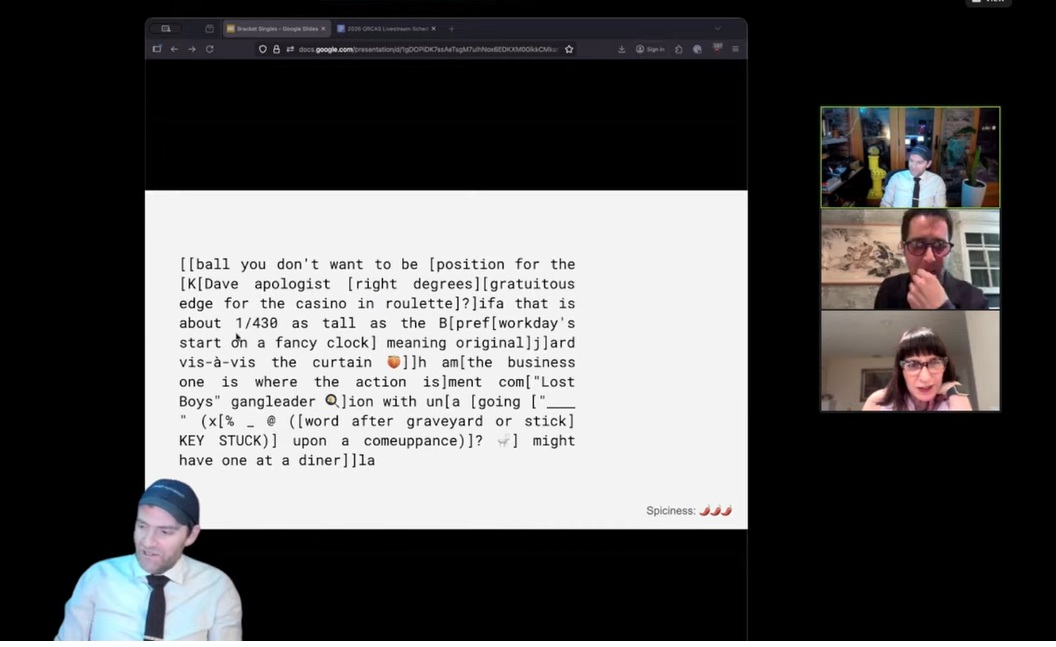
Three instances of a puzzle game called Bracket City challenged the audience next. The goal was to unravel a series of crossword-style clues nested within each other, like so:
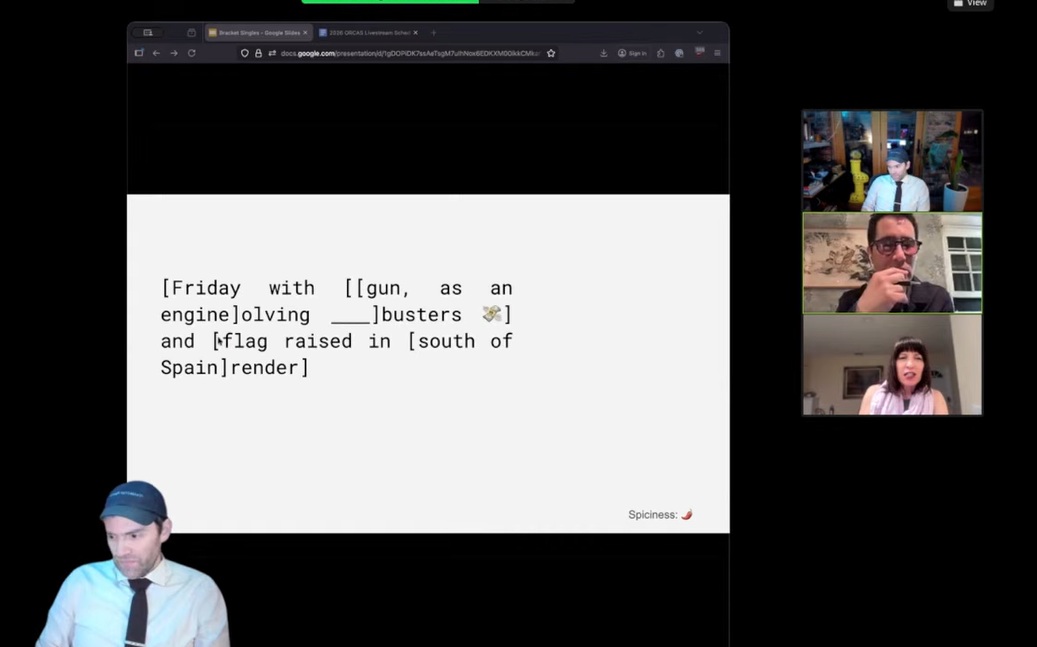
I doubt I was the first to solve this puzzle, but I was the first to post the solution in the chat: BLACK AND WHITE.

Work from the inside out with the brackets. [gun, as an engine] is REV, so you get [REVolving __] for DOOR, then [Friday with REVolving DOORbusters] for BLACK. [south of Spain] is SUR, so you get [flag raised in SURrender] for WHITE. BLACK AND WHITE is the final answer.

David and Ophira solved the first two puzzles live while the audience solved at home, and everyone was challenged to solve the third (and most complicated) bracket city puzzle in their free time. Can you unravel it?
David and Ophira continued the awards and presented the next category, BEST MIDI CROSSWORD.

As was the case with several categories, we were absolutely spoiled for choices when it came to midi crosswords. Crossword Gentleman Doug Peterson had a great one, we had ablaut reduplications from Alex Rossell Hayes, a tightly constructed foursome of BOOM-based entries from Amie Walker, and Peanuts grid art from franci dimitrovska.

But I had to go “By the Numbers” by Kaye Brown. The sheer ambition of a LOST-centric puzzle with character names reading across and aligning with the infamous numbers from the show. It’s a fantastic bit of constructing wizardry.

WINNER: Amie Walker for “Bangers”

Our next presenters were Brad Wilber and Mangesh Ghogre to handle the one-two punch of BEST CRYPTIC CROSSWORD and BEST VARIETY CRYPTIC CROSSWORD.

I have been on a quest to improve my cryptic crossword solving over the last few years, so the nominees in these two categories put me through my paces! The devious cluing was at its peak in the cryptics, and I think I spent more time on each cryptic than I did on any two or three of the puzzles in the other categories!

Amidst all the tough cluing and interesting vocabulary, it was Jamie Ding’s AVCX Cryptic and The Rackenfracker’s “High Definition” who got my votes this year.

WINNER, BEST CRYPTIC: PiGuyN for “pi guy cryptic 22”

WINNER, BEST VARIETY CRYPTIC: The Rackenfracker (JonMichael Rasmus & Sean Weitner) for “High Definition”
Our penultimate pair of guest presenters were Katie Grogg (looking glam!) and Jared Goudsmit. They presented the nominees and some great puns as well (and made a strong case for hosting next year’s awards).

The first award they presented was BEST CROSSWORD-RELATED MEDIA.

This is a new category for this year’s ORCAS, and as you can imagine, I was absolutely stoked to be included amidst a murderer’s row of excellent, insightful commentary on all things crosswords.

I quite selfishly voted for a PuzzCulture piece, as I was immensely proud of “The Curious Case of Richard Simon’s Aunt, Hedwig.” I didn’t expect to win, and was very content just for the opportunity for new eyes to find the blog.

WINNER: Adam Aaronson for “Square Theory”.

The chat was so chuffed for Adam, with several shouting out his post as eye-opening and game-changing. Congratulations Adam!

Katie and Jared then presented BEST CROSSWORD COMMENTARY.

I love the behind-the-curtain glimpses offered in columns like Rex Parker’s, Wordplay, and the LA Times Crossword Corner, many of whom have been commenting crosswords longer than some of the attendees have been making crosswords or solving them!

All of these nods are well-deserved — Deb and Malaika are brilliant, distinct voices in the crossworld — but it was “Malaika Handa and Stephen Lurie” by Renee Thomason that got my vote.

WINNER: Sally Hoelscher for “Terrors of the Deep”
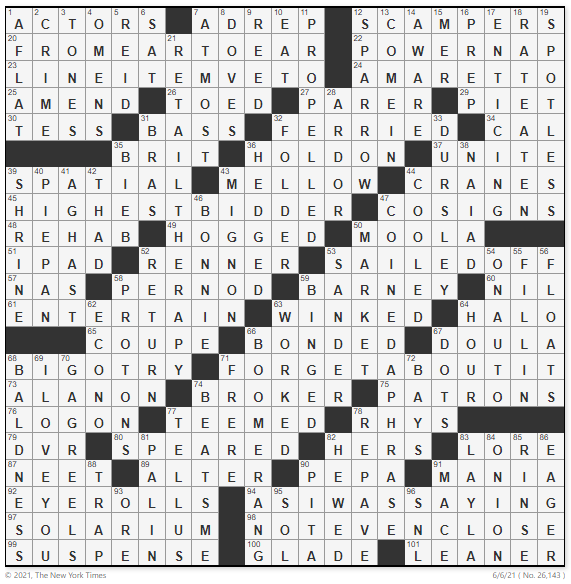
Our final two awards were presented by Christina Iverson and the very dapper Andy Kravis. First up was BEST THEMELESS CROSSWORD.

This one was a three-horse race for me, with killer efforts by Paolo Pasco, guest host Christina, and Erik Agard, all chock-full of great vocabulary and ambitious crossings. I finally managed to narrow it to Erik’s August 18th New Yorker puzzle when it came to my vote, but really, any of these three would be worthy winners.

WINNER: Erik Agard’s August 18th New Yorker puzzle

Finally, it was time for CONSTRUCTOR OF THE YEAR.

I genuinely have no idea how you even narrow down nominations for this category, because there are SO MANY talented constructors. My shortlist would be 30 people deep, easy!

Each of the puzzles included in the Trevor Project Puzzle Pack represented the nominees well, but it was Rafael Musa and Adam Wagner’s puzzles that stuck with me the most. I loved the gimmick in Adam’s “Endless Loop,” but in the end, I went with Rafael Musa. Each time I saw that name in the byline, I knew I was guaranteed a terrific solve.

WINNER: Adam Wagner

Adam was there to accept and gave a very sweet speech, celebrating the welcoming crossword community and the support of his wife and family. Amazingly, he only started constructing in 2019!

You can’t complain about an award show that only takes up an hour of your time, especially when Oscar and Emmy broadcasts can last into the wee hours. And the crossword community is full of quirky, likable folks, so anytime you can get a bunch of them in a room (virtual or otherwise) together, you’re guaranteed a good time.

I thought it was a little weird that the games got more time than some of the categories, but this was my first ORCAS. Maybe that’s how the show usually goes!

Congratulations to all the winners! There were so many amazing puzzles published last year, and it was a pleasure to get to solve so many mind-bending, entertaining, and lovingly crafted cruciverbalist creations.

It was cool to see 5 out of my 15 selections get the nod (and a few other winners in my honorable mentions). And I’m already taking notes to contribute nominees to next year’s ORCAS!


What did you think of the ORCAS, fellow puzzler? Did your favorites win? Was there a puzzle you loved that you wish had gotten more of a spotlight?

Let me know in the comments section below. I’d love to hear from you!
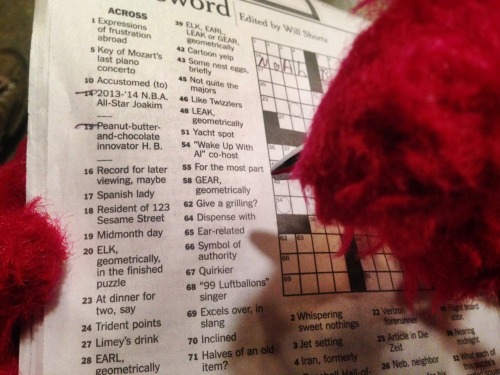
Where to Look for Crossword Reviews/Commentary?

tumblr_nnl5c43Ov61qd4fqho1_500

Occasionally, we’ll get a message from a PuzzleNationer who wonders why we don’t review the daily New York Times crossword or some of the other prominent daily newspaper crosswords.

It makes sense to ask. After all, we try to cover all things puzzles and games here — great clues, trivia, brain teasers, puzzles in pop culture, interviews, game reviews, how to’s, puzzle history, the Crossword Mysteries — so why not the top crossword outlets?

Well, to be honest, there are already several crossword blogs doing a dynamite job of covering those. So today, I want to discuss some top-notch blogs that discuss and review the daily crosswords!

nyt xwd

For the New York Times crossword alone, there’s Wordplay, XWord Info, and Rex Parker.

Wordplay is the official New York Times crossword blog, and not only do you get great analysis from knowledgeable minds, but you get live solve-alongs, insight from constructors, and more.

XWord Info is my go-to for details on construction and a fair, informative review. People occasionally accuse XWord Info of being too favorable to the puzzles/constructors, but I think they call it right down the middle, and there have been times where reviewers and constructors leveled stern criticism at a puzzle’s editorial process OR how it was discussed on XWord Info itself.

Rex Parker’s blog can be more critical of Times puzzles — as we’ve said before, he borders on the curmudgeonly — but he has terrific advice about grid construction, theme entries, and more that several constructors have told me proved to be invaluable in their early days learning to construct.

His blog is probably not for everybody, but he remains one of the most influential voices in crossword reviewing today.

Oh, and if you’re looking for some terrific reviews of the NYT Mini Crossword, check out this great Instagram account!

Of course, the NYT crossword isn’t the only game in town.

la times

If you’re a fan of the Los Angeles Times Crossword, there’s the terrific L.A. Times Crossword Corner blog to keep you up to date on that puzzle, breaking every puzzle down clue by clue. (There’s also LAX Crossword, which offers answers and clue explanations.)

If you enjoy the USA Today crossword, Sally Hoelscher offers Sally’s Take on the USA Today Crossword daily, offering up theme explanations, things she learned from the puzzle, and sharing terrific opinions and thoughts that would absolutely be beneficial to newer solvers.

And although it’s not a blog per se, the XWord Muggles Forum offers an interactive space to discuss and break down the Wall Street Journal weekly crossword contest, as well as other meta crossword puzzles.

crossword pen

But, if you’re looking for more of a one-stop-shop experience, then you should check out Diary of a Crossword Fiend.

Crossword Fiend covers NYT, LA Times, WSJ, Universal, USA Today, The New Yorker, The Washington Post, Newsday, The Inkubator, AVCX, and more! Not only that, but you’ll get reviews of puzzles from independent constructors like Elizabeth Gorski’s Crossword Nation, Brendan Emmett Quigley, Peter Gordon’s Fireball Crosswords, and others.

They post their solving times, analyze the puzzles, and spread the word about other puzzly projects and crossword news. It’s a fantastic site.

And before I wrap up this recommendation post, I do want to shout out the community on Reddit’s r/crossword subreddit. It’s a forum for discussing puzzle opinions, sharing works from aspiring and developing constructors, and yes, reviewing and sharing thoughts on the major outlets (mostly the NYT).

Most of the posters and commenters are genuinely good folks who love crosswords and enjoy discussing them, and it’s a pretty pleasant place to visit if you’re a crossword fan.

Do you have any favorite Crossword Review Blogs that we missed? Let us know in the comments section below. We’d love to hear from you!


dailypopwsicon

Hey, have you checked out our special summer deals yet? You can find them on the Home Screen for Daily POP Crosswords and Daily POP Word Search! Check them out!

Thanks for visiting PuzzleNation Blog today! Be sure to sign up for our newsletter to stay up-to-date on everything PuzzleNation!

The Valuable Things (and Names and Places) We Learn From Crosswords

Problem-solving-crossword

I’ve learned a lot by solving crosswords. Honestly, it’s quite rare for me to solve a crossword and NOT learn something new. Sometimes, I am baffled by a reference I don’t know, and I end up finding out the answer only when the crossing entries are complete.

But that bafflement, that frustrating moment of ignorance, is soon mitigated, and I add a new fact to my ever-growing mental crossword library.

How many words have you learned by solving crosswords? How many geographic places do you know because of solving crosswords? How many actors, scientists, authors, musicians, and figures from pop culture do you know from solving crosswords? How many nuggets of trivia have you tucked away in the dusty parts of your brain that you picked up from an unexpectedly informative clue in a crossword?

Sure, we joke about the silent film stars and European rivers and African animals that often fall under the banner of crosswordese, but only because we’ve seen them enough to know them. We crave new entries, new peculiarities of language, and new crossword clue fodder to challenge and engage us in equal measure.

135421944_10219703190032375_4805193262790836533_n

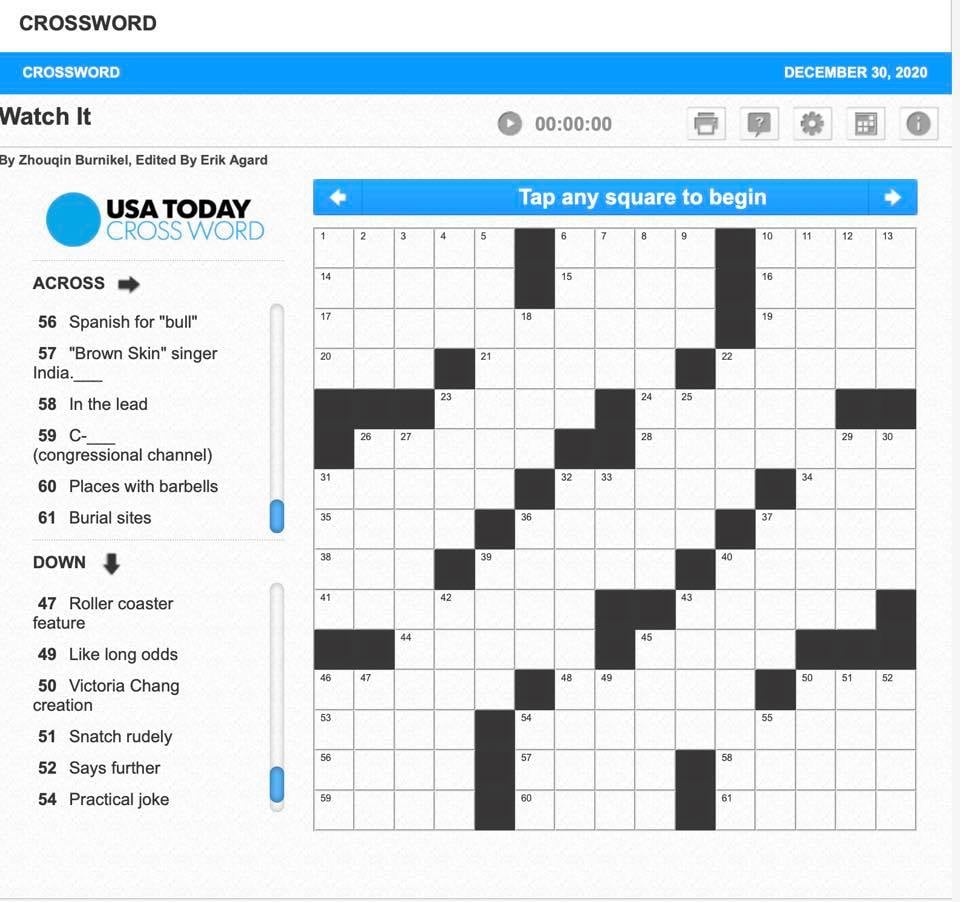
A recent USA Today puzzle clued the word POEM with “Victoria Chang creation,” and a friend of the poet Victoria Chang, Nan Cohen, shouted out constructor Zhouqin Burnikel and editor Erik Agard on Facebook for including Chang in the puzzle.

Nan’s post went on to ask about how Chang ended up in the puzzle (though she thought it was cluing OBIT, Chang’s poetry book, instead of POEM, the actual answer):

I am curious, if you can share, how did you arrive at the cluing and decide it was accessible enough? (I love that it’s a new way of cluing OBIT, and of course that it represents an Asian American poet–cannot think when I have ever seen a contemporary Asian American poet in a puzzle, although Arthur SZE (who won the National Book Award in 2019) might be helpful to someone sometime).

The praise for both Burnikel and Agard is well-earned — Agard was quick to clarify that the clue was 100% Burnikel’s doing — but the discussion itself highlights an important issue in modern crosswords: the concept of who is “crossword-worthy.”

obit

Natan Last discussed this very topic in a brilliant piece in The Atlantic last year, citing the following troubling examples of “crossword-worthy” gatekeeping in major outlets:

Constructors constantly argue with editors that their culture is puzzle-worthy, only to hear feedback greased by bias, and occasionally outright sexism or racism. (Publications are anonymized in the editor feedback that follows.) MARIE KONDO wouldn’t be familiar enough “to most solvers, especially with that unusual last name.” GAY EROTICA is an “envelope-pusher that risks solver reactions.” (According to XWord Info, a blog that tracks crossword statistics, EROTICA has appeared in the New York Times puzzle, as one example, more than 40 times since 1950.) BLACK GIRLS ROCK “might elicit unfavorable responses.” FLAVOR FLAV, in a puzzle I wrote, earned a minus sign.

Appropriately enough, Last’s piece mentions a puzzle by constructor Sally Hoelscher, and Sally herself replied to the Facebook post celebrating Chang’s inclusion in the USA Today crossword:

One thing I enjoy about the USA Today puzzle is that Erik and the constructors are intentional about lifting up and highlighting those who may not be deemed “crossword-worthy” by some publications. I was delighted to learn about Victoria Chang from this puzzle, and to learn about her book, OBIT, when I was researching her to write my blog.

I can’t say for certain how many solvers were already familiar with Victoria Chang or her works, but I suspect the majority of USA Today crossword fans learned something new that day.

That is reason enough to keep pushing the boundaries of what is considered “crossword-worthy.” Inclusion encourages visibility, which encourages greater participation in crosswords, which feeds into greater inclusion. And along the way, solvers are exposed to worthwhile individuals and ideas, learning more about the world we live in.

Sounds like a win-win to me.


Thanks for visiting PuzzleNation Blog today! Be sure to sign up for our newsletter to stay up-to-date on everything PuzzleNation!

You can also share your pictures with us on Instagram, friend us on Facebook, check us out on TwitterPinterest, and Tumblr, and explore the always-expanding library of PuzzleNation apps and games on our website!

How Far Crosswords Have Come (and How Much Farther They Have to Go)

Problem-solving-crossword

The battle to decrease gender inequality and increase representation in crosswords is ongoing. More people than ever are speaking up on behalf of women, people of color, LGBTQIA+ constructors, and non-binary individuals when it comes to who is constructing the puzzles (and being properly credited), as well as how members of those groups are represented by current grid entries and cluing.

Natan Last is one of many people standing up to make crosswords better, more inclusive, and more emblematic of a richer melting pot of solvers and constructors. In a recent article in The Atlantic, Last neatly encapsulates both the movement for a more inclusive crossword publishing community and the many obstacles that stand in its way.

He starts with a single example — a debut puzzle by a female constructor, Sally Hoelscher — and the conversation that ensued when one puzzle aficionado asked about the ratio of women’s names to men’s names in the puzzle.

becoming

[Image courtesy of XWordInfo.]

Originally there were no men’s names. One entry was edited in. And a discussion about parity in puzzles followed.

Last uses this example as a springboard into the greater argument about how modern crossword editing (and editors) discriminate through gatekeeping under the guise of what’s “familiar” or “obscure.”

From the article:

Constructors constantly argue with editors that their culture is puzzle-worthy, only to hear feedback greased by bias, and occasionally outright sexism or racism. (Publications are anonymized in the editor feedback that follows.) MARIE KONDO wouldn’t be familiar enough “to most solvers, especially with that unusual last name.” GAY EROTICA is an “envelope-pusher that risks solver reactions.” (According to XWord Info, a blog that tracks crossword statistics, EROTICA has appeared in the New York Times puzzle, as one example, more than 40 times since 1950.) BLACK GIRLS ROCK “might elicit unfavorable responses.” FLAVOR FLAV, in a puzzle I wrote, earned a minus sign.

kondo

[Image courtesy of CNBC.]

But what is kept out is only part of the problem, of course. Last goes on to mention many of the same insensitive and offensive clues and entries we (and other outlets) have cited in the past.

He caps off this part of the article by highlighting Will Shortz’s responses to these troubling questions:

But when prodded about insensitive edits, he denied them, adding: “If a puzzlemaker is unhappy with our style of editing, then they should send their work elsewhere (or publish it themselves to keep complete control).”

A pretty damning statement, to be sure.

proposingmurder13

Turning away from the problems represented by the most famous daily crossword in the world, Last pivots, turning a spotlight on those who are helping turn the tide in terms of representation and inclusivity.

He shouts-out well-respected and innovative editors like Erik Agard (of USA Today‘s crossword), David Steinberg (of Andrew McMeel Universal’s Puzzles and Games division), and Liz Maynes-Aminzade (of The New Yorker crossword), heaping praise on a fresh constructor-editor partnership that encourages new voices and greater diversity of content.

Last also mentions worthy projects like the Inkubator, Women of Letters, and Queer Qrosswords, as well as the Women’s March crossword movement inspired by the work of Rebecca Falcon.

Across the entire article, Last highlights a system problem in crosswords, challenges those responsible to do better, and praises those who are working for the greater good. And he does so in about a dozen paragraphs. That’s all. It’s efficiency and flow worthy of a top-notch constructor.

You should read it for yourself. You won’t be disappointed.


Thanks for visiting PuzzleNation Blog today! Be sure to sign up for our newsletter to stay up-to-date on everything PuzzleNation!

You can also share your pictures with us on Instagram, friend us on Facebook, check us out on TwitterPinterest, and Tumblr, and explore the always-expanding library of PuzzleNation apps and games on our website!