It takes two to puzzle…

I’m always on the lookout for new and different puzzle styles to discuss here, because there’s a seemingly endless supply of puzzly inventiveness in the world, and I endeavor to share as much of it as possible with my fellow PuzzleNationers.

A few days ago, I was reminded of a brain teaser variation that’s a little different from our usual fare, and I thought I’d put it in the spotlight.

Today, we’re talking about guided lateral thinking puzzles!

Let me start you off with a standard lateral thinking puzzle (which is a fancy way of saying “brain teaser”). This one is an all-time favorite of mine:

A man is found murdered on the floor with 53 bicycles scattered around the room. How did he die?

Now, this may sound like a particularly violent end at a local bike shop, but the lateral thinkers and brain teaser proficient types out there have probably already sussed out the true answer.

The man cheated at cards and was killed for it. Bicycle is a famous brand of playing cards, and with 52 cards in your standard deck, 53 implies cheating.

That’s a pretty simple one.

The difference between regular brain teasers like that one and guided lateral thinking puzzles is that a guided lateral thinking puzzle requires two people: one to ask questions in the hopes of solving it, and the other to know the solution and answer the other player’s questions with only yes or no responses.

The scenarios are often more involved than your usual brain teaser, but you’re only given a brief story to start with. These are not rigid brain teasers like the seesaw one we tackled earlier this year. These puzzles depend on your ability to narrow down the possibilities with strategically worded questions.

Here’s an example of a guided lateral thinking puzzle:

Ann, Ben, and Chris are siblings who were conceived on the same day. This year, Ann will be attending third grade while Ben and Chris attend kindergarten. Why?

While you could try to come up with a solution with just this information, guided lateral thinking puzzles encourage you to talk through your suspicions as you ask questions and uncover the truth.

So, what would you ask? What’s your starting theory? (My first instinct was to go straight to imagining how Leap Day was involved, before quickly realizing that was a ridiculous supposition.)

But maybe you have a better theory. Were they conceived by different people? Was it the same day, but different years?

Posing these questions to your partner in puzzly crime could help you find the answer.

The folks at I09 posted a link to six guided lateral thinking puzzles (including the Ann/Ben/Chris one I mentioned above). Give it a listen and try cracking these puzzles alongside the podcasters!

And let me know how you did! Did you solve any of them right away? Did any of them thoroughly stump you? And would you like to see more puzzles like this on PuzzleNation Blog in the future?

Thanks for visiting PuzzleNation Blog today! You can share your pictures with us on Instagram, friend us on Facebook, check us out on TwitterPinterest, and Tumblr, and be sure to check out the growing library of PuzzleNation apps and games!
A puzzle hunt 100 years in the making!

Riddles, codebreaking, and scavenger hunts are three of my favorite puzzly topics. I’ve covered each extensively in blog posts previously, exploring not only the history and ever-changing nature of puzzles, but how deeply ingrained puzzle-solving is in our culture, past and present.

Tuesday’s post was about a fairly simple encoded puzzle I found lurking inside a short story. That simplicity, that accessibility is part of why I wrote about it.

For you see, fellow puzzlers, today’s post is not about a simple puzzle. Today’s post covers all three of the topics above — riddles, codebreaking, and scavenger hunts — in a sprawling, mindboggling story about a globe-spanning mystery that gamers and puzzlers joined forces to unravel.

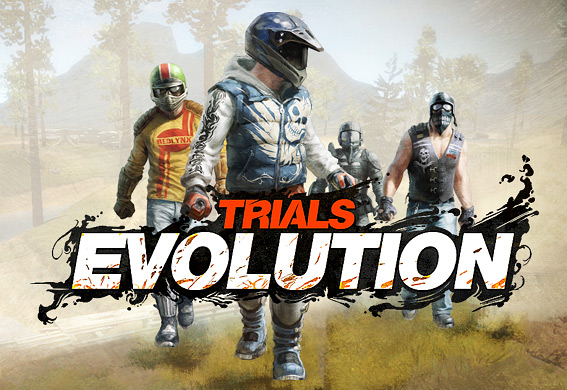
It all started in April 2012 with the release of a video game called Trials Evolution, created by the game designers at Redlynx.

trials_evo_frontpage_large

Trials Evolution is a motorcycle racing game that incorporates real-world physics into the gameplay, challenging players to complete obstacle-filled courses as fast as possible.

Now, this might not seem like the type of game to conceal a fiendish riddle, but players were actually expecting a challenging puzzle to be hiding within the game, because Trials HD, a previous installment of the series, featured a riddle to solve that helped build the Trials gaming community.

So expectations were high for whatever riddle was lurking inside Trials Evolution. And it did not disappoint.

First, players had to locate a series of wooden planks throughout the game, planks that featured encrypted writing on them. Once assembled and decrypted, the planks featured instructions for a special maneuver for players to perform in the game while a particular piece of music played.

Successfully completing this task earned the player a bonus song, which included lyrics suggesting players transform the song into a visual form. Cagey players realized this meant running a spectral analysis on the song — a visual graph of sound or energy — which revealed a hidden message in Morse Code.

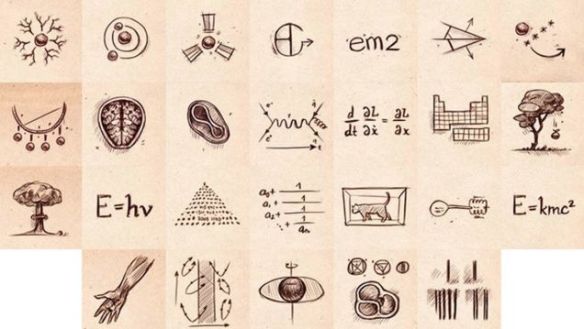
That message led to a website where the images below started appearing daily, one by one.

1293940361449154218

(It’s worth noting that these images started appearing in late 2013, more than a year after the game was released!)

Each image references a particular scientist. Once all twenty-six images were revealed, the indefatigable players had a visual alphabet to work with.

So when a message appeared using the images instead of letters, players cracked that code as well.

Still with me?

That code led to four sets of coordinates. Real world coordinates across the world! This riddle was only getting more complex the deeper players went!

globe_detailmap2

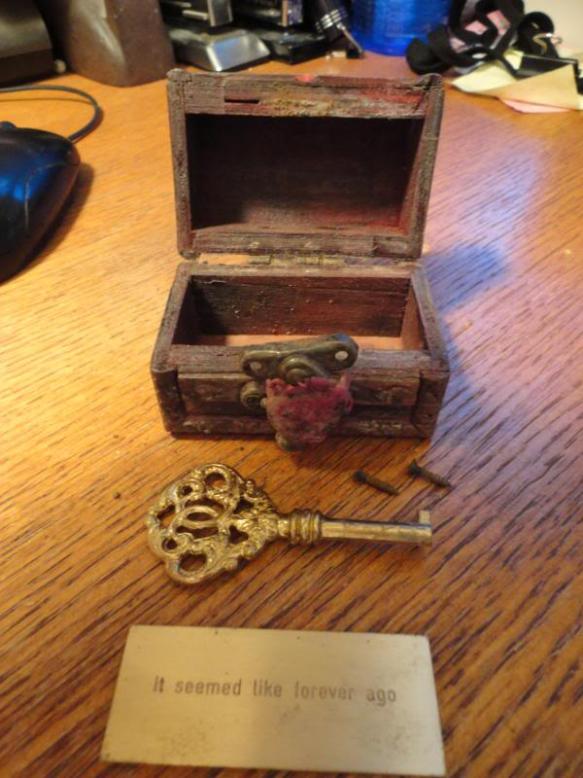
Something awaited intrepid players in San Francisco, California; Bath, England; Helsinki, Finland; and Sydney, Australia. In each location, players uncovered small chests, each containing a key and a metal plaque with the message “It seemed like forever ago” on it. (The Helsinki location also featured French documents, supposedly from 300 years ago, as well as an antique pocket watch.)

So, what do the keys open? What does it all mean?

Well, there was one last message. On the other side of the metal plaque included in each chest, there was a message:

Midday in Year 2113.
1st Sat in Aug
One of Five keys will open the box
Underneath the Eiffel Tower

That’s right. This riddle can only be unraveled nearly a century from now! This puzzle has gone from a hidden bonus feature in a video game to actual scavenger hunting in the real world, and is now becoming a multigenerational quest.

mauricemeyer

Take a moment and ponder that. It blows my mind to think about a puzzle that took dozens of people to conquer and will now become a story told to friends and sons and daughters as golden keys are passed down, all in the hopes of seeing what awaits us underneath the Eiffel Tower on a particular day in August in 2113.

And it all started with a motorcycle racing video game.

[For more details on the Trials Evolution riddle, check out this thorough write-up on Kotaku.]

Thanks for visiting PuzzleNation Blog today! You can share your pictures with us on Instagram, friend us on Facebook, check us out on TwitterPinterest, and Tumblr, and be sure to check out the growing library of PuzzleNation apps and games!
Puzzles in Pop Culture: The Big Bang Theory

Puzzles in Pop Culture is all about chronicling those moments in TV, film, literature, art, and elsewhere in which puzzles play a key role. In previous installments, we’ve tackled everything from The West Wing, The Simpsons, and M*A*S*H, to MacGyver, Gilmore Girls, and various incarnations of Sherlock Holmes.

And in today’s edition, we’re delving into the world of The Big Bang Theory, CBS’s runaway hit about four nerdy scientists — Leonard, Sheldon, Howard, and Raj — bumbling their way through social interactions of all sorts.

Although the show covers all sorts of activities often deemed “nerdy” — roleplaying games like Dungeons & Dragons, The Lord of the Rings, comic books, cosplay, conventions, obsessive fandom, etc. — they rarely play puzzles. Usually, the closest they get are board games and card games, whether real ones like 3-D chess or fictional ones like Mystic Warlords of Ka’a.

But in episode 3 of season 7, The Scavenger Vortex, the boys and their girlfriends embarked on one of my favorite puzzly pursuits: the scavenger hunt.

Here, hunt organizer Raj lays down the rules with plenty of style:

The teams end up being the odd couples of Leonard and Bernadette (Howard’s girlfriend), Sheldon and Penny (Leonard’s girlfriend), and Howard and Amy (Sheldon’s girlfriend), allowing some new pairings for the writers to have fun with.

For instance, we’re treated to this exchange between Howard and Amy, where Amy references her unpopularity growing up:

Howard Wolowitz: Wow, you’re really good at puzzles.
Amy Farrah Fowler: I did them all the time as a kid. As my mom used to say: when you’re doing a puzzle, it’s like having a thousand friends. She was full of fun lies like that.

The game starts with a jigsaw puzzle, which quickly reveals the location of the next clue: the comic book store. (Although Sheldon forces Penny to wait while he completes the entire puzzle.)

When the competitors arrive at the comic book store, a cardboard cutout of the Riddler holds their next clue.

Riddle me this:
Arrah, Arrah, and gather ’round,
this hero is legion-bound,
He multiplies N by the number of He,
and in this room the thing you’ll see.

Sheldon instantly solves the riddle, followed by Howard and Amy, then finally by Bernadette and Leonard, highlighting how well the three teams are working together. (Either Sheldon or Penny takes the lead, depending on the task, while Howard and Amy collaborate well, and overcompetitive Bernadette basically yells at Leonard the entire time.)

Arriving at the geology lab at the university, Penny and Sheldon reveal the next puzzle: To continue on your quest, leave no stone unturned.

While they turn over various rock samples in the lab, Sheldon explains how he solved the riddle.

Arrah pointed to Jan Arrah, a member of the DC Comics superhero team The Legion of Super-Heroes, who goes by the name Element Lad. This pointed Sheldon to the Periodic Table of Elements, where he multiplied the atomic number of N, Nitrogen (7) by the atomic number of He, Helium (2), getting 14, the atomic number of Silica, which pointed him to either the geology lab or the chemistry lab.

And the final line of the riddle — “and in this room, the thing you’ll see” — pointed toward the Marvel superhero The Thing, who is made entirely of rock.

As Sheldon is showing off his impressive riddle-cracking skills, underdog Penny actually solves the current puzzle, realizing that “no stone unturned” didn’t mean the samples in the lab. It meant the Rolling Stones poster hung on the door, which she lifts to reveal map coordinates.

This sends them to a bowling alley, and then to the disused elevator shaft in Leonard, Sheldon, and Penny’s apartment building. A montage mentions further puzzles at the planetarium and the tar pits (and plans to attend a Neil Diamond concert for new chums Howard and Amy), before ending up in the laundry room at Leonard, Sheldon, and Penny’s apartment building.

Three bags of laundry await the players, and they quickly realize each bag contains only pants, except for a single shirt of Sheldon’s. A shirt with a spot on it.

Fans of the show, of course, know where their final destination — and the coin — awaits them. But when they tear apart the couch, there’s no coin.

In the end, we discover the final clue was a red herring, and Raj had slipped gold coins into everyone’s pockets earlier in the day. (Which is some pretty impressive sleight-of-hand, I must say.)

And although Raj’s big lesson — it’s getting together and playing that’s important, not the prize at the end — is lost on his fellow castmates, it really does encapsulate the best in group puzzling and gaming… the experience.

Maybe The Big Bang Theory gets puzzles after all.


Thanks for visiting PuzzleNation Blog today! You can share your pictures with us on Instagram, friend us on Facebook, check us out on TwitterPinterest, and Tumblr, and be sure to check out the growing library of PuzzleNation apps and games!

It’s Follow-Up Friday: Hats Off to You edition!

Welcome to Follow-Up Friday!

By this time, you know the drill. Follow-Up Friday is a chance for us to revisit the subjects of previous posts and bring the PuzzleNation audience up to speed on all things puzzly.

And today, I’d like to revisit the subject of brain teasers.

A few years ago, we posted a riddle that had been making the rounds online. It centered around four men buried up to their necks in the ground, each one trying to figure out what color hat he is wearing.

It’s a great exercise in logic and deduction, one that most solvers unraveled after a few minutes.

As it turns out, there’s a more complex version of this riddle. But this one involves 100 people!

One hundred prisoners are lined up single file, facing in the same direction. Each prisoner will be randomly assigned either a red hat or a blue hat.

No one can see the color of his own hat. However, each person is able to see the color of the hat worn by every person in front of him. So the person at the head of the line cannot see the color of anyone’s hat, the second prisoner can see only the first prisoner’s hat, the third can see the first two prisoners’ hats, and so on. The last person in line — the 100th prisoner — can see the colors of the hats on all 99 people in front of him.

Beginning with the last person in line, and then moving to the 99th person, the 98th, etc., each will be asked to name the color of his own hat. If the color is correctly named, the person lives; if incorrectly named, the person is shot dead on the spot.

Everyone in line is able to hear every response as well as hear the gunshot; also, everyone in line is able to remember all that needs to be remembered and is able to compute all that needs to be computed.

Before being lined up and given their hats, the 100 prisoners are allowed to discuss strategy, with an eye toward developing a plan that will allow as many of them as possible to name the correct color of his or her own hat (and thus survive). They know all of the preceding information in this problem. Once lined up, each person is allowed only to say “Red” or “Blue” when his turn arrives, beginning with the last person in line.

What would your plan be to save as many people as possible? How many prisoners can you definitely save?

It’s an absolutely diabolical riddle, one that definitely taxed my puzzle skills. And different plans have different chances for success! Will you save half? 75%? Can you save everyone?

[Click here and scroll down for the solution, courtesy of the folks at IO9.]

Thanks for visiting PuzzleNation Blog today! You can share your pictures with us on Instagram, friend us on Facebook, check us out on TwitterPinterest, and Tumblr, and be sure to check out the growing library of PuzzleNation apps and games!
It’s Follow-Up Friday: Riddled and Tippled edition!

Welcome to Follow-Up Friday!

By this time, you know the drill. Follow-Up Friday is a chance for us to revisit the subjects of previous posts and bring the PuzzleNation audience up to speed on all things puzzly.

And today, I’d like to return to the subject of riddles and brain teasers!

We’ve featured plenty of them on the blog over the years, from this Parking Lot puzzler to Lewis Carroll’s most infamous riddle. But it never occurred to us to test our riddle-solving and brain-teasing skills under the influence of a few glasses of wine.

Thankfully, Sudoku enthusiast and YouTuber Hannah Hart (of My Drunk Kitchen fame) took it upon herself to ask her fans to submit riddles for her to unravel while tipsy.

Did you figure them out faster than Hannah? Do you think a glass of wine would help your puzzling? (Or perhaps I should ask “do puzzles drive you to drink?” *laughs*)

Since people were submitting more riddles for her to solve, I couldn’t resist tossing in one of my own:

Four jolly men sat down to play,
And played all night till break of day.
They played for cash and not for fun,
With a separate score for every one.
When it came time to square accounts,
they all had made quite fair amounts.
Now, not one has lost and all have gained –
Tell me now, this can you explain?

A little something to keep you busy on this lovely Friday. Enjoy.

Thanks for visiting PuzzleNation Blog today! You can share your pictures with us on Instagram, friend us on Facebook, check us out on TwitterPinterest, and Tumblr, and be sure to check out the growing library of PuzzleNation apps and games!

Puzzles in Pop Culture: Are You Afraid of the Dark?

Everyone loves a good scary story, especially around Halloween, myself included. In fact, the only thing I like better than a good scary story is a good scary story with some puzzling included.

So, in the spirit of the spooky season, I thought we could delve into one of my favorites from Nickelodeon’s Saturday night (SNick) lineup: Are You Afraid of the Dark?

[Submitted for the approval of the Midnight Society…]

Are You Afraid of the Dark? was an anthology series, centered around a group of young storytellers who called themselves The Midnight Society. Each week, one of them would offer up a terrifying tale (but not too terrifying, because it was Nickelodeon, after all), oftentimes reminiscent of classic horror stories like “The Monkey’s Paw,” or episodes of The Twilight Zone or The Outer Limits.

Most of them featured your standard horror tropes — vampires, ghosts, evil magicians, cursed items — but a few of them dove headfirst into the puzzle-game realm, pitting the protagonists against fiendish foes with only their puzzly wits to protect them.

[Nope, not THAT pinball wizard.]

In “The Tale of the Pinball Wizard,” a young man named Ross gets a job at the mall, only to disobey his new boss by playing a pinball machine he discovered in the back room. Playing well past closing time, he leaves the store and finds himself locked inside the mall, where the storyline of the pinball game has come to life!

Battling the dark knight and trying to ensure the princess reaches the throne, Ross outwits the villains (with a bit of puzzly tactical finesse) and wins the game, forgetting a classic video game trope: when the game’s over, you go back to start. As his wronged boss looks down on him from outside the pinball game, Ross realizes he’s trapped… just in time for a giant pinball to loom menacingly from the top of the mall escalator.

(Yes, most of the “morals” of each story involved listening to your elders, not venturing off on your own, and generally being less of a brat.)

They would return to the game-comes-to-life gimmick later in “The Tale of the Forever Game,” where a jerkish young man plays a Jumanji-like game with his friends as the unwitting pieces. If he loses, he takes the place of his cursed opponent, condemned to lure other unsuspecting jerks into playing weird, poorly-scripted board games.

In one game-inspired story, “The Tale of the Zombie Dice,” a young gambler named Tate wagers a year’s worth of free arcade games against the not-in-any-way-transparently-evil Mr. Click, the arcade’s owner.

[Nope, not these Zombie Dice.]

As you might expect, Tate loses, and ends up shrunk down and locked away, intended to be sold overseas as a pet! (I know, very weird.) It’s up to his friend Alex to save the day (but not before first losing a round of Zombie Dice, because, you know, high stakes and all that).

Alex goes in double-or-nothing against Mr. Click, and gets to choose the wager. Alex, while not a gambler, employs an old-school bar bet brain teaser, betting that he can finish two big mugs of soda before Mr. Click can finish one small glass.

(His only condition? Mr. Click can’t start drinking until Alex has finished the first of his mugs. Mr. Click suspects Alex has a trick up his sleeve, like he’ll move Mr. Click’s glass, so Alex lays down a new rule: neither player can touch the other’s drinking glass.)

When Mr. Click agrees on the condition that Alex drink three mugs of soda, Alex instantly accepts, because crafty villains are rarely crafty enough to see a good guy scamming them. The bet is on!

If you figured out that Alex finishes his first mug and puts it down right over Click’s glass, congratulations! You’re smarter than this week’s villain.

Thwarted by the wager he accepted, Mr. Click is defeated and Tate is freed. (They never mention if Alex gets any free games at the arcade.)

But when it comes to puzzly stories, you have to go all the way back to the very first episode for the best one: “The Tale of the Phantom Cab.”

It’s a slightly-convoluted tale of two boys taken to a house in the woods by a strange cab, and confronting the weirdo who lives there, Dr. Vink. Said weirdo challenges the boys to answer riddles like “How far can you walk into the woods?” (To the credit of our protagonists, they knock out most of the riddles with ease.)

But when one riddle proves too tricky, the boys end up back in the cab. You see, the cab is actually a ghost cab, reliving the same deadly crash over and over again, and if the boys don’t solve the last riddle, their fate is sealed.

Thankfully, one of the boys solves the riddle in the nick of time, and they escape. But, seriously who would want their life resting on the riddle “what has no weight, can be seen by the naked eye, and if put in a barrel it will make the barrel lighter?”

It just goes to show you: it’s always good to keep your puzzly skills sharp, because you never know when you’ll have to outwit monsters, villains, and things that go bump in the night.

Thanks for visiting PuzzleNation Blog today! You can share your pictures with us on Instagram, friend us on Facebook, check us out on TwitterPinterest, and Tumblr, and be sure to check out the growing library of PuzzleNation apps and games!