What’s Better in Puzzles and Games – Loud or Quiet?

One of my favorite things about puzzles is how peaceful they are.

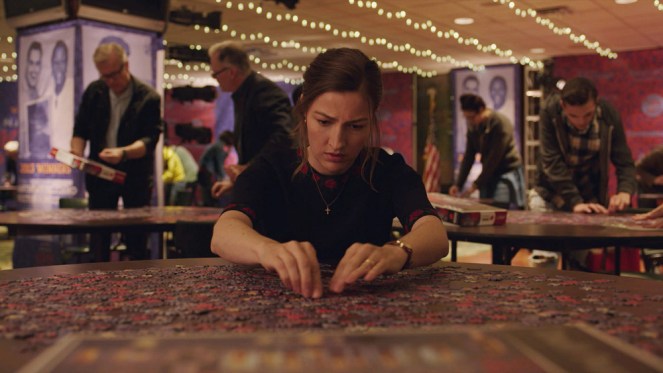
Sure, escape rooms can be cacophonous, and dropping a jigsaw puzzle can be infuriating, but for the most part, puzzles are soothing.

The satisfying scratch of pencil on paper as you fill in a word, watching the pile of unplaced jigsaw pieces slowly dwindle as the picture continues to form, getting a little victory chime when you solve a puzzle in your favorite app…

Board games, on the other hand, tend to get loud.

Sometimes, it’s good-natured debate or enthusiastic contributions, like when things get tense in a cooperative game, or when the game generally encourages rambunctiousness, like Throw Throw Burrito.

Other times, it’s a by-product of the gameplay itself. There’s a fair amount of frenzied clacking in Hungry Hungry Hippos, for instance, but I never hear people complain about the noise that comes along with a round or two of marble-chomping.

[Image courtesy of Grey Mass Games.]

Of course, that increase in volume can be for reasons that are a little more heated. Maybe someone betrayed someone else in a game like Sheriff of Nottingham. Monopoly famously inspires people to flip the board in frustration.

Social deduction games where identities are secret, or where there’s some level of deception involved, also tend to get pretty loud. Whether it’s Mafia, Ultimate Werewolf, Secret Hitler, Blood on the Clocktower, or others, raised voices are common.

But when it comes to loud board games, I think we can all agree that one particular dexterity takes the cake.

Say it with me now…
JENGA!

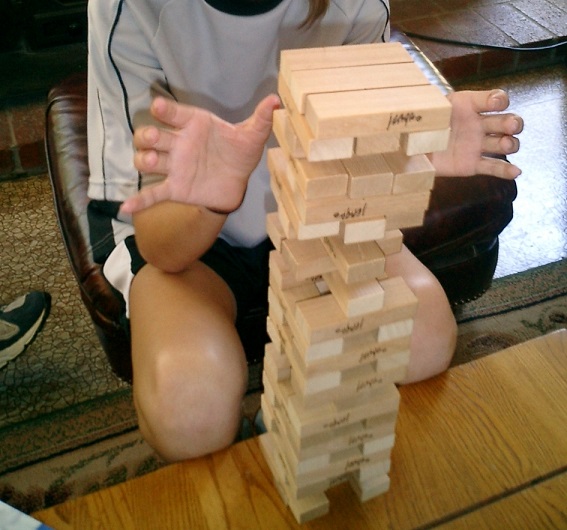
Yes, Jenga — by design — is loud. The only way the game can end is with a toppling tower of wooden blocks. CRASH! I know several board game cafes that have banned it for that specific reason.

Sure, KerPlunk can be loud, but even a stack of falling marbles doesn’t seem to compare to the jarring clatter of a stack of Jenga tiles hitting the table and/or the floor.

Sure, Perfection can be loud, but that’s kind of the point. You’re trying to complete the task BEFORE the buzzer. So it is possible to play without the cacophony.
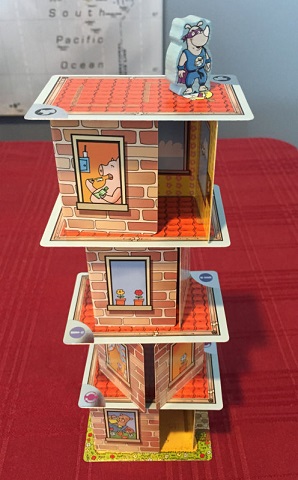
Jenga is so infamously loud that there are other games that sell themselves on being quieter than Jenga but offering the same stacking mechanic. Rhino Hero and Rhino Hero Super Battle employ cards instead of wooden blocks, so the collapse is less more tolerable, while Catch the Moon employs ladders, which makes for an oddly soothing yet still stressful game experience.

But where do you stand on noise-making games and puzzles? Do you like them soothing and soft or calamitous and crashing? And just what is the loudest game? Let us know in the comments section below. We’d love to hear from you.


Thanks for visiting PuzzleNation Blog today! Be sure to sign up for our newsletter to stay up-to-date on everything PuzzleNation!

You can also share your pictures with us on Instagram, friend us on Facebook, check us out on TwitterPinterest, and Tumblr, and explore the always-expanding library of PuzzleNation apps and games on our website!

5 Questions for Crossword Constructor Chez Knox!

Welcome to 5 Questions, our recurring interview series where we reach out to puzzle constructors, game designers, writers, filmmakers, musicians, artists, and puzzle enthusiasts from all walks of life!

This feature is all about exploring the vast and intriguing puzzle community by talking to those who make puzzles and those who enjoy them.

And this marks the fifth edition of our series of interviews where we turn our eyes to the future of crosswords. Instead of interviewing established talents in the field, I’ve been reaching out to new and up-and-coming constructors and asking them to share their experiences as a nascent cruciverbalist.

And we’re excited to welcome Chez Knox as our latest 5 Questions interviewee!

knox

It doesn’t matter if they’re squares or hexagons; if you’re talking grids of repeated shapes, Chez Knox has you covered.

Her debut crossword puzzle will be published by The Inkubator later this year, so you know her skills with squares are topnotch. And as for the hexagons, she recently contributed the Alabama hexagon to a crowd-sharing effort to complete a 50-states quilt. The national quilt museum even had exhibition space reserved for the quilt before COVID complications cancelled the exhibit.

And now, fellow quilting/sewing enthusiast Shannon Downey is taking this Internet-united work of quilt creativity around the country to share the power of art and craftivism, thanks to creative folks like Chez.

Chez was gracious enough to take some time out to talk to us, so without further ado, let’s get to the interview!


5 Questions for Chez Knox

1. How did you get started with puzzles?

The Sunday newspaper was a bit of a ritual around my house growing up. My dad and I always read the comics and did the word puzzles together.

2. As you start to interact with the puzzle community at large, what have you learned along the way? What has been the most surprising part of the process for you?

Everyone genuinely wants to help a constructor succeed. I think I’ve been most surprised at the size of the cruciverbalist community – there are a lot of people out there into this kind of work!

What, in your estimation, makes for a great puzzle?

A great puzzle has a very clever theme connecting dots I’ve never before connected.

A good clue gives me so much joy! Lately I like finding puzzles with a well-executed clue echo. There’s a hint of nuance to this technique that makes me smile. (A clue echo is when the same clue is used twice in a puzzle. It is usually one word or a very short phrase. The answers contrast each other but connect through the clue.)

One example might be: 2D and 34A may both be clued as “Green” and the answers might be ENVIOUS and UNSEASONED.

What do you most enjoy — or try hardest to avoid — when constructing your own?

I try to avoid crosswordese – common fillers like ENO, OLIO, EKE, etc. But sometimes they are little words that sneak into a grid fill so that the sanity of the constructor is saved.

adventureImage-image-1512060253232-superJumbo

3. Do you have any favorite crossword themes or clues, either your own or those crafted by others? Who inspires you as a constructor?

My favorite themes are ones that highlight words inside of theme words/phrases. It could be a hidden word that plays on the meaning of the theme entry word or a handful of theme entries containing a common word among them. In the grid design, squares that make up this word would be shaded or circled.

An example of this kind of theme is given in Patrick Berry’s Crossword Constructor Handbook.

Theme entries:

  • CLAUDE MONET
  • MADE MONEY
  • SIMON DEMONTFORT
  • DESDEMONA
  • PANDEMONIUM

Do you see the common word here? (It’s DEMON)

I find Erik Agard’s puzzles to be particularly eloquent and clever. They challenge me in a new way and I love that! That’s the kind of feeling I want my puzzles to give people.

4. What’s next for Chez Knox?

The day-to-day answer is more puzzle construction practice. My goal is to get to a place where one of my puzzles is being published once a month.

Zooming out from the day-to-day, I’ve had a lot of change in my life recently so I don’t want to think about anything new for a while! My husband and I are settling into a new house while I’m setting into life as a Waldorf class teacher after 20 years in the field of IT. I have a class of first graders that I will teach all the way through eighth grade! (How fun is that?!)

Meanwhile, daily crossword puzzles keep me grounded and in connection with my love of the English language. I am SO EXCITED to be a boring person who delights in making a home, teaching, sewing, and solving/constructing crossword puzzles!

5. What’s one piece of advice you would offer fellow solvers, aspiring constructors/setters, and puzzle enthusiasts?

There are lots of free constructing resources available but if you’re serious about creating your own puzzles, you’ll need to pay for things like software and word lists.


A huge thank you to Chez for her time. You can follow her on Instagram for all of her creative endeavors, and be sure to keep your eyes peeled for her Inkubator debut! I can’t wait to see what she creates next!

Thanks for visiting PuzzleNation Blog today! Be sure to sign up for our newsletter to stay up-to-date on everything PuzzleNation!

You can also share your pictures with us on Instagram, friend us on Facebook, check us out on TwitterPinterest, and Tumblr, and explore the always-expanding library of PuzzleNation apps and games on our website!
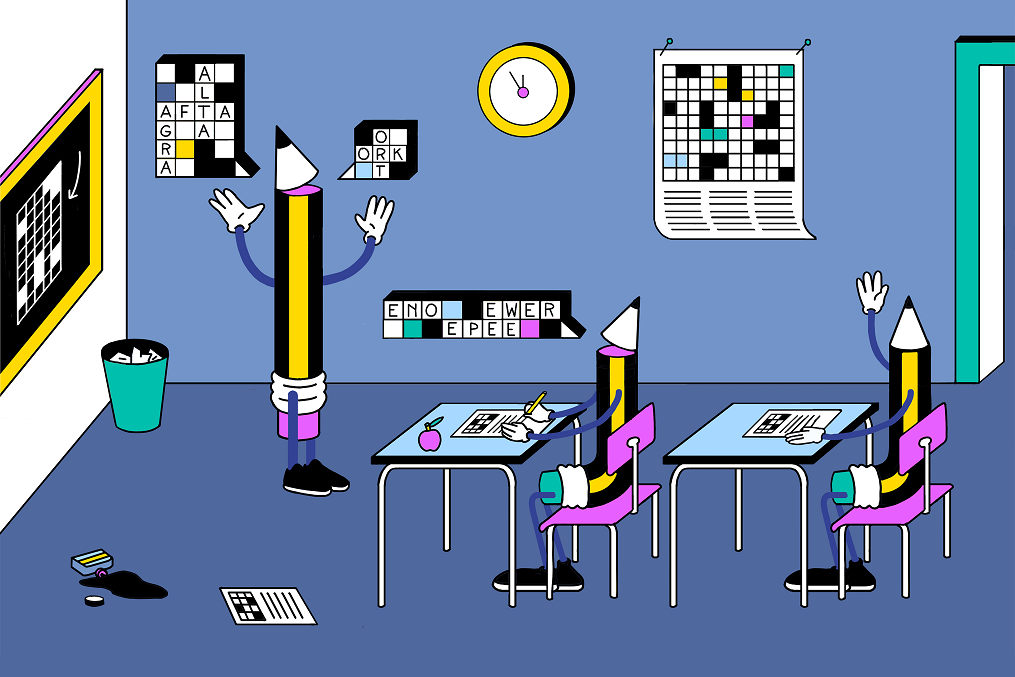
Puzzles in Plain Sight: Spinning Yellow Circles edition

Adobe_Semaphore_Wide_768x512.0

About six months ago, I shared the story of a secret code lurking in plain sight, sitting atop the Capitol Records Building in Los Angeles. It’s not the only time that buildings have made their way into the blog; in previous posts, we’ve discussed the giant crossword adorning the side of an apartment building in Lvov, Ukraine, as well as the optical illusion awaiting art lovers in a Roman palace.

But it was the only time we’ve discussed a secret code being shared on the side of a building.

Until today, that is.

Yes, my friends and fellow puzzlers, there’s another building out there broadcasting secret messages for all to see. It’s also in California. And this one is more devious than the blinking light on the Capitol Records Building.

adobe semaphore 1

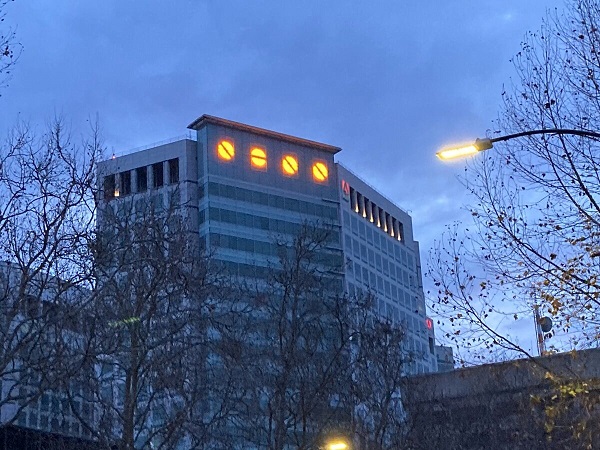
Say hello to Almaden Tower, the San Jose headquarters of Adobe, the software company behind Acrobat, Illustrator, and numerous other editing programs.

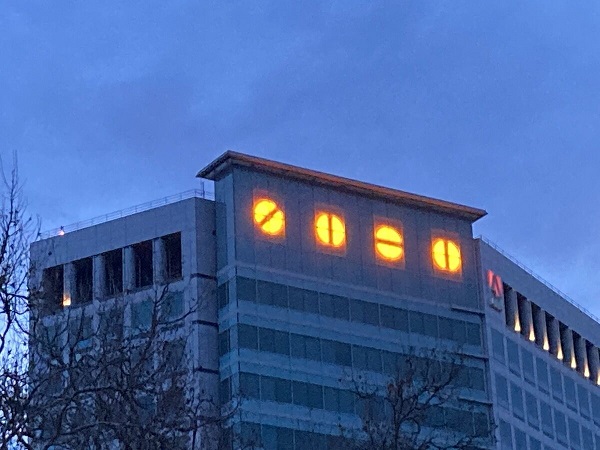
As you can see, there are four bright yellow circles beside the Adobe logo. These 10-foot-high digital lights all rotate. And if you pay enough attention, you might discover the secret message being broadcast.

The messages began transmitting in 2006. The code was cracked for the first time in 2007, and it wasn’t a brief message either. The lights were secretly transmitting the entire text of the Thomas Pynchon novel The Crying of Lot 49.

You see, the rotating circles allow for a form of semaphore alphabet, a way of secretly forming letters or symbols based on the position of each of the circles. They can be horizontal, vertical, a left-leaning diagonal, or a right-leaning diagonal. The various combinations of these positions create a semaphore alphabet of 256 possible characters.

adobe semaphore 2

But this was only the first part of the encryption. Even if you uncovered and charted this pattern, you still had to decode the secret messages detailing specific key words that would help you break the Vigenere encryption of the actual text.

It took MONTHS for two tech workers to figure out the semaphore language, decipher the code, and uncover the final message.

So naturally, just like the hidden alien language in the animated sci-fi comedy Futurama, it was replaced with a second, more complex code to be unraveled.

That code, which started transmitting in 2012, wasn’t broken until 2017 when a math professor started streaming footage of the Adobe building and charting the various positions of the circles.

But his examination led him to believe that it wasn’t just text being broadcast this time… it was an audio message. After discovering a chain of symbols that he believed was a space or bit of silence in an audio broadcast, he graphed the results, which resembled an audio wave.

It turns out, his suspicions were correct, and further analysis resulted in the true audio being uncovered: Neil Armstrong’s famous message from the moon landing.

Apparently, a new code and message are currently being brainstormed for Adobe’s devious puzzle monument. Who knows what Ben Rubin, the designer, has in store for solvers this time?


Thanks for visiting PuzzleNation Blog today! Be sure to sign up for our newsletter to stay up-to-date on everything PuzzleNation!

You can also share your pictures with us on Instagram, friend us on Facebook, check us out on TwitterPinterest, and Tumblr, and explore the always-expanding library of PuzzleNation apps and games on our website!

Solutions to Last Week’s Detective Riddles!

cluedupp1

Last week, we delved into a curious cousin of brain teaser family — detective riddles. These crime-fueled and investigation-filled little logic problems often cast you as the detective, the accused, or simply someone putting on their deerstalker hat and endeavoring to suss out the actual truth.

And we couldn’t resist putting your puzzle skills to the test with a few detective riddles. Did you unravel them easily or find yourself stumped?

Let’s find out, shall we?


#1

A Japanese ship was leaving the port and on its way to open sea. The captain went to oil some parts of the ship and took his ring off so it wouldn’t get damaged. He left it on the table next to his bunk. When he returned, it was missing. He suspected three crew members could be guilty and asked them what they had been doing for the ten minutes that he had been gone.

The cook said, “I was in the kitchen preparing tonight’s dinner.”

The engineer said, “I was working in the engine room making sure everything was running smoothly.”

The seaman said, “I was on the mast correcting the flag because someone had attached it upside down by mistake.”

The captain immediately knew who it was. How?

Answer: The seaman was to blame.

The key to this one is paying attention to the ship and the flag. A Japanese ship would be flying the Japanese flag, and it’s hard to believe a white field with a red circle in the center could be hung “upside down.”

302568

#2

A chemist was murdered in his own lab. The only evidence was a piece of paper that had the names of chemical substances written on it. The substances were nickel, carbon, oxygen, lanthanum, and sulfur. The chemist only had four people come by his lab on the day of the murder: fellow scientist Claire, his nephew Nicolas, his wife, and his friend Marc.

The police arrested the murderer right away. How did they know who it was?

Answer: Nephew Nicolas was to blame.

If you know your elemental abbreviations, you probably noticed the correlation between what the chemist wrote down and one of the suspects. Ni + C + O + La + S spells the criminal’s name and points the finger at the criminal from beyond the grave.

#3

A man was found on the floor dead with a cassette recorder in one hand and a gun in the other. When the police arrived at the scene they pressed play on the recorder. It was the man’s voice. He said, “I have nothing else to live for. I can’t go on,” followed by the sound of a gunshot.

After listening, the police knew that this was a murder, not a suicide. How?

Answer: Dead men don’t rewind.

The cassette recorder was all prepped for someone to press play, which means someone stopped the tape and rewound it after the gunshot was recorded. If it had been a suicide, the tape recorder would have just kept running after the gunshot, since there wasn’t anyone alive to stop it.


How did you do, fellow puzzlers and PuzzleNationers? Did you solve all three? Let us know in the comments section below! We’d love to hear from you.

Thanks for visiting PuzzleNation Blog today! Be sure to sign up for our newsletter to stay up-to-date on everything PuzzleNation!

You can also share your pictures with us on Instagram, friend us on Facebook, check us out on TwitterPinterest, and Tumblr, and explore the always-expanding library of PuzzleNation apps and games on our website!
A Puzzly Discovery Under the Sea!

We’ve talked quite a bit about the importance of Enigma machines in the past.

The quest to crack the unbreakable Nazi code machine spanned the Atlantic Ocean and resulted in never-before-seen collaborations between analysts, codebreakers, and puzzlers from all walks of life, dedicating hours upon hours every day to trying to unravel the secrets of German communications. Cracking the code would be the key to intercepting crucial information and outmaneuvering the Nazi war machine.

We’ve discussed those twin decryption locations — Arlington Hall in the US and Bletchley Park in the UK — as well as the efforts of codebreakers like Elizebeth Smith Friedman to dismantle the work of Nazi spymasters both during and after World War II.

The story of Alan Turing is inextricably linked with that of the Enigma device, even though there were three Polish mathematicians — Rejewski, Rózycki & Zygalski — who had already demonstrated that the Nazi code was breakable and even managed to reverse engineer an Enigma machine.

Strangely, we rarely talk about the Enigma machines themselves. They were dangerously efficient, as explained in this article from Atlas Obscura:

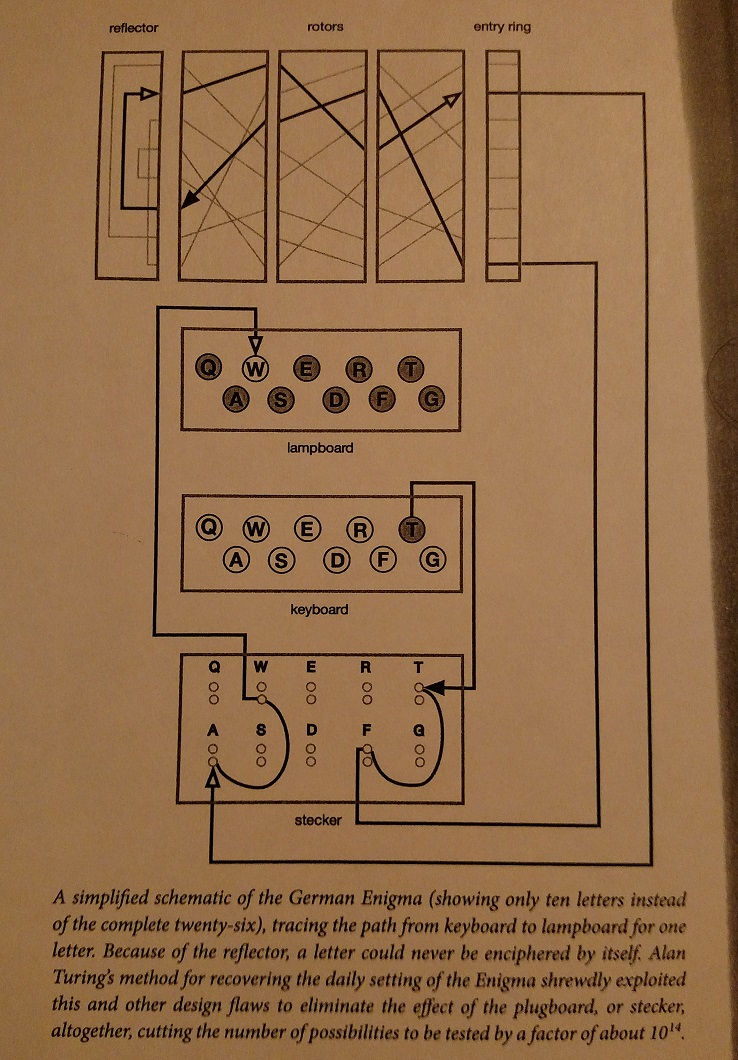
When the Nazis needed to send confidential messages, they entered the dispatches into the machine, which substituted every letter using a system of three or four rotors and a reflector, encrypting the message for a recipient Enigma machine to decode.

Getting Allied hands on one during the war was a top priority, so much so that the standing orders on German ships and U-boats was to throw them overboard and let the sea claim them, rather than risking the chance of the Allies getting ahold of one.

underwater enigma

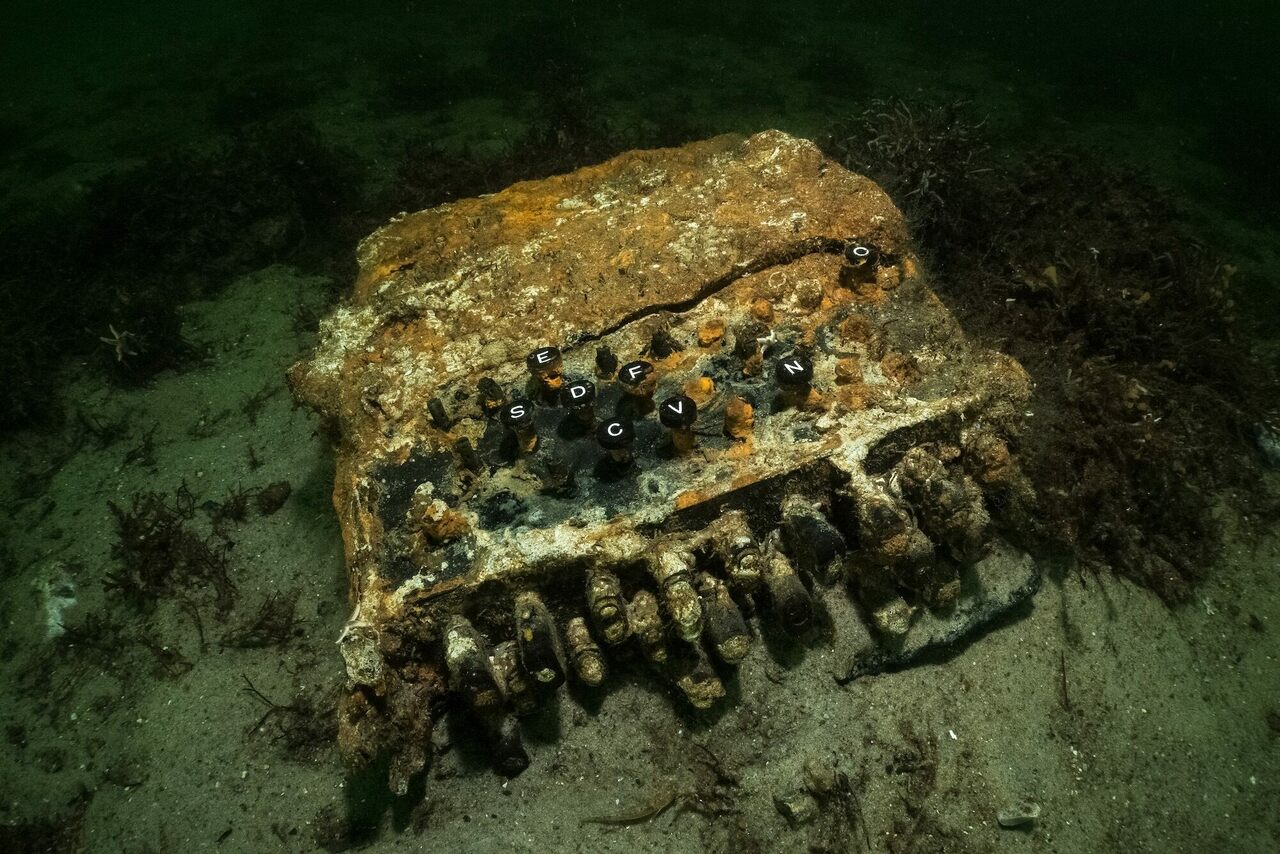
But the sea doesn’t always keep secrets forever, and a recent dive by a marine biologist team discovered the remains of an Enigma machine in the Bay of Gelting:

He noticed a contraption tangled up in the fishing line the crew had headed down to collect. The device, which at first seemed like an old typewriter sitting under at least 30 feet of water, was a Nazi Enigma machine, likely one of hundreds abandoned and thrown overboard in the dying days of the German war effort.

And those devices still contain valuable information decades later.

Each Enigma machine has a serial number, and if this machine’s number is still legible after decades underwater, it could reveal which ship or Nazi unit the Enigma machine belonged to. This would allow researchers to track the use of the device and what impact its use or its absence had on the war effort overall.

Yes, it’s not just mussels and fish that call this device home, but a readily accessible history of the device itself, if we can only read it.

underwater enigma 2

And now, instead of being protected at all costs by German officers, this machine is now protected by archaeologists and researchers, sitting in a tank of demineralized water in order to flush out the salt and salt water that has so corroded the machine over time. It will spend almost a year in that tank before any restoration efforts can proceed.

Successful recoveries of these machines are understandably rare, and this is a chance to add to the historical record of codebreaking and puzzling during World War II. Here’s hoping we can stumble upon more of these lost treasures in the future.


Thanks for visiting PuzzleNation Blog today! Be sure to sign up for our newsletter to stay up-to-date on everything PuzzleNation!

You can also share your pictures with us on Instagram, friend us on Facebook, check us out on TwitterPinterest, and Tumblr, and explore the always-expanding library of PuzzleNation apps and games on our website!
Monopoly Opens Up the Community Chest to the Community!

monopoly

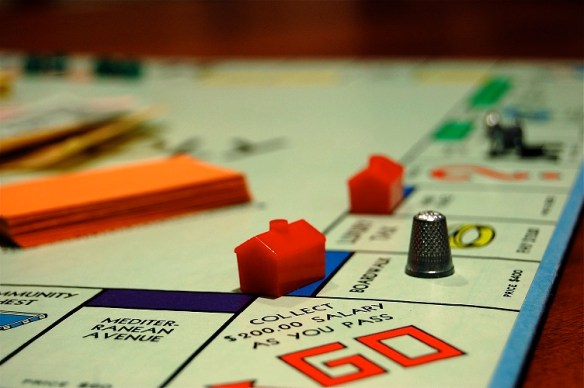
Monopoly has been around for more than 80 years, and over the decades, they’ve made all sorts of attempts to modernize or update the product. They’ve ditched paper money for electronic banking and credit cards, they’ve utilized motion sensors, and even released Millennial, political, and cheaters’ editions in the hopes of freshening up the game.

This time around, they’re asking for the public’s help in changing the game. Specifically, they’re looking to update the Community Chest cards.

community-chest-vintage

According to the Hasbro press release:

Covering topics like beauty contests, holiday funds, and life insurance, there is no denying the Monopoly game’s Community Chest Cards are long overdue for a refresh. And, coming out of the tumultuous year of 2020, the term “community” has taken on a whole new meaning. Hasbro is counting on their fans to help reflect what community means in their real lives, into the Monopoly game, by voting for new cards like “Shop Local”, “Rescue A Puppy” or “Help Your Neighbors.”

Naturally, because of the Internet, this is already being reported in some outlets as a desperate attempt by the company to appear “woke” or more socially aware. And that seems a tad pessimistic in my view.

Sure, this could be a cynical corporate strategy, but it doesn’t mean updating the game is a bad idea. I mean, when’s the last time the bank actually made an error in your favor and you got $200?

community-chest-bank-error-in-your-favor

This isn’t even the first time they’ve crowdsourced an update to the game. A House Rules edition of the game was published with five house rules suggested by fans.

In 2017, Hasbro launched an Internet poll to determine a new lineup of tokens for editions of the game, which resulted in the boot, wheelbarrow, and thimble being removed from the game (and replaced with a rubber duck, a penguin, and a Tyrannosaurus rex).

So they’ve posted a poll where you can choose between two possible options for each of the 16 cards.

For instance, one pairing let me choose between “You go to the local school’s car wash fundraiser — but forget to close your windows! Pay $100” and “You held a neighborhood party — but you didn’t recycle your trash! Pay $100.”

Other cards mention bake sales, video chatting, running for charity, volunteering, community gardens, donating blood, and more.

community chest

So, this begs the question: what suggestions would you make?

Would you replace the beauty contest with second place in a hot wings-eating contest? Would you help a friend secure a small business loan? Would you contribute to an off-the-grid community?

Let us know your ideas for new and fresh Community Chest card ideas in the comments section below! We’d love to hear from you.


Thanks for visiting PuzzleNation Blog today! Be sure to sign up for our newsletter to stay up-to-date on everything PuzzleNation!

You can also share your pictures with us on Instagram, friend us on Facebook, check us out on TwitterPinterest, and Tumblr, and explore the always-expanding library of PuzzleNation apps and games on our website!