How is a poem like a puzzle? That question’s easier to answer than the Mad Hatter’s classic “How is a raven like a writing desk?” From crosswords to cryptograms, many beloved puzzles do, if nothing else, resemble poems in their mutual wordiness. However, some forms of poetry are more puzzly than others—compare a sprawling collection of free and blank verse like T.S. Eliot’s “The Waste Land” to the concise machinery of a syllabically limited haiku, the boundaries of which are as strict as the edges of a crossword puzzle.
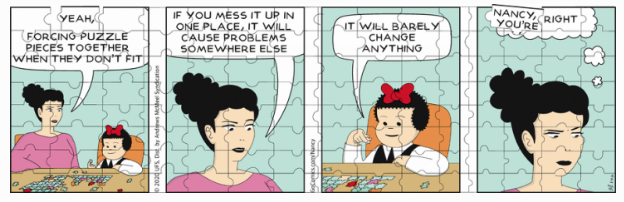
Like Nancy, though, you can always break the boundaries of form to create new meaning.
When you start to write a haiku, your possibilities are wide-open; with each word you set down, though, the potential choices for what might follow narrow. In effect, your “word bank” shrinks, and if three syllables already occupy the first line, then any words longer than two syllables are ineligible for that line’s continuation. The poet’s puzzling brain must kick into action, considering words for their dimensions and how they might lock into place with the words directly alongside them.
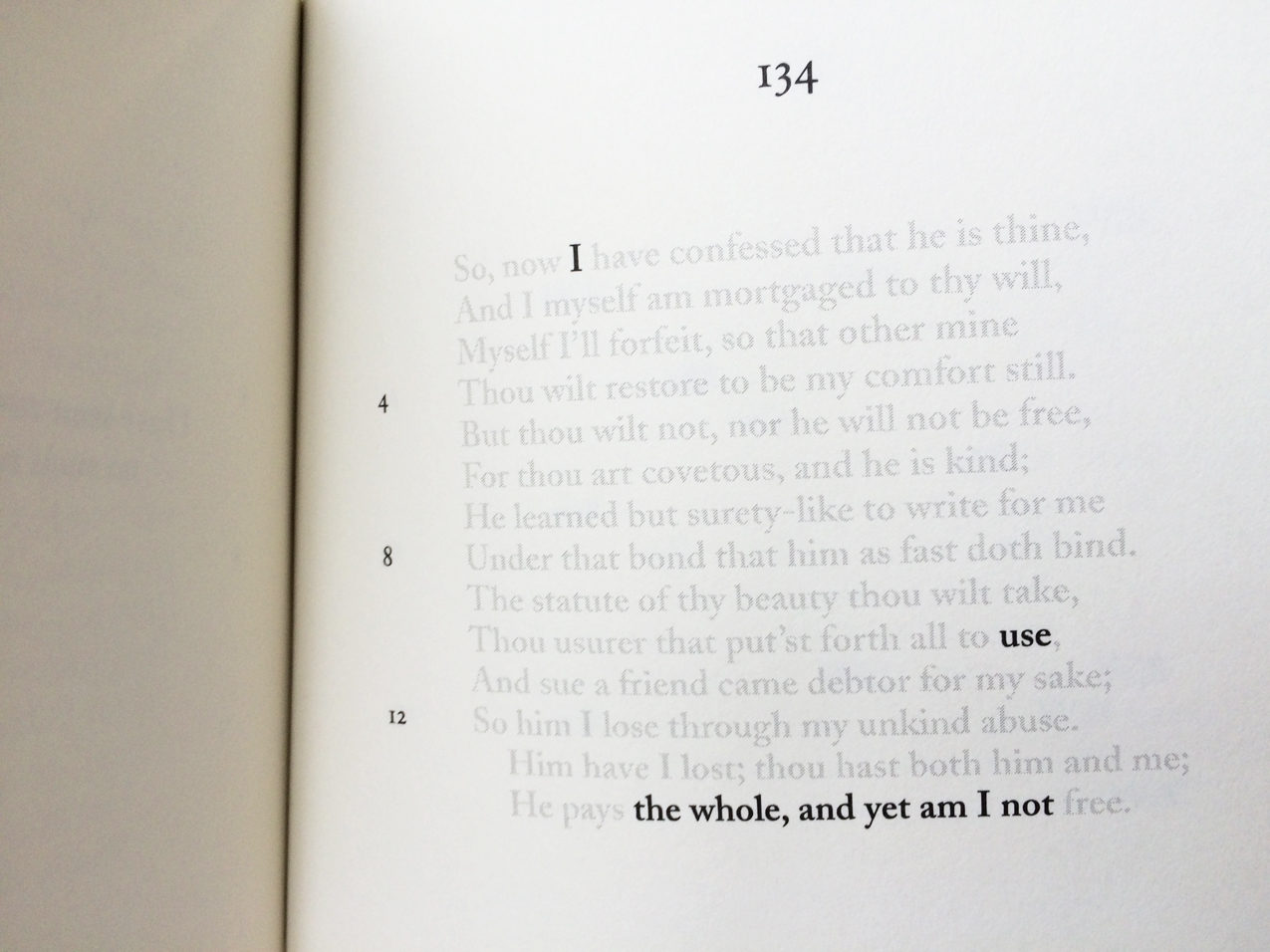
Haikus aren’t the only poetic forms that require this type of geometric thinking. Similarly brainteasery in their construction are sonnets, villanelles, and sestinas. Concrete poems take the shape of objects relevant to their contents, and erasure poetry—much like a word seek—highlights hidden messages by winnowing the chaos of a pre-existing text.
An erasure poem by Jen Bervin, made from one of Shakespeare’s sonnets.
What about a more sprawling, less tightly organized work like “The Waste Land,” then? Beyond the wordiness it has in common with cryptograms et al, is it left out of our riddle’s answer? Roddy Howland Jackson, in the recent essay, “Beastly Clues: T. S. Eliot, Torquemada, and the Modernist Crossword,” appears to argue that no, such works are very much like puzzles.
Jackson takes us back to the 1920s, when “The Waste Land” first appeared in print, and modernist poetry and puzzles alike were derided by critics. He locates “a question asked about labour and idleness in this period: are crosswords and difficult poems worth the efforts required to elicit literary pleasure and linguistic revitalisation? Or merely a waste of time?”
As a poet and puzzler, this question resonates with me a century later. Swimming in the high-pressure waters of hustle culture makes us highly sensitive to the terror of “wasting time,” as in doing anything that doesn’t build our personal brands. Writing and reading poetry that isn’t tidily instagrammable? Solving puzzles that aren’t social media fads? By hustle culture’s standards, both of these things are wastes of time.
So how is a poem like a puzzle? Both present us with opportunities to take back our time, to carve out pockets of our days where we exert mental energy purely for the joy of thinking. Instead of being just a bullet point on your resume, your problem-solving skills can be part of how you resist the pressure to always have your nose to the grindstone.
Next week, we’ll encourage you to find joy in poetry by more closely examining one particular puzzly form. In the meantime . . .
It’s strange that puzzles and games don’t seem to have urban legends attached to them, even though they’ve been with us for so long.
I mean, sure, there’s palindromes believed to have magical powers… and cursed puzzle boxes like in the Hellraiser films… but I can’t think of any pervasive urban legends around modern puzzles and games.
It strikes me as odd because there are plenty about video games, which are a relatively new art form, generally speaking. There are stories about haunted Legend of Zelda cartridges and sinister destructive secret characters in Minecraft.
There’s the supposed Madden Curse (where athletes who appear on the cover of Madden games end up suffering poor seasons or getting injured), and even the conspiracy stories about an arcade game called Polybius that government agents used to download game data from in the 1980s.
It starts, as many urban legends, bits of folklore, and spooky stories do, with a hazy recollection. There’s a forum on Reddit cleverly titled “Tip of my joystick,” where people can post details about a game whose name they don’t remember, and the other posters help them remember it.
The post was about one of those complete-a-task/farming-style games, like Animal Crossing, Stardew Valley, or Farmville.
Except it had an appropriately sinister twist, like something out of a Hitchcock movie or an episode of a weekly crime drama like Criminal Minds or Bones.
At one point, the player gets into an argument with their wife and kills her. The game continues as a farm simulator, except you periodically have to hide the body from police.
This was clearly meant to be a darkly tongue-in-cheek game mechanic, almost Weekend at Bernie’s-esque. Obviously, this game wouldn’t be for everyone. You might even think people were purposely creating a dark urban legend of their own by making this post in the first place.
But the fellow posters of r/tipofmyjoystick tried their darnest to figure out the identity of this game. Some asked questions for further details, while others suggested possible games, but were quickly proved wrong.
The game remained unidentified for several years, coming to be known as “that evil farming game,” even getting its own dedicated reddit forum.
The original poster, at one point, finally concluded at one point that they must have dreamt the game, or misremembered something while half-asleep.
In the years before the Internet became the prolific searching and information tool it is now, I had plenty of experiences describing random TV episodes or b-movies that people presumed I had made up or dreamt up while home sick on the couch from school. (One particular episode of MacGyver involving a hidden temple with traps and a giant blue gemstone, for instance, was a joke in my group of friends for years until I could finally point to the episode on Netflix or the episode page on IMDb to prove its existence.)
So what was this “evil farming game” the original poster remembered? Was it real? Or a sleepy invention?
Well, it turns out it was neither.
Diligent posters and game fans went looking through the video library of a YouTuber called Vinesauce after the original poster mentioned watching it often. And they found a video where Vinesauce jokingly suggested a farming style game with the grim addition to the gameplay.
The original poster misremembered this as a real game, and started the ball rolling on an Internet video game urban legend that lasted half a decade.
It turns out, our brains are good at this sort of thing — convincing ourselves that what we half-remember is real — and this urban legend evolved as something similar to the Mandela Effect, a mass misremembering of something.
Two prominent examples of the Mandela Effect from recent history are the Berenstain Bears (which many people swear should be the BerenSTEIN bears) and the movie Shazaam staring Sinbad, which never existed. (They’re misremembering the Shaquille O’Neal genie movie Kazaam from 1996.)
So, this spooky mystery was solved, but perhaps a more interesting mystery — how the original poster’s brain created this fake game in his memory — stands in its place.
I found this story both fascinating and charming — if a little morbid — and I thought it would be the perfect puzzly conclusion to the Halloween season.
Have you ever misremembered something like this, fellow puzzlers, or experienced something similar to the Mandela Effect? Or are there any urban legends about puzzles and games that we should know about? Let us know in the comments section below! We’d love to hear from you.
Trick or treating is over, but there’s no trick here. Treat yourself to some delightful deals on puzzles. You can find them on the Home Screen for Daily POP Crosswords and Daily POP Word Search! Check them out!
Thanks for visiting PuzzleNation Blog today! Be sure to sign up for our newsletter to stay up-to-date on everything PuzzleNation!
Yes, “the best tournament held in New York on a Saturday in August” is bringing a New York Saturday in August to you, as Lollapuzzoola 13 goes virtual.
Whether you’ll be solving on that Saturday or as part of the Next Day Division, you’re sure to encounter some top-notch puzzles worthy of the Lollapuzzoola name.
Just look at the constructors involved in this year’s tournament! Stella Zawistowski and Robyn Weintraub return for the second year in a row, and they’ll be joined Rachel Fabi, Brooke Husic, joon pahk, and Sid Sivakumar (who just constructed for this year’s Boswords tournament). I can’t wait to see what they have in store for the competitors!
Starting around 12:30pm Eastern, you can follow along on the Twitch livestream that will be running for the duration of the tournament. In addition to the five tournament puzzles and championship rounds, there will be bonus games and a virtual pizza party! (Be sure to bring your own pizza.)
This is not only another wonderful opportunity to bring the puzzle community together, it’s also a charitable event, as a portion of the proceeds from the tournament will be donated to Color of Change and the Save the Children Coronavirus Response Fund.
It should be a great time, either in person or for solvers at home. Lollapuzzoola is truly one of the highlights of the puzzle calendar.
I know the last few months have been hard for a lot of people. But it’s also been inspiring to see communities rally and work together, even while social distancing, to take care of each other. And loads of creative folks out there have been raising money for charity in clever and entertaining ways.
One of the biggest annual fundraisers is Red Nose Day, a yearly international event dedicated to eradicating child poverty. There are often special TV events tied into the Red Nose Day, and this year was no exception.
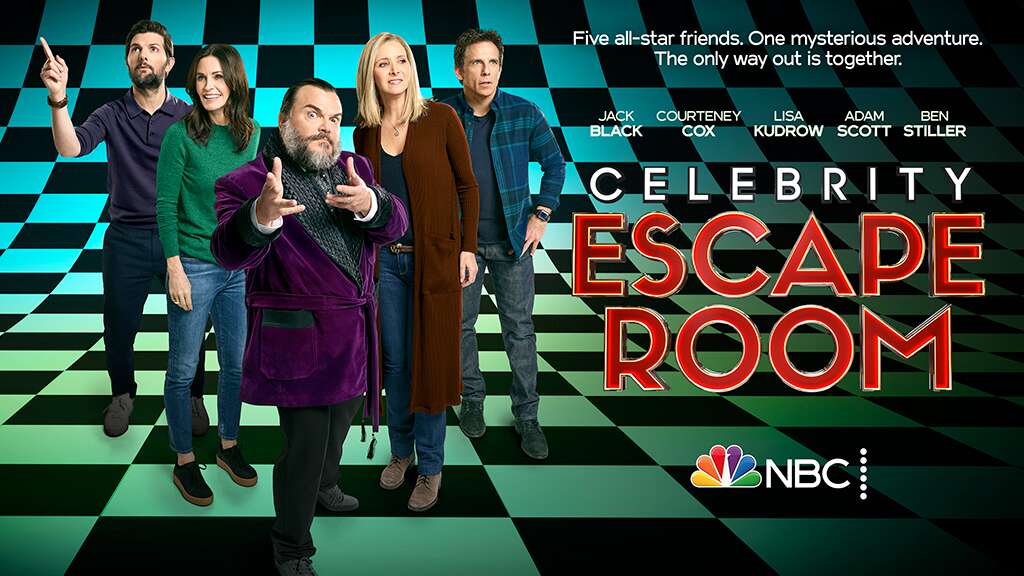
NBC employed a more puzzly route than most participating networks, as they presented an hour-long show dedicated to a celebrity-filled escape room.
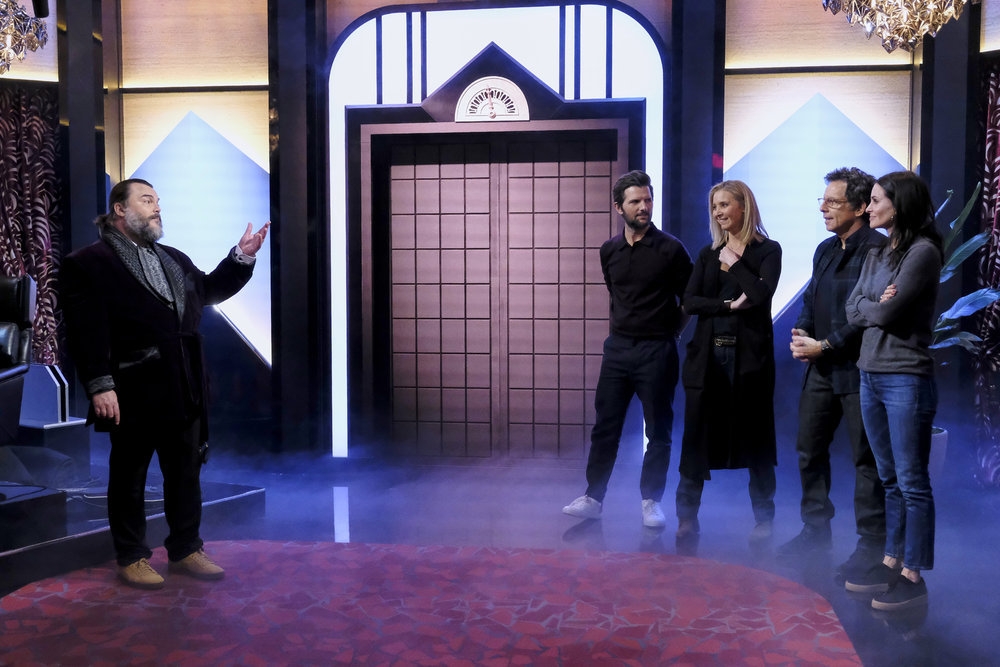
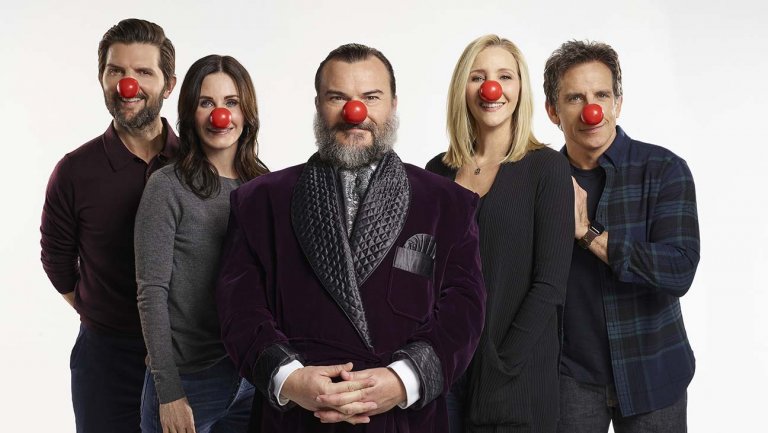
Musician and actor Jack Black hosted, serving as the exuberant and maniacal gamemaster for the event. Ben Stiller, Adam Scott, Courteney Cox, and Lisa Kudrow were the celebrity players, and they had one hour to escape Jack’s series of rooms. For each puzzle they successfully solved, they would earn $15,000 in charitable donations from the event’s sponsor, M&Ms.
Jack explained the rules, and then informed them that they were allowed three hints to help them solve the puzzles. Each hint was represented by a red clown nose, the official symbol of Red Nose Day.
You can watch the entire special video below, or continue reading for a recap of the show and a breakdown of each puzzle:
RECAP
The celebs were escorted into an elevator and sent on their way. The team immediately started trying to figure out how to escape.
But the elevator wasn’t a puzzle room. Jack was just messing with them, sending the elevator up and down before opening it.
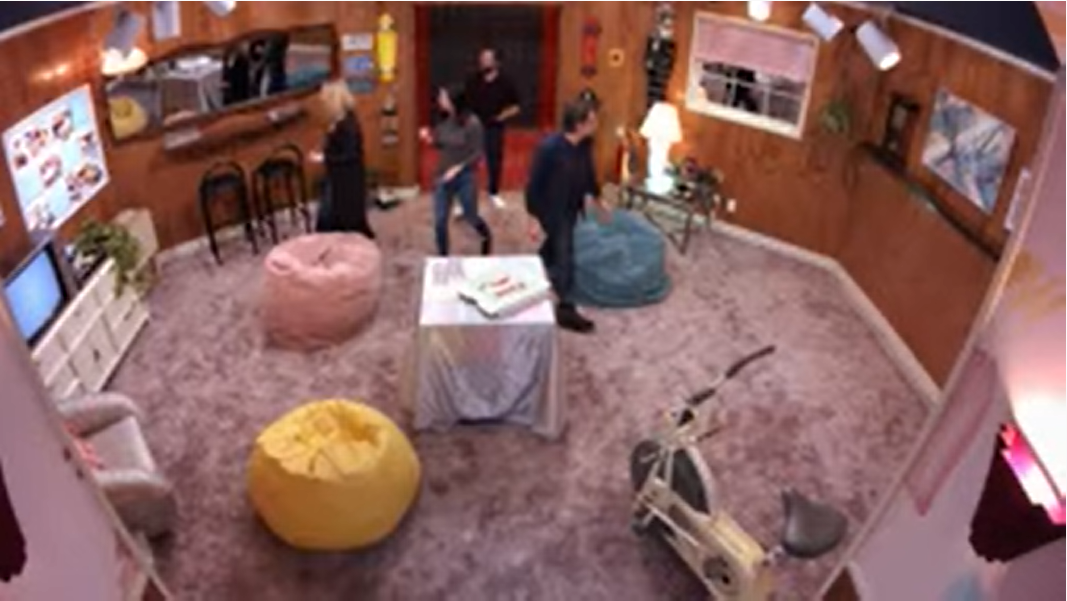
The group’s first actual challenge was an 80’s themed room, which contained not only numerous references to the decade (posters, movies, decor, etc.), but references to each actor’s career to serve as a distraction. Jack Black informed the audience of two key locations to pay attention to — a photo wall and the table with pizza on it — but didn’t explain the actual puzzles.
Courteney Cox stumbled upon a clue — a recorded message from Jennifer Lopez — that sent the celebs to their yearbooks on one of the shelves. Inside, they each found a different variation of a picture of people sitting on a couch, each one with more people in it.
Ben Stiller not only realized that they needed to be placed somewhere in order, but spotted where to do so.
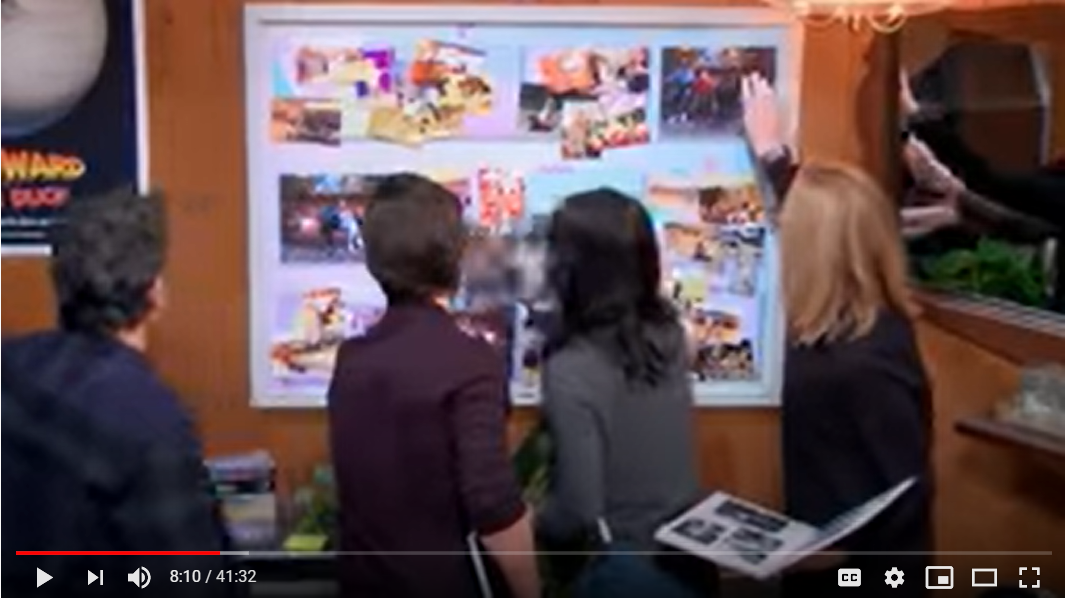
The photo wall was a 3×4 grid, with 8 photos already placed and 4 open spaces. My first instinct would have been to place the photos in order of the rows (as if reading the photos in storyboard order from left to right, row to row).
But the photos had to be placed in column order from left to right, ignoring the rows. Courteney figured this out, and a couch folded out from the wall. Having successfully completed a puzzle, $15,000 was added to the team’s charity total.
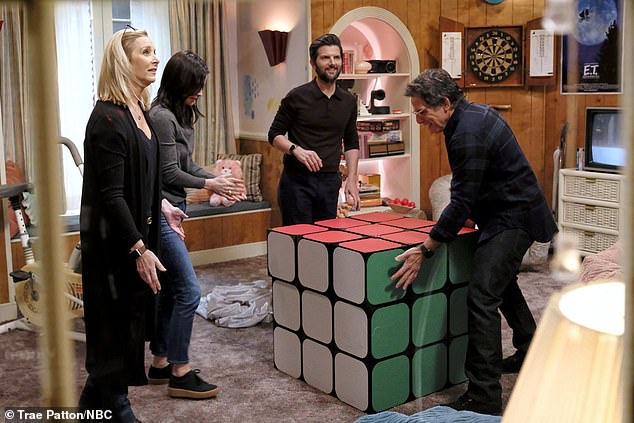
By all sitting on the couch, they activated the TV, which aired a commercial for Rubik’s Cubes. Ben realized the pizza and tablecloth in the center of the room were covering a giant Rubik’s Cube. (Instead of being rotated and twisted, this one had removable magnetic blocks, which made solving it easier.)
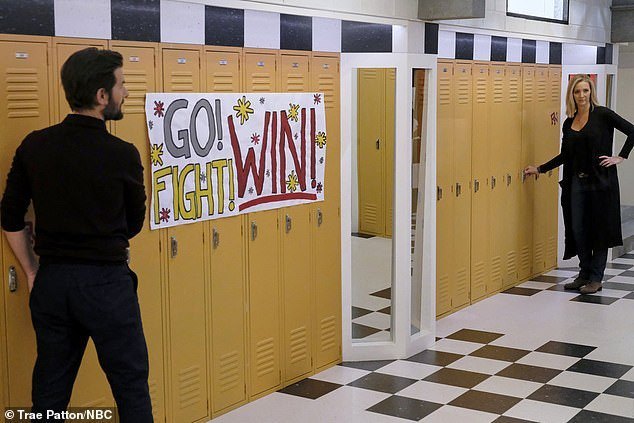
The celebs immediately started checking the lockers, but they were all locked. While searching for their next puzzle, the celebs misinterpreted a banner that said “Let’s get loud” and started screaming.
It’s silly, but hey, in an escape room, sometimes you’ll try anything.
Ben spotted the clue on the floor, and Courteney realized that some of the floor tiles could be pulled up, revealing a picture puzzle to be assembled. They solved the puzzle — a picture of Jack in a mascot costume — and it opened the trophy case. That made their charity total rise to $45,000.
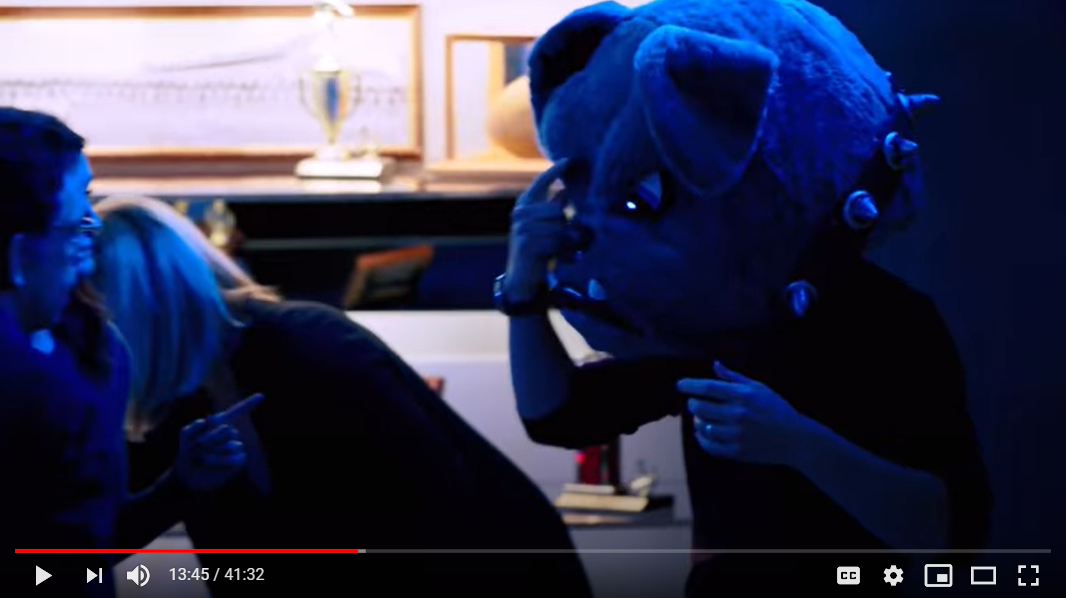
When Adam put the mascot head on, the lights dimmed, and he began looking for the next clue. Three of the celebs tried the mascot head on, but they couldn’t find anything. So they used one of their red noses and asked for a hint.
Jack intervened and told them to direct the mascot head’s vision toward the lockers. On certain lockers, the mascot’s head revealed in invisible ink the birthdays of the four players. After some difficulty, Adam realized they should open the lockers in birthday order, which caused all four to open. (Four puzzles completed, $60,000 earned.)
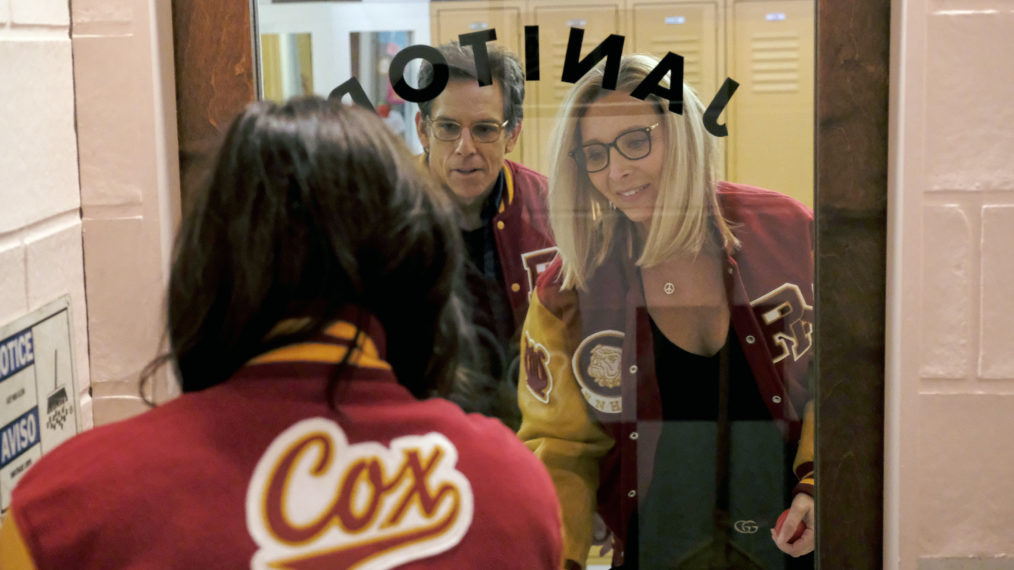
As the other players removed letterman jackets from the lockers, Courteney stepped into her locker (which was larger inside than the others) and Jack shut it behind her, seemingly locking her in. While trying to figure out how to free Courteney, they all decided to put their jackets on.
Jack directed the audience to pay attention to the janitor’s closet, the trophy case, and the cubby area for the next puzzle.
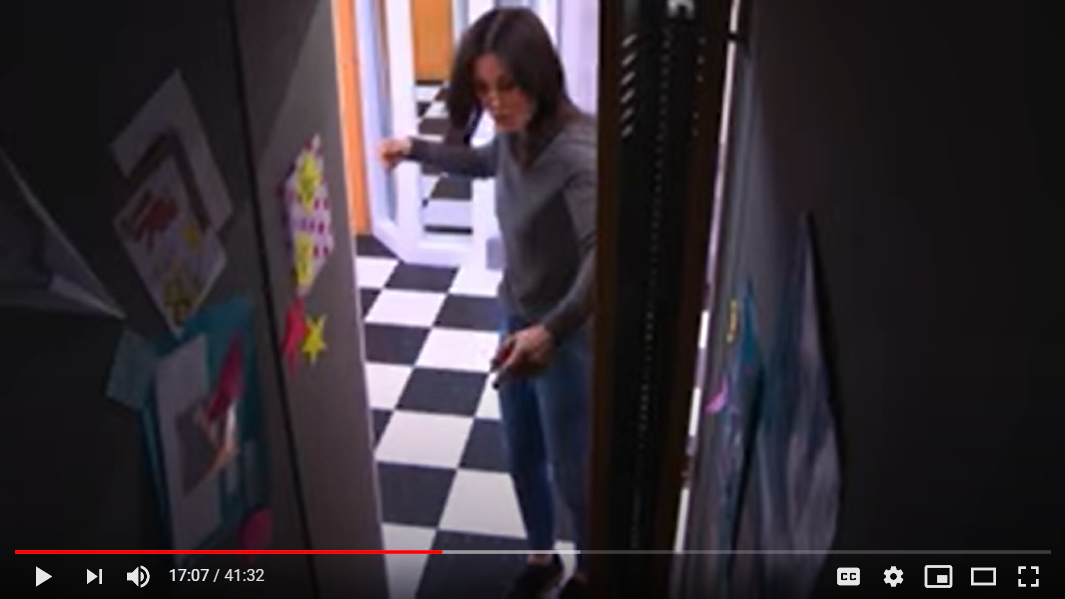
Courteney discovered her locker secretly led into the locked janitor’s closet. Meanwhile, the other players found prom tickets in their jackets.
Unable to free Courteney (the inside door handle came off in her hand), the celebs were flummoxed again, even trying to play rock-paper-scissors to open the door. (Bafflingly, Ben doesn’t know how to play.) They decided to ask for their second Red Nose hint. Jack pointed them toward the janitor’s to-do list, which has four tasks on it, three completed.
The unfinished task referenced the water fountain, and upon investigating it, Adam found the door handle for the janitor’s closet, freeing Courteney (and earning another $15,000).
Doing so activated the TV in the trophy case, and special guest “Principal” Kelly Clarkson provided a year-in-review that recounted the trophy won by each celeb, and suggested they hang up their jackets on the Wall of Fame (the cubby area).
The celebs missed the trophy clue and just hung their jackets up (not realizing that the trophies — first place, second place, third place, and fourth place — indicated the order of the jackets).
They tried birthday order again, then headed back to the trophy case, realized their mistake, and put the jackets in the correct order, earning another $15,000 for charity.
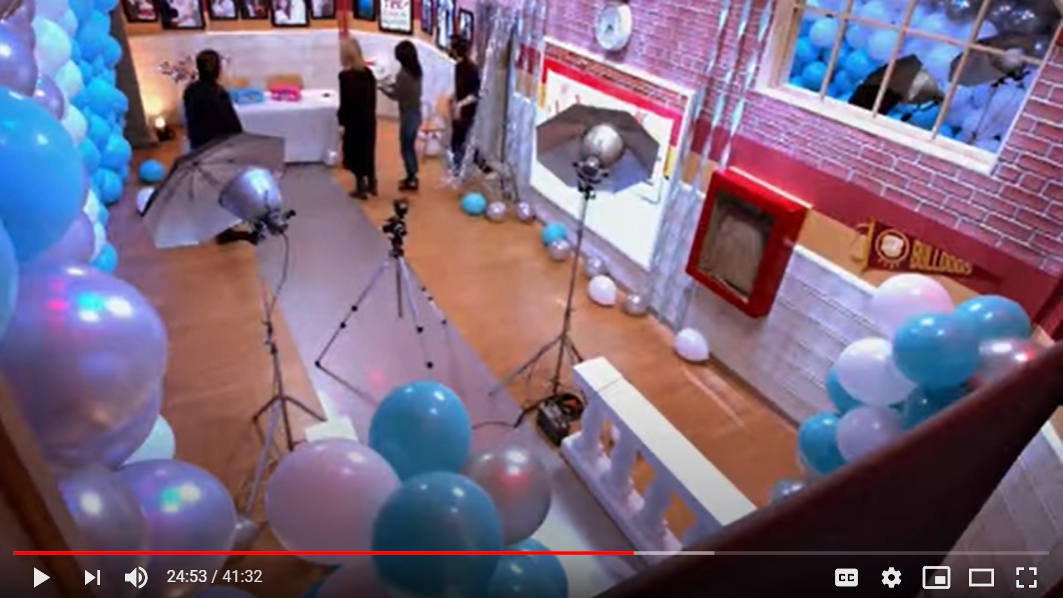
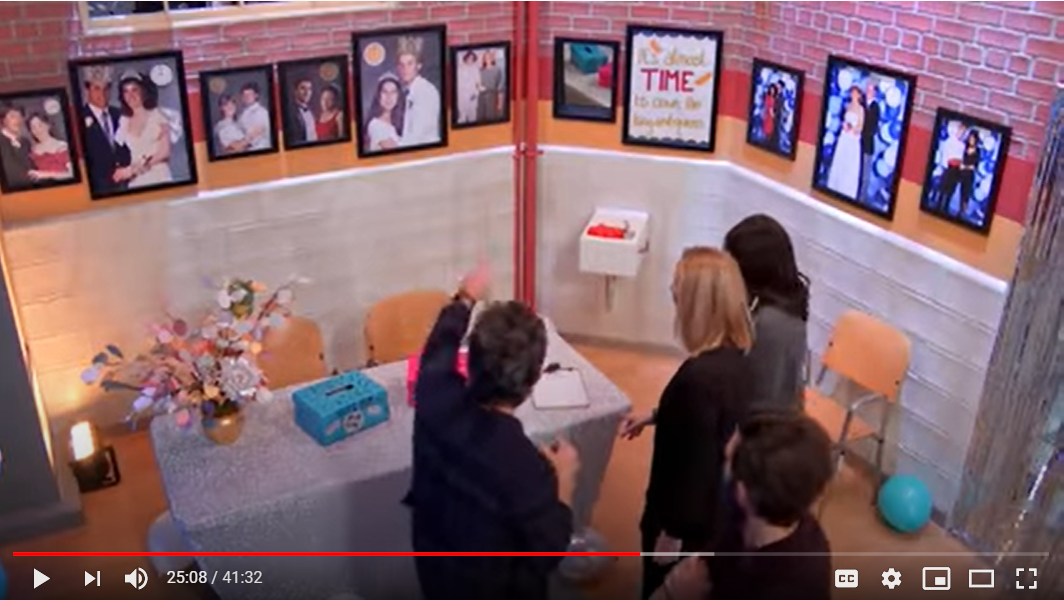
Part of the locker wall then opened up to reveal a room decorated for prom, complete with balloons and a space for couple/group photos. Jack directed viewers to pay attention to the clock on the wall, the photos of couples on the wall, and the photography setup.
Relying on the clue “it’s almost time for crown the king and queen,” they puzzled out that there are clocks on all of the photos, but it reads 9 PM for the crowned couple.
Courteney eventually realized there was a stepladder that would allow her to reach the clock, and rotated it until it read 9 PM. (Their charity total was now $105,000!)
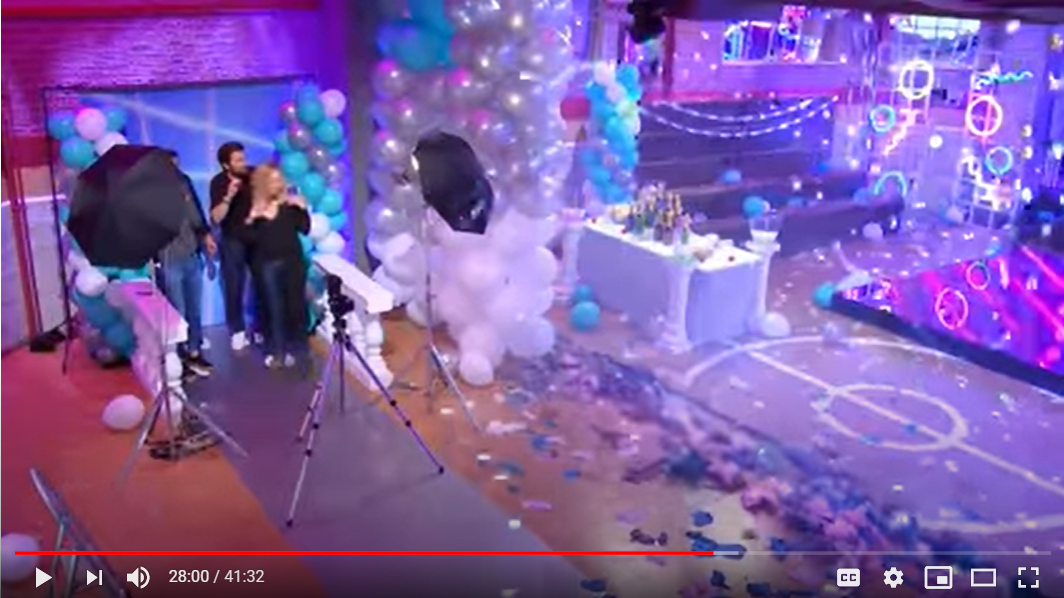
Completing the puzzle activated the lights in the photo area. They posed for their picture, and when they snapped it, the balloon wall burst, revealing a gym decorated for prom. (It also scared the daylights out of them, which made for a great prom photo.)
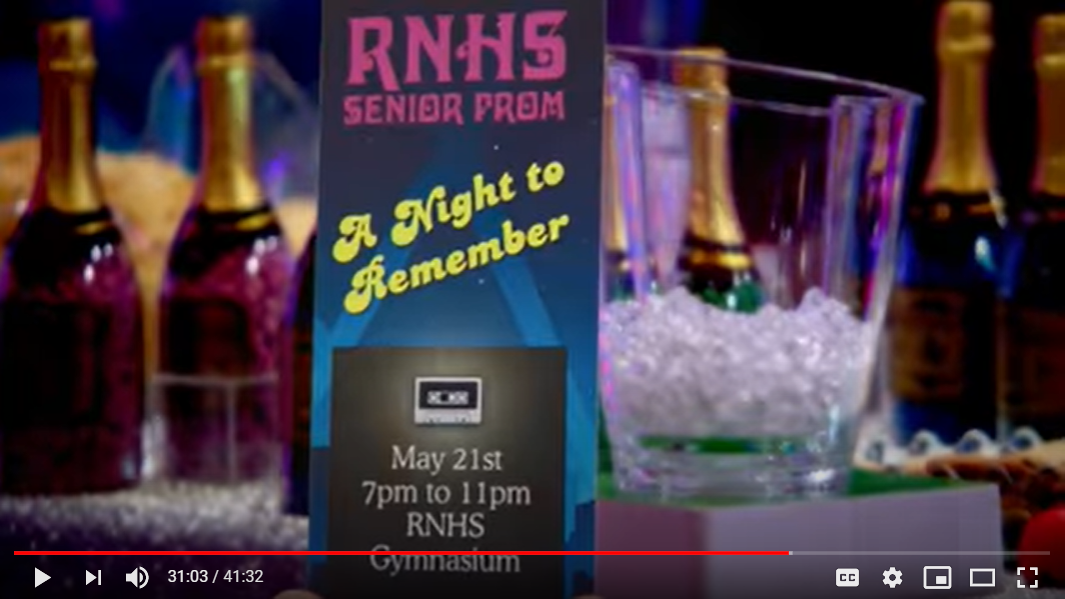
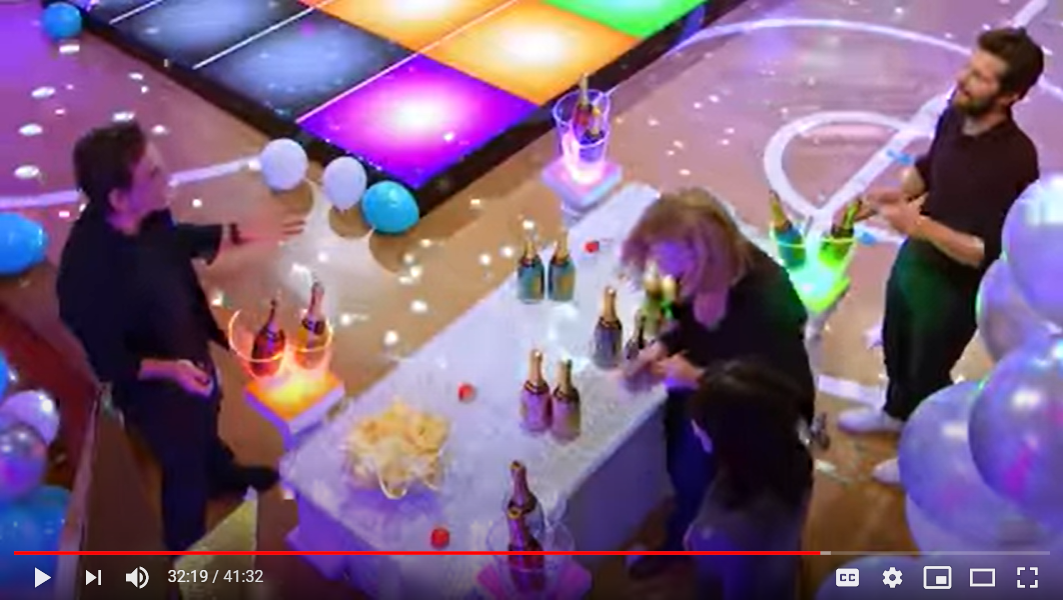
Jack then fully explained the next puzzle to the audience, as the celebs had to match the images on their prom tickets to certain champagne bottles (filled with M&Ms) on the refreshments table, which would then point them to particular light-up squares on the electronic dance floor.
The celebs immediately zeroed in on the symbols on the champagne bottles, but didn’t know what to do with them. Jack taunted them, hoping to goad them into using their third and final hint, until Courteney spotted the matching symbol on her prom ticket.
Now finally pairing up bottles of M&M champagne, Courteney again figured out that the colors of each pair of bottles should combine to match the color of the podium they’re placed on. It’s a pretty impressive bit of puzzling, I must admit.
Each time they placed a pair of bottles correctly, part of the dance floor lit up.
Unfortunately, they confused the colors required to make pink with the colors needed to make orange, which slowed them down. Fixing their mistake and completing the puzzle, they ran to the dance floor with another $15,000 for charity.
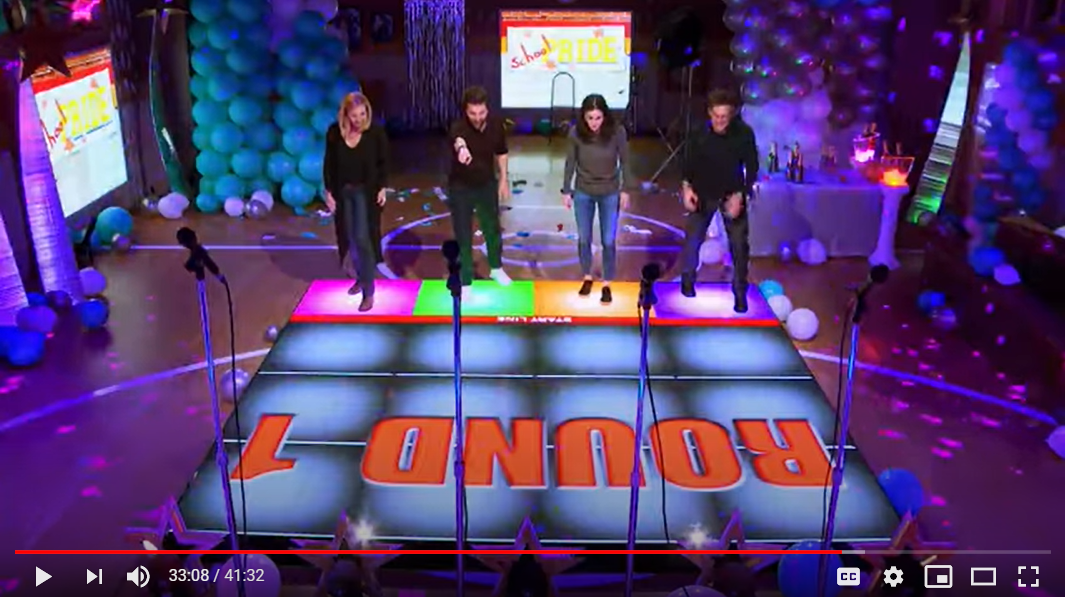
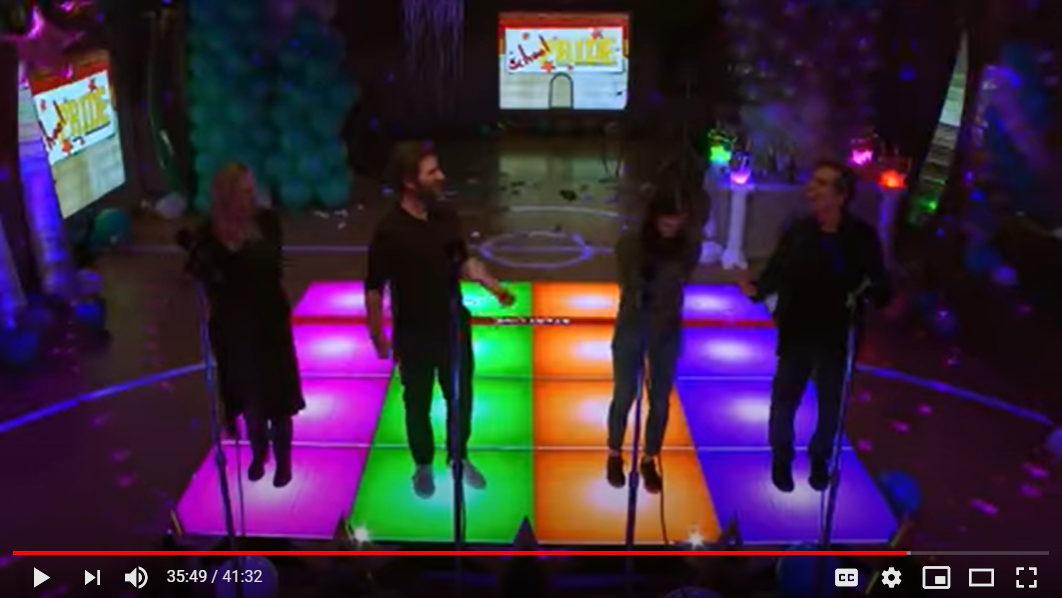
The dance floor was a 4×4 grid, with each player standing in a different colored square in the bottom row. As the dance floor lit up in a sequential pattern of lights, the team realized they were playing a Simon-style game where they had to step forward in a certain order to match the pattern of colored lights displayed on the floor.
There were three rounds of the game. The first (and simplest) required a single step each onto the second row. The second required two steps (meaning eight total moves in order), and third required three steps (meaning a more complicated twelve-step order).
Once they sorted out their timing issues in the first round, they flew through the second and third rounds, solving the puzzle and earning another $15,000.
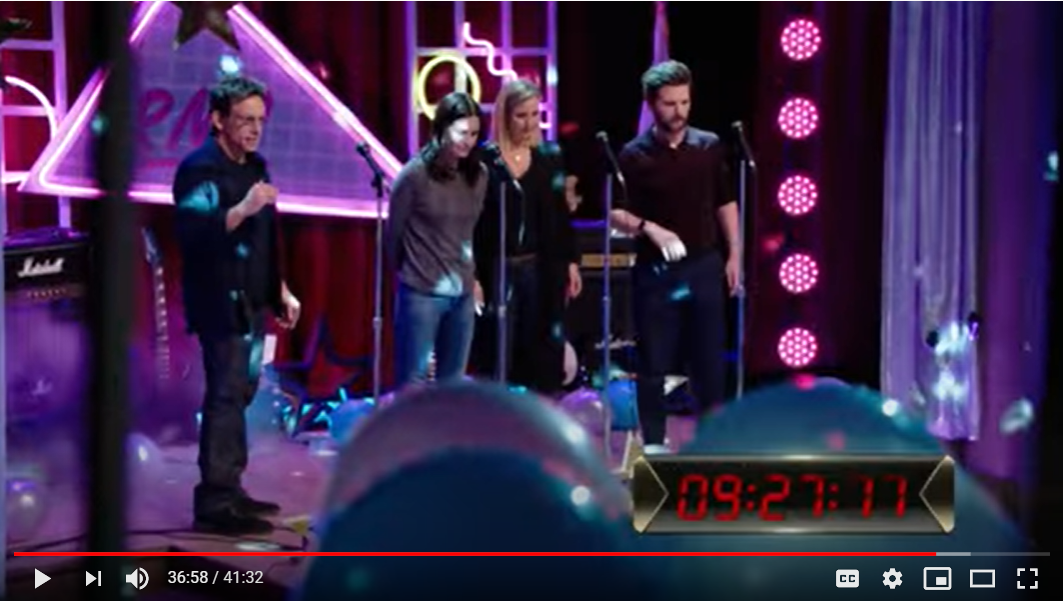
Jack then instructed the group to go onstage and sing their way out of the room as their final challenge. He noted they only had 9 and a half minutes left to escape.
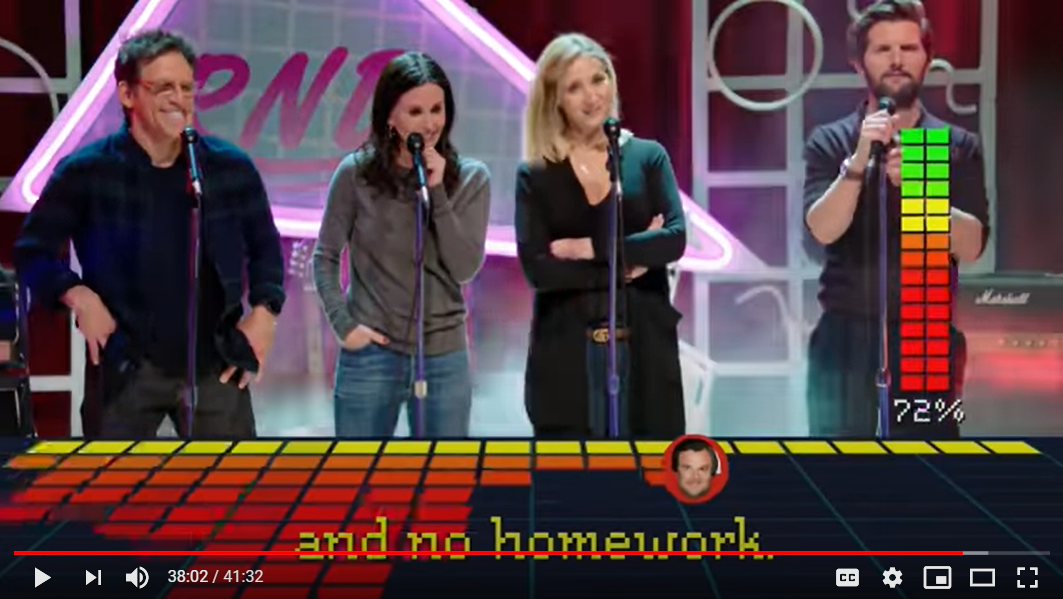
A video wall across the room activated, and Adam and Mike, the two remaining Beastie Boys, wished them luck. When Jack started playing guitar over the intercom, Ben recognized the song as “(You Gotta) Fight For Your Right (to Party),” which they’d have to sing karaoke-style to escape.
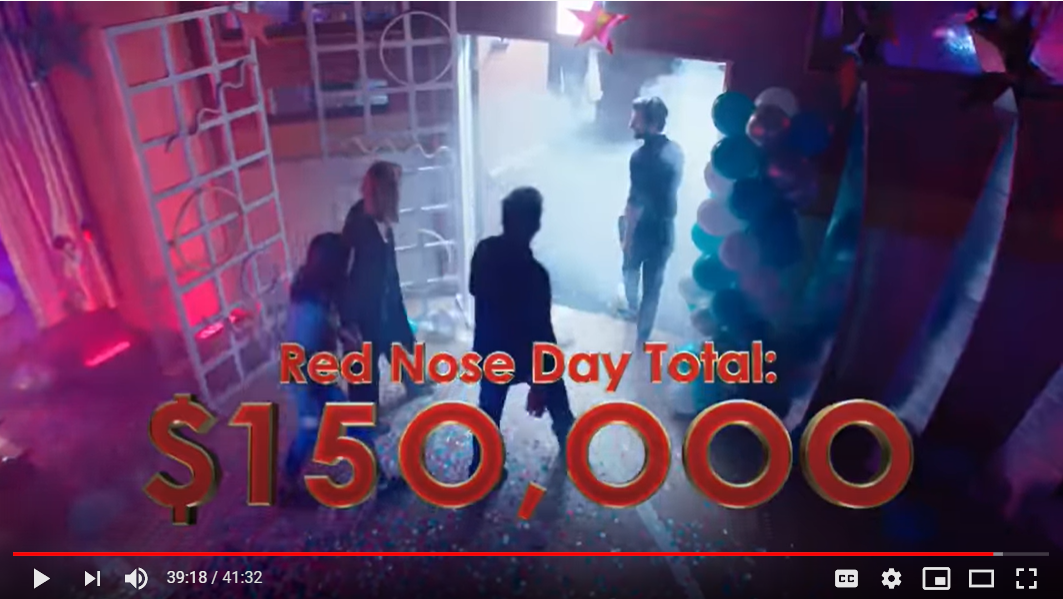
But Lisa didn’t know the song, and she consistently botched the rhythm on each of her turns. Thankfully, that didn’t hinder the group too much, and after being startled one last time (with victory confetti), they escaped the prom with a total $150,000 for charity, and a little over 6 minutes to spare.
Honestly, as a fan of escape rooms, I really enjoyed this. It’s a great — if highly budgeted — example of this puzzle genre, and a strong introduction for anyone who has never tried them.
The puzzles ranged from simple to moderately hard, but for the most part were fairly intuitive. Also, while it’s embarrassing in the moment to try silly things and draw dumb conclusions while trying to solve puzzles, it’s also very entertaining to watch someone else do the same.
All in all, it was a fun event hosted for a great cause, and the four celebrity players (plus gamemaster Jack) made an engaging cast of characters. The little interviews interspersed throughout also added a lot. (Plus, at the end, we found out Courteney loves escape rooms, which explains her mad puzzle skills.)
If you’d like to contribute to the fine charity work Red Nose Day represents, please click here for more details.
Thanks for visiting PuzzleNation Blog today! Be sure to sign up for our newsletter to stay up-to-date on everything PuzzleNation!
Sometimes, when you look at a puzzle, you know immediately what to do and how to solve. In my opinion, a great deal of Sudoku’s success is due to its intuitive nature. You see the grid, the numbers, and you know how to proceed.
Crosswords are similarly straightforward, with numbered clues and grid squares to guide new solvers. (The “across” and “down” directions also help immensely.)
That’s not to say that these puzzles can’t be off-putting to new solvers, despite their intuitive nature. I know plenty of people who are put off by crosswords simply by reputation, while others avoid Sudoku because they’re accustomed to avoiding ANY puzzle that involves numbers, assuming that some math is involved. (I suspect that KenKen, despite its successes, failed to replicate the wild popularity of Sudoku for similar reasons.)
But plenty of other puzzles require some explanation before you can dive in. A Marching Bands or Rows Garden puzzle, for instance, isn’t immediately obvious, even if the puzzle makes plenty of sense once you’ve read the instructions or solved one yourself.
The lion’s share of pen-and-paper puzzles fall into this category. No matter how eye-catching the grid or familiar the solving style, a solver can’t simply leap right into solving.
Thankfully, this won’t deter most solvers, who gleefully accept new challenges as they come, so long as they are fair and make sense after a minute or so of thought. Cryptic crossword-style cluing is a terrific example of this. At first glance, the clues might appear to be gibberish. But within each clue lurks the necessary tools to unlock it and find the answer word.
Brain teasers often function the same way. You’re presented with a problem — a light bulb you can’t see and three possible switches for it, for instance — and you need to figure out a way to solve it. It might involve deduction, wordplay, or some clever outside-the-box thinking, but once you find the answer, it rarely feels unfair or unreasonable.
But, then again, there are also puzzles that can baffle you even once you’ve read the instructions and stared at the layout for a few minutes. Either the rules are complex or the solving style so unfamiliar or alien that the solver simply can’t find a way in.
In short, puzzles as a whole operate on a spectrum that spans from intuitive to non-intuitive.
Want an example of baffling or non-intuitive? You got it.
GAMES Magazine once ran a puzzle entitled “Escape from the Dungeon,” where the solver had to locate a weapon in a D&D-style dungeon. A very small crossword puzzle was found in one room on a paper scroll.
But the solution had nothing to do with solving the crossword.
The actual solution was to take the crossword to a magician who removed letters from the fronts of words. Removing the C-R-O-S left you with a sword, completing the overall puzzle.
That sort of thinking is so outside the box that it might as well be in a different store entirely. Video games, particularly ones from the point-and-click era, have more than their fair share of non-intuitive puzzles like this. You can checkouttheselists for numerous examples.
And as escape rooms grow in popularity, more of them seem to be succumbing to less intuitive puzzling as a result of trying to challenge solvers.
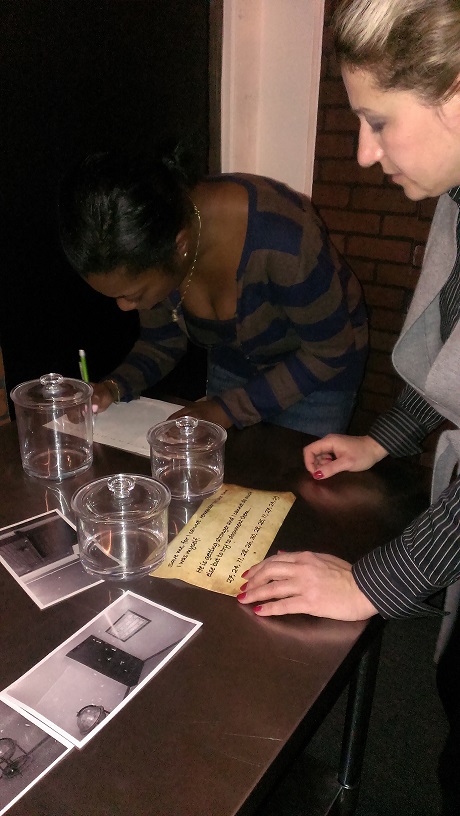
For example, in one escape room I tried, various fellow participants uncovered two stars, a picture of the three blind mice, and four different items that represented the seasons. Amidst all the locks to open, puzzles to unravel, and secrets to find, it never occurred to any of us that these three unconnected numbers would have to be assembled as a combination to a lock. By asking for a hint, we were able to figure out to put them together and open the lock, but it’s not a terribly intuitive puzzle.
Perhaps the greatest challenge for a puzzle constructor — be it a pen-and-paper puzzle, an escape room scenario, or a puzzle hunt dilemma — is not creating a dynamite, unique puzzle, but ensuring that finding the solution is fair, even if it’s difficult or mind-boggling.
This sort of thinking informs not only my work as a puzzlesmith, but the designs for my roleplaying games as well. If my players encounter a gap, there’s some way across. If there’s a locked door, there’s a way through it. Oftentimes, there’s more than one, because my players frequently come up with a solution that eluded me.
In the end, that’s the point. All puzzles, no matter how difficult, exist for one reason: to be solved. To provide that rush, that a-ha moment, that satisfaction that comes with overcoming the clever, devious creation of another sharp mind.
And non-intuitive puzzles are tantamount to rigging the game.
Thanks for visiting PuzzleNation Blog today! Be sure to sign up for our newsletter to stay up-to-date on everything PuzzleNation!
For years now, crowdfunding platforms like Kickstarter and Indiegogo have been hotbeds of innovative puzzle and game design, and I’m always happy to spread the word about worthy projects that I think will delight and intrigue my fellow PuzzleNationers.
So let’s take a look at some projects that are currently seeking funding and see if any pique your interest!
Culturally timely clues and entries are a hallmark of this marvelous variation on Gordon’s long-running Fireball Crosswords brand, and you can rest assured that each Fireball Newsflash Crossword grid will be well-constructed and cleverly clued.
With twenty puzzles sent to you by email — one every two to three weeks — you’ll always have some terrific puzzling to look forward to.
Gordon has a knack for melding flowing grid design with sharp, topical entry words, and much of the time, you’ll not only be impressed by how much material makes it into the grid, but by what major and minor events you’ve missed recently! Gordon’s history of topnotch puzzles is all the incentive you need to contribute.
75% funded with 5 days to go, this project is a yearly favorite of mine, and I always look forward to supporting it.
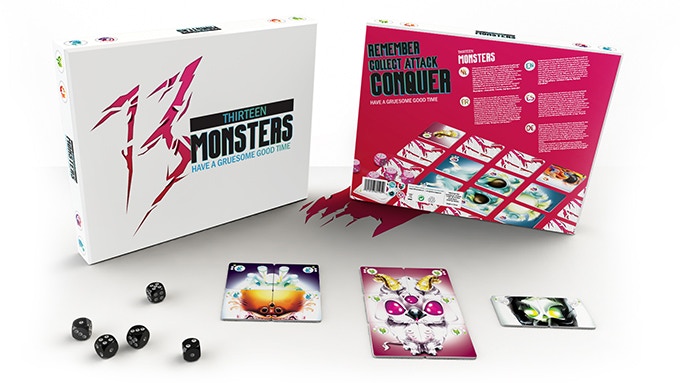
A game that takes the strategy of a monster-building game like Bears vs. Babies or Epic Spell Wars of the Battle Wizards and adds a memory component to the gameplay, 13 Monsters requires luck, skill, and tactics in order to assemble monsters and battle your fellow players for dice-rolling, monster-making supremacy.
Because you can only build your monster by finding matching pieces — which you do by flipping tiles and remembering where matching parts are, like in Memory or Concentration — experienced players and newbies have an equal chance at the game’s outset of making moves that seriously impact the game.
With fun mechanics, delightful art, and a clever premise, 13 Monsters looks like a blast.
77% funded with three days to go, 13 Monsters could easily cross the finish line in time, and if more people watched the incredibly charming How to Play video on the Kickstarter page, I think they’d be funded already.
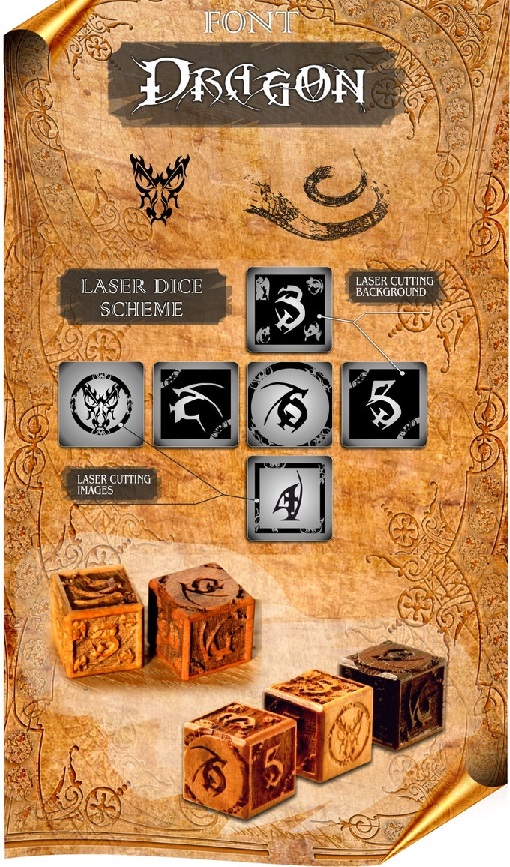
Our third project adds an artistic touch to a classic game tool: dice.
Dragon and Celtic Laser Dice allow you to augment your games — or your game-centric decor — with beautifully designed and intricately realized wooden and metal dice. With laser-cut precision, these dice are eye-catching and could inspire the creation of whole new games just for these dice alone.
Understandably, the project has already reached its funding goals with 24 days to go, but I still think it’s a gorgeous product that will appeal to game fans all over.
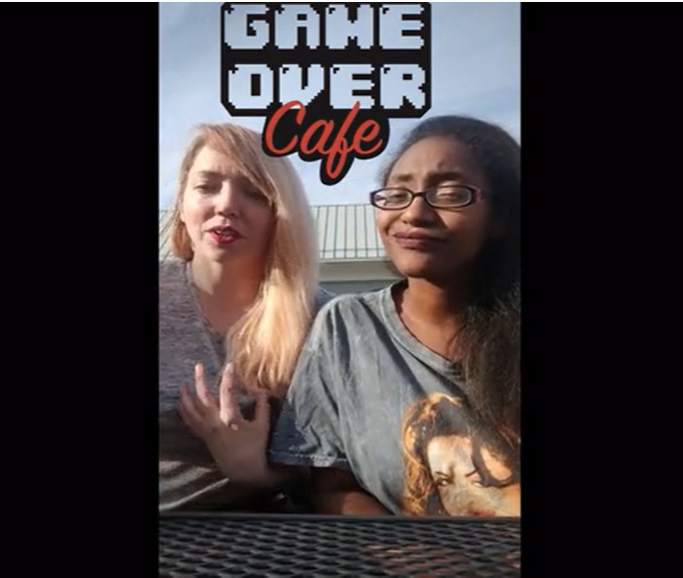
Our fourth and final project today doesn’t focus on game fans all over, instead opting to focus on game fans in one particular area: Chattanooga, Tennessee.
You see, the dynamic duo of Gina and Janay want to open a gamer-friendly coffee shop — The Game Over Cafe — that mixes classic store elements with video game regalia and programming.
Proposing to be a “Gamer-friendly establishment offering quality coffee and beverages, delicious tea, snacks, and sandwiches,” The Game Over Cafe has potential to be a marvelous new business and networking spot for games and gamers.
A quarter of the way to their funding goal with 29 days to go, I think there’s a solid chance this project will find support and fulfill its mission.
Have any of these games or projects hooked you? Let us know which ones you’re supporting in the comments section below! And if there are any campaigns you’re supporting that we missed, let us know!
Thanks for visiting PuzzleNation Blog today! Be sure to sign up for our newsletter to stay up-to-date on everything PuzzleNation!












 PuzzCulture