How Far Away Are Computer-Generated Crosswords?

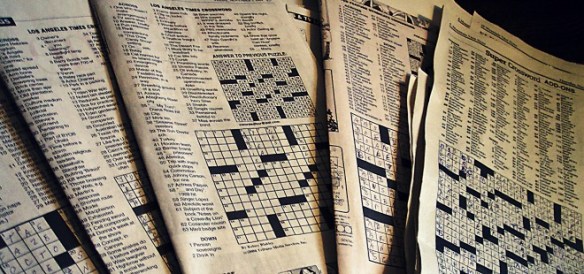
[Image courtesy of ESLTower.]

There’s no denying that computers play a large role in the world of crosswords today.

Some companies use computer programs to generate their unthemed crosswords, no human intervention necessary. Computer programs like Crossword Compiler aid constructors in puzzle design and grid fill, allowing them to build and cultivate databases of words with which to complete their grids.

And, of course, with those little computers in your pocket, you can solve all kinds of crosswords (like those in our Daily POP Crosswords and Penny Dell Crosswords apps).

Heck, computers are even getting pretty good at solving crosswords — just look at Matt Ginsberg’s evolving crossword program, “Dr. Fill.

An article in Smithsonian Magazine posed the question, “why haven’t computers replaced humans in crossword creation?”

The answer, as you’d expect, is simple: computers are just fine at plugging words into established grids and generating basic, unthemed crosswords.

But unthemed is the key word there.

When people think of The Los Angeles Times, The New York Times, The Chronicle of Higher Education, The American Values Club, The Crosswords Club, or any of the other well-respected crossword outlets in the market today, I doubt unthemed puzzles are what comes to mind.

And when it comes to creating themes, innovating, and playing with the conventions of crosswords in order to create puzzles that surprise and challenge solvers, computers simply don’t have the chops.

They might be able to solve puzzles, but as far as I can tell from my research, there’s no program out there capable of generating and executing a theme with any sort of wordplay element involved.

[Image courtesy of Crossword Compiler.]

There is an art to creating an exciting grid, an intriguing theme, or a new puzzle mechanic that solvers have never seen before. The creativity of constructors is truly boundless.

And, it seems, the potential for crossword grids is just as boundless.

Recently, Oliver Roeder of FiveThirtyEight challenged the puzzle fans in his readership to calculate how many different crossword puzzle grids were possible.

He offered the following conditions:

  • They are 15-by-15.
  • They are rotationally symmetric — that is, if you turn the grid upside down it appears exactly the same.
  • All the words — that is, all the horizontal and vertical sequences of white squares — must be at least three letters long. All the letters must appear in an “across” word and a “down” word.
  • The grid must be entirely connected — that is, there can be no “islands” of white squares separated from the rest by black squares.

Now, obviously, all of those rules can be violated for the sake of an interesting theme. We’ve seen grids with vertical symmetry, islands of white squares, and more. Heck, plenty of grids allow words to go beyond the grid itself, or allow multiple words to share puzzle squares.

[“Cutting Edge” by Evan Birnholz. A puzzle where answers extend
beyond the grid. Image courtesy of The Washington Post.]

But assuming these rules are standard, what total did solvers come up with?

None. They couldn’t find a total.

One solver managed to calculate that there were 40,575,832,476 valid 13-by-13 grids following the above conditions, but could not apply the same technique to 15-by-15 grids.

40 billion valid grids. For a comparison, there are 5,472,730,538 unique solutions for a 9×9 Sudoku grid, and I previously calculated it would take 800 years to use every possible 9×9 Sudoku grid.

Of course, that’s 40 billion 13-by-13 grids. The number of possible 15-by-15 grids must be orders of magnitude larger.

Consider this: There were 16,225 puzzles published in The New York Times before Will Shortz took over the NYT crossword. The current number of NYT crosswords in the XWordInfo database is somewhere in the neighborhood of 25,000 puzzles.

And they’re one of the oldest crossword outlets in the world. Even when you factor in the number of newspapers, magazines, subscription services, and independent outlets for crosswords there are these days, or have been in the past, we barely scratch the surface of a number like 40 billion.

Maybe by the time we’ve run through that many, AI constructors will have caught up.


Thanks for visiting PuzzleNation Blog today! Be sure to sign up for our newsletter to stay up-to-date on everything PuzzleNation!

You can also share your pictures with us on Instagram, friend us on Facebook, check us out on TwitterPinterest, and Tumblr, and explore the always-expanding library of PuzzleNation apps and games on our website!

How Tweet It Is!

Crosswords occupy a curious niche in popular culture.

They’re a part of everyday life, appearing in newspapers, apps, puzzle books, mysteries, and more. That simple patterning of black and white squares, no matter where it appears, brings them to mind.

And yet, despite their ubiquity, they’re not always viewed as something for the everyman. Some consider them off-putting or intimidating, steeped in obscure cluing and peculiar verbiage intended to keep casual solvers out.

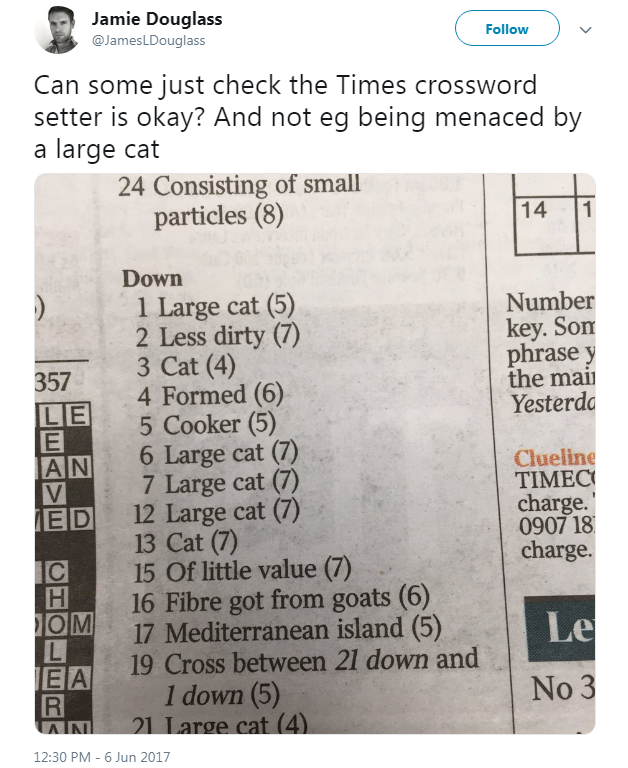
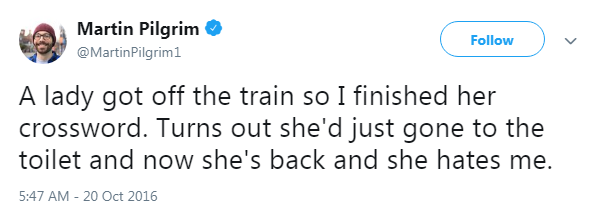
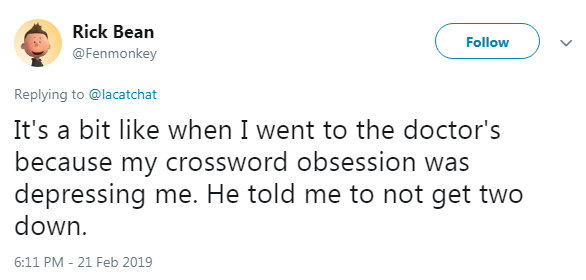
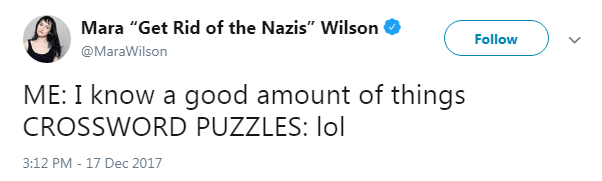
That mix of familiarity and unfamiliarity makes crosswords the perfect fodder for comedians. The crew at HuffPost proved this by compiling a list of humorous tweets focusing on crosswords.

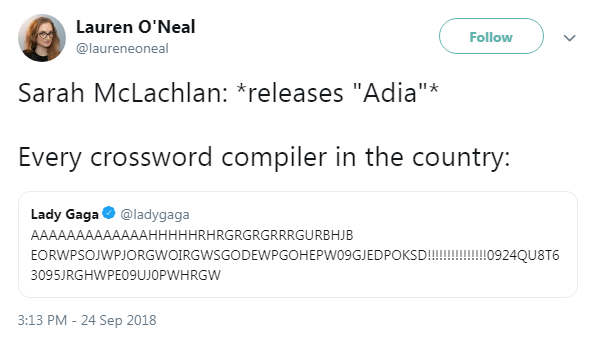
Some of them referenced the odd letter combinations you encounter in grids…

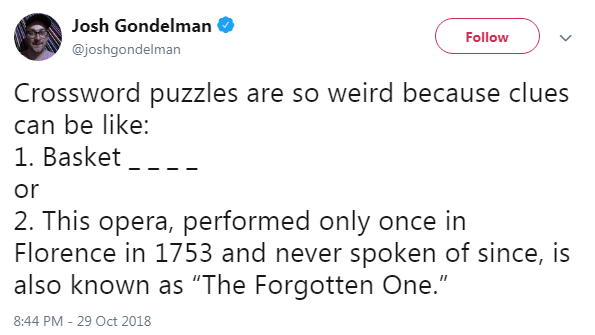
Or the difficulty some clues offer…

Or just the general difficulty of the puzzle…

But other tweets had fun with specific puzzles…

Or with the act of solving itself…

And, given how often wordplay finds its way into crosswords, it’s only appropriate to close out with a pun…

(That last one wasn’t in the HuffPost article. There’s plenty more puzzle humor out there, I just happened to stumbled across it yesterday before writing this post.)

Have you encountered any funny crossword-themed tweets recently? Let us know in the comments section below! (And be sure to follow us on Twitter, where we share little gems like these whenever we can.)


Thanks for visiting PuzzleNation Blog today! Be sure to sign up for our newsletter to stay up-to-date on everything PuzzleNation!

You can also share your pictures with us on Instagram, friend us on Facebook, check us out on TwitterPinterest, and Tumblr, and explore the always-expanding library of PuzzleNation apps and games on our website!

Puzzles… in… Space!

When you’re a puzzle enthusiast, you never know where your interest might take you, or what interesting and unexpected people you’ll encounter along the way. All sorts of folks enjoy puzzles, after all.

If you enjoy puzzles with trivia, you could bump into Who Wants to Be a Millionaire? winners or Jeopardy! champions like Ken Jennings. The New York Times has introduced us to several famous crossword enthusiasts. The British government is publishing puzzle books. Heck, actors Joel McHale and Neil Patrick Harris both included puzzles in their autobiographies!

Even astronauts are getting into the puzzly spirit!

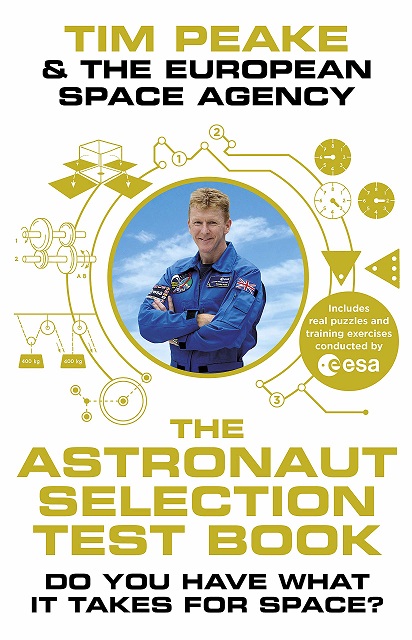
Astronaut Tim Peake spent half a year in one of the most fascinating places in the solar system: the International Space Station. He was the first British astronaut to serve under the banner of the European Space Agency, and the first British astronaut to perform a spacewalk.

Upon returning to Earth, he turned his attention to more literary efforts, penning three books about space. The third, published last year in partnership with the European Space Agency, takes readers behind the scenes of the ESA screening process for astronauts.

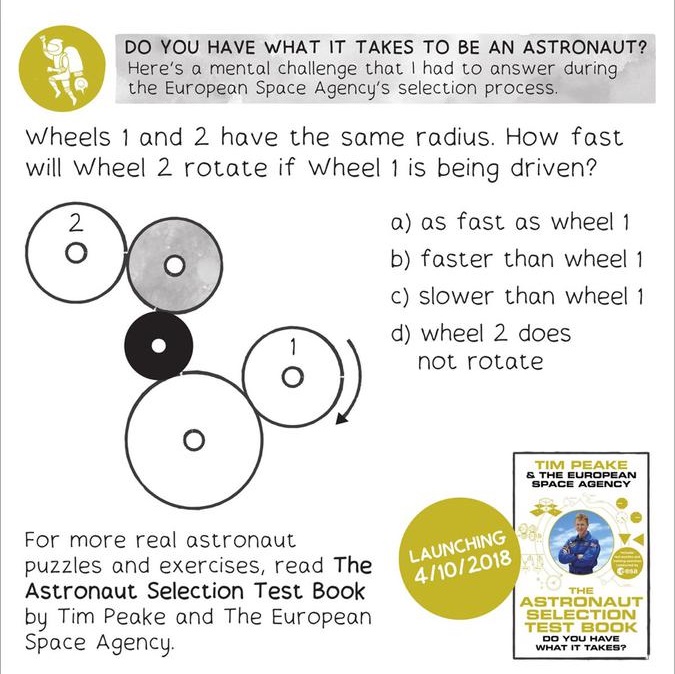
Yes, puzzles are part of the screening process for the ESA.

Would you like to try your hand at solving some of them?

How did you do? Let us know in the comments section below! We’d love to hear from you

And if you’d like, you can find more of these puzzles in Peake’s delightful book The Astronaut Selection Test Book: Do You Have What it Takes for Space?

Do you have what it takes? I suspect that you do, fellow puzzler.


Thanks for visiting PuzzleNation Blog today! Be sure to sign up for our newsletter to stay up-to-date on everything PuzzleNation!

You can also share your pictures with us on Instagram, friend us on Facebook, check us out on TwitterPinterest, and Tumblr, and explore the always-expanding library of PuzzleNation apps and games on our website!
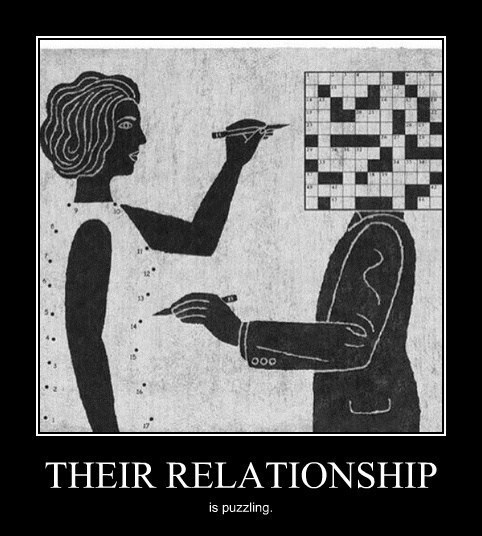
Science Says Board Games Are Good For Your Relationship?

[Image courtesy of Medium.com.]

One of the hallmarks of a healthy relationship is enjoying the same activities. If you’re spending time together doing something you both find engaging, then you’re golden.

But, as it turns out, there are some activities that offer greater benefits than others.

According to a recent study published by Baylor University, couples who play board games together are actually strengthening their relationships chemically.

[Incidentally, there is a hilarious world of photos dedicated to couples with chess boards out there. Here are just some of my favorites.]

From the article on Baylor.edu:

For the study, Melton and Maria Boccia, Ph.D., professor of child and family studies, recruited 20 couples ranging in age from 25 to 40. Couples were randomly assigned to participate in one of two couple dates — game night or couple art class — for one hour.

One group played board games in a familiar home-like setting. Couples were alone. These couples chose familiar games that would not require them to read instructions.

The study was designed to examine any increase in levels of oxytocin in the couples’ hormone levels. Oxytocin, often referred to as the hugging hormone, plays a role in building social connections.

[Image courtesy of Daily Mail.]

Here’s the breakdown on oxytocin release increases:

  • men in the art class
  • women playing board games
  • women in the art class
  • men playing board games

Curiously, while there wasn’t a significant difference between the latter three categories, men in the art class released 2 to 2.5 times more oxytocin than the other groups.

There were measurable increases in the oxytocin levels for both men and women playing board games, lending credence to the idea that playing together is good for your relationship.

Some of the games used in the study: cards, checkers, chess, dominoes, and Monopoly. Given some of my unpleasant experiences playing Monopoly, I’m surprised that one didn’t throw off the curve somewhat.

[Image courtesy of Grey Mass Games.]

It does make me wonder, though, if some games would provoke greater oxytocin releases than others.

Would cooperative games like Pandemic, Forbidden Island, or Castle Panic! lead to increases, or is the type of game irrelevant? Are more stressful games, like those with timers or ones where quick reaction time is integral to winning, less likely to build those chemical connections?

Sounds like a field ripe for further study. Of course, I’m a little biased. I’ll take any excuse to play more games. =)


Thanks for visiting PuzzleNation Blog today! Be sure to sign up for our newsletter to stay up-to-date on everything PuzzleNation!

You can also share your pictures with us on Instagram, friend us on Facebook, check us out on TwitterPinterest, and Tumblr, and explore the always-expanding library of PuzzleNation apps and games on our website!
Valentine’s Day Puzzle Fun!

It’s Valentine’s Day.

I know, I know, you’ve been bombarded with Valentine’s-themed content for days or weeks now.

I get that. Sure, I could spend today’s post talking about examples of puzzly romance like romantic cryptic crossword clues. I could regale you with tales of marriage proposals cloaked in puzzly trappings. I could offer up some last-minute gift ideas. I could discuss romantic puzzle moments from television.

But maybe you want a break. Maybe… you just want to read about puzzles.

And whether you’re single or in a relationship, a fan of today or a detractor of Valentine’s Day trapping, there’s one thing we can all agree on.

We love a good puzzle.

So I cooked one up for you.

Of course, I couldn’t ignore the holiday, so with Valentine’s Day in mind, it seemed appropriate to whip up a Partners puzzle for you to solve. Enjoy!

Can you unscramble and match these pairs from film, television, and literature?

Why nineteen? Well, it’s 2019, and I couldn’t resist flouting the convention of nice round numbers by not coming up with a 20th entry. Heck, maybe I’ll make this a thing, avoid round numbers for a while longer, do a top 12 instead of a top 10. Just to keep this gag going.

Oh, and I couldn’t include some of my favorite couples for logistical reasons (too many 3-letter anagrams would be blah) or obscurity, so shout-out to Han & Leia, Gemma & Leopold (FitzSimmons!), Vastra & Jenny, and of course, both Jim & Pam and Tim & Dawn from The Office.

Anyway, enjoy putting your anagram and matching skills to work! Let us know how you did in the comments below!


Thanks for visiting PuzzleNation Blog today! Be sure to sign up for our newsletter to stay up-to-date on everything PuzzleNation!

You can also share your pictures with us on Instagram, friend us on Facebook, check us out on TwitterPinterest, and Tumblr, and explore the always-expanding library of PuzzleNation apps and games on our website!
PuzzleNation Product Review: Time Breaker

[Note: I received a free copy of this game in exchange for a fair, unbiased review. Due diligence, full disclosure, and all that. Yada yada disclaimer.]

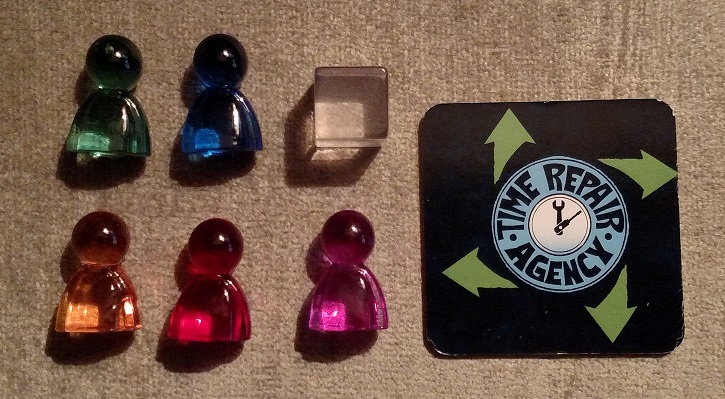
Criminals are bad enough as it is, but time criminals… they’re the worst. Not only can they screw up the present, but they can screw up the past AND the future as well. As a member of the Time Repair Agency, it’s your job to travel through time to apprehend these miscreants — these time breakers — and set things right.

But be careful. You’re not the only TRA agent on the hunt, and every criminal captured is a feather in that agent’s cap, so don’t be surprised if other TRA agents try to interfere with your efforts.

Whether you’re searching the dawn of time or the year 3000, the life of a TRA agent isn’t easy.

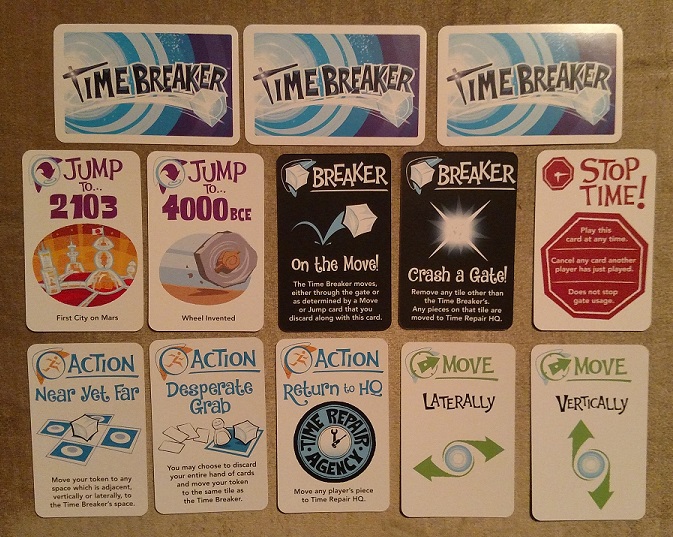
[The intrepid agents of the Time Repair Agency and the dastardly Time Breaker.]

That’s the concept behind Time Breaker, the newest card game from the inventive crew at Looney Labs, and honestly, I think it’s their best game yet.

Time Breaker not only improves upon some of the ideas behind Chrononauts, but incorporates strong elements from the Fluxx games in order to add more choice and more excitement to the game play.

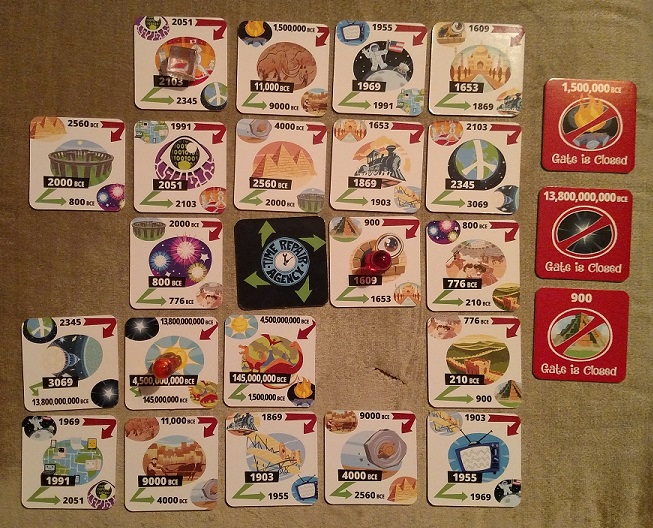
The game board consists of 25 tiles arranged randomly in a 5×5 grid pattern. 24 of these tiles represent specific moments in time. The 25th is the Time Repair Agency, and it’s always the center tile. It’s your job to navigate the board, capture the Time Breaker, and return to the Time Repair Agency with your quarry.

You do so by playing various cards that dictate your movements. (Players experienced with Fluxx will recognize the idea of Action cards, as well as some of the actions you can perform.)

There are move cards that allow you to move from tile to tile, regardless of where those moments are in time. There are jump cards that allow you to move to a specific tile. And there are action cards that allow you to perform different tasks, including playing extra cards from your hand, or traveling backwards in time. There are also Stop Time cards, which cancel other players’ actions, and Breaker cards that alter the game board or affect how the criminal moves.

Since the game is a race to see who reaches the Time Breaker first, it’s clever to allow the players multiple ways to navigate the board. You can move your piece across tiles (like any normal board game), you can jump to certain times with the cards, and you can navigate time itself by moving either backward or forward in time.

You see, since each tile is a moment in time, there are two arrows on the tile — one going forward, one going back. Those arrows can help you jump around the board. For instance, if you’re on the tile 13,800,000,000 BCE (the start of the universe), following the green arrow forward takes you to 4,500,000,000 BCE (the formation of the sun), which due to the random nature of the game board’s layout, could be anywhere, not just the next tile over.

Or you could follow the red arrow backward in time, if you have the proper card for it. (Since we’re talking about the first card in our timeline, it turns out time is cyclical, and going backward takes you to the future, the year 3069 (the colonization of Alpha Centauri).

Time Breakers manages to pack a lot of strategy and choice into a small package, ensuring that the game has major replay value. That’s no surprise, of course, since replayability is a hallmark of the Looney Labs brand.

But by combining a playing space that’s different every time (similar to Fluxx: The Board Game or Forbidden Island), the randomness of the cards you draw, and the ability to manipulate the board by closing access to certain time tiles, you have a dynamic game that always feels fresh.

All those elements could make for an uneven playing experience, but the cards are perfectly balanced, meaning no matter what cards you draw, you’re going to have a fair shot of winning the game. Luck is always a factor, but strong strategy and an ability to adapt on the fly will take you far.

And Andrew Looney makes juggling all of these elements look easy.

Complimented by a jovial art style, rich in bright colors and whimsy — not to mention a prediction of world peace only a few centuries away! — Time Breaker continues the innovative, enjoyable tradition long established by games like Fluxx, Just Desserts, and Get the MacGuffin. This game is great fun.

Time Breaker is available from Looney Labs and participating retailers on February 28, but you can preorder it by clicking here!


Thanks for visiting PuzzleNation Blog today! Be sure to sign up for our newsletter to stay up-to-date on everything PuzzleNation!

You can also share your pictures with us on Instagram, friend us on Facebook, check us out on TwitterPinterest, and Tumblr, and explore the always-expanding library of PuzzleNation apps and games on our website!