It’s Follow-Up Friday: Passover Puzzling edition!

Welcome to Follow-Up Friday!

By this time, you know the drill. Follow-Up Friday is a chance for us to revisit the subjects of previous posts and bring the PuzzleNation audience up to speed on all things puzzly.

And in today’s post, I’m returning to the subject of Rube Goldberg machines.

[Click here or on the image for a larger version.]

For the uninitiated, a Rube Goldberg machine is an intentionally overcomplicated device that uses multiple steps to accomplish a simple task. It’s an exercise in creative inefficiency, and a delightful one at that.

But some Rube Goldberg machines are designed to give those odd intermediate steps greater meaning, so that instead of an elaborate series of domino-style mechanical events leading to one minor accomplishment, several things are accomplished along the way.

And every once in a while, a Rube Goldberg machine tells a story, using those intermediate steps to depict meaningful events along the way. It’s a colorful and inventive way to teach, one that definitely grabs your attention.

The Jewish festival of Passover begins tonight, and I recently stumbled across a Rube Goldberg device that presents the story of Passover, including the liberation from slavery in Egypt, the plagues, and Moses leading the Exodus.

Enjoy:

You know, if other important historical events were told in Rube Goldberg fashion, I think history classes would be far more popular. Just saying.


Thanks for visiting PuzzleNation Blog today! Be sure to sign up for our newsletter to stay up-to-date on everything PuzzleNation!

You can also share your pictures with us on Instagram, friend us on Facebook, check us out on TwitterPinterest, and Tumblr, and explore the always-expanding library of PuzzleNation apps and games on our website!

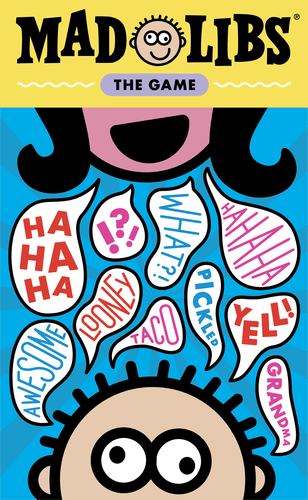
PuzzleNation Product Review: Mad Libs: The Game!

mad-libs_uawibn

[Note: I received a free copy of this game in exchange for a fair, unbiased review. Due diligence, full disclosure, and all that.]

There are a lot of puzzly games where wordplay is key. In Scrabble, Bananagrams, or Words with Friends, it’s all about forming words and fitting them into grids. In Taboo, it’s all about communicating without using certain words. In Balderdash, it’s all about crafting the perfect definition, either to mislead other players or to demonstrate your mastery of language and vocabulary.

Mad Libs: The Game follows in that grand tradition of wordplay, but instead of forming words, avoiding them, or defining them, this game is about using them to their utmost in order to entertain your fellow players.

madlibs2

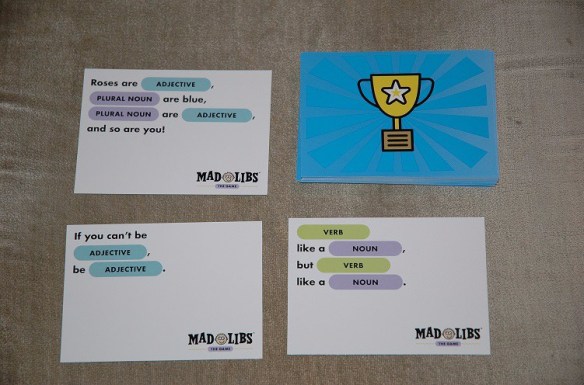
Each player starts with 7 Word cards. Each card depicts a word in noun, verb, adjective, or adverb form (or multiple forms, for adaptable words), and these cards are the ingredients for cooking up funny, weird, entertaining sentences in the game.

But what do you do with those cards? Easy! Just like the original fill-in-the-blank stories, you’re going to use those cards to conjure up the best ways to fill the blanks in our Sentence cards.

So each round begins with a new Sentence card and the players choosing Word cards from their hand in order to come up with the most entertaining words to fill in the blanks for this round’s Sentence card. Then everyone reads their completed sentence aloud, and a vote is held where players point to the player with the best completed sentence. That player then wins a point.

The first player to earn three points wins.

madlibs1.jpg

Now, this style of gameplay won’t seem revolutionary to anyone who has played with magnetic poetry or indulged in the much-raunchier Cards Against Humanity or one of the many other games in that vein.

But whereas those games tend to traffic in shock value for their humor, Mad Libs: The Game is all about silliness. This is a game that encourages that same level of creativity, wordplay, and surprise, but in a way that’s appropriate for family gameplay. For example, unlike the very adult themes found in CAH, the harshest words in this game are more along the lines of “pierce” or “heartless,” nothing that would raise a parent’s eyebrow.

madlibs3

[Example of a completed sentence:
Puppies may make the world go ’round,
but it’s flower girls that pay the bills.”]

This is a terrific gateway game for younger puzzlers to get them to not only think about words, but to explore how to use them effectively. It combines humor, storytelling, silliness, and craft to make a good, clean, and most importantly, fun time.

Looney Labs is usually the home of gleefully chaotic games like Fluxx and Loonacy, but they always manage to couch their products in family replayability, and Mad Libs: The Game is no exception.

You can pick up Mad Libs: The Game here, and to check out all of our reviews of Looney Labs games and products, click here!


Thanks for visiting PuzzleNation Blog today! Be sure to sign up for our newsletter to stay up-to-date on everything PuzzleNation!

You can also share your pictures with us on Instagram, friend us on Facebook, check us out on TwitterPinterest, and Tumblr, and explore the always-expanding library of PuzzleNation apps and games on our website!

The end of Sudoku?

I recently read in Owen O’Shea’s book The Call of the Primes that there are 5,472,730,538 unique solutions for a 9×9 Sudoku grid.

Yes, five billion is a very big number, but these days, billions aren’t what they used to be. I mean, think about how many newspapers, magazines, and puzzle books feature Sudoku puzzles. It’s a huge amount of material every year.

So, the thought occurs to me…how long before those 5,472,730,538 unique solutions run out?

To be fair, it’s not like reaching Peak Oil or a point of no return. I’ve solved a lot of Sudoku puzzles, and never once have I felt like I was re-solving a grid I’ve seen before, even if I was. This is purely a matter of mathematical curiosity. How long would it take for us to use up every last possible 9×9 grid?

Man, where do I begin?

Well, if I’m going to talk Sudoku puzzles, it makes sense to start with our friends at Penny Dell Puzzles.

Across seventeen Sudoku titles, they publish approximately 23,236 Sudoku puzzles a year, and probably an additional 350 per year across their Crossword/Variety and Variety titles for a total of 23,586 puzzles in a calendar year.

Now, Penny Dell Puzzles is the top puzzle publisher in North America — #humblebrag — and let’s assume there are another half-dozen publishers worldwide matching their output. That gives us a ballpark of 165,100 Sudoku puzzles published worldwide.

But what about newspapers?

According to the Newspaper Association of America, there were 1,331 daily newspapers in 2014, and there were 1,450 daily newspapers in 2005, making an 8.2% decrease from a decade before. If we apply that percentage to the number of daily newspapers worldwide as of 2005, 6,580 titles, we get 6,040 daily newspapers worldwide. And although they may not ALL have a daily Sudoku, this will help cover some of the major magazines that also carry Sudoku that I’ve excluded from my ballpark calculations.

That gives us 6,040 newspapers x 365 puzzles a year for a total of 2,204,600 puzzles a year.

Now, for other publishing efforts regarding Sudoku, Amazon.com lists 20,718 results for Sudoku, and if we apply an average of 217 puzzles per title — which seems a fair approximation, based on the stats published by our friends at Penny Dell Puzzles, the fact that some books will have more puzzles, and some results will be ABOUT Sudoku and probably contain few to none actual puzzles — that’s 4,495,806 puzzles available right now in the world’s biggest bookstore. (Yes, obviously not all of them were published this year, but hey, this is meatball mathematics.)

Unfortunately, statistics on Sudoku are sketchy at best for the mobile app market, online puzzling, and downloadable puzzles through Playstation Network, Wii, and other gaming platforms, so I can’t factor those puzzles into my calculations.

But just with the numbers I’ve got here, we’re talking about 6,865,506 Sudoku puzzles worldwide. So, if each of those Sudoku puzzles is unique — which is possible, if unlikely — that barely makes a dent in our total of possible Sudoku grid layouts, which you recall is 5,472,730,538.

So, if we’re producing 6,865,506 unique Sudoku puzzles a year, it’ll take nearly 800 years to use every possible 9×9 grid! (For the folks at Penny Dell Puzzles, it would take nearly 232,033 years! So they’re in the clear. *laughs*)

I guess we won’t be running out anytime soon.


Thanks for visiting PuzzleNation Blog today! Be sure to sign up for our newsletter to stay up-to-date on everything PuzzleNation!

You can also share your pictures with us on Instagram, friend us on Facebook, check us out on TwitterPinterest, and Tumblr, and explore the always-expanding library of PuzzleNation apps and games on our website!

It’s Follow-Up Friday: Hashtag Hilarity edition!

Welcome to Follow-Up Friday!

By this time, you know the drill. Follow-Up Friday is a chance for us to revisit the subjects of previous posts and bring the PuzzleNation audience up to speed on all things puzzly.

And today, I’m posting the results of our #PennyDellPuzzleComedy hashtag game!

You may be familiar with the board game Schmovie, hashtag games on Twitter, or@midnight’s Hashtag Wars segment on Comedy Central.

For the last few months, we’ve been collaborating on puzzle-themed hashtag games with our pals at Penny Dell Puzzles, and this month’s hook was #PennyDellPuzzleComedy, mashing up Penny Dell puzzles and anything and everything having to do with stand-up comics, film and television comedians, funny movies, funny shows, funny plays… even one-liners or jokes!

Examples include: David Letterboxesman, The Three Anagr-amigos, or “Take a Letter, Please!”

So, without further ado, check out what the puzzlers at PuzzleNation and Penny Dell Puzzles came up with!


Puzzle Comedians!

Rodney Danger-Textfields

George Carlinkwords

“Weird Al”-phagrid Yankovic

Dr. Dementossing and Turning

Fill-In Diller / Phyll-Ins Diller

Kenken Jeong

David Cross Pairs

Lewis Blackout!

Andrew Dice Game

Cryptomedian Adam Scrambler

Rows-anne Garden

Alphabet Soupy Sales

Dan Ayk-wordplay

Gilda-Quote Radner

Rose-anagrams Rose-anagrams Dannagrams


Puzzle Comedy Films!

History of the World, Part One and Only

Happy Fill-in More!

Meet the Frameworks

You Don’t Maze with the Zohan

Austin Flower Powers

April Sillycrostics!

Four Square Weddings and a Funeral

Three from Nine to Five

Roxanne-agrams

Across and Down and Out in Beverly Hills

Alphabet Duck Soup

Animal Crackers House


Puzzle Comedy TV Shows!

A Bits and Pieces of Fry and Laurie

Two for One and a Half Men

Rowan and Martin’s Fill-In

Three of a Kind’s Company

“I Love Loosey Tiles!”

Saturday Night Line ‘Em Up

Sanford and Sunrays

All in the Family Ties

Happy Daisy

Leave It to Weaver Words

The Odds and Evens Couple

[Plus there were a few Seinfeld references in puzzly form:]

“By the way, they’re real, and they’re Sudoku Spectacular!”

“The Bubbles Boy”


Puzzle Jokes and Routines!

“Who’s on first and last?” / “Who’s Calling on first! What’s Left on second!”

Knock, Knock! Who’s Calling?

Why did the chicken cross the Middle of the Road? To get to the other Slide-o-gram!

“Nehh…What’s Left, Doc?”

How do you send a message to a skeleton? By Crypt-O-Gram!

What do you get when you insult a puzzle editor’s work? Cross words!

Have you heard about the most amazing Framework ever constructed? It was a Revelation!

Knock-knock.
Who’s there?
Guess
Guess Who?
Hey, that’s my favorite puzzle!

Knock-knock
Who’s there?
Lotto
Lotto who?
I bet there’s a lotto people entering this hashtag game!

Knock-knock
Who’s there?
The Wizard
The Wizard who?
The Wizard is wise and humorous. Didn’t you read the blurb?

Knock-knock
Who’s there?
Zip It
Zip It who?
Zip it, you! I’ve had enough of your knock-knock jokes


And the PuzzleNation audience got involved as well! @_screenhog tweeted the excellent entries Funny or Diagramless and Patchwords Adams!

Have you come up with any Penny Dell Puzzle Comedy entries of your own? Let us know! We’d love to see them!

Thanks for visiting PuzzleNation Blog today! Be sure to sign up for our newsletter to stay up-to-date on everything PuzzleNation!

You can also share your pictures with us on Instagram, friend us on Facebook, check us out on TwitterPinterest, and Tumblr, and explore the always-expanding library of PuzzleNation apps and games on our website!

Delving into the ACPT puzzles!

One of the highlights of the puzzle year is the American Crossword Puzzle Tournament, and the impressive, challenging, and well-constructed puzzles awaiting solvers there rank among the craftiest you’ll ever see.

So let’s put them under the microscope and see how I did!


Puzzle 1: For Cooler Heads by Kristian House

The opening puzzle was an excellent introduction to tournament solving, well-constructed but not too challenging. The grid featured two shaded 2×2 blocks within the fill (containing the word CELL), as well as three themed entries and a revealer for those shaded squares (CELL BLOCKS). The theme entries themselves were jail-themed phrases punnily clued, and they were very accessible.

Interesting grid entries included SCOPE OUT, BILOXI, GAUSS, and my favorite clues were “Something done by a prisoner” for TIME, “Spade doing a lot of digging” for SAM, and “Place to find a spare tire?” for ABDOMEN. This was a very solid Puzzle 1.

Puzzle 2: “T” TIME by Patrick Blindauer

Patrick is a top name in puzzles, and he set himself quite a constructing challenge with Puzzle 2. Not only did every clue start with the letter T, but every entry, both across and down, included a T. Very impressive.

If you read my recap of the tournament, you’ll recognize this as the puzzle with the diabolical crossing of CONTE and CORTANA that flummoxed so many competitors, but honestly, I found the entire upper-right corner to be tough. Much tougher than the rest of the puzzle, comparatively. Otherwise it was a very accessible grid, but one that asked a bit more from solvers than Puzzle 1.

Interesting grid entries included SPIN ART, SANTANA, and CORONET, and my favorite clues were “‘That’s all folks,’ for Mel Blanc” for EPITAPH and “Trojan material” for LATEX.

Puzzle 3: Series Cancellations by Mike Shenk

This time around, each of the theme entries was a television show with one letter missing. For instance, “TV series about a driver rear-ending another motorist” clued BRAKING BAD. Together, the missing letters from each entry spelled the word CENSOR reading down in the lower-right corner. This was very clever construction, and the puzzle offered some fun wordplay with the “new” shows as clued.

But there was something else lurking in the grid. The lower-right corner featured a pretty diabolical crossing that could’ve misled solvers. The correct entries were ROMANI crossing CRIER at the I, but a solver could easily fill in those entries as ROMANY crossing CRYER. Pretty sneaky.

Interesting grid entries included BOSWELL, NO MAYO, and A TO Z (as well as the way-too-hard for this puzzle AZUSA), and my favorite clues from the puzzle were “River past Memphis” for NILE, “Sch. for fathers-to-be” for SEM, “Focus on the road” for CAR, and quite appropriately for the tournament, “Didn’t get the 150-point solving bonus, say” for ERRED.

Puzzle 4: Symbology by Zhouqin Burnikel

This was the toughest puzzle thus far, as some of the entries were simply clued with a symbol like “/” or “[ ]” and you had to come up with the theme answer that fit the symbol or symbols. For instance, CUT SHARPLY (slash) and TAX LEVELS (brackets) were the answers to the above clues. Very crafty.

Given the challenge level, this felt like a good warm up for the infamous Puzzle 5, which was looming next.

Interesting grid entries included C’EST LA VIE and NO FEAR ACT, and my favorite clues were “Set in stone, say” for ETCH, “Fails to finish a sentence?” for ESCAPES, and “Pound note?” for ARF.

Puzzle 5: Changing Lanes by Patrick Berry

There are two sounds I’ll always associate with the tournament. The first is the whoosh of everyone turning over their puzzles and beginning at the same time. The second is the groan that accompanies the timer running out during Puzzle 5.

Puzzle 5 is always a beast, and this year’s puzzle did not disappoint. (Well, it probably disappointed a few people, but not with the craftsmanship of the puzzle itself.)

I admit, this one melted my brain. I got that some of the entries would shift from reading down to reading across and back again (in a zigzag pattern), but it took me a long while to realize that those “lane changing” entries would share those unclued lines reading across, but in the other direction. Had I been competing in the tournament, there’s no way I would have completed this one within the 30-minute tournament deadline. Brutal.

Interesting grid entries included CAR TALK, BOB VILA, TOLTEC, and LION CUB, and my favorite clues were “Drawing room?” for ART STUDIO and “Block lettering?” for LEGO.

Puzzle 6: I’ll Be There by Joel Fagliano

Rounding out Saturday’s competition was a nice mental palate cleanser after the diabolical Puzzle 5. In Joel Fagliano’s contribution to the tournament, the letter “I” added to standard phrases to make them comparative (like “Quaker State” becoming QUAKIER STATE comparing California to Nebraska). It’s a neat hook, one easily gettable for solvers already rundown by Puzzle 5.

Interesting grid entries included BBQ PIT, I RAISE, FOOD COMA, and RAZZIE, and my favorite clue was easily “Girl who’s coming back with something valuable?” for TESSA (asset backwards).

Puzzle 7: Page-Turners by Lynn Lempel

Sunday started off strong with this well-read entry by Lynn Lempel. As indicated by the title, the themed entries were novels with the last word in the title anagrammed. For instance, “Lord of the Flies” becomes LORD OF THE FILES and “Tender is the Night” becomes TENDER IS THE THING.

A solid closer with lots of accessible crosswordese, this puzzle was perfect for easing solvers out of tournament mode right before the big championship showdown.

Interesting grid entries included ALVIN AILEY, GANGSTA, ACOLYTE, and STEPS ON IT, and my favorite clues were “Soprano not known for music” for CARMELA and “Manhattan spot” for BAR.

Puzzle 8: The Low-Down (And Across) by Mark Diehl

And then, we were down to one. The final puzzle of the tournament offered three sets of clue difficulties (A for the top performers, B for the solid performers, C for everyone else). And there were a lot of longer entries crossing in this grid, so there were fewer giveaway words to get you started.

I found the solve to be pretty challenging, and I’m constantly amazed at how fast the finalists solve these puzzles. (For context, tournament winner Howard Barkin solved it in 8 minutes, using the A clues.)

I solved it with the B clues, and still with some difficulty. Interesting grid entries included PARLANCE, TOOK A HINT, and RARIN’ TO GO, and my favorite clue was easily “They have wings but never leave the ground” for SNOW ANGELS.


Overall, I was impressed with the quality and ingenuity of puzzles we saw in the tournament, and as always, it reminded me of just how quick, how cunning, and how clever many of the tournament solvers are. These puzzles were a real treat.

Thanks for visiting PuzzleNation Blog today! Be sure to sign up for our newsletter to stay up-to-date on everything PuzzleNation!

You can also share your pictures with us on Instagram, friend us on Facebook, check us out on TwitterPinterest, and Tumblr, and explore the always-expanding library of PuzzleNation apps and games on our website!

At least there’s no giant boulder chasing you…

[Is this the way out or a costly dead end?]

We’ve tackled all sorts of brain teasers in the past. From the Brooklyn Nine-Nine desert island seesaw to several hat puzzles, from Cheryl’s birthday logic puzzle to a diabolical light switch puzzle, we have conquered all challengers thus far!

But never before have we confronted a puzzle with as much backstory as today’s contender. Ladies and gentlemen and PuzzleNationers of all sorts, today we battle the Temple Tunnel puzzle.

Imagine that you’re a professor leading a group of eight grad students on an expedition into a booby-trap-filled temple.

[No, not THAT professor.]

After two of the students bump into an altar, they activate a trap, sending everyone scrambling for the exits before the temple collapses all around you.

The group finds itself in a room with five tunnels and an hourglass detailing how much time you have to escape. One of them leads back to the altar and the other four are possible routes of escape. Unfortunately, you can’t remember which one it is!

All you remember is that it took approximately twenty minutes to get here from the exit. How do you determine which tunnel is the correct one, and get everyone to safety?

Oh wait, there’s one more little complication. That altar the students bumped into? It released the vengeful spirits of the temple’s king and queen, which have possessed two of your students. So you can’t trust what they say.

So how do you figure out which tunnel is the right one without being deceived by your two compromised students?

[Image courtesy of XKCD.com.]

*deep breath* Wow, that’s quite a setup! So let’s summarize:

  • You have an hour to escape, and four corridors to explore.
  • Each corridor will require 40 minutes to explore: 20 minutes to determine if it’s the exit, and 20 minutes back to report your findings.
  • Whatever groupings you break the team up into, you have two possible liars among them, and no way to determine which ones are the liars before sending them down a tunnel.

For a wonderful animated version of this puzzle, as well as its solution, check out the YouTube video below from TED-Ed:

Now, while the solution itself is quite clever, I can’t help but ask certain questions:

It says that the possessed students can’t harm the others, but can they mislead them with actions as well as words?

I’ve seen several proposed solutions that included not only sending groups down the tunnels, but instructing one or more of them to leave the temple immediately if they find the exit (meaning that not seeing them return would confirm they’d found the exit). But if the liars can simply stay at the dead end, that would be a false confirmation of finding the exit.

The video is ambiguous about this, because it says the spirits will lead them to their doom, but then it also says that the curse only affects their communication.

How does the group know you’re not one of the liars?

The solution is entirely dependent upon you being able to explore a tunnel alone, because that determines the groupings for the other three tunnels. If you have to take someone with you (either an honest student or a liar), that affects your ability to draw proper conclusions from the other groupings. And even if you find the exit, the student with you could lie about it, and there’s no way to prove the truth to the group definitively.

Why not just ask each student individually a question the ancient king or queen wouldn’t know the answer to?

Presumably the spirits of ancient royalty wouldn’t know about the latest episode of NCIS or which version of Windows we’re up to.

In any case, this was a delightful mind-bender, one that has stumped many an intrepid solver. How did you do? Tell us in the comments below!


Thanks for visiting PuzzleNation Blog today! Be sure to sign up for our newsletter to stay up-to-date on everything PuzzleNation!

You can also share your pictures with us on Instagram, friend us on Facebook, check us out on TwitterPinterest, and Tumblr, and explore the always-expanding library of PuzzleNation apps and games on our website!