You’ve heard of Logic Art, but let me ask you, fellow puzzler… have you heard of Word Seek Art?
Please allow me to introduce you to the world of LexaPics.
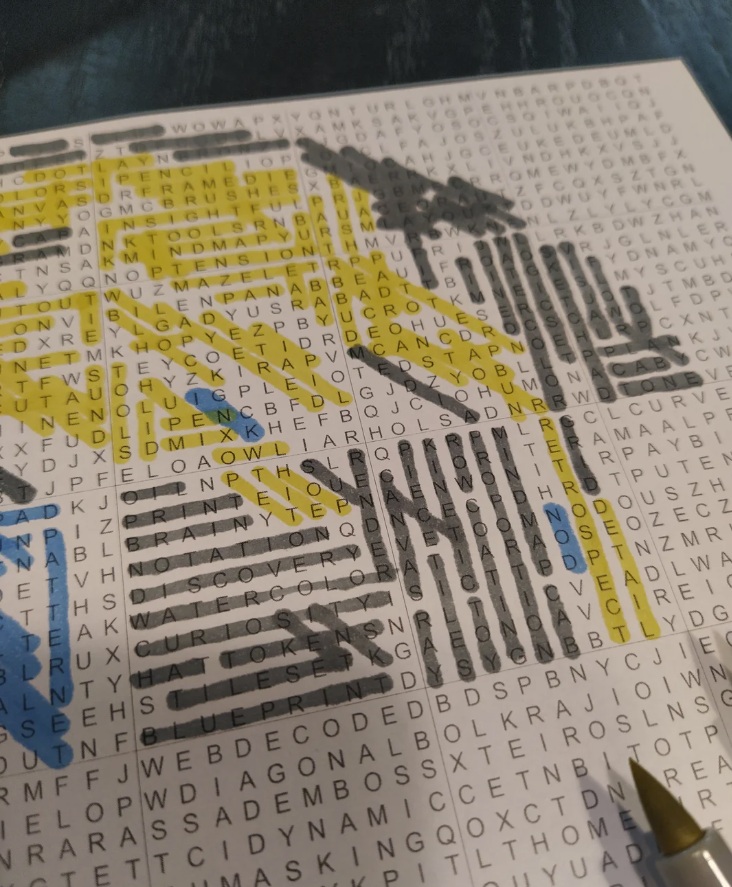
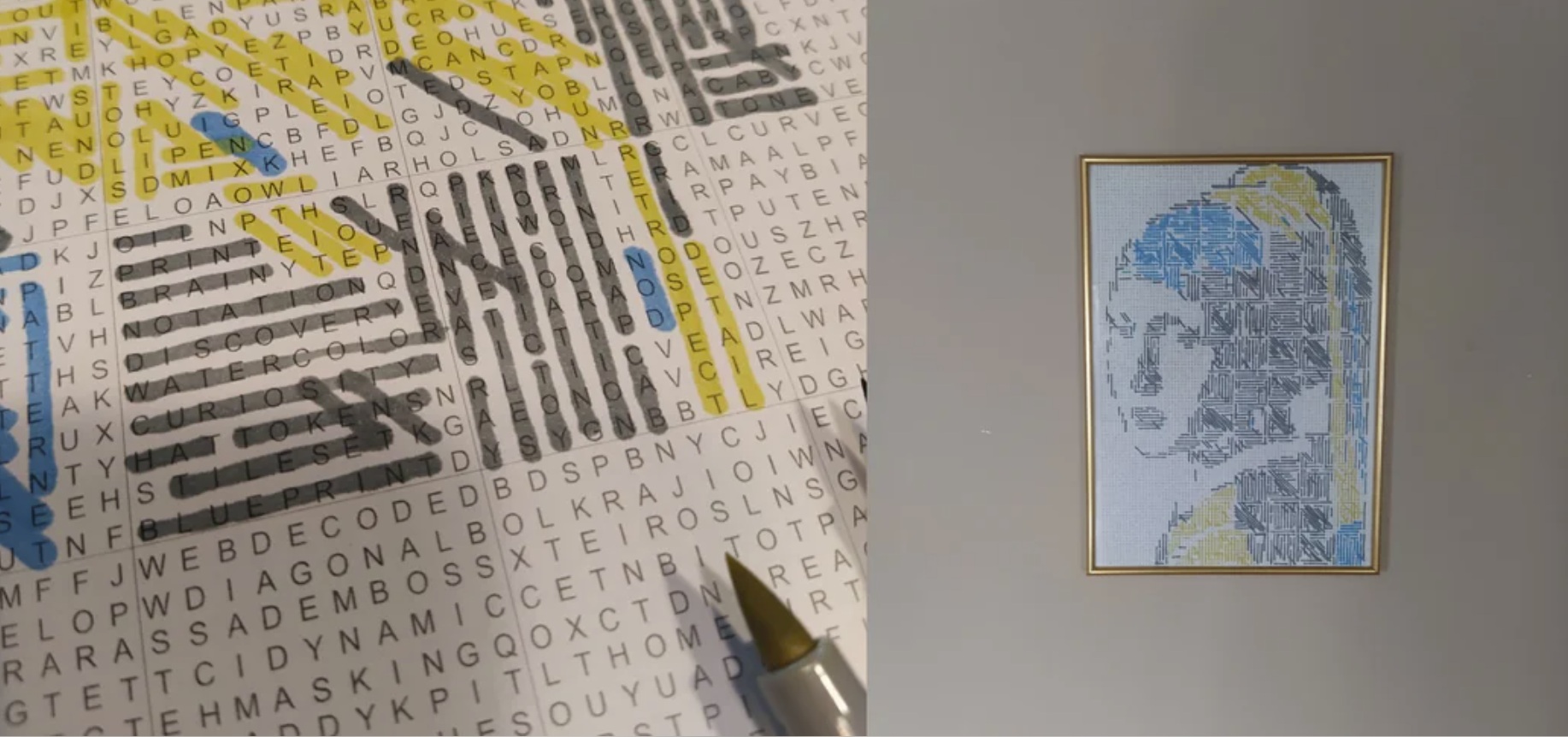
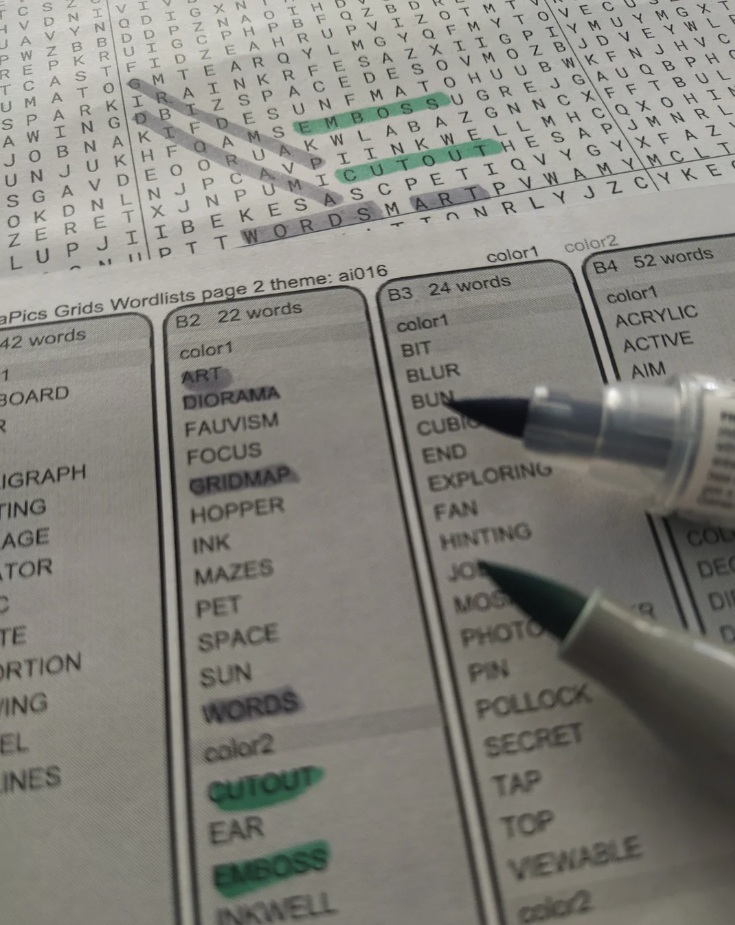
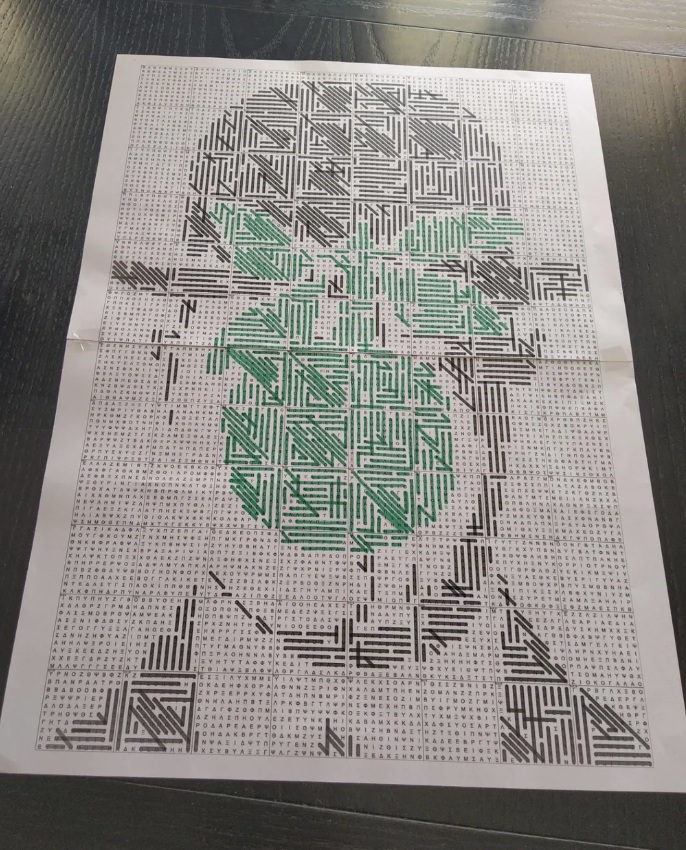
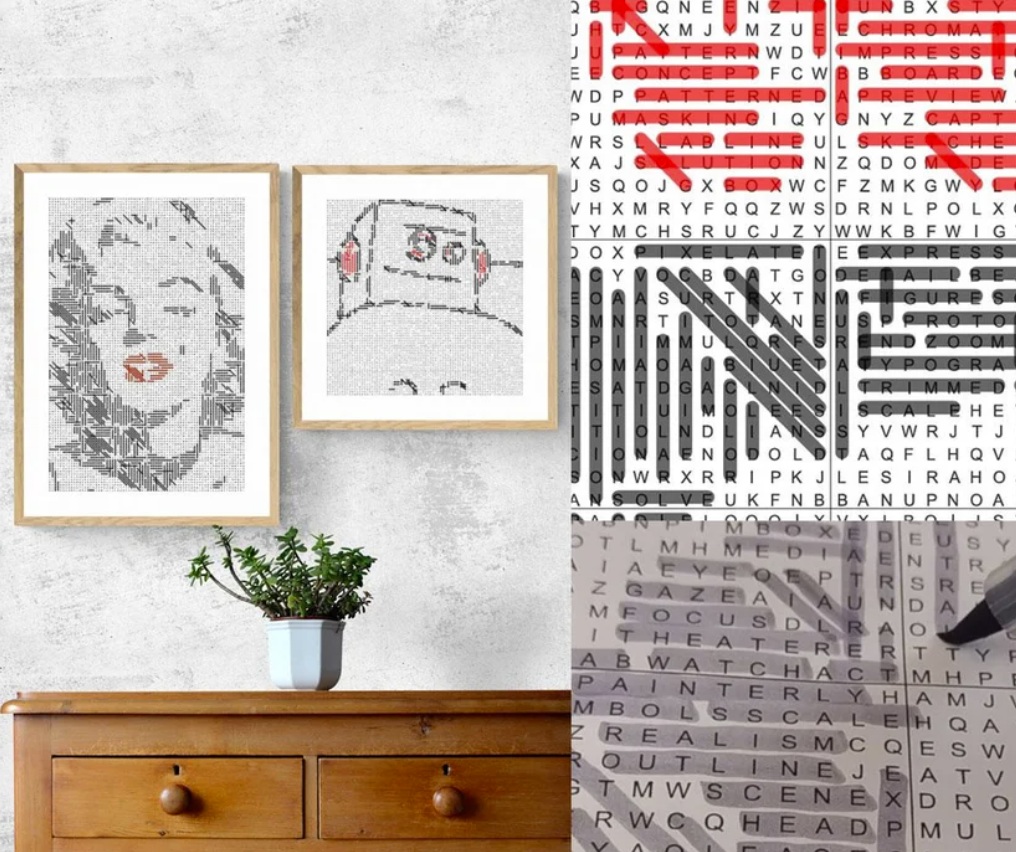
LexaPics are the creation of Vasiliki Papadopoulou, who designs specially curated word seek grids and sorted word lists to create works of art when solved!
The grid is divided into different cells, and you get a word list for each cell, with different parts of the word list organized by color.
And as you find your words, the work of art slowly emerges line by line.
As you can see, Vasiliki has created grids inspired by Vermeer and Magritte, as well as grids inspired by iconic celebrities like Marilyn Monroe.
Lexa comes from Greek word Lexis λέξη (since i am from Greece) that means word and Pics as pictures, but also a playful nod to “pixels” — the building blocks of modern digital art.
Not only does he have a Kickstarter campaign for LexaPics launching soon, but he’s actually created an Instructables page for anyone who would like to make their own LexaPic!
I love seeing the creative ways people put new spins on classic puzzles, and this is both beautiful and so cleverly accessible.
I’ve always been a sucker for optical illusions, which I consider puzzles for the eye. They’re a visual treat that tricks you into seeing things that aren’t there. These inspired bits of perceptual trickery can fool you into thinking near is far, big is small, or two dimensions are really three.
And I’ve been fascinated ever since by this growing subset of glitch art where incredible precision is required to create physical art that looks fuzzy, uncertain, or even moving from the right angle.
So you can imagine my joy when I found this YouTube short:
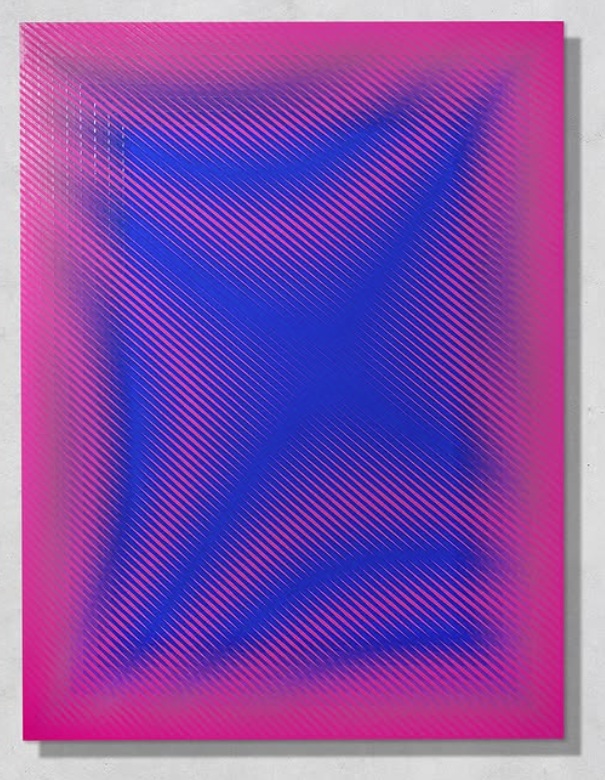
This is the work of artist Enzo Prina, a physical media artist who specializes in Moiré art.
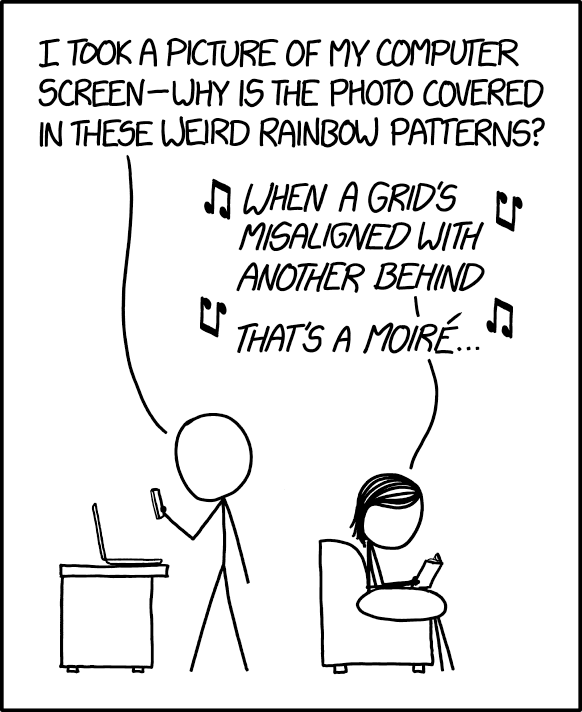
What is Moiré, you may ask? Well, XKCD has a fun explanation:
But please allow me to elaborate.
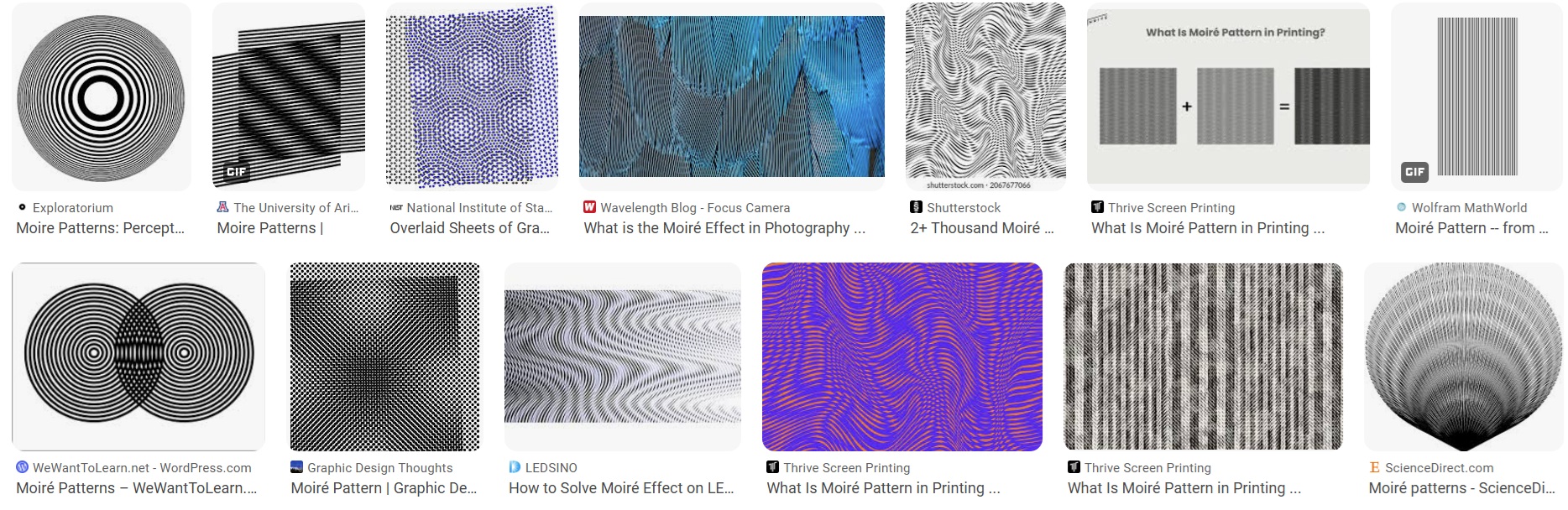
Moiré, which is both a mathematical and an artistic term, is the use of two or more overlapping grid patterns with regular spacing to create an interference pattern.
By overlapping these intricately formed and carefully spaced patterns at an angle to each other (and not directly lined up), you create the eye-catching patterns you see above.
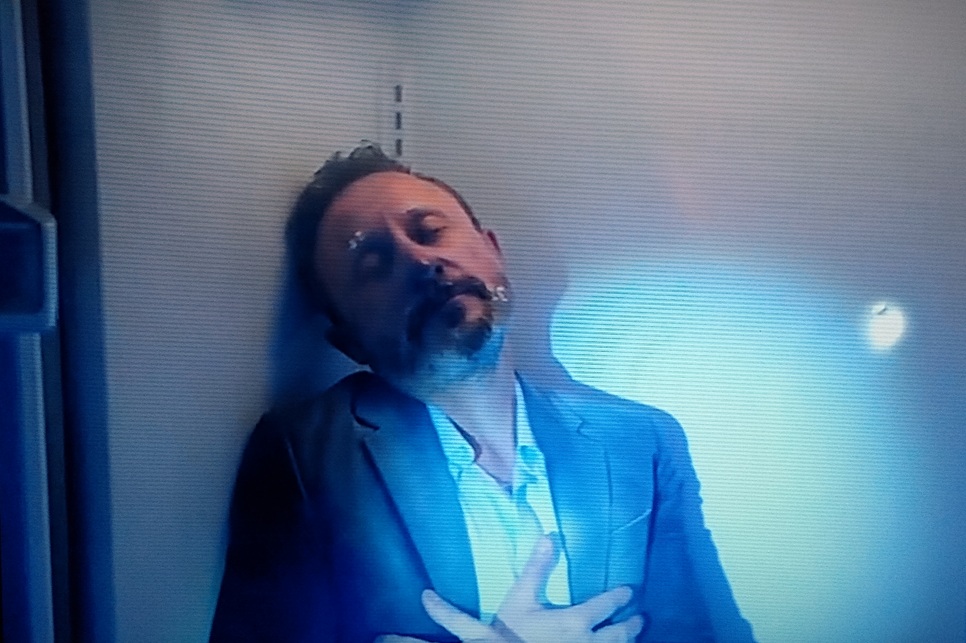
Moiré patterns are all around us. If you’ve ever seen a Houndstooth jacket on an old television program, or tried to photograph a TV screen or computer screen at the wrong angle, you’ve no doubt noticed a Moiré pattern.
While making Moiré patterns isn’t difficult, you can see that Prina’s work is far more complex than simply layering two patterns. He maps out his designs with tape, meticulously pulling layer by layer of tape strands from his work as he paints it, making the creation process as gorgeous and mind-bending as the final product.
It’s truly something to behold, both during and after.
Prina claimed on LinkedIn back in January that he’d just started making art again after a ten-year break, and clearly that break has reenergized him, as his work continues to evolve and diversify in fascinating ways.
This intersection of art and mathematics really struck a chord with me. It’s not surprisingly, really, given that I’ve had Tom Lehrer on the brain for days, and he similarly combined math and artistic whimsy to create works of art that played with perception and imagination.
What a treat.
Now everyone, go stare at something boring and rest your eyes for a while.
What would a Boggle grid look like that contained every word in the English language?
Well, there are somewhere between 1 million and 1.5 million words in the English language, so I imagine it would be pretty big.
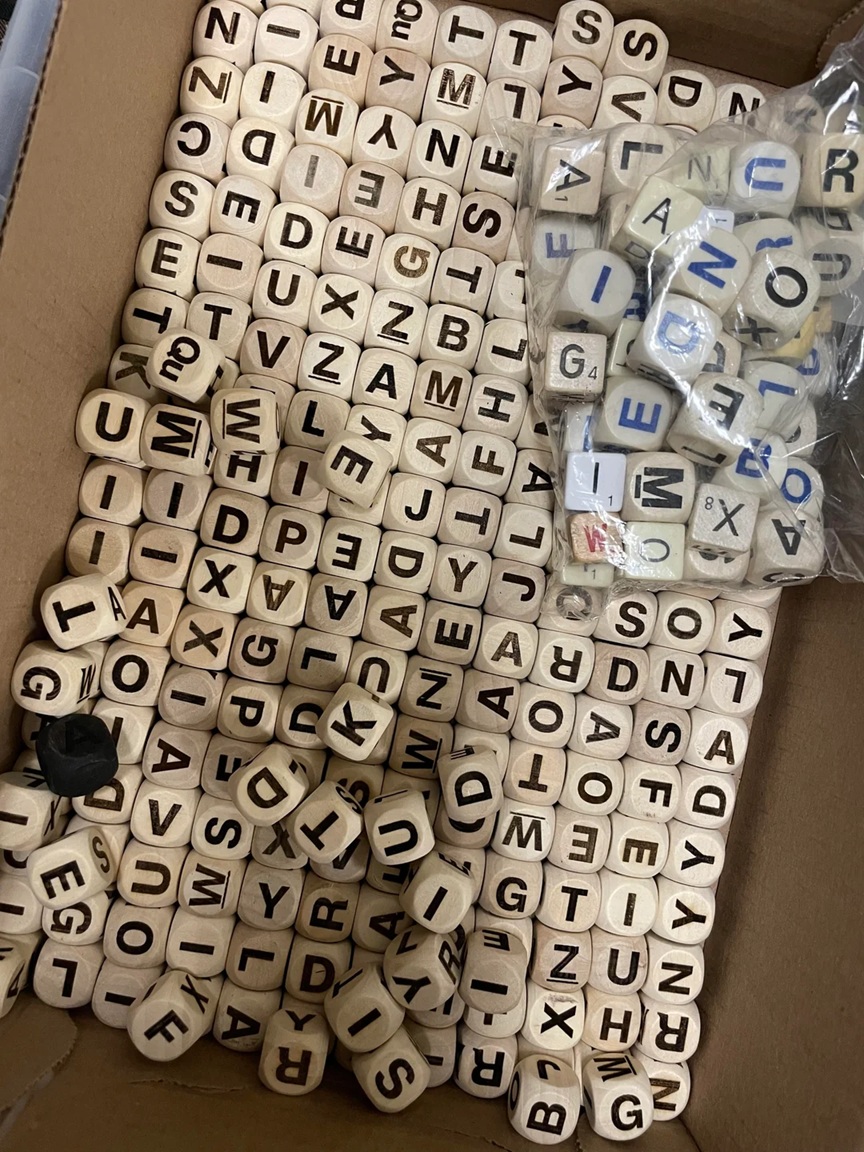
The redditor is an artist, and their goal is to make a sculpture composed of Boggle dice. And their concept is fascinating:
The idea for the piece is that it’s a linguistic Rorschach that conveys someone could find whatever they want in it. But it would be even cooler if it literally contained any word someone might reasonable want to say or write.
So, where do you start with something like this? Our artist has a suggestion:
To simplify, we could scope it to the 3000 most important words according to Oxford. True to the nature of Boggle, a cluster of letters could contain multiple words. For instance, a 2 x 2 grid of letter dice T-R-A-E could spell the words EAT, ATE, TEA, RATE, TEAR, ART, EAR, ARE, RAT, TAR, ERA. Depending on the location, adding an H would expand this to HEART, EARTH, HATE, HEAT, and THE...
What would be the process for figuring out the smallest configuration of Boggle dice that would let you spell those 3k words linked above? What if the grid doesn’t have to be a square but could be a rectangle of any size?
Naturally, creative minds accepted the challenge.
One user claimed that an online Boggle website called Squaredle has two 10×10 boards with just under 900 words of 4 or more letters.
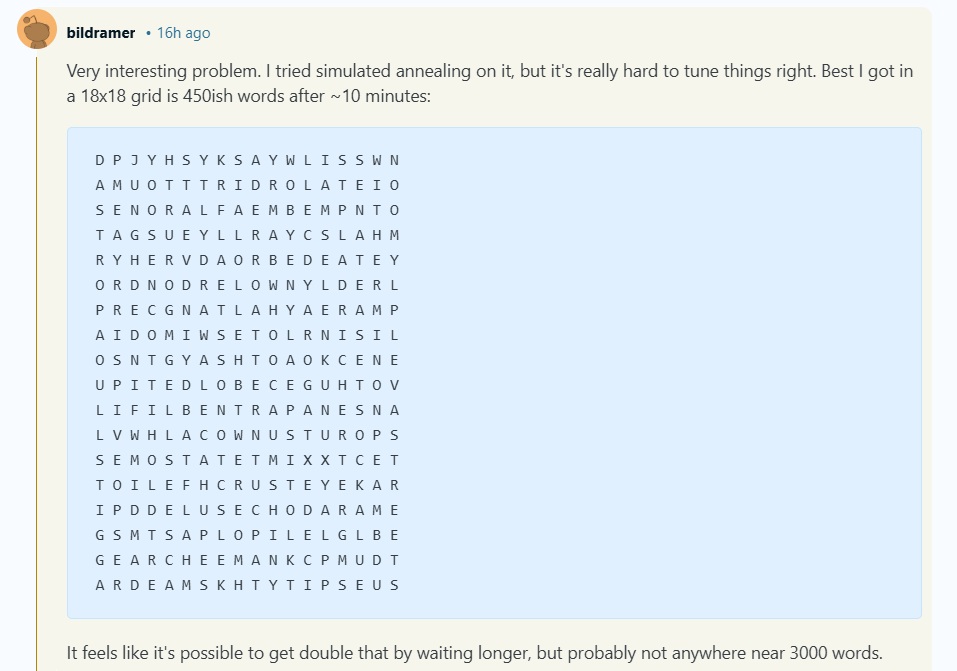
Another user, a programmer, was able to create an 18×18 grid with approximately 450 words in under 10 minutes.
As you might expect, I was unable to resist diving into this one. But I’m not a programmer, so let’s do some meatball mathematics to get a sense of the scope of the puzzly conundrum before us.
We can extrapolate that if we get 450 words in an 18×18 grid, we’d need seven 18×18 grids connected to approach 3,000 words, assuming there’s some consistency in letter efficiency.
If we stick to the rectangular suggestion of the original post, a 63×36 rectangle (six 18×18 grids in a 2×3 arrangement, plus a 9×36 grid attached at the bottom) should allow for those 3,000 words.
Now, I can’t verify that. But 63×36 means 2,268 letters in the grid. Which, with a 3,000 word goal (including two- and three-letter words) kinda feels possible.
Of course, this is just to cover that 3,000 word list. Remember that the English language is estimated to contain between 1 million and 1.5 million words total.
That’s 333-and-a-third times more, if we use a million words. It’s 500 times more words if we assume 1.5 million words.
So, that’s 2,268 letters in our 3,000 word grid. Multiply that by 500 and you get 1,134,000 letters in the grid.
That means we’d need a grid that’s 1,065 x 1,065 to cover the entire English language.
So what does that mean in Boggle terms?
A standard six-sided die is 16 millimeters. That’s 17,040 millimeters, or 17.04 meters. That’s 67.09 inches. We’re talking about a Boggle game that’s FIVE AND A HALF FEET ACROSS.
That’s one heck of a Boggle grid.
Now, of course, these numbers are all estimates, and dubious ones at that. But I couldn’t resist TRYING to find an answer, even if it’s just a ballpark number.
You see, fellow puzzlers, this brand of puzzle efficiency tickles something in my brain, as there are several Penny Press puzzles I quite enjoy that employ a similar idea.
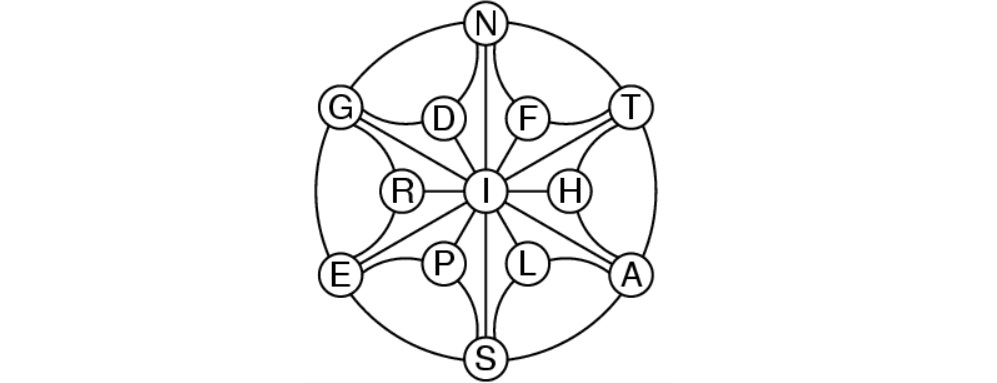
Starspell (pictured above) involves finding words in a star-shaped grid, except unlike Boggle, you can reuse letters. So you could bounce back and forth from A to N and spell BANANA, for instance.
Word Maze involves a small grid with many words hidden inside Boggle-style (though it’s actually a themed word list, meaning it’s not optimized to just cram as many words inside as possible).
Letter Perfect is a reversal of the idea, seeing if the solver can arrange letters in a mostly-empty 4×4 grid to fit every word in a given wordlist. It’s excellent training for a challenge like this, since you learn about efficiency of letter placement and how many words can spell out with neighboring letters if you’re clever.
I don’t know if any programmers will figure out how to build a language-spanning Boggle grid, but I look forward to seeing them try!
In recent times, religion and the world of puzzles and games have crossed paths with sometimes surprising results.
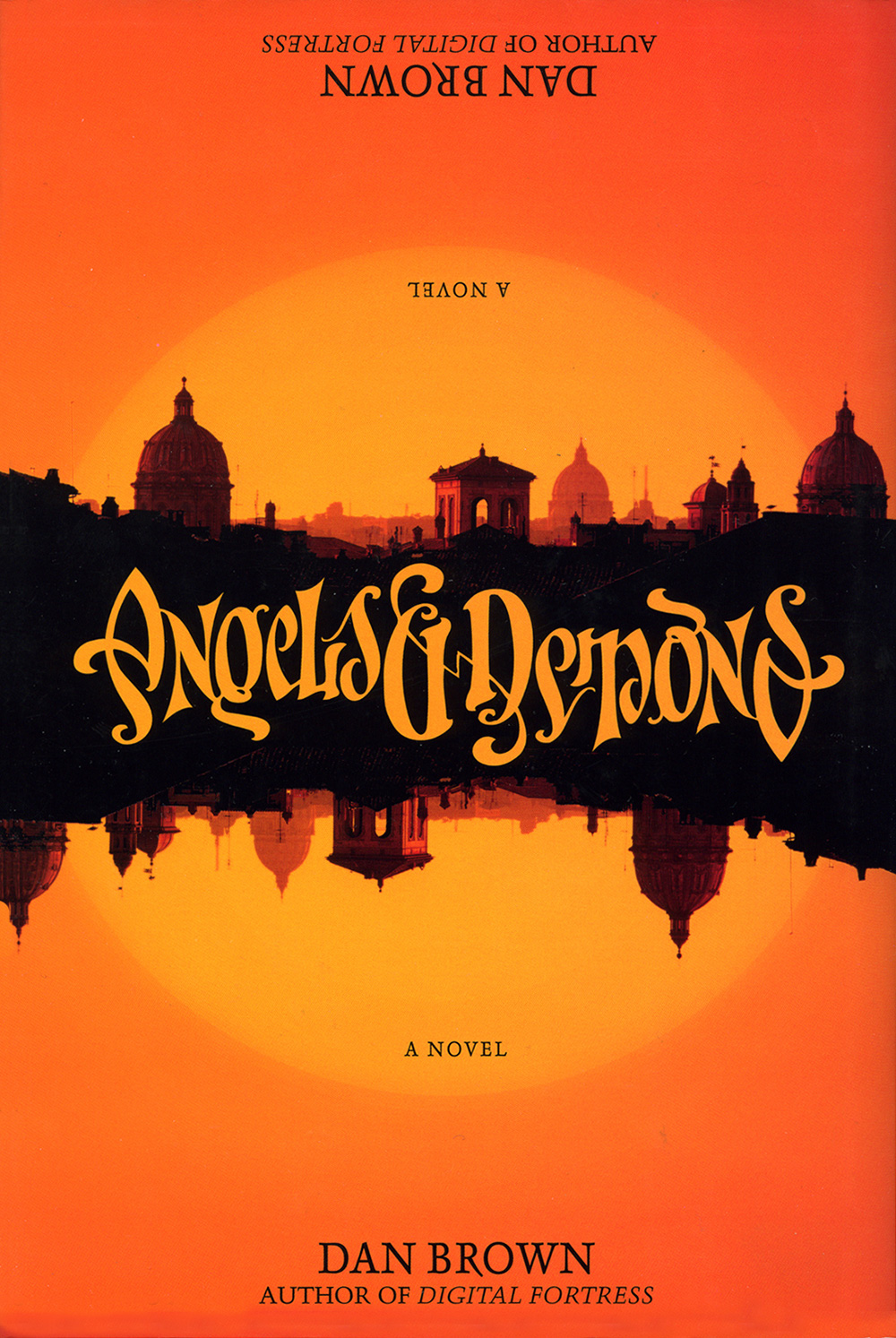
The film adaptation of The Da Vinci Code, a fairly puzzle-centric thriller, was widely denounced by members of the Catholic Church, and there was similar resistance, though less vocal, against the sequel film, Angels & Demons.
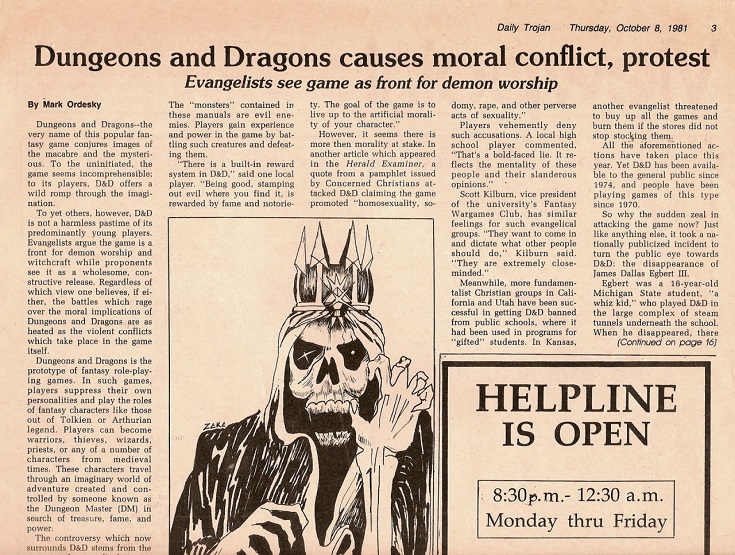
And, of course, in the 1980s, the roleplaying game Dungeons & Dragons was condemned as Satanic and dangerous to young minds.
I say that the above is strange because, for the most part, these seem to be anomalies or isolated incidents. There are numerous instances throughout history where puzzles and games were embraced by religion, even used as tools to teach aspects of religious beliefs.
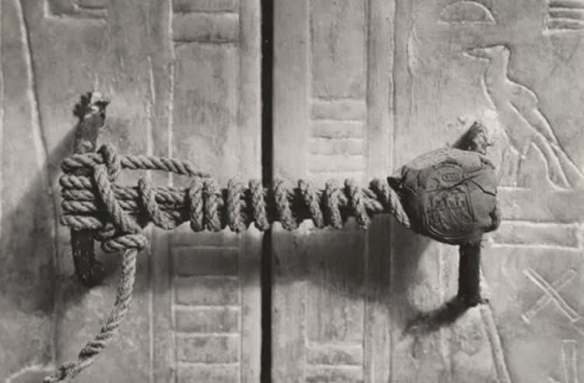
For instance, in ancient Egypt, we’ve seen evidence of puzzly techniques used not just to secure the tomb of Tutankhamun, but also to disguise the language and rituals employed by elite members of their society. Puzzles were entrusted to keep their secrets well beyond the grave.
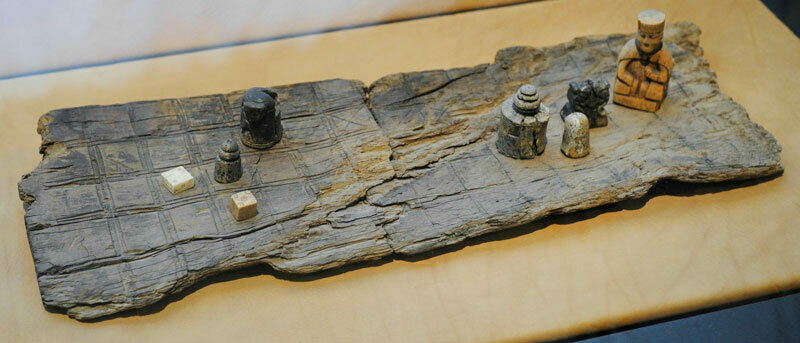
You see, some Senet boards have religious iconography on them, believed to symbolize the journey into the afterlife. So gameplay — or the inclusion of the gameboard itself among the belongings of the deceased — represented that journey and the quest to learn more about it.
Some online articles have taken to referring to Senet as “the Rosicrucian board game of death,” which is a harsh misinterpretation.
There was also an afterlife connection with games for the Vikings.
According to Mark Hall, a curator at Perth Museum and Art Gallery, there have been 36 burials where board games of some description have been found in the graves around Northern Europe.
These grave sites grant intriguing insight into how the Vikings viewed board games as a learning tool. It’s believed that including a board game among the effects of the deceased signaled not only their skill and status as a warrior, but their preparedness for the afterlife itself. Heck, their win-loss records were even recorded for posterity!
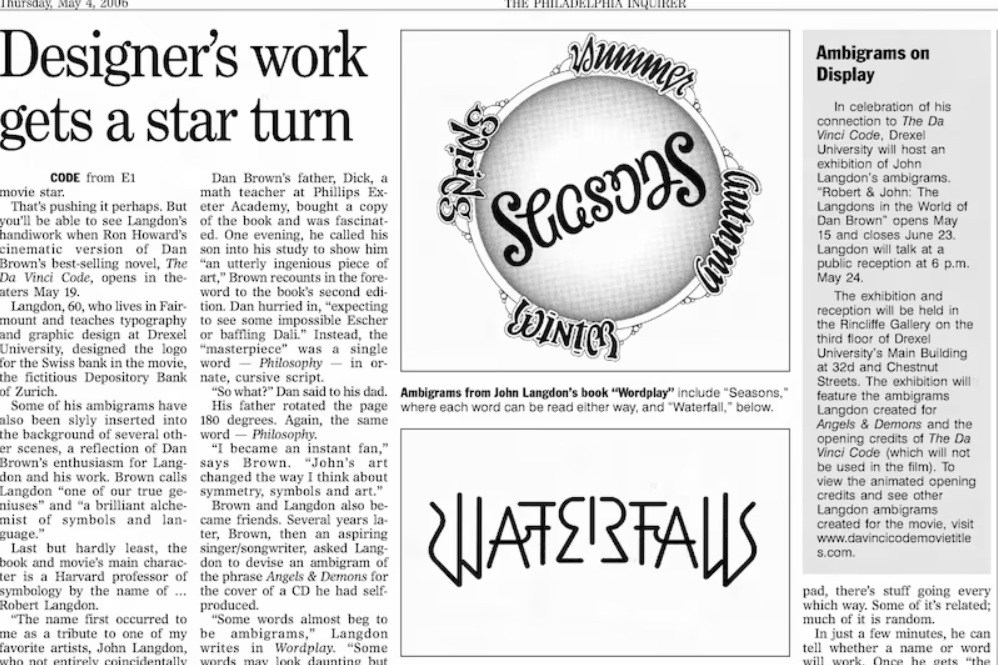
Palindromes were believed to work as magical shields that protected those wearing the talismans bearing such clever wordplay.
Heck, even the shape of dice were influenced by changing religious views. Early dice games gave very little consideration to the shape or evenness of dice, because rolls were believed to be guided by Fate or some greater outside force, so the shape didn’t matter.
As religious beliefs evolved away from gods and greater forces intervening in such things, the general spirit of fairness in dice began to prevail, and the shape, balance, and pip distribution of dice became much more standardized.
And as for the Catholic Church, I certainly didn’t mean to make it look like I was picking on them in the introduction, because there are positive associations between the church and the world of puzzles and games as well.
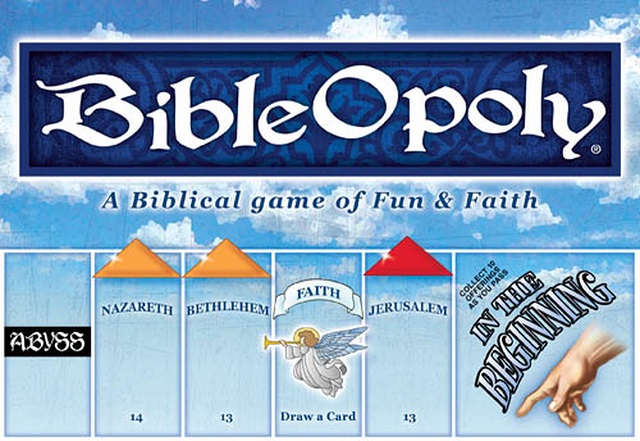
And no, I’m not just talking about lighthearted products like BibleOpoly or the cottage industry of family-friendly games like Bible editions of Outburst, Scattergories, Apples to Apples, Scrabble, and Taboo.
Chess boards and other game boards have been found in houses formerly used by the Knights Templar, for instance.
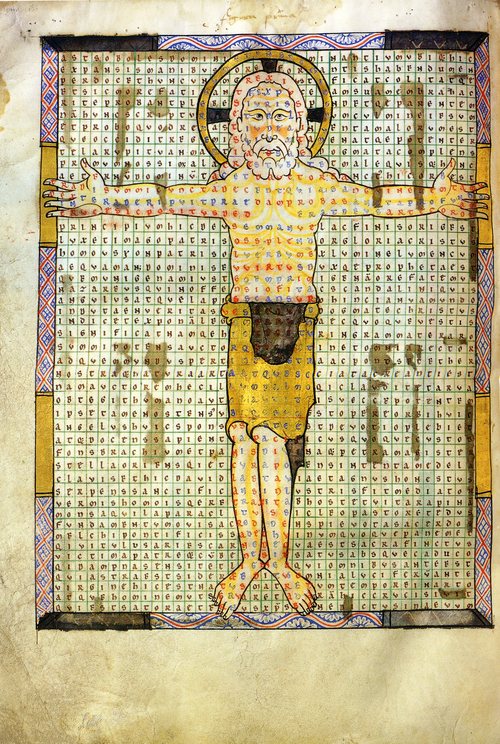
There’s also the puzzly art of carmina figurata, poems wherein either the entire body of the poem or select parts form a shape or pattern. These works originated as religious tributes, poems where letters were colored red to stand out from the regular black lettering in order to draw attention to or highlight a certain religious figure.
[“De laudibus sanctae Crucis” by Oliverus.
Image courtesy of WTF Art History.]
There would be hidden words or messages concealed in the text, some speaking of the religious icons at the center of the piece in glowing terms.
Do you have any favorite puzzles and games that have an element of religion to them, fellow puzzlers and PuzzleNationers? Let us know in the comments section below. We’d love to hear from you!
Halloween is almost here, and we have some spookily good deals for you to check out. You can find them on the Home Screen for Daily POP Crosswords and Daily POP Word Search! Check them out!
Thanks for visiting PuzzleNation Blog today! Be sure to sign up for our newsletter to stay up-to-date on everything PuzzleNation!
You may be familiar with the board game Schmovie or hashtag games on Twitter.
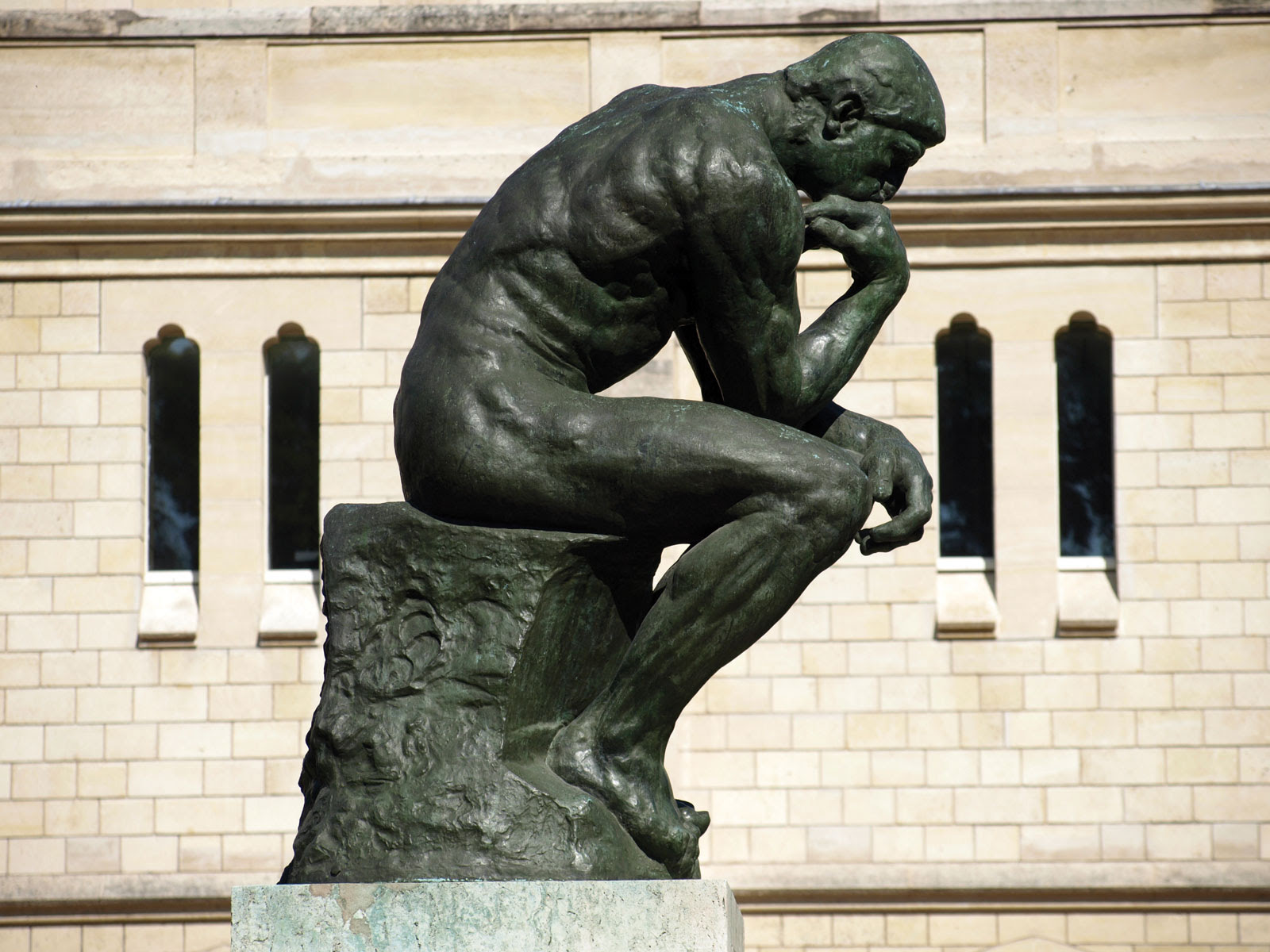
For years now, we’ve been collaborating on puzzle-themed hashtag games with our pals at Penny Dell Puzzles, and this month’s hook was #PennyDellPuzzleArt. Today’s entries all mash up Penny Dell puzzles with artists, famous pieces, techniques, styles, and more from the world of art!
Examples include: The First and Last Supper, O’Keeffeword, and Rows Avant-Garden.
So, without further ado, check out what the puzzlers at PuzzleNation and Penny Dell Puzzles came up with!
Puzzly Artists!
Vincent On-The-Van Gogh Word Seek
Christo Crosswords
Three-Toulouse-One
Paul Cezanneagrams
Picassudoku
Michel(Try-Angle)o
Eugene DelaCrostic
Henri Word-a-Matisse
Camille PissarRows Garden
Paul Klee-from-nine
Anagram Magritte Squares
Eileen Gray That Again
Paul GaugIn the Middle
Marc ChagAll Fours
Grand Tour Moses
Elizabeth Catlettgories
Thomas EakInsert-a-Word
Piet Mondriagain
Liubov Sergeievna Popoverlay
Alfred StieglIts Your Move
Frank Lloyd Right Angles
Man SunRays
Man Raylroad Ties
CrackerJackson Pollock
Joan Miro Image
Johannes Vermeer-or Image
Wassily KenKendinsky
Louise Burgeois Tiles
“Here I sit so broken hearted…”
You can Fill-In the rest!
#Fitting Description
Famous Puzzly Art Pieces, Styles, and Terminology!
“Still Life with Apples and Pairs in Rhyme” (Paul Cezanne)
“The Two (for One) Fridas” (Frida Kahlo)
Pen and In(k) the Middle
Crisscrosshatch
DADArtboard
RocoCodebreaker
Around the Baroque
Letter DrOP Art
Have you come up with any Penny Dell Puzzle Art entries of your own? Let us know! We’d love to see them!
Thanks for visiting PuzzleNation Blog today! Be sure to sign up for our newsletter to stay up-to-date on everything PuzzleNation!
Heck, there’s a coffee mug where you can fill out different crosswords that all fit the same empty, fillable grid on the outside of the mug. I have a crossword analog wall clock that’s solvable.
But this is definitely the first time I’ve seen a crossword made of snow.
I think the gripping nature of this artistic act of puzzly expression was best summed up by his brother on Twitter:
This is a REAL crossword puzzle with REAL questions and solutions (see the thread) constructed on a REAL ice rink done by my REAL brother who is REALLY impressive.
I’m curious if other frigid puzzle styles will follow suit. Will we see an ice rink word seek where he has to skate around the words to loop them? Perhaps a rime-crafted rebus to challenge observers with wordplay?
There are definitely possibilities here, with a natural timer built-in as well!
Forgive the unintentional pun, but this is pretty cool.
Thanks for visiting PuzzleNation Blog today! Be sure to sign up for our newsletter to stay up-to-date on everything PuzzleNation!