PuzzleNation Product Review: Chroma Cube

[Note: I received a free copy of this game in exchange for a fair, unbiased review. Due diligence, full disclosure, and all that. And this concludes the disclaimer.]

As longtime readers know, puzzle games centering around logic and deduction can come in many different forms, from cats milling around a living room to abstract shapes interacting in curious ways. They often have many moving parts and solving mechanics to keep in mind.

But other logic puzzles strip away flashy trappings and overly elaborate designs and take a minimalistic approach to puzzling. The subject of today’s product review, Chroma Cube, falls neatly into the latter category.

Chroma Cube boils a deduction puzzle down to its essentials, employing pleasing design that seems basic, but allows for great depth and challenge nonetheless. All you need to tackle Chroma Cube is a game board, twelve colored cubes, and your challenge cards.

The object of the puzzle is simple: complete each challenge card by placing all 12 cubes in the correct positions on the board.

Most of the challenge cards place some of the colored cubes for you to get your started. Once you’ve set up your board to match the starting pattern on the card, it’s up to you to use the clues provided to figure out how to place the remaining cubes.

The challenge cards ease the solver into the puzzle at first, relying mostly on clues about positioning on the board, referring to rows, columns, and neighboring cubes.

As you might expect, with each new challenge card, the puzzles increase in difficulty, and the clues grow more complex and inventive. Some refer to colors only by the first letters — leaving you to ponder whether it applies to Brown or Black, for instance) — while others offer contextual clues, like a rule that the cubes in each row should be in alphabetical order from the left to right.

A few even rely on knowledge outside the puzzle game itself, like knowing the colors in the Irish flag. These clues are rarer, but add a nice bit of crossword-style flavor to an otherwise Sudoku-like solving experience.

The team at Project Genius did an excellent job of keeping the clues fresh and interesting, constantly introducing new rules and wrinkles to the puzzles. By the time you’re encountering puzzles with no set cubes, or ones that require you to swap set cubes with newly placed cubes — a very clever twist on the idea of “set” pieces — you realize that no matter how many tricks you’ve figured out, the challenge cards have new ones waiting for you.

(Naturally, these are only some of the clue mechanics you’ll encounter. I don’t want to spoil some of the really inventive and challenging ones.)
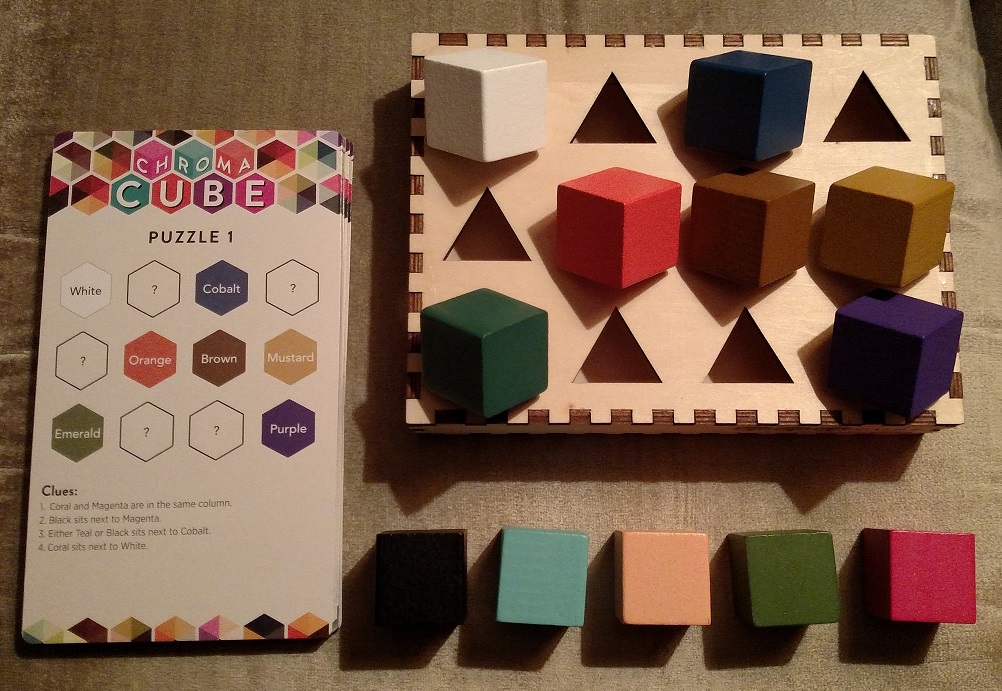
Chroma Cube’s later challenge cards offer plenty of difficulty and cluing craftiness to keep established puzzlers coming back for more, but without alienating new solvers that have developed and honed their deductive talents by playing through the game’s earlier scenarios.

I was thoroughly impressed by how much the creative team at Project Genius got out of 12 colored cubes and a wooden board to place them on.

Not only that, but the game is beautiful, eye-catching in its presentation. The wooden pieces have a weight to them, and solving is a delightfully tactile experience. (The challenge cards can be tucked away in a slot within the board, making it a breeze to move around the house.

Heck, you could easily leave it on your coffee table as a puzzly conversation piece and it wouldn’t look out of place.

Chroma Cube is a wonderfully visual take on classic deduction-style solving, one that will keep you on your toes from the first challenge card to the last.

Chroma Cube, distributed by Project Genius, is available at Barnes & Noble and other participating retailers.


Thanks for visiting PuzzleNation Blog today! Be sure to sign up for our newsletter to stay up-to-date on everything PuzzleNation!

You can also share your pictures with us on Instagram, friend us on Facebook, check us out on TwitterPinterest, and Tumblr, and explore the always-expanding library of PuzzleNation apps and games on our website!
PuzzleNation Product Review: Deblockle

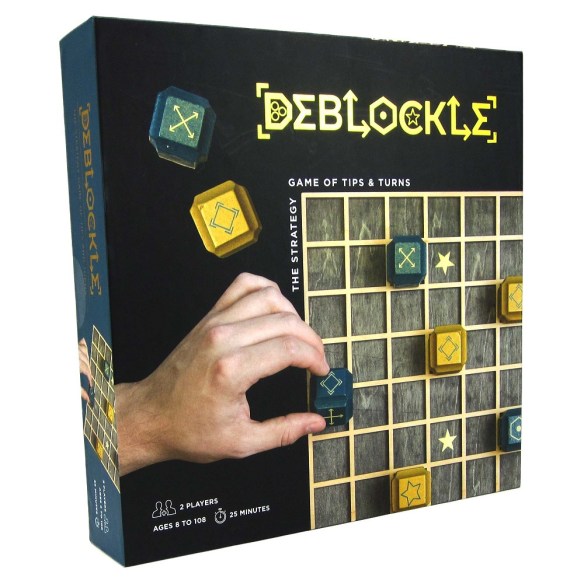
deblocklenewpackaging

[Note: I received a free copy of this game in exchange for a fair, unbiased review. Due diligence, full disclosure, and all that.]

Chess, checkers, backgammon, Go, Othello… all of the classic board games rely upon the idea that both players know how the pieces can and will move from round to round. That way, they can strategize, they can prepare defenses, they can circumnavigate your attempts to flummox them. To outmaneuver someone, you have to know how they can maneuver.

But what if your opponent could potentially move in five different ways? How would that alter your strategy? How would that alter your gameplay?

Beware, fellow puzzlers… one-on-one board gaming just got a little more complicated with Deblockle.

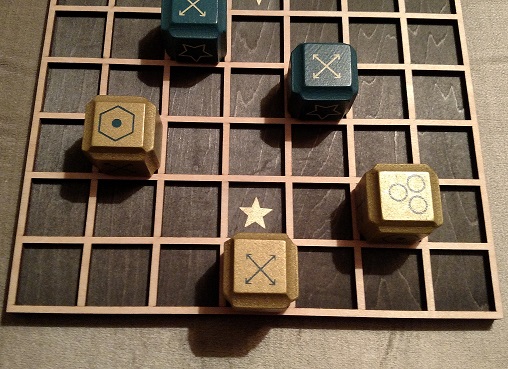
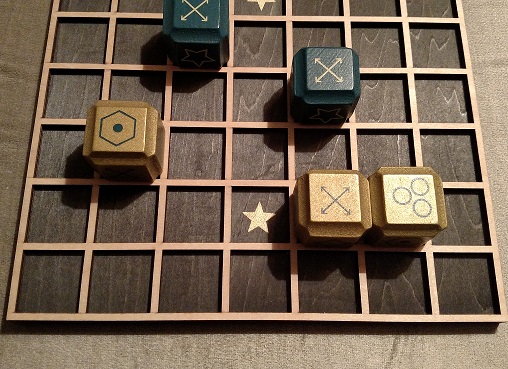
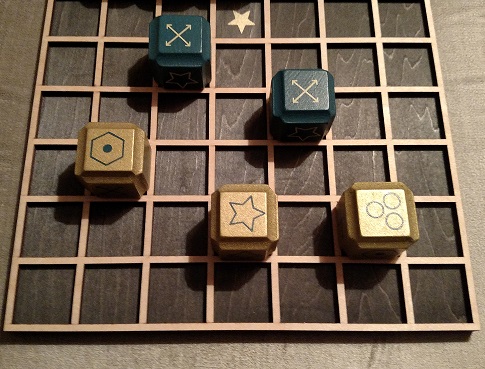
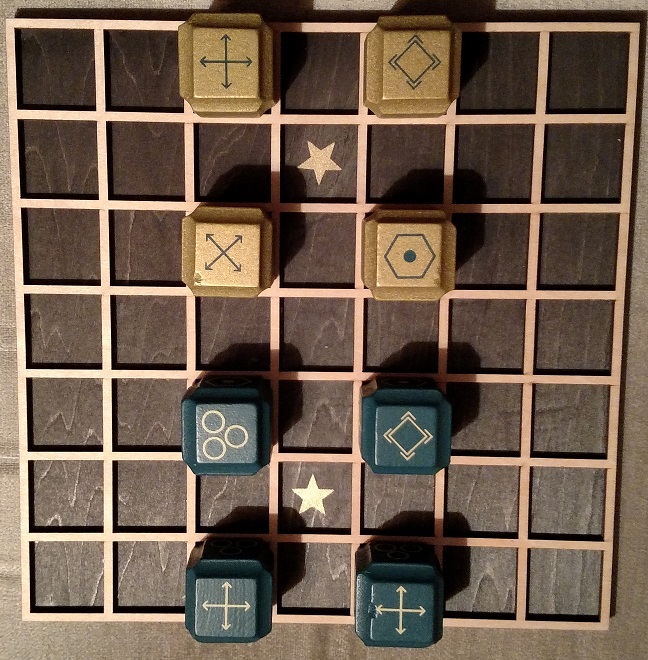
Masterminded by the team at Project Genius, Deblockle pits two players head to head to see who can remove their four blocks from the board first.

That’s right, there aren’t sixteen pieces to keep track of, like in chess, or twelve, like in checkers. There are just four blocks for you, and four blocks for your opponent.

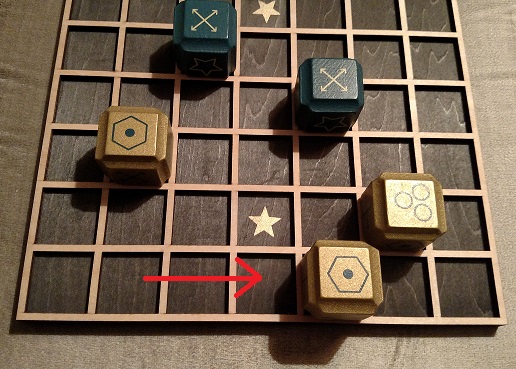
But here’s where things get tricky. Each turn, you have two moves. The first move is to roll one of your blocks into an adjacent space (either vertically or horizontally).

The second move is to place your block according to whichever symbol that landed face-up because of that roll.

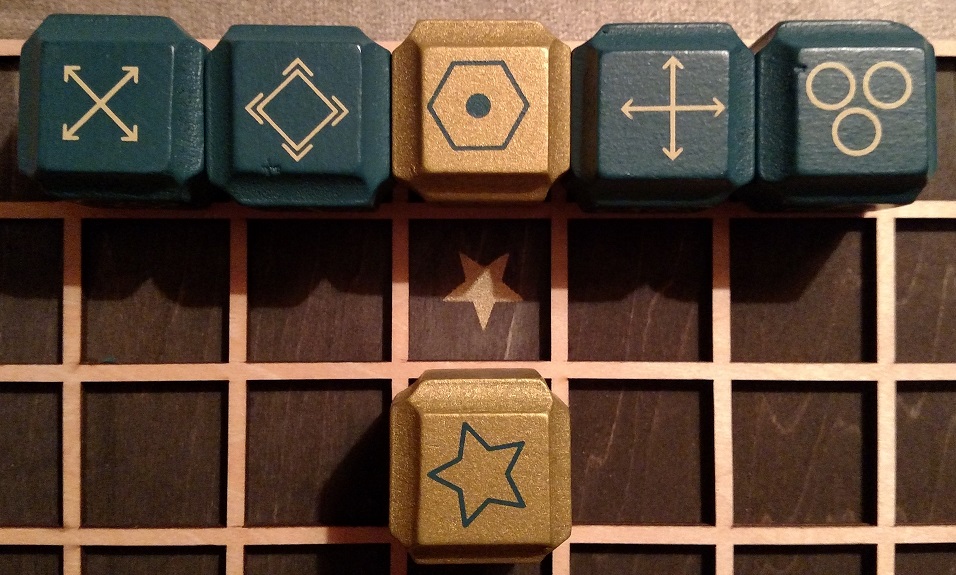
There are six symbols, each with a corresponding action:

  • Stop: your turn is over, there is no second move
  • Cross: move your block one space either horizontally or vertically
  • X: move your block one space diagonally
  • Hoops: move your block three spaces (vertically or horizontally) in any combination, including backtracking over a space you just occupied
  • Slider: move your block either vertically or horizontally until you reach the end of the row or column, or until you’re stopped by another block

With each of those second moves, you’re not rolling the block to reveal a new symbol; you’re picking it up and placing it into its new position.

And yes, there are six symbols, and I only listed five above. That’s because the sixth symbol, the star, can only be revealed if you’re rolling onto one of the star spaces on the board. By rolling the block star-side-up onto a star space, you remove the block from play.

That’s the only time you can roll your block star-side-up, and the only time you’re allowed to occupy a star space with your block.

There are only two star spaces on the board, and you can only remove your blocks from the game if you utilize the star space opposite you.

And that’s when things get really tricky. Because it’s entirely likely that your opponent’s blocks will prevent you from rolling onto the symbol you wanted. So you’re puzzling out how exactly to roll and move your blocks so you’ll end up adjacent to the star space with the star symbol waiting to be rolled face-up, and also playing defense to impede your opponent’s efforts to navigate and manipulate the board to their own advantage.

It’s a lot to keep track of, and it makes for an immensely engrossing, engaging puzzle duel for two players. You’ve got the resource management of Risk, the piece placement mechanics of chess, and the defensive gameplay of Stratego and other strategy games.

And since the blocks are placed in their starting positions by your opponent — after rolling them randomly to see which symbol is face-up to start — every game of Deblockle is different. Opening gambits — like those you can learn in chess — are useless, because you won’t know how you can move your blocks initially until your opponent places them.

There is a wonderfully fresh challenge factor to Deblockle that many other head-to-head board games lack. While playing the game over and over will allow you to develop techniques and skills for how to better move your blocks, there are no shortcuts to becoming a better player through sheer repetition, because each opening setup is different.

Project Genius has managed to stuff a massive amount of gameplay, strategy, and style into those four little blocks, and they’ve got a real winner on their hands here.

[Deblockle is available from Project Genius and other participating retailers, for players starting at 8 and up!]


Thanks for visiting PuzzleNation Blog today! Be sure to sign up for our newsletter to stay up-to-date on everything PuzzleNation!

You can also share your pictures with us on Instagram, friend us on Facebook, check us out on TwitterPinterest, and Tumblr, and explore the always-expanding library of PuzzleNation apps and games on our website!
PuzzleNation Product Review: IcoSoKu

[Note: I received a free copy of this game in exchange for a fair, unbiased review. Due diligence, full disclosure, and all that.]

Most puzzles — whether we’re talking about puzzle boxes, jigsaw puzzles, physical brain teasers, or mechanical puzzles — operate under a simple premise: the puzzle arrives in one configuration, and it’s up to you to solve it and put it into a different configuration.

With puzzle boxes, you’re opening them. With jigsaws, you’re assembling the pieces. With physical brain teasers and mechanical puzzles, you’re separating them, freeing a given piece, or accomplishing a particular task. But in each case, they’ve arrived that way. You have been pitted against the designer.

Project Genius‘s IcoSoKu is something different. IcoSoKu challenges you to create your own puzzle, and then solve it.

The setup is elegant in its simplicity. It’s a puzzle ball consisting of a twenty-sided icosahedron base, twelve numbered pegs, and twenty triangular tiles with different combinations of pips at the corners.

To start, remove all of the tiles and all of the pegs from the icosahedron. Place the numbered pegs wherever you wish on the puzzle ball.

Then, you must figure out how to arrange the triangular tiles on the puzzle ball.

This is tougher than it seems. Each triangular tile has a different combination of pips in its corners. Some corners have none, while others have one, two, or three pips. And each corner neighbors a different numbered peg. Each numbered peg is surrounded by five corners, and the pips on each corner, when added together, should total the number on the peg.

And with numbers ranging from 1 to 12, you have to be both clever and careful in your tile placement. That peg labeled “1” can only have a single pip neighboring it, meaning that the other four tiles surrounding that peg should have empty corners.

[Three different looks at the same solved puzzle ball.]

IcoSoKu combines the deduction of placement puzzles like Minesweeper or Blackout! with the mathematical puzzling of a magic square or a Sudoku puzzle. And by making the puzzle three-dimensional, it places a healthy demand on your puzzly faculties. You’re constantly tipping and turning the puzzle ball, because you can never see the whole puzzle at once, making it much harder to manage your tiles and maintain a good sense of just how many of those valuable little pips you’ve already used.

And as soon as you’ve placed the final tile and searched the puzzle ball all over, confirming a successful solution… all you want to do is strip away all of the tiles and pegs to test your wits again.

Assigning pegs randomly creates a completely different solving experience from bundling all the large numbers together on one side and all the small numbers together on the other side of the ball. Although you will begin to spot certain patterns and techniques that will come in handy as you solve each successive permutation of the puzzle, you’ll still find IcoSoKu to be an engaging and satisfying challenge.

Plus there are other ways you can enjoy the puzzle after cracking it yourself. I challenged a fellow puzzler to a timed IcoSoKu solve-off! First, I arranged the pegs and timed how long it took her to solve the puzzle ball I’d devised. Then, she arranged the pegs and timed how long it took me to unravel the puzzle ball she’d created. It added a fun touch of competition and uncertainty to the solving experience, one that my patient solo-solving didn’t capture.

But whether you’re tackling IcoSoKu yourself or with a puzzly rival, you’ll find plenty to enjoy here. It’s a DIY puzzle, masterfully put together and waiting for you to execute.

IcoSoKu is available from Project Genius and other participating retailers, appropriate for solvers 9 and up!


Thanks for visiting PuzzleNation Blog today! Be sure to sign up for our newsletter to stay up-to-date on everything PuzzleNation!

You can also share your pictures with us on Instagram, friend us on Facebook, check us out on TwitterPinterest, and Tumblr, and explore the always-expanding library of PuzzleNation apps and games on our website!