The Curvature Blindness Illusion Strikes!

Optical illusions are puzzles for the eye. They reveal how different combinations of images — light and shadow, shape and density, foreground and background — can trick viewers into seeing something unexpected.

And we are still discovering new illusions that deceive and delight us.

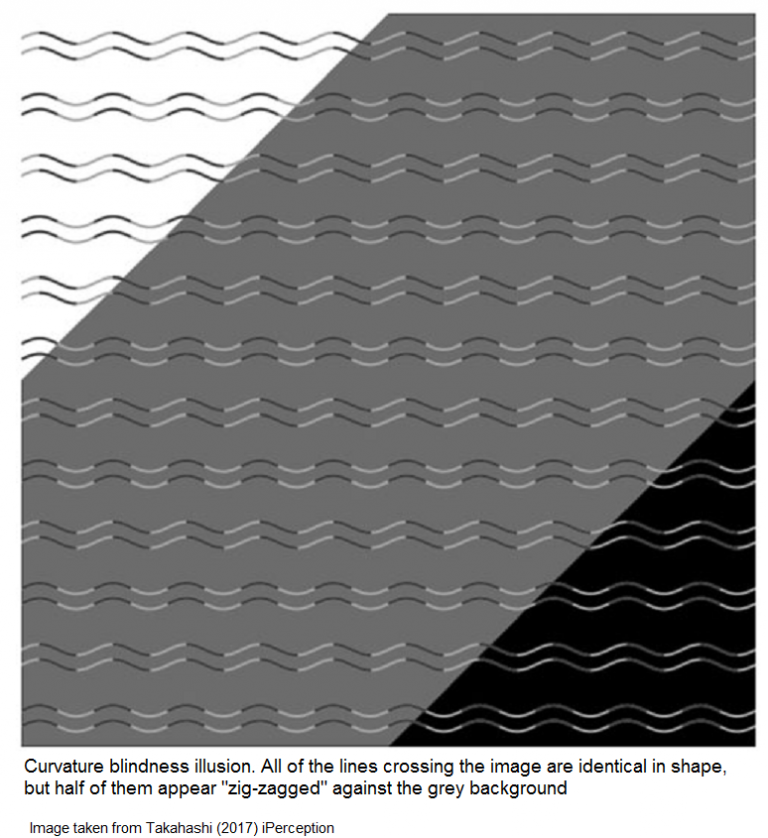
In the above image, pairs of wavy lines run horizontally across the screen. In the white and black corners, they’re fine. But in the gray area, half of those wavy lines suddenly look like zigzags.

The only difference? The alternating pattern of light and dark patches on each line. In lines where the peaks of the waves are dark and the valleys are light, the wavy pattern remains.

But when the dark and light patches are the ascending and descending parts of the wave, our eyes interpret them as lines forming corners instead of wavy lines.

This is known as the curvature blindness illusion.

As with many optical illusions, this is all about contrast. The white and black backgrounds allow you to view the alternating pieces as one continuous wavy line, whereas the gray background forces you to regard those alternating pieces as individual segments.

Those individual segments are granted the illusion of three-dimensions, and our minds process the lighter ascending line and the darker descending line as “walls” forming a corner, rather than the rising and falling of a sine wave.

It’s amazing how distinctly different the pairs of lines look with just those small variations. Even knowing how I’m being manipulated, it’s still hard to convince myself that I’m not actually seeing what I’m seeing.

Very cool stuff.


Thanks for visiting PuzzleNation Blog today! Be sure to sign up for our newsletter to stay up-to-date on everything PuzzleNation!

You can also share your pictures with us on Instagram, friend us on Facebook, check us out on TwitterPinterest, and Tumblr, and explore the always-expanding library of PuzzleNation apps and games on our website!

Consider the Pencil…

We spend a lot of time talking about pencil-and-paper puzzles here on the blog, but it’s rare for us to focus on the “pencil” part of that pairing.

Whether you prefer a regular pencil or a mechanical pencil for your puzzling, there’s no denying that having an eraser is a pretty comforting feature. (Although there is a certain confidence exuded by solving in pen.)

But how much do you actually know about everything that goes into making that classic solving tool?

Well, The New York Times has you covered. They recently posted an in-depth look behind the scenes of the production process at the General Pencil Company, and the photographs alone, like the one featured above, are fascinating.

From the article:

Such radical simplicity is surprisingly complicated to produce. Since 1889, the General Pencil Company has been converting huge quantities of raw materials (wax, paint, cedar planks, graphite) into products you can find, neatly boxed and labeled, in art and office-supply stores across the nation: watercolor pencils, editing pencils, sticks of charcoal, pastel chalks. Even as other factories have chased higher profit margins overseas, General Pencil has stayed put, cranking out thousands upon thousands of writing instruments in the middle of Jersey City.

The vivid, full-color photos in the gallery are accompanied by thoughtful musings on the writing process itself, making the article a quick, thoughtful read that’s worth your time.

Here’s one more snippet that stuck with me:

In an era of infinite screens, the humble pencil feels revolutionarily direct: It does exactly what it does, when it does it, right in front of you. Pencils eschew digital jujitsu. They are pure analog, absolute presence. They help to rescue us from oblivion… When you hold a pencil, your quietest little hand-dances are mapped exactly, from the loops and slashes to the final dot at the very end of a sentence.

That excerpt about simplicity reminds me of a classic exchange from The West Wing:

Leo McGarry: We spent millions of dollars developing a pen for the astronauts that would work in zero gravity. Know what the Russians did?
Toby Ziegler: Used a pencil?
Leo McGarry: They used a pencil.

And although that story about millions spent on a space pen has been thoroughly debunked, the point remains.

Pencils get the job done.


Thanks for visiting PuzzleNation Blog today! Be sure to sign up for our newsletter to stay up-to-date on everything PuzzleNation!

You can also share your pictures with us on Instagram, friend us on Facebook, check us out on TwitterPinterest, and Tumblr, and explore the always-expanding library of PuzzleNation apps and games on our website!

The Robots Are Here and They Can Spell

[Image courtesy of World of Weird Things.]

I warned you, fellow puzzlers. You can’t say I didn’t warn you.

The robots are coming, and they want our puzzles and games.

Let’s look at the hit list:

  • Deep Blue defeated Russian chess grandmaster Garry Kasparov under standard chess tournament time constraints
  • IBM’s supercomputer Watson bested previous Jeopardy! champions Brad Rutter and Ken Jennings to nab a million-dollar prize
  • An AI program called DeepMind taught itself to play several Atari games with superhuman proficiency
  • There are several robots constructed out of LEGOs that solve Rubik’s Cubes in seconds flat
  • Dr. Fill, the crossword-solving computer program, competes at the American Crossword Puzzle Tournament, and in a matter of five years, it has jumped from 141st place in the 2012 tournament to 11th place in the 2017 tournament
  • Just last year, an AI developed by Google, AlphaGo (a product of DeepMind), twice defeated Ke Jie, the 19-year-old Go tournament champion ranked number one in the world

And Scrabble fans, you’re the next ones in the crosshairs of the machines.

During last week’s Consumer Electronics Show (CES), the Industrial Technology Research Institute out of Taiwan debuted the IVS Robot — aka The Intelligent Vision System for Companion Robots — a machine capable of defeating human competitors at Scrabble.

[Image courtesy of ABC News.]

Instead of tiles and a standard Scrabble board, the IVS reads letter cubes (similar to a child’s alphabet blocks) played on a slightly larger gameboard. But time limits for play and standard rules still apply.

From an article on Engadget:

It’s hard not to be impressed by all the moving parts here. For one, the robot has to learn and understand the rules of the game and the best strategies for winning. It also needs to be able to see and recognize the game pieces and the spots on the board. That means it can read the letters on the cubes and identify the double-letter and triple-word score spots.

And, last but not least, it needs the dexterity to place the pieces on the board and not disturb the existing letters — which is especially difficult when you’re laying down two words next to each other to rack up those two-letter combos.

A quick Google search confirms that the robot bested practically every reporter, tech-savvy or otherwise, that crossed its path.

In the video below, North American Scrabble champion Will Anderson teams up with reporter Lexy Savvides to battle the robot, but a technical error prevents the game from getting very far:

Still, you can see the potential here. I’m sure it won’t be long before the IVS Robot is making appearances at Scrabble tournaments, attempting to establish machine dominance over another puzzly activity.

Stay strong, fellow puzzlers.


Thanks for visiting PuzzleNation Blog today! Be sure to sign up for our newsletter to stay up-to-date on everything PuzzleNation!

You can also share your pictures with us on Instagram, friend us on Facebook, check us out on TwitterPinterest, and Tumblr, and explore the always-expanding library of PuzzleNation apps and games on our website!

Kickstarter Roundup!

Oh yes, it’s that time again. For several years now, crowdfunding platforms like Kickstarter and Indiegogo have been hotbeds of innovative puzzle and game design, and I’m always happy to spread the word about worthy projects that I think will delight and amaze my fellow PuzzleNationers.

So let’s take a look at some projects that are currently seeking funding and see if any pique your interest!


Verwald’s Treasures is a puzzle hunt designed by Nathan Curtis that can be solved either from home or in a live puzzle hunt event held in the Boston area.

Curtis promises that the puzzle hunt will involve over thirty different puzzles, including three-dimensional challenges to really test your puzzly mettle.

For a smaller donation, you’ll receive a number of variety pencil puzzles (unconnected to the puzzle hunt itself), but in order to participate in the hunt itself, pledges start at $60. The campaign is about halfway funded with 22 days to go, and should provide a puzzly challenge outside the norm for solvers accustomed to pencil-and-paper puzzles.
Another puzzle-filled project is The Conjurer’s Almanaq, touted as an escape room in a book. It is a self-contained puzzling experience that will test all sorts of puzzly skills, masquerading as a book of magic. Clearly a great deal of storytelling and homework has gone into this one, including cryptic tales of the great Qdini, who created the book.

Plus this Kickstarter edition of the book will be different from the mass market version to come. Not only will more of the pages be in color, but backers will receive their copy of the book at least a month before the mass market version goes on sale.

This seems like a really intriguing campaign, and it’s already over 200% funded with two weeks to go, so your chances of seeing the campaign come to fruition are already pretty good.

Let’s switch gears from puzzles to games and check out The Mansky Caper, a heist game from Ray Wehrs at Calliope Games.

There are safes to crack, explosives to acquire, loot to hide, and other members of an ambitious mob family to contend with. You can forge alliances with other players too, but be careful… if you press your luck too far, you might just fall victim to an explosive booby trap.

This looks like great fun, and it’s three-quarters of the way funded with over three weeks to go in the campaign.

For a game with more of a social element — heavy on negotiation — there’s Black Hole Council. Every player is a member of council that allocates resources to different planets — and consigns some to destruction in a black hole.

Each player has their own agenda they’d like to advance, and as the role of “leader” passes from player to player, deals are negotiated, bribes are offered, arguments are made, and votes are held to see just how the various planets are arranged. Can you convince your fellow players to make moves that are to your advantage, or will these planets slip from your fingertips?

The game is already funded and chasing stretch goals at this point (with over two weeks to go), and it looks like a nice step up in complexity from other deceit and negotiation games like Coup or The Resistance.

We’ll conclude today’s Kickstarter roundup with a music-minded strategy game, Re-Chord.

In this game, you’re a guitarist pursuing the top of the charts, and you do so by playing actual chords to complete songs and build your level of fame. You can learn music while you play!

The game is 200% funded with over 20 days to go — which means they’re well on their way to funding expansions to the game, additional chord cards, and more — and it seems like a clever mix of music and tactics, the perfect bridge to bring non-gamers to the table.


Have any of these games hooked you? Let us know which ones you’re supporting in the comments section below! And if there are any campaigns you’re supporting that we missed, let us know!

Thanks for visiting PuzzleNation Blog today! Be sure to sign up for our newsletter to stay up-to-date on everything PuzzleNation!

You can also share your pictures with us on Instagram, friend us on Facebook, check us out on TwitterPinterest, and Tumblr, and explore the always-expanding library of PuzzleNation apps and games on our website!

An Amazing New Resource for Aspiring Constructors!

Just yesterday, I mentioned the accessibility of many modern puzzle constructors thanks to the Internet. Of course, I was referring to access to their puzzle content, but a new project has reminded me that many constructors are also very accessible when it comes to advice and encouragement.

Deb Amlen wrote an article about a new Facebook page, the Puzzle Collaboration Directory, that is encouraging new and aspiring constructors to reach out to established names in the industry and build an interactive community. This is an amazing resource for puzzlers whose enthusiasm might be undercut by lack of confidence or experience in crafting themes, building grids, and creating clues.

From the introductory post:

If you’re a puzzle constructor looking to collaborate or to be a resource to those seeking one, kindly add your name, contact info, and puzzle specialties to the file entitled “constructors list.”

If you’re here looking for someone to collaborate with, ask questions of, or something in that general vicinity, you can peruse the aforementioned file and reach out to any of the constructors listed – we’ll be happy to hear from you. If you have a question that everyone would benefit from hearing, or if you want to work with someone and you’re not picky about who, feel free to post directly in the group to that effect.

Terrific, innovative, and generous puzzlers like joon pahk, Erik Agard, Robyn Weintraub, Andy Kravis, Doug Peterson, Tracy Bennett, and more have all signed up to mentor aspiring constructors and answer questions.

This is just one more example of how awesome the puzzle community is. We’re all fans of puzzles and we’re more than happy to encourage others with the same passion. (Heck, a few years ago, we also shared some constructing advice right here on the blog.)

You never know where the next great puzzle theme will come from, or who will be wowing you with crafty clues and brain-melting themes in the future.

Good luck to all the constructors getting started there, and a hearty thank you to all the constructors who have already signed up to share their time, insights, and knowledge. I can’t wait to see what comes from this marvelous new resource.


Thanks for visiting PuzzleNation Blog today! Be sure to sign up for our newsletter to stay up-to-date on everything PuzzleNation!

You can also share your pictures with us on Instagram, friend us on Facebook, check us out on TwitterPinterest, and Tumblr, and explore the always-expanding library of PuzzleNation apps and games on our website!
PuzzleNation Review: Topple Magazine

One of the best things about being a puzzle constructor these days is the level of access solvers have to you and your puzzles. Many constructors create and maintain their own puzzle subscription services, funding them through tips, crowdfunding, subscription fees, or direct-to-solver sales. When puzzly skills and a knack for self-promotion meet, you have the opportunity for real success in building a reputation and an audience.

So when constructor Gregory Gray reached out to me regarding his puzzle e-magazine, Topple, I was all ears. Whether it’s print books, downloadable puzzle packets, or Kickstarter campaigns, I’m always happy to spread the word about puzzle projects that I think the PuzzleNation audience will enjoy.

Gregory sent me the latest edition of Topple (issue VII) to review, so let’s dive right in.

Issue 7 offers a variety of different puzzles to try out. Anagramming and word-forming challenges, trivia, a rebus, some deduction, find-the-path games, and more can be found across these 12 pages of puzzles (plus solution pages, obviously).

I was immediately impressed with all of the different solving styles on display. Shying away from classics like crosswords, word seeks, and fill-ins, Topple opts for puzzles that offer greater opportunities to incorporate art and interesting layouts.

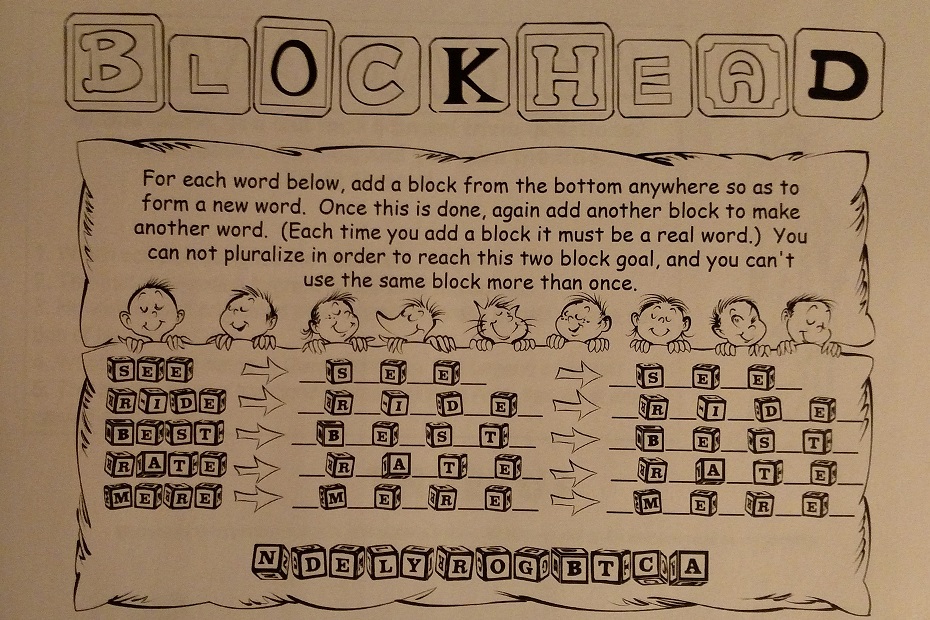
From the anagram rings of ‘Gram Crackers to the alphabet blocks of Blockhead, a great deal of work has clearly gone into not only the puzzles, but the presentation of them, which makes for a very eye-catching solving experience.

The mix of art and puzzles also presents a more welcoming tone for new solvers, who might find a denser arrangement of puzzle grids to be more off-putting or daunting. Each puzzle is given plenty of space to establish itself, so even unfamiliar puzzle types seem more inviting.

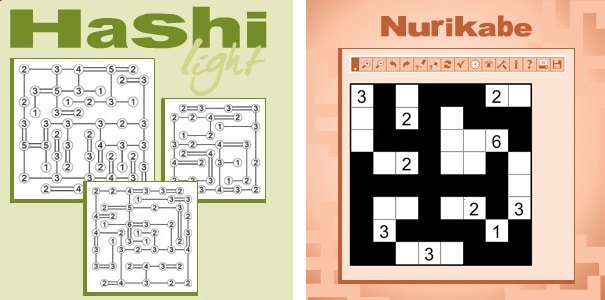
But solvers who prefer a bit more challenge will also find something worth their time in this issue of Topple, as a two-page spread of Japanese-style deduction puzzles awaits you in the middle of the book. Whether you’re connecting the dots in Masyu and Hashi or deducing the placement of numbers in Kakuro or black square in Nurikabe, these were easily the most challenging puzzles in the entire magazine, a pleasant change of pace for a more experienced solver.

[Examples of Hashi and Nurikabe puzzles.
Images courtesy of Conceptis Puzzles.]

To be fair, the book isn’t perfect. Some of the blurbs explaining the rules of each puzzle are a bit clunky, which can lead to moments of solver confusion. For instance, it’s not immediately clear in Blockhead if you can anagram the letters in each given word, or if those letters stay in place while you add a letter from the options below.

But those hiccups are few and far between, and for the most part, I found solving issue 7 of Topple to be a very enjoyable solving experience. I breezed through some puzzles, while others put my puzzly skills to the test.

And with Topple, you get quite a bang for your buck. Literally: Each issue of Topple is only $1, and when you consider both the variety of puzzles and the production quality of the book, it’s a steal.

So if you’re looking to try something new without breaking the bank, Topple is an excellent place to start.

The complete Topple collection, along with a free downloadable sampler pack of puzzles, can be found here. You can also subscribe to Topple through Patreon, and be sure to keep up with all things Topple-related on their Facebook page.


Thanks for visiting PuzzleNation Blog today! Be sure to sign up for our newsletter to stay up-to-date on everything PuzzleNation!

You can also share your pictures with us on Instagram, friend us on Facebook, check us out on TwitterPinterest, and Tumblr, and explore the always-expanding library of PuzzleNation apps and games on our website!