The puzzle community is really amazing. It’s an incredibly open, friendly, and welcoming band of creators, miscreants, wordsmiths, and trivia buffs from all walks of life, united by a love of wordplay and the satisfying discovery of a solution, be it to a puzzle or a problem.
Basically, if you’re in a bind, if you need help, there’s usually a puzzler there by your side to back you up.
This blog has given me plenty of opportunities to detail wonderful charitable programs spearheaded by puzzlers in the past, and today, it’s my pleasure and my privilege to bring another to your attention, my fellow PuzzleNationers.
Like last year’s Puzzles for Progress (which inspired it!), Queer Crosswords is all about providing a small puzzly incentive to do some good and reach out.
Once you’ve donated to one of the worthy causes detailed here — including the ACLU, PFLAG, The Trevor Project, the Trans Women of Color Collective, and others — you can send a copy of your charitable receipt to Nate Cardin at queerqrosswords@gmail.com.
And in return, you’ll receive a PDF loaded with 22 pages of original puzzles by great constructors like Tracy Bennett, Todd Gross, Mark Halpin, Andrew Ries, Trip Payne, Jenna LaFleur, Andy Kravis, and more.
It’s a little puzzly thank you for playing your part in building a better world, and I applaud everyone involved in this venture.
[You can click here for full details on Queer Crosswords.]
Thanks for visiting PuzzleNation Blog today! Be sure to sign up for our newsletter to stay up-to-date on everything PuzzleNation!
Even when I’m not thinking about puzzles or intending to learn about puzzles, puzzles find me.
I was reading one of the most recent editions of Ripley’s Believe It or Not!, those delightful compendiums of all things amazing, weird, and unlikely. Everything from world records and peculiar habits to once-in-a-lifetime events and mind-bending coincidences are found between the covers of these collections.
And one particular fact caught my eye:
Eighty-six prisoners at Exeter Jail in Devon, England, signed a formal letter of complaint claiming that a Sudoku puzzle in the local newspaper — the Exeter Express and Echo — on May 21, 2015, was impossible to solve.
Here is the message the prisoners sent to the editor of The Exeter Express and Echo:
Dear Sir/Madam, I am sadly writing this letter in A LOT of disappointment.
As you will see, I’ve enclosed last week’s Sudoko [sic] page and we (along with 84 other prisoners) believe you printed a ‘hard’ Sudoku which is IMPOSSIBLE to complete.
As being prisoners we are only aloud [sic] access to Thursday’s issue, so we couldn’t verify the truth.
Yours FAITHFULLY,
Michael Blatchford Shane Smith
Yes, The Exeter Express and Echo is printed twice a week, and since the answers to Thursday’s puzzles appear on Monday, and the inmates don’t have access to Monday’s issues, they were unable to check their own work.
So, naturally, I had to see whether this Sudoku puzzle was as unsolvable as the inmates claimed.
Finding a copy of the puzzle wasn’t hard. Here, I’ll post it here, in case you want to try your hand at it yourself:
In all honesty, I’m not the strongest or the fastest Sudoku solver. But I did complete this puzzle, difficult as it was. I suspect, given time, you would complete it as well. I don’t mean to impugn the Sudoku skills of the Exeter Jail population. I’m just saying.
As it turns out, the inmates had made a few key mistakes, mostly in the middle section, and since they apparently solve in ink, it made things much harder.
But, in a lovely response, the staff at The Exeter Express and Echo promised to make Monday papers available to the inmates as well, so they can double-check their answers next time. That’s nice.
And here’s hoping their Sudoku solving has been smooth sailing ever since. Apparently, it has been, since Ripley’s has yet to mention them a second time.
Thanks for visiting PuzzleNation Blog today! Be sure to sign up for our newsletter to stay up-to-date on everything PuzzleNation!
The 41st annual American Crossword Puzzle Tournament was this weekend, and puzzlers descended on the Stamford Marriott Hotel once again to put their puzzly skills to the test in what is lovingly known as “the Nerd Olympics.”
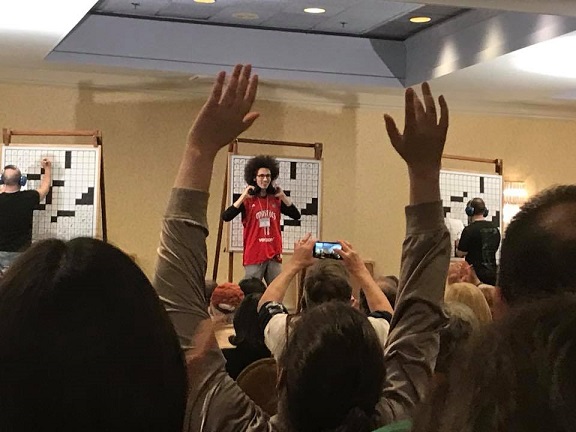
The tournament takes place over two days, with six puzzles to solve on Saturday, followed by one on Sunday. Then the top three finishers in the A, B, and C brackets solve the championship puzzle on whiteboards in front of the audience.
On Friday and Saturday night, there are often puzzle events, demonstrations, and panels by top puzzlers and figures in the puzzle world as well.
I made the journey down to Stamford myself Saturday morning, arriving with plenty of time to spare to prep our spot in the puzzle marketplace and say hello to friends and puzzly acquaintances. This year, I was joined at the Penny Dell Puzzles booth once again by my friend and partner-in-promotion Stacey Scarso.
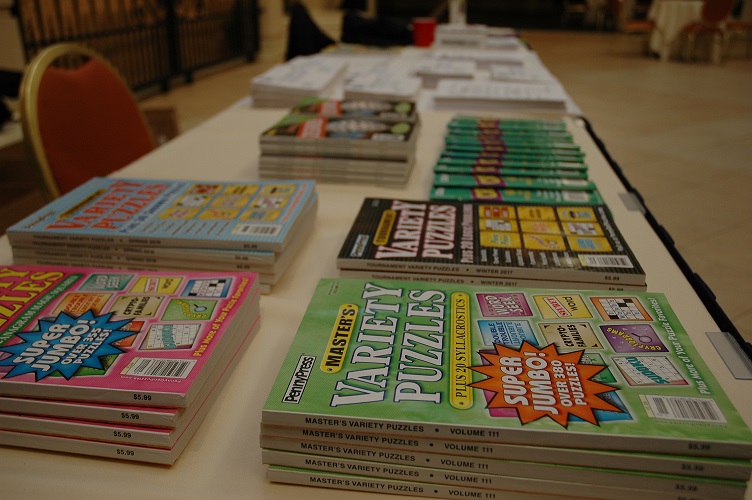
The Penny Dell crew had a terrific setup as always, with a metric buttload of magazines to give away, including copies of The Crosswords Club and several flavors of Tournament Variety, Master’s Variety, and Dell Sunday Crosswords. They were also running a kickass promotion offering half-price on a year’s subscription to Crosswords Club, which is a great deal.
Plus we had a terrific sample puzzle for the Daily POP Crosswords app, constructed by the marvelous Angela Halsted! You can click this link for the answer grid AND a bonus offer for anyone who missed our ACPT tournament puzzle!
PLUS we held a contest to win a bundle of PDP puzzle swag, including a mug, a tote bag, an umbrella, and a bunch of puzzle magazines! All you had to do was solve a marvelous crossword variant puzzle cooked up by the folks at Penny Dell. (Though I did have a hand in writing some of the clues.)
And, yes, in their downtime between tournament puzzles, many competitors DO solve other puzzles.
At 9 AM, the tournament was two hours away, but the marketplace was up and running. There were puzzle magazines galore from the Village Bookstore (as well as a table of Merl Reagle’s puzzle books), a booth loaded with Nathan Curtis’s various puzzly projects, and ACPT-themed jewelry, key chains, teddy bears, magnets, and other items from All of the Things.
As competitors readied themselves for the day’s solving, I had plenty of time to see friends of the blog like Crosswords Club editor Patti Varol, crossword gentleman Doug Peterson, constructor Joanne Sullivan, and Penny Press variety editor Keith Yarbrough!
Perhaps the best part of attending the tournament is getting to chat with so many members of the puzzle community in one place. There were first-time attendees and enthusiastic rookies; apparently, contestants ranged in age from 17 to 92(!), and there was a 90-year-old rookie competing this year!
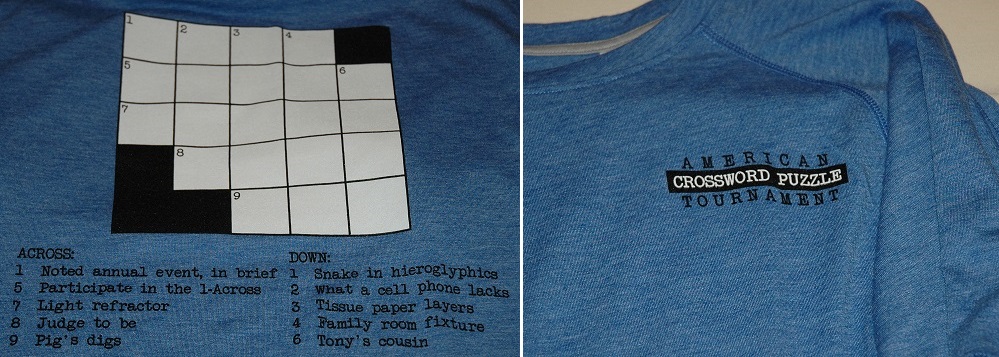
There were long-time puzzle fans who have been competing at ACPT for years, if not decades, many of whom were decked out in puzzle shirts, puzzle scarves, and other grid-heavy accoutrements.
One of the attendees even offered to buy the Crossword Puzzle Junkie shirt off my back! I assured him that that would work for him and literally no one else in attendance.
But I digress.
Many of the top constructors in the business were there, names like David Steinberg, Evan Birnholz, Joon Pahk, Peter Gordon, and more, along with former champions and first-rate competitors like Dan Feyer, Tyler Hinman, Howard Barkin, Ellen Ripstein, and Stella Zawistowski.
Getting to connect faces and personalities with names I know from tournaments like the Indie 500 is a real treat, and so many of the people in the puzzle world are genuinely nice, funny individuals. Not only that, but I also got to meet several fellow trivia fiends from the Learned League community!
The two hours before showtime passed quickly, and soon, the marketplace emptied and the ballroom filled as competitors took their seats for Puzzle 1.
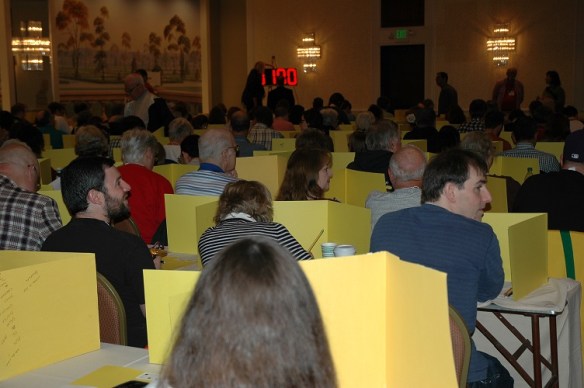
Attendance jumped again this year, which meant not only was the main ballroom absolutely jam-packed with competitors, but an overflow room was needed to accommodate the nearly 700 solvers in Stamford!
When Puzzle 1 arrived, most competitors found Tracy Gray’s puzzle to be quick and fair. One solver in particular, constructor Erik Agard, delivered an absolutely blistering time, solving the puzzle in under 2 minutes! (A feat not seen since Dan Feyer did so in 2015.) It immediately rocketed Erik to the top of the leaderboard in impressive fashion.
Puzzle 2, constructed by prolific puzzler Zhouqin Burnikel, surprised some solvers with its difficulty. Then again, Puzzle 2 has been on the tougher side for at least the last few years, but I think many solvers forget that, given how legendarily difficult Puzzle 5 is every year. It’s easy to forget other puzzles can offer quite a challenge along the way.
Puzzle 3 was constructed by Mike Shenk, and served as a well-received palate-cleanser before the lunch break. Solvers scattered to the four winds in order to grab a bite to eat before returning by 2:30 for Puzzle 4.
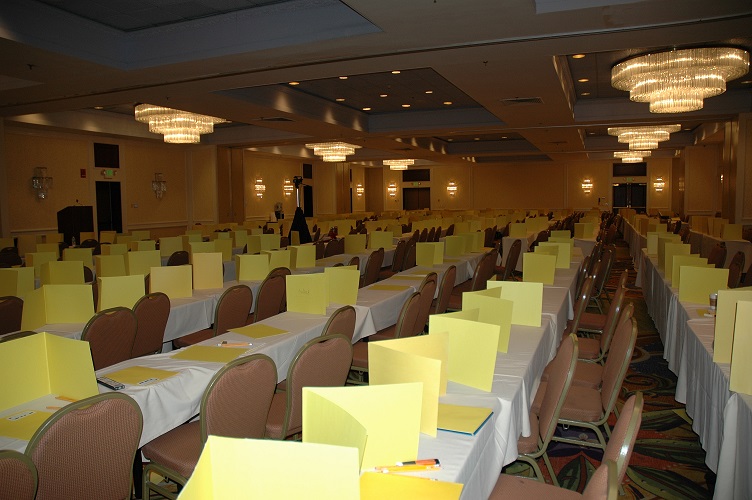
[Even empty, all the dividers make the room feel packed…]
And what a Puzzle 4 it was. Constructed by Damon Gulczynski, this puzzle had a visual element that tripped up several top competitors. (An unclear blurb “explanation” didn’t help matters, and several competitors told me they would’ve been better off with no blurb at all.)
The judges were forced to actually explain the puzzle before competitors began Puzzle 5. It was a disappointing way for the second half of the tournament day to kick off.
Not only that, but one solver was mistakenly given Puzzle 5 to solve INSTEAD of Puzzle 4. He managed to solve it in the shorter time allotted, but couldn’t fairly solve Puzzle 4 afterward because of the explanation. I haven’t been able to follow up and find out what exactly happened to his score.
Finally, after the unexpected drama of Puzzle 4, it was time for Puzzle 5. This year, constructor Joel Fagliano did the honors, and according to competitors, it was as challenging as expected, really putting the craftiness and keen wits of the solvers to the test. (Apparently, computer solving program Dr. Fill failed to complete puzzle 5, one of its few slip-ups in an otherwise impressive year for the program.)
After the diabolical Puzzle 5, competitors closed out the day with Puzzle 6, constructed by Lynn Lempel, and declared it both fun and fair. The competitors dispersed to rest their brains (or solve more puzzles). We packed up the Penny/Dell table and headed for home.
And although I wasn’t present for Sunday’s tournament finale, I continued to get updates from friends and fellow puzzlers.
Puzzle 7, constructed by Patrick Berry, was what you might expect from a constructor of his caliber: elegant fill, very little crosswordese, and great fun.
Erik Agard remained at the top of the leaderboard, having kept a great solving pace after his outstanding performance on Puzzle 1 — a nice redemption for him after a heartbreaker last year, when an error dropped him out of finals contention after a strong performance overall.
So the final three would be Erik, Dan Feyer (7-time champ), and David Plotkin (a familiar name in the top ten).
Thankfully, this year, there was no repeat of last year’s flub where the B-level finalists got the A-level clues or anything like that. And there were no distinct time advantages among the top solvers.
It was simply a match-up of some of the fastest, sharpest puzzlers. (Including 2 rookies in the C-level final!)
Erik Agard would complete the puzzle first, solving it in under 5 minutes. By comparison, huge swathes of Dan and David’s grids were still empty at this point. It was a stunning showing for a very well-liked member of the puzzle community!
Dan Feyer would wrap the puzzle up in 9 minutes, with David Plotkin following at around 13.
As he had done all tournament, Erik solved with incredible speed and precision, claiming his first tournament victory!
And it was a strong showing for many other familiar names! Doug Peterson placed 14th (up from 18th last year!), David Steinberg placed 23rd (up from 28th!), and Patti Varol placed 74th (up from 103 last year!) out of a field of almost 700 participants. (And even with one eye tied behind his back, Keith Yarbrough managed an impressive performance as well!)
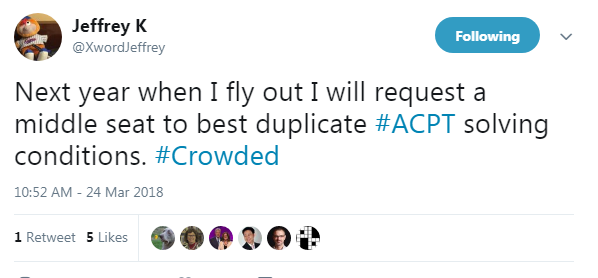
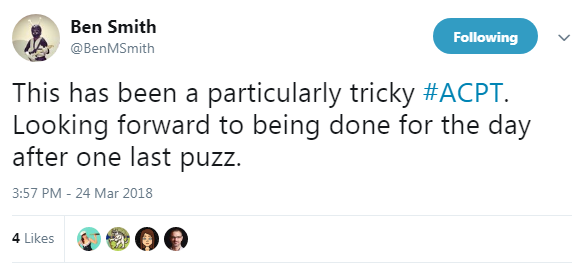
[I wonder how many competitors this tweet applies to…]
It’s always great fun to spend time with fellow puzzlers and wordplay enthusiasts, immersing myself in the puzzle community and enjoying all the charm and camaraderie that comes with it.
We’ll see you next year!
Thanks for visiting PuzzleNation Blog today! Be sure to sign up for our newsletter to stay up-to-date on everything PuzzleNation!
Puzzlers from all over are sharpening their pencils and their wits as they gear up for what is affectionately known as the Nerd Olympics, and we here at PuzzleNation wish all of the competitors the best of luck!
Here’s hoping Puzzle #5 isn’t as diabolical as it has been in previous years!
There is a topnotch lineup of constructors to challenge this year’s competitors. Not only do we have Patrick Berry and Mike Shenk — perennial contributors to the tournament — as well as the prolific Zhouqin Burnikel and other ACPT stalwarts like Lynn Lempel, Sam Ezersky, Joel Fagliano, and Damon Gulczynski. Only Tracy Gray is a newcomer to crafting tournament puzzles. I can’t wait to see what they’ve concocted for this year’s tournament!
Good luck to everyone competing! And hey, if you need a pencil sharpener — or you’d like some terrific puzzly freebies and contests — we’ll be hanging out with our pals at the Penny Dell Puzzles table again this year! Be sure to stop by!
Thanks for visiting PuzzleNation Blog today! Be sure to sign up for our newsletter to stay up-to-date on everything PuzzleNation!
Last week, a murder investigation turned into a puzzly treasure hunt for a group of NCIS investigators, a team who investigates criminal cases involving members of the military. So join us as we rundown the events of “Treasure Hunt,” episode 17 of season 4 of NCIS: New Orleans.
The episode opens during a pirate-themed festival, as two women search for the secret entrance to an exclusive costume party. Unfortunately, instead of drunken revelry, they stumble upon a dead body, strung up inside a warehouse on the waterfront.
The NCIS team soon arrives, and the coroner identifies the victim as an oceanographer, Lt. Commander Elaine Dodd. Dodd was beaten before her death, and her arm was partially skinned, perhaps as part of an interrogation.
Dodd’s oceanographic work centered around Grande Isle, the former stomping grounds of the infamous pirate Jean LaFitte. The team makes contact with Dodd’s father, Tom, a former Green Beret. He expected her to show up at his house in Florida after an excited phone call, but she never arrived. This leads the team to believe that Dodd’s death had something to do with a treasure hunt, one of the things she and her father bonded over.
Forensic analysis reveals that her arm was skinned to remove a tattoo, but they’re able to reconstruct the image: a simple compass and some coordinates. These confirm the treasure hunt theory: Dodd had apparently made some progress in locating the lost Napoleon Fleur de Lis, a jewel-encrusted emblem stolen by Jean LaFitte and hidden away.
Following the coordinates to a church, Special Agent Pride and lab tech Sebastian search the area, finding their way upstairs to a lofted storage area. But someone has beaten them to the punch, opening fire and sending the agents scurrying for cover.
Pride chases the two suspects, but they get away, and when he doubles back to the loft, he finds Sebastian examining a statue stored in the church attic. Once the statue is removed from its pedestal, a secret compartment opens, revealing a wooden puzzle book wrapped in cloth.
The puzzle book is marked with a fleur de lis and bears an inscription of Jean LaFitte’s signature. The investigation of Dodd’s murder has officially become a treasure hunt.
Back at the field office, Agent Gregorio would prefer to use a knife to crack open the book, but Sebastian insists on solving the cipher to open the book, as some puzzle books include a vial of acid inside that would destroy the book if tampered with.
While he works on the puzzle book, cameras outside the church help the agents ID one of the suspects, a mercenary for hire. Dodd’s father Tom enters the office, hoping for progress, and recognizes the suspect. He points the agents toward the mercenary’s usual employer, a specialist in deep-sea diving and sunken galleons. Dodd’s father offers to arrange a meeting, and the team is wary, but takes him up on his offer.
Meanwhile, Sebastian and Gregorio check Dodd’s phone records and find several calls to a local professor, Michelle Faucheux, an expert in LaFitte and pirate history, who they believe helped Elaine find the coordinates. But when they arrive at her home, it has been ransacked, the professor locked in a closet. After they release her and calm her down, she confirms she’d been talking to Elaine.
Tom makes good on his word and lures his contact to a bar with the agents in tow. But the man, Walton, claims he hasn’t worked with either of the suspects in months. He warns Tom and the team away from the treasure hunt, clearly spooked by the ruthlessness he’s observed.
Sebastian and Gregorio bring Michelle back to the office, and she’s stoked to see the puzzle book. The cover of the puzzle book is encrypted, and they have to turn a dial in order to unlock it. But they need a key word to help solve the cipher. After trying out various words, they focus on LaFitte’s brother, Pierre — the most likely person to be hunting for LaFitte’s treasure. This leads them to try the word “Cabildo,” the jail in which Pierre had been incarcerated.
Using that as the key word — and a Vigenere cipher to crack the code — leads them to the answer “fleur de lis”, and they unlock the puzzle book’s cover. The iris in the center opens, revealing a latch, and they open the puzzle book.
On the left page is a clock puzzle, and on the right is a map with smaller code dials beneath it, along with a plate reading BLF6.
Agent Pride calls them, informing Gregorio that the two suspects are camped out right down the street from the office. He and the team are en route, but they expect trouble soon.
Oddly enough, the suspects simply hang back and wait as the team reunites. The agents suspect the mercenaries are waiting for the team to lead them to the fleur. So the team focuses on the riddle, hoping for a chance to gather more info on whomever is bankrolling the gun-toting baddies.
The riddle “Move as the clock” offers a hint for how to find which code letters to enter, but they’re not sure where to start. Pride theorizes that BLF6 could point toward Barthelemy Lafon, an architect and city planner from the 1700s who also palled around with the LaFitte brothers. He is buried in a local cemetery, in a crypt located at F6 on the map.
Gregorio, Sebastian, and Michelle head to the crypt while Agents Percy and LaSalle keep their eyes on the suspects, getting close enough to clone their phones and gain access to their calls and text messages. Pride and Dodd’s father are back at the field office, trying to figure out who would literally kill to have the artifact.
The puzzle book trio spot an engraved fleur de lis over the letter L in “Lafon”. They try “moving as the clock” by moving clockwise to the next crypt. Another fleur de lis over another crypt engraving gives them the final letter they need, unlocking a compartment in the book and revealing both the suspected acid vial and a piece of paper. It’s a partial map with another riddle written in French. Michelle quickly translates it as “enter this last crypt to find the fleur de lis” and runs off.
At this point, all of the viewers become very suspicious of Michelle. I mean, come on, the riddle was four lines long, and given how tough the puzzle book had been to crack thus far, this seemed too easy.
Meanwhile, the suspects leave after receiving a text that the fleur is NOT in the cemetery. As you might have suspected, Michelle texted the suspects and has been behind everything the whole time. But the viewers are clearly one-up on the agents, who blindly follow Michelle to another crypt, where Michelle traps them inside and runs off.
We get some unnecessary backstory on Michelle involving a dead brother and being scammed out of treasure by the Spanish government, but who cares, what about the treasure hunt?
Pride and Tom go after Michelle while Percy and LaSalle hunts for the easily bamboozled agents, who are trapped in the crypt and running out of air. Pride and Tom head out to Fort Macomb, a repurposed, then abandoned, base which was formerly known as Chef Menteur. (It’s unclear whether they solved the map clue that Sebastian photographed and sent them before being trapped or if they just followed the hired goons.)
But nonetheless, they’re en route to the treasure while Gregorio and Sebastian set a fire inside the crypt, hoping the smoke will escape and lead their fellow agents to them before they suffocate. Their plan works, and they’re rescued.
At Fort Macomb, Pride orders Tom to stay with the car, and heads into the fort, getting the drop on Michelle. Unfortunately, her goons capture Tom, and Pride loses the standoff. In classic villain fashion, Michelle has Pride dig up the treasure for her.
At her moment of triumph, Tom puts his Green Beret training to work, taking out one of the hired thugs as Pride dispatches the other. Since we’re running on full cliche at this point, Tom has a chance to kill the woman who killed his daughter, but spares her after a speech from Pride. The better man and all that.
The episode closes with the team admiring the bejeweled source of everyone’s consternation. Tom decides to donate the fleur to the city, because that’s what his daughter would have done. Nice closer.
All in all, I was a little underwhelmed by the episode, because the plotline twists failed to keep up the same interest level that the treasure hunt did. Once they were done with the puzzle book, the cliches rapidly took over.
Who stops in the middle of a treasure hunt to tattoo a clue on themselves? Why wasn’t the tattoo artist a suspect? That would have been a nice touch. Also, Michelle’s transparent villainy wasn’t nearly as fun as her geeky schoolgirl excitement at cracking puzzles alongside Sebastian. That was easily the show’s highlight.
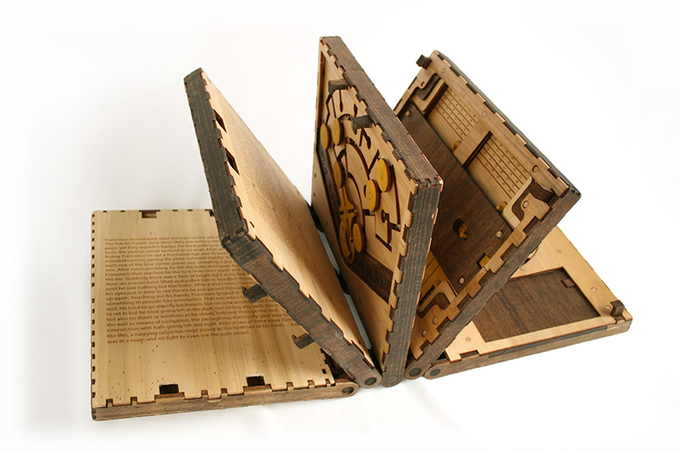
I do want to give a special shout-out to the Codex Silenda team, who created the specially weathered-looking puzzle book for the episode. I wrote about them back in August of 2016 when their wildly-successful Kickstarter campaign originally closed. They’ve been busy fulfilling orders for Kickstarter backers ever since, and they were clearly excited to see one of their puzzle books on a national stage like this.
What’s more amazing is that the puzzle book cracked by the NCIS team in this episode was only a few pages deep. The full Codex Silenda is much larger and more intricate! No doubt the real Jean LaFitte would’ve splashed out for the complete Codex in order to bamboozle potential treasure hunters.
Still, it’s always nice to see crime shows explore the possibilities that puzzles offer. Splicing up the occasional murder with a puzzle (or better yet, a treasure hunt) is a pleasant change of pace for the procedural genre. Nicely done, NCIS: NO.
Thanks for visiting PuzzleNation Blog today! Be sure to sign up for our newsletter to stay up-to-date on everything PuzzleNation!
Chess is one of the all-time classic games. Alongside Checkers, Go, Tic-Tac-Toe, and mah-jongg, chess is one of the cornerstones of the genre, one of the first games we’re introduced to, and one of the formative games upon which we build concepts of strategy, timing, and opportunity.
Over the centuries, there have been numerous attempts to reinvent chess or find new ways to play. We’ve talked about puzzly variations on chess in the past, all of which can be played with a standard chess set. (Except for that guillotine set we featured last year.) But if you’re looking for a truly unique chess experience, the team at Chessplus have a simple, elegant game for you.
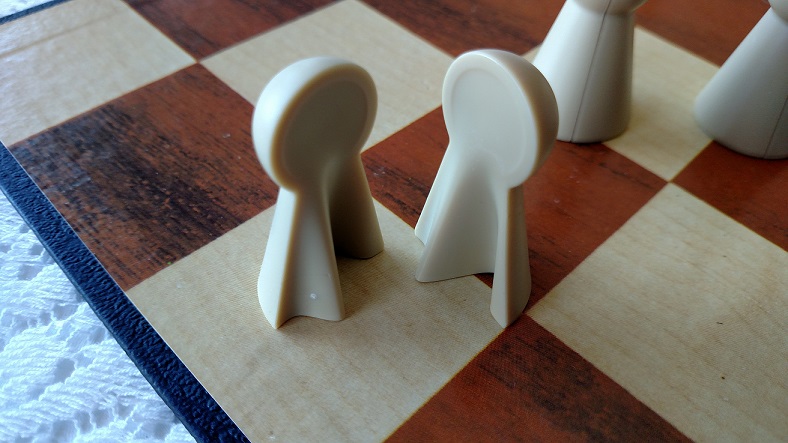
Chessplus is played under standard chess rules, but with one crucial difference: you can combine your pieces into more powerful ones.
Do you want a pawn that can make less-expected moves, or a knight that can play conservatively? Combine a knight and pawn into a single piece with the abilities of both. Do you need to keep your queen where it is, but still want a versatile piece that can command the board? Easy. Combine a rook and a bishop, and you’ve got a new piece that works just like a queen.
[Only the king is a solid piece. Every other piece can be combined with others.]
Merging pieces not only allows you to take advantage of each component’s abilities, but it can also allow you to more swiftly transport pieces across the board. Instead of a pawn crawling across the board one square at a time, combine it with a rook who can send it straight across the board, where it is then promoted to a queen! Or combine two pawns so you only have to escort one piece across the board safely, then split them again and voila! Two pawns promoted into new queens.
Oh yes, merging the pieces doesn’t link them forever. You can split them at any time. That feature adds another layer to your gameplay, since putting one merged piece into play deep in your opponent’s territory can suddenly become two separated pieces again.
Now, this piece-combining mechanic is a double-edged sword. Yes, you have a more powerful, mobile game piece. (I was very excited to try out combining a knight and a queen, just to make the queen even more dangerous.) But if someone takes a merged piece, you lose BOTH halves, making them as vulnerable as they are valuable. Imagine an opponent capturing my merged knight/queen, so I lose a knight AND a queen in one turn. That could be a devastating loss.
As you’d expect, it took a little while to grow accustomed to these new variant pieces. With so much to keep track of during a normal chess game, pieces with greater mobility make strategy — both offensive and defense — a bit more complicated.
But it was also great fun. Early Chessplus games tend to be faster, more aggressive, because of the greater mobility allowed by some of the merged piece combinations. But once you’ve played a few games, your more traditional chess mindset settles in, and gameplay tends to become more measured and tactical.
Just imagine. A single change that offers a world of new possibilities and challenges. That’s brilliant, in my estimation. Chessplus is a wonderful way to reinvigorate chess if the game has lost its luster for you. And if you are a dedicated player, I think Chessplus will prove to be a welcome change of piece from the traditional game.
[Chessplus sets start at $35.95 (for just the pieces) and are available from the shop on Chessplus.com.]
Thanks for visiting PuzzleNation Blog today! Be sure to sign up for our newsletter to stay up-to-date on everything PuzzleNation!
















 PuzzCulture