Too Topical? Too Safe? Too Family Friendly? — What Belongs in Crosswords?

Building a great crossword is a balancing act.

Your grid entries need to be interesting, yet accessible. You need to navigate long crossings and tight corners without resorting to too many abbreviations, too much crosswordese, or creating the dreaded Natick, a crossing of two obscure entries. Some solvers don’t like partial phrases, others don’t like proper names or brand names.

Your cluing has to be clever but not impenetrable. How much wordplay is too much? How many fill-in-the-blank clues before your clue section resembles your grid? The cluing must be fresh and vibrant yet timeless and not too of-its-era to make the cut for reprint and collection later.

No matter how you clue it, older solvers may decry newer names, slang, terminology, or pop culture references, while younger solvers will bemoan not just older references they consider passe, but long-established crossword-friendly words they quickly tire of seeing.

And that’s all without considering the difficulty in creating engaging, interesting themes or gimmicks for the puzzle.

Man, it’s amazing crosswords get made at all.

cg53bed4980c7a1

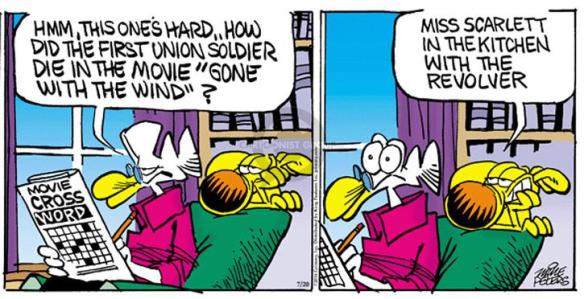
[Image courtesy of Mike Peters and The Comic Strips.]

That question of fresh entries and cluing vs. older/more familiar fare is a curious one. It raises further questions.

For instance, how much can you talk about what’s going on in the world?

By referring to unpleasant topics, however topical, will you alienate solvers who use the crossword as an escape? Or do you risk the puzzle feeling too sanitized and safe by NOT acknowledging the circumstances of the world at the time of the puzzle’s publication?

There are arguments for both sides. I mean, who wants to see ADOLF in a grid? (But then again, it’s not like IDI AMIN has a hard time finding his way into grid fill.)

farrar

Margaret Farrar believed that crosswords should avoid “death, disease, war and taxes.” Purposely avoiding unpleasant fill and cluing is informally known as the “Sunday Morning Breakfast Test.” (Our friends at Penny Press know plenty about this, as they shy away from unpleasant entries with diligence.)

But on the flip side, to ignore the unpleasantness of the world potentially ignores the people that unpleasantness affects.

As we continue to push for greater representation in crosswords in both editorial staff and constructors, you cannot deny that including the experiences of women, people of color, and members of the LGBTQIA+ community somewhat necessitates facing those unpleasant aspects of our history and our society.

To exclude them is to exclude potentially thought-provoking and important fill and cluing. (One could easily argue that the vast majority of our own Eyes Open crosswords would not pass the Sunday Morning Breakfast Test.)

9d7c4-14606390052169604336

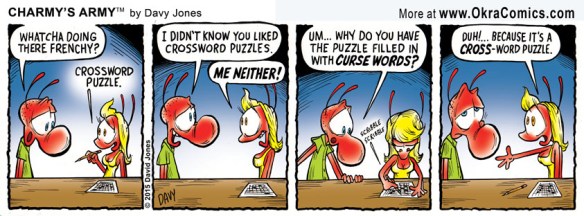
[Image courtesy of Charmy’s Army.]

Not everyone greets adding new cultural fill with open arms, of course. A few years ago, an LA Times crossword solver complained to us (on our holiday gift guide post, of all places) about “ignorant ghetto language” in the crossword. He referred specifically to innocuous entries like “sup,” “did,” and “street cred.”

Thankfully, he is an outlier.

But on the topic of excluding words from crosswords, when Will Shortz was asked about it, he had an interesting response:

If a word or term is used in the columns of The Times, or in cultured society in general, I think it’s probably O.K. for a crossword, even if it’s touchy or slightly unpleasant. I strive to have crosswords reflect real life as much as possible. … I don’t believe in banning words, except for the very worst. And I’d be happy to abolish the term ‘breakfast test’ completely.

breafkast

I think this is a topic I’m going to ask crossword solvers about more often. I’d be curious to see where they stand on crossword content and topicality.

I suspect opinions will vary, but I also suspect that most solvers welcome new fill, new entries, and new references in clues. Every crossword is an opportunity to learn and expand one’s knowledge, and add to the mental lexicon of crossword knowledge we each build as we solve.

So where do you stand, fellow puzzlers? Do you prefer your crosswords as an escape or as a puzzly reflection of the world around us? Let us know in the comments section below! We’d love to hear from you.


dailypopwsicon

Have you checked out our special summer deals yet? You can find them on the Home Screen for Daily POP Crosswords and Daily POP Word Search! Check them out!

Thanks for visiting PuzzleNation Blog today! Be sure to sign up for our newsletter to stay up-to-date on everything PuzzleNation!

Puzzles in Pop Culture: TV Escape Rooms!

sidequest2

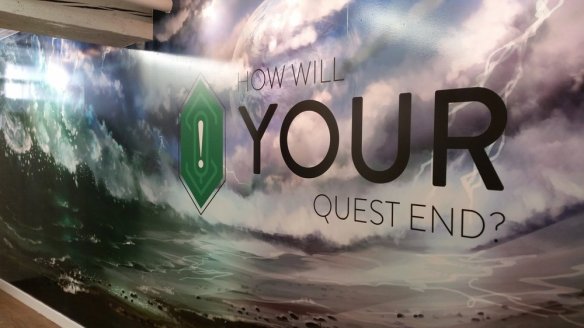
[Image courtesy of Yelp.]

It’s always interesting when TV shows incorporate puzzles into their stories. Not only do we get to see what Hollywood (and by extrapolation, the general public) thinks about a given puzzly experience, but we learn more about the characters when they face a particular puzzle or challenge.

This is especially true for sitcoms and comedies, since they usually have less time to focus on the puzzling and therefore put the spotlight on character relationships.

And it occurred to me that there are a number of different shows over the last few years that have featured the characters in escape room-style puzzle settings.

Why don’t we take a look at how accurately these puzzly experiences were portrayed, how difficult the room appeared to be, and what the characters’ solving skills were like?

Please enjoy as we explore fictional escape rooms from TV in our latest edition of Puzzles in Pop Culture!

big bang theory pic

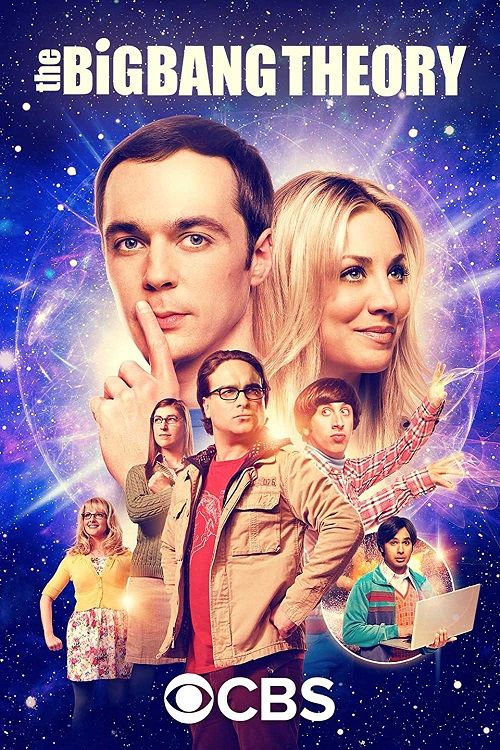
[Image courtesy of IMDb.]

For our first offering, we turn to the CBS juggernaut The Big Bang Theory. Over the years, TBBT has featured puzzly activities like giant Jenga, a holiday-fueled session of Dungeons & Dragons, and a scavenger hunt with puzzly clues.

So I wasn’t surprised that their take on escape rooms was the same: fairly accurate, but simplified and streamlined for a mainstream audience.

The room in TBBT is pretty spacious, moreso than pretty much any escape room I’ve seen. But the level of detail is easily something achievable for high-end rooms. Also, I’ve heard about escape rooms with actors playing zombies before, so this is legit.

(In fact, one I heard about in Washington D.C. had a zombie on a chain; the chain got longer the more time solvers took to crack puzzles, cutting the room in half at one point!)

We don’t get to see much of their solving, as they allude to puzzles conquered instead of showing us, so it’s hard to gauge difficulty. But given that most of the characters featured in the scene hold doctorates, we can safely assume the puzzles were middle-of-the-road or slightly harder.

However, the episode ignores the fact that you’re trying to escape the room in a certain amount of time. The characters seemed disappointed by their impressive performance, but they probably posted one of the top times in that room’s history. Nothing to sneeze at.

  • Accuracy rating: 4/5
  • Room difficulty: 3/5
  • Character solving skills: 5/5

[Image courtesy of FOX.com.]

Another show that hasn’t shied away from puzzly content is the former FOX and current NBC hit Brooklyn Nine-Nine. This comedy/drama set at a New York City police precinct has featured a seesaw brain teaser, a crossword-fueled arson mystery, and several multilayered heist storylines set around Halloween.

Puzzle enthusiast Captain Holt invites his fellow officers out to an escape room, and is dismayed when the disinterested Gina and the bumbling Hitchcock and Scully end up being his only fellow players. The group is immediately hampered by Hitchcock wasting two of their three hints, and Holt accidentally wasting the third.

The hint system is usually not as rigid in escape rooms. Three hints is common, though many places allow you to ask for more; sometimes there’s a time penalty, sometimes not. Also, the room in B99 is a three-hour challenge, which was a surprise. The standard time is an hour, though I’ve seen rooms push it to ninety minutes.

The group has also clearly not tried the classic escape room method of “touch everything,” because an hour and a half into the game, having found only one of the four keys needed to escape the room, Holt has not yet investigated the bright red phone sitting out in the open.

This is another escape room where difficulty is tough to judge. Unfortunately, we’re not given enough details on the first key (which involves some sort of chess puzzle) and the fourth key to really gauge the room. But despite the rocky start, the lovable team of misfits manages to escape.

  • Accuracy rating: 3/5
  • Room difficulty: 2/5
  • Character solving skills: Holt gets a 3.5/5, everyone else gets a 2/5.

always-sunny

[Image courtesy of Variety.]

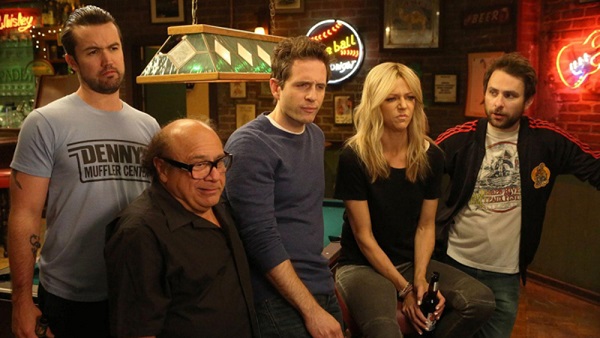
Next, let’s turn our eyes to It’s Always Sunny in Philadelphia.

The characters in this darkly comedic show all consider themselves devious masterminds, but for the most part, they tend to get in each others’ way and foil their own schemes through silly self-sabotage. Although a few impressive schemes do come to fruition over the years, it’s hard to consider this group a crackerjack team of puzzle solvers.

This escape room breaks the mold quite a bit, since the company brings the escape room trappings to the apartment of two of the characters. This is much more elaborate than any escape room set you can buy for the home, and I don’t know of any companies that deliver an escape room to the house.

You might think this home field advantage would be a boon, but instead, all chance of cooperation immediately goes out the window. One pair takes the key to a lock, the other pair takes the lock, and they spend the entire time negotiating instead of solving.

iasip

[Image courtesy of IMDb. Because of the language involved, I couldn’t
use an actual video clip and keep the blog post family friendly.]

Once they actually agree to collaborate and open the lock, they discover a list of tasks for them to complete, and they have virtually no time left to do so. (Our only hint to the room’s difficulty comes from the fact that Dee has completed the room beforehand, so it can’t have been too difficult.)

They claim victory when Sweet Dee falls out a window after getting trapped in her brother Dennis’s bedroom. In order to check on Dee’s status, the game runner opens the door and the remaining players consider it a win.

  • Accuracy rating: 1/5
  • Room difficulty: 2/5
  • Character solving skills: 0/5

crazyex_s01a-1170x658

[Image courtesy of Frame Rated.]

The final entry in our comedic quartet of escape room episodes comes from the musical CW show Crazy Ex-Girlfriend. This romantic drama, comedy, and coming-of-age story often features characters breaking out into elaborate song and dance routines, and many of the songs have become modern classics.

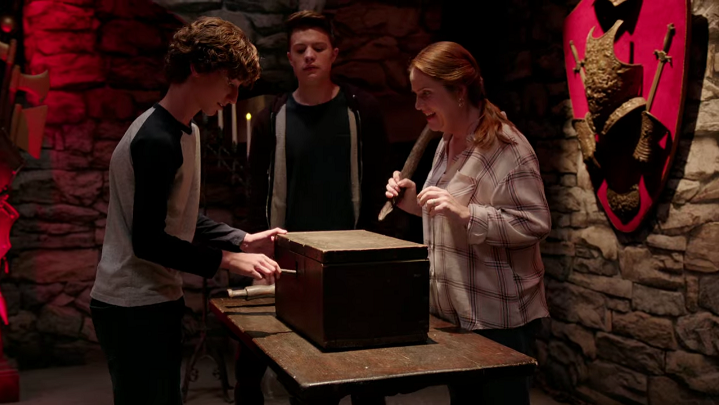
The show didn’t tackle puzzly content often, and indeed, the escape room in question is a b-plot in this particular episode, as main character Rebecca offers her escape room experience to friend Paula and her two disinterested sons.

The escape room is medieval-themed and huge, with lots of great set pieces and detail. The mix of exploring, touching things, solving puzzles, cooperating, and placing objects in particular places are all very traditional escape room moments.

ceg escape

[Image courtesy of Laura E. Hall.]

Though I was a little disappointed that the elements of the final puzzle are sitting out in plain sight the whole time. You could easily ACCIDENTALLY solve the last puzzle first and be out in minutes.

But Paula’s sons prove to be able puzzlers, attentive and clever, revealing things about themselves that Paula didn’t know. (In fact, the entire escape room subplot is all about Paula learning about who her sons have become, which is Puzzly Storytelling in Sitcoms 101.)

They all escape, having found new common ground, and it’s easily the most delightful ending of the four escape room scenarios we’ve looked at today.

  • Accuracy rating: 4/5
  • Room difficulty: 3/5 (the final puzzle is a long anagram, which is pretty tough, but the rest of the room is easy)
  • Character solving skills: 4/5

What did you think of this look at escape rooms from TV, fellow puzzlers? Should we look at more fictional escape rooms and see how they hold up?

I’ve heard Bob’s Burgers has one, as well as Schitt’s Creek. Let us know in the comments section below! We’d love to hear from you.

dailypopwsicon

Hey, have you checked out our special summer deals yet? You can find them on the Home Screen for Daily POP Crosswords and Daily POP Word Search! Check them out!

Thanks for visiting PuzzleNation Blog today! Be sure to sign up for our newsletter to stay up-to-date on everything PuzzleNation!
Solving Crosswords and Stopping Bad Guys With Superman!

51DA14425CL._SX276_BO1,204,203,200_

[Image courtesy of Amazon.]

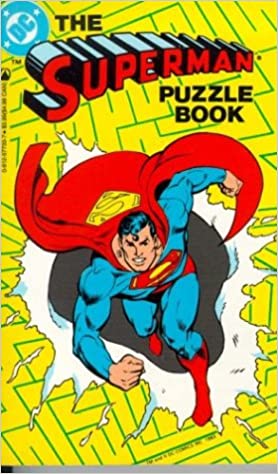
When you think of comic books and puzzles, one character instantly springs to mind: The Riddler. He’s easily the most iconic puzzly figure in comics, and his many twisty challenges for Batman have ranged from simple word games to death-defying escape rooms.

But did you know that Superman also has some puzzling in his expansive superheroic past?

In fact, Lois Lane’s life once depended on Superman’s ability to complete crossword puzzles!

Beckcollyerjoan

[Image courtesy of Superman Fandom Wiki.]

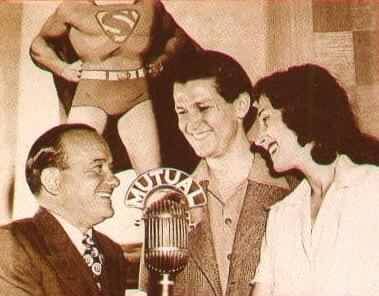
Yes, back in 1948, from April 15th until May 3rd, The Adventures of Superman radio show (aka the Superman Radio Program) featured Superman facing off against a gang of kidnappers and thieves, as well as a devious mastermind, in “The Crossword Puzzle Mystery.”

At that point, the crossword hadn’t even become a daily feature in The New York Times yet. (The first Sunday edition crossword debuted in February of 1942. The daily version wouldn’t appear until 1950.)

So how did crosswords cross paths with The Man of Steel?

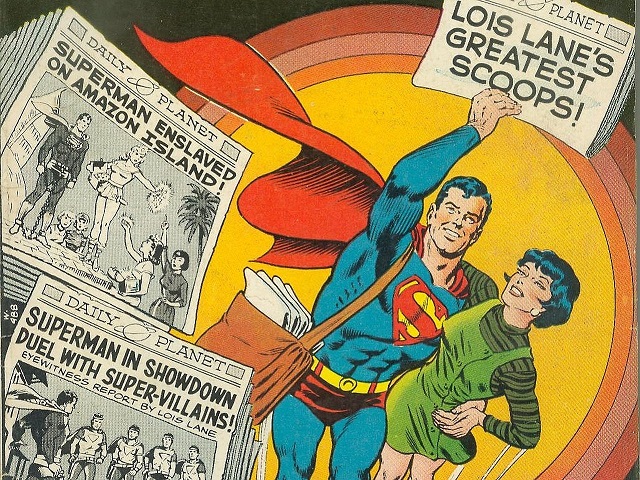
Well, it all starts with Lois Lane on an airplane, solving a crossword in order to find out where she’s going. Lois had received a tip from Horatio F. Horn, a local correspondent for The Daily Planet, and now she finds herself on a hunt across (and down) America for her next destination.

thumb-1920-388894

[Image courtesy of DC Comics, via Alpha Coders.]

The puzzle leads her to Moundville, a mining town where Horatio has gone missing. She meets a sinister gold-toothed man, and then goes missing herself. Cub reporter Jimmy Olsen soon arrives in Moundville, trying to locate both Lois and Horatio, but having no luck.

Eventually, Clark Kent gets involved, solving the same crossword puzzle as Lois and heading to Moundville himself. He arrives just in time to save Jimmy Olsen from being dragged off a cliff by a spooked horse. (You know how it is with spooked horses in old mining towns.)

After a hotel fire (an attempt on Jimmy and Clark’s lives), Clark finds three more crossword puzzles, but they’re partially destroyed. So he returns to Metropolis to track down solvable copies of each crossword, hoping they’ll reveal the whereabouts of Lois and Horatio.

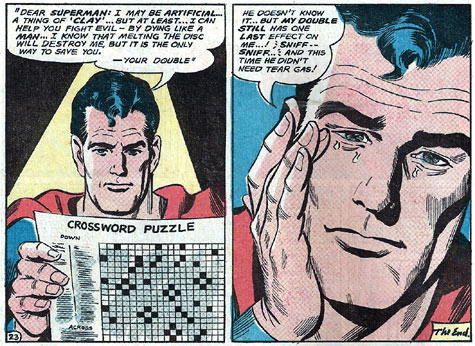
Yes, one of the episodic cliffhangers was Clark solving crosswords while Lois and Horatio were held in a secret cave at gunpoint. It’s gloriously silly.

impostor8

[Image courtesy of DC Comics, via David Morefield.]

Solving the crosswords leads Superman to believe that someone in Moundville is planning to steal a shipment of gold, so he returns to the town and teams up with Jimmy and a local sheriff to get more information. He deduces that a particular shipment going out that night is the target, and manages to rescue Lois and Horatio from the gang of ruffians planning the theft.

It turns out that the mastermind of the thefts is the owner of a Metropolis newspaper syndicate — who supplies puzzles to all the papers, including The Daily Planet — and would alert a vast network of gangs in the West to various gold shipments going out by putting the name of the town in the puzzle.

That’s how Horatio ended up investigating in the first place: he’s a crossword fan himself and noticed the pattern.

The serial concludes with Superman capturing the rest of the thieves in Moundville while the Metropolis police arrest the nameless puzzle mastermind. Good job, everyone! Another crime spree thwarted, thanks to solving puzzles!


space

[Image courtesy of DC Comics, via View Comic.]

The plot of this radio serial is quite similar to the plot of the first Crossword Mysteries film — both featuring thieves informed about targets through the local crossword — and honestly, it tickled me to imagine all these gun-toting ne’er-do-wells scattered throughout the western states, solving crossword puzzles every day and waiting to see where they’d need to go robbing.

This plan also implies that the crossword constructor NEVER mentioned towns or cities at other times, because that would send his goons on wild goose chases. Imagine all the abbreviated Canadian provinces they’d be searching, not to mention the European rivers.

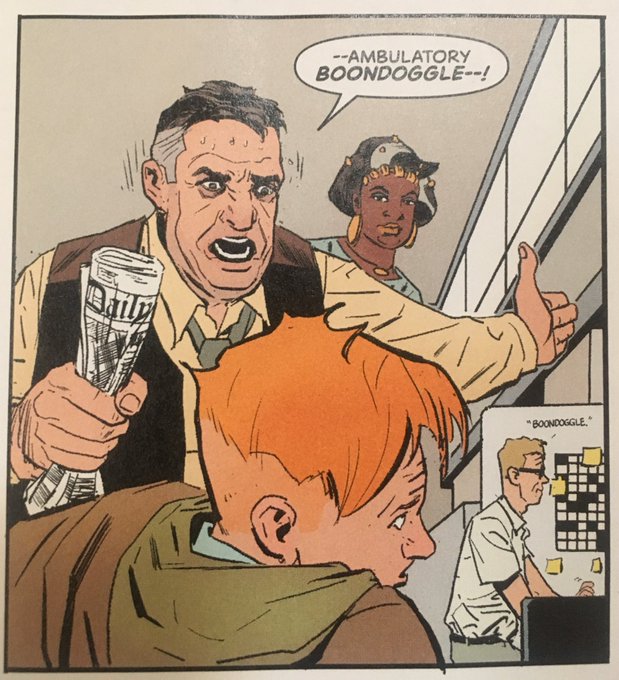
Perhaps this fiasco resulted in The Daily Planet hiring their own crossword editor, because later on in the comics, we see someone in the newspaper offices with a crossword pattern on his wall:

D_w1vLVXYAQayAL

[Image courtesy of Adam Talking Superman, who offered this caption: Huge fan of the newest Daily Planet character, crossword puzzle guy listening to Perry White’s vocabulary!]

Still, it’s fascinating to know that a major radio program — one with over two THOUSAND episodes — devoted literal weeks of airtime to a crossword-themed mystery.

It also makes you wonder what else is lurking in the daily crossword grids. What other devious crimes are afoot right under our noses?

I guess we better keep solving, folks! Our puzzly vigilance could be a crime-riddled town’s only hope!


dailypopwsicon

Hey, have you checked out our special summer deals yet? You can find them on the Home Screen for Daily POP Crosswords and Daily POP Word Search! Check them out!

Thanks for visiting PuzzleNation Blog today! Be sure to sign up for our newsletter to stay up-to-date on everything PuzzleNation!

Best (Crossword) Correction Ever: A Six-Month Anniversary

hooray-for-no-progress

Last week we marked two fairly auspicious anniversaries in crossword history, celebrating 15 years since the release of Wordplay and 150 years since the birth of crossword inventor Arthur Wynne.

There are loads of crossword-related anniversaries worth celebrating. The birthdays of constructors and influential editors. Anniversaries of events like ACPT, Lollapuzzoola, and others.

Heck, in a few years, we’ll be seeing the centennials for Margaret Farrar’s first book of crosswords for Simon & Schuster AND the invention of the cryptic crossword by Edward Powys Mathers (aka Torquemada), not to mention one hundred years since there was a Broadway musical revue about puzzles!

(Somebody really needs to get to work writing Wordplay: The Musical.)

abracadaver11

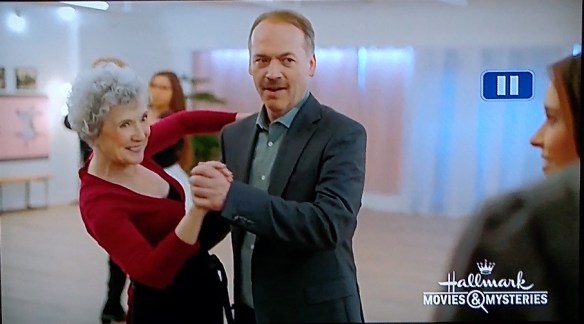
[Dancing Will Shortz cameo!]

Well, this week, we have a somewhat less momentous anniversary, but still something that brings a smile to my face when I think of it.

But first, a bit of context.

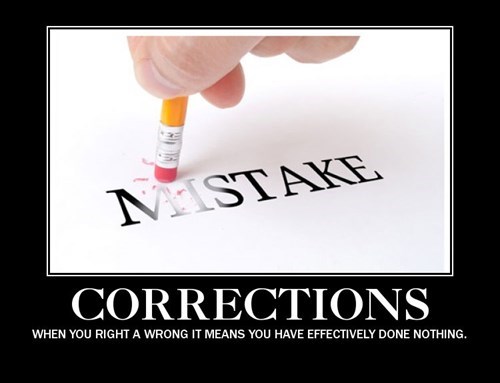
If you’ve read a newspaper for any length of time, you’ve come across the corrections section. Corrections are part of newspaper publishing. No matter how good your content or how thorough your editing and proofreading, some things slip by on occasion.

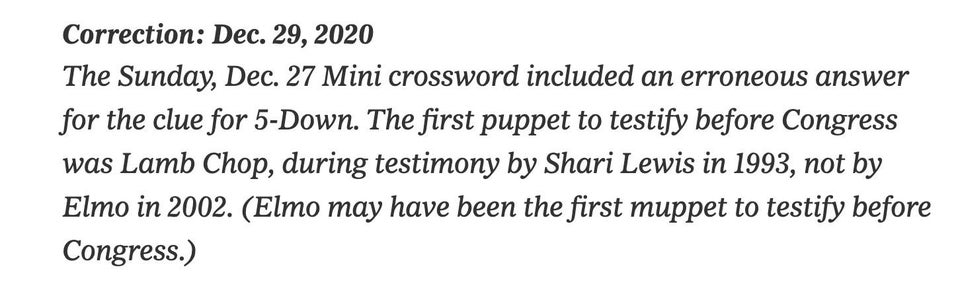
This is as true for the crossword as it is for any other section of the paper. Back in April of this year, a Tuesday mini crossword puzzle featured incorrect clues for two across entries, and the correction appeared the next day.

Some corrections are better than others, more memorable, more interesting. And today is the six-month anniversary of what I consider to be the best correction, crossword or otherwise, ever in the New York Times.

correction 1

But, hilariously, the story doesn’t end there.

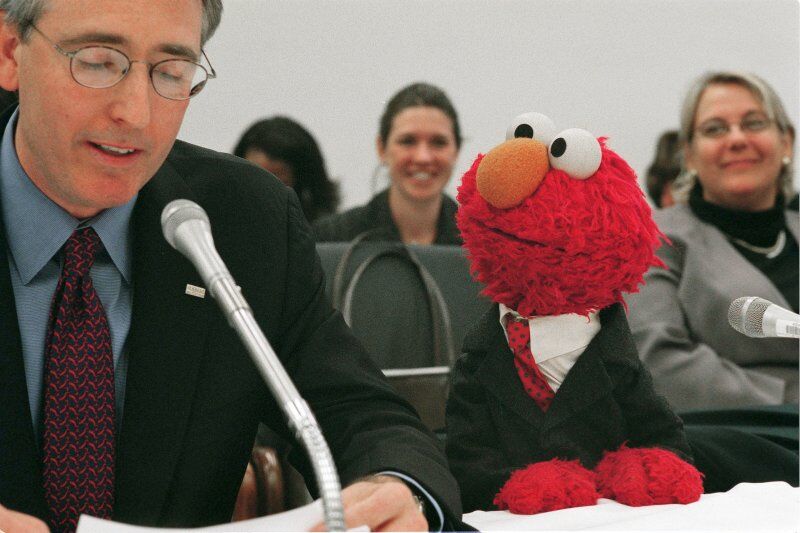
Elmo-Washington

[Image courtesy of muppet.fandom.com.]

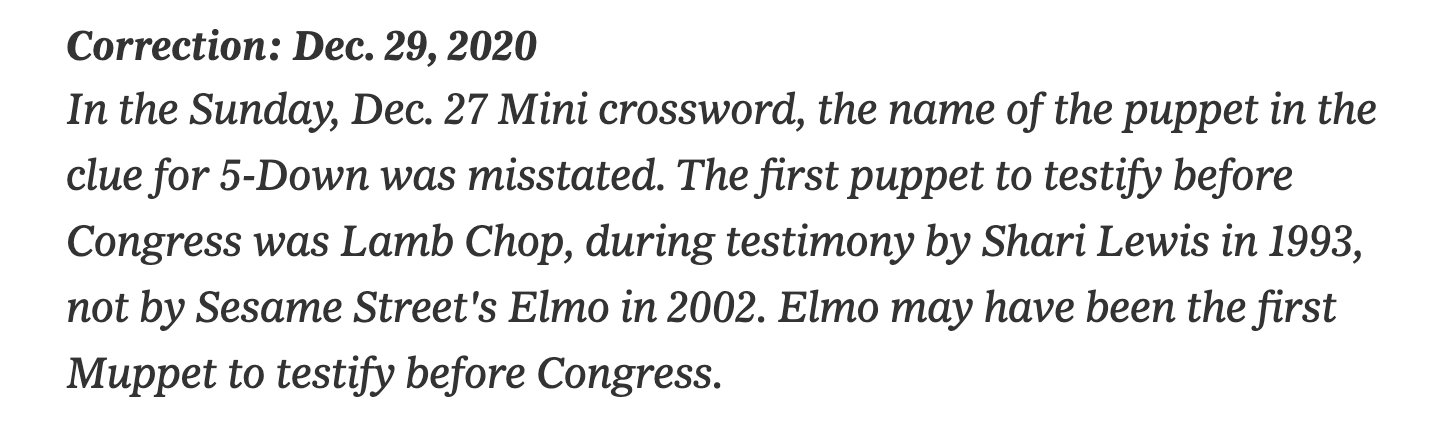
They then had to issue a correction for the correction, which is just icing on the cake:

correction 2

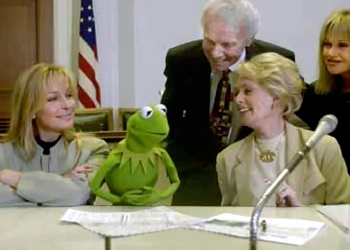
Then, a sharp-eyed puzzler on Twitter under the handle @CoolKrista pointed out that the correction was STILL wrong. You see, the first Muppet to lobby Congress was Kermit the Frog in the year 2000.

WildAnimalProtectionAct

[Image courtesy of muppet.fandom.com, specifically an article titled
“Kermit’s political affiliation,” which is just so great.]

(And yet, the water remains potentially muddied. After all, do you consider Big Bird a Muppet? Because Big Bird went to Congress back in 1989.)

These are the sort of minutiae-filled rabbit holes that the Internet was pretty much designed for. How can you not love it?

You can follow the whole saga on the New York Times Wordplay Twitter account. Please enjoy.

Oh, and Happy Six-Month Anniversary, Best Correction Ever. We salute you.


dailypopwsicon

Have you checked out our special summer deals yet? You can find them on the Home Screen for Daily POP Crosswords and Daily POP Word Search! Check them out!

Thanks for visiting PuzzleNation Blog today! Be sure to sign up for our newsletter to stay up-to-date on everything PuzzleNation!
Say It Ain’t Sudoku: A Puzzly Hashtag Game!

201654408_4210866405626741_6616576075734839633_n

You may be familiar with the board game Schmovie or hashtag games on Twitter.

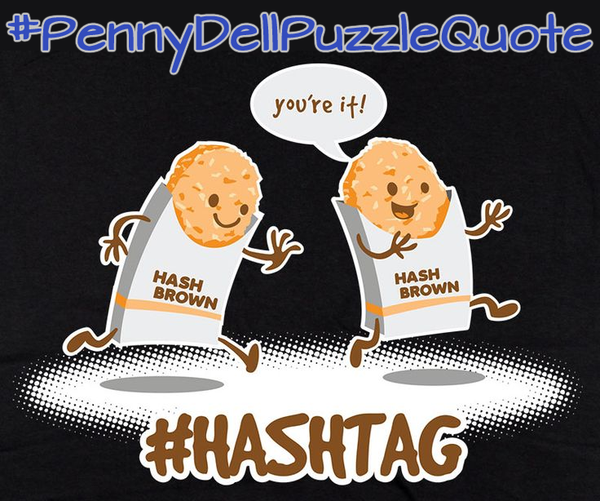
For years now, we’ve been collaborating on puzzle-themed hashtag games with our pals at Penny Dell Puzzles, and this month’s hook was #PennyDellPuzzleQuote. Today’s entries all mash up Penny Dell puzzles with famous quotations!

Examples include: “Be the Changaword you wish to see in the world,” “Loose Blips sink ships,” or “Cogito, ergo Sum Triangles.”

So, without further ado, check out what the puzzlers at PuzzleNation and Penny Dell Puzzles came up with!


One cannot Step by Step in the same river twice.

We’ll Anacross that bridge when we get to it.

One and Only if by land, Two at a Time if by sea.

You miss 100% of the shots you don’t Give and Take.

Piece by piece comes from within. Do not Word Seek it without.

It ain’t over ’til it’s Overlaps.

A Penny Press saved is a Penny Press earned.

It takes two to Tanglewords.

The buck Stoplines here.

It’s all right there in Block and White.

Leave no Stepping Stones unturned.

Don’t judge a Bookworm by its cover.

Chain Words are only as strong as their weakest Linkwords.

Picture This…worth a thousand Word Seeks.

A stitch in time saves Three from Nine.

When the going gets Mind Boggler, the Mind Boggler gets going.

When life gives you Share-A-Letter, make Alphabet Soup.

All Four One and one Four-Most.

That’s one small Stepping Stones for man…

You are the Masterwords of your unspoken Word Seeks, but a slave to the Wordfinders you have spoken.

The only thing we have to fear is test-solving forty Codewords in a row.

. . . and go round and round and round in the Circle Sums game.

The pre-type reviewer’s red pen is mightier than the sword.


Members of the PuzzleNation readership also got in on the fun when we spread the word about this hashtag game online!

On Facebook, fellow puzzler Ralph Angelo B. Sinson contributed this quote that he didn’t even have to alter!

“If you come to a Logic show, you get all creeds, colors, religions, and sexual orientations.”


dailypopwsicon

Have you checked out our special summer deals yet? You can find them on the Home Screen for Daily POP Crosswords and Daily POP Word Search! Check them out!

Thanks for visiting PuzzleNation Blog today! Be sure to sign up for our newsletter to stay up-to-date on everything PuzzleNation!

PN Product Review: Godzilla: Tokyo Clash

Today’s board game review was selected by the PuzzleNation readership through polls on social media!

Would you like more polls to determine reviews, pop culture recaps, and other blog content? Let us know in the comments section below. We’d love to hear from you!


The-original-Godzilla-rel-001

Godzilla returned to theaters this year for the umpteenth time with Godzilla vs. Kong, and after 67 years of cinematic dominance, the King of the Monsters is still an incredibly popular figure in pop culture.

That being said, Godzilla’s board game resume isn’t nearly as impressive. In fact, it’s mostly the pits. Surprisingly, making a good board game about monsters fighting each other is harder than you’d think. (Only two come to mind — King of Tokyo and Smash City — and sadly, neither features cinema’s most iconic city-smashing monster.)

Perhaps even more surprising is the fact that this dilemma might’ve just been solved by a very unlikely source, a company more famous for their collectible figurines than their games: Funko.

In today’s blog post, we’re reviewing a Godzilla game that finally got it right, as we explore Godzilla: Tokyo Clash.

714M7tnjGTL._AC_SL1300_

Not only do you have four famous film kaiju (aka monsters) to choose from — Godzilla, Mothra, King Ghidorah, and Megalon — but the game board is different every time you play, thanks to the tile design that allows for numerous different arrangements.

Each of the monsters has a special ability unique to that monster, as well as a deck of action cards that are specifically designed for your monster. Whoever is playing as Godzilla will have different moves, tactics, and attacks than the person playing as Mothra, King Ghidorah, or Megalon, and this adds further replay value to the game.

Plus you randomly choose two ways that the city tries to fight back against the monsters, adding further variety to the wrinkles that color the game play on multiple playthroughs.

You have an energy bar, which is used to control how much you attack the vehicles, buildings, and other kaiju around you. So, in addition to planning for the moves other players make — as well as the moving vehicles on the game board — you also have to manage your attacks based on your available energy.

Smashing buildings and vehicles gives you energy, which you can use to attack the other monsters on the board. Successful attacks give you trophies, which count toward your overall Dominance point total. Whoever has the most points at the end of the game wins.

That’s right! Every player stays active for the whole game — unlike many other monster-fighting games, where players can be eliminated and then you just sit around and watch the rest of the game.

The art is gorgeous, evoking a vibrant style inspired by classic Godzilla movie posters (and don’t worry, the instructions are in English). The miniatures are marvelously detailed, and the game is loaded in references to the films. You don’t have to know them to play the game, but for diehard Godzilla fans like myself, it’s vindication after years of mediocre kaiju-themed games.

And the game is very reasonably priced, considering the quality of the miniatures, the game board tiles, and the overall art. This ticks a lot of boxes for both board game fans and Godzilla enthusiasts.

That being said, the game does have some downsides. The two-player version is far less engaging than the three- or four-player versions, because your tactics are so limited by just throwing vehicles back and forth at each other and smashing buildings. The strategic moves and planning are deeper and far more enjoyable with more targets, threats, and things to consider.

81vjLbMWEwL._AC_SL1500_

It might sound silly, but in this game about monsters smashing things, it’s simply more fun when there are other people smashing stuff too.

Also, I’m not a huge fan of the Dominance system, since it’s a little distracting  to have two sets of numbers to keep track of — the energy and the victory points — but I confess I can’t think of another mechanic that would still allow all of the players to keep playing.

All in all, I was very impressed by this game. It’s easy to pick up, fun to master, and offers a ton of variety for new and experienced players. Plus there’s a surprising amount of tactical puzzling involved, which elevates the game beyond a simple you-go-then-I-go mentality.

This game is a win.

[Godzilla: Tokyo Clash is available from Funko Games and other participating retailers.]


dailypopwsicon

Have you checked out our special summer deals yet? You can find them on the Home Screen for Daily POP Crosswords and Daily POP Word Search! Check them out!

Thanks for visiting PuzzleNation Blog today! Be sure to sign up for our newsletter to stay up-to-date on everything PuzzleNation!