A Handful of Puzzly Resources for Constructors!

Crossword.

The internet has really grown the crossword community by leaps and bounds. Puzzlers can share favorite puzzles, reviews, opinions, and feedback with fellow solvers, constructors, editors, and publishers at the touch of a button. With downloadable puzzles, online solving, and puzzle apps (like Daily POP Crosswords!), access to puzzles has never been easier.

Entire forums dedicated to solving and sharing a love of puzzling are cultivating a new generation of solvers and encouraging ambitious new constructors. Twitter is a great place to start, there’s a growing community on r/crossword, and on Facebook, you’ve got both the American Crossword Puzzle Tournament group and the Crossword Puzzle Collaboration Directory to keep you informed and aware of all things crossword.

That’s to say nothing of the fact that both solvers and constructors have greater access to resources than ever before. There are reviewers breaking down the crosswords printed by the major outlets on a daily basis, and blogs like Wordplay exploring how to construct and what words solvers and constructors should know. With searchable databases like XWordInfo out there as well, you can hunt down clues, entries, themes, and a huge chunk of the history of crosswords with ease.

But sadly, not all resources have made their way online, so building a personal library of key volumes to peruse and refer to can help boost your solving and constructing efforts.

So today, I thought I’d share a few of my personal favorite resources that I use when constructing not only crosswords, but all sorts of other puzzles, in the hopes that you find them useful as well.

Your mileage may vary, but to me, these books have been invaluable.


descriptionary

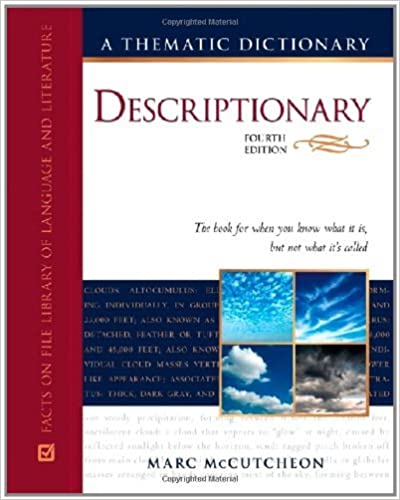
Descriptionary: A Thematic Dictionary (Fourth Edition) by Marc McCutcheon

Word Menu, in either book or online form, has long been the gold standard when it comes to building themed word lists that you can trust to be well-sourced and reliable. But when I need a theme idea, I have much greater luck flipping through the pages of the Descriptionary, a cross-cultural theme listing that covers everything from weather to fashion, medicine to crime.

Searchable by topic in the front and individual words in the index, it’s never difficult to find a list I’ve used before or to zero in on a topic as needed. I ended up buying my own copy after checking out the copy from my local library at least a half-dozen times, and I’ve never regretted it.

rhyming dictionary

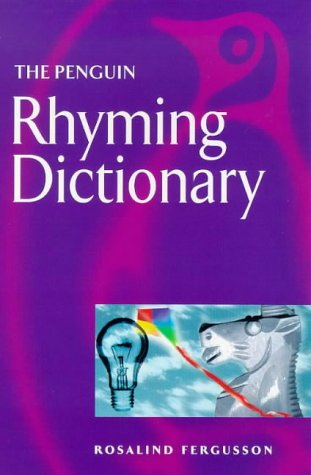
The Penguin Rhyming Dictionary by Rosalind Fergusson

Whether I’m cluing, looking for rhymes to support a playful theme, or playing with pronunciation for a particular bit of wordplay, The Penguin Rhyming Dictionary is my go-to resource. It’s absolutely loaded with vocabulary, organized by individual rhyming syllables and patterns (as well as near-rhymes). Just look up your word to rhyme in the back index, and then go work.

cook's essential

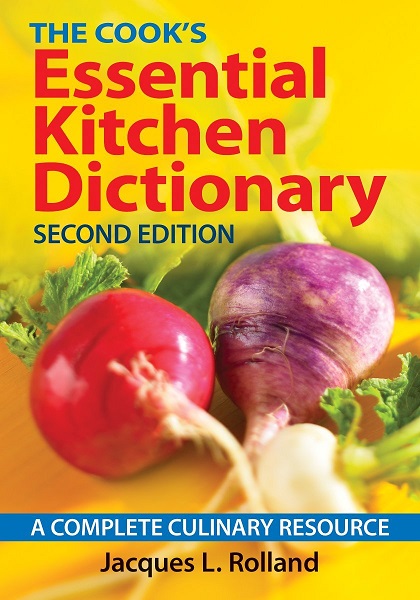
The Cook’s Essential Kitchen Dictionary: A Complete Culinary Resource by Jacques Rolland

This book is a tremendous resource, running the gamut from food and equipment to cooking styles and common vernacular. Not only are these definitions informative, complete with preparation instructions and suggested dishes for given ingredients, but they add little touches of culinary history to the mix, offering context and greater detail.

The book also features subsections listing varieties of apples, cheese, salt, pasta shapes, and other ingredients. Whenever I need food-related clues or theme entries, this is my first stop.

dictionaries

I’m a sucker for weird words and colorful vocabulary, so I thoroughly enjoy constructing any unthemed puzzle that allows me to play with language. And there’s any number of niche dictionaries out there to bolster your puzzle lexicon and spruce up any word list.

Here’s a list of some of my favorites:

  • Mrs. Byrne’s Dictionary of Unusual, Obscure, and Preposterous Words by Josefa Heifetz Byrne
  • Murfles and Wink-a-peeps: Funny Old Words for Kids by Susan Kelz Sperling
  • The Endangered English Dictionary by David Grambs
  • The Word Museum: The Most Remarkable English Words Ever Forgotten by Jeffrey Kacirk
  • Informal English: Puncture Ladies, Egg Harbors, Mississippi Marbles, and Other Curious Words and Phrases of North America by Jeffrey Kacirk
  • The Great Panjandrum (and 2,699 Other Rare, Useful, and Delightful Words and Expressions) by J.N. Hook
  • Stone the Crows: Oxford Dictionary of Modern Slang by John Ayto and John Simpson
  • I Love It When You Talk Retro: Hoochie Coochie, Double Whammy, Drop a Dime, and the Forgotten Origins of American Speech by Ralph Keyes
  • The Meaning of Tingo and Other Extraordinary Words from Around the World by Adam Jacot de Boinod
  • That’s Amore!: The Language of Love for Lovers of Language by Erin McKean
  • Much Ado About English: Up and Down the Bizarre Byways of a Fascinating Language by Richard Watson Todd
  • America in So Many Words: Words That Have Shaped America by David K. Barnhart and Allan A. Metcalf
  • The Highly Selective Dictionary of Golden Adjectives for the Extraordinarily Literate by Eugene Ehrlich
  • Word Catcher: An Odyssey Into the World of Weird and Wonderful Words by Phil Cousineau

(And, although this book isn’t a dictionary, it includes some terrific vocabulary along the way, so it’s worth checking out: Reading the OED: One Man, One Year, 21,730 Pages by Ammon Shea.)


Hopefully these resources can aid you in your puzzling endeavors as they’ve assisted me many times over. Are there any offline resources I’ve missed? Let me know in the comments section below! I’d love to hear from you.

Thanks for visiting PuzzleNation Blog today! Be sure to sign up for our newsletter to stay up-to-date on everything PuzzleNation!

You can also share your pictures with us on Instagram, friend us on Facebook, check us out on TwitterPinterest, and Tumblr, and explore the always-expanding library of PuzzleNation apps and games on our website!

Let’s Play Crossword Bingo!

Crossword.

If you solve enough crosswords, you’re bound to encounter some words more often than others.

Maybe the word has grid-friendly letters or a letter pattern that facilitates editing. Maybe it’s an otherwise obscure item that crosswords have kept in the zeitgeist.

Or maybe it’s a just three-letter word with vowels on either end, be it a female sheep, a tavern drink, a mine find, or fury, and that corner just won’t be completed without one of them.

Some solvers find fault with those words, the constructors who use them, or the outlets that publish puzzles featuring them. Other solvers, however, find fun ways to acknowledge their ubiquity.

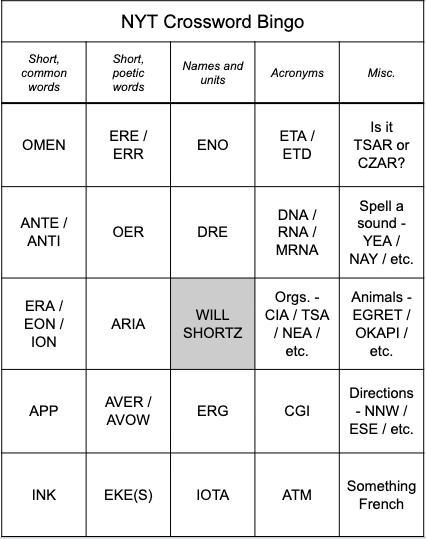
For instance, a reddit user under the handle “atleasttheresmusic” created a bingo card based on words that crop up regularly in The New York Times crossword:

xwd bingo 1

Not only did they hit some classic examples of crosswordese, but they even managed to categorize their entries, highlighting crossword tropes like “short, poetic words” and the frequent use of abbreviations.

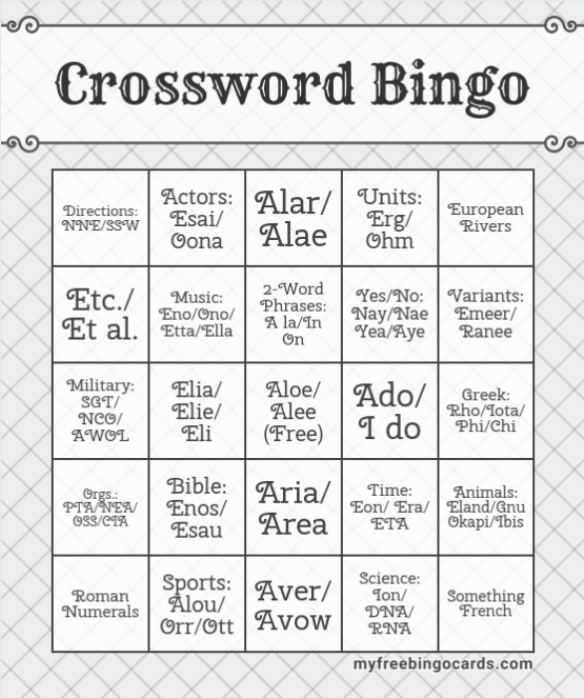
Between the bingo card itself and the many suggestions shared by fellow puzzlers in the comments, I couldn’t resist taking a crack at making a crossword bingo card of my own:

xwd bingo 2

As you can see, I’ve also organized the columns by category; from left to right, there’s abbreviations, names, vowel-heavy words, 3-letter entries, and non-U.S. terminology.

I couldn’t fit every entry I wanted to — EKE/IKE fell by the wayside, as did EWER — but I managed to jam a fair amount of crosswordese and personal pet peeves onto the card. Plus, given how often ALEE and ALOE appear, they’re basically a free space in the center of the card.

So how did I do, fellow puzzlers and PuzzleNationers? What words should I have included? Did the cleaner card created by “atleasttheresmusic” win out over mine, or did we both succeed in having some fun at the expense of crosswords?

And, most importantly, how quickly would you get BINGO if you used one of our cards? Let us know in the comments section below! We’d love to hear from you.


Thanks for visiting PuzzleNation Blog today! Be sure to sign up for our newsletter to stay up-to-date on everything PuzzleNation!

You can also share your pictures with us on Instagram, friend us on Facebook, check us out on TwitterPinterest, and Tumblr, and explore the always-expanding library of PuzzleNation apps and games on our website!
The New York Times Crossword Now Accepts Online Submissions!

Photo by Matt MacGillivray, licensed via Creative Commons

There’s good news for aspiring and established crossword constructors out there, as The New York Times crossword is now accepting online submissions.

I could be cynical and say it’s about time for a change like this, given that The Los Angeles Times has been accepting online submissions for at least a decade now, and many of the other major outlets made the transition well before 2020.

But I won’t. This is a moment worth celebrating.

True, it was inevitable that the Times would move in this direction. I don’t know if the tipping point was the pandemic, given how many other companies and businesses have been forced to adapt to a paperless/lower-contact way of doing business, or if the department was simply following a directional shift the industry had already taken.

But I’m glad they have. This may seem like a relatively small change, but it’s significant for several reasons.

1.) It’s simply easier

People send emails, attach documents, and share files every day. How often do you hit the post office?

2.) Electronic submission encourages younger solvers to get involved

New blood is a necessity for any industry, crosswords included, and when the standard-bearer makes a shift toward inclusivity (even if it’s just a matter of technological familiarity), it’s a step in the right direction.

3.) Electronic submission helps level the playing field

Having to mail submissions has a price attached, through envelopes, paper, and postage, whereas electronic submissions don’t. Yes, the price of crossword construction programs is still a hindrance, limiting access to some, but again, this is a step in the right direction.

The submission page is loaded with information, including specs on puzzles, file formats for submission, and the submission form itself.

Plus NYT-savvy constructors and staff like Joel Fagliano have already posted answers online to Frequently Asked Questions in forums like the Crossword Puzzle Collaboration Directory, and have offered to answer any other questions constructors have.

Hopefully this change means not only an influx of new talent, but greater accessibility for underrepresented groups in crosswords.


Thanks for visiting PuzzleNation Blog today! Be sure to sign up for our newsletter to stay up-to-date on everything PuzzleNation!

You can also share your pictures with us on Instagram, friend us on Facebook, check us out on TwitterPinterest, and Tumblr, and explore the always-expanding library of PuzzleNation apps and games on our website!

Cultural Sensitivity and Crosswords: Where Is The Line?

crossword1

A few days ago, an entry in The New York Times Crossword caught the eye of a solver. That solver posted about it in the Facebook group “The Crossword Puzzle Collaboration Directory,” which is dedicated to encouraging new constructors to make and submit puzzles.

That post kicked off an intense debate about problematic entries and how to handle them. Not only is this topic far from settled, but it’s emblematic of a larger question: where is the line?

You see, one of the advantages of our modern Internet-savvy culture is that feedback is virtually instantaneous now. If someone is offended or troubled by an entry or clue in the Monday crossword, it doesn’t take days for a letter to the editor to arrive at the paper. It takes seconds to post online and reach a potential audience.

Of course, that rapid response is a double-edged sword, because hot takes and rush-to-judgment commentary are just as quick to spread.

Both sides of that double-edged sword were in full effect as the replies piled up on that original Facebook post. As those in agreement with the original poster offered their support, counterpoints rolled in, either in defense of the entry or the clue.

(Naturally, given that this is the Internet, some chose to expand on the topic in general disagreement with a culture they claimed was too sensitive and quick to condemn every little thing that offended them. But since those people are an incredible waste of time and energy and have little interest in genuine discussion, this will be my last mention of them.)

Other posters focused on the mechanics of the puzzle itself, pointing out easy fixes that would have prevented the potentially problematic word from appearing at all. Some of these folks sided with the original poster, pointing out that a word that is potentially problematic should be edited out, and it’s part of a constructor’s job to think of these things.

And that’s the question. How much should constructors and editors be taking the potentially problematic aspects of words into consideration when constructing?

True, it’s not always possible to anticipate every negative response to the words filling your grid or the accompanying clues. (Heck, we have numerous examples of words and clues slipping through that catch fire with part of the audience in the worst possible way.)

But is that part of a constructor’s job?

In my opinion, yes, it is.

Crosswords should be inclusive. They should be an engaging activity that evokes occasional frustration but eventual satisfaction, whether you’re completing a grid, unraveling a particularly tricky theme, or besting your previous solving time. It should be fun. It should be entertainment, a distraction.

It should NOT be a place where people feel excluded, or where personal or historical traumas surface because of cluing or grid fill.

For example, I don’t believe CHINK should appear in crosswords, even as “flaw in one’s armor,” because anyone casually glancing at the grid will only see that word, not necessarily the context.

We can do better.

[Image courtesy of Bogoreducare.org.]

Originally, I wasn’t going to mention the specific clue/entry at all, because the issue is larger than this one example. But knowing the word that offended our original poster adds context.

The entry was NOOSE, and the clue was “End of a hangman’s rope.”

For the poster, the associations surrounding both clue and entry were troubling. But, for the most part, the main reason for posting appeared to be twofold:

1. Pointing out that the word’s inclusion in the grid was easily avoidable
2. Asking if other constructors/aspiring constructors found the entry as problematic as she did

She wasn’t calling for peoples’ heads. She was opening a dialogue and inviting discussion. She made her personal feelings clear — by using the word “appalled” — but made the discussion about something larger than her individual reaction.

Problem-solving-crossword

Some replies concerned the clue more than the entry, pointing out that the noose was used for many other, non-negative uses. The general association of nooses with lynching was brought up, with some instantly making the connection while others felt it was unfair or hypersensitive to make that association. Others brought up the word LYNCH, asking if the entry was problematic even if the cluing was about director David or actress Evanna.

These aren’t easy questions to answer. This is obviously not a debate that will be concluded anytime soon. But it’s one worth having.

And when it comes to conclusions to draw from all this, I think the original poster said it best in one of her replies: “In my opinion, it’s better to err on the side of empathy.”

Amen.


Thanks for visiting PuzzleNation Blog today! Be sure to sign up for our newsletter to stay up-to-date on everything PuzzleNation!

You can also share your pictures with us on Instagram, friend us on Facebook, check us out on TwitterPinterest, and Tumblr, and explore the always-expanding library of PuzzleNation apps and games on our website!
More Puzzle Discounts, Freebies, and Links!

Hey there, fellow puzzlers and PuzzleNationers.

We know it can be hard to keep yourself engaged, distracted, and entertained during these trying times, so we’ve compiled a few puzzly links and options for you!

littlegirlatgrandmas

A lot of companies, creators, and puzzlers are putting their products out there at a discount or on a Pay-What-You-Want basis (and sometimes for free!) to help distract home-bound bodies from the unpleasantness and uncertainty going on around us.

Examples include the awesome team at DriveThruRPG (and the many marvelous contributors who post there), as well as your friendly neighborhood puzzle app makers at PuzzleNation. We’re all throwing the digital doors wide open.

The New York Times is offering free access to its Spelling Bee puzzles, as well as up to eight free solves a day for their Tiles puzzles. The website PZZL has a bunch of free puzzles for solvers as well.

Plus numerous constructors are putting their creations out there for you to solve. One example is T Campbell’s monstrous comic book-themed puzzle with Stan Lee drawn in black squares! Check it out:

ETze6duXsAAufU4

Do you know of any other puzzly folks or companies that are offering discounts or freebies right now? Let us know so we can help spread the word!

And remember: be sure to support puzzlers, or local businesses, or artists you love online, or any other small businesses or entrepreneurs during this trying time.

Happy puzzling!


Thanks for visiting PuzzleNation Blog today! Be sure to sign up for our newsletter to stay up-to-date on everything PuzzleNation!

You can also share your pictures with us on Instagram, friend us on Facebook, check us out on TwitterPinterest, and Tumblr, and explore the always-expanding library of PuzzleNation apps and games on our website!
Puzzling From Home!

Problem-solving-crossword

In the wake of puzzly public events like the American Crossword Puzzle Tournament being cancelled, as well as the shutdown of various school districts, workplaces, and businesses in order to limit exposure to the Coronavirus, it’s completely understandable that some puzzle fans may be feeling disappointed or even isolated from their fellow puzzlers.

But fear not! There are all sorts of options available to solvers looking to enjoy a puzzly experience from home, either on their own or with friends.


If you’re looking for crosswords, all you need is your computer. The New York Times, The LA Times, The Washington Post, and many other outlets offer online puzzle-solving, either by subscription or through watching ads before solving.

If you have access to a printer, you can print those puzzles out for the true pencil-and-paper solving experience.

And it’s not just newspapers. Many constructors — Brendan Emmett Quigley comes to mind — offer their own free puzzles semi-regularly (though you’re welcome to tip as a thank you). There is a world of puzzles out there on the Internet awaiting solvers.

But you don’t even have to go to a computer anymore. There are loads of terrific puzzles available right on your phone. Forgive us for tooting our own horn, but Daily POP Crosswords is a great puzzle app with a free puzzle every day and additional puzzle packets available for purchase or through our in-app coin system. (We also offer Word Seeks, Sudoku, and a marvelous story-driven puzzle mystery, Wordventures, if you’re looking for something different.)

Oh, and speaking of something different, if you’re looking to delve into more elaborate puzzles, there are some fantastic puzzle services by mail that offer all sorts of challenges.

enigmasmall

Wish You Were Here by the Enigma Emporium conceals an entire mystery within a handful of postcards, challenging you to mine them for every scrap of information as you uncover a series of coded messages. It’s spycraft in an envelope, very clever stuff.

The Cryptogram Puzzle Post out of the UK offers something unique, mixing puzzles and encryption with bits of mystery and supernatural narratives to create standalone chapters in an ongoing story. So you can pick one season or an entire year, depending on how deep you want to go!

And for multi-month affairs, there are outlets like Hunt a Killer and The Mysterious Package Company, which create vast, immersive puzzle experiences by mail. (Though according to friends’ recommendations, Hunt a Killer works better without the month wait between installments.)

As you can see, there’s a wide variety of ways you can puzzle from home, whether you prefer to solve online, by email, on the phone, or by mail!


That’s all well and good, you might be saying, but what about the social aspect? Well, there are options there as well, even from the comforts of your home.

Photo by Matt MacGillivray, licensed via Creative Commons

Some puzzlers actually livestream their puzzle-solving online through avenues like Twitch, Facebook, and YouTube. The New York Times periodically does this as well, often with celebrity guest solvers!

You can keep your eyes peeled on Facebook and Twitter for constructors and solvers who do so. It often adds a fun, communal element to puzzle-solving (especially if they struggle with the same tricky clues that you do). Some pub trivia outlets are also moving online to allow for participating from home!

new york times

But if you don’t want to wait for someone to livestream their solving, you can do it yourself! Between Facetime and similar apps on smartphones and all the online avenues for audio and video-chatting (Skype, Google Hangouts, Discord, etc.), you could pair up with a friend and tag-team a crossword puzzle or other puzzly challenge!

It’s like co-working, except with puzzles. Co-solving!

In times like this, where uncertainty abounds and our comfortable routines have been upended, puzzles can offer a wonderful refuge from all the stresses of the world. And with technology on our side, we can even keep the communal joys of puzzling in our lives.

Happy puzzling, friends.


Thanks for visiting PuzzleNation Blog today! Be sure to sign up for our newsletter to stay up-to-date on everything PuzzleNation!

You can also share your pictures with us on Instagram, friend us on Facebook, check us out on TwitterPinterest, and Tumblr, and explore the always-expanding library of PuzzleNation apps and games on our website!