Puzzle Culture: Tone-Deaf Cluing?

The latest comic on Hayley Gold’s wonderful webpage Across and Down brought an article on Slate to my attention, and I wanted to share my thoughts on the subject.

The article by Ruth Graham was entitled “Why Is the New York Times Crossword So Clueless About Race and Gender?” and the centerpiece of the article was last week’s Tuesday puzzle, particularly the 31-Down clue “Decidedly non-feminist women’s group” for HAREM.

Ick.

HAREM is a troublesome word to clue as it is, one of those filler words that makes crosswords feel so behind-the-times, like PAGAN (which is always clued like “heathen” instead of as someone non-aligned with the bigger religions).

[A crossword that looks as old-timey as modern ones sometimes feel…]

Even the clues that pass for innocuous when it comes to HAREM, like “Sultan’s bevy of beauties,” are a little unpleasant, as if some tuxedo-clad goon is describing the contestants for Miss America, another antiquated practice that should go by the wayside.

But I’m getting off track here.

Graham’s point was about women and people of color being poorly treated by insensitive, thoughtless cluing, and she clearly did her homework while commenting on incidents in the past:

“Hateful” and “awful” may seem a bit harsh for what reads like a lame attempt at cheekiness. But the clue is certainly tone-deaf. And it’s not the first time a puzzle’s un-PC cluelessness has annoyed people. In 2012, the answer ILLEGAL was clued with: “One caught by the border patrol.” The offensive use of illegal as a noun set off a brouhaha that made its way to Univision.

In 2013, a national puzzle syndicate apologized for using the clue “Shylock” for the answer JEW. And in November, Shortz issued a mea culpa for the clue “Exasperated comment from a feminist.” Answer: MEN — presumably with an invisible exclamation point and flying sweat out of a Cathy comic.

[Image courtesy of TheGloss.com.]

I’m surprised she left out the granddaddy of them all when it comes to crossword insensitivity: the June 6, 2008 crossword that featured ETHNIC CLEANSING as 11-Down. (Special thanks to Eric Berlin’s website and Rex Parker’s blog for helping me track down the exact date on that one.)

She went on to discuss the dearth of women and people of color in puzzle constructing — something that is slowly changing, thankfully — as well as the tendency to only bring black culture into crosswords with “homies” and “thugs” in order to clue words like HOOD and GANGSTA, but there was one style of cluing that I feel should also be discussed in the same light.

You’ll see foreign words often clued with the English equivalent, and then some indicator of a foreign place. “One, in Seville” for UNO, or “Sea, in Paris” for MER. That’s all well and good.

[Image courtesy of Tumblr.]

But I’ve always been a little uncomfortable with clues like “June, to Juan” or “Left, to Pablo” that are meant to follow the same format. Picking names that are stereotypically associated with a given culture or ethnicity may not be as overtly hostile as cluing “Gangsta rap characters” as THUGS, but it’s certainly not MUCH better.

And we should do better. Crosswords are a cultural microcosm, representing the commonalities and peculiarities of our language in a given time and place. They represent our trivia, our understanding, our cleverness, our humor, and, yes, sometimes our shortcomings.

But if each crossword is a tiny time capsule, we should try our damnedest to have it represent the best of us.


Thanks for visiting PuzzleNation Blog today! Be sure to sign up for our newsletter to stay up-to-date on everything PuzzleNation!

You can also share your pictures with us on Instagram, friend us on Facebook, check us out on TwitterPinterest, and Tumblr, and explore the always-expanding library of PuzzleNation apps and games on our website!

Puzzle Plagiarism, Part 3: Parker Out

After months of nothing, things are suddenly moving forward with the Universal Uclick/USA Today puzzle plagiarism scandal.

A quick recap: Programmer Saul Pwanson and constructor Ben Tausig uncovered a pattern of unlikely repeated entries in the USA Today and Universal crosswords, both of which are edited by Timothy Parker.

Eventually, more than 65 puzzles were determined to feature “suspicious instances of repetition” with previously published puzzles in the New York Times and other outlets, with hundreds more showing some level of repetition.

Parker “agreed to temporarily step back from any editorial role for both USA Today and Universal Crosswords” in March.

Last week, there was finally a new development, as Universal Uclick stated that they’d confirmed “some” of the allegations against Parker, and he’d be taking a three-month leave of absence.

That underwhelming semi-admission of Parker’s guilt led to calls for a boycott of USA Today and Universal Uclick, and many other game companies and puzzle constructors have followed suit.

So where are we now?

Well, as reported by Oliver Roeder of FiveThirtyEight, Christopher Mele of the New York Times, and Deb Amlen of Wordplay, Timothy Parker is out as editor of the USA Today crossword.

According to Gannett, who publishes USA Today:

No puzzles that appear in Gannett/USA TODAY NETWORK publications are being edited by Timothy Parker nor will they be edited by Timothy Parker in the future.

This still leaves some important details up in the air. For one thing, Parker is still employed by Universal Uclick, even if USA Today and Gannett won’t be using any puzzles he’s touched.

We also don’t know who will be taking his place providing puzzles for USA Today and other Gannett publications.

According to Oliver Roeder:

Fred Piscop, who has been interim editor, told me that his position was temporary unless he was officially informed otherwise, and that there was nothing else he could tell me at this point. A call to Universal Uclick was not returned.

Clearly things are far from settled for Parker, Universal Uclick, and USA Today.

Regarding the #gridgate boycott, one of the outspoken organizers had this to say:

As far as we can tell, USA Today and its parent company Gannett just vowed not to use puzzles edited by Timothy Parker ever again. That bold statement — sure, months late, but welcome nonetheless — was all we were looking for. If they stick to their word, we’ll stop our boycott. We can’t claim credit for the result, but we can say that our friends shining a flashlight on the wrongdoing did help get USA Today to speak out publicly and settle the score.

We’re maintaining the boycott of Universal Uclick, though. They’re continuing to employ someone they’ve admitted is a plagiarist—someone who apparently plagiarized our friends’ work. And just because USA Today isn’t buying Parker’s puzzles doesn’t mean no one else will. We can’t even be sure if the person editing the puzzles isn’t Parker, because he’s made a habit of hiding behind pseudonyms. So we’ll keep this boycott going until we’re sure they’ve got a plan for puzzles that aren’t edited by someone they think is a plagiarist.

Uclick, the ball’s in your court.


Thanks for visiting PuzzleNation Blog today! Be sure to sign up for our newsletter to stay up-to-date on everything PuzzleNation!

You can also share your pictures with us on Instagram, friend us on Facebook, check us out on TwitterPinterest, and Tumblr, and explore the always-expanding library of PuzzleNation apps and games on our website!

The Indie 500 Crossword Tournament returns soon!

Last year, a new crossword tournament joined the ranks of the American Crossword Puzzle Tournament and Lollapuzzoola, immediately carving out its own niche in the puzzle world. The Indie 500 offered top-notch puzzles and a pie-fueled solving experience both live in Washington, D.C., and for solvers at home.

And it’s back! The second edition of The Indie 500 is happening on Saturday, June 4, and this year, it’s all decked out in a prom motif.

I reached out to the team behind last year’s event, and constructor/director Andy Kravis was happy to answer my questions and offer some insight into this year’s event.

Andy has been published in the New York Times, the Chronicle of Higher Education, the Los Angeles Times, and other venues, and he was excited to discuss this year’s tournament with the PuzzleNation audience.

1.) I’m very glad to see The Indie 500 returning for a second year. What did you learn from the inaugural event, and what are you hoping to change/improve?

We’re glad to be back! Here’s a list of things we learned from the inaugural Indie 500:

How to run a crossword tournament.

None of us had ever done anything like this before, so every step was brand new to us. We all went into it knowing that building our own crossword tournament from the ground up was going to be a lot of work, but I don’t think any of us fully appreciated how much work it would be until we were already neck-deep in it. We started planning about a year in advance, and one thing I learned is that it takes almost exactly a year to plan a successful Indie 500, even with a team of five directors and a ton of wonderful volunteer test-solvers and staffers.

As for the tournament itself, a lot of our more ambitious ideas — writing a meta suite to raise funds for the tournament, using a new scoring system, having a contest to find a tourney puzzle by a new constructor — worked out really well, so we brought them back this year. We got some great feedback from attendees about which puzzles they enjoyed most, which parts of the program worked well, and so on, all of which we incorporated into our planning for this year. On the whole, the tournament will look a lot like last year’s: five preliminary puzzles of varying difficulty, plus a finals puzzle for the top three scorers in both divisions.

I would say the most visible change we’re making is getting lots of new faces involved. After last year’s event, Evan Birnholz was hired as the Washington Post‘s new crossword constructor (whoo!), and Neville Fogarty entered the last year of his Ph.D program, so they both had to step away from their directorial duties. We were thrilled to bring on Angela Olson Halsted, who’s been a terrific addition to our team, and we’ve also gotten to work with a lot of really talented constructors this year as well.

We’re always open to ideas of how to improve the tournament experience, so feel free to e-mail us at xwordtournament@gmail.com if you have suggestions.

[Andy, alongside Sara Nies, solves at the 2015 Lollapuzzoola event.]

2.) Last year’s theme was racing, and this year’s theme is prom. What about prom appealed to the team more than other possibilities?

We knew almost immediately after wrapping last year’s tournament that we wanted this year’s Indie 500 to be prom themed. The biggest upside, and the main reason we chose it as our theme, is that we really wanted to see what we could do when working with other new constructors in teams. By bringing on prom dates, we now have the opportunity to showcase not just the work of our contest winner but also of the additional constructors we’ve invited. Some of our constructing teams bring very different voices to the constructing process, and it’s been really cool to see how those styles have meshed. And of course you don’t have to take a date to prom — you can go solo, or you can go with a group — and we’ve also kept that in mind while planning the tournament.

We also love the aesthetics of prom. As we tossed around ideas for this year’s tournament, we kept returning to the similarities between a disco ball and a crossword grid, and Raina Zheng did an awesome job designing this year’s logo with that idea in mind. It was easy for us to see the aesthetics of crosswords in disco balls, tuxedos, limousines, and dance floors, and it’s also fun for us to think of ways to inject some of the colorful elements of prom back into a crossword tournament.

Plus, our tradition of playing entrance music for our finalists makes possibly more sense with a prom theme than it did with a racing theme.

In a broad metaphorical sense, I think prom is more in line with what we’re about than racing anyway. Racing seems like a natural fit for a crossword tournament — it’s an individual pursuit that’s about speed (plus the checkered flag and the Indy/Indie pun were too good to resist). But I think what’s great about crossword tournaments is that crossword people have an excuse to get together and have fun and celebrate.

[Possible crossword prom looks?]

3.) One of my favorite aspects of The Indie 500 is that you hold a contest for constructors to join the team and contribute a puzzle to the tournament. Last year’s winner was Finn Vigeland, and this year’s winner is puzzle newcomer Sam Trabucco. What sort of response did you get when you announced this year’s contest, and what made Sam stand out?

Those of you who solved last year’s puzzles know just how lucky we were to get Finn’s submission. We got a lot of excellent puzzles that year, quite a few of which we’ve since been pleased to see published in venues like AV Club and Fireball Crosswords.

We chose Finn’s puzzle because it had a unique combination of clean and lively fill, clues with a clear voice, and a tricky theme that had the potential to incorporate a unique visual element (namely, the candy bars that ended up going in the grid). The version of the puzzle that ran during the tournament ended up being one of my favorite puzzles that year.

[One of the candy bars from Finn Vigeland’s Indie 500 puzzle.]

We didn’t get quite as many submissions this year, and yet picking a winner was just as tough. After narrowing the group of submissions to four or five entries that stood out to us as the best of the bunch, we debated for a long time before picking the puzzle that turned out to be Sam’s. Without giving too much away, what we liked about Sam’s submission was that the theme was something we hadn’t seen before, and the fill was really fresh and showed a point of view.

One thing I want to mention is that after we unblinded the submissions, we were really disappointed not to have received more entries from women and people of color. We’ve already started talking about what we can do to encourage more submissions from that pool of talent next year. This is a top priority for us in running the best indie crossword tournament we can.

4.) Finally, and most importantly, will there still be pie?

Yes, there will be pie. In fact, we’re considering a Pie-Only division in 2017.

Thanks to Andy for taking the time out to answer my questions! You can check out the full details on The Indie 500 by clicking here!

(I’m already signed up to solve from home, and I can’t wait to see this year’s puzzles.)


Thanks for visiting PuzzleNation Blog today! Be sure to sign up for our newsletter to stay up-to-date on everything PuzzleNation!

You can also share your pictures with us on Instagram, friend us on Facebook, check us out on TwitterPinterest, and Tumblr, and explore the always-expanding library of PuzzleNation apps and games on our website!

Delving into the ACPT puzzles!

One of the highlights of the puzzle year is the American Crossword Puzzle Tournament, and the impressive, challenging, and well-constructed puzzles awaiting solvers there rank among the craftiest you’ll ever see.

So let’s put them under the microscope and see how I did!


Puzzle 1: For Cooler Heads by Kristian House

The opening puzzle was an excellent introduction to tournament solving, well-constructed but not too challenging. The grid featured two shaded 2×2 blocks within the fill (containing the word CELL), as well as three themed entries and a revealer for those shaded squares (CELL BLOCKS). The theme entries themselves were jail-themed phrases punnily clued, and they were very accessible.

Interesting grid entries included SCOPE OUT, BILOXI, GAUSS, and my favorite clues were “Something done by a prisoner” for TIME, “Spade doing a lot of digging” for SAM, and “Place to find a spare tire?” for ABDOMEN. This was a very solid Puzzle 1.

Puzzle 2: “T” TIME by Patrick Blindauer

Patrick is a top name in puzzles, and he set himself quite a constructing challenge with Puzzle 2. Not only did every clue start with the letter T, but every entry, both across and down, included a T. Very impressive.

If you read my recap of the tournament, you’ll recognize this as the puzzle with the diabolical crossing of CONTE and CORTANA that flummoxed so many competitors, but honestly, I found the entire upper-right corner to be tough. Much tougher than the rest of the puzzle, comparatively. Otherwise it was a very accessible grid, but one that asked a bit more from solvers than Puzzle 1.

Interesting grid entries included SPIN ART, SANTANA, and CORONET, and my favorite clues were “‘That’s all folks,’ for Mel Blanc” for EPITAPH and “Trojan material” for LATEX.

Puzzle 3: Series Cancellations by Mike Shenk

This time around, each of the theme entries was a television show with one letter missing. For instance, “TV series about a driver rear-ending another motorist” clued BRAKING BAD. Together, the missing letters from each entry spelled the word CENSOR reading down in the lower-right corner. This was very clever construction, and the puzzle offered some fun wordplay with the “new” shows as clued.

But there was something else lurking in the grid. The lower-right corner featured a pretty diabolical crossing that could’ve misled solvers. The correct entries were ROMANI crossing CRIER at the I, but a solver could easily fill in those entries as ROMANY crossing CRYER. Pretty sneaky.

Interesting grid entries included BOSWELL, NO MAYO, and A TO Z (as well as the way-too-hard for this puzzle AZUSA), and my favorite clues from the puzzle were “River past Memphis” for NILE, “Sch. for fathers-to-be” for SEM, “Focus on the road” for CAR, and quite appropriately for the tournament, “Didn’t get the 150-point solving bonus, say” for ERRED.

Puzzle 4: Symbology by Zhouqin Burnikel

This was the toughest puzzle thus far, as some of the entries were simply clued with a symbol like “/” or “[ ]” and you had to come up with the theme answer that fit the symbol or symbols. For instance, CUT SHARPLY (slash) and TAX LEVELS (brackets) were the answers to the above clues. Very crafty.

Given the challenge level, this felt like a good warm up for the infamous Puzzle 5, which was looming next.

Interesting grid entries included C’EST LA VIE and NO FEAR ACT, and my favorite clues were “Set in stone, say” for ETCH, “Fails to finish a sentence?” for ESCAPES, and “Pound note?” for ARF.

Puzzle 5: Changing Lanes by Patrick Berry

There are two sounds I’ll always associate with the tournament. The first is the whoosh of everyone turning over their puzzles and beginning at the same time. The second is the groan that accompanies the timer running out during Puzzle 5.

Puzzle 5 is always a beast, and this year’s puzzle did not disappoint. (Well, it probably disappointed a few people, but not with the craftsmanship of the puzzle itself.)

I admit, this one melted my brain. I got that some of the entries would shift from reading down to reading across and back again (in a zigzag pattern), but it took me a long while to realize that those “lane changing” entries would share those unclued lines reading across, but in the other direction. Had I been competing in the tournament, there’s no way I would have completed this one within the 30-minute tournament deadline. Brutal.

Interesting grid entries included CAR TALK, BOB VILA, TOLTEC, and LION CUB, and my favorite clues were “Drawing room?” for ART STUDIO and “Block lettering?” for LEGO.

Puzzle 6: I’ll Be There by Joel Fagliano

Rounding out Saturday’s competition was a nice mental palate cleanser after the diabolical Puzzle 5. In Joel Fagliano’s contribution to the tournament, the letter “I” added to standard phrases to make them comparative (like “Quaker State” becoming QUAKIER STATE comparing California to Nebraska). It’s a neat hook, one easily gettable for solvers already rundown by Puzzle 5.

Interesting grid entries included BBQ PIT, I RAISE, FOOD COMA, and RAZZIE, and my favorite clue was easily “Girl who’s coming back with something valuable?” for TESSA (asset backwards).

Puzzle 7: Page-Turners by Lynn Lempel

Sunday started off strong with this well-read entry by Lynn Lempel. As indicated by the title, the themed entries were novels with the last word in the title anagrammed. For instance, “Lord of the Flies” becomes LORD OF THE FILES and “Tender is the Night” becomes TENDER IS THE THING.

A solid closer with lots of accessible crosswordese, this puzzle was perfect for easing solvers out of tournament mode right before the big championship showdown.

Interesting grid entries included ALVIN AILEY, GANGSTA, ACOLYTE, and STEPS ON IT, and my favorite clues were “Soprano not known for music” for CARMELA and “Manhattan spot” for BAR.

Puzzle 8: The Low-Down (And Across) by Mark Diehl

And then, we were down to one. The final puzzle of the tournament offered three sets of clue difficulties (A for the top performers, B for the solid performers, C for everyone else). And there were a lot of longer entries crossing in this grid, so there were fewer giveaway words to get you started.

I found the solve to be pretty challenging, and I’m constantly amazed at how fast the finalists solve these puzzles. (For context, tournament winner Howard Barkin solved it in 8 minutes, using the A clues.)

I solved it with the B clues, and still with some difficulty. Interesting grid entries included PARLANCE, TOOK A HINT, and RARIN’ TO GO, and my favorite clue was easily “They have wings but never leave the ground” for SNOW ANGELS.


Overall, I was impressed with the quality and ingenuity of puzzles we saw in the tournament, and as always, it reminded me of just how quick, how cunning, and how clever many of the tournament solvers are. These puzzles were a real treat.

Thanks for visiting PuzzleNation Blog today! Be sure to sign up for our newsletter to stay up-to-date on everything PuzzleNation!

You can also share your pictures with us on Instagram, friend us on Facebook, check us out on TwitterPinterest, and Tumblr, and explore the always-expanding library of PuzzleNation apps and games on our website!

ACPT 2016 Wrap-Up!

ACPT LOGO

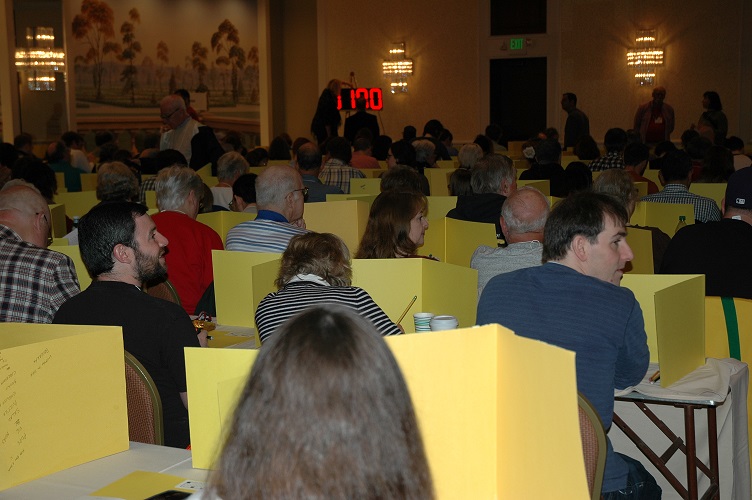
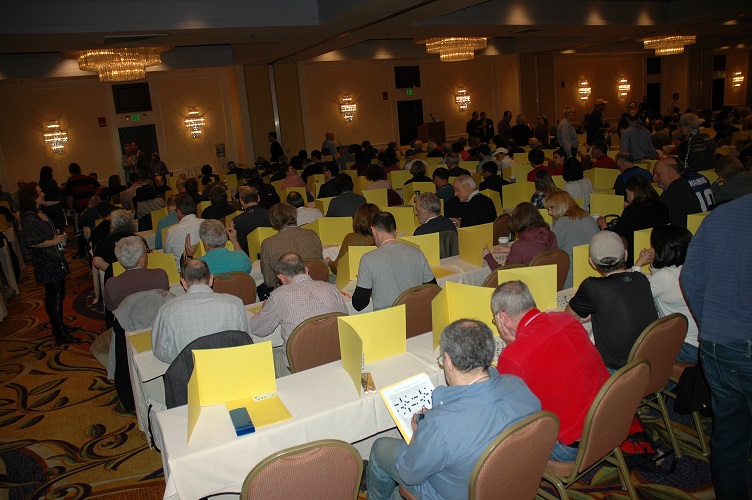
The 39th annual American Crossword Puzzle Tournament was this weekend, and puzzlers descended on the Stamford Marriott Hotel to put their puzzly chops to the test in what is lovingly called “the Nerd Olympics.”

The tournament takes place over two days, with six puzzles to solve on Saturday, followed by one on Sunday. Then the top three finishers solve the championship puzzle on white boards in front of the audience.

On Friday and Saturday night, there are often puzzle events, demonstrations, and panels by top puzzlers and figures in the puzzle world as well.

(This year, Friday night featured author and puzzler Eric Berlin hosting an Escape the Room-themed puzzle hunt that received rave reviews from participants, and Saturday night saw the first Merl Reagle Memorial Lifetime Achievement Award in crossword construction presented to constructor Maura Jacobson. Her husband accepted on her behalf from Merl’s widow, and there wasn’t a dry eye in the house.)

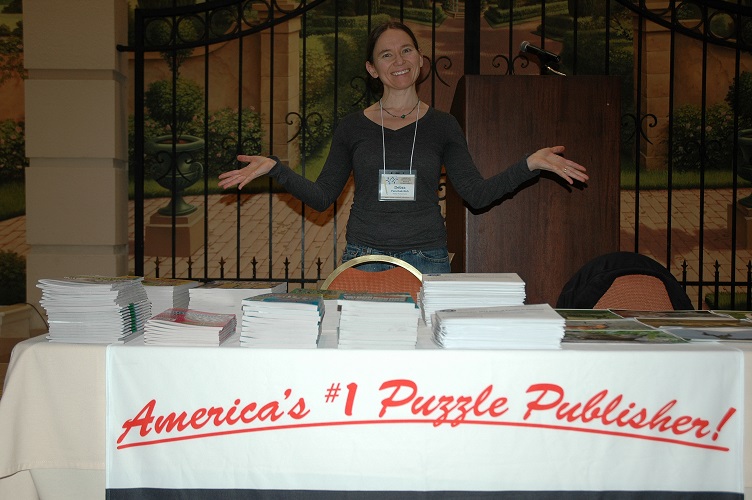
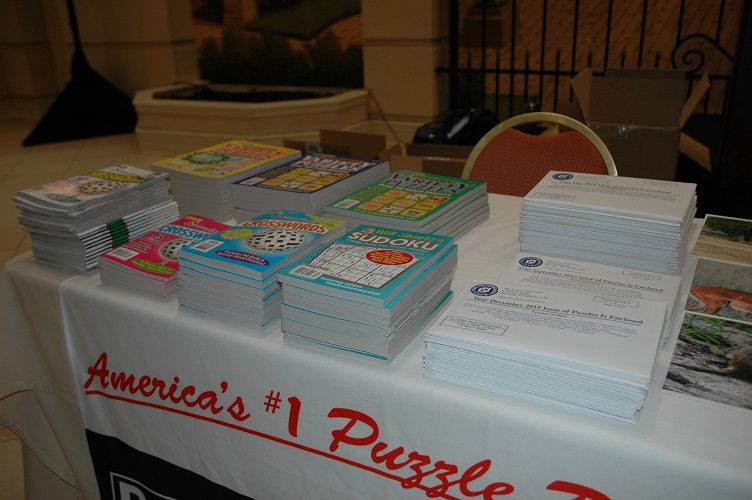
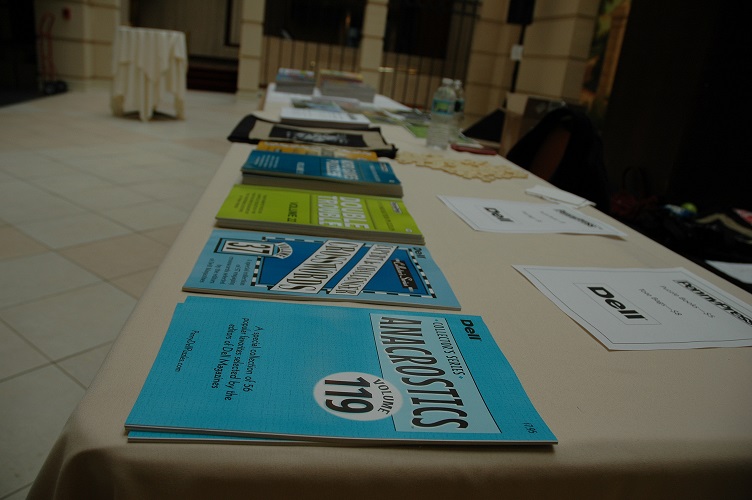
I made the journey down to Stamford myself Saturday morning and sat in with my friend, proofreader and puzzler Debra Yurschak Rich, at the Penny Dell Puzzles booth.

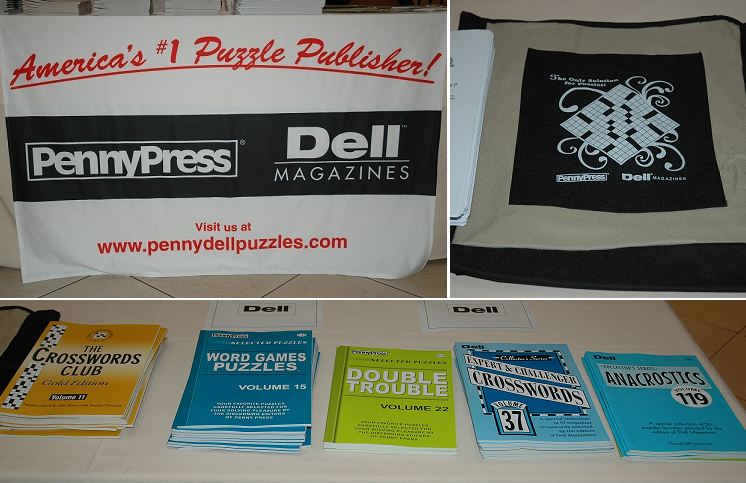
Our pals at Penny Dell Puzzles had a terrific setup as always, with great books and tote bags for purchase and a metric buttload of magazines to give away, including copies of The Crosswords Club, Will Shortz’s Sudoku, and several flavors of Tournament Variety, Master’s Variety, and Dell Sunday Crosswords!

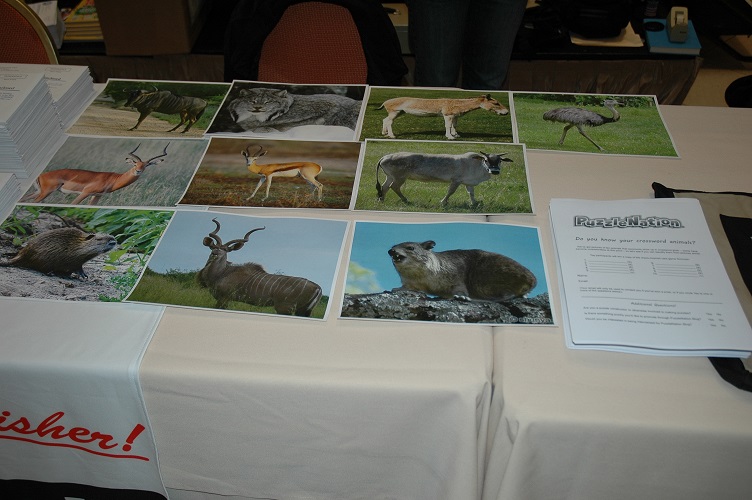
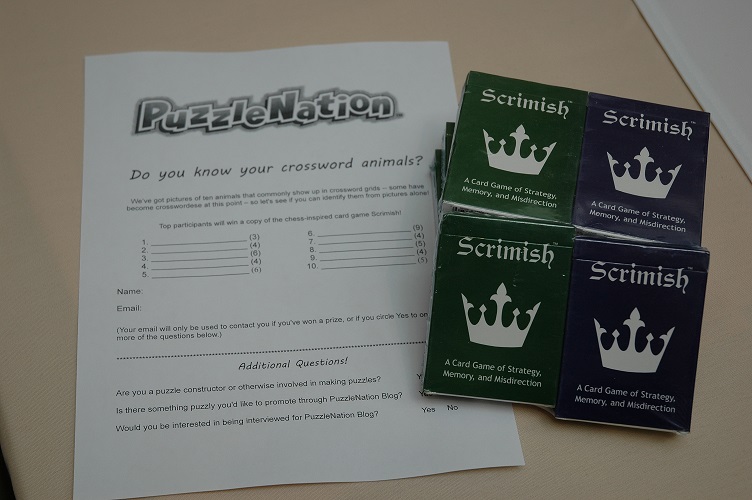
And they didn’t mind at all when I conquered and annexed the middle of the table for PuzzleNation’s in-person version of Friday’s View a Clue crossword animals puzzle. Many competitors stopped by the table to try their luck, allowing some to thoroughly impress their fellow puzzlers with their knowledge of African antelopes, while others were flummoxed trying to match names they’d written into grids dozens of times with images of the actual animal!

(One woman told me she’d seen many of these animals during a trip to South Africa, and even EATEN some of them, but she couldn’t identify them by name. I imagine it’s quite rare to know what an animal tastes like but not what it LOOKS like.)

At 9 AM, the tournament was two hours away, but the marketplace was up and running. In addition to the usual ACPT swag, the marketplace included Hayley Gold and her Across & Down comics, the aforementioned Eric Berlin (repping his Winston Breen books and Puzzle Your Kids subscription puzzles), a collection of Merl Reagle’s puzzle books, and an impressive selection of puzzly titles from the marvelous crew at The Village Bookstore in Pleasantville, New York!

Plus I got to see friends of the blog like Crosswords Club editor Patti Varol, constructor Ian Livengood, crossword gentleman Doug Peterson, and Penny Press variety editor Keith Yarbrough!

Another treat of the tournament is getting to chat with numerous puzzle luminaries I’ve gotten to know through PuzzleNation Blog, like New York Times Wordplay blogger Deb Amlen, constructor and Pre-Shortzian Puzzle Project curator David Steinberg, constructor Joon Pahk, top solver and former champion Ellen Ripstein, constructor George Barany, Evan Birnholz of Devil Cross, top competitor Tyler Hinman, and, of course, New York Times puzzle editor Will Shortz.

The two hours before showtime passed quickly, and soon, the marketplace emptied and the ballroom filled as competitors took their seats for Puzzle 1.

Puzzle 1 didn’t stagger any of the participants, although there was no repeat of Dan Feyer’s blisteringly fast under-two-minute solve like last year. Three minutes seemed to be the benchmark for the top performers this year.

But Puzzle 2 had a crossing that flummoxed several solvers: CORTANA crossing CONTE. Constructor Patrick Blindauer, not in attendance, was no doubt on the receiving end of some Puzzle 5-level heat for that one. But when Doug reached out to Blindauer, it turns out that THAT wasn’t Blindauer’s corner! It had been edited, with MONTANA becoming CORTANA.

I had no idea puzzles accepted for the tournament were edited that much!

Puzzles 3 and 4 passed without incident, and people seemed to enjoy both the camaraderie of the event and the opportunity to compete against their own best times from previous years.

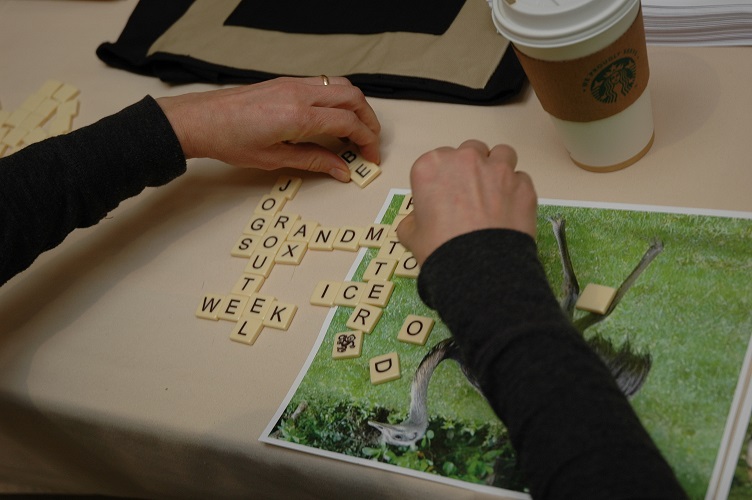
[In our downtime, Debra and I indulged in a round or two of Bananagrams, because it was a day for wordplay of all sorts.]

Then Patrick Berry’s Puzzle 5 arrived, complete with zigzagging entries and a thoroughly impressive fill. (“Wow” was uttered several times by competitors describing their impression of the always-dreaded fifth puzzle of the day.)

Between puzzles 5 and 6, I handed out prizes for our View a Clue crossword animals game: copies of Scrimish, donated by that game’s terrific design team!

Two copies went to our top performers — one got ALL TEN and another got nine out of ten — and two copies went in a drawing from all of the players who gave it their best shot. So congratulations to Robert Moy (who pitched a shut-out), Robert Kern, Abbie Brown, and the man known only as Dan (who got all but one)!

After the diabolical inventiveness of Puzzle 5, Puzzle 6 was tackled by the solvers, who declared it a fun and fair end to the day’s competition. The solvers dispersed to rest their brains; we packed up the table, and headed for home.

And although I wasn’t present for Sunday’s tournament finale, I continued to get updates from friends and fellow puzzlers.

The day started off with Lynn Lempel’s Puzzle 7, which received strong reviews, but did little to alter the standings of the top competitors.

Soon, it was time for the finalists to be announced. When it came time for the top three to solve on their whiteboards in front of their fellow competitors, two of the names were quite familiar to attendees: Dan Feyer, defending six-time champion, and Howard Barkin, four-time champion and perennial participant in the finals.

Conspicuous by his absence was another familiar name and former champion, the performer who made last year’s finals such a nail-biting showdown: Tyler Hinman. An unfortunate error in Puzzle 2 took him out of the running, so the final member of the live-solving trio would be David Plotkin. (Joon Pahk, Francis Heaney, Al Sanders, Jon Delfin and other regular key performers were also near the top.)

He and Howard prepared for a thoroughly wordy and daunting battle with Mr. Feyer, whose excellent performance in the seven previous puzzles had him leading his competitors by three minutes.

You can watch the final puzzle being solved below:

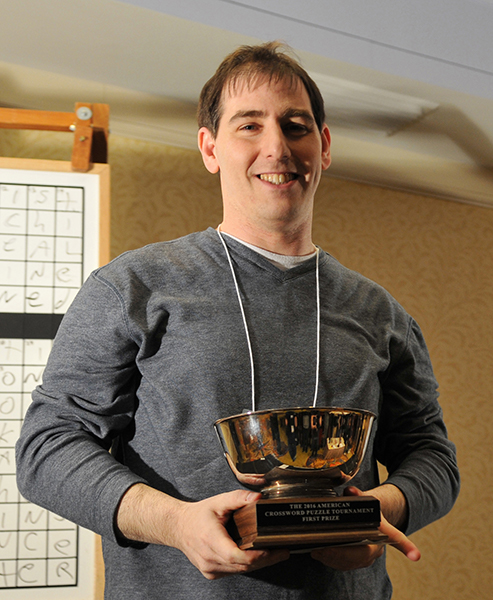
In a stunning upset, Howard Barkin did the seemingly impossible, besting Dan Feyer and claiming the top spot! The room erupted for him as others sat by, stunned that the expected seventh straight win for Dan was not to be.

[Howard poses with his well-earned trophy.]

But that’s not all! Friend of the blog and crossword gentleman Doug Peterson placed 13th overall AND won the finals for Division B! Congratulations to Doug!

And it was a strong showing for many other familiar names! Patti Varol placed 97 (up from last year’s 109 showing), David Steinberg 113th, Kathy Matheson 237th, and Keith Yarbrough 266th out of a field of nearly 600 participants.

It was certainly a day for surprises, strong emotions, and puzzly camaraderie. It’s always great fun to spend time with fellow puzzlers and wordplay enthusiasts, immersing myself in the puzzle community and enjoying all the charm and weirdness that comes part and parcel with it.

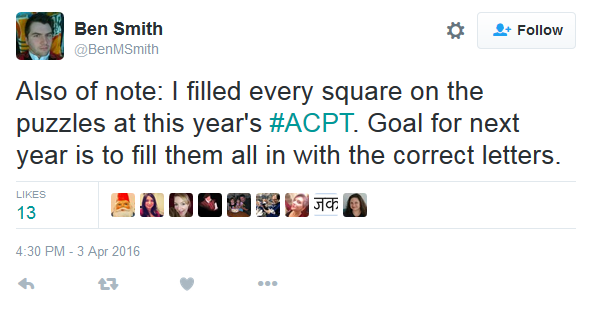
That would’ve been my closing statement, but I think the final word belongs to competitor Ben Smith:


Thanks for visiting PuzzleNation Blog today! Be sure to sign up for our newsletter to stay up-to-date on everything PuzzleNation!

You can also share your pictures with us on Instagram, friend us on Facebook, check us out on TwitterPinterest, and Tumblr, and explore the always-expanding library of PuzzleNation apps and games on our website!


Other puzzles you might not know! (Volume 1)

We’re all puzzle fans here, right? And sometimes we need something new, something fresh and engaging to rejuvenate our love of puzzles. We know all the classics — crosswords, fill-ins, logic puzzles, word seeks, Sudoku, cryptograms, and anagram puzzles — but there’s a whole wide world of puzzles out there to explore that you might not even know about!

So, in today’s post, I’m going suggest some puzzles to check out, based on each of those classic solving experiences.


Let’s start with crosswords.

From the New York Times and LA Times crossword puzzles to the Penny Dell Crossword App, there’s no shortage of terrific crosswords of all difficulty ranges awaiting solvers.

But there are also some terrific variant crosswords for you to try out, like Double Trouble.

[Click here or on the grid for a larger version, complete with clues.]

In a Double Trouble crossword, you can put one, two, or three letters into a box, making for a more difficult solve that the standard one-letter one-box crossword.

But if you want to go a little farther afield, you can try something like Marching Bands.

[Image courtesy of Brendan Emmett Quigley’s website.]

A Marching Bands puzzle has two sets of clues. The first set clues the rows reading across, with two clues per line. But the second set is where things get interesting. See those alternating rings of light and dark shading? The second set clues words reading clockwise along those rings, or bands.

So instead of words meshing across and down, as in a standard crossword, you have across clues and band clues interacting to help you fill the grid. It’s a wonderful variation on familiar crossword rules, but one challenging enough to keep you interested. (For a more in-depth look, click here!)

But maybe you like crossword cluing but you’d like an answer more interesting than just a grid filled with words. Fair enough, have you ever tried Crostics?

[Click here or on the grid for a larger version.]

Crostics, also known as Anacrostics (from our friends at Dell Magazines) or Acrostics (as made by friend of the blog Cynthia Morris), feature a series of clues and letter blanks to be filled.

Those letter blanks each have coordinates assigned, so that when you fill the correct letters into those blanks, you’re also filling blanks in a grid below to spell out a bonus message, quotation, or anecdote. (It’s a one-to-one ratio, so each letter blank corresponds to a letter blank in the grid. If there’s one J in the message, you’ll find a J in the answer words.)

Although you don’t have the overlapping entries to help you puzzle out answers like crosswords or Marching Bands do, you can use the grid below as a solving aid. As each word in the message emerges, you can fill in those letters in the blanks above (using those same coordinates).

And for something along the same vein, you’ve got Word Games Puzzles.

[Click here or on the grid for a larger version.]

You still get the message reading out in a grid and the letter blank coordinates like in Crostics, but instead of a bunch of crossword-style clues, you instead get four mini-games to solve. One might be trivia or encryption, another might involve some wordplay, another might offer themed clues, and the fourth might be an anagram game.

Each will challenge you in different ways, and the use of repeated letters — a change from Crostics with their one-to-one letter blank to grid letter ratio — gives you more than one chance to fill in the final message.

Hopefully, one or more of these puzzles will pique your interests and offer a welcome new solving experience!


Next week, I’ll have recommendations for fans of Fill-In puzzles, and in future installments, we’ll tackle word seeks, logic puzzles, Sudoku, and more! If you’ve got recommendations for your fellow puzzlers, please let us know in the comments!

Thanks for visiting PuzzleNation Blog today! Be sure to sign up for our newsletter to stay up-to-date on everything PuzzleNation!

You can also share your pictures with us on Instagram, friend us on Facebook, check us out on TwitterPinterest, and Tumblr, and explore the always-expanding library of PuzzleNation apps and games on our website!