Crosswords: Scourge of Society!

Study history for any length of time, and patterns will emerge. One of the most curious patterns is how new forms of recreation are embraced, then inevitably sensationalized, stigmatized, and finally vindicated when cooler heads prevail. You see it over and over again in pop culture across the decades.

Video games continue to suffer from periodic demonization, accused of instigating violence in children. Harry Potter books are still banned by some schools and communities for spreading occult ideas. Not so long ago, one of my favorite pastimes — Dungeons & Dragons — was maligned as Satanic and damaging to young minds.
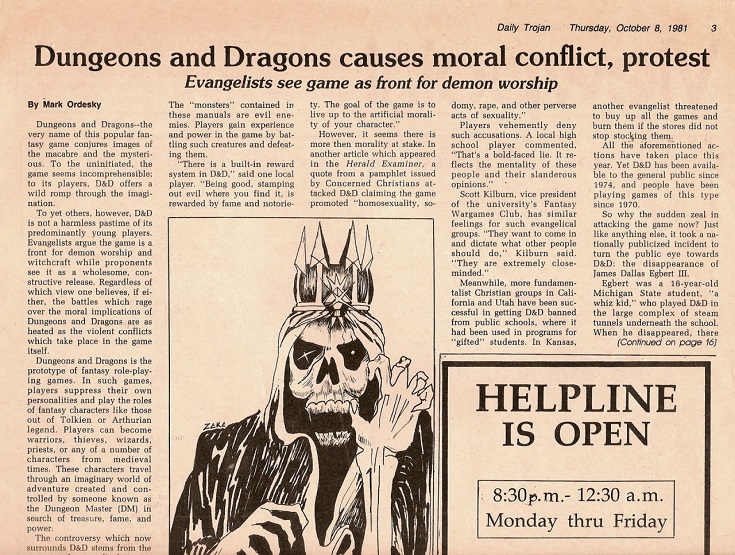
All of these panics were (and are) patently ridiculous. After all, you can go back through history and find other examples that are absolutely ludicrous in retrospect.

For example, check out this excerpt from The San Antonio Texan from August 26, 1858, about the dangers of overindulging in reading:

A whole family brought to destitution in England, has had all its misfortunes clearly traced by the authorities to an ungovernable passion for novel reading entertained by the wife and mother. The husband was sober and industrious, but his wife was indolent and addicted to reading everything procurable in the way of romance. This led her to utterly neglect her husband, herself and her eight children.

One daughter in despair, fled the parental home, and threw herself into the haunts of vice. Another was found by the police chained by the legs to prevent her from following her sister’s example. The house exhibited the most offensive appearance of filth and indigence. In the midst of this pollution, privation and poverty, the cause of it sat reading the last ‘sensation work’ of the season, and refused to allow herself to be disturbed in her entertainment.

That is proper nonsense.

And yet, it should come as no surprise to you, fellow puzzler, that crosswords also received this kind of treatment. Yes, crosswords were the focal point of a moral panic.

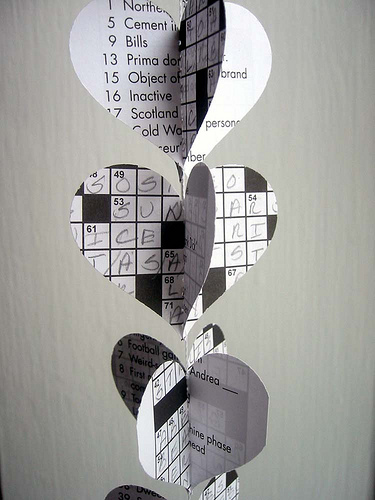
Arthur Wynne’s “word-cross” first appeared in The New York World in 1913. Simon & Schuster published The Cross-Word Puzzle Book, edited by Margaret Farrar, in 1924. 1924 also marked the first time a UK newspaper, The Sunday Express, would publish crosswords. By that point, crosswords were officially a fad, inspiring fashion trends (black and white patterns), hit songs, and musical revues on Broadway.

Ah, 1924. It was a strange year for crosswords. Because 1924 also saw some of the most inflammatory accusations hurled at the simple pencil-and-paper puzzles.

In November of that year, Canadian Forum referred to the spread of crosswords as an “epidemic obsession.”

The paper went on to psychoanalyze crossword solvers, claiming that crosswords were, at heart, a regressive and childish pursuit:

It is obvious from the similarity of the cross-word puzzle to the child’s letter blocks that it is primarily the unconscious which is expressing itself in the cross-word puzzle obsession.

The same year, The London Times went so far as to call America “enslaved” by the puzzle:

[The crossword] has grown from the pastime of a few ingenious idlers into a national institution: a menace because it is making devastating inroads on the working hours of every rank of society… [people were seen] cudgeling their brains for a four-letter word meaning ‘molten rock’ or a six-letter word meaning ‘idler,’ or what not: in trains and trams, or omnibuses, in subways, in private offices and counting-rooms, in factories and homes, and even — although as yet rarely — with hymnals for camouflage, in church.”

That church reference was particularly notable, as there were church sermons decrying the negative influence of crosswords on society. Sermons! Imagine crosswords being treated like heavy metal in the ’80s. It’s mind-boggling.

Much like that hyperbolic story about a family decimated by reading, newspapers published dubious tales of familial collapse sparked by crosswords:

Theodore Koerner of Brooklyn asked his wife for help in solving a crossword. She begged off, claiming exhaustion. Koerner shot her (superficially) and then shot himself (fatally).
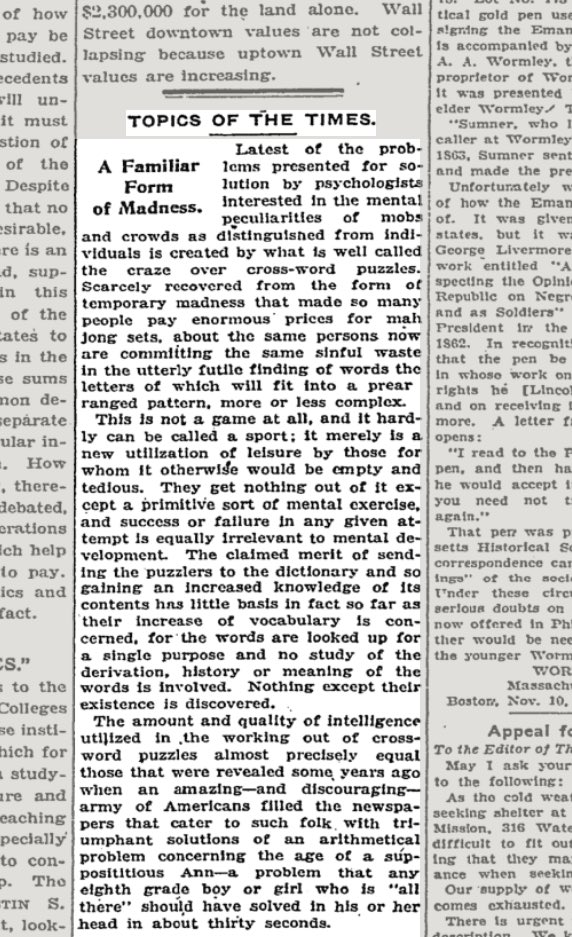
And The New York Times, bastion of puzzles for the last 75 years? Yes, even the Gray Lady had harsh things to say about crosswords:

Scarcely recovered from the form of temporary madness that made so many people pay enormous prices for mahjongg sets, about the same persons now are committing the same sinful waste in the utterly futile finding of words the letters of which will fit into a prearranged pattern, more or less complex.

The paper went on to call crosswords “a primitive form of mental exercise” and compare their value to that of so-called brain teasers that should be solved by schoolchildren in 30 seconds or less.

Crosswords wouldn’t debut in the New York Times until 1942.

But could there have been a hint of truth buried beneath all the sensationalism? Perhaps.

There were reports that overzealous solvers, desperate for an edge over other puzzlers, went so far as to desecrate books at the New York Public Library in order to prevent others from utilizing the same resources. A sign, circa 1937, firmly stated that “the use of library books in connection with contests and puzzles is prohibited.”

Those darn crossword addicts, always getting into trouble. Can’t trust ’em.

So, the next time someone tells you crosswords are boring and passe, you can tell them that crosswords were as cool and as dangerous as rock n’ roll, once upon a time.

Heck, they still are.

[Thanks to The Atlantic, The Senior Times, Historical Nonfiction on Tumblr, The 13th Floor, and CommuniCrossings for images and quotations.]


Thanks for visiting PuzzleNation Blog today! Be sure to sign up for our newsletter to stay up-to-date on everything PuzzleNation!

You can also share your pictures with us on Instagram, friend us on Facebook, check us out on TwitterPinterest, and Tumblr, and explore the always-expanding library of PuzzleNation apps and games on our website!

Tackling the 2018 Indie 500 Puzzles!

June 2 marked the fourth annual Indie 500 Crossword Tournament, hosted in Washington, D.C., by constructors Erik Agard, Neville Fogarty, Andy Kravis, Peter Broda, and Angela Olsen Halsted. The first tournament had a racing theme, the second had a prom theme, the third had a time theme, and this year was fashion-themed!

While I couldn’t attend the tournament, I did download the tournament puzzles, and last weekend I finally had the opportunity to sit down and tackle them. And today, I thought I’d offer my thoughts on those puzzles, for any interested PuzzleNationers who might be considering participating in the event in the future.


Before the official tournament puzzles start, there’s a warm-up puzzle, a 13x grid entitled “Top Gear” by Neville Fogarty and Erik Agard. The hook is simple and accessible — celebrity names where the first name is a type of top, like COTTON MATHER for “crop top” or SHERMAN HEMSLEY for “tank top” — and with good fill and some tricksy cluing, you’ve got a nice pace-setter for the tournament puzzles to come.

Interesting grid entries included COSTUME CHANGE, GAINER, OMEN II, and THAT TOO. My favorite clue was the Arrested Development-inspired “What you might find in a bag marked ‘DOVE – DO NOT EAT'” for BAR SOAP.

[Image courtesy of Vertigo Mag.]

#1 On the Walk by Angela Olsen Halsted

The tournament proper opened with this terrific puzzle. The grid had solid fill entries with very little crosswordese, making for a marvelous introduction to the high quality level you’ve come to expect from Indie 500 puzzles. The theme entries all contained the word CAT in shaded boxes in the grid, slowly descending the main diagonal path of the grid, making for a literal catwalk.

The comment beneath the title, “Please, no meowing,” is not only a fun hint, but a hilarious callback to the Crossword De-Cat-hlon puzzle from last year’s Lollapuzzoola tournament, which had solvers meowing out loud as part of the solving experience. (That’s immediately what came to mind for me, anyway.)

All in all, a cracking opener for the tournament.

Interesting grid entries included PREGGERS, SABRA, ANITA HILL, and IMAC. My favorite clue was “Something you shouldn’t tell a woman to do” for SMILE.

[Image courtesy of Slideshare.]

#2 Unmentionables by Anna Gundlach

Puzzle 2 immediately raised the difficulty level, layering long interesting entries along the top right and bottom left corners of the grid to challenge the solver a bit more.

Couple that with a hook that required some very tight grid construction: unclued entries (making them “unmentioned”) in the grid like BRIEFS and BRA, each of which appears under the word WEAR in the grid. So you’ve got unmentionables and underwear. A really fun and clever execution of a good hook.

Interesting grid entries included AFAIK, RED STATES, TWENTY-ONE, and ROOMBA. My favorite clue was easily “Things that might come out in a row?” for SWEAR WORDS.

#3 Mall Shook Up by Laura Braunstein

As you might expect from the title, this puzzle involved clothing stores at the mall which had been all jumbled up. For example, one line read SECRET BANANA GAP, referencing Victoria’s Secret, Banana Republic, and Baby Gap. So those missing words would end up in other jumbled store listings. Laura went above and beyond in her store mixing, probably providing the most entries I’ve ever seen in a puzzle of this style.

There was one awkward crossing that tripped me up — NEW ME crossing AD WAR — but for the most part, this was a strong puzzle to mark the halfway point for the tournament.

Interesting grid entries included MANTA RAY, NO REPLY, TONSURE, RICOTTA, and BREW PUBS. My favorite clue was “Cat in a Blake poem” for TYGER.

[Image courtesy of Garment Care.]

#4 Tailoring Instructions by Andy Kravis and Sophia Maymudes

Probably the hardest puzzle in the tournament, strictly for its cluing style for the theme entries, which felt more like Crostic clues. Each themed hint would have a straightforward clue, and then in parentheses, tailor’s instructions for how to trim or manipulate the actual answers to fit into the grid.

For instance, the clue “Setting of ‘The Hobbit’ (‘Take this one up a bit’)” takes the full answer reading down, MIDDLE EARTH, and “takes it up a bit,” excluding the bottom two letters and leaving the answer MIDDLE EAR.

Although the vocabulary of the grid itself wasn’t much harder than the usual fare, this was definitely the toughest theme to unravel. Kudos to those who did so in a timely fashion.

Interesting grid entries included GO PRO, RIHANNA, LIAISE, RAIN GOD, and TRANS AM. My favorite clues were “App for a lift but not a Lyft” for UBER and “Word after baby or before cat” for FAT.

[Image courtesy of Cyanide & Happiness.]

#5 Coin Purses by Neville Fogarty

The visual design here — featuring shaded boxes forming u’s in order to create little visual purses, complete with a coin (a box with a circle inside, waiting for a correct answer). Managing to name four five-letter purse brands — GUCCI, COACH, FENDI, and PRADA — each one with a letter inside that spelled out CASH, and the very clever revealer in the center of the grid, reading simply “moneybags.”

Interesting grid entries included IM FED UP, LEFT ARM, DINGUS, TENUTO, DINOS, and SPAMBOT. My favorite clues were probably 2 Down and 44 Down — clues reading that each entry was an anagram of the other — eventually revealing LIMEADE and EMAILED as the anagrammical pair.

#6 Addition by Subtraction by Lily Silverstein and Erik Agard

The final puzzle provided a really solid challenge for the solve, but otherwise was relatively straightforward. The revealer here was POCKET SQUARE, and indeed, there were four black squares that served as hidden pockets for missing letters throughout the grid. For instance, when applied to the bottom left corner, the answers TIE and NEON, as well as URS reading down, became TIE ONE ON and OURS.

And wouldn’t you know it, those pocket letters spelled out the word DONE when solvers were done. A challenging and worthy finale for the event.

Interesting grid entries included E-SHARP, ALDO GUCCI, ATTAQ, and ICE PLANET. My favorite clues were a tie between “Simba’s kingdom” for ANIMALIA and “Figure with two axes, perhaps” for GRAPH.

It was a strong closing puzzle — and the clues on both the Outside Track and Inside Track were well-written and clever — but I’d be remiss if I didn’t mention one of the bonus puzzles in the packet.

The Tiebreaker concept made for a theme that was brilliant in its literalness. The grid featured shaded boxes, each split by a black square, which “broke” types of ties. AS/COT (alas and cotton), BO/LO (garbo/locke), and CRA/VAT (fulcra/vats) were all tiebreakers. A marvelous visual gag. I loved it.


Overall, this was the best edition of the Indie 500 yet. The puzzles mingled the inventiveness of the previous three tournaments with strong grid design, clever clues, and a real willingness to play around with crossword conventions.

The constructors made the most of the fashion theme, resulting in some super-impressive wordplay and theme ideas. All in all, this was an engaging and worthy series of puzzles, designed to delight and challenge solvers in equal measure.

I look forward to its return next year, and hopefully some of you will join me in accepting the Indie 500 challenge!

Note: There were additional puzzles included in the puzzle packet, but since they were outside the regular tournament puzzles, I didn’t review them. But believe me, they are worth your time.


Thanks for visiting PuzzleNation Blog today! Be sure to sign up for our newsletter to stay up-to-date on everything PuzzleNation!

You can also share your pictures with us on Instagram, friend us on Facebook, check us out on TwitterPinterest, and Tumblr, and explore the always-expanding library of PuzzleNation apps and games on our website!

The BosWords Crossword Tournament Returns Soon!

Sunday, July 29th, from noon to 5 PM, puzzlers from all over will gather at The Roxbury Latin School in West Roxbury, Massachusetts for the second edition of the BosWords Tournament, and registration opens today!

With three divisions to choose from — Red Sox (Expert), Paw Sox (Amateur), and Pairs — puzzlers of all ages and experience levels will have the opportunity to test their puzzly wits.

The five themed puzzles in regular competition have been constructed by Laura Braunstein, Andrew Kingsley, John LiebJoon Pahk, and Brendan Emmett Quigley, and after the scores from those puzzles are tabulated, a championship themeless crossword by David Quarfoot awaits the top three solvers in each division!

BosWords is asking for $20 for adults, $20 for pairs, and $10 for students to attend and compete, which is a real bargain!.

You can check out their Facebook page for full details!

Will you be attending the BosWords tournament, fellow puzzlers and PuzzleNationers? Let us know! We’d love to hear from you!


Thanks for visiting PuzzleNation Blog today! Be sure to sign up for our newsletter to stay up-to-date on everything PuzzleNation!

You can also share your pictures with us on Instagram, friend us on Facebook, check us out on TwitterPinterest, and Tumblr, and explore the always-expanding library of PuzzleNation apps and games on our website!

The Indie 500 Crossword Tournament returns tomorrow!

That’s right! Tomorrow, June 2nd, will mark the fourth annual edition of the tournament, and registration is still open for $30, plus you can participate from home for only $10! Click here for details!

Not only that, but once again they’ve whipped up a meta-suite of puzzles to boot, and you name your own price for it!

I expect great things from the immensely talented team of constructors and directors they’ve assembled: Laura Braunstein, Erik Agard, Lily Silverstein, Sophia Maymudes, Angela Olson Halsted, Andy Kravis, Peter Broda, Anna Gundlach, and Neville Fogarty. With a “Dressed to Fill” theme, topnotch constructors, and pie (there’s always pie), you can’t go wrong!

You can click here for the Indie 500 home page, and click here for a rundown of last year’s puzzles!

Will you be competing? Or participating from home? Let us know in the comments below!


Thanks for visiting PuzzleNation Blog today! Be sure to sign up for our newsletter to stay up-to-date on everything PuzzleNation!

You can also share your pictures with us on Instagram, friend us on Facebook, check us out on TwitterPinterest, and Tumblr, and explore the always-expanding library of PuzzleNation apps and games on our website!

Publish More Women!

That was the message received loud and clear by attendees at the American Crossword Puzzle Tournament last year if they saw Erik Agard’s t-shirt. The future ACPT champion was amplifying a call that has resonated throughout the puzzle community for years now.

And yet, puzzles are often still regarded as a boys’ club.

Despite the fact that Margaret Farrar got the ball rolling. Despite the fact that Maura Jacobson contributed a puzzle to each of the first 34 ACPT tournaments and created over 1400 puzzles for New York Magazine. Despite a grand tradition of female innovators, tournament champions, and topnotch constructors that continues to this very day.

This topic once again took center stage recently when Will Shortz, gatekeeper for The New York Times crossword, posted his thoughts on the subject online:

Periodically I get asked, “Why aren’t more female constructors published in the New York Times?” And I always think, “Well, we don’t get a lot of submissions from women.” But until now I’ve never counted.

So this afternoon I counted. I looked through 260 recent submissions … and counted 33 by female constructors. That’s a little under 13%.

This figure is in line with the percentage of female constructors we publish. Last year, according to the stats at XwordInfo, 13% of the crosswords published in the Times were by women. So far this year the figure is slightly better — 15%.

Why this number is still so low, I don’t know.

In positive news, the number of new female constructors is significantly higher. In 2016, 31% of the 26 contributors who made their Times debut were female. In 2017, 19% were female. So far this year 27% have been female. XwordInfo lists all the names.

Our goal is to be inclusive. We want the Times crossword to reflect the lives, culture, and vocabulary of the people who do it, and having more female-made puzzles would provide better balance.

Still for us to publish more women constructors, we need to receive more puzzles by women. That’s the bottom line.

Our policy is open submissions. If you’re a woman who’d like to get into crossword constructing, we’d welcome your contributions, and we’ll be happy to work with you to get you published.

Reactions across the puzzle community have been mixed, but a number of people found Will’s response lacking. They asked what actual steps would be taken in order to encourage women and other underrepresented groups. Would there be additional support from the NYT for these sought-after constructors? Or would the status quo remain precisely that?

Those are questions worth asking. After all, the Times has been celebrating its 75th anniversary for the last year and a half with celebrity guest constructors. But how many of those celebrity collaborations have been with female constructors?

Three. That’s a project with huge visibility and mainstream media crossover potential, and the number is three.

And speaking of media crossover, it wasn’t that long ago — less than two years, actually — that the divisive clue “Decidedly non-feminist women’s group” for HAREM appeared in the NYT. Ruth Gordon wrote a brilliant piece in Slate highlighting how cluing standards at the Times could be exclusionary:

“Hateful” and “awful” may seem a bit harsh for what reads like a lame attempt at cheekiness. But the clue is certainly tone-deaf. And it’s not the first time a puzzle’s un-PC cluelessness has annoyed people. In 2012, the answer ILLEGAL was clued with: “One caught by the border patrol.” The offensive use of illegal as a noun set off a brouhaha that made its way to Univision.

And in November, Shortz issued a mea culpa for the clue “Exasperated comment from a feminist.” Answer: MEN — presumably with an invisible exclamation point and flying sweat out of a Cathy comic.

So, how has the NYT crossword been doing over the last two years?

We can turn again to the insightful Erik Agard for context. While guest-posting on Rex Parker’s puzzle blog, Erik took a moment to celebrate and spread the word about Women of Letters, the marvelous 18-puzzle charity project we also discussed a few weeks ago:

It’s also a lot of women! In fact, there are more woman-constructed crosswords in this collection than there have been published by the New York Times so far this year. Those who fail to see the urgency in closing the gender gaps in crossword constructing and editing often posit that ‘you can’t tell the difference between a crossword written by a woman and one written by a man’ (ergo, whether women are equally represented has little bearing on the end product, so why should we care).

The puzzles in Women of Letters disprove that thesis in a big way, through the dizzying array of less-traveled roads explored by themes, grids, and clues alike. From the juiciest marquee answers in the themelesses to the simplest choice of referencing a legendary actress by her accolades and not just [Bond girl], the collection never ceases to be a breath of fresh, inimitable air. (As the young people say: “Your fave could never.”)

That comment was posted on April 29th, and yes, as of April 29th, the New York Times crossword had published 17 puzzles from female constructors (including male/female collabs). That’s 17 out of 119 puzzles for the year, or 14.3%.

Erik helpfully provided some other statistics for the sake of comparison:

  • Crosswords With Friends: 33/119 = 27.7%
  • The Los Angeles Times: 31/119 = 26.1%
  • American Values Club Crossword: 3/18 = 16.7%
  • Chronicle for Higher Education: 2/16 = 12.5%
  • Wall Street Journal: 9/99 = 9.1%
  • Fireball Crosswords: 0/19 = 0%

It’s also worth pointing out that, as of April 29th, our Daily POP Crosswords app stood at 87/119, or 73.1%.

If you update the listings up through May 15th, Daily Pop Crosswords published 95 puzzles by women over 135 days. March alone featured 21 puzzles by women across 31 days. Heck, in February, only two puzzles the entire month were constructed by men. (Er, man, to be more specific. The same chap constructed both.)

But those aren’t the only numbers worth celebrating. Our friends at Penny/Dell Puzzles maintain an impressive publication rate for The Crosswords Club subscription service. They publish six puzzles a month, so from January to May, that’s 30 puzzles, and 16 were constructed by women (including three collabs). The January issue was all female constructors.

That’s no surprise, honestly, given the company. At Penny/Dell Puzzles, women constitute the majority of not only puzzle editors, but upper management as well.

So, forgive me if I come off as flippant, but when Will Shortz asks, “Why this number is still so low?”, I have to ask why as well.

Because the constructors are out there, right now, doing tremendous work.


Thanks for visiting PuzzleNation Blog today! Be sure to sign up for our newsletter to stay up-to-date on everything PuzzleNation!

You can also share your pictures with us on Instagram, friend us on Facebook, check us out on TwitterPinterest, and Tumblr, and explore the always-expanding library of PuzzleNation apps and games on our website!

The Indie 500 Crossword Tournament returns soon!

Three years ago, a new crossword tournament joined the ranks of the American Crossword Puzzle Tournament and Lollapuzzoola, immediately carving out its own niche in the puzzle world. The Indie 500 offered topnotch puzzles and a pie-fueled solving experience both live in Washington, D.C., and for solvers at home.

And it’s back! The fourth edition of The Indie 500 is happening on Saturday, June 2, and this year, the theme is “Dressed to Fill.”

This year’s tournament follows the same format as previous years: five preliminary puzzles of varying difficulty, plus a final puzzle for the top three scorers in both divisions.

[There’s also a fair amount of slapstick.]

Registration is open for the tournament, and if you can make it to D.C., it’s only $30 to compete! But don’t worry if you can’t, because solving from home is only $10!

Not only that, but there’s a fashion-themed meta suite that lets you name your own price, as well as access to the previous tournament bundles for $5 apiece. Those are super-affordable prices for some outstanding puzzles!

Andy Kravis, Erik Agard, and Neville Fogarty all make their fourth appearance as veteran constructors — understandable, since they’re also event organizers — and they’re joined once again by Angela Olson Halsted and Peter Broda, as well as tournament newcomers Anna Gundlach, Laura Braunstein, Lily Silverstein, and Sophia Maymudes!

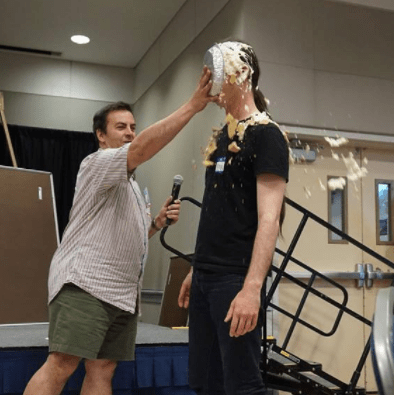
And, of course, there will be pie.

You can click here for the Indie 500 home page, and click here for a rundown of last year’s puzzles!

Will you be competing, or participating from home? Let us know in the comments below!


Thanks for visiting PuzzleNation Blog today! Be sure to sign up for our newsletter to stay up-to-date on everything PuzzleNation!

You can also share your pictures with us on Instagram, friend us on Facebook, check us out on TwitterPinterest, and Tumblr, and explore the always-expanding library of PuzzleNation apps and games on our website!