Picture this…

There are all kinds of puzzles. That’s one of the best things about being a puzzle fan: the fact that there are so many varieties of puzzle out there waiting to challenge you. From word searches and crosswords to Sudoku and cryptograms, from brain teasers and sliding-tile puzzles to pattern puzzles and rebuses, the possibilities are endless.

One of the most engaging (and surprisingly challenging, I’ve found) fall under what I’d call picture puzzles.

Picture puzzles demand keen visualization skills, since they often involve manipulating shapes in your head. You might be asked to deduce what letter is on the hidden side of a six-sided die, or how to divide farmland with only three lines and separate every sheep from each other. It’s visual trickery and topnotch puzzle-solving wrapped up in one.

And one of my favorite Picture puzzle wizards is Sam Loyd.

I was introduced to Mr. Loyd’s puzzles in Mathematical Puzzles of Sam Loyd — a collection assembled by puzzle aficionado Martin Gardner — a book I stumbled upon in the library one day while strolling the shelves.

The collection offers math puzzles and brain teasers, deduction problems and tracing games, but the ones that most intrigued me were his Picture puzzles.

Now, adding pictures to puzzles is hardly a new idea. David L. Hoyt’s Jumble puzzle features one, and plenty of Matching / Spot the Difference puzzles — like the Match-Up and The Shadow puzzles offered by our pals at Penny/Dell Puzzles — rely heavily on art. But there’s a marvelous charm to Loyd’s drawings, creating a scene and telling a small story as he offers one brain teaser after another.

I’ll post a few of my favorites, so you can get a sense of not only his artistic stylings, but the extreme cleverness involved in creating these puzzles.

Each of these puzzles requires a keen ability to visualize shapes in your head, as well as some serious craftiness to conquer the challenge Loyd sets before you.  Have you figured them out?

I’ll post the solution to the first one and leave the others for you to puzzle out.

[I didn’t line it up perfectly, but you get the idea.]

Loyd is part of a marvelous tradition of inventiveness and creativity that has helped contribute to the rich and vibrant puzzle world we enjoy today.

[To check out more of Sam Loyd’s puzzles, you can visit this website dedicated to his puzzly legacy (including several puzzles for sale!), a treasure trove of Picture puzzle fun.]

Thanks for visiting the PuzzleNation blog today! You can like us on Facebookfollow us on Twitter, cruise our boards on Pinterest, check out our Tumblr, download our Classic Word Search iBook (recently featured by Apple in the Made for iBooks category!), play our games at PuzzleNation.com, or contact us here at the blog!

5 Questions for Director and Editor David Rogers

Welcome to another edition of PuzzleNation Blog’s interview feature, 5 Questions!

We’re reaching out to puzzle constructors, video game writers and designers, writers, filmmakers, and puzzle enthusiasts from all walks of life, talking to people who make puzzles and people who enjoy them in the hopes of exploring the puzzle community as a whole.

And I’m overjoyed to have David Rogers as our latest 5 Questions interviewee!

An Emmy-award-winning editor, producer, and director, David has worked on NewsRadio, Seinfeld, Entourage, and The Office (as well as the sadly short-lived but very funny shows Andy Richter Controls the Universe and The Comeback).

During his time on The Office, he edited 60 episodes and directed 9, including the funniest episode of the show’s final season, “A.A.R.M.” He’s currently contributing to The Mindy Project, which is in its second season on Fox.

David was gracious enough to take some time out to talk to us, so without further ado, let’s get to the interview!

5 Questions for David Rogers

1.) You’re both a director and an editor for The Mindy Project, which means you play a significant role in taking disparate scenes and shots and assembling them into a cohesive, entertaining whole. Sounds like just about the ultimate in real-life jigsaw-style puzzle solving. What goes into the production of a given episode, and what are your thoughts as you prepare it for air?

I think the process of putting together any episode of any television show is more like solving a puzzle than anybody watching at home actually realizes, and The Mindy Project is a perfect example of this. From the moment the writers start on a script, they have to be conscious of who is currently doing what and what has happened before, and what’s going to happen down the road. Once the script gets into the hands of a director and the production staff, then more puzzle solving begins.

You break it down and start scouting locations and casting guest stars and then the first ADs (Assistant Directors) put together a shooting schedule. But they have to build it in a way where they can accommodate actors’ availabilities, place locations on a day where we can get the most done, and they also have to be aware of “turnaround issues” for cast and crew, that is whenever we wrap on one day, the cast and crew get a certain amount of time off before the next day’s call time.

An example I’ll give is when I directed “Bro Club For Dudes,” we shot two days, Thursday and Friday, of a Mixed Martial Arts Arena fight down at Hollywood Park. But we had a cameo from Dana White, the president and owner of the UFC, but he was only available Tuesday morning and we didn’t have the location for that day.

So we shot at another location that looked like a dingy hallway that looked like it was a part of our arena, and we also shot a street fight in the loading dock there between Morgan and Ray Ron, and since they were near our stages at the Universal lot, we finished a little after lunch and then came back to our stages and shot more there.

Another example was Adam Pally, who really kicked ass in his fighting scenes, wasn’t available to shoot on the following Monday and we had a hospital room scene of he and Mindy bonding as she stitches him up. Our solution was to build a small three-wall set at our Hollywood Park location and shoot the scene at the end of Friday night.

As an editor, you’re getting multiple takes and different jokes and plenty of alternate lines and performances, and you really have to sift through everything to figure out what’s the funniest, what’s the best, and how do they all connect together to make a cohesive story. It just takes time and building different versions until you see what truly works the best.

And in the process of cutting out time and sharpening the story, you move scenes around, add and change lines with additional dialog recorded later, and there are lots of other elements that come into play including music, sound FX, and what we call “invisible” visual FX that all help make the show we want to make.

[David with his Emmy Award for Outstanding Single-Camera Picture Editing for a Comedy Series (one of two he’s won for The Office!)]

2.) You’re a big fan of comic books. What influence does that sort of long-form serialized storytelling have on your approach to TV production?

I am a huge fan of comic books and have been ever since I was 5 years old and got my first “The Brave and the Bold.” It’s interesting that when I was younger I was all about the art, and as I got older it was all about the writing and the art didn’t have to be from John Byrne or George Pérez or Neal Adams. But when you read a comic book, you’re really watching a TV show or movie in your head. You’re “casting” voices for the different heroes, you’re imagining what the action scenes and explosions are like, and you’re giving life to still images on a page much like a director uses a set of storyboards.

And that’s the part of a comic book where even if the artist isn’t a favorite like the ones I mentioned above, their work is still essential to what makes the comic book a living, breathing thing. There are these great examples given in How To Draw Comics The Marvel Way, where John Buscema and Stan Lee demonstrate two different pages of art work for the same material. One is fine and gets the story across, but the other is so much more exciting and dramatic and really puts you into the action — and that’s what good directors are constantly aware of when they’re shooting a scene.

What is visually better for the material? What adds to the humor or the drama or the action? And in TV where the schedule is so tight and the budget is always being looked at, what can you do with the tools and time that you have?

I came from The Office, where we were limited with how to shoot scenes because of the hand-held documentary style of the show, but we would still focus on things like shooting it spy or in the room, cross-covering with two cameras, or whipping around with just one, and really blocking positions and making the most of what our shots looked like without them looking like they were set up.

In the penultimate episode “A.A.R.M.,” I directed a scene where Dwight runs Angela off the road and then proposes to her with a bullhorn as traffic goes by in the background. The shots included a go-pro camera set up in Angela’s car where we would see Dwight pull alongside of her as they both “free-drove” — that’s when the actors are really driving the cars.

Meanwhile we get a “boat to boat” shot, where a free-driving process trailer — a truck made for rigging cameras and lights — leads in front of them with two cameras shooting straight back to cover the action. The shot from inside Angela’s car shows their faces very clearly as the scene plays and really brings out the comedy of the situation. Then from the outside, our Stunt Driver Dwight cuts off and runs Stunt Driver Angela off the road and this shot really highlights the action and danger of the stunt.

When we get to the next part of the scene and the cars are on the side of the road, we blocked the actors and cameras in a way so that when Dwight is tender and heartfelt (and yet proposing with a bullhorn), we can see the noisy cars going by on the street behind them, which adds to what should be a very intimate and yet very comedic marriage proposal.

Choosing how to shoot and compose a scene like that, and then executing it is absolutely like putting together a gigantic, complicated, wonderful puzzle!

3.) I understand you’re also a classic television automobile enthusiast. What can you tell us about that?

I don’t know if I’m so much a classic television automobile enthusiast as I am a Super Car enthusiast. I love the Mach 5 from Speed Racer, the DeLorean time machine from Back to the Future, the 1966 Batman television show Batmobile, Herbie the Love Bug, and of course K.I.T.T. from Knight Rider. I just bought a full sized Trans-Am Firebird replica of K.I.T.T and I’m in the process of adding a Season 4 1-TV dash and really making the interior look like the car did on the show. It’s a fun side project and it’s something I’ve wanted since even before I could actually drive!

4.) What’s next for David Rogers?

I hope to continue editing. directing, and producing on The Mindy Project, which I really think is an exceptionally funny, very high quality, well-made show. I am also starting to develop some of my own ideas for TV shows as I look to direct more things down the road, including hour-longs and maybe even an independent film.

5.) If you could give the readers, puzzle fans, and aspiring TV and filmmakers in the audience one piece of advice, what would it be?

Persistence. Never give up and always work on your skills. So often getting the first job is really all about being in the right place at the right time. And you have to be ready to deliver when the pieces all come together and the time comes for you to step up and show everyone what you can do!

Many thanks to David for his time. You can see his work on The Mindy Project, which airs on Tuesdays at 9:30 P.M. Eastern on Fox, and be sure to check out his full filmography on his IMDb page. I can’t wait to see what he crafts for us next.

Thanks for visiting the PuzzleNation blog today! You can like us on Facebookfollow us on Twitter, cruise our boards on Pinterest, check out our Tumblr, download our Classic Word Search iBook (recently featured by Apple in the Made for iBooks category!), play our games at PuzzleNation.com, or contact us here at the blog!

Bigger really is better, sometimes…

giantsudoku

[A massive Sudoku grid, created to promote a Sudoku gameshow in England in 2005.]

There’s just something about puzzles on a grand scale. From the Great Urban Race’s citywide scavenger hunts to the Internet-spanning curiosity that is Cicada 3301, puzzly ambition makes for some truly mindblowing experiences.

But those are puzzles of staggering complexity and scope, not actual physical size. When it comes to sheer dimensions, you have to go building-size.

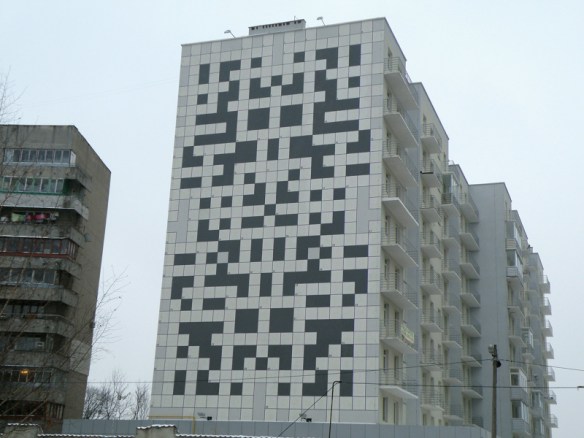
There is, of course, the solvable crossword from Lviv, Ukraine, where the grid takes up the entire side of an apartment building, with clues hidden all over the city. It’s a brilliant tourism move and a terrific challenge (especially if you don’t read Cyrillic).

OLYMPUS DIGITAL CAMERA

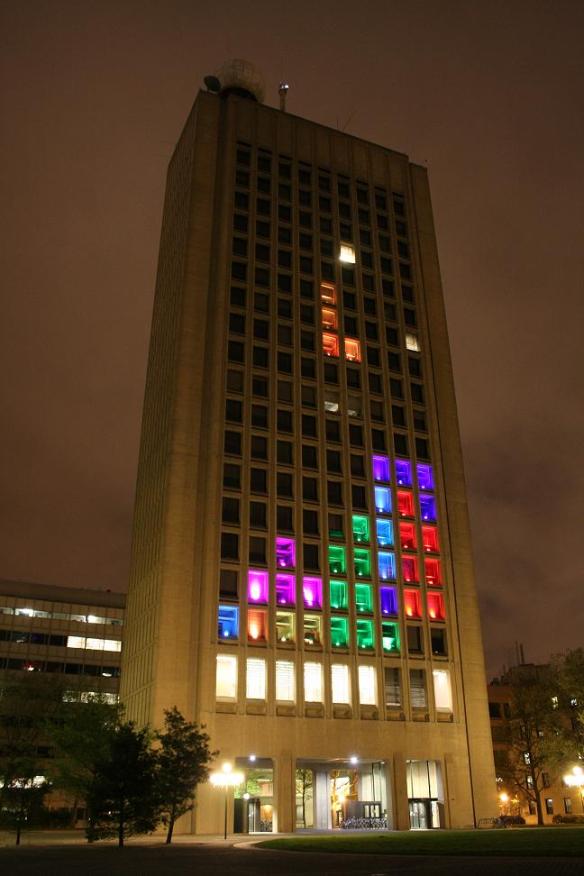
There was also the classic MIT hack from 2012 where ambitious miscreants transformed one side of the Green Building into a multicolored, playable Tetris game. (I recently learned that students from Brown University in Rhode Island accomplished a single-color version of the same feat back in 2000. You can find video of both hacks here.)

tetris1_img6080

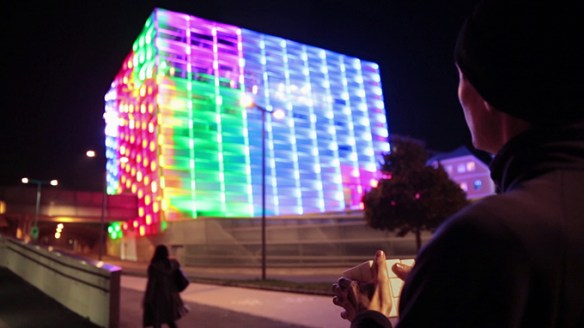
But Javier Lloret has upped the ante with Puzzle Facade, an art installation which transforms the Ars Electronica building in Linz, Austria into a solvable Rubik’s Cube.

Using a small handheld cube as an interface, a solver can manipulate the cube and watch the same changes carried out across two entire sides of the building in full color.

rubikbuilding

As you might expect, having only two sides of the cube available makes for a greater solving challenge, but who cares when you’re lighting up a building with every twist and turn!

It’s a fantastic meeting of puzzly fun and electronic wizardry, and the latest in a grand tradition of massive-scale creativity. I cannot wait to see what intrepid puzzlers come up with next.

Thanks for visiting the PuzzleNation blog today! You can like us on Facebookfollow us on Twitter, cruise our boards on Pinterest, check out our Tumblr, download our Classic Word Search iBook (recently featured by Apple in the Made for iBooks category!), play our games at PuzzleNation.com, or contact us here at the blog!

PuzzleNation Book Review: The Centenary of the Crossword

Welcome to the eighth installment of PuzzleNation Book Reviews!

All of the books discussed and/or reviewed in PNBR articles are either directly or indirectly related to the world of puzzling, and hopefully you’ll find something to tickle your literary fancy in this entry or the entries to come.

Let’s get started!

Our book review post this time around features John Halpern’s The Centenary of the Crossword.

With the hundredth anniversary of the Crossword only a few weeks behind us, interest in puzzle is perhaps at an all-time high. With that in mind, constructor John Halpern has put together a tribute to the crossword that’s part history, part solving tool, and part celebration of everyone’s favorite pen-and-paper puzzle.

It’s a wonderful introduction to puzzles for anyone looking to get into solving crosswords. Beyond the timeline of puzzle history and glimpses into the minds of various constructors (or setters, as they’re known in England) and crossword editors (Rich Norris of the Los Angeles Times and Will Shortz of the New York Times included), Halpern offers numerous solving hints, including a terrific breakdown of cryptic cluing for fans of British-style crosswords.

Not only that, but the book is chock full of complete puzzles for the reader to solve, starting (quite appropriately) with Arthur Wynne’s marvelous “Word-Cross” and proceeding straight through to the modern day, featuring constructors from around the world. These puzzles show the depth and variety of crossword grids and cluing, and I think even well-established solvers will get a lot out of tackling the puzzles Halpern has collected.

The book is capped off with interviews with the top solvers from last year’s American Crossword Puzzle Tournament, some terrific clues (including some from PuzzleNation Blog favorites David Steinberg and Doug Peterson), and a delightful collection of crossword-centric anecdotes, weird words, and impressive anagrams.

Essentially a cross-section of modern puzzling and the rich puzzle community, The Centenary of the Crossword is a quick and informative read, peppered with puzzles to engage and challenge you. I’m happy to report that I learned a great deal about crosswords (especially cryptics!) from Halpern’s work, and enjoyed every minute of it. What a treat.

[To check out all of our PuzzleNation Book Review posts, click here!]

Thanks for visiting the PuzzleNation blog today! You can like us on Facebookfollow us on Twitter, cruise our boards on Pinterest, check out our Tumblr, download our Classic Word Search iBook (recently featured by Apple in the Made for iBooks category!), play our games at PuzzleNation.com, or contact us here at the blog!

A puzzle mystery three years running…

It’s January, and for some cryptography enthusiasts and high-level puzzle solvers, their Christmas gift has finally arrived in the form of another Cicada 3301 mystery.

Two years ago, a curious message appeared on the message board 4chan:

“Hello. We are looking for highly intelligent individuals. To find them, we have devised a test.

There is a message hidden in this image.

Find it, and it will lead you on the road to finding us. We look forward to meeting the few that will make it all the way through.

Good luck.

3301″

Intrigued Internet users quickly discovered that this message concealed numerous other images, clues, and puzzles. It was the start of an elaborate chain that led to hidden websites, as well as GPS coordinates across the globe. (Many of these puzzles and clues were accompanied by an image of a cicada, giving the mystery both a name and a symbol.)

Obscure knowledge (poetry, mathematics, literature, and history have all contributed to various clues), advanced cryptography skills, and some serious tenacity were required to navigate the labyrinthine maze laid out by whoever masterminded Cicada 3301.

Eventually, the savviest and sharpest code-breakers found their way to a secret website, one that vanished after a certain number of crafty solvers discovered it. It then shut down, never revealing to the outside world who was behind the puzzles or why they’d created them.

A year later, on January 5, 2013, another series of puzzles appeared, utilizing different solving techniques, different GPS coordinates, and admitting another select group of puzzle solvers to a secret website before it too shut down.

As of this posting, new puzzles have appeared all over the Internet, though Cicada 3301 enthusiasts believe the vast majority of them to be the work of hoaxers and admirers. (Only one clue so far, a message on Twitter from an account previously used by Cicada 3301, is considered legitimate.)

As you might expect, theorizing abounds regarding the reasons behind the Cicada 3301 puzzles. With the advent of viral marketing and ever-savvier customers, there’s always the possibility that this is an incredibly elaborate video game tie-in or corporate advertising project. (It definitely reminds me of the down-the-rabbit-hole ARG style of that puzzle hidden within the game Portal I wrote about last year.)

But the sheer complexity — and the intrinsic level of secrecy regarding how the puzzles and websites have been managed — has led conspiracy theorists to suspect the CIA, the NSA, or some other government entity. Another leading theory is that a bank or private security company is behind Cicada 3301, recruiting topnotch cryptographers to improve security features and thwart cybercrimes.

It may sound silly or a bit too Last Starfighter-ish, but recruitment-through-puzzle-solving is nothing new to the intelligence community. Crossword puzzles were used to identify potential recruits for Britain’s Bletchley Park, one of the key cryptography centers during World War II.

Whatever the purpose of Cicada 3301’s puzzles, there’s no doubt that puzzle solvers and codebreakers the world over can’t wait for another shot at a challenge like this.

[For further information, check out this NPR story, sent to me by friend of the blog Cathy Quinn!]

Thanks for visiting the PuzzleNation blog today! You can like us on Facebookfollow us on Twitter, cruise our boards on Pinterest, check out our Tumblr, download our Classic Word Search iBook (recently featured by Apple in the Made for iBooks category!), play our games at PuzzleNation.com, or contact us here at the blog!

5 Questions: Alumni Edition

Undoubtedly one of the most popular features on the blog in 2013 was 5 Questions, our interview series featuring puzzle constructors, authors, filmmakers, game designers, puzzle enthusiasts, and creative people in general whose work and play relates to puzzles.

As 2013 was winding down, I reached out to our 5 Questions alumni to catch up and ask them what they’d been up to since appearing here last. (Or when I’m not pestering them for crossword construction advice or New Year’s Resolutions. *laughs*)

And so many of them were happy to share their latest projects with the PuzzleNation audience!

Author Robin Sloan’s marvelous novel Mr. Penumbra’s 24-Hour Bookstore is out in paperback, and the prequel story Ajax Penumbra 1969 is available as an eBook. I asked him about what he’s been doing, and his answer was brief and exciting:

Let’s see… I’m hard at work on a new novel!

That’s about it 😀

Can’t wait to see what he’s got in store for us next.

[Click here to check out Robin’s session of 5 Questions, as well as our book review of Mr. Penumbra’s 24-Hour Bookstore here.]

Great Urban Race Senior Manager Jordan Diehl was also happy to bring us up to speed on what the GUR crew has been up to:

We just finished a successful Championship event in San Juan, Puerto Rico. It was our first time outside of the continental US, and the race was really well-received. Like in years past, a total of $10,000 was given out, but this year it was divided among the top 8 teams as opposed to years past where only first place received cash prizes.

The division of prizes will remain as we enter our 2014 season:
First place: $6,000
Second place: $2,000
Third place: $1,000
Fourth – Eighth place: $200 each

And speaking of, we are excited that our 2014 season is just around the corner!

We’ve consolidated our schedule for 2014; our first event is in late January and the last regular-schedule event of the season will be June 7. This leaves us room for another new Championship location in a potentially colder climate that we could not typically do in November/December (the usual dates of our Championship) as we are looking at an August/September Championship date.

Here at Great Urban Race, we’ve decided that 2014 is the “Year of You,” and we are focusing on listening to participant feedback more than ever. We put out a vote for Championship locations as well as several other campaigns like it through our social media pages.

[Be sure to check out the Great Urban Race website for more details, and click here to read Jordan’s session of 5 Questions.]

Kathy Matheson (a.k.a. puzzle blogger Crossword Kathy) had some interesting news to share, not only regarding her puzzle-constructing aspirations, but interacting with the PuzzleNation readership as well!

After the 5 Questions interview appeared, I was pleasantly surprised to get feedback from a couple of your readers! One is a fellow journalist here in Philly — I recognized his byline but have never met him, and didn’t know he was a puzzler, too. He told me about a local constructor he interviewed a few years ago, when she was 95! Now she’s about to turn 100, and he said she’s still making crosswords. Amazing. I hope to write a story about her myself, somehow tying it in to the just-passed centennial of the crossword.

The other person who contacted me is a constructor I admire who very kindly offered to help with my grid-building dreams. Part of me really wants to take him up on the offer, but part of me is very independent and wants to do it alone.

The truth is that I haven’t spent as much time constructing as I should, so perhaps I should do more of that before asking for help. I did send the L.A. Times one of my puzzles, which was rejected by a very nice note saying that “there’s some good work in your grid, but the theme puns are too stretchy” for their taste. Oh well.

[I have no doubt we’ll be seeing Kathy’s name in a puzzle byline in 2014. Click here to check out her session of 5 Questions!]

Puzzle poet Peter Valentine regularly posts his latest creations on Twitter and Tumblr — I’ve posted his poem “Birthday” for the 100th Anniversary of the crossword above — and has recently added another social media platform to his arsenal.

I’ve started an instagram feed, @peterboothby, which helps to reach many more folks and generate discussion.

[You can check out the full archive of his poems here, as well as his session of 5 Questions here.]

As you might’ve expected, constructor and puzzle historian David Steinberg has kept himself very busy between his own crossword construction and his work on the Pre-Shortzian Puzzle Project, which recently passed the 14,000 puzzle mark!

On December 21, the crossword centennial, I gave a talk at the Palos Verdes Peninsula Center Library on crossword history, the Pre-Shortzian Puzzle Project, and crossword editing, solving, and constructing. Also, I constructed a special centennial puzzle for the Focus page in The Orange County Register.

[Check out The Orange County Register, where David serves as crossword editor, as well as his session of 5 Questions here.]

Prolific constructor Robin Stears has been puzzling up a storm since last we spoke.

The dust has settled from the 100th anniversary celebrations, and of course, the other holidays took up some time, but I’m ready to get back to work. My daughter took pity on me and spent a day fixing my Tumblr blog so that it’s easier to find, sent out messages to all my Tumblr followers, and helped me set up a Tumblr-exclusive giveaway (to make up for my ineptitude). She even tweaked it for the holidays!

I’m starting off the year with a 21×21 StearsWords puzzle entitled “Things to Look Forward to in 2014.” There’s so much to look forward to, it needed a giant-size puzzle.

The Trivia Challenge puzzles seemed to be popular, so there will be more of those. I’ll continue to invite social media fans to send me their ideas and watch them come to life–a Reddit fan suggested “Doctor Who,” a Tumblr fan is responsible for the “Game of Thrones” puzzle, and a Facebook fan challenged me to do a “420” puzzle; clearly, I’m open to just about anything. (Someone asked me to do a cryptogram/crossword, where solvers have to decipher the clues, and then solve the puzzle. It sounds like a lot of work, but also a lot of fun; it also sounds perfect for a contest.)

Naturally, I’ll be keeping a close watch on what’s hot, just in case there’s another “Sharknado”-like event that begs to be immortalized in crossword. And solvers will still find the majority of my work in Penny/Dell puzzle books. They’ve been printing my puzzles for over twenty years, and I’m a huge fan of their puzzle books, as evidenced by the ginormous stack of Good Time Crosswords in my office.

[You can also join Team StearsWords by clicking here, and check out her session of 5 Questions here.]

As you might expect, David L. Hoyt has been busy. The most syndicated man in puzzles continues to produce his signature Jumble puzzles, but he also has a new puzzly product to share.

Just 2 Fun (pictured above) is David’s latest creation and his first app for younger players (ages 9 and up). The app is available for iPad, iPad mini, iPhone 4 and 5 and iPod touch devices. Just 2 Fun is a kids’ version of the enormously successful puzzle app Just 2 Words.

[You can explore all of David’s puzzly creations on his website, and check out his session of 5 Questions here.]

Even our latest interviewee, New York Times crossword editor Will Shortz, had something to share with us in the few weeks since appearing on the PuzzleNation Blog.

You may recall him mentioning his favorite pastime:

At the moment I’m close to finishing a personal goal — to play table tennis every day this year. As I write this (on Dec. 17), I’ve played every single day since Jan. 1 — 351 days in all.

I’m happy to report that Will did in fact complete his 365 days of table tennis for 2013, even throwing a party to celebrate. (I suspect New Year’s Eve may have also contributed to the festivities.)

[Check out Will’s contributions to NPR’s Weekend Edition here, as well as his session of 5 Questions here. We hope to have more information on his new puzzle magazine Will Shortz’s WordPlay very soon.]

Thank you to all of our 5 Questions alums! They helped make 2013 a banner year for PuzzleNation Blog, and as we head into 2014 with new interviews to come, I promise to keep you posted on everything these brilliant puzzly folks are up to.

Thanks for visiting the PuzzleNation blog today! You can like us on Facebookfollow us on Twitter, cruise our boards on Pinterest, check out our Tumblr, download our Classic Word Search iBook (recently featured by Apple in the Made for iBooks category!), play our games at PuzzleNation.com, or contact us here at the blog!