Product Review: That’s Not a Hat

[Note: I received a free copy of this game in exchange for a fair, unbiased review.]

Most memory games are pretty simple, falling into one of two categories: you either observe a pattern and repeat it, or you look at multiple items and remember where they are when hidden/concealed.

Memory games that include a social mechanic are rarer, and memory games with a social mechanic AND bluffing are rarer still.
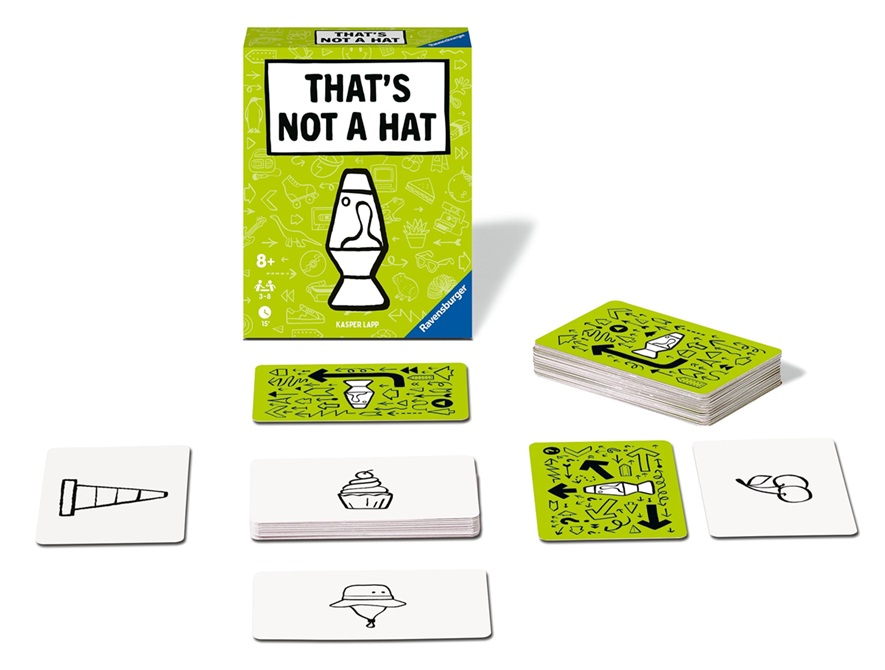
Imagine a white elephant or Yankee swap gift exchange, except in reverse. You know what all the gifts are to start, but then they are wrapped one by one and traded around, and you need to remember what’s inside each one.

That’s the main idea behind Ravensburger’s social memory game That’s Not a Hat, and it’s brilliantly simple… until it is suddenly not so simple.
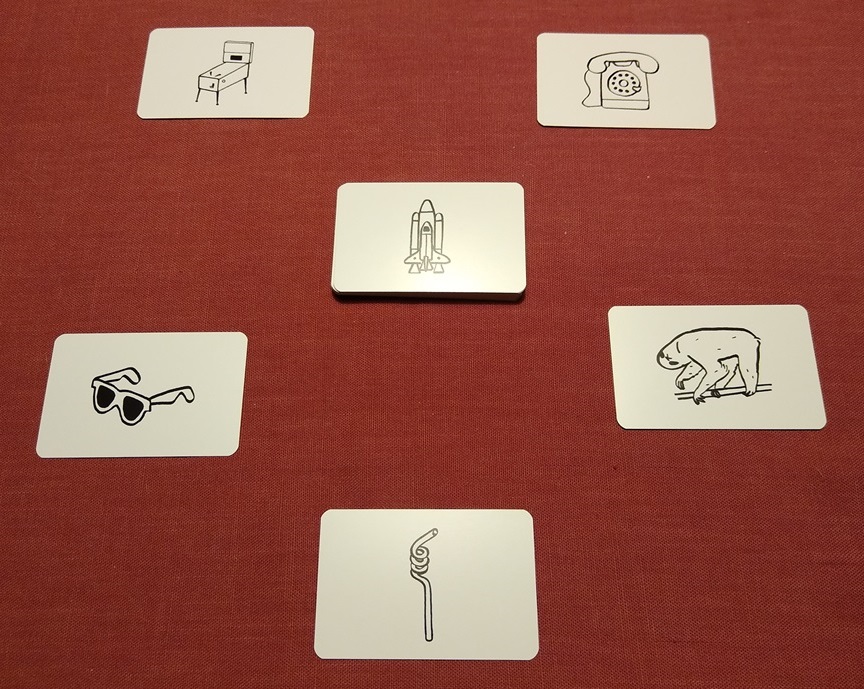
As you can see, everyone starts with a gift. The first player pulls a new gift from the stack in the center of the table, shows it to everyone, then places it facedown.

They then hand that gift to the player indicated by the arrow on the back of the card.
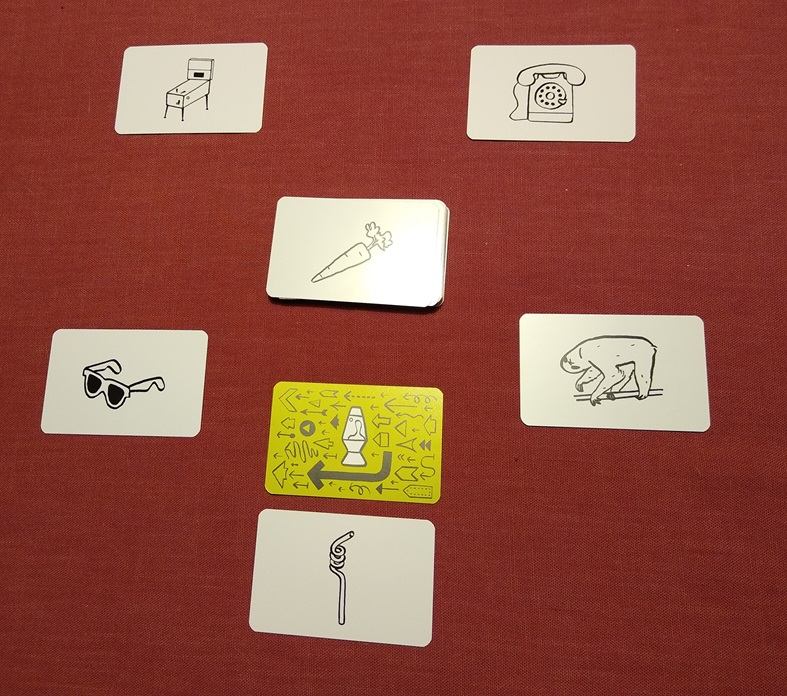
So the player to the right with the sloth card received the space shuttle, flipped it over, and handed it to the swizzle stick player to their left, saying “I have a nice space shuttle for you.”

The player receiving the gift has two options: accept the gift (meaning that they know it’s a space shuttle underneath and agree with the gift giver) or refuse the gift (meaning that they suspect the item underneath is NOT what the gift giver said).

In this case, the game has just started, so our swizzle stick player accepts the gift.
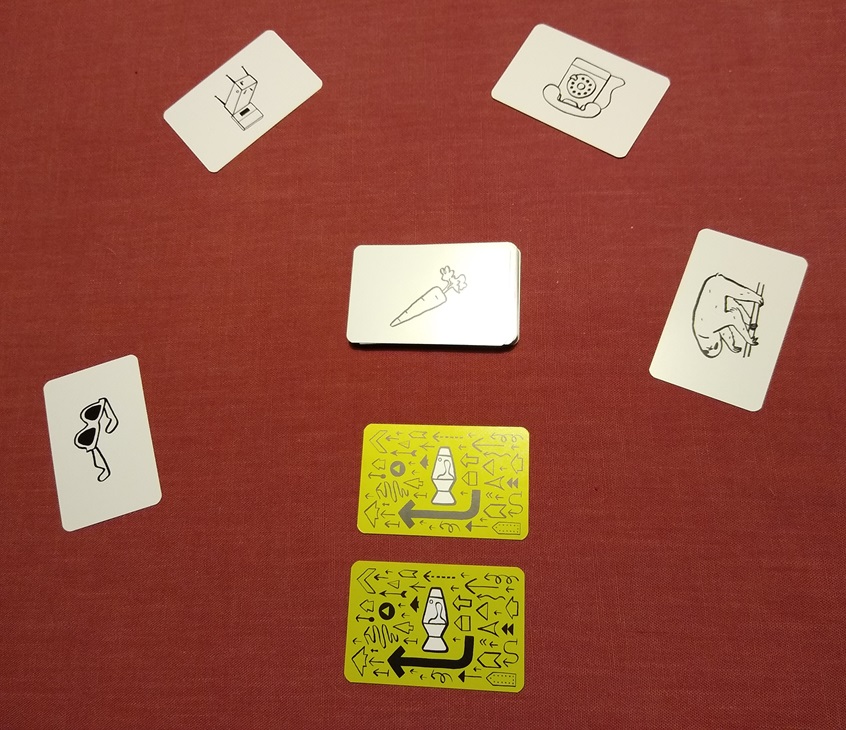
It would be rude to immediately regift what they were just given, so the swizzle stick player turns over their “old gift” and follows the arrow, saying “I have a nice swizzle stick for you” and giving that card to the player to the left (the sunglasses player).
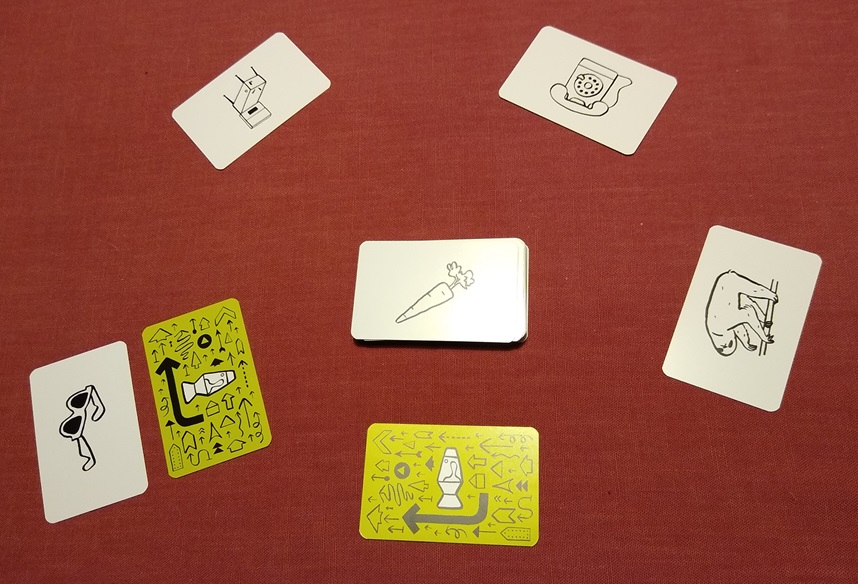
The sunglasses player accepts, turns over their old gift, says their line, and follows the arrow.
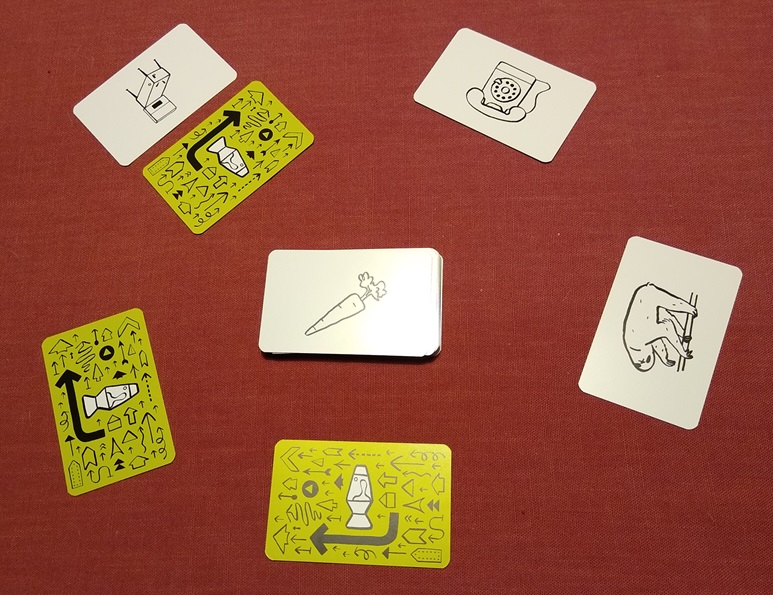
In this simplified version, the arrows only go in one direction, whereas in the regular game, arrows can go left or right (or, in the advanced play style, to any player, depending on the arrows).
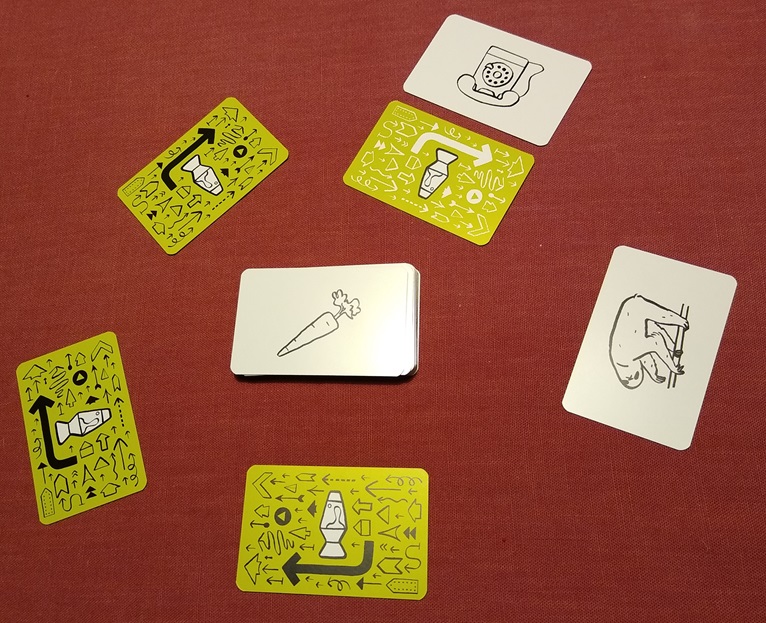
Now, as the cards continue moving around from player to player, can you remember what was under all those cards? You’re gonna have to, because it gets harder and harder to remember what each card represents.
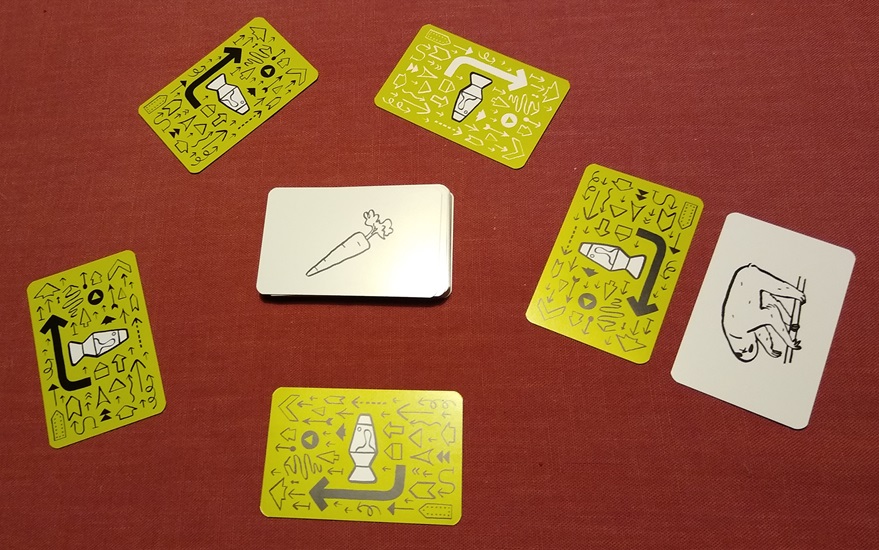
Eventually, someone is going to forget, and their “I have a nice __ for you” is going to be met with a refusal. If the refusing player is correct and the gift giver has forgotten what’s under the card, the gift giver takes that card and gets a point. If the refusing player is incorrect and the gift giver correctly remembered what’s under the card, then the refusing player takes the card and gets a point.

The game then resumes with a new present and all the previous cards STILL flipped over. The game ends when one player gets three points.


This combination of memory, interaction, and bluffing (if you forget what’s under your card) makes for a very fun, very mellow play experience, one that only grows tougher and more entertaining the more you play.

On the second game, I had so many images in my head from previous rounds that I immediately forgot what was under my card and earned a point.

With up to eight players at the table, 110 cards to choose from, plus mechanics to make the game easier or harder for the players, That’s Not a Hat is instantly replayable and never feels tired.

Now, you may start to worry about your memory before too long. It’s okay, though, because you’ll quickly be distracted by the laughter (and bad bluffs) to come.

[That’s Not a Hat is for 2 to 8 players, ages 8 and up, and it’s available from Ravensburger and participating websites (in two editions) starting at only $9.99!]
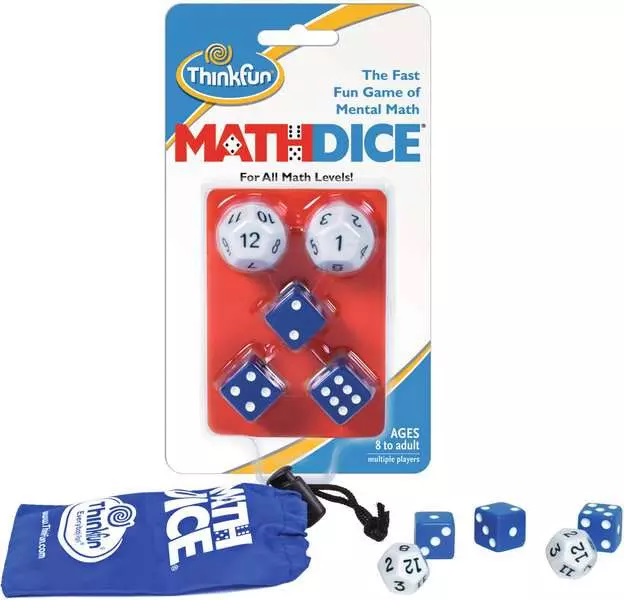
Product Review: ThinkFun’s Math Dice

[Note: I received a free copy of this game in exchange for a fair, unbiased review.]

If you’re not currently in school, you probably haven’t thought about Order of Operations in a while. Maybe six little letters will bring it all back to you: PEMDAS. Parentheses, Exponents, Multiplication, Division, Addition, Subtraction. (I learned to remember it as “Please excuse my dear Aunt Sally.)

This was a handy mnemonic device to explain how to break down complex equations into simpler ones. But it’s also the basis for ThinkFun’s latest puzzly game: Math Dice.

Math Dice challenges players to put their mathematical skills to the test, using randomly rolled dice and their own numerical ingenuity to get the closest to a given number.

But before we get started with the actual gameplay, I want to take a moment to appreciate how the instruction manual eases new players (and players with less confidence in their math skills) into the game.

After explaining the rules, and offering several techniques to make the game easier or harder, depending on player comfort levels, the manual offers numerous examples to make new players more familiar with all the options available to them.

It’s a terrific way to allay player uncertainty and show them some of the creative ways to mix different operations to make different totals.

Now let’s take a look at the gameplay:

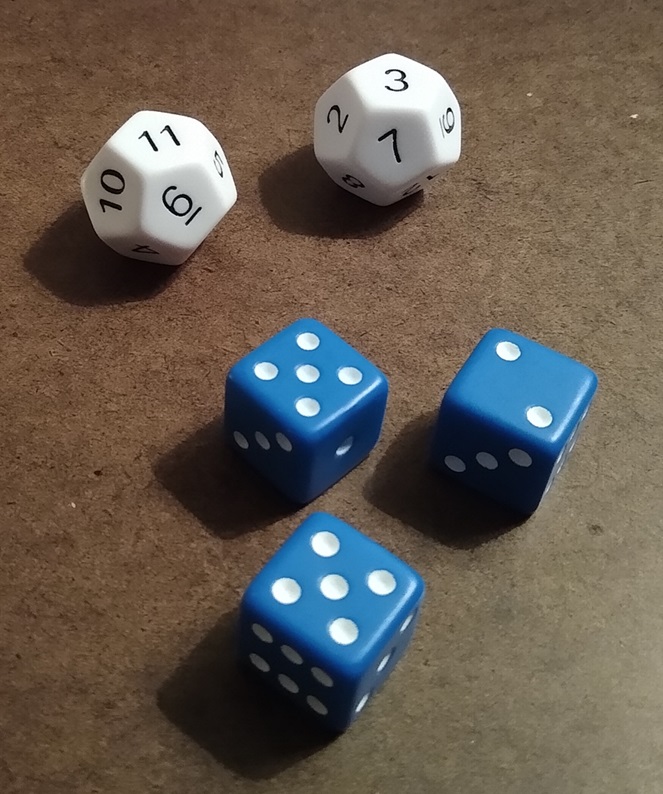
For example, the two 12-sided dice rolled a 12 and a 1. When multiplied, you get your target number of 12. Now the players must try to either match 12 or get closer to 12 than any other player, using the 2, 3, and 6 rolled on the 6-sided dice.

Simple addition will get you to 11.
(3 x 2) + 6 will get you to 12.
(6 – 2) x 3 will also get you to 12.
Can you find any other ways to make 12 from those dice?

This one is a little tougher. The two 12-sided dice rolled an 11 and a 3, giving us a target number of 33. We also have less flexibility with the 6-sided dice, since we have a 2 and two 5s.

(5 x 5) + 2 will get you to 27. Pretty good!
5^2 + 5 will get you to 30.
2^5 + 5 will get you to 37.

In this case, player who got 30 wins a point!

As someone who is always idly playing with words and numbers during mental downtime or between tasks, this game really appeals to the playful side of my puzzly brain. The challenge of making two sets of numbers balance is both challenging and soothing in the best way, like the purely mental equivalent of a fidget toy or other tool to keep your hands and mind engaged.

But this is also a clever launchpad to introduce younger puzzlers to the idea that numbers aren’t just classwork or homework, they’re something to play with. They’re puzzle pieces to rearrange and put together in all sorts of ways to create new results.

ThinkFun excels at turning learning experiences into engaging puzzles and games. Over the years, they’ve done so with logic problems, optics, programming, gravity, deduction, mechanical puzzles, and more, so it’s no surprise they’ve managed to do the same quite deftly with the basics of mathematics.

[Math Dice is for 2 or more players, ages 8 to Adult, and it’s available from ThinkFun and participating websites starting at only $6.99!]

Heardle, Hurtling Toward the Internet’s Future

With Wordle’s surging popularity earlier this year came a slew of derivatives like Nerdle, Queerdle, and Trekle, all fighting for second place in the guessing game spotlight. Heardle, it seems, was the real breakthrough hit. Launched in February by product designer Glenn Angelo, Heardle gives listeners six tries to figure out a song’s identity, based on increasingly lengthy clips from the song’s intro. Angelo’s initial inspiration was just the pun of the name, though the concept can be traced back to the television game show Name That Tune,or to its radio-based predecessor, Stop the Music.

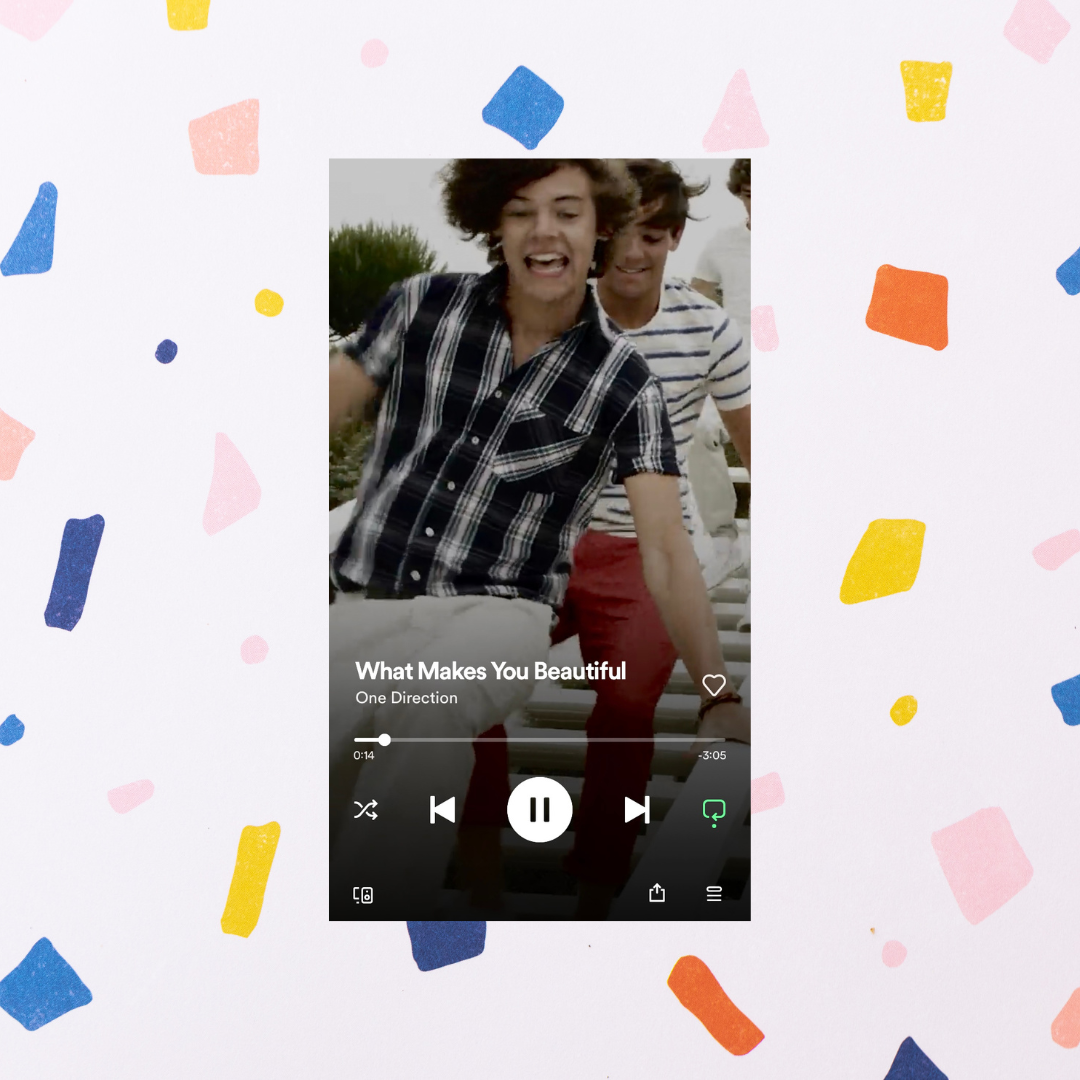
Like Wordle, Heardle updates daily, uniting players in listening to a single song together, creating the illusion of people all over the world huddling around the same jukebox. Some days unite the crowd more than others, depending on how avid a tune’s fanbase. I’ve recently seen a couple of different viral social media posts excitedly imploring people to play the day’s Heardle, once when it featured One Direction’s “What Makes You Beautiful,” and again when the answer was My Chemical Romance’s “Welcome to the Black Parade.” (Full disclosure: I recognized the One Direction song immediately.)

Student Gigi Vincent, who plays Heardle every day, explained the game’s appeal by contrasting it with the movie-clip trivia game Framed. She noted that while the brain behind Framed “clearly has a specific taste, so you can really narrow things down once you understand their repertoire, Heardle is more democratic [in its song choices], and therefore harder,” making for a compelling challenge.

Just as the strength of Wordle’s appeal lead to a purchase by The New York Times, Spotify has heard the acclaim for Heardle and snatched it up in response. This is Spotify’s first game acquisition—the company’s previous purchases have primarily been forms of podcast technology. Spotify’s press release about the acquisition quotes the company’s Global Head of Music, Jeremy Erlich, as saying “We are always looking for innovative and playful ways to enhance music discovery and help artists reach new fans.” According to the release, the company intends to eventually “integrate Heardle and other interactive experiences more fully into Spotify,” building on the eye-catching, meme-able feature of Spotify Wrapped to further gamify music streaming.

The illusion of democracy.

I spoke to media specialist, musician, and Heardle dabbler Sam Hozian about his strong disapproval of the acquisition. He said that it runs directly opposite to the Heardle ethos that Vincent highlighted above, elaborating, “Spotify is the anti-democratization of music. It creates an illusion of democracy because people have a sense that anyone can upload to Spotify and become a hit, but it’s one-in-a million that this will happen . . . It’s not easy for Spotify to make money off of independent artists,” so that’s not where the corporation puts its resources.

Hozian isn’t the only disapproving player. Last week, the BBC ran an article entitled, “Heardle Spotify move hits sour note with some fans.” Complaints lodged in the article include that winning streak stats have been deleted, and that the website is now showing as unavailable in some countries.

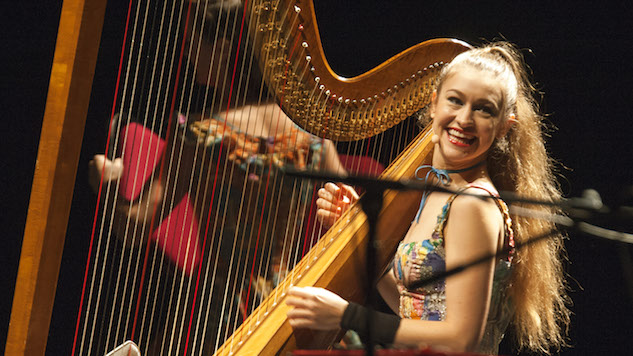
Joanna Newsom has been among Spotify’s most outspoken critics.

Until Spotify sees through its plans to more fully integrate Heardle, the main difference is that the challenging songs are now hosted by the streaming app itself, rather than by SoundCloud. Angelo’s original choice to use SoundCloud for the game was not politically motivated. Instead, he’s cited convenience as the reason; the SoundCloud player was quick and easy to set up within a day. SoundCloud, however, would seem to be more in line with Heardle’s democratic ethos. SoundCloud touts itself as “the first music company to introduce fan-powered royalties, where independent artists can get paid more because of their dedicated fans.” Compare this to oft-repeated criticisms that Spotify underpays artists for streaming their work.

Lest I sound like Spotify’s biggest detractor, rest assured that I am a daily user of the platform. Access to algorithmically generated playlists and the playlists of strangers worldwide opens the door to musical discoveries I would otherwise never have made. In this age of attacks on the Internet Archive, when the ubiquity of Amazon’s cloud services make fully boycotting Amazon an uphill battle, it’s tempting to go quietly into the future of the internet—a future in which everything is owned by a small handful of monopolies, pay-walled and demanding access to our IRL identities. Still, I believe that it is important to resist this new wave of the web in whatever ways you can. Maybe you’ll switch from Google Chrome to Firefox; maybe you’ll download some indie games; maybe you’ll give up Spotify for SoundCloud. We all have our parts to play in shaping the fair, equitable, weird, creative internet that we want to see.

infinitely more complex than any map of the path could ever be.


You can find delightful deals on puzzles on the Home Screen for Daily POP Crosswords and Daily POP Word Search! Check them out!

Thanks for visiting PuzzleNation Blog today! Be sure to sign up for our newsletter to stay up-to-date on everything PuzzleNation!

Queer Games Bundle: Undoing the Curse

For the second year in a row, queer indie game developers and gamers alike are celebrating Pride Month with the Queer Games Bundle. Until the end of June, interested parties can download almost 600 games and game-adjacent zines for $60, with a cheaper option available to those for whom that cost is prohibitive. Described as “an initiative to collaboratively support as many queer indie/micro/art devs and makers as possible,” the bundle is a project of swampbabes, a small New York organization of game artists. Swampbabes, as a collective, is “interested in sharing experimental, non-commercial, renegade games-related art and projects and providing a platform for diverse voices and bodies outside the structures of already established hierarchies.” 

“kate sees your future,” by game creator Bagenzo

The bundle certainly provides a platform for diverse voices. There is a massive amount of content in the bundle, so much so that the selection might be intimidating. Let me provide some starting points. For those intrigued by last week’s blog post, there are two volumes of a zine chockablock with Twine tips and tricks, called “The Twine Grimoire.” Wordle fanatics might be entertained by “Herdle,” which casts Wordle’s distinct collections of squares as farm animals in need of herding. Did my post about stealing back your time via poetry resonate with you? You might find joy in “Time Bandit,” a game for Windows and MacOS that forces the player to slow down.

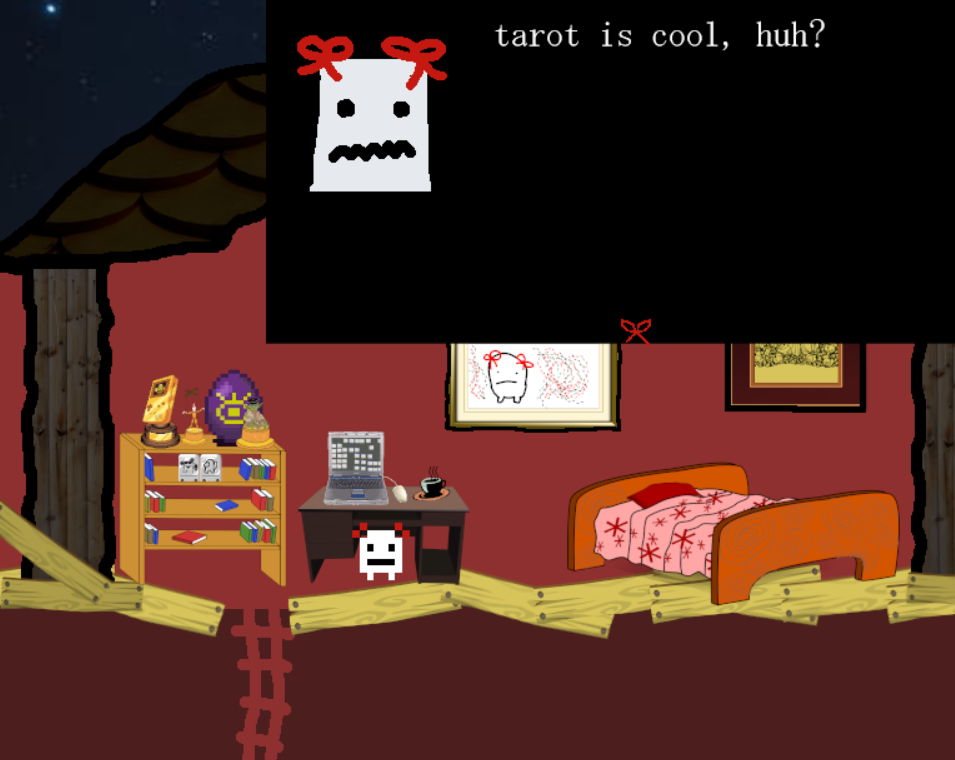
If tabletop roleplaying is your preferred gaming mode, never fear—included TTRPG guides range from the adorable and arguably self-explanatory “Rodents With Guitars” to the cyberpunk “Escape from Neo-Millenia.”  I was pleasantly surprised by the number of bundle entries incorporating tarot, like the solo journaling game “My One True Wish,” the browser-based “kate sees your future,” digital tarot deck, “Slimegirl Tarot,” and “A Note in Time,” a TTRPG about writing a letter to your younger self.

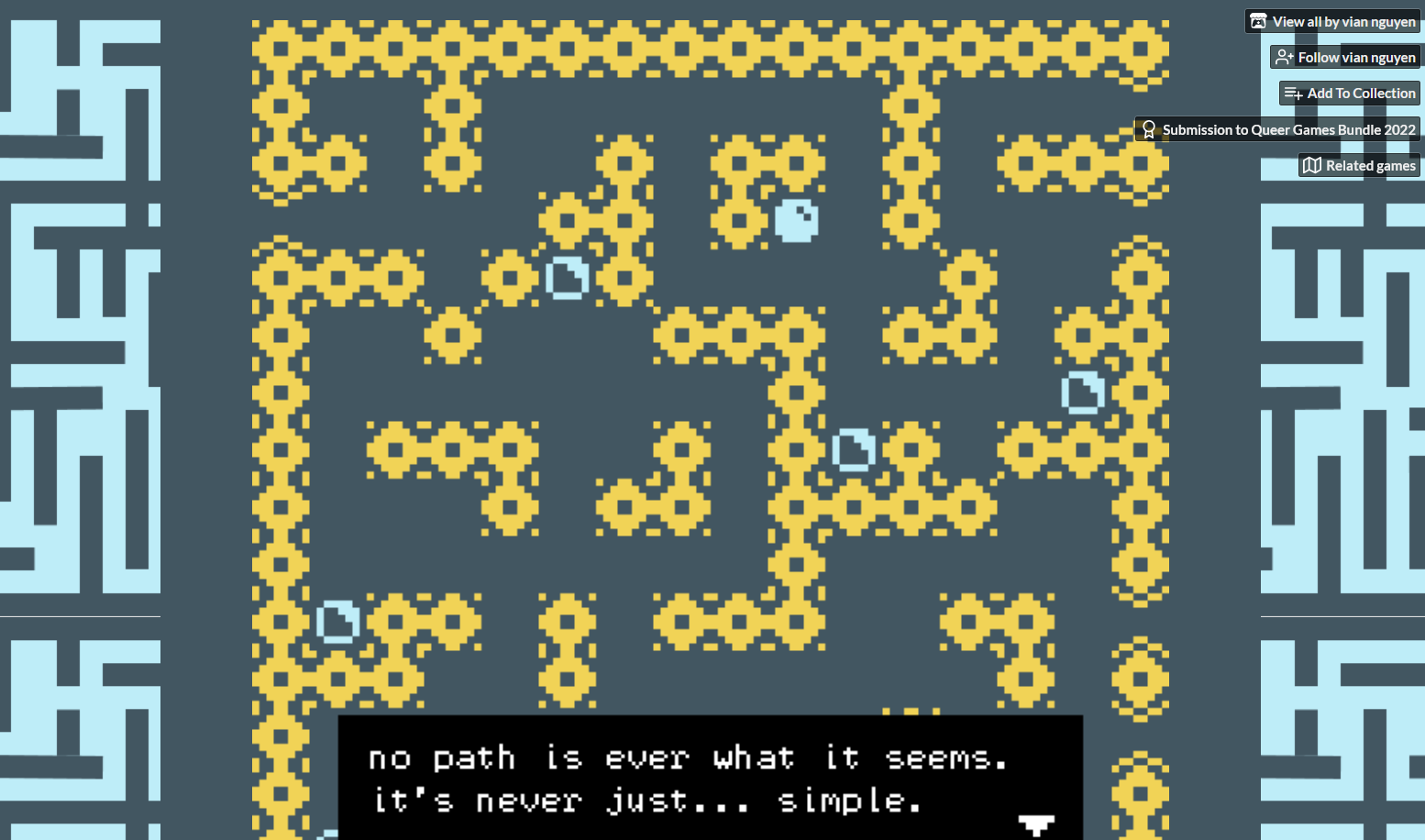
“people are labyrinths” by game creator Vian Nguyen

The puzzle-minded among you are likely to enjoy the game RESYNC, available for Windows, MacOS, and Linux (the bundle can be filtered according to the operating systems compatible with each game). RESYNC challenges you to work with robots as allies, solving puzzles to “uncover the true purpose of the mysterious outpost” on which your character has crash-landed. Then there’s the browser-based “people are labyrinths,” a collection of mazes studded with wistful dialogue boxes meditating on topics such as loss, the complex inner workings of other people, and an unwanted job.

Swampbabes states on their website that they hope the community their work fosters “begins to undo the curse inherited from mainstream video game culture.” They leave up to the imagination what exactly that curse is, but if you too feel that mainstream video game culture is cursed, and want to do something about it, purchasing the Queer Games Bundle is a win-win situation: hours of fun for you, and financial support for queer game developers. As of this writing, over a thousand gamers have purchased the bundle, raising almost $66,000 that will be split among the creators at Pride Month’s end.  


You can find delightful deals on puzzles on the Home Screen for Daily POP Crosswords and Daily POP Word Search! Check them out!

Thanks for visiting PuzzleNation Blog today! Be sure to sign up for our newsletter to stay up-to-date on everything PuzzleNation!

Love Poems and Games: Twined Together

For most gamers, Zork is the classic example of a choose-your-own-adventure, text-based gaming experience. Although Oregon Trail is relatively adorned in images, italso fits the bill. When I think of this genre of game, my mind goes down a slightly different path. Instead, I first think of the Zork parody Thy Dungeonman, hosted on Flash cartoon site Homestar Runner. Then, I think of the queer indie games made in the early 2010s on Twine.

Open-source, hypertext-based storytelling tool Twine was invented by web developer Chris Klimas thirteen years ago. At the time, Klimas had no way of knowing what a hit the program would be in the indie gaming community, but was inspired by the creativity of its users to keep improving its functionality. On November 3, 2009, he wrote about finding a love poem that Dan Waber was scripting in Twine, and said, as a way of explaining “Why I’m Doing This,” “what I’m doing helps people do real things, to make poetry even. There aren’t that many developers out there making things that people make poetry with. I feel lucky.”

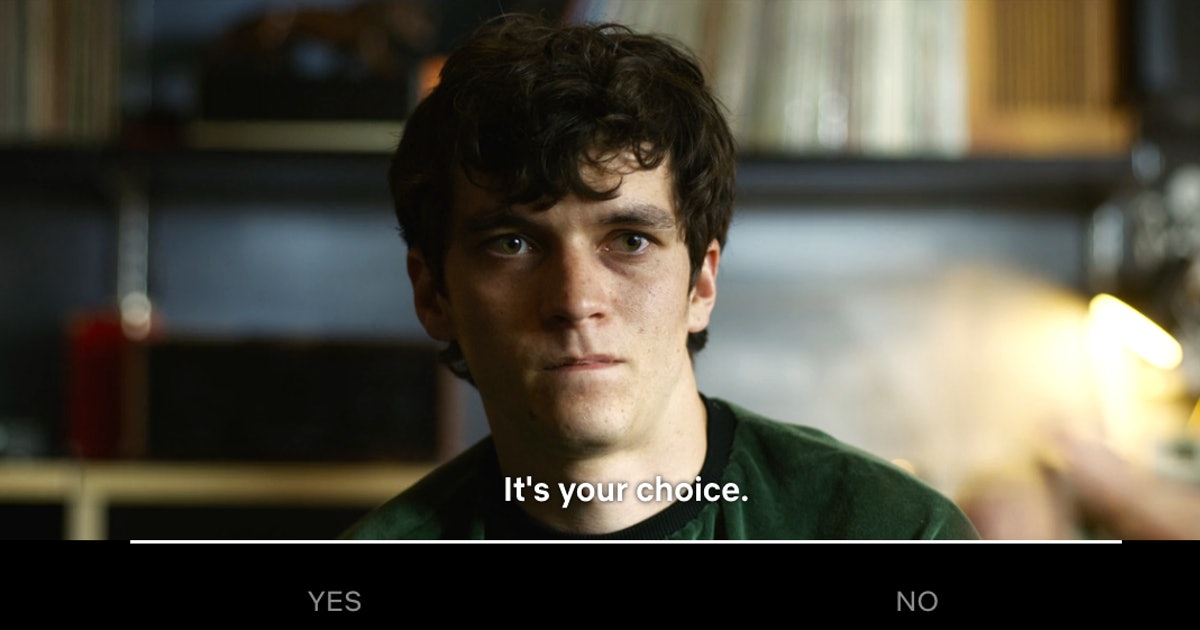
Black Mirror imports the choose-your-own-adventure format to viewers’ TV screens

Perhaps Twine’s greatest brush with mainstream fame occurred when the creative team behind Black Mirror used it to storyboard the interactive episode “Bandersnatch.” Mostly, however, Twine has occupied a countercultural space in the world of storytelling. As Adi Robertson wrote in last year’s “Text Adventures: How Twine Remade Gaming,” “Twine’s simplicity felt liberating. It imbued games with the DIY spirit of homemade zines, many of them weirder, sharper, and queerer than their mainstream counterparts.”

In 2013, The Guardian‘s gaming blog shared a post entitled, “Anna Anthropy and the Twine Revolution.” Anna Anthropy isn’t the only game designer highlighted in the article as a revolutionary in the world of gaming; merritt k and Porpentine Charity Heartscape are also mentioned as crucial figures who made the most of Twine’s capacities. Heartscape’s Twine works include Howling Dogs, an award-winning claustrophobic simulation of a prison cell, and k’s include (ASMR) Vin Diesel DMing a Game of D&D Just For You, which is exactly what it sounds like. As we ring in LGBTQ pride month, the Anna Anthropy Twine game that I’d like to look at closer is called Queers in Love at the End of the World.

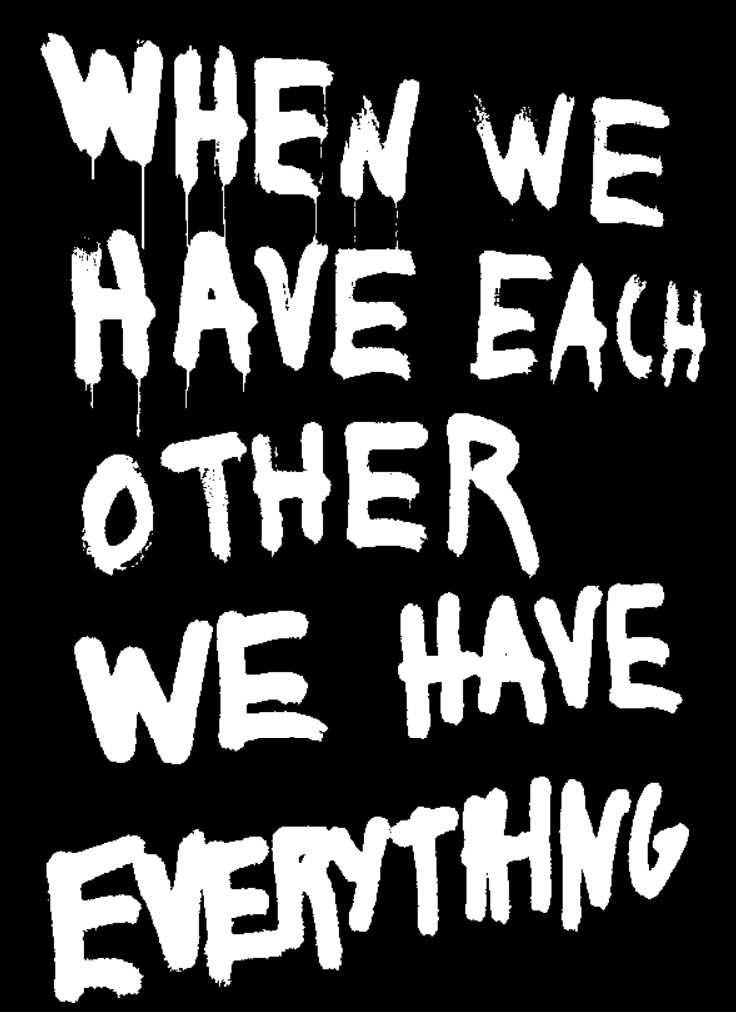
Queers in Love at the End of the World lasts exactly ten seconds, time kept by a countdown in the corner of the screen. The game begins with the white text on a black screen, “In the end, like you always said, it’s just the two of you together. You have ten seconds, but there’s so much you want to do: kiss her, hold her, take her hand, tell her.” Each of the bolded words is clickable, leading to more options for how exactly you might want to spend these last moments. No matter what, when the countdown reaches zero, the game ends the same way: “Everything is wiped away” (more lyrical than The Oregon Trail’s “You have died of dysentery”). Clicking through to the afterword provides one last piece of context, the scrawled words, “WHEN WE HAVE EACH OTHER WE HAVE EVERYTHING.”

A year after dubbing Anna Anthropy a leader of the Twine Revolution, The Guardian published games critic Cara Ellison’s “A Verse About Queers in the Love at the End of the World.” The subheading, “Twine developer Anna Anthropy turns game mechanics into poetry,” calls back to Klimas’ early inspiration: love poetry. Ellison’s verse refers to the ten-second timer as “tyrannical,” in agreement with Adi Robertson’s claim that Twine games “can compromise [the] sense of control” that a reader would normally have over the pacing of a choose-your-own-adventure-story. Ellison writes: “I want to treat those Twine rooms like Carrie’s prom night and gut them / I want to call that timer’s parents and say DO YOU KNOW WHAT IT HAS DONE TO ME,” pouring frustration onto the page. This is a desperate, angry love poem to a simultaneously brief and expansive interactive love poem.

My earlier post about translating poetry encouraged you to approach poems as games, with a willingness to engage in creative, productive failures. The queer Twine revolution of the last decade shows that it is also possible to treat games as poems. Any game built from language has the capacity to be movingly lyrical and verbally innovative (even a game of Dungeons & Dragons DMed by Vin Diesel). The first Twine Revolution may have passed, but Twine is still an available tool. Why not take it for a spin and map out a poem-game of your own? The second Twine Revolution might begin right on your laptop.


You can find delightful deals on puzzles on the Home Screen for Daily POP Crosswords and Daily POP Word Search! Check them out!

Thanks for visiting PuzzleNation Blog today! Be sure to sign up for our newsletter to stay up-to-date on everything PuzzleNation!

PN Product Review: GeoLogic

[Note: I received a free copy of this puzzle in exchange for a fair, unbiased review.]

Imagine embodying the forces behind the Big Bang. Science fiction writers do this all the time, bringing into being entire new planets, studding them with swathes of land and bodies of water, devising chemically unfamiliar atmospheres. While I am a writer, fiction is not my forte, meaning that the wonders of world-building are typically out of my wheelhouse—at least, they were. Enter Thinkfun’s GeoLogic: World-Changing Logic Puzzle. This puzzle sells itself as an opportunity to “create your own world,” and “become a planetary architect,” promises that appeal to me as a science fiction fan. The puzzle is recommended for ages eight and up, and requires only one player, though planet-building can be a team activity too.

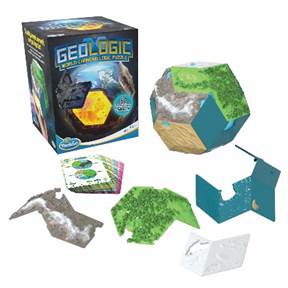
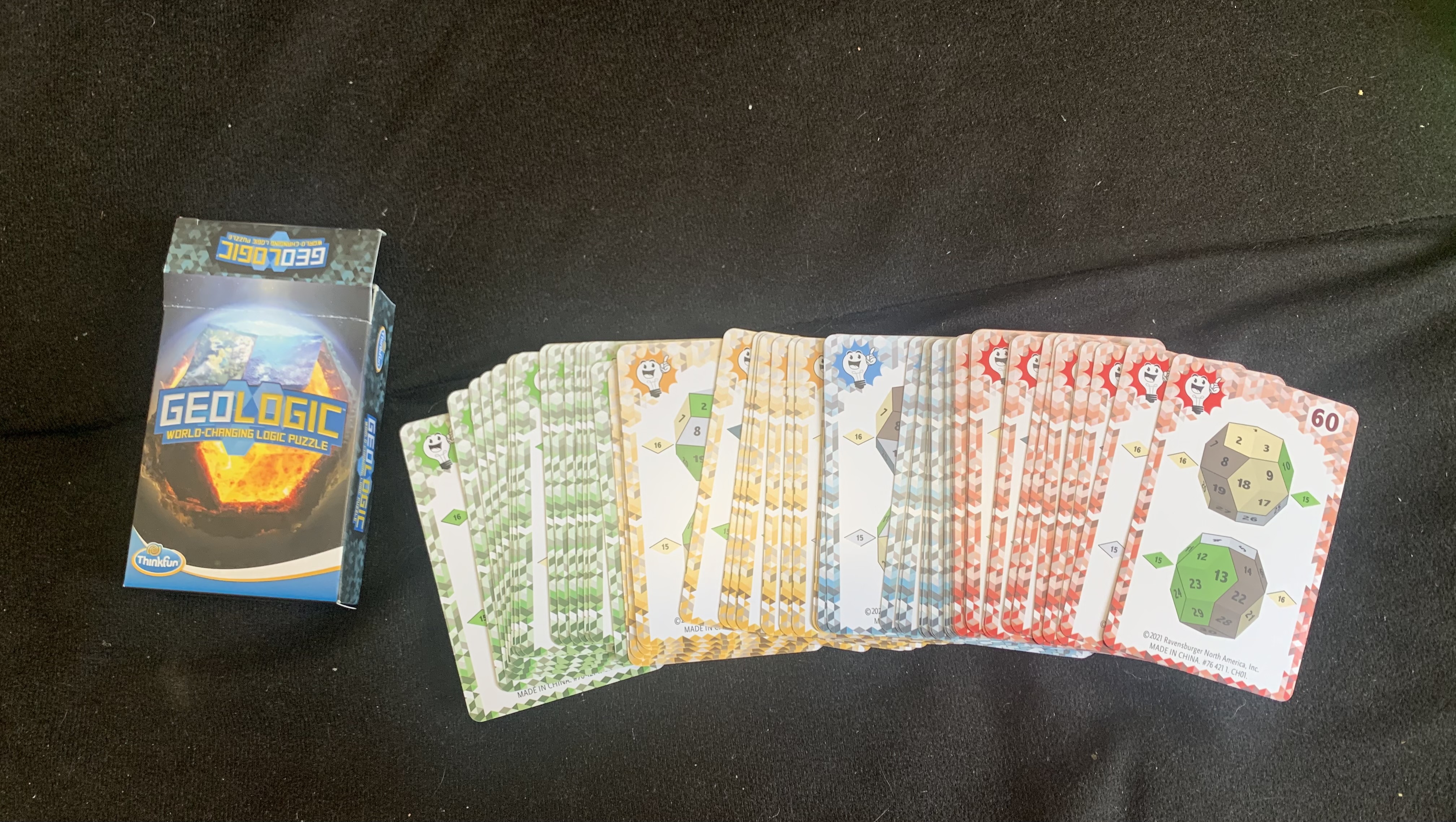
GeoLogic offers a route to science-fictional world-building other than the written word, bringing the invention of alien landscapes into the hands-on, three-dimensional realm. Born from a conversation between inventors Ken and Jeremy about the concept of a thirty-sided game die, the puzzle consists of a thirty-sided planetary core, fourteen snap-in-place pieces representing five biomes, and sixty challenge cards. Cards range from easy to expert, each indicating where certain biome pieces should go on the planetary core to start. The solver is then left to figure out where to insert a list of remaining biome pieces in order to completely cover the globe’s surface.

The challenge cards are optional; they are intended for players who would prefer to test spatial-logical skills rather than engage in more free-form, creative play. This mode of engaging with GeoLogic still has a science-fictional appeal; it just happens to fall more into the category of consuming science fiction than acting as its mastermind. If you dream of discovering new planets through a process of trial-and-error, then you’ll likely find using the challenge cards a perfect way to spend an afternoon, working your way up the ladder of difficulty levels.

If you’d rather ignore the challenge cards instead, you can take the game up on its suggestion that you “get creative and design your own planets.” As the box asks, “Want to create the largest landmass known to humans? Or oceans that span half the globe?” Now’s your chance! This approach to GeoLogic does require a certain amount of spatial-logical skill, as the goal remains the same: cover all thirty sides of the planetary core in some combination of awkwardly-shaped desert, forest, mountains, tundra, and ocean. If you are looking for a purely creative exercise, you might find the limitations of where the different biome pieces fit to be a frustrating hindrance to your imagination running wild.

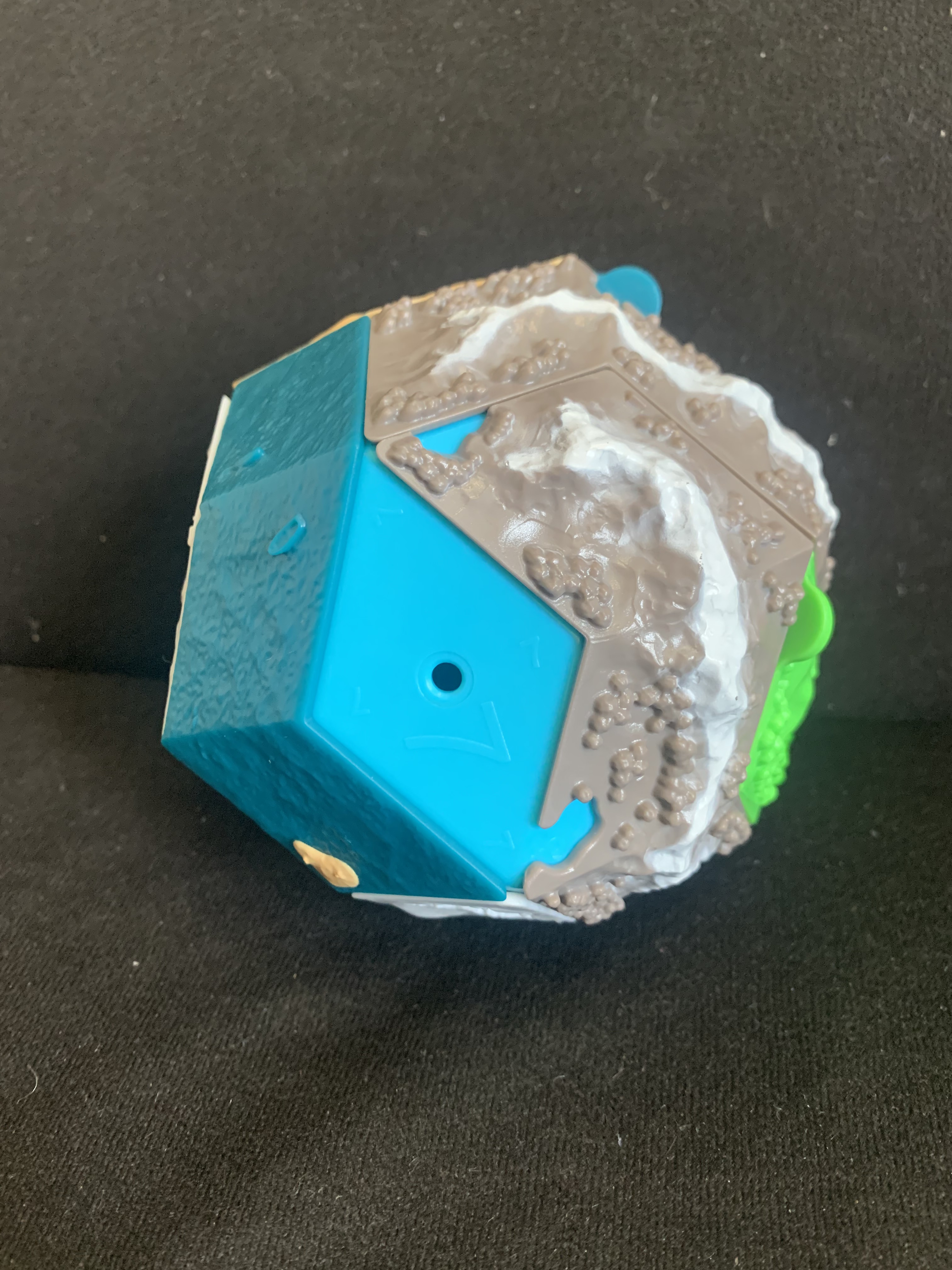
An example of a built world that does not meet the goals of the game.

The solver most likely to be enchanted by GeoLogic, by my estimate, is the Tetris fan who longs for a more tactile experience—snapping the pieces into place on the core is very satisfying—and who can appreciate a sprinkling of science-fictional creativity. Those driven to the product by the idea of creating new worlds are less likely to feel fulfilled, but the core and biomes could certainly be used as a jumping-off point for contemplating what different worlds are possible. Dreaming big and freely when it comes to alternate worlds is important, yes. Possibly more important, for those interested in changing the world we’ve been handed, is knowing how to still dream big when complex limitations are imposed upon us from outside.


You can find delightful deals on puzzles on the Home Screen for Daily POP Crosswords and Daily POP Word Search! Check them out!

Thanks for visiting PuzzleNation Blog today! Be sure to sign up for our newsletter to stay up-to-date on everything PuzzleNation!