Puzzles (and Games) in Pop Culture: “Strange Things Happen at the One Two Point”

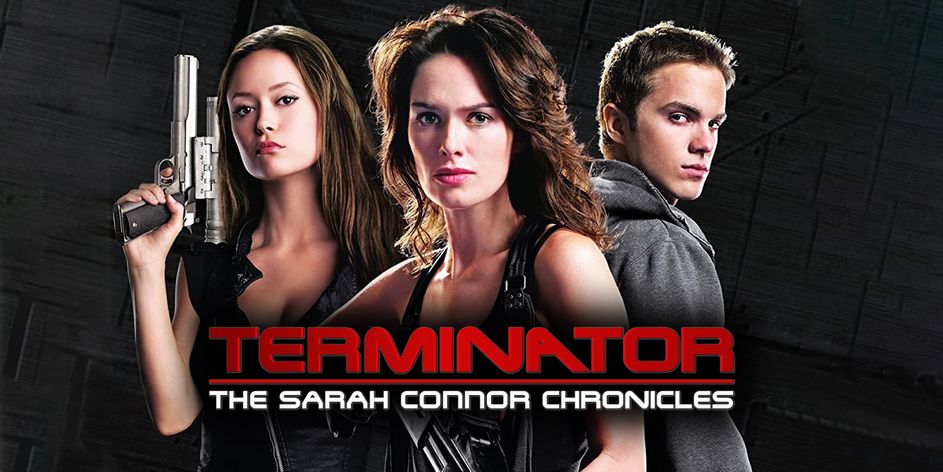
“Strange things happen at the one-two point,” is a proverb based on the ancient East Asian board game Go. As summarized by cybernetic Cameron (played by Summer Glau) in Terminator: The Sarah Connor Chronicles,“It means the usual rules don’t always apply.” More specifically, the proverb refers to the strategic idiosyncrasies of certain playing positions on the Go board; “the heuristic principles of fighting along the sides or in the [center] often fail in the corner,” Go wiki Sensei’s Library clarifies. When we fight our way into tight corners, the laws of reality that we previously knew shimmer and warp. The more boxed-in we become, the more we need to expect the unexpected.

This is a fitting sentiment to feature in Terminator: The Sarah Connor Chronicles, the fourth installment in a media property dealing with time travel and its resultant paradoxes and alternate timelines. The show depicts its characters having fought their way deep into tight, reality-bending corners in their attempts to prevent apocalypse. By the second-season episode titled for the Go proverb, the rules established in 1984’s The Terminator—what we can expect from time travel, who’s an ally and who’s an enemy, what to do if you want to live—have been thoroughly warped.

In the episode “Strange Things Happen at the One Two Point,” Sarah Connor (Lena Headey) is deeply fixated on a pattern of three dots. Earlier in the series, another time traveler left her a message in blood on a safe house wall: a list of important names with three dots next to it. Seeing these dots in her dreams, Sarah is convinced that there’s more to them then the smeared fingerprints of a dying comrade; her investigation leads her to Dakara Systems, a tech start-up with a logo of three dots. She and Derek (Brian Austin Green) break in late at night, stealing all of the computers’ hard drives and bringing them back to Sarah’s teenage son, John (Thomas Dekker), an accomplished hacker.
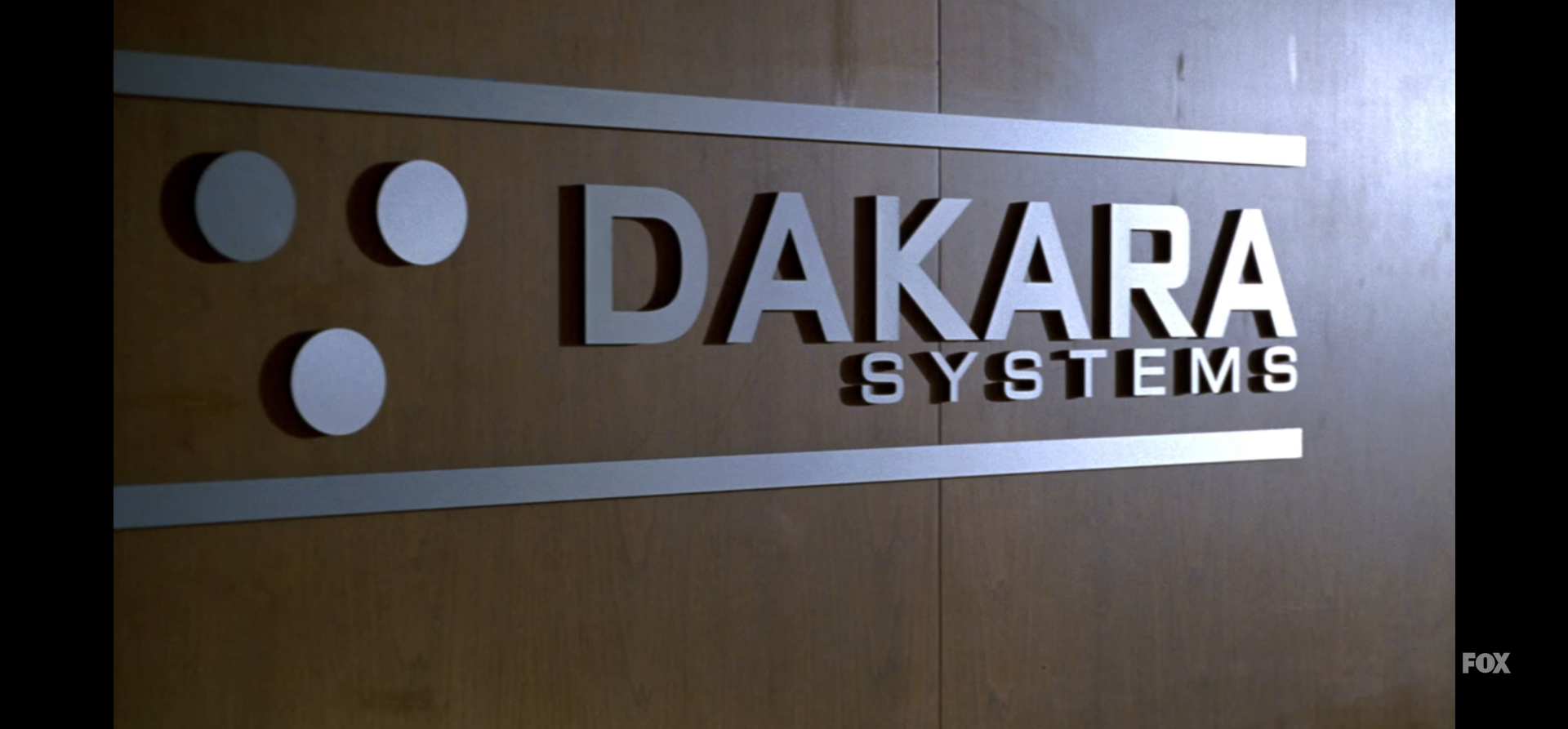
On the hard drives, John discovers designs for an artificial intelligence system, a find that sets off Sarah’s internal alarms, but John explains that the designs are useless in light of Dakara Systems’ lack of processing power. Derek calls it a dead end, accusing Sarah of instigating a wild goose chase, an accusation she rebuts with, “Artificial intelligence, the company logo, the three dots—”

“Are fingerprints,” Derek says. “It’s just blood.”

“Everything on that wall has meant something,” Sarah argues. “It’s all blood.”

Sarah is sure that The Turk, the chess-playing AI that she’s been hunting for since it was stolen from inventor Andy Goode, can be traced to Dakara Systems. Derek has lost faith. While John initially has his doubts too, by the next morning, he’s made Sarah and Cameron an appointment to meet with the heads of Dakara Systems. He explains his change of heart: “Andy Goode was building a chess program . . . It always starts small.”
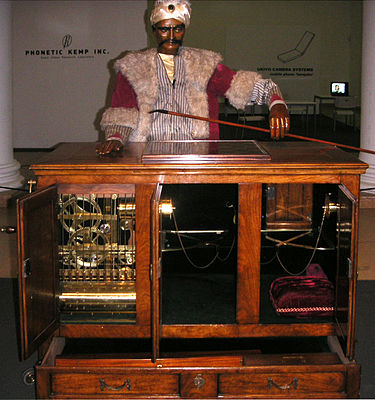
A 1980s reconstruction of the original chess-playing Mechanical Turk.

Dressed up in their best wealthy-investor chic, Sarah and Cameron meet with father-and-son team Alex (Eric Steinberg) and Xander (Eddie Shin) Akagi of Dakara Systems. Probing for connections to The Turk, Cameron poses a crucial question to Xander while Sarah and Alex grab coffee: “Do you like chess?” Later, when Sarah asks her what all of the evidence is adding up to, Cameron says, “Not The Turk. Xander doesn’t play chess. He prefers Go.” She pulls out a folding wooden board inscribed with a grid. “Xander said it’s been calculated that there are more possible Go games than atoms in the universe,” she continues, laying out black-and-white discs in the board’s center. “He’s offered to teach me how to play.”

Sarah counters, “Did he offer to tell you about his AI?” and when Cameron reiterates that Xander’s AI is not The Turk, Sarah says, “But it could be a piece of the puzzle. We’ve seen that before.”

Cameron responds, “Strange things happen at the one-two point.”
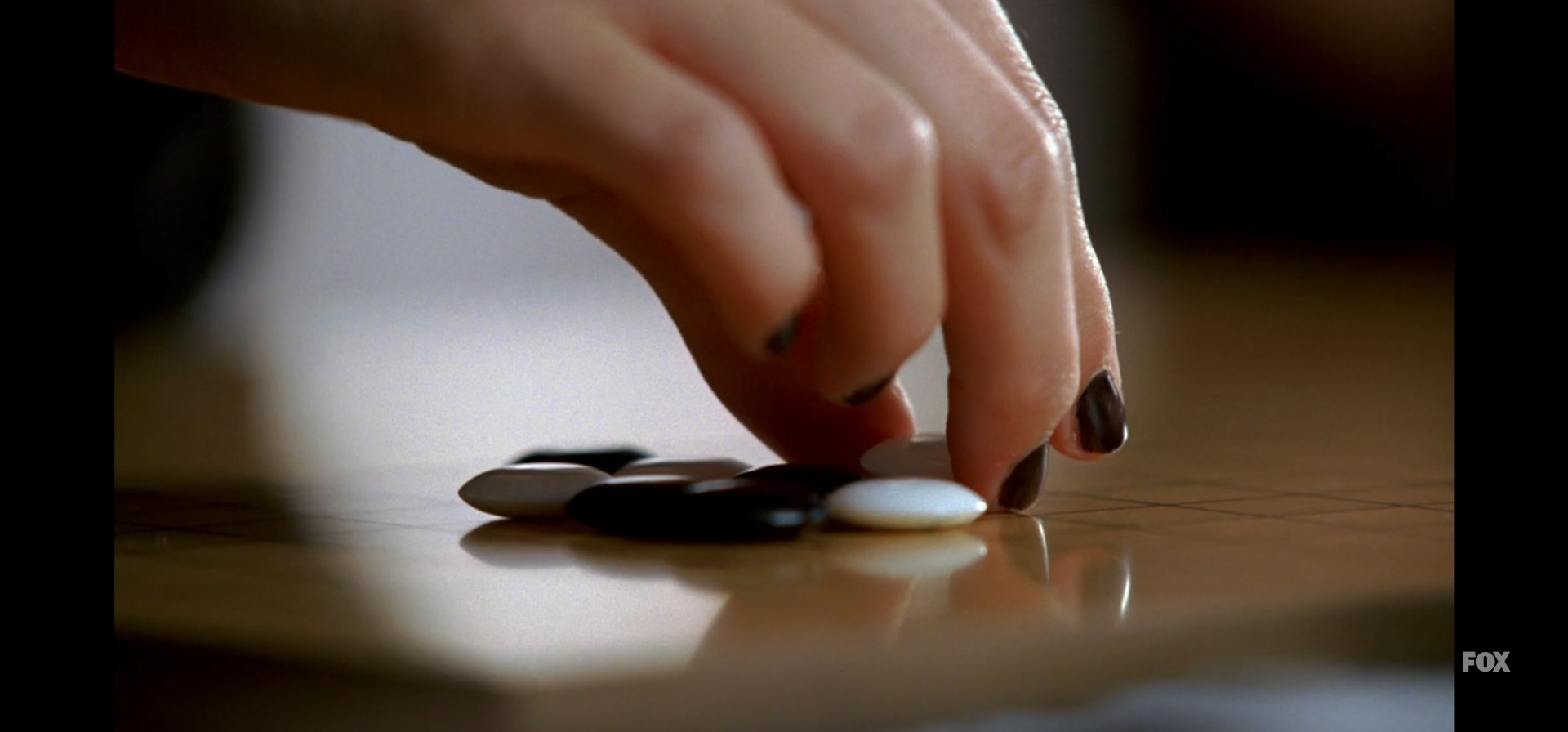
I won’t spoil for you which strange things happen here, at this point where Sarah Connor and her allies have boxed themselves in strategically by changing reality countless times in an effort to stave off nuclear apocalypse. Instead, let’s dwell together on the beauty of that phrasing, the “strange things,” as a way of describing action in a game so deceptively simple: black and white stones laid out on a grid. They don’t seem like they should stack up next to the strange things that happen in a work of science fiction—the way the air crackles and sparks with blue light whenever a new time traveler tears a hole through the decades; how a Terminator’s robotic skeleton designs a chemical bath for itself that allows its flesh and skin to regrow; the liquid metal CEO played by Garbage lead singer Shirley Manson, whose arms extend at will into gleaming daggers.

By placing Go on the same playing field as these miraculous, speculative sights, Terminator: The Sarah Connor Chronicles reminds us that games needn’t be elaborate to be magical, needn’t be novel to be surprising. As long as each player is an elaborate, novel human being, an ancient game like Go can continue to startle and move, to belong meaningfully alongside us in the twenty-first century—and further onward still.

have thought to look for otherwise.


You can find delightful deals on puzzles on the Home Screen for Daily POP Crosswords and Daily POP Word Search! Check them out!

Thanks for visiting PuzzleNation Blog today! Be sure to sign up for our newsletter to stay up-to-date on everything PuzzleNation!
Six Characters in Search of Free Will

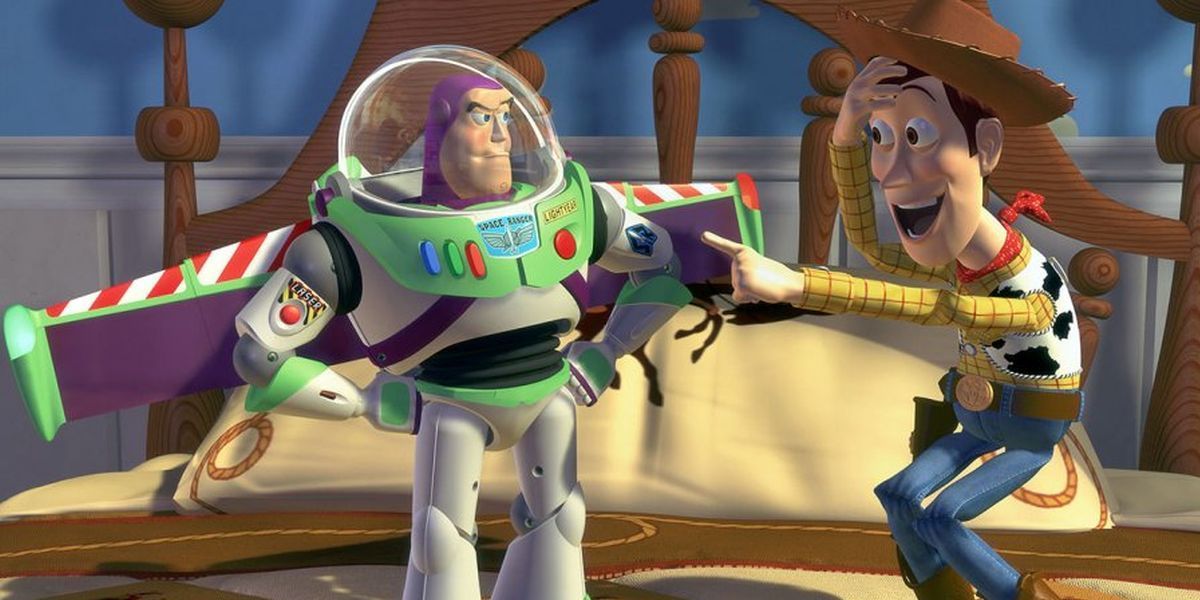
Last week, we traveled back in time, before the dawn of escape rooms, to what was nonetheless a perfect example of escape room horror: the Twilight Zone episode “Five Characters in Search of An Exit.” Now, let us jump forward, past the present, into the near-future. A clear thematic descendant of “Five Characters in Search of An Exit,” Black Mirror‘s speculative “USS Callister” takes the “everyone is a toy” premise of “Five Characters” further than the Twilight Zone episode carried it (the Black Mirror showrunners have even described the episode as “Adult Toy Story“).

In contrast to “Five Characters,” the setup of “USS Callister” is not especially simple. We begin in a clear Star Trek homage as the starship USS Callister‘s crew, helmed by Captain Robert Daly (Jesse Plemons), celebrates a victory. Abruptly, the show cuts from this slick, primary-colored setting, to a world much drabber and closer to our own. Daly is revealed to be the unassuming founder of a virtual-gaming company called Callister, and a fan of the retro sci-fi television show Spacefleet. Each of his crew members from the opening scene reappears in the Callister office as a different coworker; all, at best, seem indifferent to Daly’s existence.

Enter newly hired programmer Nanette Cole (Cristin Milioti), who is as big a fan of Daly’s work as Daly is of Spacefleet. She and Daly awkwardly hit it off, until the company’s co-founder, James Walton (Jimmi Simpson), waltzes in and steals Cole’s attention. Next thing we know, Daly returns home to sign into his VR game and reappear on the USS Callister‘s bridge. There, we see a side of him that was not immediately obvious before: he is power-hungry, violent, reveling in belittling the crew.

The next time Daly is in the office, he steals Cole’s thrown-away coffee cup and takes it home, where he uses her DNA to create a sort of virtual clone of her. This clone, despite Daly’s desire to play god, is not a mere plaything; she is fully sentient, retaining all of the original Cole’s memories, feelings, and personality. When she awakes on the USS Callister, miniskirted and vintagely coiffed, she is terrified. Without Daly present, the other crew members explain the situation, that she is stuck forever in a modded version of the VR game the original Cole programs: Infinity. They are all digital clones, all stuck.

Walton describes the situation as “an eternal waking nightmare from which there is no escape,” but Cole tries to escape regardless, running through the ship’s halls until Daly transports her back onto the bridge. She refuses to play along with the Spacefleet roleplay premise, so he uses his God-like powers to torture her until she agrees to cooperate. Still, that first flight from the bridge is not Cole’s last attempt to wiggle free of Daly’s clutches. Her schemes just get more strategic. Even when she learns that the reason Walton plays along is that Daly has Walton’s son’s DNA on a lollipop in his minifridge, Cole sees this as further motivation to take Daly’s toys away from him.

After another fumbled escape attempt that provokes Daly’s sadistic ire, Cole finally hits upon a winning plan. She spots a wormhole out the ship’s window, representing an incoming update patch to the game. Cole suggests flying straight into the wormhole, thereby deleting all of their code, killing them. Freeing them. First, however, it’s necessary for someone out in the real world to destroy the DNA hoarded in Daly’s minifridge.

The plan is for Cole to go on a mission to a planet’s surface alone with Daly, where she distracts him. Meanwhile, the crew beams up the device that Daly uses to control the game and contact the outside world. The crew is able to contact the real-world Cole, and blackmail her with the cloned Cole’s knowledge. They compel her to order a pizza to Daly’s apartment so that he’s forced to temporarily exit the game, then, while he’s occupied, to: 1. steal all of the DNA in the minifridge, and 2. replace the nodule he uses to connect to the game with a decoy that does nothing.

Cole distracts Daly by luring him into a lake.

The end result is that the crew of the USS Callister is able to successfully fly into the update patch wormhole without Daly’s interference. Contrary to their prediction, this does not erase their code; they are not killed, but they are free. They are transported from Daly’s personal, modded version of Infinity to the greater Infinity, which lives in the Cloud. Meanwhile, Daly, in his attempt to chase after them, has gotten himself stuck in his own game.

This is a much more optimistic ending than that of “Five Characters.” The characters not only are able to transform themselves from playthings to game-players; in doing so, they escape the confines of their limited world—within reason. While they are no longer imprisoned within Daly’s computer, able instead to roam the Cloud-stored game universe, they are still technically bound, forever, to the starship.

If we classify this as escape room horror, with a requirement of the genre being that someone must escape the room alive, then we are working with a more ephemeral, existential understanding of what constitutes a “room.” The characters’ ultimate goal is not to escape their physical surroundings, but to escape the game rules that have been put in front of them. The horror herein is not about literal claustrophobia, but about the gnawing psychological claustrophobia that comes from an absence of free will. They are not escaping from the ship; they are escaping from hierarchy. It is the perfect distillation of escape rooms as a team-building exercise, driving home that there is no “dictator” in “team.”

A review of the episode in The Atlantic pointed out that whereas so much of Black Mirror‘s storytelling is about “the terror of being connected,” “USS Callister” goes in the opposite direction. What begins as a seeming cautionary tale against the horrors of video games becomes, instead, an ode to collaborative approaches to gaming. The fact that the crewmembers still have each other and an infinite universe to explore is presented, unequivocally, as a happy ending. It’s a happy ending that anyone who finds joy in shared game experiences like escape rooms, multiplayer video games, or tabletop role-playing will no doubt find resonant. Hell is not other people; it is other people having undue power, and stripping us of our personhood.


You can find delightful deals on puzzles on the Home Screen for Daily POP Crosswords and Daily POP Word Search! Check them out!

Thanks for visiting PuzzleNation Blog today! Be sure to sign up for our newsletter to stay up-to-date on everything PuzzleNation!
Puzzles in Pop Culture: Person of Interest

In 2011, speculative CBS thriller Person of Interest began with the premise that a computer genius named Finch (played by Michael Emerson) had built an AI that could tell when acts of violence were about to occur in New York City. In order to intervene, he hired a former special operative named Reese (Jim Caviezel). The only information that the AI ever provides is a social security number; each episode, this leaves Finch and Reese to solve the central question: does this SSN belong to a victim of an impending crime, or a perpetrator? Do they need to be stopped, or saved?

Solving this question typically involves a veritable cornucopia of guesswork, research, hacking, plot twists, and pieces of paper taped to walls and connected by webs of string (one of my favorite TV tropes, featured in Supernatural and It’s Always Sunny in Philadelphia). Chess also features prominently, as do various secretive systems of communication. No episode is quite as likely to appeal to your inner solver, though, as season four, episode two, “Nautilus,” which aired on September 30th, 2014.

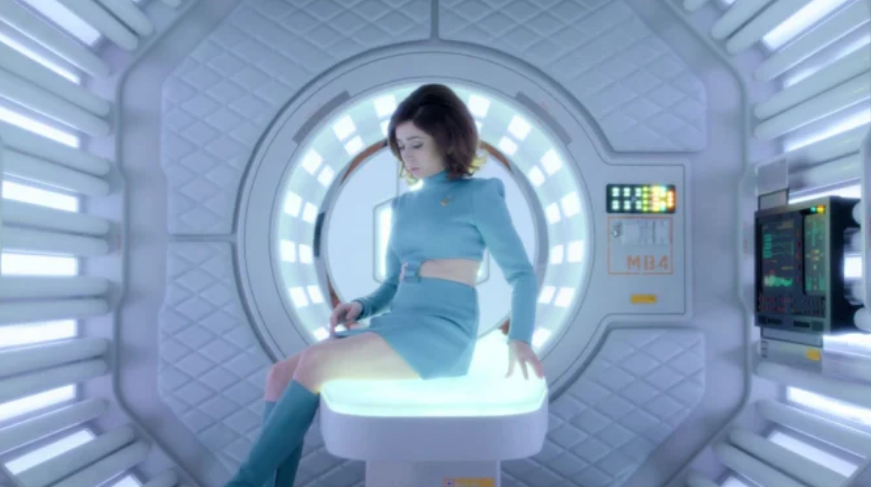
In this episode named for its chambered nautilus shell motif, Finch and Reese receive the SSN for chess grand master and college student Claire Mahoney (Quinn Shephard). She’s AWOL from school and chess in pursuit of a mysterious game’s prize. The game began with a post on an obscure message board: an image of a nautilus, captioned, “If you seek enlightenment, be the first to walk through the chambers.” There was data hidden in the image of a nautilus, and it sent Claire off down the rabbit hole.

Following her, Finch watches as she pulls a tab of paper from a lost dog sign, with a nautilus watermarked behind the numbers. After calling the number leads to nothing, Finch realizes: “It’s not a phone number . . . it’s multiplication.” Multiplying produces GPS coordinates, pointing to a location in Harlem.

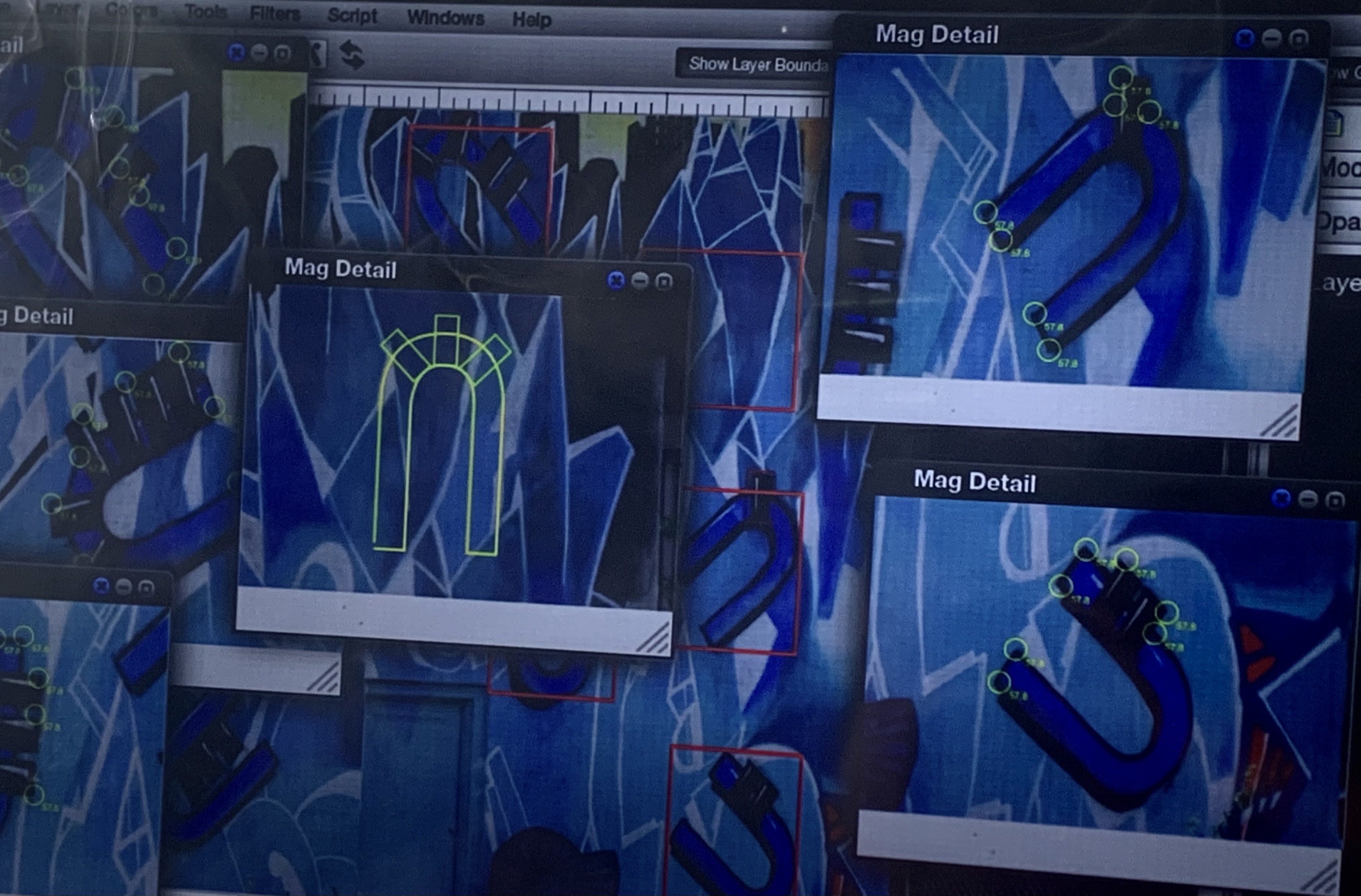
There, a mural of seemingly random shapes (painted by artist Apache Gonzalez) covers a wall. Once again, there’s the nautilus. Back in his office, Finch studies a photo of the mural, finally recognizing it as a variation on a Bongard Problem. He explains, “This particular type of puzzle presents two sets of diagrams. The diagrams in the first set share a common feature. The blocks never overlap with the curved lines. Conversely, in the second set, the blocks do touch the curves, but there’s another common element.”

Reese interjects, “There’s a different number of blocks in each diagram.”

“Using this pattern,” Finch continues, “I can fill in the blank space with the only number of blocks left out, which is three, thus solving the puzzle, creating a sort of three-pronged arch.” Googling, Reese finds a matching photo of an arch in Central Park.

That night, Claire is near the arch, standing in traffic. When Reese interrogates her about her apparent death wish, they’re interrupted, but later, the answer comes to light. If you stand at the right point in the street, banners for “motorcycle safety month” visually blend together to show the faint image of a nautilus. Beneath the nautilus: pictures of traffic lights that Finch correctly identifies as the equivalent of Braille dots. They spell out, “184th and 3rd.”

Claire’s next found in a biker bar at 184th and 3rd, staring at a bulletin board decorated in gang logos. One features a skull with nautiluses for eyes; letters surround the skull in a seemingly random arrangement. At an otherwise dead end, Reese sits at his desk, rewriting the letters over and over, seeking a scrambled word, until Fusco (Kevin Chapman) determines that the letters refer to musical notes, forming the tune to “New York, New York.” Reese is able to deduce a location: the Empire State Building’s observation deck.

Here on out, the puzzles become simpler, less compelling; from a Doylist standpoint (referring to author Sir Arthur Conan Doyle’s perspective, as opposed to fictional character John Watson’s), we might assume that the writers have decided that it’s time for the plot to dominate, turning the puzzles into mere perfunctory means to an end. I’m convinced, however, by the Watsonian explanation, that Claire has sufficiently proven herself, and the AI game-master is content now to lead her by the hand.

But why the nautilus shell? In the episode, computer hacker Root (Amy Acker) refers to the nautilus as one of nature’s examples of a logarithmic spiral. It’s commonly also referred to as an example of the golden ratio, but as explained in “Math as Myth: What looks like the golden ratio is sometimes just fool’s gold,” that’s not so true. Is that they key—that the prize Claire seeks is fool’s gold?

The episode’s primary puzzles have been solved, and the series has come to an end (though it can be streamed on HBO Max). Still, this one question of the nautilus’ significance remains. What is the symbolic connection between a nautilus shell’s chambers and the “enlightenment” the game promises? Is enlightenment encoded in the logarithmic spiral, or in something more particular to the mollusk itself? I don’t have the answers, but as the nineteenth-century poem “The Chambered Nautilus” by Oliver Wendell Holmes Sr. shows, Person of Interest’s screenwriters were not the first to see something spiritual in the nautilus, and I doubt they’ll be the last.

In closing, I offer the following excerpt from Melissa Febos’ Body Work: The Radical Power of Personal Narrative to mull over in your own pursuit of the nautilus shell’s deeper meaning:

The spiral does not belong to the nautilus shell, unless it also belongs to the whirlpool, the hurricane, the galaxy, the double helix of DNA, the tendrils of a common vine. If there are golden ratios that govern the structures of our bodies and our world, then of course there must be such shapes among the less measurable aspects of existence.


You can find delightful deals on puzzles on the Home Screen for Daily POP Crosswords and Daily POP Word Search! Check them out!

Thanks for visiting PuzzleNation Blog today! Be sure to sign up for our newsletter to stay up-to-date on everything PuzzleNation!

An Immersion Course in the Language of Images

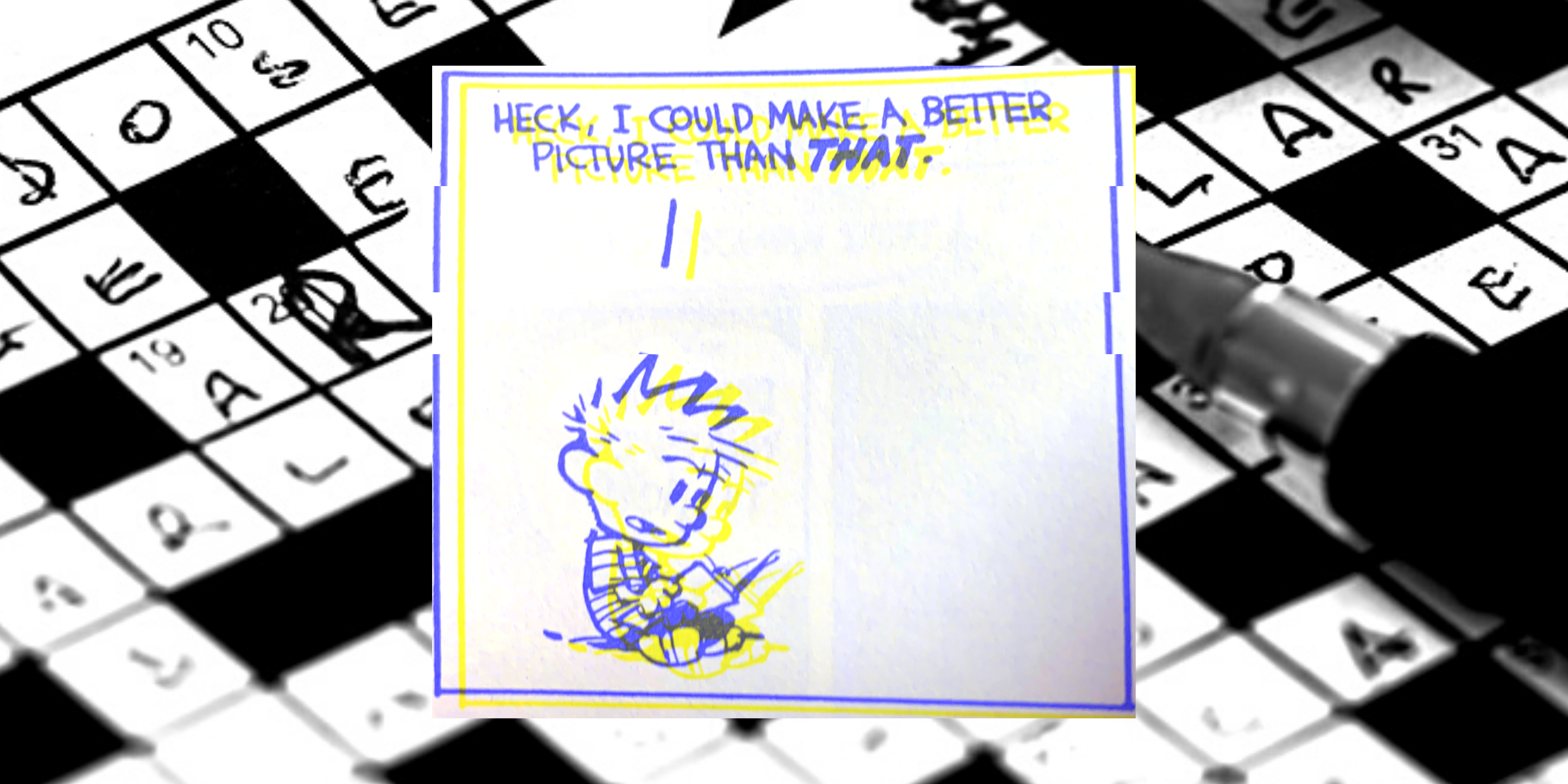
A lot can happen inside a series of squares. An Oscar-winning actor might meet a basketball star, or your favorite song might intersect with the punny punchline of a joke. Gimmicky grid construction might reveal hidden gems! Gotham might be saved from the Riddler’s clutches! Calvin and Hobbes might sculpt an army of gruesome snowmen! Krazy Kat might introduce newspaper readers to gender fluidity! You might discover new facets of your own artistic voice!

There’s a good chance you already fill in creative arrangements of squares on a regular basis, enriching your brain’s language centers by solving crosswords. Why not take this ritual a step further? Lynda Barry’s Making Comics begins with the reminder, “There was a time when drawing and writing were not separated for you,” and she shows us that it is possible to return to such a time. By partaking in the book’s exercises, you can learn to reunite images and language in your mind, to “practice the language of the image world.”

If you feel like your language centers need a good jolt, comic-making might be a perfect new hobby, and Making Comics is the perfect introductory text for puzzle fans. As Barry explains, the book’s exercises “take advantage of a basic human inclination to find patterns and meaning in random information,” and who loves patterns more than puzzlers? For instance, one simple exercise she says that anyone can do is drawing a scribble and then figuring out how to turn it into a monster. It’s that simple.

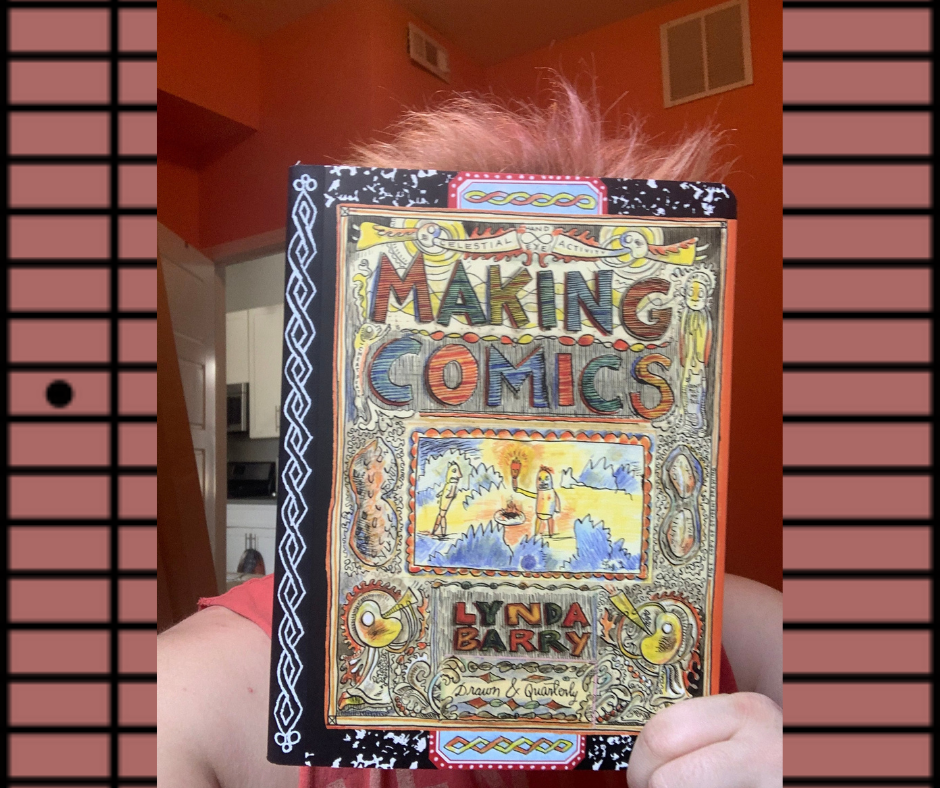
Your blogger with the book in question.

Many of the pattern-finding exercises in Making Comics’ treasure trove are collaborative, depending on a classroom setting or simply a creative partnership among friends. Others, however, can be done in solitude, including the exercises I’m going to take you through below. To prepare: Barry recommends, when just starting out, working with black Flair pens, a composition notebook (preferably not made from recycled materials), index cards (blank on one side), and basic 8.5×11 printer paper. She describes the composition notebook as “a place rather than a thing,” and says that you should try to keep it by your side like a faithful dog. “Making comics involves the same daily practice that learning any language does,” so keeping your materials handy is crucial.

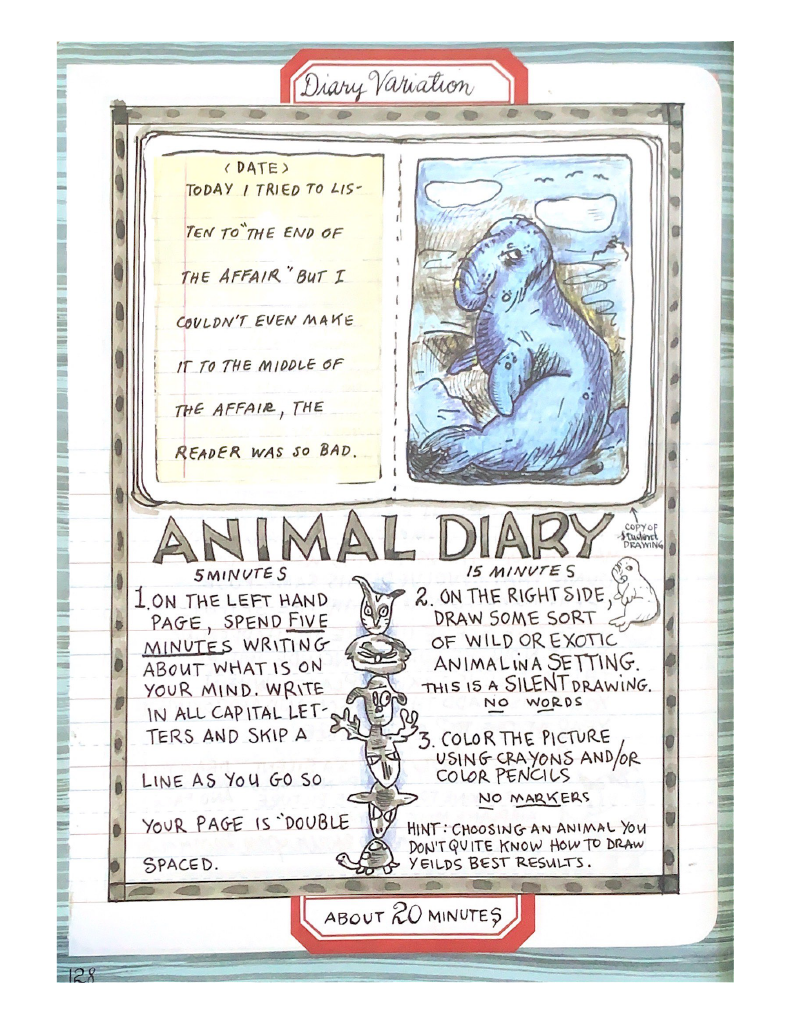
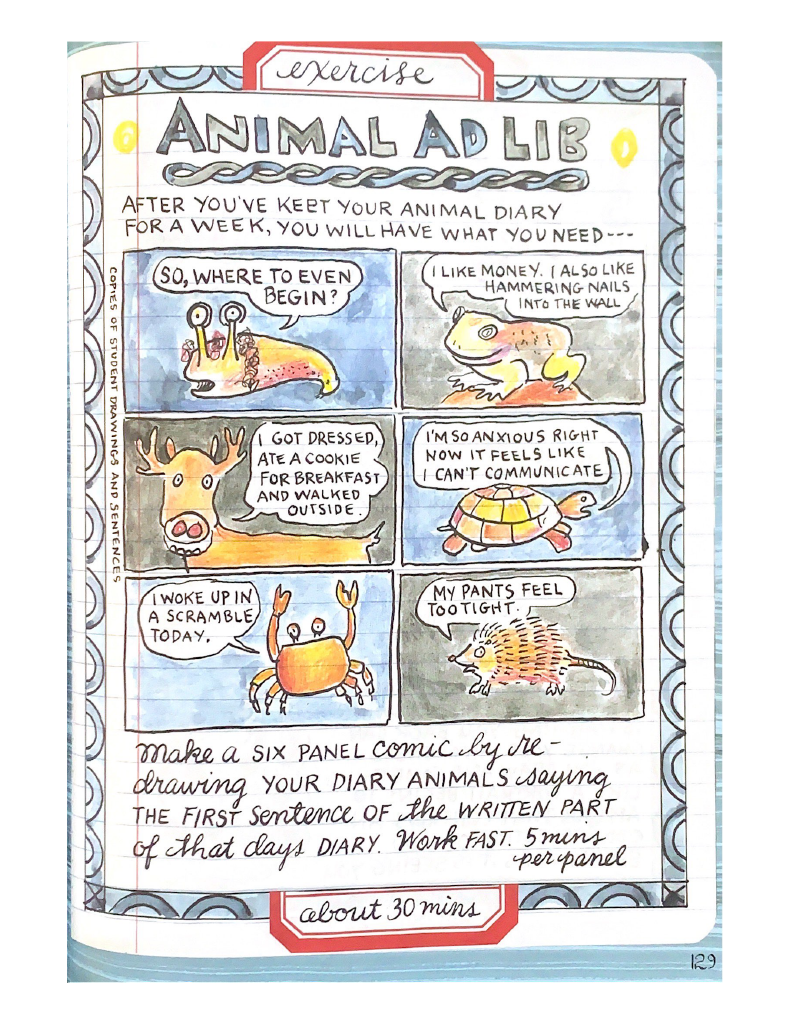
Do you have your materials? Great! Let’s dive into the Animal Diary and consequent Animal Ad Lib, instructions pictured below!

More of Barry’s comics wisdom can be found on her Tumblr and Instagram, or of course, if you’re hooked, you can always pick up a copy of the book. It’s a full immersion course in a new language, in a new way of seeing.


For more fun, daily forays into the world of language, there’s Daily POP!

You can find delightful deals on puzzles on the Home Screen for Daily POP Crosswords and Daily POP Word Search. Check them out!

Thanks for visiting PuzzleNation Blog today! Be sure to sign up for our newsletter to stay up-to-date on everything PuzzleNation!
The Monster at the End of This Blog

This past Sunday, Instagram user @muppethistory posted that PBS had newly released a Grover-centric game called “The Monster at the End of This Game.” Based on the classic children’s book of a similar name, the game joins assorted other Sesame Street fare such as “Show Me the Cookies,” “Ernie’s Dinosaur Daycare,” and “Oscar’s Rotten Ride” on the PBS Kids website and in the PBS Kids Game app.

Gameplay is unsurprisingly straightforward, designed as it is for small children. On most screens, challenges are as simple as clicking a glowing item; the imperative to draw a triangle notches the difficulty up barely a smidge. The most complex obstacle to reaching the game’s end (and the monster therein) is a shattered arrow that must, like a tangram, be restored to wholeness. As the player rebuilds the arrow, Grover despairs, “I did not know you were such a skilled puzzler!”

While I have no doubt that many of our readers’ puzzle skills outstrip my own, I do, at twenty-seven, have a significant edge on the game’s intended audience of preschool puzzlers. Why, then, did I find “The Monster at the End of the Game” so captivating? It wasn’t nostalgia for the fuzzy blue Grover’s picture-book antics fueling my determined clicking and dragging—I did not read “The Monster at the End of the Book” as a child. I had only the dimmest suspicion, via cultural osmosis, that a mirror would feature prominently in the conclusion, and could not say for certain if Grover would be the monster in the mirror, or if I would be.

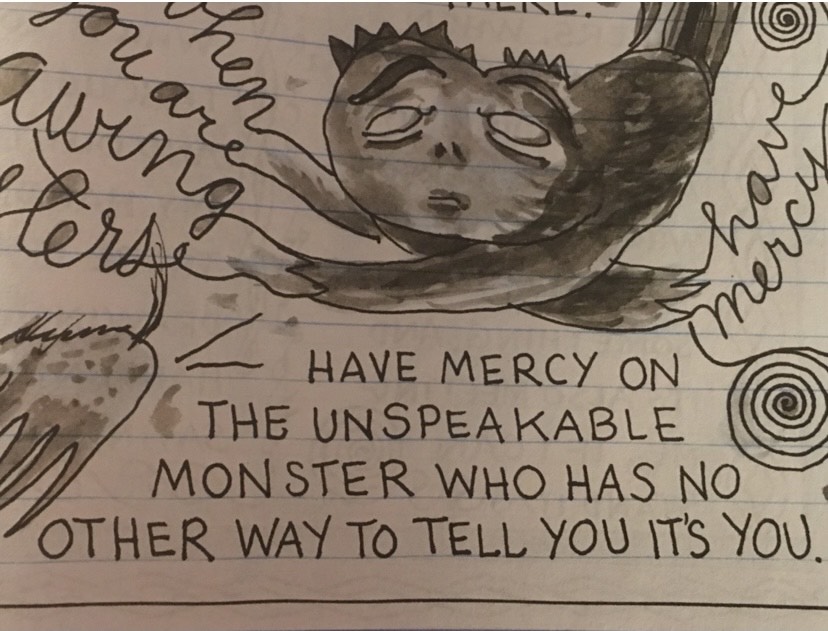
From Lynda Barry’s Making Comics

Without this particular childhood memory on my side, Grover’s pleading that I not finish the game, his insistence that only woe and horror waited for me as I progressed past the stumbling blocks he placed in my path, reminded me of nothing so much as Lemony Snicket’s narration in the A Series of Unfortunate Events books. Maybe the driving factor in convincing me to keep playing wasmy uncertainty as to how exactly it would end. But maybe it was a different branch of childhood nostalgia, fondness for the perilous problems plaguing the Baudelaire children in Snicket’s series.

In 2004, HarperCollins released a collection of puzzles called The Puzzling Puzzles: Bothersome Games Which Will Bother Some People, based on the Baudelaires’ trials and tribulations and framed as a training manual for a secret organization from the series. According to the Snicket Fandom wiki, many of the puzzles are designed to be unsolvable, and the letter to the reader from Snicket himself describes the book as “distressing,” and “frustrating,” the polar opposite of “The Monster at the End of This Game” (at least, if you’re outside Sesame Street’s target demographic).

Before signing off, Snicket writes, “I have dedicated my life to unraveling the puzzles that surround the doomed Baudelaire orphans. Why should you?”

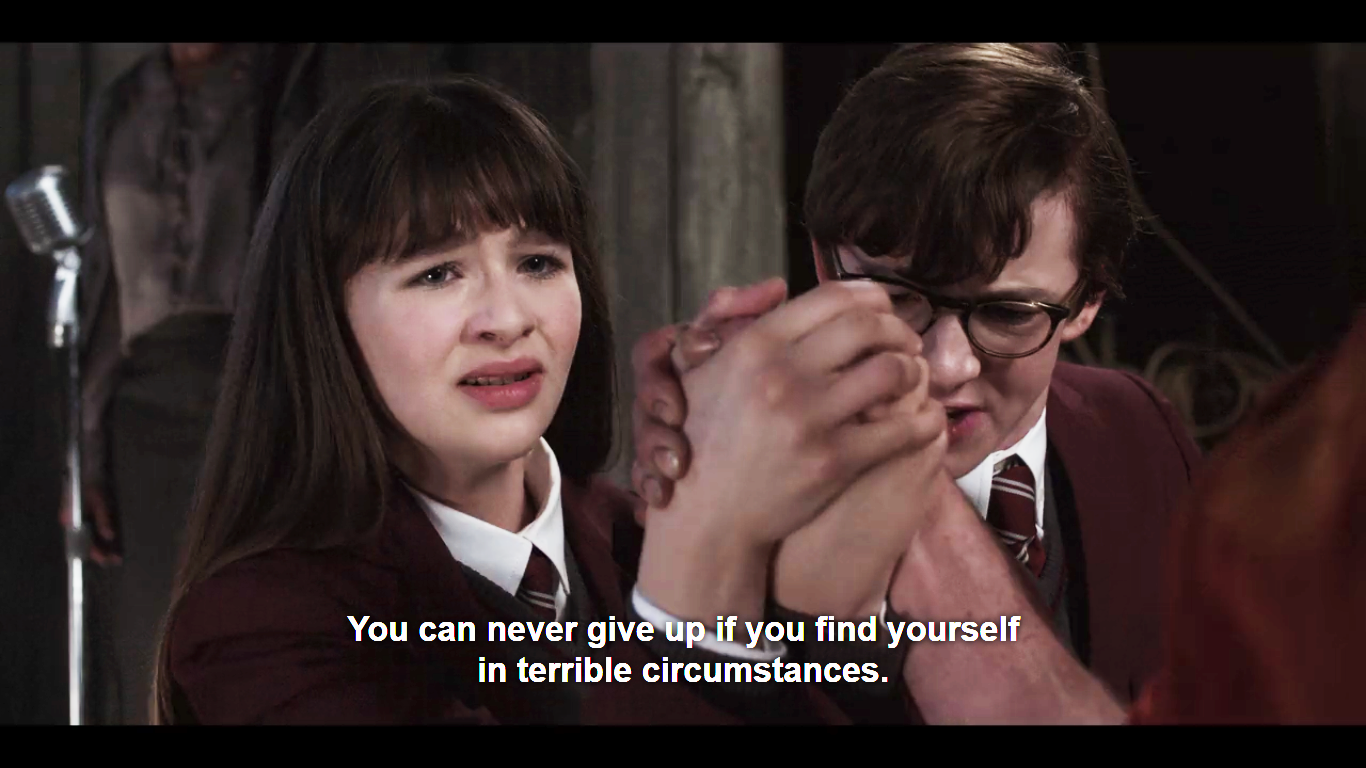
Violet and Klaus Baudelaire in the Netflix adaptation of ASoUE

Why indeed? Why try to solve the unsolvable? Why try to solve the extremely easily solvable? When the story is so good, why not try? Who can resist a compelling narrative, especially one brimming with pathos and puzzles, mystery and monsters? Whether the primary focus is on Muppets or murders, whether the monster is Grover, Count Olaf, or myself, I always want to reach the end. I’ll untie any rope, click any brick, trace any triangle—if it means gazing into the mirror at any good story’s conclusion.


If you also love the intersection of stories and puzzles, our Book Smarts, Movie Madness, and TV Time Daily POP puzzles are probably right up your alley! 

You can find delightful deals on puzzles on the Home Screen for Daily POP Crosswords and Daily POP Word Search. Check them out!

Thanks for visiting PuzzleNation Blog today! Be sure to sign up for our newsletter to stay up-to-date on everything PuzzleNation!

Returning to Wordle: The Evolution of a Phenomenon

Suddenly, for Josh Wardle, every square is green.

Each day brings a new five-letter word for Wordle’s devotees to deduce. If I had to pick one five-letter word to describe Wordle’s current moment, it would be SHIFT, as in seismic movement and mutation. This is for a couple of reasons. The first is a piece of news that rippled through the puzzle-loving internet at the end of January: Wordle has been purchased by the New York Times, and will be packaged with games like Spelling Bee and Letter Boxed going forward. Creator Josh Wardle’s Twitter announcement pointed out, “If you’ve followed along with the story of Wordle, you’ll know that NYT games play a big part in its origins and so this step feels very natural to me.” For anyone who hasn’t done a deep dive into Wordle’s genesis: Wardle is referring, here, to the fact that he created the game as a gift for his partner after she got hooked on Spelling Bee and the Times crossword.

Despite how it started, Wordle is no longer just “a love story” (as a January 3rd Times headline said). It’s also a story of hitting the jackpot—reportedly, Wardle sold the game for a number in the low seven figures—and it could become, as well, a story of the internet’s ongoing privatization. Wardle’s tweet stated that the game will be “free to play for everyone” even after its migration to the Times website, but fears to the contrary abound. A Mashable article about the news features the sub-headline, “’Paywall’ has too many letters,” and ends by gloomily describing Wordle as “beautiful while it lasted.” Twitter user @mcmansionhell summed up the ordeal: “the NYT took one nice and simple thing that a lot of people really liked, a dumb bit of fun in our exhaustingly dark times, and implied that they’ll stick it behind a paywall. exhausting.” Overall, ominous social media speculation has little to do with resenting Josh Wardle’s laudable success, and everything to do with anxiety about the once-free commons of the internet becoming less and less free by the day.

In response to this anxiety, solvers are already finding workarounds for the possible future paywall. One solution is downloading the Wordle site to your device, a process with instructions located here. Another alternative is playing on the Wordle Archive, which recycles previous days’ words.

Even if the Times does decide to throw Wordle behind a paywall, its story will remain a love story. I’m not just talking about Wardle’s love for his partner; I’m referring to the public’s intense love for the game. Regardless of who officially owns Wordle, it has taken on a life of its own, and that’s the second reason why SHIFT is the word of the moment. Minimalist though it may appear, Wordle has sparked widespread creativity, inspiring memes and jokes, craft projects, and spin-off puzzles that take the game’s basic premise and alter the specifics just enough to be novel. In a short span of time, Wordle has mutated, in many incarnations, away from where it began in Wardle’s Brooklyn home.

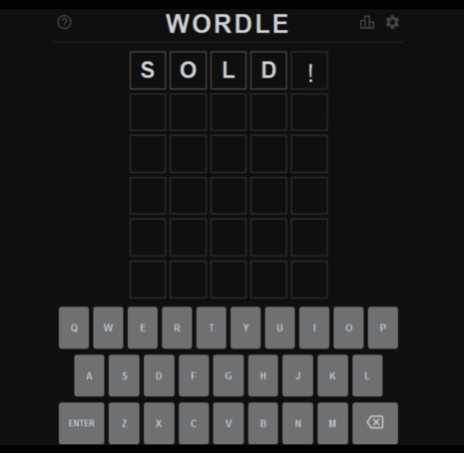
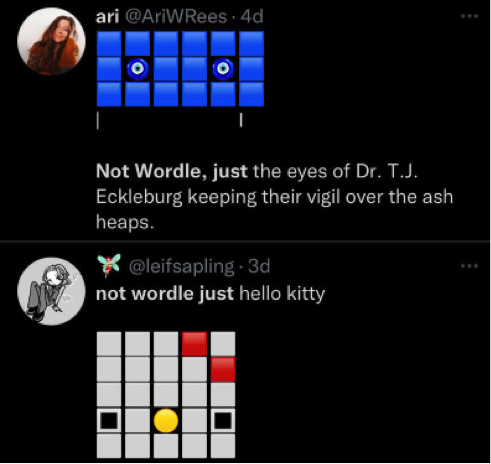
“Not Wordle, just XYZ” memes are everywhere these days, much like Wordle results themselves

Absurdle, for instance, is a version of Wordle that does not start out with one secret word in mind. Instead, behind the scenes, the site responds to the player’s guesses by—as slowly as possible—whittling down a mammoth list of possible words until the player essentially traps the computer into only having one word left. If you identified with my earlier post speculating that Wordle’s appeal lies in its un-bingeable nature and the way it provides all players with a short, sweet shared experience, then maybe the infinitely replayable Absurdle is not for you. On the other hand, if you prefer your puzzles to have concepts that can be difficult to wrap your brain around, then dive on in. You might also love to read a further explanation from the creator of the exact mechanics of the computer’s adversarial actions.

Then there’s Queerdle, a Wordle lookalike in which the word is a different length each day, but all are themed around LGBTQ culture and history. Answers have included COMPTON—in reference to the 1966 Compton Cafeteria Riot, a San Francisco-based Stonewall Riot predecessor—and DIVINE, as in the name of the drag queen best known for appearances in Hairspray and other John Waters films. When players guess correctly, a pop-up appears with a GIF or different snappy indicator of the word’s queer significance, and a grid of snake, coconut, and banana emojis meant to emulate Wordle’s shareable squares.

Byrdle is a version of Wordle where all answers are related to choral music. Gordle is Wordle for hockey fanatics. Squirdle invites players to guess names of Pokemon, Weredle howls words at the full moon, and you can probably guess the theme organizing Lordle of the Rings. Call them knock-offs, parodies, or homages, these variations most importantly are multiplying explosively. The New York Times may own the original game, but they cannot commandeer the inventive passion that Wordle has stoked in puzzlers everywhere.

____

Not Wordle, just a different exciting opportunity to solve new word puzzles each day:

You can find delightful deals on puzzles on the Home Screen for Daily POP Crosswords and Daily POP Word Search! Check them out!

Thanks for visiting PuzzleNation Blog today! Be sure to sign up for our newsletter to stay up-to-date on everything PuzzleNation!