How Women Have Shaped and Changed the World of Roleplaying Games

About a month ago, I wrote a blog post about Elizebeth Smith Friedman, one of the founders of American cryptography as we know it. One of the goals of that post was to help correct the historical record and restore Elizebeth to the prominence, accolades, and attention she so richly deserves.

A friend of mine and fellow tabletop roleplayer read that post and pointed me toward this article from Kotaku last year about the early influence of women on the development of the iconic roleplaying game Dungeons & Dragons. One of the first playable modules, the “Sage Advice” column of Dragon magazine, the inimitable art style (and maps), the long-running D&D series of novels… women played vital roles in crafting the world of D&D as many of us know it today.

This may come as a surprise to some people, given how pop culture tends to present roleplaying in general as an all-male nerdy pursuit. (The Big Bang Theory, for instance, often pushes the idea that girls don’t play D&D.)

But to me, it’s no surprise at all that women played such important roles in the development of one of tabletop gaming’s most famous franchises. Women have always been a part of roleplaying in my experience. Whether we’re talking LARPs (Live-Action RolePlaying) or tabletop, in my group of friends, female players were the norm.

The longest-running game I’ve ever been a part of — one that we’ve played on and off for over a decade — has had a brilliant female DM [dungeon master / game runner / storyteller]. Women made up half of the players in the Star Wars-based RPG campaign I ran for nearly seven years. The all-guy game that serves as the cliche sitcom punchline was rarely the case.

But I never want to assume that my experience is the same as everyone else’s. So I decided to reach out to some of the female RPG fans, game-runners, and creators I know to get their take on roleplaying games.

How did they get into RPGs? What effect has roleplaying had on their lives, their own personal creativity, and so on? And has the roleplaying world changed, either favorably or unfavorably, for them as women during their time as roleplayers?
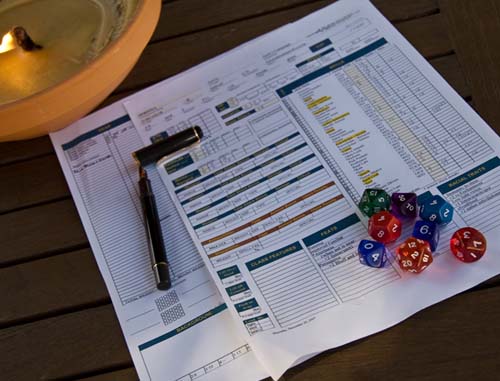
To start, I think my friend Addie wrote the perfect intro:

Twenty years ago I was dating a guy who asked, “Do you want to play Dungeons & Dragons?” and not really knowing what it was I said, “Sure why not.” Ever since that first game it felt like I found something that I was looking for, a doorway to a fantasy world I was unfamiliar with yet interested in.

D&D was the first step into a world that introduced me to other means of roleplaying, from LARPing to MMO’s [massive multiplayer online games] to text-based games online. It allowed me to exercise my creativity and become more comfortable with writing. It lead me to learn that I love to write, especially creating characters, and eventually I even co-started a text-based Marvel game called MUCK that had a successful seven years until I burned out and couldn’t run a game on my own anymore.
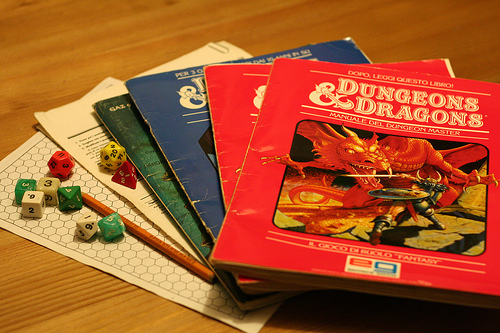
Sometimes, it’s a boyfriend who introduces the game. Other times, it’s a friend, as in Lindsay’s experience:

I started gaming when I was 14 or 15 (1990ish) when my female best friend bought a copy of the AD&D Player’s Handbook, Dungeon Master’s Guide, and Monster Manual [the three core books required for D&D] on a whim one day and she ran a game for me and her brother and, I think, a friend of her brother’s.

I’d been exposed to the idea of D&D several years before when the blue box set came out, and another female friend’s brother had it and the dice on his desk. I was utterly fascinated by the idea and wanted to play, but of course we were the Little Sister and friends, so we weren’t invited.

In Jala’s case, it was her sister:

When I was 10, my sister brought home a boxed set of D&D (the original edition) which had a map, module & etc. She was my first DM and first tabletop RPG buddy… RPGs were a way to bond with my sister originally, and later on when online RPGs were a thing it was the manner in which my sister met her husband, and the way I met my best friend (now ex-husband, though we are still friends).

But no matter how they discovered roleplaying, it made an immediate impact.

Beverly credits quite a bit to her experience roleplaying:

It changed my life by helping me form and solidify friendships. I even met my second husband because of RPGs (online and not pencil and paper) and that’s pretty rad.

It also helped me gain some confidence early on when I started game-mastering. I was pressured (in a friendly way) to try my hand at being a game master. I didn’t think I could do it, but I was with a group of trusted friends and I tried it out. It went pretty well, and because being the leader and helping guide the story had gone well in that trusted environment, I felt more empowered to try it at a small convention with people I didn’t know as well.

Those people ALSO had a good time, and each experienced helped me feel more capable in speaking in front of strangers, and if I’m being perfectly honest, also how to fake a bit of confidence at first to help me get started.

Lindsay also credits gaming as a huge factor in her life:

How has gaming affected my life? I laugh: it has been one of the two biggest parts of my life for most of my life. I met the most important people in my life through gaming, whether it be tabletop, writing for the games, or LARPing: my best friends since high school, my general social group, and my husband.

Gaming certainly helped broaden my creativity — collaborating with my best friends when we wrote tournaments or created a whole world to set games in brought so much to the forefront. Cultural knowledge, intricacy in political situations, and depth of character all came into it and we all boosted each other’s creativity. I also like playing all different races, classes, attitudes, and genders when I play — just to see what it’ll be like and to bring different parts of my personality out.

That being said, there has definitely been a sea change in how women in roleplaying have been viewed over the last twenty to thirty years.

Beverly: I have been at it in some form or another since about 1992 and mostly I have had good experiences but there have been some pretty bad ones. I think it has gotten a bit better for me over the years, but admittedly I am not as into it as I used to be.

Addie: The world has definitely become more welcoming to female gamers, at least in my experience. For many years I hid my gender online when roleplaying or playing MMOs, tending to play male characters. I never told anyone I was female but I didn’t tell anyone I wasn’t male and just let them assume. I’m sure there are people out there who are still convinced to this day I was a dude behind the screen.

Now, I have no issues with hiding my gender. The harassment isn’t there like it used to be, I’m not the “golden egg” of female roleplayers anymore.

Lindsay’s experience working inside the world of RPGs grants her a particular insight into how things have changed:

As for my own career, I wrote and edited for several game studios throughout my 20s and 30s. White Wolf in particular liked employing women in the office, but I don’t think that was really because they were committed to diversity. I think it was more because “Wimminz In Gamez Iz Edgy and Cool.” Yes, the women were incredibly capable and remain powerful writers and gamers, but still.

I work in a comic, card, and game store now, the same one where I host and play games. The customers’ attitudes are a mixed bag, really, but overall they are friendly and respectful of me as a woman and an expert. Some are overtly sexist and assholes about it – “uh, can you get [man]? I have questions. No, I don’t think you know about this, can you just get [man]?”

And yep, I know more than the man does.

That idea of “nerd cred” being checked, unfortunately, isn’t the exclusive domain of male players. My friend Athena confessed that female players can also make it hard to get into gaming:

I didn’t want to identify myself as a female RPGer to those that may attack me. I readily tell people I enjoy tabletop, RPG, and other video games in real life, but often (especially in groups of people that already somewhat know me) when I say “oh I love that game”, I get checked for my nerd card. Testing responses from people trying to make me prove I actually am a gamer… I got into D&D in the early days of high school because it looked like fun and my friend-group played. Since then, I personally have always found it somewhat difficult to “break into” new groups.

It’s been a generation since the early days of D&D, and thankfully, being a female RPGer is far more common, even if it can be hard for new players to get started.

Addie: It’s also nice because female Roleplayers aren’t the rarity they used to be.

Lindsay: I also feel like being a woman among gamers gives us a way to feel special sometimes in a world that stigmatizes, belittles, or outright ostracizes smart, creative women who don’t fit the physical or otherwise mold of what a Strong Female Character ought to be. It seems like a poor sort of evaluation, but … it’s true. Among the usual population, we’re just kind of weird, with weird interests. Among gamers, we’re rare and fascinating. That’s nice to feel sometimes.

And on the other hand, that same rare and fascinating thing crosses very quickly, very often into creepiness and even sexual inappropriateness. It’s kind of scary sometimes as a woman to walk into a new game group and have no idea what the guys are going to be like.

Jala: I can’t say that I ever experienced the kinds of horror stories you read about on Buzzfeed, myself, so my personal exchanges have ranged from being blase (occasionally with new folks I didn’t know) to absolutely hilarious (when my gay male friend was playing a flirty straight woman and I was playing a straight man whom his character hit on for example, the role reversal was funny to everyone). The respect of my personal authority was never challenged even as a teenage female DM with older people as my players, although I did exasperate a DM or two with my out-of-the-box thinking as a player. That, however, had nothing to do with my gender.

Athena: Whenever I play tabletop games — Magic, board games, D&D. etc. — the (mostly male) players don’t care AT ALL who I am. It’s generally an extremely welcoming community in person.

Lindsay: Things have absolutely changed over time. Women have gone from being only princesses to be rescued; bar wenches; prostitutes; and the subject of lonely-artist posters to writing the rules systems; being the examples of particular classes or races in said books; having a voice and presence online and in media; and more respected equals as players and writers. We still have things to overcome, but we have come SO far.

Jala: Initially although my “core group” was comprised of my sister and whatever friends (all male) we could rope into it, these days there are many more female gamers of all flavors. From being an outlier in what was a fairly esoteric and clique-filled community, I have (female and male) friends who own comic & gaming shops and run games for kids and single-session adventures for those who can only drop in from time to time. I think that the voice of women is more pronounced now and there is definitely more representation of my gender out there which is great.

Addie: When I was at PAX EAST in 2014 and playing the Pathfinder Mods, one of the random groups my friend and I got put together with ended up being all females. We had so much fun we played three modules together and the GM was shocked to find out we weren’t a regular group, just a handful of pairs of strangers. We weren’t put together because all of us were female, we were put together because we were the players waiting for a group. Ten years ago, there wouldn’t be enough women at a Tabletop booth to put a 7-player group together.

Although things are changing and the pendulum of acceptance and inclusiveness is swinging in the right direction, it’s still amazing the impact that one or two strong female voices can have in attracting and empowering other players.

Lindsay: A guy came up to me at the game store I work at to ask me how many women play D&D. He said his wife and he had played some online D&D and loved it, but she in particular was hesitant to try it in person because she felt uncomfortable with the idea of being a female newbie in a room full of guys.

I realized that this reluctance might be more common than anyone realized, and I thought about the fact that even I, a lifelong gamer, am always reassured when there’s even one other woman on a table. Thus was born my Thursday women-only D&D table. Now I have more interest than seats available at the table! One of my players said, after the last session, that she really, really enjoys playing with just women, that there’s so much less pressure to know everything off the top of your head and that roleplaying is so much more fun.

My stated goal with the game is not only to give women a table of our own but also to welcome and encourage newer gamers or total beginners. It’s a safe space for all women, and I specified that trans women are women and therefore welcome too … Safe. Space. And we’re having a good time!

Addie: I’ve also found that being a female roleplayer with 20 years of D&D under her belt, I’ve been able to help other, younger, women with getting into tabletop roleplaying. A lot of the younger roleplayers I meet online nowadays are mostly younger females who do a lot of text-based roleplaying. Now that they’re starting to get their feet wet with tabletop, they’ve come to me with questions, and I thoroughly enjoy being a “Geek Mom” to young girls.

It was a privilege talking to these women and gaining some valuable insight into the world of roleplaying games from their point of view. Just reading these stories made me even more grateful that my personal experiences with RPGs have been so positive. Seeing these amazing, creative, hilarious, and brilliant women help to shape the roleplaying community for the better… it’s something special.

I’d like to close with something Lindsay said. It is part optimism, part mission statement, and wholly appropriate to the subject at hand:

When things like Gamergate simply don’t happen any more because women’s voices are automatically respected, we’ll have gotten somewhere. Meanwhile, I’ll keep reaching out to women in gaming and helping the ones I can as well as doing what I love best.


Thanks for visiting PuzzleNation Blog today! Be sure to sign up for our newsletter to stay up-to-date on everything PuzzleNation!

You can also share your pictures with us on Instagram, friend us on Facebook, check us out on TwitterPinterest, and Tumblr, and explore the always-expanding library of PuzzleNation apps and games on our website!

Puzzles in Pop Culture: Brooklyn Nine-Nine (Plus Will Shortz!)

[Image courtesy of FOX.com.]

In our Puzzles in Pop Culture series, we’ve featured shows as diverse as Gilmore Girls, NCIS: New Orleans, The West Wing, Hell’s Kitchen, and Parks and Recreation.

But oddly enough, the puzzliest show in the series has proven to be Brooklyn Nine-Nine, FOX’s hit sitcom about a New York precinct and its oddball collection of detectives. Not only did they pose a diabolical seesaw brain teaser in one episode, but crosswords were at the heart of another key moment in the show just last year.

And today’s post marks the show’s third appearance. Join us as we delve into “The Puzzle Master,” episode 15 of season 5.


The episode opens with detective Amy Santiago passing the sergeant’s exam and doing a dorky dance. Good start.

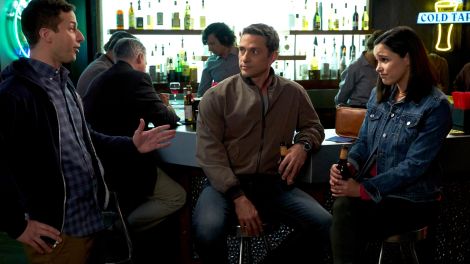
[Image courtesy of Spoiler TV.]

Her fiance, fellow detective Jake Peralta, has a doozy of a last case for he and Amy to solve as detectives. He presents her with a serial arson case that seem to be connected to the Saturday crossword puzzle. Amy, as a crossword fiend, is overjoyed.

Two different buildings have been set ablaze on two consecutive Saturdays, each with a puzzle left at the crime scene. The only other clue is a note sent to the puzzle’s “author” — not constructor, oddly — Melvin Stermley.

Amy immediately geeks out, mentioning that Stermley once created a puzzle where every word in the grid was the word “puzzle” in a different language. Jake then mentions that Stermley himself is coming in to help them with the case.

[Image courtesy of Brooklyn Nine-Nine Wiki.]

While Jake expects Melvin Stermley to be “a massive dork,” he turns out to be a handsome Hollywood tough guy type. Jake is instantly jealous. (For a nice bit of insider fun, Stermley is played by David Fumero, the husband of Melissa Fumero, who plays Amy Santiago.)

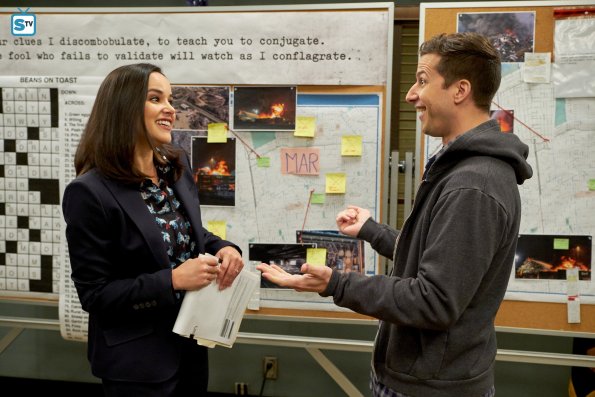
Amy has set up a display with both of Stermley’s puzzles connected to the fires, and the trio begin searching for leads. When Jake asks if he has the typical physique of a puzzler, he mentions that each puzzle only pays a couple hundred bucks, so he makes most of his money modeling. (No doubt a common response you’d get from any top constructor, right, folks?)

They read over the arsonist’s letter again: “Your clues I discombulate, to teach you to conjugate. The fool who fails to validate will watch as I conflagrate.”

Stermley suggests that they look at the answer grids of his puzzles for clues. Amy then jumps to anagramming some of the answer words. (The puzzler notes that Amy Santiago anagrams to “o, nasty amiga” and Jake Peralta to “eat a jerk, pal.”) Amy and Vin decide to split up the odd and even clues, leaving Jake out.

[Image courtesy of Spoiler TV.]

Getting nowhere with the anagrams, they wonder if “conjugate” in the arsonist’s letter means they should focus on the verbs, “the second best form of speech, after prepositions.” Jake suggests a different path, starting with possible suspects who don’t like Stermley, and the puzzler mentions the crossword night he’s hosting at a local bar. “It’s a total puz-hang,” according to Amy, and a good place to start looking.

While waiting in line outside the bar, Jake is disappointed no one is dressed like The Riddler. Amy points out someone wearing crossword-patterned pants. (Again, a common sight at the ACPT.) They chat with one of the other people in line, a woman who jokingly refers to Stermley as her future husband.

[Image courtesy of Spoiler TV.]

Before anyone can enter, they have to solve one of Stermley’s puzzles. Amy is tasked with anagramming the phrase “MEET A BRAINIER STUD, A” into the name of a place in the world. (Jake’s jealousy is piqued by the anagrammed message, of course.)

She quickly solves it — UNITED ARAB EMIRATES — and heads inside. But when Jake tries to follow, he discovers he has to solve a puzzle of his own to get in. The phrase “SAD ANUS LOSER, I GO IN” must be anagrammed into a film based on a classic book. Cut to Jake sneaking into the bathroom, because he couldn’t solve the anagram.

(It was DANGEROUS LIAISONS, by the way.)

While Jake waits in the bathroom for his pants to dry — he stepped into the toilet while climbing down from the window — two puzzle fans come in, discussing Stermley’s mad puzzle skills and how “Sam” must be pissed, as Stermley replaced him doing the Saturday crossword, bumping him down to work in Parade Magazine.

They mention Sam’s toughest clue, “a 5-letter word for a game popular in nursing homes,” to which Jake replies “BINGO.”

[Image courtesy of AV Club.]

Jake mentions it to Stermley, who says Sam Jepson is one of his best friends and has been out of town for weeks. Jake still thinks Jepson is a solid lead.

Amy and Stermley, meanwhile, have realized that both targeted buildings were at the intersection of numbered streets, and those numbered intersections also point to letters in Stermley’s puzzles: M and A. They plan to build a trap into Stermley’s next puzzle to catch the arsonist.

When given a choice between Jake’s approach and Stermley’s, Amy opts to go with the puzzle trap.

Back at the precinct, Amy has determined that the most common letters in people’s names that follow MA are L, X, R, and T — Malcolm, Max, Mark, and Matthew, for example — so Stermley constructs a puzzle using only one of each of those letters. (A pretty daunting challenge, but definitely doable — especially if the cryptic-style crossword grid on the board behind Amy is the puzzle in question. It would have fewer intersections.)

Amy plans to stake out the intersections for each of those four letters, assigning one of them to Jake. (Jake, meanwhile, makes a secret plan to have Charles stake out Sam Jepson’s apartment.)

[Image courtesy of Spoiler TV.]

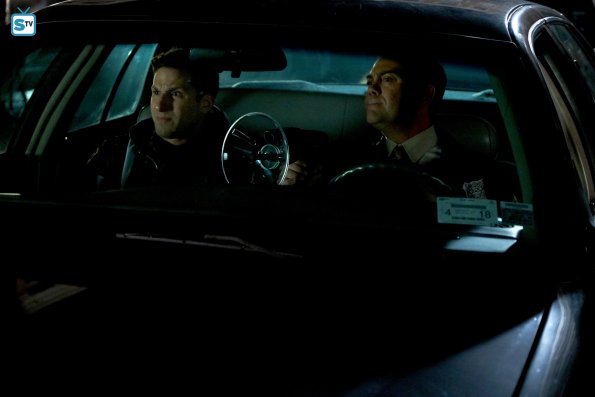
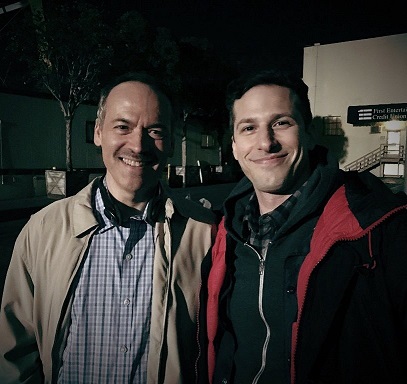
Charles spots Sam on the move — played by crossword guru Will Shortz, no less! — and Jake leaves his assignment to intercept. He and Charles follow Sam, who sits at a corner and eats soup, then calls his Mom. It turns out he has been out of town, only having returned tonight — and his marriage proposal was rejected. Bummer.

Jake returns to his assigned intersection, and the building is on fire. He has missed the arsonist.

Amy is understandably upset with Jake when they’re back at the office. Jake confesses he’s jealous of Stermley and doesn’t want Amy to wake up one day, regretting not marrying someone as smart as her. She reassures him that he’s a brilliant detective and that’s why she wants to marry him.

[Image courtesy of FOX.com.]

Jake has a epiphany, realizing that the arsonist’s name isn’t what’s being spelled out, it’s the word MARRY. (The word “conjugate” in the letter also pointed to marriage.)

And who wants to marry Stermley?

The woman in line at the bar on crossword night.

Jake and Amy bring the woman in, and it turns out the full message she intended to spell out with her fires was “MARRY ME OR ELSE I WILL KILL YOU, YOURS FOREVER, HELEN GERBELSON.”

That would take SO MANY FIRES. (I imagine she’d have to burn down several buildings more than once, given the sheer repetition of letters and the relatively few options for numbered streets.)

But, in the end, the arsonist has been caught, thanks to the power of puzzles and good police work.

[Image courtesy of Lauren Leti’s Twitter.]

Overall, I thought this was a very fun episode of the show. The anagram gags were the puzzly highlight, though I confess, I thought they’d do more with the Will Shortz cameo.

Here’s hoping there’s a crime at the Brooklyn Nine-Nine equivalent of the ACPT next year!

Also, as someone who has seen ARSON in a thousand grids, it is funny to see someone finally link the word and the act in a puzzly way.


Thanks for visiting PuzzleNation Blog today! Be sure to sign up for our newsletter to stay up-to-date on everything PuzzleNation!

You can also share your pictures with us on Instagram, friend us on Facebook, check us out on TwitterPinterest, and Tumblr, and explore the always-expanding library of PuzzleNation apps and games on our website!

PDP Tabletop Tournament: Round 1

The spirit of puzzly competition is alive and well. Not only are we still basking in the afterglow of the ACPT, but the third round of the World Puzzle Federation Puzzle Grand Prix is this weekend! AND registration for this year’s Indie 500 Crossword Tournament is now open!

But that’s not all!

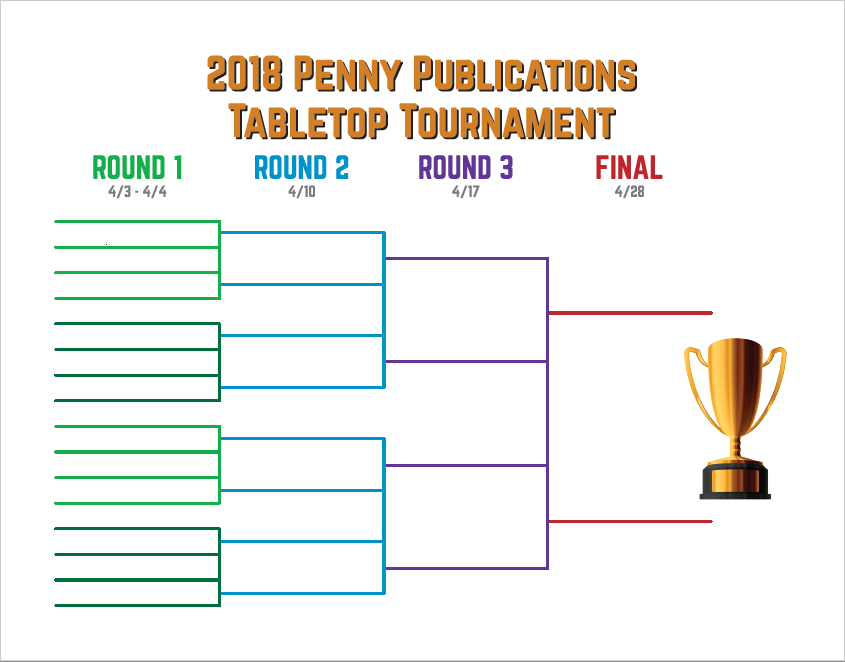
The crew at Penny Dell Puzzles put together a Tabletop Tournament in honor of the upcoming International Tabletop Day on Saturday, April 28.

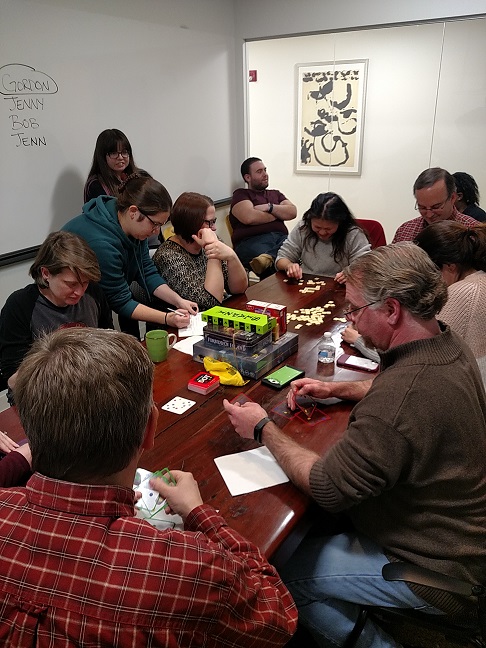
It’s a 16-person four-week tournament with different games to play every week, and round 1 kicked off this week. (This is actually the third year of the tournament, but this year has more competitors than ever before! Plus, both the 2016 and 2017 winners are competing again this year.)

One of the things I liked about the layout of the tournament is that there are no one-on-one match-ups until the final. Instead of a single-elimination tournament, competitors were slotted into groups of four. Each group of four would play two games, and the two winners (one from each game) would come from each foursome and move on to the next round.

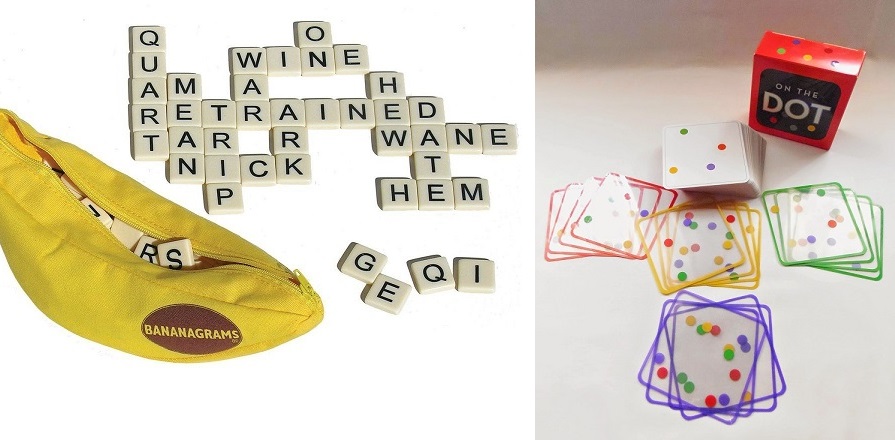
The two games for Round 1? On the Dot and Bananagrams.

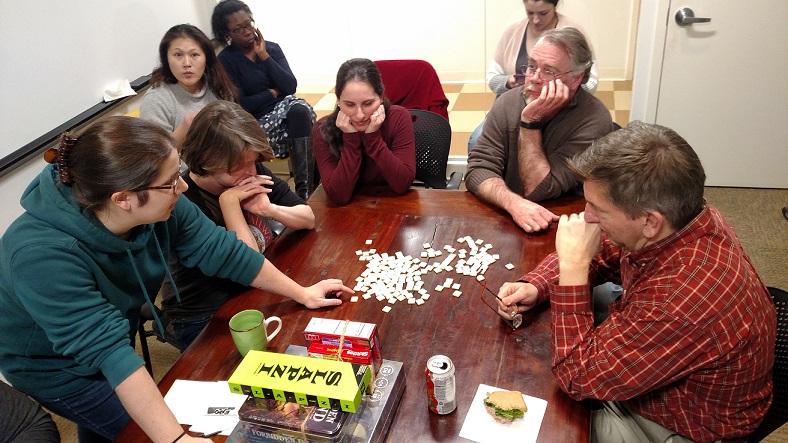
Bananagrams is a tile game where, much like Scrabble, players pull letter tiles and try to form small crossword-like grids. But in Bananagrams, you can anagram and rearrange the grid as needed, instead of being locked into using the words you’ve already played. Each player starts with a certain number of tiles, and each time you’ve used all your tiles, you say “Peel!” and each player grabs a new tile. This continues until the tile pile is depleted. Then the first player to complete their grid and say “Bananas!” is the winner, moving on to round 2.

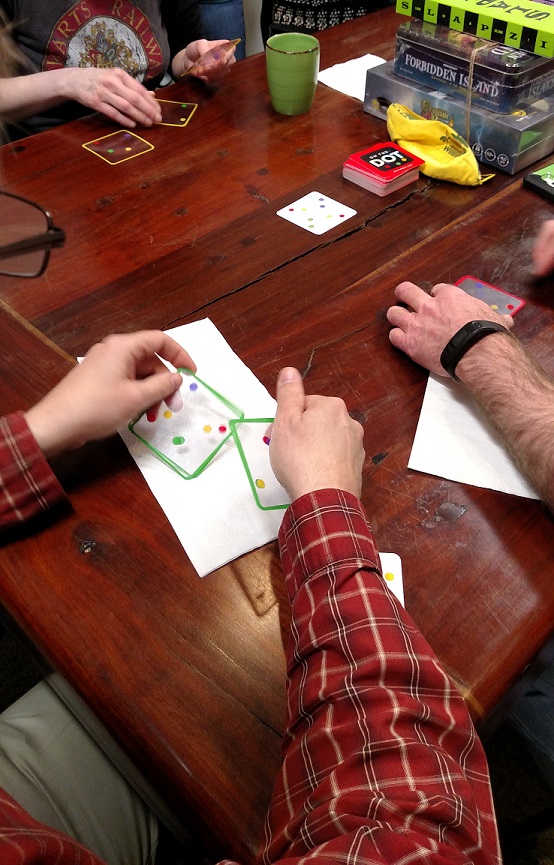
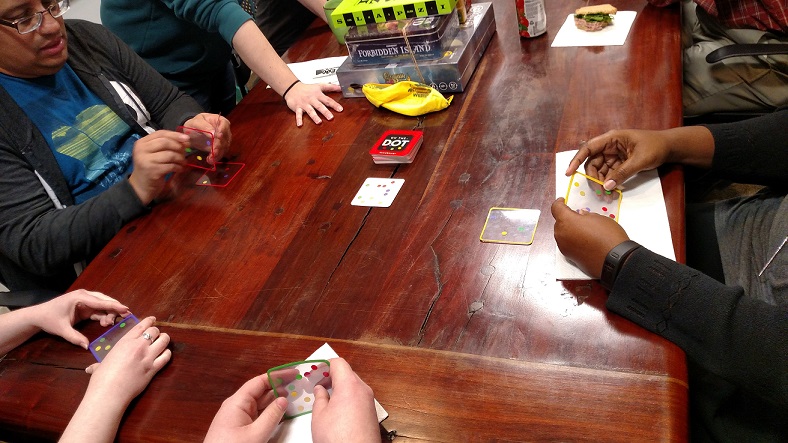
On the Dot is a pattern-matching game. Each player has four clear cards with randomly-placed colored dots on them, and it’s up to the player to arrange all four cards so that the colored dots showing match a given pattern. The first player to match three patterns would move on to the next round.

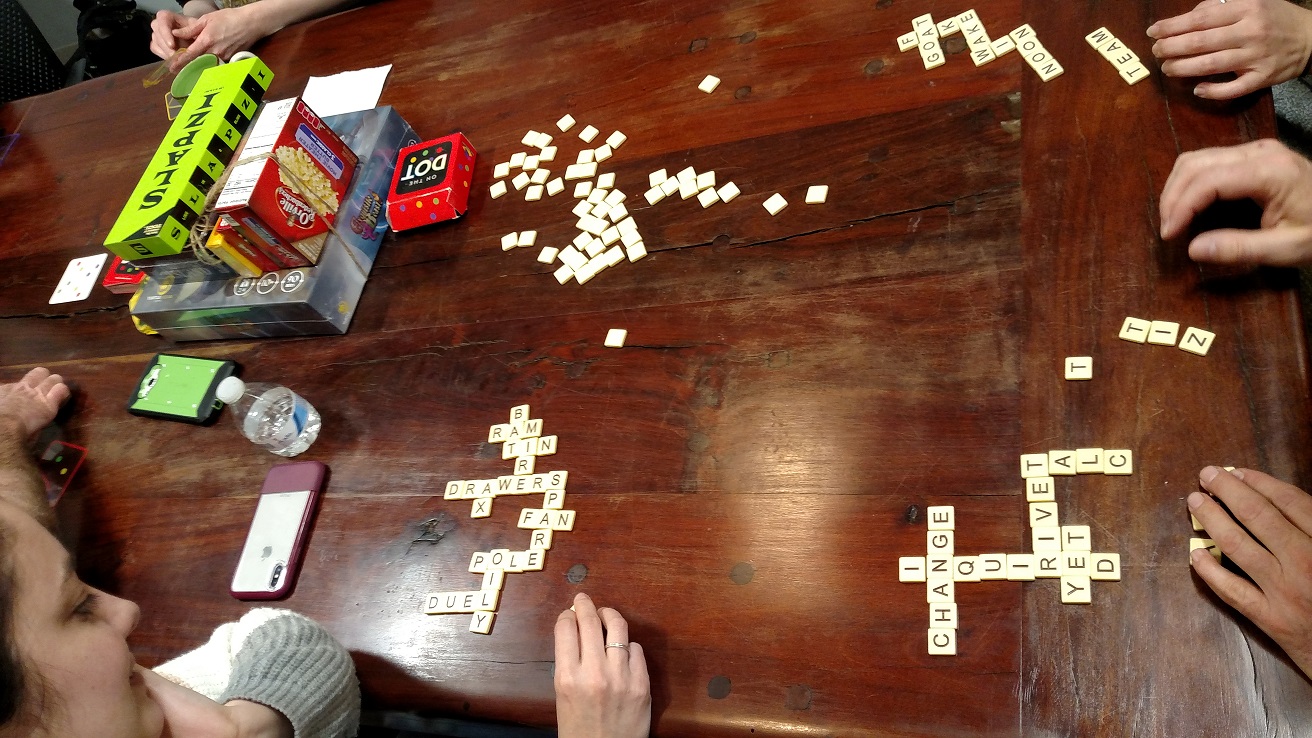
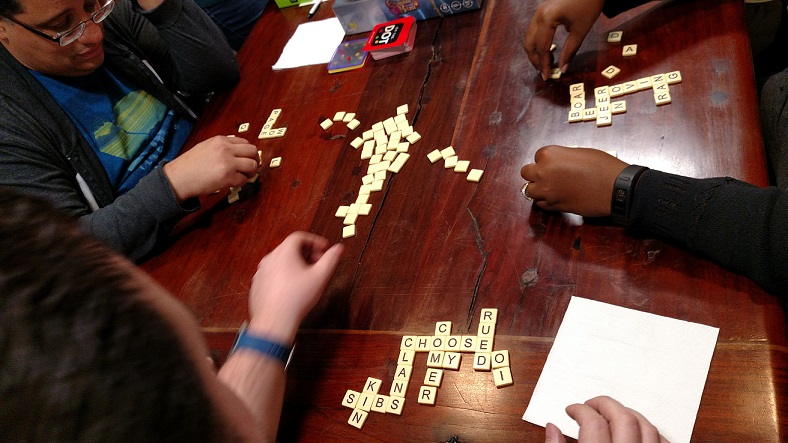
This two-winner-per-group arrangement is nice, because it offers people with different puzzle/game skills multiple chances to move on, instead of a one-and-done scenario. The two games also allow two different quartets to compete at the same time; as one group plays Bananagrams, the other plays On the Dot. Since we only had our lunch hour to complete round 1 (and 16 competitors crammed into the conference room), time was of the essence.

My group was first to compete in Bananagrams, and as the sole representative for PuzzleNation in the tournament, I was determined to make a strong showing for the brand.

Things started off smoothly. We had 21 tiles to start with, and I quickly formed a strong anchor word with DONKEY. But before long, my puzzly competitors proved their own skills were formidable, as cries of “Peel!” began to ring out, and the tile pile quickly diminished.

Honestly, I don’t think I said “Peel” once. I was always close to completing my grid, but never fast enough. But I seized my chance once the tile pile was empty. I only had a few letters left, and some quick anagramming had me confident. I called “Bananas!” and the judges came over to check my grid.

But alas, I’d made an error. I had originally played the word MAKO in part of the grid, then stole the M and A to form other words, intending to come back and fix that part later. But in my overzealousness, I left KO in the grid, which is not a word, so I was disqualified. Curses!

The player to my left was only about a half-second behind me, and she made no clumsy errors. Her grid was clean, and she was declared the first winner from our group to move on.

I would have to try my luck at On the Dot if I hoped to salvage the day.

We switched games with the other competing foursome at the table, and distributed the clear cards for the next contest: On the Dot.

Although I was disappointed with my performance in Bananagrams, I remained confident going into On the Dot, since I’m fairly strong in pattern-matching and similar forms of puzzling.

The first pattern to match was revealed, and we were off!

On the Dot really consists of two skills: being able to place the cards so the dots are in the right places AND hiding the dots and colors you don’t need. That second part can be more difficult than simply matching the pattern, honestly. If you need a yellow dot in a certain spot and nothing near it, it’s not good enough to have a yellow dot in that spot and a purple one right beside it.

I quickly cracked the first pattern, earning 1 point (and a few groans from the other competitors in my quartet).

I was able to follow that with two more victories, earning three points and a clean sweep. I was officially bound for Round 2. Huzzah!

Several other competitors that day turned in similarly dominating performances in On the Dot, while other rounds were hotly contested and came down to the wire.

The rounds of Bananagrams were a little bit slower, but still interesting. I wasn’t the only competitor who was snake-bit by improper words in Bananagrams that day. NAT disqualified one competitor, while NI disqualified another. (At least, according to the online Scrabble Dictionary we were using as our source. No matter what those knights say.)

One of the games ended in a deadlock, as neither player remaining could complete their grid. Another ended in so contentious a fashion that a tiebreaker game was needed to determine a winner!

Fortunately, the judges were prepared for this possibility, and a quick round of Slapzi was used to settle any such ties/issues.

Slapzi is a quick-reaction game where each player is dealt five double-sided cards. Each card has a unique image on each side — everything from dogs and fire hydrants to ladybugs and lawnmowers. Then a description card is played — “has two syllables” or “made of wood,” for instance — and the first person to play one of their cards that matches the description drops that card from their hand. The first person to empty their hand wins.

Between the three games, eight competitors moved on to round 2 (including last year’s champ), one step closer to a grand prize of a Game Night Gift Pack, complete with snacks!

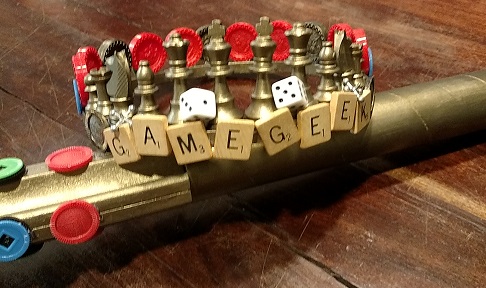
But that’s not all. The winner would also get a crown and scepter to carry around, in order to better lord their victory over their vanquished foes!

With a prize pack and a shot at becoming Tabletop Tournament Royalty on the line, things just got a lot more interesting.

To be continued…

[You can check in on the next round of the tournament live on Tuesday on our Instagram account!]


Thanks for visiting PuzzleNation Blog today! Be sure to sign up for our newsletter to stay up-to-date on everything PuzzleNation!

You can also share your pictures with us on Instagram, friend us on Facebook, check us out on TwitterPinterest, and Tumblr, and explore the always-expanding library of PuzzleNation apps and games on our website!

The Healing Power of Tetris

Despite the wealth of data out there — and all the “brain-boosting” apps and products claiming they’ll keep your brain in fighting trim — the verdict is still out on whether puzzle-solving can prevent or positively impact Alzheimer’s, dementia, or other age-related mental issues.

But that doesn’t mean that puzzles and puzzle games can’t help in other ways.

Researchers at the Karolinska Institute in Sweden have been treating people suffering from traumatic flashbacks — a form of accident-induced post-traumatic stress disorder — by having them play Tetris.

 Originally, the researchers tested this concept by showing unpleasant videos to test subjects and having them play Tetris for twenty minutes afterward. Their research showed that people who played the game — versus a control group that wrote about how they spend their time — suffered from fewer unpleasant and intrusive flashbacks or memories over the following week.

Apparently, the act of playing the game interferes with how people form the visual component of flashbacks. The gameplay doesn’t interfere with actual formation of memories, simply whether the brain will recall those unpleasant memories.

As it turns out, this might be a quality unique to Tetris or Tetris-style games. The same research team discovered that playing a quiz-style game made the flashbacks worse for those subjects than for the subjects who played no game at all after a traumatic event.

It appears that not only did Alexey Pajitnov create one of the most popular games of all-time, but that his legacy may also include helping the victims of traumatic events with their healing process. Amazing stuff.


Thanks for visiting PuzzleNation Blog today! Be sure to sign up for our newsletter to stay up-to-date on everything PuzzleNation!

You can also share your pictures with us on Instagram, friend us on Facebook, check us out on TwitterPinterest, and Tumblr, and explore the always-expanding library of PuzzleNation apps and games on our website!
April Fools! (Update: Solve Puzzles Like Never Before!)

Alas, we’re sad to inform you that PNVR — PuzzleNation Virtual Reality — the hot new tech on the puzzle scene, is just a delightful conjuring of the PN development crew. There’s no such thing.

(Not yet, anyway. Though, given how Ready Player One is performing in theaters, we might bump PNVR up the priority list.)

But we hope you enjoyed our little April Fools Day prank, particularly the free bonus coins for Daily Pop Crosswords at the end of the proverbial rainbow. It was great fun to cook up and execute, and the response from the PuzzleNation audience was terrific.

Thanks for a fun day, and keep your eyes peeled, because there are always fun, surprising ways to earn bonus coins and other great deals from PuzzleNation!

We’ll see you again soon, friends.

And please remember that puzzling and bike riding don’t mix.


Thanks for visiting PuzzleNation Blog today! Be sure to sign up for our newsletter to stay up-to-date on everything PuzzleNation!

You can also share your pictures with us on Instagram, friend us on Facebook, check us out on TwitterPinterest, and Tumblr, and explore the always-expanding library of PuzzleNation apps and games on our website!

Those Sudoku Puzzles Can Be Criminally Tough!

Even when I’m not thinking about puzzles or intending to learn about puzzles, puzzles find me.

I was reading one of the most recent editions of Ripley’s Believe It or Not!, those delightful compendiums of all things amazing, weird, and unlikely. Everything from world records and peculiar habits to once-in-a-lifetime events and mind-bending coincidences are found between the covers of these collections.

And one particular fact caught my eye:

Eighty-six prisoners at Exeter Jail in Devon, England, signed a formal letter of complaint claiming that a Sudoku puzzle in the local newspaper — the Exeter Express and Echo — on May 21, 2015, was impossible to solve.

I was instantly intrigued.

[Image courtesy of The Telegraph.]

Here is the message the prisoners sent to the editor of The Exeter Express and Echo:

Dear Sir/Madam, I am sadly writing this letter in A LOT of disappointment.

As you will see, I’ve enclosed last week’s Sudoko [sic] page and we (along with 84 other prisoners) believe you printed a ‘hard’ Sudoku which is IMPOSSIBLE to complete.

As being prisoners we are only aloud [sic] access to Thursday’s issue, so we couldn’t verify the truth.

Yours FAITHFULLY,

Michael Blatchford
Shane Smith

Yes, The Exeter Express and Echo is printed twice a week, and since the answers to Thursday’s puzzles appear on Monday, and the inmates don’t have access to Monday’s issues, they were unable to check their own work.

So, naturally, I had to see whether this Sudoku puzzle was as unsolvable as the inmates claimed.

Finding a copy of the puzzle wasn’t hard. Here, I’ll post it here, in case you want to try your hand at it yourself:

[Image courtesy of The Telegraph.]

So, is it impossible?

Well, no.

In all honesty, I’m not the strongest or the fastest Sudoku solver. But I did complete this puzzle, difficult as it was. I suspect, given time, you would complete it as well. I don’t mean to impugn the Sudoku skills of the Exeter Jail population. I’m just saying.

As it turns out, the inmates had made a few key mistakes, mostly in the middle section, and since they apparently solve in ink, it made things much harder.

But, in a lovely response, the staff at The Exeter Express and Echo promised to make Monday papers available to the inmates as well, so they can double-check their answers next time. That’s nice.

And here’s hoping their Sudoku solving has been smooth sailing ever since. Apparently, it has been, since Ripley’s has yet to mention them a second time.


Thanks for visiting PuzzleNation Blog today! Be sure to sign up for our newsletter to stay up-to-date on everything PuzzleNation!

You can also share your pictures with us on Instagram, friend us on Facebook, check us out on TwitterPinterest, and Tumblr, and explore the always-expanding library of PuzzleNation apps and games on our website!