An 80-Year-Old Literary Mystery Returns!

[The Doctor, of Doctor Who fame. No stranger to nonlinear stories.]

Avid readers and television watchers are probably familiar with the concept of nonlinear storytelling.

Whodunits often bounce forward and backward in time so that readers and detectives alike can reconstruct the events of the crime, and of course science fiction is filled to bursting with time-travel stories that tie the readers’ minds in knots. Bookworms are used to getting their story elements out of order.

But what if the entire novel was out of order? Imagine every single page out of place. Could you reassemble the story and solve the murder?

That was the question posed by Cain’s Jawbone, a 1934 novel by famed cryptic crosswords constructor Edward Powys Mathers, who published under the pseudonym Torquemada.

Readers were tasked with identifying the six victims of the killers, as well as who killed each victim. Not only that, but a successful solve also needed to include the correct order of all 100 pages of the novel.

A prize of 15 pounds was offered to the first reader who could unravel the mystery. That is no small feat, given that the number of possible page combinations is in the millions.

And yet, two solvers did submit solutions and get their prizes, even if the solution was never shared publicly.

85 years later, Cain’s Jawbone is returning to publication, allowing a new generation of puzzlers the chance to solve one of Torquemada’s greatest puzzles.

From publishing company Unbound’s announcement page:

Subscribers to Cain’s Jawbone will receive its 100 pages unbound in a box. This means that they can be spread out and placed next to each other – so much easier than when pages are bound, as in the original publication.

A space for notes is provided as well as a page to submit with the answer. Only solutions submitted on a page from the box will be eligible.

The competition is returning as well, and a prize of 1,000 pounds is being offered.

With a release date of September of this year, it will be fascinating to see how quickly modern solvers can unravel this classic mystery.


Thanks for visiting PuzzleNation Blog today! Be sure to sign up for our newsletter to stay up-to-date on everything PuzzleNation!

You can also share your pictures with us on Instagram, friend us on Facebook, check us out on Twitter, Pinterest, and Tumblr, and explore the always-expanding library of PuzzleNation apps and games on our website!

Science Says Board Games Are Good For Your Relationship?

[Image courtesy of Medium.com.]

One of the hallmarks of a healthy relationship is enjoying the same activities. If you’re spending time together doing something you both find engaging, then you’re golden.

But, as it turns out, there are some activities that offer greater benefits than others.

According to a recent study published by Baylor University, couples who play board games together are actually strengthening their relationships chemically.

[Incidentally, there is a hilarious world of photos dedicated to couples with chess boards out there. Here are just some of my favorites.]

From the article on Baylor.edu:

For the study, Melton and Maria Boccia, Ph.D., professor of child and family studies, recruited 20 couples ranging in age from 25 to 40. Couples were randomly assigned to participate in one of two couple dates — game night or couple art class — for one hour.

One group played board games in a familiar home-like setting. Couples were alone. These couples chose familiar games that would not require them to read instructions.

The study was designed to examine any increase in levels of oxytocin in the couples’ hormone levels. Oxytocin, often referred to as the hugging hormone, plays a role in building social connections.

[Image courtesy of Daily Mail.]

Here’s the breakdown on oxytocin release increases:

  • men in the art class
  • women playing board games
  • women in the art class
  • men playing board games

Curiously, while there wasn’t a significant difference between the latter three categories, men in the art class released 2 to 2.5 times more oxytocin than the other groups.

There were measurable increases in the oxytocin levels for both men and women playing board games, lending credence to the idea that playing together is good for your relationship.

Some of the games used in the study: cards, checkers, chess, dominoes, and Monopoly. Given some of my unpleasant experiences playing Monopoly, I’m surprised that one didn’t throw off the curve somewhat.

[Image courtesy of Grey Mass Games.]

It does make me wonder, though, if some games would provoke greater oxytocin releases than others.

Would cooperative games like Pandemic, Forbidden Island, or Castle Panic! lead to increases, or is the type of game irrelevant? Are more stressful games, like those with timers or ones where quick reaction time is integral to winning, less likely to build those chemical connections?

Sounds like a field ripe for further study. Of course, I’m a little biased. I’ll take any excuse to play more games. =)


Thanks for visiting PuzzleNation Blog today! Be sure to sign up for our newsletter to stay up-to-date on everything PuzzleNation!

You can also share your pictures with us on Instagram, friend us on Facebook, check us out on Twitter, Pinterest, and Tumblr, and explore the always-expanding library of PuzzleNation apps and games on our website!

PuzzleNation Product Review: Time Breaker

[Note: I received a free copy of this game in exchange for a fair, unbiased review. Due diligence, full disclosure, and all that. Yada yada disclaimer.]

Criminals are bad enough as it is, but time criminals… they’re the worst. Not only can they screw up the present, but they can screw up the past AND the future as well. As a member of the Time Repair Agency, it’s your job to travel through time to apprehend these miscreants — these time breakers — and set things right.

But be careful. You’re not the only TRA agent on the hunt, and every criminal captured is a feather in that agent’s cap, so don’t be surprised if other TRA agents try to interfere with your efforts.

Whether you’re searching the dawn of time or the year 3000, the life of a TRA agent isn’t easy.

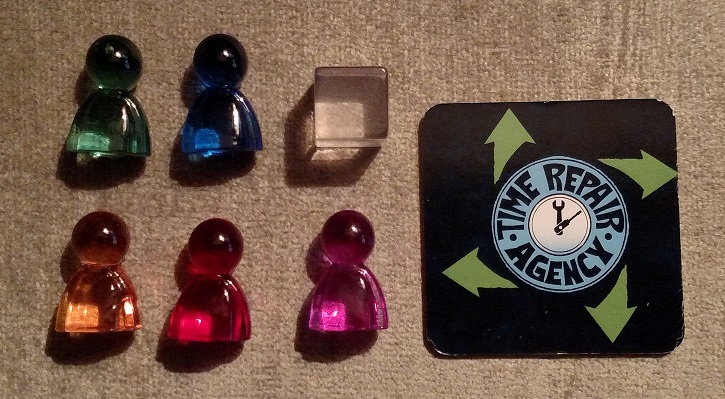
[The intrepid agents of the Time Repair Agency and the dastardly Time Breaker.]

That’s the concept behind Time Breaker, the newest card game from the inventive crew at Looney Labs, and honestly, I think it’s their best game yet.

Time Breaker not only improves upon some of the ideas behind Chrononauts, but incorporates strong elements from the Fluxx games in order to add more choice and more excitement to the game play.

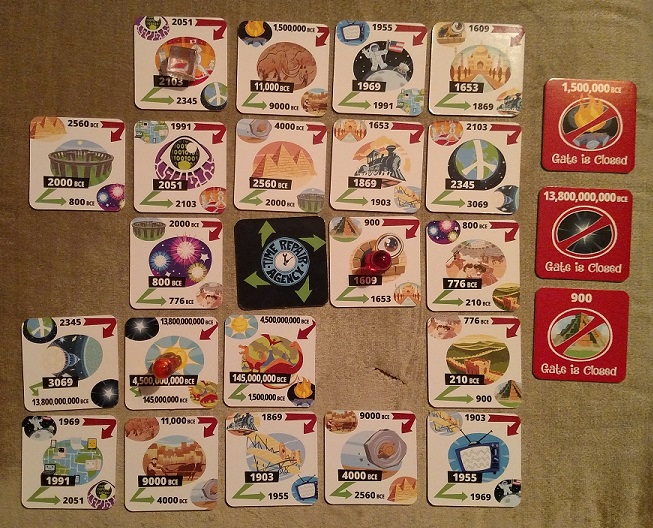
The game board consists of 25 tiles arranged randomly in a 5×5 grid pattern. 24 of these tiles represent specific moments in time. The 25th is the Time Repair Agency, and it’s always the center tile. It’s your job to navigate the board, capture the Time Breaker, and return to the Time Repair Agency with your quarry.

You do so by playing various cards that dictate your movements. (Players experienced with Fluxx will recognize the idea of Action cards, as well as some of the actions you can perform.)

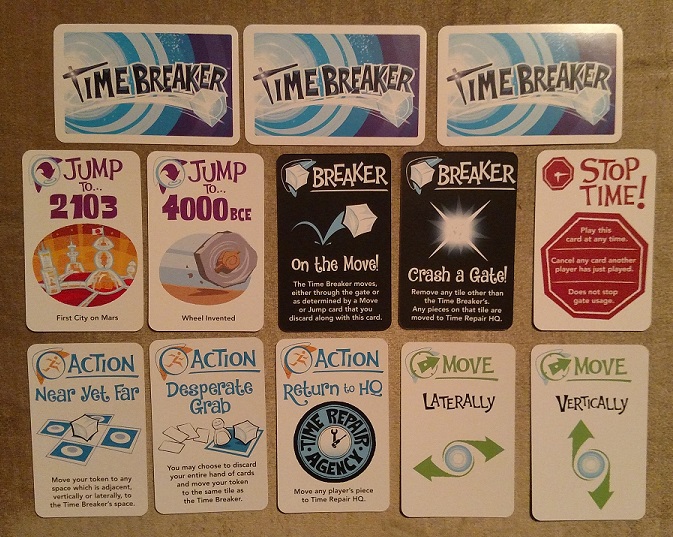
There are move cards that allow you to move from tile to tile, regardless of where those moments are in time. There are jump cards that allow you to move to a specific tile. And there are action cards that allow you to perform different tasks, including playing extra cards from your hand, or traveling backwards in time. There are also Stop Time cards, which cancel other players’ actions, and Breaker cards that alter the game board or affect how the criminal moves.

Since the game is a race to see who reaches the Time Breaker first, it’s clever to allow the players multiple ways to navigate the board. You can move your piece across tiles (like any normal board game), you can jump to certain times with the cards, and you can navigate time itself by moving either backward or forward in time.

You see, since each tile is a moment in time, there are two arrows on the tile — one going forward, one going back. Those arrows can help you jump around the board. For instance, if you’re on the tile 13,800,000,000 BCE (the start of the universe), following the green arrow forward takes you to 4,500,000,000 BCE (the formation of the sun), which due to the random nature of the game board’s layout, could be anywhere, not just the next tile over.

Or you could follow the red arrow backward in time, if you have the proper card for it. (Since we’re talking about the first card in our timeline, it turns out time is cyclical, and going backward takes you to the future, the year 3069 (the colonization of Alpha Centauri).

Time Breakers manages to pack a lot of strategy and choice into a small package, ensuring that the game has major replay value. That’s no surprise, of course, since replayability is a hallmark of the Looney Labs brand.

But by combining a playing space that’s different every time (similar to Fluxx: The Board Game or Forbidden Island), the randomness of the cards you draw, and the ability to manipulate the board by closing access to certain time tiles, you have a dynamic game that always feels fresh.

All those elements could make for an uneven playing experience, but the cards are perfectly balanced, meaning no matter what cards you draw, you’re going to have a fair shot of winning the game. Luck is always a factor, but strong strategy and an ability to adapt on the fly will take you far.

And Andrew Looney makes juggling all of these elements look easy.

Complimented by a jovial art style, rich in bright colors and whimsy — not to mention a prediction of world peace only a few centuries away! — Time Breaker continues the innovative, enjoyable tradition long established by games like Fluxx, Just Desserts, and Get the MacGuffin. This game is great fun.

Time Breaker is available from Looney Labs and participating retailers on February 28, but you can preorder it by clicking here!


Thanks for visiting PuzzleNation Blog today! Be sure to sign up for our newsletter to stay up-to-date on everything PuzzleNation!

You can also share your pictures with us on Instagram, friend us on Facebook, check us out on Twitter, Pinterest, and Tumblr, and explore the always-expanding library of PuzzleNation apps and games on our website!

In Crossword Clue Parlance, it’s M, or K, or Grand

[Image courtesy of BikeNoob.com.]

A thousand of anything is a lot. Sure, the Proclaimers made it sound longer by mentioning 500 miles and then 500 more, but we’re still talking about 1000 miles there. That’s a lot of miles.

I wrote my first post for PuzzleNation Blog in August of 2012, nearly six and a half years ago.

This week, I uploaded my one-thousandth blog post on this site.

You might think after three posts a week for years, I’d be burned out. But it’s quite the opposite. I enjoy exploring the world of puzzles, delving into history, cracking the memes and riddles that go viral, interviewing all sorts of puzzle creators and fans, trying out new games and puzzles, talking about our awesome puzzle apps like Daily POP Crosswords and Wordventures…

And sharing all of that with the PuzzleNation audience.

It’s a privilege, it really is. In many ways, I’ve become the voice of PuzzleNation, and I take that responsibility seriously. I try to both inform and entertain, and I’m constantly hunting for something new and unexpected to offer you.

[Image courtesy of Forbes.com.]

And speaking of you, the PuzzleNation readership, it kind of blows my mind how many different ways I get to interact with you.

I mean, first and foremost, there’s PuzzleNation Blog. Three times a week (and sometimes more), I meander up and down the seemingly endless avenues of the puzzle world and discuss them with you. What a treat.

And then there’s Facebook and Twitter, where I not only discuss all of our projects, but I can play games like the Crossword Clue Challenge every weekday and try to outwit you. (Spoiler alert: I rarely do.)

I also have opportunities to answer questions, share posts and information from fellow puzzlers, and engage with people one-on-one, something that feels increasingly elusive these days.

There’s Pinterest and Instagram, as well as in-person events like the American Crossword Puzzle Tournament and the Connecticut Festival of Indie Games.

And honestly, I want more of that. So let me ask you something, fellow PuzzleNationer…

What do you want to see from PuzzleNation Blog in 2019?

Is it brain teasers? Original puzzles for you to solve? Behind the scenes content about our apps? Tutorials on how to solve various puzzles? More interviews with constructors and other puzzle/game designers? More puzzle history? More reviews?

Comment below, or on social media, or even in person. Tell us what you want to see. Let’s make the most of this platform, shall we? =)

[Image courtesy of Bogoreducare.org.]

I’ve gotta say, it’s a little daunting to be celebrating one thousand blog posts with you.

I know some of you have been with us since practically the beginning, and I’m grateful. I know some of you have only recently started following us, and I’m happy to welcome you. Some of you I know by name, and many of you I don’t know at all — but I’m hoping to change that in the future.

In any case, thank you for your support, your enthusiasm, your ideas, your comments, your feedback, your shares and likes and clicks and hearts and thumbs up and app downloads and reviews and everything else we’ve shared. I look forward to many many more.


Thanks for visiting PuzzleNation Blog today! Be sure to sign up for our newsletter to stay up-to-date on everything PuzzleNation!

You can also share your pictures with us on Instagram, friend us on Facebook, check us out on Twitter, Pinterest, and Tumblr, and explore the always-expanding library of PuzzleNation apps and games on our website!

Answers to our National Puzzle Day Starspell!

For National Puzzle Day (aka International Puzzle Day), we laid down the gauntlet for you, fellow puzzlers.

We challenged you to put your vocabulary skills and your word-forming knowhow to the test with a Starspell puzzle specially constructed for the holiday (as it featured all the letters in the phrase INTERNATIONAL PUZZLE DAY)..

The goal was to form common six-letter words by moving from letter to connected letter in the Starspell diagram. You were allowed to repeat letters, but only so long as you left the letter first and then came back to it.

We found 28 six-letter words. Did you find more than that?

Here’s our list: ALATED, ATONED, DEALER, DELETE, DENIED, DENOTE, DEPEND, EATERY, ELATED, EYELET, LAUREL, LENDED, LENDER, NEATEN, NEATER, NOTATE, PEALED, PENDED, REDEAL, RED-EYE, REINED, RELATE, RENDED, RENDER, REPEAL, REPEAT, TENDED, TENDER.

Did you find any that we missed? Let us know in the comments section below! We’d love to hear from you!


Thanks for visiting PuzzleNation Blog today! Be sure to sign up for our newsletter to stay up-to-date on everything PuzzleNation!

You can also share your pictures with us on Instagram, friend us on Facebook, check us out on Twitter, Pinterest, and Tumblr, and explore the always-expanding library of PuzzleNation apps and games on our website!

PuzzleNation Product Review: Thinking Putty Puzzle

[Note: I received a free copy of this game in exchange for a fair, unbiased review. Due diligence, full disclosure, and all that. Yada yada disclaimer.]

ThinkFun has been pushing the envelope for years when it comes to logic puzzles. Whether we’re talking lasers, electrical circuits, colors, shadows, or gravity, they continue to find innovative ways to test the puzzly skills of their customers.

And the subject of today’s review is no exception. It takes a very simple idea — connecting colored dots on a grid — and adds a tactile, intriguing twist.

Let’s take a closer look at their newest offering, Thinking Putty Puzzle.

In Thinking Putty Puzzle, the solver has to connect the colored dots to their matching counterparts on the grid. They do so by bending, stretching, and shaping packets of putty into lines that connect the dots.

But those paths cannot cross. That would be too easy. Instead, the solver must map out how to connect the dots without crossing.

(There are bridge pieces that allow the putty paths to pass over or under each other, but otherwise, the paths cannot interact.)

And so, a simple connect-the-dots game becomes an engaging puzzle that involves careful planning and use of the grid space.

It looks like a lot of available space, but it fills up faster than you’d think with six paths to draw.

As you can see, the puzzle consists of a playing grid (which doubles as storage for the game and the putties), six colors of Crazy Aaron’s Thinking Putty (including a ThinkFun exclusive Binary Blue color), three bridge pieces, three blocking pieces (representing obstacles to be circumvented), and the 60 challenge cards.

The Challenge Cards increase in difficulty as you work your way through the deck. Beginner and Intermediate Challenges give way later to Advanced and Expert puzzles that will have you wracking your brain to twist, turn, and maneuver your six putty paths around the playing grid.
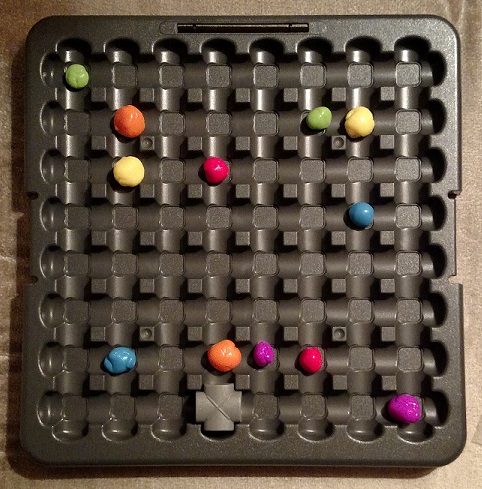
Each Challenge Card tells you where to place the colored dots to connect, as well as any bridge or blocking pieces are part of the grid.

From there, it’s all up to you. How do you proceed with 12 points to connect?

Maybe you start by connecting the nearest ones in order to figure out how to best use the remaining space.
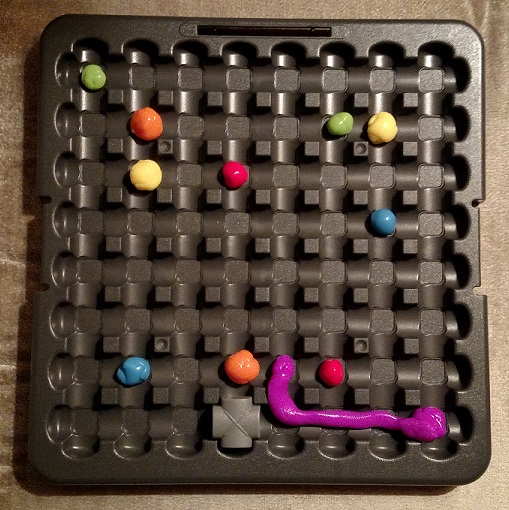
Or perhaps you work out which dots will need to use the outermost paths and place those, so that the interior remains open for trickier maneuvering.

It’s easy to pull the putty until it’s stringy, which makes it harder to manipulate. Instead, I found it worked best to pull quickly and forcefully, almost suddenly, rather than gradually. It makes quite a satisfying SNAP sound when you’ve done it right, and there’s no stringy mess to clean up.

Also, be careful to avoid letting the various colors touch. The putty happily sticks to itself, so any pieces that intermingle are VERY difficult to separate.

That being said, the putty doesn’t adhere at all to the playing area, making the set up for the next puzzle — or clean up when you’re done puzzling — easy as could be.

(I, for one, was grateful that the sparkles in the Binary Blue didn’t rub off. When I first saw the glitter, it gave me Christmas card flashbacks.)

In terms of the actual puzzle-solving, strategy plays a bigger role here than you might expect. Honestly, it’s more like playing Risk or Chess than your solving usual logic puzzle.

For instance, once you’ve placed the red path in our example, your eyes naturally turn to the upper left corner, where green, orange, and yellow dots await. You need to place the green path in such a way that it doesn’t block or cut off access to the yellow or orange dots.

By thinking about the spaces needed to get in or out of those dots, it helps you eliminate bad paths to take, because in this puzzle, knowing where your path SHOULDN’T be is just as valuable as knowing where it should be.

Thinking Putty Puzzle takes the satisfaction of jigsaws and other physical puzzles to another level. While placing a jigsaw puzzle piece is cool, it’s not as cool as kneading the colored putty into a new path and tracing it onto the grid as part of your solve.

I expected to get a little bored with it after a while, but I didn’t. Watching the grid fill up with completed paths and seeing the puzzle come together never got old. On the contrary, the escalating difficulty made it all the more fulfilling to conquer each card and squish the putty back into a single lump while I prepped the next Challenge Card.

So, if you’re looking for a fun and accessible way to get younger solvers into puzzles — or you just prefer your logic puzzles to be more hands-on than the usual pencil-and-paper variety — then you’re sure to enjoy Thinking Putty Puzzle.

[Thinking Putty Puzzle is available from ThinkFun and other participating retailers.]


Thanks for visiting PuzzleNation Blog today! Be sure to sign up for our newsletter to stay up-to-date on everything PuzzleNation!

You can also share your pictures with us on Instagram, friend us on Facebook, check us out on Twitter, Pinterest, and Tumblr, and explore the always-expanding library of PuzzleNation apps and games on our website!