Puzzles in Pop Culture: Sherlock Holmes (a.k.a. The puzzle is afoot!)

Mystery novels and stories are catnip to puzzlers, because they’re an entertaining way to exercise our deductive skills and enjoy puzzling outside our usual fare of apps, games, and paper puzzles.

And surely there’s no greater boon to the mystery-loving puzzler than the ongoing adventures of Sherlock Holmes in all his forms. Not only is there are series of feature films starring the Great Detective, but there are two television programs focusing on his singular brand of puzzling: Sherlock and Elementary.

[Note: I will be discussing both seasons of Elementary, seasons 1 and 2 of Sherlock, and the season 3 premiere. So consider this your spoiler alert.]

Beyond the normal whodunnit storytelling that frames both shows — a staple of the genre that traces back to the original Sir Arthur Conan Doyle stories and novels — there are smaller puzzles to unravel.

Perhaps the most famous from the Doyle canon is “The Adventure of the Dancing Men,” where Holmes solves a curious pictographic code in the hopes of preventing a heinous crime.

And both Sherlock and Elementary frequently return to this cryptographic trope, for both dramatic tension and storytelling twists and turns.

Episode 2 of Sherlock, “The Blind Banker,” has a cryptographic mystery at the heart of the story, one that echoes “The Adventure of the Dancing Men” and its similarly perilous stakes.

Codebreaking is also at the core of the season 2 premiere, “A Scandal in Belgravia,” as Sherlock attempts increasingly complex ways of cracking the code of Irene Adler’s phone. (There’s a marvelous scene where he introduces a dummy phone in order to copy her keystrokes is foiled when Irene realizes the dummy phone is a fake, and in turn types in a fake passcode. It’s a terrific exchange of gamesmanship.)

The cipher used in the season 3 premiere, “The Empty Hearse,” is another prime example, and one that quick-witted viewers could solve alongside Sherlock, as he and Mary decipher the message and pursue Watson’s kidnappers.

Elementary has had its fair share of codes as well. The season 2 episode “The Diabolical Kind” featured numerous techniques for coding information — from hidden spaces in seemingly innocuous drawings to elaborate letter-shifting codes akin to the Caesar cipher — all of which Holmes unraveled with ease. (Sadly, the puzzlers in the audience aren’t given much opportunity to crack the codes themselves.)

But each show has also played on the natural human ability to find meaningless patterns in chaos and interpret them as hidden messages. Sherlock‘s season 2 episode “The Hounds of Baskerville” had Watson chasing down a Morse Code message that turned out to be nothing more than flashes of light.

And Elementary‘s most recent episode had an excellent sequence where Watson read too much into a former mobster’s statement about “a mutt” who would be “in the ground tomorrow.” (Watson suspected the “mutt” referenced a suspect’s mixed ancestry, while “in the ground tomorrow” would point toward the suspect’s Jewish heritage and burial traditions.) Holmes correctly dismissed both as red herrings.

Both Sherlock and Elementary had a bit of fun exploring characters fixating on small clues, only to be misled. It’s an intriguing path to take when the main character of each show bases so many conclusions on similarly minuscule bits of data.

With such a richness of Sherlockian material on television these days, both mystery fans and puzzlers have plenty to sate their appetites.

Thanks for visiting the PuzzleNation blog today! You can like us on Facebookfollow us on Twitter, cruise our boards on Pinterest, check out our Tumblr, download our Classic Word Search iBook (recently featured by Apple in the Made for iBooks category!), play our games at PuzzleNation.com, or contact us here at the blog!

Picture this…

There are all kinds of puzzles. That’s one of the best things about being a puzzle fan: the fact that there are so many varieties of puzzle out there waiting to challenge you. From word searches and crosswords to Sudoku and cryptograms, from brain teasers and sliding-tile puzzles to pattern puzzles and rebuses, the possibilities are endless.

One of the most engaging (and surprisingly challenging, I’ve found) fall under what I’d call picture puzzles.

Picture puzzles demand keen visualization skills, since they often involve manipulating shapes in your head. You might be asked to deduce what letter is on the hidden side of a six-sided die, or how to divide farmland with only three lines and separate every sheep from each other. It’s visual trickery and topnotch puzzle-solving wrapped up in one.

And one of my favorite Picture puzzle wizards is Sam Loyd.

I was introduced to Mr. Loyd’s puzzles in Mathematical Puzzles of Sam Loyd — a collection assembled by puzzle aficionado Martin Gardner — a book I stumbled upon in the library one day while strolling the shelves.

The collection offers math puzzles and brain teasers, deduction problems and tracing games, but the ones that most intrigued me were his Picture puzzles.

Now, adding pictures to puzzles is hardly a new idea. David L. Hoyt’s Jumble puzzle features one, and plenty of Matching / Spot the Difference puzzles — like the Match-Up and The Shadow puzzles offered by our pals at Penny/Dell Puzzles — rely heavily on art. But there’s a marvelous charm to Loyd’s drawings, creating a scene and telling a small story as he offers one brain teaser after another.

I’ll post a few of my favorites, so you can get a sense of not only his artistic stylings, but the extreme cleverness involved in creating these puzzles.

Each of these puzzles requires a keen ability to visualize shapes in your head, as well as some serious craftiness to conquer the challenge Loyd sets before you.  Have you figured them out?

I’ll post the solution to the first one and leave the others for you to puzzle out.

[I didn’t line it up perfectly, but you get the idea.]

Loyd is part of a marvelous tradition of inventiveness and creativity that has helped contribute to the rich and vibrant puzzle world we enjoy today.

[To check out more of Sam Loyd’s puzzles, you can visit this website dedicated to his puzzly legacy (including several puzzles for sale!), a treasure trove of Picture puzzle fun.]

Thanks for visiting the PuzzleNation blog today! You can like us on Facebookfollow us on Twitter, cruise our boards on Pinterest, check out our Tumblr, download our Classic Word Search iBook (recently featured by Apple in the Made for iBooks category!), play our games at PuzzleNation.com, or contact us here at the blog!

Bigger really is better, sometimes…

giantsudoku

[A massive Sudoku grid, created to promote a Sudoku gameshow in England in 2005.]

There’s just something about puzzles on a grand scale. From the Great Urban Race’s citywide scavenger hunts to the Internet-spanning curiosity that is Cicada 3301, puzzly ambition makes for some truly mindblowing experiences.

But those are puzzles of staggering complexity and scope, not actual physical size. When it comes to sheer dimensions, you have to go building-size.

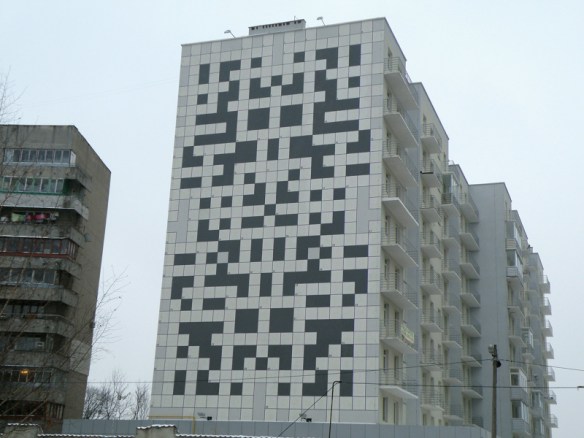
There is, of course, the solvable crossword from Lviv, Ukraine, where the grid takes up the entire side of an apartment building, with clues hidden all over the city. It’s a brilliant tourism move and a terrific challenge (especially if you don’t read Cyrillic).

OLYMPUS DIGITAL CAMERA

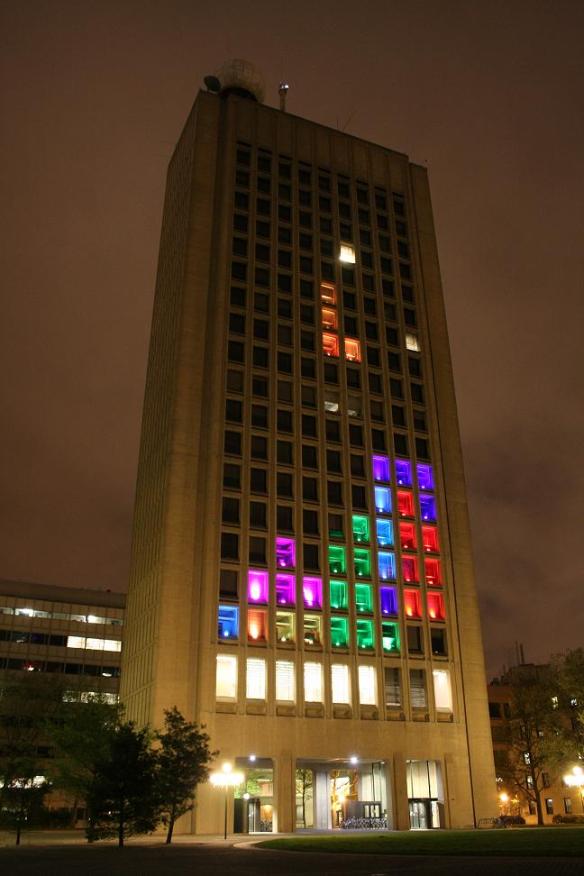
There was also the classic MIT hack from 2012 where ambitious miscreants transformed one side of the Green Building into a multicolored, playable Tetris game. (I recently learned that students from Brown University in Rhode Island accomplished a single-color version of the same feat back in 2000. You can find video of both hacks here.)

tetris1_img6080

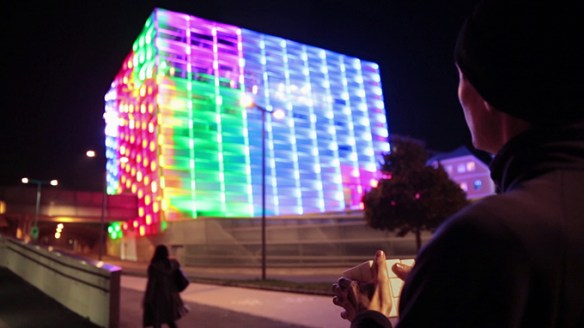
But Javier Lloret has upped the ante with Puzzle Facade, an art installation which transforms the Ars Electronica building in Linz, Austria into a solvable Rubik’s Cube.

Using a small handheld cube as an interface, a solver can manipulate the cube and watch the same changes carried out across two entire sides of the building in full color.

rubikbuilding

As you might expect, having only two sides of the cube available makes for a greater solving challenge, but who cares when you’re lighting up a building with every twist and turn!

It’s a fantastic meeting of puzzly fun and electronic wizardry, and the latest in a grand tradition of massive-scale creativity. I cannot wait to see what intrepid puzzlers come up with next.

Thanks for visiting the PuzzleNation blog today! You can like us on Facebookfollow us on Twitter, cruise our boards on Pinterest, check out our Tumblr, download our Classic Word Search iBook (recently featured by Apple in the Made for iBooks category!), play our games at PuzzleNation.com, or contact us here at the blog!

PuzzleNation Product Review: Pink Hijinks, Chrononauts, and Fluxx: The Board Game

fluxx0

Looney Labs is a game company with a creative model everyone can get behind: high replay value through wildly interactive, adaptable game play. Perhaps best known for their card game Fluxx, Looney Labs games are designed for portability, packing a lot of punch into smaller, more efficient packaging.

They offered us the opportunity to try out three of their games for the Holiday Puzzly Gift Guide, each with its own unique flavor and playing style, and we put them to the full PuzzleNation Blog test.

pink1

The set-up for Pink Hijinks seems simple enough. Three stacks of pink pyramids (small on top of medium on top of large, like a little tree) occupy the middle row of a 3×3 grid.

Based on the roll of the die, you and your opponent maneuver your pieces with one of two goals in mind: either trying to either fill your home row with all three pyramids of a given size, or pushing all nine pyramids into your opponent’s row.

It’s a miniature chess game, allowing for offensive and defensive strategies. After a few rounds, we started improvising new rules and different gameplay styles, and discovered how much fun you could have with nine little pink pyramids. Pretty good for a game that fits in your pocket.

pink2

Pink Hijinks is part of Looney Labs’ multi-colored Looney Pyramids series, an ever-expanding line of puzzle games built around their signature pyramid game pieces. Not only can you buy individual games, but the company is constantly releasing new variations on their games through their website, allowing players to combine pieces from multiple Looney Pyramids products and play brand-new games. (They’ve even compiled a listing of fan-designed games using Looney Pyramids!)

As far as I can tell, the Looney Pyramids series has the loftiest of goals: to offer as many unique playing experiences as a deck of cards, arguably the most adaptable tool in a gamester’s arsenal. And based on their lineup thus far, Looney Labs is well on their way toward reaching that goal.

chrono1

Time travel isn’t easy. If it was, everyone would do it. And Looney Labs takes that idea to the next level with Chrononauts, a card game where multiple time travelers are manipulating history, capturing artifacts, and racing to return to their own time with their missions complete.

Chrononauts is all about the cards. You’ve got mission cards, ID cards, timeline cards that make up the playing space, artifact cards, cards that change history (and others that change it back), as well as cards that can help or hinder your fellow time travelers.

chrono2

The history-changing aspect is the most puzzly part of the game, as you determine what moments to change (and which to protect from your opponents) in order for your timeline to come to pass, but ensuring you don’t accidentally end the game by creating too many temporal paradoxes. The designers did an impressive job figuring out how major points in history were interconnecting, and watching the effect ripple down through the cards after making a bold history-altering move is arguably the best part of the game.

My one caveat regarding Chrononauts is that the game goes far too quickly with only two players. It’s a game designed around consequences, and the more consequences that are out of your hands, the more engaging and challenging the game becomes. I’d recommend you always recruit as many players as possible to make the gameplay last.

fluxx2

There are certain things you take for granted when playing a board game. You pick your game piece, and that’s yours for the duration of the game. You draw a given number of cards per turn. The board itself is static, so you can strategize.

But in Fluxx: The Board Game (titled to distinguish it from Fluxx: The Card Game), all of these givens are up for grabs, making for easily the most gleefully chaotic board game experience I’ve ever had. The board is made up of nine individual tiles, which can be shifted or rotated by your fellow players. The rules can be changed, affecting the number of spaces you move per round, how many cards you can hold, and even how many goals you must achieve before the game is over.

fluxx1

[A simple punch card helps players keep track of the ever-shifting rules.]

It’s mind-melting fun, a game that demands constant awareness and a strong ability to think on your feet, since the rules can change in an instant. (One game, a card was played that made the players switch game pieces, so I went from little blue men to little green circles, and the swerve threw me off for at least two rounds.)

fluxx3

Fluxx is the perfect example of the Looney Labs creative model: high replay value through wildly interactive, adaptable game play. Every game of Fluxx is different, not only because the rules are so malleable, but because with multiple games under your belt, you and your opponents become craftier, more adeptly manipulating the board and the rules to your advantage. It’s a great time.

I think puzzle fans and board game fans alike will find quite a bit to enjoy with the games from Looney Labs. So if you’ve got some Christmas cash burning a hole in your pocket, check them out!


Thanks for visiting the PuzzleNation blog today! You can like us on Facebookfollow us on Twitter, cruise our boards on Pinterest, check out our Tumblr, download our Classic Word Search iBook (recently featured by Apple in the Made for iBooks category!), play our games at PuzzleNation.com, or contact us here at the blog!

The greatest gift exchange there never was…

It’s Christmas Eve, so hopefully you’ve perused our Holiday Puzzly Gift Guide and completed all your shopping in a timely and not-at-stress-inducing, hair-tearing-out manner.

But if not, fear not! Some of the puzzliest and cleverest people in the artistic, board game, and puzzle communities may have just come up with the perfect last-minute solution for you.

You’re probably familiar with the concept of the White Elephant gift exchange, wherein everyone supplies a gift, and then a game of keeping or swapping takes over, allowing people to take turns, develop friendly little rivalries, and generally enjoy a bit of holiday frivolity.

But have you ever heard of a White Heffalump exchange?

This year, numerous game designers, artists, and puzzlers were recruited to participate in a White Elephant gift exchange. But this exchange had a marvelous twist: every gift was imaginary.

So everyone involved — including such names as James Ernest (head of Cheapass Games, publishers of Veritas), John Kovalic (artist for Munchkin and creator of ROFL!) and puzzler constructions Eric Berlin and Brendan Emmett Quigley — created an imaginary gift for the exchange.

And then they all played the game on Twitter, so fans and friends could enjoy the madcap holiday cheer.

Here are a few of the “gifts” created for the White Heffalump gift exchange:

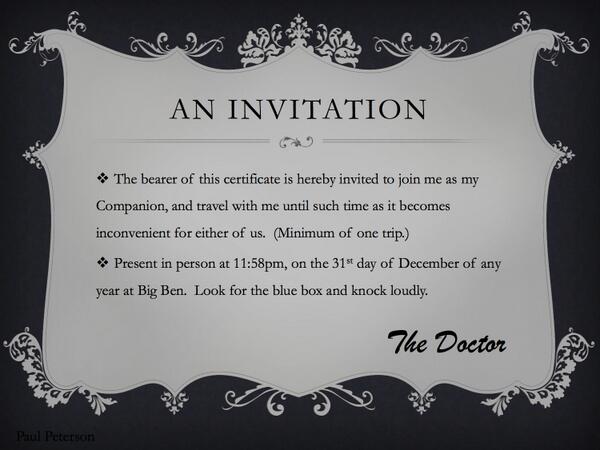
It’s easy to imagine a trip with The Doctor would be a highly sought-after prize.

What’s more heartwarming than retroactively sharing a friendship since first grade? (And possibly an iron-clad alibi, should you need one…)

It’s like one of those grab-the-money booths from an old game show, but with SWEETS!

A formidable steed and a delicious meal all in one. You can’t lose!

And the wily Matt Forbeck offered up the ideal machine for generating presents for next year’s White Heffalump exchange.

From “time to play with toys” and a dapper platypus to a 29-word crossword and a wish-granting pocket pet, the gifts were hilarious, innovative, and absolutely ridiculous, and the gameplay back and forth as people traded and stole gifts was just as entertaining.

[For more details on the exchange, check out Matt Forbeck’s write-up here.]

So, if you’re still struggling with gift ideas, you can always go the White Heffalump route. It’s creative, low-budget, and loads of fun. Enjoy!

Thanks for visiting the PuzzleNation blog today! You can like us on Facebookfollow us on Twitter, cruise our boards on Pinterest, check out our Tumblr, download our Classic Word Search iBook (recently featured by Apple in the Made for iBooks category!), play our games at PuzzleNation.com, or contact us here at the blog!

5 Questions with Puzzle Master Will Shortz

Welcome to another edition of PuzzleNation Blog’s interview feature, 5 Questions!

We’re reaching out to puzzle constructors, video game writers and designers, writers, filmmakers, and puzzle enthusiasts from all walks of life, talking to people who make puzzles and people who enjoy them in the hopes of exploring the puzzle community as a whole.

And I’m overjoyed to have Will Shortz as our latest 5 Questions interviewee!

Without a doubt the most famous name in crosswords today, Will Shortz is the crossword editor for the New York Times, a position he’s held since 1993 (after putting in time with both GAMES Magazine and our friends at Penny/Dell Puzzles). In his time as editor, he’s been credited with spearheading a sharp decrease in crosswordese in Times puzzles, as well as offering a greater level of visibility and acknowledgment for individual constructors.

He continues to serve as the amiable face of crosswords across all forms of media — on the radio with NPR, on television in The Simpsons and How I Met Your Mother, and in theaters with the documentary Wordplay. (He even provided the Riddler’s puzzle clues that so bamboozled the Dark Knight in the film Batman Forever.)

But solvers interested in puzzles beyond crosswords will also have a treat in store for them in 2014! The folks at Penny Press have teamed up with Will to create Will Shortz’s WordPlay, a magazine featuring crafty variety puzzles and crossword variants created by some of today’s top constructors.

Will was gracious enough to take some time out to talk to us, so without further ado, let’s get to the interview!

5 Questions for Will Shortz

1.) As the world’s first (and only) degree-holding enigmatologist, was becoming the editor of the New York Times crossword always a goal you had in mind, or did you foresee yourself doing something else with your singular degree?

Since childhood I’d always planned a career in puzzles, just not as crossword editor for The Times. In fact, I didn’t envision a career with crosswords at all. I imagined myself in an attic or a tiny house somewhere making novelty puzzles and sending them out for publication — probably living in poverty, but doing what I wanted. I fell into puzzle editing without a lot of planning.

But I do have a law degree from the University of Virginia (J.D., 1977), so if puzzles ever end up not working out for me, I always have that to fall back on!

2.) The hundredth anniversary of the crossword is fast approaching. Given your familiarity with puzzles both past and present, what does the hundredth anniversary mean to you? And where do you think puzzles will be a hundred years from now?

I’m not good at predicting the future. But I will say that crosswords are the best and most flexible form of puzzle ever devised, because they involve language (which we all use) and connect with virtually everything in life. They can be made easy or hard, small or large, tricky or straightforward, topical or of general interest. There’s a crossword for everyone and every mood.

Also, there’s something very appealing about filling empty squares. As humans, I think we like to fill empty spaces, and doing that in a crossword seems to satisfy some elemental human need. Even if print media die someday, I think crosswords will probably exist forever in one form or another.

[Here, Will and constructor Merl Reagle appear with the Simpsons in a
promotional pic for the episode “Homer and Lisa Exchange Cross Words.”]

3.) I could ask you how far in advance you choose puzzles for publication (considering the Times’ famous incremental rise in difficulty throughout the week), or inquire about your work as NPR’s resident puzzle master, but to be honest, I’m more curious about what you do when you’re NOT doing puzzles. What other activities or hobbies do you enjoy?

As friends know, I’m almost as fanatical about table tennis as I am about puzzles (emphasis on *almost*). I own my own club — the Westchester Table Tennis Center, just north of New York City. It’s one of the largest table tennis facilities in North America, and I believe it’s the nicest (which I say having played in almost 200 clubs in 43 states and two Canadian provinces).

At the moment I’m close to finishing a personal goal — to play table tennis every day this year. As I write this (on Dec. 17), I’ve played every single day since Jan. 1 — 351 days in all. And I’m filming myself every day as proof. At the end of the year, if I succeed, some friends of mine in Hollywood have promised to edit a 3- or 4-minute video of me playing every day, which I’ll throw up on YouTube.

My ultimate goal is to become national table tennis champion for my age.

4.) What’s next for Will Shortz?

No plans for anything else. I love what I’m doing. I’ve been the crossword editor of The Times now for 20 years, overseer of the U.S. team for the World Puzzle Championship for 22 years, puzzlemaster for NPR’s “Weekend Edition” for almost 27 years, director of the American Crossword Puzzle Tournament for 36 years, and program director for the annual convention of the National Puzzlers’ League for 38 years. That’s plenty to keep me occupied.

5.) If you could give the readers, writers, and puzzle fans in the audience one piece of advice, what would it be?

I have two goals in life: One, to make the world a little better for being here. And Two, to enjoy myself. I think that’s a good philosophy for anyone.

Many thanks to Will for his time. You can follow him on Twitter (@Will_Shortz) and listen to his NPR appearances on Weekend Edition here! And keep your eyes peeled for the first issue of Will Shortz’s WordPlay, which will be hitting newsstands in February!

Oh, and I suppose you could always check out the New York Times Crossword, if you’re so inclined. =)

Thanks for visiting the PuzzleNation blog today! You can like us on Facebookfollow us on Twitter, cruise our boards on Pinterest, check out our Tumblr, download our Classic Word Search iBook (recently featured by Apple in the Made for iBooks category!), play our games at PuzzleNation.com, or contact us here at the blog!