The art (and science) of optical illusions

Visual trickery plays an important role in puzzles. It can be the clever rebus that challenges you to find the words each image represents, or a visual brain teaser that forces you to think outside the box.

But nowhere in the realm of puzzles is visual trickery more obvious or more disconcerting than in optical illusions. Some are simple, like the famous old woman/young woman image above (or this hilarious video version). But others are not only more complex, they’re absolutely mind-bending.

And if we’re talking mind-bending optical illusions, at some point, you have to mention the work of Akiyoshi Kitaoka.

[Akiyoshi Kitaoka’s “A Bulge,” featuring nothing but squares.]

Dr. Kitaoka is a professor of psychology at Ritsumeikan University in Kyoto, Japan, and he has extensively studied biology and psychology. He has quickly emerged as a modern master of optical illusions, utilizing not only shapes and color gradients to trick the eye, but also to simulate motion in a static image!

Two of the techniques frequently cited in his work with illusions are perceptual transparency and visual completion. Both rely heavily on how our brain and eye process the incredible amount of information we perceive every second of every day.

This is probably the most famous example of a visual completion illusion:

Basically, our brain employs mental shortcuts in order to simplify the information. For instance, visual completion (also known as filling-in) occurs when information unavailable to the eye is assumed to be there and mentally added by the brain.

Perceptual transparency, on the other hand, involves how we can perceive one surface behind another.

Check out this amazing photo from a published paper on perceptual transparency, entitled Zen Mountains:

[The mountains in the background look transparent,
even appearing to overlap each other in impossible ways.]

Dr. Kitaoka’s illusions utilize visual shortcuts and processes such like these, but his most famous creations involve a perceptual technique known as the Fraser-Wilcox Illusion, which involves using lighter and darker gradients of black and white in order to trick the eye into perceiving motion. Essentially, moving from dark to light gradually creates the illusion of motion.

Kitaoka’s work, however, maximizes this effect by employing contrasting color schemes in order to challenge the eye further.

Feast your eyes upon “Rotating Snakes,” Kitaoka’s most diabolical optical illusion:

[For the full effect, click the image and
scroll down for a full-screen version!]

By employing color as well, the rotation illusion is even more striking. In all honesty, I can’t look at it too long or my stomach starts to feel a little off-kilter!

Similarly, Kitaoka tricks the eye into perceiving waves rolling diagonally over this quilt-like sheet in “Primrose’s Field:”
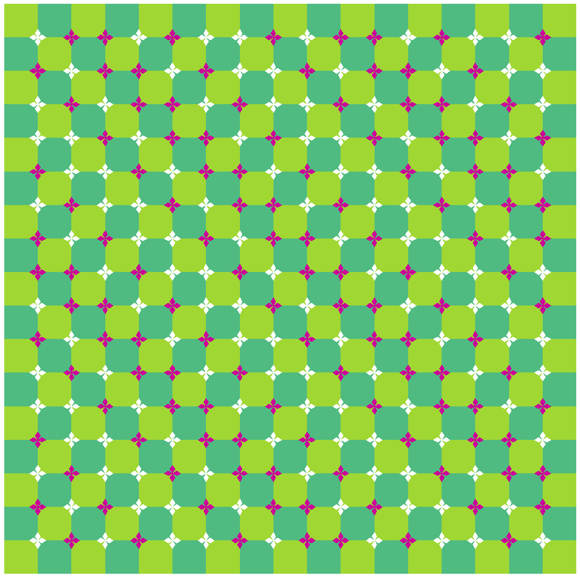
As we understand more about the eye and how it perceives the visual stimuli it receives, as well as more about the brain and how it processes information, I suspect we’ll be able to craft even more convincing, mind-blowing, and unnerving examples of visual sleight of hand.

And undoubtedly, Akiyoshi Kitaoka will be leading the way.


Many thanks to Dr. Kitaoka for granting permission for me to feature three of his illusions in this post. You can check out more of his amazing work on his website, as well as some of his books on Amazon here!

Thanks for visiting PuzzleNation Blog today! You can share your pictures with us on Instagram, friend us on Facebook, check us out on Twitter, Pinterest, and Tumblr, and be sure to check out the growing library of PuzzleNation apps and games!

It’s Follow-Up Friday: Puzzle Book edition!

Welcome to Follow-Up Friday!

By this time, you know the drill. Follow-Up Friday is a chance for us to revisit the subjects of previous posts and bring the PuzzleNation audience up to speed on all things puzzly.

And today, I’m posting the results of our #PennyDellPuzzleBooks hashtag game!

You may be familiar with the board game Schmovie, hashtag games on Twitter, or @midnight’s Hashtag Wars segment on Comedy Central.

For the last few months, we’re been collaborating on puzzle-themed hashtag games with our pals at Penny/Dell Puzzles, and this month’s hook was Penny/Dell Broadway Puzzles!

Examples might be The Lord of the Diamond Rings or The Da Vinci Codeword or Alphabet Soup for the Soul.

So, without further ado, check out what the puzzlers at PuzzleNation and Penny/Dell Puzzles came up with!


Charlotte’s Spider’s Web

Right Angles and Demons

The Grapes of Word Math

The Scarlet Letterboxes / The Scarlet Letter Logic

The Fault in Our Starspell / The Fault in Our Star Words

Harry Potter and the Halftime Prince

Harry Potter and the Sorcerer’s Stepping Stones

Brave New Word Seeks / Brave New Word Games

The Lion, the Witch, and the Word Seek

The Wizard Words of Oz

The “Mystery Person” of Edward Drood

To Kill a Missing Word (List)

The Fountainheads & Tails Word Seek

Around the Block in Eighty Days / Around the Bend in 80 Days

A Tale of Two-Step Cities

The Three of a Kind Musketeers

Oh, the Places, Please You’ll Go!

Peyton’s Places, Please

Anagrams Karenina

Anagram of Green Gables

North & South of Eden

The Swiss Family Robinson Ties

Bowl Game of Thrones

Ender’s Bowl Game

Fahrenheit Two for One / Fahrenheit 451 and Only

Sudoku Road

Cryptograms Wake / Fill-Ins Wake / Figgerits Wake

Kakuro Pioneers!

Little Puzzler on the Prairie

First and Last of the Mohicans

The Picture Sleuth of Dorian Gray / The Picture This of Dorian Gray

Watership Spelldown

Buried Treasure Island

The Countdown of Monte Cristo

Take It from There to Eternity

The Sign of Four Corners / The Big Four Corners

The Doomsday Bookworms

Great Crostictations

A Wrinkle in Time Machine

The Perks of Being a WallFlower Power

Catch-22 for One

The Hotel on the Poet’s Corner of Bitter and Sweet

50 Shades of Grey Shadows

The Joy Luck Crosswords Club

Jurassic Park What’s Left

My What’s Left Foot

Only The Shadow Knows

From Alphabet Soup to Nuts

Match Up Made in Heaven

Beat the Clock-work Orange

A Hive for a Honeycomb

Star Words

The Lost Symbol-lic Logic

Lord of the Rings: The Fellowship of the Ringmaster

The Sylla-rillion

The Hunger Word Games

198-Four Square

The Sum Totals Also Rises

And one overachiever…

The “Lion” (‘Em Up), the “Which” (Way Words), and the “Word”robe by C(ircle) S(ums) Lewis


We also received a terrific one from @_Screenhog, Cross Sums of All Fears!

Have you come up with any Penny/Dell Puzzle Books of your own? Let us know! We’d love to see them!

Thanks for visiting PuzzleNation Blog today! You can share your pictures with us on Instagram, friend us on Facebook, check us out on Twitter, Pinterest, and Tumblr, and be sure to check out the growing library of PuzzleNation apps and games!

It’s Follow-Up Friday: For the Wynne edition!

Welcome to Follow-Up Friday!

By this time, you know the drill. Follow-Up Friday is a chance for us to revisit the subjects of previous posts and bring the PuzzleNation audience up to speed on all things puzzly.

And today, I’d like to return to the subject of Arthur Wynne.

[Image courtesy of express.co.uk.]

In 1913, Arthur Wynne created the first modern crossword puzzle — which he called a Word-Cross puzzle — and over a hundred years later, we are still enjoying the ever-increasing variety of puzzles and clues spawned by that “fun”-filled grid. (Click here for more details on that groundbreaking puzzle.)

Wynne was born on June 22, 1871 in Liverpool, England, but moved to the states in the early 1890s, spending time in Pittsburgh and New York City before creating his Word-Cross puzzle for the New York World. (We can also credit Wynne with the use of symmetrical black squares in crossword grids.)

So, in honor of Mr. Wynne’s 144th birthday, I’ve got a little word creation puzzle for you! How many words of four or more letters can you make from the letters in ARTHUR WYNNE’s name?

I came up with 110! Can you match or top my wordcount? Let me know!

Thanks for visiting PuzzleNation Blog today! You can share your pictures with us on Instagram, friend us on Facebook, check us out on Twitter, Pinterest, and Tumblr, and be sure to check out the growing library of PuzzleNation apps and games!

The Perils of Puzzling: Alternate solutions!

[Thinking hard. Image courtesy of popsci.com]

The science, fantasy, and science fiction website io9 has a marvelous weekly feature run by Robbie Gonzalez, wherein they tackle brain teasers and riddles both new and old. I’ve explored several of them here on PuzzleNation Blog, most notably the 100 Men in Hats puzzle, which expanded on the Men in Hats puzzle concept from one of our earliest posts.

But one of their latest riddles provided a valuable example of how crucial test-solving and crowd-sourcing can be to a puzzle’s success.

The idea was simple enough: look at the numbers below, and determine what number should take the place of the question mark. The only guideline? The answer was NOT six.

I posted this riddle on our Facebook page on Monday and shared it with fellow editors at the PuzzleNation office, and got all sorts of answers in return.

One solver came up with 5 as the answer, positing that the vertical numbers formed fractions. So, with 1/2 and then 3/4 as the next number, the pattern would be adding 1/4. Adding 1/4 to 3/4 equals 1, and 5/5 equals 1.

There were other solutions that also yielded 5 as an answer, like doing what my friend called a zigzag equation, adding 1 from the top to 4 from the bottom to get 5 on the top as the answer, and then reversing it by adding 2 from the bottom to 3 from the top, getting 5 on the bottom as the missing answer.

A second solver came up with 3 as the answer, adding the top row to equal 9, and then trying to do the same with the bottom row.

Another solver saw them as two separate patterns, where going from 1 to 3 involved adding 2 and going from 2 to 4 involved multiplying by two. Therefore, by this method, the answer is 8. (Yet another solver did the same, except they squared the numbers along the bottom row, leading to 16 as the answer.)

As you can see, there were all sorts of mathematical solutions. When you’re told to ignore the most obvious solution, your mind can create some truly innovative ways of reimagining the information available.

[A head full of numbers. Image courtesy of equip.org]

Several solvers thought outside the box and came up with R, relating the numbers by their positions on a gearshift knob instead of mathematically.

As it turns out, this was the solution the puzzle’s creator initially intended, only realizing later that the puzzle had many possible solutions.

In his own words: The riddle was too open-ended. Whether you interpreted it as a mathematical puzzle, or an automotive design puzzle, it was poorly posed, and that’s on me. Puzzle-posing is an art in and of itself, and it’s easy to mess up. For a solution to be satisfying, the person posing the puzzle needs to provide enough information that the puzzle is unambiguously solvable, but not so much that it gives too much away.

[A proposed layout that points more directly toward the creator’s intended solution.]

Now, as a puzzler myself, I can absolutely empathize with Mr. Gonzalez here. There are plenty of times I’ve created a puzzle or a brain teaser and assumed that everyone would follow the same path I envisioned, considering the solution if not obvious, then at least reproduceable.

But solvers can always surprise you by finding alternate routes to the answer or utilizing a different way of thinking that ends with a second, but still valid solution.

So after a few stumbles and missteps of my own in the past that were similar to the one in today’s puzzle, I now make sure to have another set of eyes on my brain teasers, either during the creation process or as a test-solver afterward.

A second set of eyes can be absolutely invaluable in helping you spot possible alternate solutions.

Thanks for visiting PuzzleNation Blog today! You can share your pictures with us on Instagram, friend us on Facebook, check us out on Twitter, Pinterest, and Tumblr, and be sure to check out the growing library of PuzzleNation apps and games!

It’s Follow-Up Friday: Broadway Puzzles edition!

Welcome to Follow-Up Friday!

By this time, you know the drill. Follow-Up Friday is a chance for us to revisit the subjects of previous posts and bring the PuzzleNation audience up to speed on all things puzzly.

And today, I’m posting the results of our #PennyDellBroadwayPuzzles hashtag game!

[Sir Ian McKellen, exhausted from coming up with puns all night.]

You may be familiar with the board game Schmovie, hashtag games on Twitter, or @midnight’s Hashtag Wars segment on Comedy Central.

For the last few months, we’re been collaborating on puzzle-themed hashtag games with our pals at Penny/Dell Puzzles, and this month’s hook was Penny/Dell Broadway Puzzles!

Examples of shows might be “Oooooooooooooklahoma Runs!” and examples of songs might be “(I Am) Sixteen Going on Seven-Ups” or “Give and Take My Regards to Broadway.”

So, without further ado, check out what the puzzlers at PuzzleNation and Penny/Dell Puzzles came up with!


Shows!

Figgerits on the Roof / Fiddler’s Frame on the Roof (featuring the smash song Matchmaker)

Keep On Movin’ Out

Les MiséraBubbles

The Bookworms of Mormon / The Book of Bricks and Mortar

La Cage aux Fill-Ins

Lucky Starlight Express

Jesus Christ Superstarspell / Jesus Christ Superscore

The Mystery Word of Edwin Drood / The Mystery Person of Edwin Drood

A Chorus Line ‘em Up / Draw the Chorus Line / End of the Chorus Line / A Crostic Line

A Funny Thing Happened on the Way to the Foursomes / Four(-um) Corners / Four Square

How to Succeed in Boxes Without Really Trying

A Little Puzzler Night Music

The Fan Words of the Opera / The Shadow of the Opera

Sunrays Boulevard

Oh! (Quote) Cal-cu(la)ta!

Hair-A-Letter

The Best Little Scoreboard in Texas / The Best Little “Score”house in T(ripl)ex-as

Annie-gram

Annie-gram Get Your Gun

Fill-Into the Woods / Drop-In to the Woods

Avenue (Q)uotagrams

Kiss Me, Kate-gories

The Curious Incident of the Dog in the Timed Framework

Godspell(down) / Godspellbound / God Spell it out

Can-Can Cancellations

Les Miz(sing Vowels)

The WIZard Words

Wizard Words of Oz, featuring the song “Follow the Yellow Brick By Brick Road”

Bowl Mame

The Pajama Bowl Game

Cactus Flower Power

The 25th Annual Putnam County Starspelling Bee

Odds and Evens Couple by Neil Simon Says

The Merry Window Boxes

A Balancing Act of God

Kiss of the Spider’s Web

Drummerman of La Mancha


Songs!

“Ya Got Double Trouble” (The Music Man)

“Sit Down, You’re Rockin’ the Quick Quote” (Guys and Dolls)

“There’s a Places, Please for Us” (West Side Story)

“The Circle Sums of Life” (The Lion King)

“Dance: Ten, Looks: Three from Nine” / “Dance a Perfect Ten, Looks Three of a Kind” (A Chorus Line)

“I Don’t Need Anything But You Know the Odds” (Annie)

“Scoremaster of the House” (Les Miserables)

“Getting to Know You Know the Odds” (The King & I)

“Mamma Mia needs some Alphabet Soup!!” (Mamma Mia)

“Surrey with the Fringe On Top to Bottom” (Oklahoma!)

“Ease on Down the Crossroads” (The Wiz)

“Cell Blockbuilders Tango” (Chicago)

“I Don’t Know How To Solve This” (and I’ve solved so many puzzles before…) (Jesus Christ Superstar)

“No Places, Please Like London” (Sweeney Todd)

“No Good Deal” (Wicked)

“Grease Is the Codeword” (Grease)

“A Whole New Word Trails” (Aladdin)

“I’m Still Here & There” (Follies)


Some of our Twitter followers also got in on the fun, with @MicMcCracken tweeting “Les Misery Loves Company!”

And, naturally, it wouldn’t be a PuzzleNation game unless someone went above and beyond the call of duty. This time around, fellow PuzzleNationer Debra created a puzzly version of the opening stanza of “My Favorite Things”!

Crosswords and Word Seeks and Sudoku
Fill-Ins and Ken-Kens and Logic Problems too
Codewords and Crostics and Diamond Rings
These are a few of my favorite things!


All in all, the game was great fun!

Have you come up with any Penny/Dell Broadway Puzzles of your own? Let us know! We’d love to see them!

Thanks for visiting PuzzleNation Blog today! You can share your pictures with us on Instagram, friend us on Facebook, check us out on Twitter, Pinterest, and Tumblr, and be sure to check out the growing library of PuzzleNation apps and games!

Letter rip! It’s lipogram time!

[Building words and phrases, one letter at a time.]

This week I did something a little different in the preview for today’s blog. Usually on Mondays, I post a brief preview of the week’s blog posts, Facebook and Twitter content, et cetera.

But instead of a short teaser about the entry, I posted the following clue:

How quickly can you find out what is unusual about this paragraph? It looks so ordinary that you would think that nothing was wrong with it at all and, in fact, nothing is. But it is unusual. Why? If you study it and think about it you may find out, but I am not going to assist you in any way. You must do it without coaching. No doubt, if you work at it for long, it will dawn on you. Who knows? Go to work and try your skill. Par is about half an hour.

Did you figure out what’s curious about it? It’s missing the letter E!

[A keyboard displaying the most commonly used letters in the language in delightful bar-graph form. It should come as no surprise which letter appears most frequently.]

That paragraph is a terrific example of a lipogram, a written work that purposely avoids or leaves out a given letter. Lipograms are part writing challenge and part puzzle, taxing your vocabulary and your creativity.

(Removing any letter can make things tougher. I remember when my friend’s L key on his keyboard stopped working. “I think it will do well” became “I think it wi do we” until he started using the 1 key as a substitute L.)

And if you think writing a paragraph without the letter E is tough, imagine writing an entire novel without it. Ernest Vincent Wright did just that in 1939 with his 50,000 word novel Gadsby. He even went so far as to rephrase famous lines by William Congreve and John Keats in order to keep the letter E away.

Gadsby partially inspired a French author named Georges Perec to do the same, and his novel La Disparition (also known as A Void) doesn’t feature a single E over the course of three hundred pages.

There are numerous other lipogrammatic works and puzzles, but I think my favorite is the novel Ella Minnow Pea by author Mark Dunn.

Not only is the novel told through letters or notes shared by several characters, but the narrative grows increasingly lipogrammatic as the story progresses.

Check out this summary from Wikipedia:

The novel is set on the fictitious island of Nollop, off the coast of South Carolina, which is home to Nevin Nollop, the supposed creator of the well-known pangram “The quick brown fox jumps over the lazy dog.” This sentence is preserved on a memorial statue to its creator on the island and is taken very seriously by the government of the island.

Throughout the book, tiles containing the letters fall from the inscription beneath the statue, and as each one does, the island’s government bans the contained letter’s use from written or spoken communication. A penalty system is enforced for using the forbidden characters, with public censure for a first offense, lashing or stocks (violator’s choice) upon a second offense and banishment from the island nation upon the third.

So as the book progresses, fewer and fewer letters are used! It’s both an impressive linguistic feat and a wonderful work of totalitarian satire. (And how can you not love a character’s name sounding like LMNOP?)

[In a Christmas episode of the ’90s cartoon Animaniacs, Wakko keeps spelling Santa “Santla,” inspiring a rousing, punny version of “Noel” to correct Wakko’s spelling.]

Our friends at Penny/Dell Puzzles have a lipogram puzzle: Dittos. In Dittos, you’re given a series of letters, and then told to spell five common words using those letters AND a given letter. You can repeat the given letter as many times as necessary.

For example, if you were given the letters AAENRY and then told to make 2 five-letter words, using D as many times as necessary, you might come up with DREAD and DANDY.

But what about the flip side? What if you decided you were only going to use one vowel? Well then, my ambitious friend, you’ve accepted the challenge of creating a univocalic.

I’m not familiar with any longer works that are univocalic. You usually see them in paragraph form or, occasionally, palindrome form. “A man, a plan, a canal… Panama!” is probably the most famous univocalic in history.

(Univocalics are not to be confused with supervocalics, which are words that include all five vowels, like sequoia or abstemious.)

I hope you’ve enjoyed this look at a curious subset of puzzles and wordplay. One of my fellow puzzlers suggested I pursue lipograms as a follow-up to my post a little while back about single-letter puzzles, and I couldn’t resist.

Have you ever tried to write a lipogram or univocalic, PuzzleNationers? Let me know! I’d love to see them!

Thanks for visiting PuzzleNation Blog today! You can share your pictures with us on Instagram, friend us on Facebook, check us out on Twitter, Pinterest, and Tumblr, and be sure to check out the growing library of PuzzleNation apps and games!