It’s Follow-Up Friday: Sharknado puzzle edition!

Welcome to Follow-Up Friday!

By this time, you know the drill. Follow-Up Friday is a chance for us to revisit the subjects of previous posts and bring the PuzzleNation audience up to speed on all things puzzly.

And today, we’re returning to the subject of holidays.

I like to talk about puzzly holidays, but this week has marked more of a cinematic holiday.

Yes, for the third summer in a row, a Sharknado movie has rampaged across our screens, bringing ridiculous action and inexplicable acts of shark-fighting heroism to millions of viewers.

And I thought to myself, what better way is there to mark the occasion than to create a Sharknado-themed deduction puzzle?

So that’s exactly what I did! Enjoy!

Sharknados are terrorizing cities across America! Every day, one of our heroes (April, Claudia, Fin, Gilbert, or Nova) has bravely ventured into a sharknado-afflicted city, armed with a weapon (baseball bat, chainsaw, grenade, laser, or rifle.)

No two heroes were in the same city on the same day, and no hero used any weapon more than once. No weapon was used more than once in the same day, nor was any weapon used more than once in the same city. Can you complete the schedule chart below?

Thanks for visiting PuzzleNation Blog today! You can share your pictures with us on Instagram, friend us on Facebook, check us out on TwitterPinterest, and Tumblr, and be sure to check out the growing library of PuzzleNation apps and games!

It takes two to puzzle…

I’m always on the lookout for new and different puzzle styles to discuss here, because there’s a seemingly endless supply of puzzly inventiveness in the world, and I endeavor to share as much of it as possible with my fellow PuzzleNationers.

A few days ago, I was reminded of a brain teaser variation that’s a little different from our usual fare, and I thought I’d put it in the spotlight.

Today, we’re talking about guided lateral thinking puzzles!

Let me start you off with a standard lateral thinking puzzle (which is a fancy way of saying “brain teaser”). This one is an all-time favorite of mine:

A man is found murdered on the floor with 53 bicycles scattered around the room. How did he die?

Now, this may sound like a particularly violent end at a local bike shop, but the lateral thinkers and brain teaser proficient types out there have probably already sussed out the true answer.

The man cheated at cards and was killed for it. Bicycle is a famous brand of playing cards, and with 52 cards in your standard deck, 53 implies cheating.

That’s a pretty simple one.

The difference between regular brain teasers like that one and guided lateral thinking puzzles is that a guided lateral thinking puzzle requires two people: one to ask questions in the hopes of solving it, and the other to know the solution and answer the other player’s questions with only yes or no responses.

The scenarios are often more involved than your usual brain teaser, but you’re only given a brief story to start with. These are not rigid brain teasers like the seesaw one we tackled earlier this year. These puzzles depend on your ability to narrow down the possibilities with strategically worded questions.

Here’s an example of a guided lateral thinking puzzle:

Ann, Ben, and Chris are siblings who were conceived on the same day. This year, Ann will be attending third grade while Ben and Chris attend kindergarten. Why?

While you could try to come up with a solution with just this information, guided lateral thinking puzzles encourage you to talk through your suspicions as you ask questions and uncover the truth.

So, what would you ask? What’s your starting theory? (My first instinct was to go straight to imagining how Leap Day was involved, before quickly realizing that was a ridiculous supposition.)

But maybe you have a better theory. Were they conceived by different people? Was it the same day, but different years?

Posing these questions to your partner in puzzly crime could help you find the answer.

The folks at I09 posted a link to six guided lateral thinking puzzles (including the Ann/Ben/Chris one I mentioned above). Give it a listen and try cracking these puzzles alongside the podcasters!

And let me know how you did! Did you solve any of them right away? Did any of them thoroughly stump you? And would you like to see more puzzles like this on PuzzleNation Blog in the future?

Thanks for visiting PuzzleNation Blog today! You can share your pictures with us on Instagram, friend us on Facebook, check us out on TwitterPinterest, and Tumblr, and be sure to check out the growing library of PuzzleNation apps and games!

The art (and science) of optical illusions

Visual trickery plays an important role in puzzles. It can be the clever rebus that challenges you to find the words each image represents, or a visual brain teaser that forces you to think outside the box.

But nowhere in the realm of puzzles is visual trickery more obvious or more disconcerting than in optical illusions. Some are simple, like the famous old woman/young woman image above (or this hilarious video version). But others are not only more complex, they’re absolutely mind-bending.

And if we’re talking mind-bending optical illusions, at some point, you have to mention the work of Akiyoshi Kitaoka.

[Akiyoshi Kitaoka’s “A Bulge,” featuring nothing but squares.]

Dr. Kitaoka is a professor of psychology at Ritsumeikan University in Kyoto, Japan, and he has extensively studied biology and psychology. He has quickly emerged as a modern master of optical illusions, utilizing not only shapes and color gradients to trick the eye, but also to simulate motion in a static image!

Two of the techniques frequently cited in his work with illusions are perceptual transparency and visual completion. Both rely heavily on how our brain and eye process the incredible amount of information we perceive every second of every day.

This is probably the most famous example of a visual completion illusion:

Basically, our brain employs mental shortcuts in order to simplify the information. For instance, visual completion (also known as filling-in) occurs when information unavailable to the eye is assumed to be there and mentally added by the brain.

Perceptual transparency, on the other hand, involves how we can perceive one surface behind another.

Check out this amazing photo from a published paper on perceptual transparency, entitled Zen Mountains:

[The mountains in the background look transparent,
even appearing to overlap each other in impossible ways.]

Dr. Kitaoka’s illusions utilize visual shortcuts and processes such like these, but his most famous creations involve a perceptual technique known as the Fraser-Wilcox Illusion, which involves using lighter and darker gradients of black and white in order to trick the eye into perceiving motion. Essentially, moving from dark to light gradually creates the illusion of motion.

Kitaoka’s work, however, maximizes this effect by employing contrasting color schemes in order to challenge the eye further.

Feast your eyes upon “Rotating Snakes,” Kitaoka’s most diabolical optical illusion:

[For the full effect, click the image and
scroll down for a full-screen version!]

By employing color as well, the rotation illusion is even more striking. In all honesty, I can’t look at it too long or my stomach starts to feel a little off-kilter!

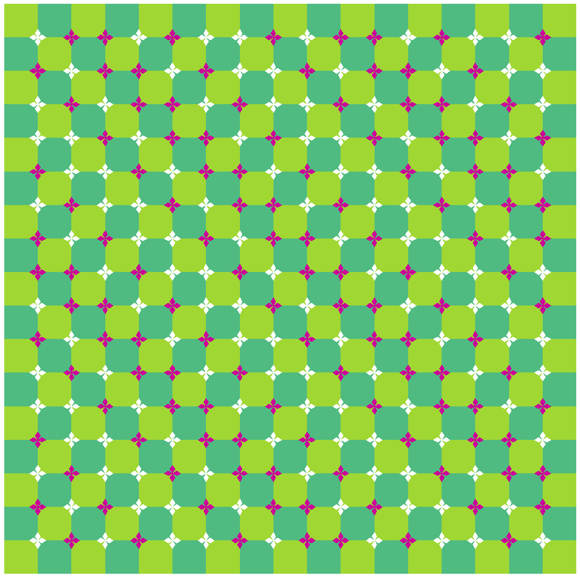
Similarly, Kitaoka tricks the eye into perceiving waves rolling diagonally over this quilt-like sheet in “Primrose’s Field:”

As we understand more about the eye and how it perceives the visual stimuli it receives, as well as more about the brain and how it processes information, I suspect we’ll be able to craft even more convincing, mind-blowing, and unnerving examples of visual sleight of hand.

And undoubtedly, Akiyoshi Kitaoka will be leading the way.


Many thanks to Dr. Kitaoka for granting permission for me to feature three of his illusions in this post. You can check out more of his amazing work on his website, as well as some of his books on Amazon here!

Thanks for visiting PuzzleNation Blog today! You can share your pictures with us on Instagram, friend us on Facebook, check us out on TwitterPinterest, and Tumblr, and be sure to check out the growing library of PuzzleNation apps and games!

It’s Follow-Up Friday: Puzzle Book edition!

Welcome to Follow-Up Friday!

By this time, you know the drill. Follow-Up Friday is a chance for us to revisit the subjects of previous posts and bring the PuzzleNation audience up to speed on all things puzzly.

And today, I’m posting the results of our #PennyDellPuzzleBooks hashtag game!

You may be familiar with the board game Schmovie, hashtag games on Twitter, or @midnight’s Hashtag Wars segment on Comedy Central.

For the last few months, we’re been collaborating on puzzle-themed hashtag games with our pals at Penny/Dell Puzzles, and this month’s hook was Penny/Dell Broadway Puzzles!

Examples might be The Lord of the Diamond Rings or The Da Vinci Codeword or Alphabet Soup for the Soul.

So, without further ado, check out what the puzzlers at PuzzleNation and Penny/Dell Puzzles came up with!


Charlotte’s Spider’s Web

Right Angles and Demons

The Grapes of Word Math

The Scarlet Letterboxes / The Scarlet Letter Logic

The Fault in Our Starspell / The Fault in Our Star Words

Harry Potter and the Halftime Prince

Harry Potter and the Sorcerer’s Stepping Stones

Brave New Word Seeks / Brave New Word Games

The Lion, the Witch, and the Word Seek

The Wizard Words of Oz

The “Mystery Person” of Edward Drood

To Kill a Missing Word (List)

The Fountainheads & Tails Word Seek

Around the Block in Eighty Days / Around the Bend in 80 Days

A Tale of Two-Step Cities

The Three of a Kind Musketeers

Oh, the Places, Please You’ll Go!

Peyton’s Places, Please

Anagrams Karenina

Anagram of Green Gables

North & South of Eden

The Swiss Family Robinson Ties

Bowl Game of Thrones

Ender’s Bowl Game

Fahrenheit Two for One / Fahrenheit 451 and Only

Sudoku Road

Cryptograms Wake / Fill-Ins Wake / Figgerits Wake

Kakuro Pioneers!

Little Puzzler on the Prairie

First and Last of the Mohicans

The Picture Sleuth of Dorian Gray / The Picture This of Dorian Gray

Watership Spelldown

Buried Treasure Island

The Countdown of Monte Cristo

Take It from There to Eternity

The Sign of Four Corners / The Big Four Corners

The Doomsday Bookworms

Great Crostictations

A Wrinkle in Time Machine

The Perks of Being a WallFlower Power

Catch-22 for One

The Hotel on the Poet’s Corner of Bitter and Sweet

50 Shades of Grey Shadows

The Joy Luck Crosswords Club

Jurassic Park What’s Left

My What’s Left Foot

Only The Shadow Knows

From Alphabet Soup to Nuts

Match Up Made in Heaven

Beat the Clock-work Orange

A Hive for a Honeycomb

Star Words

The Lost Symbol-lic Logic

Lord of the Rings: The Fellowship of the Ringmaster

The Sylla-rillion

The Hunger Word Games

198-Four Square

The Sum Totals Also Rises

And one overachiever…

The “Lion” (‘Em Up), the “Which” (Way Words), and the “Word”robe by C(ircle) S(ums) Lewis


We also received a terrific one from @_Screenhog, Cross Sums of All Fears!

Have you come up with any Penny/Dell Puzzle Books of your own? Let us know! We’d love to see them!

Thanks for visiting PuzzleNation Blog today! You can share your pictures with us on Instagram, friend us on Facebook, check us out on TwitterPinterest, and Tumblr, and be sure to check out the growing library of PuzzleNation apps and games!

It’s Follow-Up Friday: For the Wynne edition!

Welcome to Follow-Up Friday!

By this time, you know the drill. Follow-Up Friday is a chance for us to revisit the subjects of previous posts and bring the PuzzleNation audience up to speed on all things puzzly.

And today, I’d like to return to the subject of Arthur Wynne.

[Image courtesy of express.co.uk.]

In 1913, Arthur Wynne created the first modern crossword puzzle — which he called a Word-Cross puzzle — and over a hundred years later, we are still enjoying the ever-increasing variety of puzzles and clues spawned by that “fun”-filled grid. (Click here for more details on that groundbreaking puzzle.)

Wynne was born on June 22, 1871 in Liverpool, England, but moved to the states in the early 1890s, spending time in Pittsburgh and New York City before creating his Word-Cross puzzle for the New York World. (We can also credit Wynne with the use of symmetrical black squares in crossword grids.)

So, in honor of Mr. Wynne’s 144th birthday, I’ve got a little word creation puzzle for you! How many words of four or more letters can you make from the letters in ARTHUR WYNNE’s name?

I came up with 110! Can you match or top my wordcount? Let me know!

Thanks for visiting PuzzleNation Blog today! You can share your pictures with us on Instagram, friend us on Facebook, check us out on TwitterPinterest, and Tumblr, and be sure to check out the growing library of PuzzleNation apps and games!

The Perils of Puzzling: Alternate solutions!

[Thinking hard. Image courtesy of popsci.com]

The science, fantasy, and science fiction website io9 has a marvelous weekly feature run by Robbie Gonzalez, wherein they tackle brain teasers and riddles both new and old. I’ve explored several of them here on PuzzleNation Blog, most notably the 100 Men in Hats puzzle, which expanded on the Men in Hats puzzle concept from one of our earliest posts.

But one of their latest riddles provided a valuable example of how crucial test-solving and crowd-sourcing can be to a puzzle’s success.

The idea was simple enough: look at the numbers below, and determine what number should take the place of the question mark. The only guideline? The answer was NOT six.

I posted this riddle on our Facebook page on Monday and shared it with fellow editors at the PuzzleNation office, and got all sorts of answers in return.

One solver came up with 5 as the answer, positing that the vertical numbers formed fractions. So, with 1/2 and then 3/4 as the next number, the pattern would be adding 1/4. Adding 1/4 to 3/4 equals 1, and 5/5 equals 1.

There were other solutions that also yielded 5 as an answer, like doing what my friend called a zigzag equation, adding 1 from the top to 4 from the bottom to get 5 on the top as the answer, and then reversing it by adding 2 from the bottom to 3 from the top, getting 5 on the bottom as the missing answer.

A second solver came up with 3 as the answer, adding the top row to equal 9, and then trying to do the same with the bottom row.

Another solver saw them as two separate patterns, where going from 1 to 3 involved adding 2 and going from 2 to 4 involved multiplying by two. Therefore, by this method, the answer is 8. (Yet another solver did the same, except they squared the numbers along the bottom row, leading to 16 as the answer.)

As you can see, there were all sorts of mathematical solutions. When you’re told to ignore the most obvious solution, your mind can create some truly innovative ways of reimagining the information available.

[A head full of numbers. Image courtesy of equip.org]

Several solvers thought outside the box and came up with R, relating the numbers by their positions on a gearshift knob instead of mathematically.

As it turns out, this was the solution the puzzle’s creator initially intended, only realizing later that the puzzle had many possible solutions.

In his own words: The riddle was too open-ended. Whether you interpreted it as a mathematical puzzle, or an automotive design puzzle, it was poorly posed, and that’s on me. Puzzle-posing is an art in and of itself, and it’s easy to mess up. For a solution to be satisfying, the person posing the puzzle needs to provide enough information that the puzzle is unambiguously solvable, but not so much that it gives too much away.

[A proposed layout that points more directly toward the creator’s intended solution.]

Now, as a puzzler myself, I can absolutely empathize with Mr. Gonzalez here. There are plenty of times I’ve created a puzzle or a brain teaser and assumed that everyone would follow the same path I envisioned, considering the solution if not obvious, then at least reproduceable.

But solvers can always surprise you by finding alternate routes to the answer or utilizing a different way of thinking that ends with a second, but still valid solution.

So after a few stumbles and missteps of my own in the past that were similar to the one in today’s puzzle, I now make sure to have another set of eyes on my brain teasers, either during the creation process or as a test-solver afterward.

A second set of eyes can be absolutely invaluable in helping you spot possible alternate solutions.

Thanks for visiting PuzzleNation Blog today! You can share your pictures with us on Instagram, friend us on Facebook, check us out on TwitterPinterest, and Tumblr, and be sure to check out the growing library of PuzzleNation apps and games!