A PuzzleNation First Look: Will Sudoku

Sudoku puzzles haven’t been around all that long, especially when compared to the hundred-plus years of longevity that the crossword puzzle brings to the table. Nonetheless, Sudoku puzzles remain one of the most popular puzzles these days, whether solved with pen and paper or in app form.

I’ve written about some of the many Sudoku variants before, but today’s post is something different. It’s the debut of a brand-new type of Sudoku. That’s right! I have the distinct pleasure of introducing you to Will Sudoku, the creation of topnotch puzzler Bassey Godwin.

This is a standard Will Sudoku grid. (Not to be confused with the Will Shortz’s Sudoku magazine.)

Named in honor of puzzle master and New York Times Crossword editor Will Shortz, Will Sudoku offers a challenge that your average Sudoku puzzle cannot match.

Instead of placing the numbers 1-9 in a 9×9 grid so that each row, column, and 3×3 box features all nine numbers without repeats, Will Sudoku tasks you with filling in the grid in such a way that the numbers 1-8 appear only once in each of the rows and columns as well as the 4×4 boxes.

As you can see, each row and column is split into two tracks, inside and outside. Horizontal lines are indicated by the similar triangular cells in the corresponding boxes in a row. For instance, horizontal line 1 contains 45238761; horizontal line 2 contains 23816457, as shown above.

The vertical lines work the same way, with outside and inside tracks within each column. This tight arrangement means a LOT of information is available to a keen-eyed solver, but there are also more spots to place your numbers.

There are numerous variations included in this puzzle bundle:

  • Will Triangular Box Sudoku: Instead of 4×4 squares, the grid is divided into large triangles that contain all 8 numbers
  • Will Horizontal Bar Sudoku and Will Vertical Bar Sudoku: Instead of the 4×4 squares, the grid is divided into vertical or horizontal bars that contain all 8 numbers
  • Will Variable Boxes Sudoku: A mix of 4×4 squares, vertical and horizontal bars, and triangles appear in a single grid

In addition to these variations, Bassey experiments with the form and offers a few new twists on his established template.

  • Will Sudoku Word Search: Instead of the numbers 1-8, eight letters appear in a grid, and once you’ve finished placing them all, you search the grid Word Seek-style to find an 8-letter word reading out in some direction
  • Will Trigonal Sudoku: A Will Sudoku grid is divided diagonally, leaving you half a grid to solve. Cleverly enough, each of the three sides of the triangle also adhere to standard Will Sudoku rules, with all 8 digits appearing once each.
  • Finally, and most challengingly, there is Will Samurai Sudoku, where you confront five interconnected Will Sudoku grids in one monster puzzle.

This debut collection of Will Sudoku offers 150 puzzles for $10!

As a solver, I was very impressed with how many different solving styles emerged from the Will Sudoku template. And going from nine numbers to eight certainly didn’t decrease the puzzle’s difficulty! (The new inside and outside tracks in each column and row certainly took a little getting used to.)

The puzzles marked “average” will keep you on your toes, and some of the ones marked “tough” will really test your deduction and logic skills. But for the price, you simply can’t go wrong.

Thank you to Bassey Godwin for giving PuzzleNation Blog the exclusive first look at Will Sudoku and allowing us to share this clever new Sudoku variant with our fellow PuzzleNationers and the online puzzle community at large!

But before I go, I want to leave you with one last surprise: a video of Bassey himself solving a Sudoku puzzle blindfolded! It’s mind-blowing stuff, and the perfect sendoff for this post. Take it away, Bassey!


Thanks for visiting PuzzleNation Blog today! Be sure to sign up for our newsletter to stay up-to-date on everything PuzzleNation!

You can also share your pictures with us on Instagram, friend us on Facebook, check us out on TwitterPinterest, and Tumblr, and explore the always-expanding library of PuzzleNation apps and games on our website!

Well, that escalated quickly.

I talk a lot in this blog about the role puzzles have played in history, in our culture, and as touchstones for particular individuals. But it’s far more rare for me to talk about one puzzle in particular that changed someone’s life.

Today, I have the privilege of doing precisely that, because a puzzle crafted by our friends at Penny Dell Puzzles has changed two lives for the better.

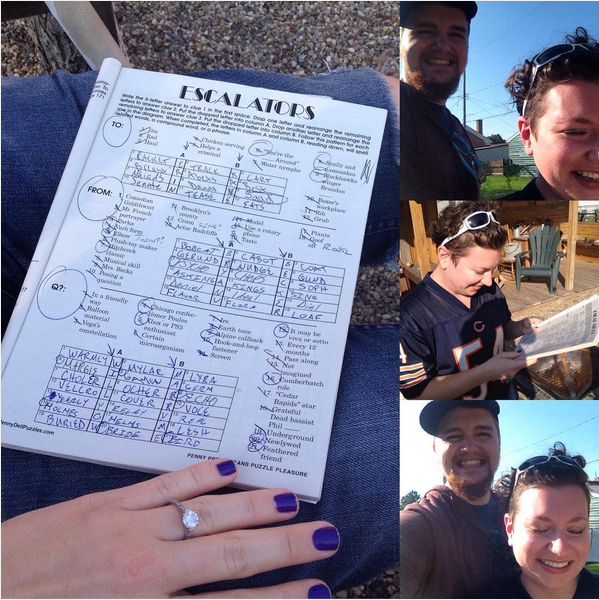
One day, a gentleman named Bryan reached out to Penny Dell Puzzles with an audacious proposition: his girlfriend is a big fan of their puzzles and he wanted their help in crafting a special puzzly proposal of marriage!

He supplied ideas for clues and entry words, and a topnotch editor accepted the challenge of crafting a page of Escalators puzzles specially tailored for the occasion.

(For the uninitiated, an Escalators puzzle involves clued entries where a 6-letter word loses a letter and anagrams into a 5-letter word, then loses another letter and is anagrammed into a 4-letter word. Those lost letters end up spelling out words and phrases reading down when each grid is complete.)

So this singular puzzle featured his girlfriend’s name, then his name, and then the fateful question: will you marry me?

And to really cap off the presentation, the puzzle was inserted into an actual puzzle magazine (in a special limited run at the printers), so that our hero could deftly guide her toward the puzzle with her being none the wiser.

It’s an absolutely awesome idea, a testament to puzzly ingenuity, and honestly, just about the cutest proposal story I’ve ever heard.

I’ll let Bryan take it from here, in an email to his fellow collaborators at Penny Dell Puzzles:

I wanted to let you know that I proposed to Erin today with the puzzle and she said yes! It went perfectly. The puzzle looked great in the book and Erin thought nothing of it, thinking it was just another Escalators puzzle.

Once we got about halfway through the puzzle and she saw my name, it became kind of obvious, and once I knew that she knew, I got down on one knee and popped the question.

She was so surprised and blown away she even forgot to say yes and was just asking how I made it happen! She did eventually say yes after a lot of hugging, kissing, and tears, and then we continued to solve the puzzle before making calls to the rest of our family and friends.

Congratulations to Bryan and Erin! I wish them nothing but the best on their journeys to come.

And kudos to our friends at Penny Dell Puzzles for truly going the extra mile for puzzle fans and romantics alike.


Thanks for visiting PuzzleNation Blog today! Be sure to sign up for our newsletter to stay up-to-date on everything PuzzleNation!

You can also share your pictures with us on Instagram, friend us on Facebook, check us out on TwitterPinterest, and Tumblr, and explore the always-expanding library of PuzzleNation apps and games on our website!
A pickle of a puzzler!

A little touch of absurdity never hurts when it comes to a good logic problem or brain teaser.

There’s the classic river-crossing puzzle (with either a fox, a goose, and a bag of beans and or a wolf, a goat, and a cabbage) that challenges you to get all three across without one eating one of the others, but it never explains why you have a wolf or a fox in the first place!

We never really question why we need to know the weights of castaways or why knowing the color of your hat might save your life; we just accept the parameters and forge onward.

Some brain teasers, curiously enough, seem intentionally nonsensical by design. Many claim that Lewis Carroll’s famous Alice in Wonderland riddle “Why is a raven like a writing-desk?” was created without a solution. Of course, that hasn’t stopped many (myself included) from posing solutions to the riddle anyway.

And that brings us to today’s brain teaser — “Pickled Walnuts” by Hubert Phillips — which I discovered on io9.com:

You are given a series of statements which may seem to you more or less absurd. But, on the assumption that these statements are factually correct, what conclusion (if any) can be drawn?

1. Pickled walnuts are always provided at Professor Piltdown’s parties.
2. No animal that does not prefer Beethoven to Mozart ever takes a taxi in Bond Street
3. All armadillos can speak the Basque dialect.
4. No animal can be registered as a philatelist who does not carry a collapsible umbrella.
5. Any animal that can speak Basque is eligible for the Tintinnabulum Club.
6. Only animals that are registered philatelists are invited to Professor Piltdown’s parties.
7. All animals eligible for the Tintinnabulum Club prefer Mozart to Beethoven.
8. The only animals that enjoy pickled walnuts are those who get them at Professor Piltdown’s.
9. Only animals that take taxis in Bond Street carry collapsible umbrellas.

I will tell you, as a starter, that a conclusion CAN definitively be drawn from these statements. (Honestly, if there wasn’t some solution, I wouldn’t waste your time with it.)

So, what conclusion can be drawn from these statements?

Armadillos do not enjoy pickled walnuts!

How do I know this for sure? Allow me to walk you through my deductive process.

We know that all armadillos speak Basque, according to statement 3. Therefore, according to statement 5, armadillos are eligible for the Tintinnabulum Club.

Now, according to statement 7, armadillos prefer Mozart to Beethoven. But, in statement 2, we’re told that no animal that does not prefer Beethoven to Mozart ever takes a taxi in Bond Street, which means that armadillos do NOT take taxis in Bond Street.

Therefore, according to statement 9, armadillos do not carry collapsible umbrellas, which also disqualifies them from being registered as philatelists, according to statement 4. And since only registered philatelists are invited to Professor Piltdown’s parties (according to statement 6), armadillos are not invited to the Professor’s parties.

Finally, statement 8 tells us that the only animals that enjoy pickled walnuts are those who get them at Professor Piltdown’s, which means armadillos do not enjoy pickled walnuts!

Honestly, I didn’t find this brain teaser particularly difficult because you can find those middle links very quickly, and by linking more and more statements, you eventually find the two ends — armadillos and pickled walnuts — and your conclusion is waiting for you.

This would’ve been a more difficult puzzle if some red-herring statements were thrown in that didn’t connect to the rest, like “All squirrels on Beaumont Avenue have Tuesdays off” or “The birdbaths on Bond Street were designed by a German sculptor who enjoyed hot dogs.”

Nonetheless, this is a terrific exercise in finding order in what at first appears to be chaos. It’s what puzzlers do: we make sense of the universe, one puzzle at a time.


Thanks for visiting PuzzleNation Blog today! Be sure to sign up for our newsletter to stay up-to-date on everything PuzzleNation!

You can also share your pictures with us on Instagram, friend us on Facebook, check us out on TwitterPinterest, and Tumblr, and explore the always-expanding library of PuzzleNation apps and games on our website!

It’s Follow-Up Friday: Rubik’s Magic edition!

Welcome to Follow-Up Friday!

By this time, you know the drill. Follow-Up Friday is a chance for us to revisit the subjects of previous posts and bring the PuzzleNation audience up to speed on all things puzzly.

And today I’d like to return to the subject of puzzle magic!

Oh yes, puzzle magic is most definitely a thing. Arguably the most famous practitioner is friend of the blog and crossword constructor David Kwong, who not only contributes both puzzles and magic to television shows and film projects, but has created some truly mindblowing magic tricks involving puzzles.

The other night, I was watching Penn and Teller: Fool Us, a show where magicians and performers from all around the world present their best tricks, illusions, and bits of magical wizardry to try and stump the famous duo. And lo and behold, another master of puzzle magic appeared!

But where David Kwong works his magic with crosswords, Steven Brundage uses a different puzzly tool: Rubik’s Cubes.

Check out this video where he dazzles Penn and Teller with several quick solves and feats of puzzly manipulation:

That behind-the-back trick was pretty fantastic, wasn’t it? You can check out more of Steven’s magic on his YouTube page! And let me know if you’ve seen any other acts of puzzle magic! I’d love to check them out!


Thanks for visiting PuzzleNation Blog today! Be sure to sign up for our newsletter to stay up-to-date on everything PuzzleNation!

You can also share your pictures with us on Instagram, friend us on Facebook, check us out on TwitterPinterest, and Tumblr, and explore the always-expanding library of PuzzleNation apps and games on our website!

View a Clue: Common Crossword Words!

Welcome to a brand-new feature on PuzzleNation Blog: the View a Clue game!

I talk about crosswords a lot here, and rightfully so. Crosswords are the most famous pen-and-paper puzzles in the world, and here at PuzzleNation, you can always find terrific, fresh puzzle content for our Penny Dell Crosswords App!

And although I love running our daily Crossword Clue Challenge on Facebook and Twitter, I wanted to try something different today.

I’ve selected ten words that commonly show up in crossword grids — some crosswordese, some not — and I want to see if the PuzzleNation readership can identify them from pictures. It’s a visual puzzle I call View a Clue!

Let’s give it a shot!


#1 (4 letters)

#2 (4 letters)

#3 (4 letters)

#4 (4 letters)

#5 (4 letters)

#6 (4 letters)

#7 (3 letters)

#8 (4 letters)

#9 (4 letters)

#10 (4 letters)


How many did you get? Let me know in the comments below! And if you’d like to see another View a Clue game (maybe about common names in crosswords or crosswordy animals!), tell us below!

Thanks for visiting PuzzleNation Blog today! Be sure to sign up for our newsletter to stay up-to-date on everything PuzzleNation!

You can also share your pictures with us on Instagram, friend us on Facebook, check us out on TwitterPinterest, and Tumblr, and explore the always-expanding library of PuzzleNation apps and games on our website!

It’s Follow-Up Friday: So Long, Yogi edition

Welcome to Follow-Up Friday!

By this time, you know the drill. Follow-Up Friday is a chance for us to revisit the subjects of previous posts and bring the PuzzleNation audience up to speed on all things puzzly.

And today I’d like to return to the subject of wordplay!

There are certain names that are instantly associated with wordplay:

  • William Archibald Spooner and his spoonerisms, like “Is the bean dizzy?” instead of “Is the dean busy?”
  • Sam Weller and his Wellerisms, like “‘Simply remarkable,'” said the teacher when asked his opinion about the new dry-erase board.” (Quite similar to Tom Swifty and his puns.)
  • Sylvia Wright and her mondegreens, like “Excuse me while I kiss this guy” for “Excuse me while I kiss the sky.”

From authors Lewis Carroll and Jasper Fforde to poet Shel Silverstein and YouTuber Hannah Hart, from characters like Officer Dogberry and Mrs. Malaprop to comedians like George Carlin, Steven Wright, Bo Burnham, and Mitch Hedberg, these names are synonymous with puns, wordplay, and the magic of language.

Sadly, this week, we lost someone noted for his unintentional and hilarious wordplay. This week, Yogi Berra passed away.

You’ve most likely heard at least one of his famous lines:

  • Always go to other people’s funerals; otherwise they won’t go to yours.
  • I knew the record would stand until it was broken.
  • Ninety percent of this game is half-mental.
  • We made too many wrong mistakes.

Joe Garagiola captured Yogi’s legacy of memorable quotes perfectly when he said, “Fans have labeled Yogi Berra ‘Mr. Malaprop,’ but I don’t think that’s accurate. He doesn’t use the wrong words. He just puts words together in ways nobody else would ever do.”

And apparently it was a family trait. In The Yogi Book: I Really Didn’t Say Everything I Said!, there’s a page that features Yogi-isms from every member of his family, proving that nobody is immune to delightful word fumbles from time to time.

Yogi, thanks for all the laughs and all the times you made us look at words differently.


Thanks for visiting PuzzleNation Blog today! Be sure to sign up for our newsletter to stay up-to-date on everything PuzzleNation!

You can also share your pictures with us on Instagram, friend us on Facebook, check us out on TwitterPinterest, and Tumblr, and explore the always-expanding library of PuzzleNation apps and games on our website!