Crosswords, Cryptics, Constructors, and… Setters?

One of the privileges of writing two or three posts a week for this blog is that it pushes me to expand my own horizons when it comes to puzzles. I reach out to puzzlers, game designers, and pop culture personalities of all sorts; I try out new games and puzzles; I obsessively scour the Internet for new projects, new products, and new stories that involve puzzles.

Oftentimes, that continuous search takes me beyond the borders of the United States, allowing me to explore what puzzles mean to other countries and cultures. And I am forever intrigued by the differences in crossword puzzles between America and the UK.

The world of cryptic crosswords (or British-style crosswords, as some call them) is a bit different from the world of American crosswords. Instead of constructors, they have compilers or setters, and while constructor bylines and attributions were a long time coming on this side of the Atlantic, setters in the UK have been drawing loyal followings for decades, thanks to their unique and evocative pseudonyms.

While Will Shortz, Merl Reagle, Patrick Blindauer, Brendan Emmett QuigleyPatrick Berry, Trip Payne, Matt Gaffney, and Bernice Gordon represent some of the top puzzlers to grace the pages of the New York Times Crossword, names such as Araucaria, Qaos, Arachne, Crucible, Otterden, Tramp, Morph, Gordius, Shed, Enigmatist, and Paul are their word-twisting counterparts featured in The Guardian and other UK outlets.

In fact, beloved setter Araucaria will soon be the subject of a documentary. For more than 50 years, he challenged and delighted cryptic crossword fans, amassing a loyal following. In January of 2013, he even shared his cancer diagnosis with the audience through a puzzle in The Guardian.

While the Wordplay documentary, as well as interviews on PuzzleNation Blog and other sites, have given solvers some insight into the minds and lives of constructors and setters, it’s wonderful to know that the life of a fellow puzzler will be chronicled in so intimate a format.

Thanks for visiting PuzzleNation Blog today! You can share your pictures with us on Instagram, friend us on Facebook, check us out on TwitterPinterest, and Tumblr, and be sure to check out our library of PuzzleNation apps and games!

A revolution in puzzles?

Crosswords have certainly changed the world. They’re the most popular puzzles in history, challenging the minds of millions every day and kickstarting a pencil-and-paper puzzle revolution in the process. Heck, they’ve even been used in England as part of the recruitment process for code breakers and other puzzly government positions!

But did you know that some constructors have been accused of trying to bring about actual revolutions with crosswords?

Oh yes! The Venezuelan newspaper El Aragueno has been accused on several occasions of hiding encrypted messages within their daily crossword puzzles in order to incite revolt against the government. (And a year ago, another Venezuelan newspaper, Ultimas Noticias, was accused of concealing messages ordering the assassination of a public official!)

While there are no details on what the incendiary message secretly contained within El Aragueno’s puzzle might have said, this isn’t the only time crosswords and constructors have run afoul of the powers that be.

Back in June of 1944, physics teacher and crossword constructor Leonard Dawe was questioned by authorities after several words coinciding with D-Day invasion plans appeared in London’s Daily Telegraph.

The words Omaha (codename for one of Normandy’s beaches), Utah (another Normandy beach codename), Overlord (the name for the plan to land at Normandy on June 6th), mulberry (nickname for a portable harbor built for D-Day), and Neptune (name for the naval portion of the invasion) all appeared in Daily Telegraph crosswords during the month preceding the D-Day landing.

So it was possible (though highly improbable) that Dawe was purposely trying to inform the enemy of Allied plans, and the powers that be acted accordingly. (In the end, no definitive link could be found, and consensus is that Dawe either overheard these words, possibly slipped by soldiers stationed nearby, and slipped them into his grids unwittingly, or this is simply an incredible coincidence.)

Either way, it just goes to show you how influential crosswords have been (and could be!) over the last hundred years.

Thanks for visiting PuzzleNation Blog today! You can share your pictures with us on Instagram, friend us on Facebook, check us out on TwitterPinterest, and Tumblr, and be sure to check out our library of PuzzleNation apps and games!

Clever Cluing & Playing With Expectations

Probably my favorite aspect of a truly great crossword puzzle is topnotch cluing. For me, the perfect field of clues covers a lot of subjects (history, pop culture, etc.), uses engaging wordplay to make me work for my solve, and surprises me a few times with some diabolically clever cluing.

That last one is particularly difficult, because a clever clue needs to work on multiple levels, misleading you in one direction but still allowing you to have that a-ha moment of realization when you finally get it. Clever clues play with a solver’s expectations, trusting us to make snap assumptions that turn out to be wrong.

[Trust me, Google Image searching “a-ha moment” is a delightful way to spend a few minutes. This woman seems WAY too excited, even for a eureka moment.]

For instance, “Second cousin?” is one of my all-time favorite clues. It uses an established phrase to push you in one direction (following what sounds like a standard synonym-style clue), but any crossword solver worth their salt knows that a question mark implies some wordplay is afoot.

Indeed, the common crossword clue construction “____ kin” or “____ cousin” — meaning something like or similar to whatever fills that blank — provides our next hint, pushing our attention back to the word “second.” And once it clicks that we’re not using “second” in terms of counting, but in terms of “increment of time,” the wordplay reveals the real answer: MOMENT.

It’s a great a-ha clue, seemingly simple but immensely clever.

There was a terrific story on FoxSports.com about another case of a solver’s expectations getting the best of him. Detroit Tigers player Max Scherzer was excited to see himself referenced in a USA Today crossword, under the clue “Max Scherzer’s pride.”

The answer was a three-letter word, and the constructor was expecting most solvers to come up with ARM as the answer. But Scherzer had something else in mind, posting on his Twitter account:

Check out 7 down in the USA TODAY… If They did their homework the answer should be DIC for eye color. #luvdablueye

DIC is the standard DMV abbreviation for dichromatic eyes, meaning eyes of two different colors.

Just goes to show you need to keep an open mind and stow your expectations at the door when you tackle crosswords these days.

Thanks for visiting PuzzleNation Blog today! You can share your pictures with us on Instagram, friend us on Facebook, check us out on TwitterPinterest, and Tumblr, and be sure to check out our library of PuzzleNation apps and games!

Let’s get it (kick)started!

The newest tool in the arsenal of big thinkers and big dreamers is crowdfunding, wherein creators take their ideas directly to the people in the hopes that a lot of small donations will add up into capital to make their ideas reality.

Websites like Kickstarter and Indiegogo have literally made dreams come true — heck, LeVar Burton’s Reading Rainbow Kickstarter just raised over a million dollars in ONE DAY — and it’s quickly becoming a key outlet for worthy puzzle projects. Some top-tier constructors are going straight to the fanbase with their puzzles, and with marvelous results. Constructors like Trip Payne, Eric Berlin, and Matt Gaffney have all had success on Kickstarter and Indiegogo with previous campaigns.

In the past, we’ve covered several crowdfunding campaigns, including Rachel Happen’s Baffledazzle puzzles, The Doubleclicks’ board game and pop culture-infused musical endeavors, and a company making board games and card games accessible to the visually challenged.

And I wanted to spread the world about some other puzzly endeavors that might interest the PuzzleNation readership.


The first is Peter Gordon’s Fireball Fortnightly News Crosswords.

Peter Gordon is known across the puzzle community for his Fireball Crosswords, a challenging brand of puzzle for ambitious solvers, as well as an easier weekly news-themed puzzle for The Week magazine. So now, he’s combined the two to create Fireball Fortnightly News Crosswords!

Every two weeks, you’ll receive a crossword by email that includes as many topical news-related items in the grid as possible. So you get your news and your crossword in one fell swoop. Not as difficult as his usual Fireball Crosswords, these puzzles will still let you flex your solving muscles twice a month.

With backer prizes like additional crossword books and the chance to create a puzzle with a master puzzler, Fireball Fortnightly News Crosswords might be right up your alley!

The second Kickstarter campaign features a puzzle app for Android devices.

Blackout is similar to Lights Out, Q*Bert, and other puzzle games where you must make every icon on the screen the same color, which becomes a tougher task to complete as the patterns grow more complicated and each click affects neighboring shapes.

The game will feature multiple levels of difficulty — including one where the icons change shape as well as color — ensuring it’ll keep you thinking and clicking for quite some time to come.

Finally, we have Block Party.

Block Party is a pattern-matching game featuring several shapes, colors, and patterns, and players must find parties — groupings of similar aspects or collections of each different aspect — without touching the blocks. The first player to shout “Party!” then reveals the grouping they’ve spotted, and the game continues.

Block Party combines visual reflexes, pattern-matching skills, memory retention, and spatial reasoning to create an immersive game that appears deceptively simple at the outset.

With backer rewards like a printable version of Block Party and limited-edition versions of the game, this campaign is ready to engage solvers of all ages.

The amazing thing about all of these projects is that the audience, the potential fans, have an enormous role to play not only in sharing their thoughts with game and puzzle creators, but in showing their support for designers and projects they believe in, and doing so in a meaningful way.

Here’s hoping each of these projects finds success.

Thanks for visiting PuzzleNation Blog today! You can share your pictures with us on Instagram, friend us on Facebook, check us out on TwitterPinterest, and Tumblr, and be sure to check out the growing library of PuzzleNation apps and games!

Bigger really is better, sometimes…

giantsudoku

[A massive Sudoku grid, created to promote a Sudoku gameshow in England in 2005.]

There’s just something about puzzles on a grand scale. From the Great Urban Race’s citywide scavenger hunts to the Internet-spanning curiosity that is Cicada 3301, puzzly ambition makes for some truly mindblowing experiences.

But those are puzzles of staggering complexity and scope, not actual physical size. When it comes to sheer dimensions, you have to go building-size.

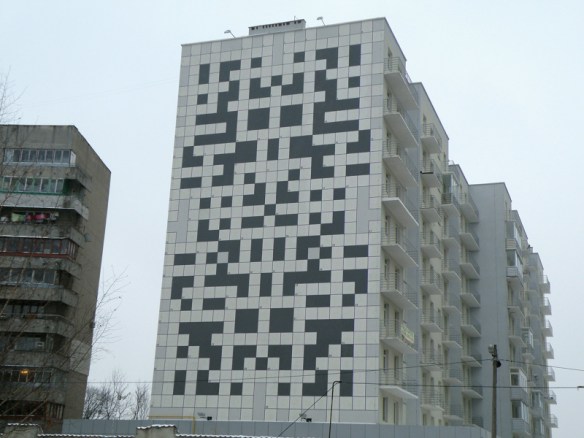
There is, of course, the solvable crossword from Lviv, Ukraine, where the grid takes up the entire side of an apartment building, with clues hidden all over the city. It’s a brilliant tourism move and a terrific challenge (especially if you don’t read Cyrillic).

OLYMPUS DIGITAL CAMERA

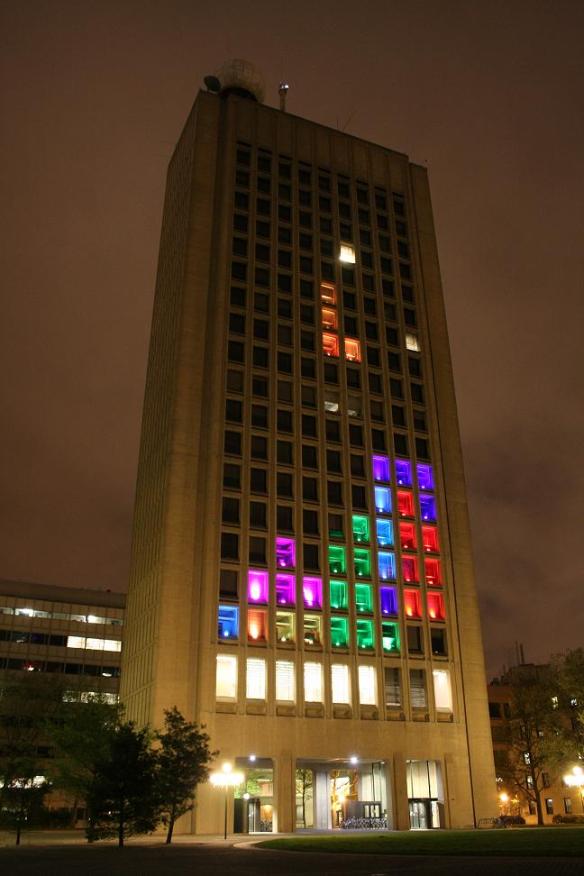
There was also the classic MIT hack from 2012 where ambitious miscreants transformed one side of the Green Building into a multicolored, playable Tetris game. (I recently learned that students from Brown University in Rhode Island accomplished a single-color version of the same feat back in 2000. You can find video of both hacks here.)

tetris1_img6080

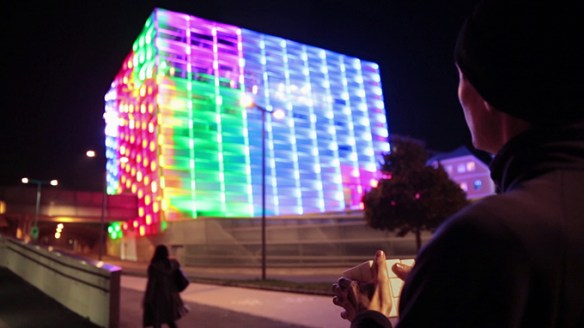
But Javier Lloret has upped the ante with Puzzle Facade, an art installation which transforms the Ars Electronica building in Linz, Austria into a solvable Rubik’s Cube.

Using a small handheld cube as an interface, a solver can manipulate the cube and watch the same changes carried out across two entire sides of the building in full color.

rubikbuilding

As you might expect, having only two sides of the cube available makes for a greater solving challenge, but who cares when you’re lighting up a building with every twist and turn!

It’s a fantastic meeting of puzzly fun and electronic wizardry, and the latest in a grand tradition of massive-scale creativity. I cannot wait to see what intrepid puzzlers come up with next.

Thanks for visiting the PuzzleNation blog today! You can like us on Facebookfollow us on Twitter, cruise our boards on Pinterest, check out our Tumblr, download our Classic Word Search iBook (recently featured by Apple in the Made for iBooks category!), play our games at PuzzleNation.com, or contact us here at the blog!

How to Make a Crossword: Closing Advice

We have featured a wealth of wonderful (and often, hard-won) advice for the aspiring constructor, but once more, I have to give the final word to constructor Doug Peterson:

“Not really a “do-not-do,” but one pitfall for many newbie constructors is trying to do too much too soon. A rookie will come up with a fabulous theme, a 25×25 reverse-double-rebus with sprinkles on top, but the poor guy or gal doesn’t have the construction chops to pull it off. And often the whole concept is inconsistent or otherwise flawed.

“I think it’s important to start with the simple stuff. Make a few 15×15 puzzles with 3 or 4 theme entries each. Get a feel for the basics of themes, grid design, and clue writing before moving on to painting-the-Sistine-Chapel-level stuff. I certainly don’t want to stifle creativity, but for most constructors not named Patrick Berry, there’s a learning curve.”

Good luck, my fellow puzzlers!