This Weekend: Puzzly Tournaments and Film Debuts!

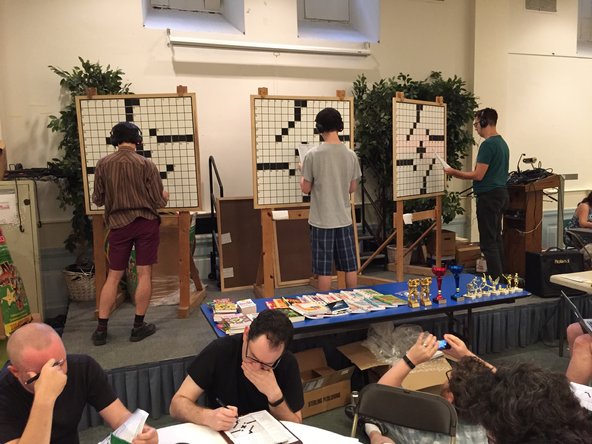
This Sunday, July 29, from noon to 5 PM, puzzlers from all over will gather at The Roxbury Latin School in West Roxbury, Massachusetts for the second annual BosWords Tournament!

With three divisions to choose from — Expert, Amateur, and Pairs — puzzlers of all ages and experience levels will have the opportunity to test their puzzly wits.

The four themed puzzles in regular competition have been constructed by Laura Braunstein, Andrew Kingsley, John Lieb, Joon Pahk, and Brendan Emmett Quigley, and after the scores from those puzzles are tabulated, a championship themeless crossword by David Quarfoot awaits the top three solvers in each division!

BosWords is asking for $20 for adults, $20 for pairs, and $10 for students to attend and compete, which is a real bargain!.

You can check out their Facebook page for full details!

But that’s not all that’s happening in the world of puzzles this weekend!

Yes, the film Puzzle opens today in select theaters!

The film stars Kelly MacDonald (who you might know from Brave, Boardwalk Empire, Gosford Park, or Trainspotting), Irrfan Khan (Life of Pi, Slumdog Millionaire, In Treatment, and Jurassic World), and David Denman (The Office, Angel, 13 Hours, and Logan Lucky).

The plot focuses on Agnes, a suburban mother taken for granted by her husband and family, who discovers a passion for solving jigsaw puzzles. This newfound passion unexpectedly draws her into a new world – where her life unfolds in ways she could never have imagined.

The trailer below hints at the beautiful cinematography and engaging performances of all involved, and I suspect this film will be something special:

Will you be attending the BosWords tournament or hitting the theaters to watch Puzzle, fellow puzzlers and PuzzleNationers? Let us know! We’d love to hear from you!


Thanks for visiting PuzzleNation Blog today! Be sure to sign up for our newsletter to stay up-to-date on everything PuzzleNation!

You can also share your pictures with us on Instagram, friend us on Facebook, check us out on TwitterPinterest, and Tumblr, and explore the always-expanding library of PuzzleNation apps and games on our website!

Puzzles in Pop Culture: Comic Strips

Two weeks ago, we took a puzzly detour into the world of comic strips and explored all the puzzly references we could find in the annals of Garfield publishing history.

In the course of compiling those comics, I stumbled across many others that referenced crosswords and other puzzles. As it turns out, plenty of iconic comic strips have had something to say about puzzles. It makes sense, really, given that crosswords and comic strips are both synonymous with reading the newspaper every day.

So naturally, I couldn’t resist putting some comic strips aside for the PuzzleNation readership to enjoy.


We start off today with this Fred Basset comic strip, wherein a mischievous dog saves the most important part of the paper for his owner.

In this Beetle Bailey strip, we’re not only reminded of the true power behind the General, but of the power of crosswords to eat up your free time.

In the Peanuts comics, many of Snoopy’s best jokes are visual gags, given that most of the other characters can’t understand him. In this case, the joke is on us, as Snoopy and Woodstock crack a curious crossword entry together.

Calvin and Hobbes also had their fun with filling in crosswords, as Calvin takes his usual outside-the-box approach and applies it to our favorite puzzles. (He’d clearly be a whiz at Double Trouble and other crossword variants.)

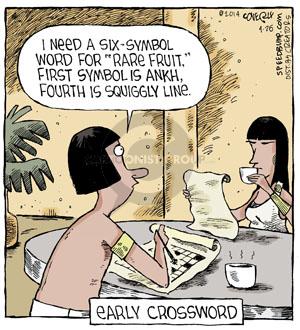
In this strip by artist Dave Coverly, he reimagines crosswords in an earlier era. (And makes me wonder what an all-symbol crossword would be like.)

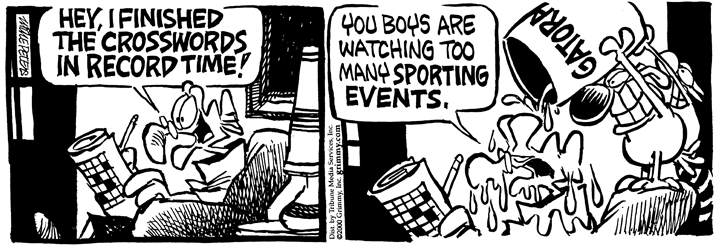
There’s a marvelous sense of accomplishment that comes with solving your first crossword. In this comic from Mother Goose and Grimm, the celebration is a bit more enthusiastic.

Many comic strips have fun with the difficulty of crosswords or the wordplay involved in the cluing. But this one by J. Gravelle presents the trouble you can get into by making assumptions while letters are still missing.

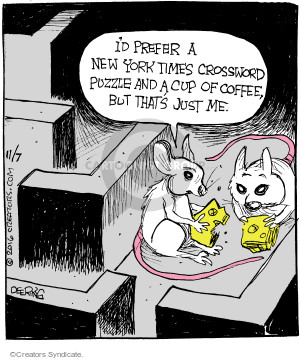
In this comic from John Deering’s Strange Brew, the human condition — and the rat condition — are summed up in one poignant quote.

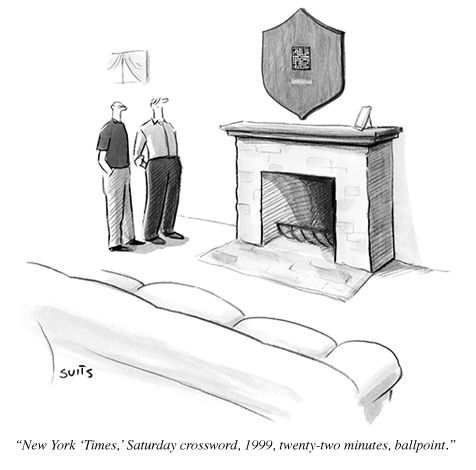
And speaking of The New York Times crossword… we’ve all felt like this at one point or another.

Finally, we get a little meta with this one. But it makes sense, given that the funnies page and the daily crossword are usually in close proximity.

I hope you enjoyed this brief sojourn into comic strip — and puzzle — history. Do you have any comic strips mentioning puzzles that we missed? Let us know! We’d love to hear from you!


Thanks for visiting PuzzleNation Blog today! Be sure to sign up for our newsletter to stay up-to-date on everything PuzzleNation!

You can also share your pictures with us on Instagram, friend us on Facebook, check us out on TwitterPinterest, and Tumblr, and explore the always-expanding library of PuzzleNation apps and games on our website!

5 Questions with Comedian, Animal Activist, and Puzzler Elayne Boosler!

Welcome to 5 Questions, our recurring interview series where we reach out to puzzle constructors, game designers, writers, filmmakers, musicians, artists, and puzzle enthusiasts from all walks of life!

It’s all about exploring the vast and intriguing puzzle community by talking to those who make puzzles and those who enjoy them! (Click here to check out previous editions of 5 Questions!)

And I’m excited to welcome Elayne Boosler as our latest 5 Questions interviewee!

If you haven’t heard of Elayne Boosler from her decades-long stand-up career — including being named one of Comedy Central’s Top 100 Comedians of All Time — you’ve certainly seen her work in radio, television, movies, and print. Elayne is a triple threat — comedian, actress, writer — and the founder of Tails of Joy, a non-profit organization dedicated to rescuing and caring for animals.

She became a quadruple threat last year when she added her first New York Times crossword to her accolades in a collaboration with constructor Patrick Merrell. (Of course, she’s also appeared as an answer in the NYT crossword over 30 times. In her words, “Yes, it’s cool. But one day when I’m really famous, I’m going to be 18 Down, and then 22 Across is going to say, “See 18 Down”.)

Elayne was gracious enough to take some time out to talk to us, so without further ado, let’s get to the interview!


5 Questions for Elayne Boosler

1. How did you first get into puzzles?

I’ve always had a touch of dysgraphia/dyslexia; my cursive writing (as they called it back in the 1800s) was always illegible, and when banks still checked signatures on checks I’d get about five calls a day. “But they are written on the same day, three checks in a row, and the signatures don’t match at all.” I know. I can read and write upside down and backwards. I remember driving in the car with my parents when I was really little, and reading a sign. I said, “Bar. R-A-B. Bar.” I can also sing any song you can throw at me, backwards, which once saved my life when I went to a school to talk to twelve-year-olds. I guess wordplay was the natural next step.
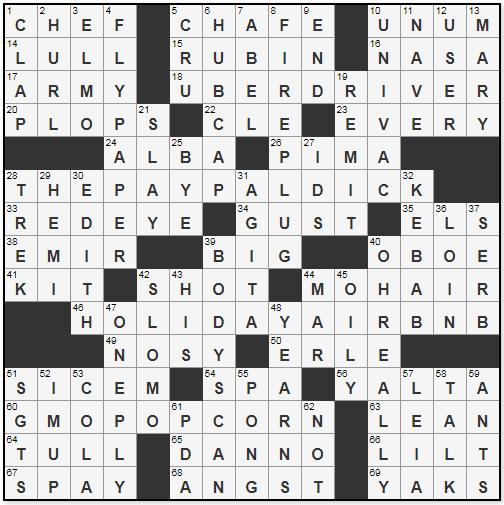
2. Now that you’ve made a New York Times-level crossword of your own, what was the most surprising part of the process for you? What did you enjoy?

I never passed any year of math in my entire life, and basically, making a crossword is math. The gentleman I made the puzzle with, Patrick Merrell, was a saint. If they threw some hyperactive puppy at me who thought she knew how comedy worked and said, “Write comedy together!”, and she emailed useless things to me three times a day, I’d kill her. Patrick was an unbelievably patient, wonderful, and talented teacher.

Though I’ve done crosswords all my life, as a layperson I never got the nuance of just how specific the theme clues have to be. It was mind-boggling. I think I sent Patrick clues and answers for a full month before he finally got to spell “water” in my hand. As an added bonus, Patrick wasn’t just brilliant about the words, he’s a crossword artist. His desire for grid symmetry and beauty was fascinating. I enjoyed all of it. Even the frustration.

Do you ever see yourself collaborating on or constructing another crossword?

I would love to collaborate on another puzzle. As you can imagine, after several months of thinking of nothing but themes, clues, and answers, I could not just turn my “crossword mind” off. So I have a LOT of lists of themes, clues, and answers, and I hope I get another opportunity to use them.

3. Many people know you from your trailblazing stand-up comedy career, or your appearances on shows like Night Court. But these days, you’re more synonymous with your charity work protecting animals. How did you get started with Tails of Joy?

I’ve always loved animals. I always knew I wanted to be a rescuer. Being on the road for forty-six years, I got to meet lots of rescuers in different states, and looked for a way I could have the most impact. What I learned was, three old ladies in Ohio will save more cats and dogs in a year than the entire bloated, overgrown Humane Society of the United States (HSUS) which has $300 million and is NOT a rescue organization! I knew the “little guys” needed someone to keep them from falling through the cracks.
So I founded Tails of Joy twenty years ago, and that’s what we do. We’re a nationwide and beyond, all animal (dogs, cats, birds, reptiles, sea life, wildlife, snakes, bunnies, big cats, primates, elephants, bears, everybody!!) rescue and advocacy group, which provides “Little Guy Grants” to the smallest, neediest rescue groups or individuals all across the country. If you’re reading this and you need help with an animal, contact us! All my money goes there. Every time a dog walks by my husband says, “There goes our beach house.”

4. What’s next for Elayne Boosler?

Thanks for asking. I have a boxed set of four of my specials, plus a new CD — Timeless — coming out on Comedy Dynamics on August 31st. I’m featured in the new season of “CNN’s History of Comedy”, Sunday nights at 10pm, and I’m featured in HBO’s new documentary, “Robin Williams: Come Inside My Mind”. I have a new piece up at CNN.com, “Elayne Boosler: Saying ‘Joke’ is no Excuse for Offensive Behavior.” And I spend hours every day doing rescue.

5. If you could give the readers, writers, and puzzle fans in the audience one piece of advice, what would it be?

I’m sure they already know this. When you look at a puzzle and you can’t fill in even one word, and you walk away, you come back later and sit down and fill it all in in five minutes. What does that tell you? The subconscious is always working, it’s always carrying out your directives, conscious or not.

So it’s very important to always try to speak in the positive, because you are actually giving your brain orders. In comedy, I have never said “I killed” or “I died”. I don’t say that. If you want to remember your keys, don’t say “I hope I don’t forget my keys”, because your mind hears “forget my keys”. You have to say, “I hope I remember my keys”. In essence, the subconscious has no sense of humor, so be careful how you program it.


A huge thank you to Elayne for her time. You can follow her on Twitter (or visit her website, Elayneboosler.com) for updates on her many MANY ongoing projects, and be sure to visit Tails of Joy to explore all of the wonderful work she does for animals.

Thanks for visiting PuzzleNation Blog today! Be sure to sign up for our newsletter to stay up-to-date on everything PuzzleNation!

You can also share your pictures with us on Instagram, friend us on Facebook, check us out on TwitterPinterest, and Tumblr, and explore the always-expanding library of PuzzleNation apps and games on our website!

Crosswords: Scourge of Society!

Study history for any length of time, and patterns will emerge. One of the most curious patterns is how new forms of recreation are embraced, then inevitably sensationalized, stigmatized, and finally vindicated when cooler heads prevail. You see it over and over again in pop culture across the decades.

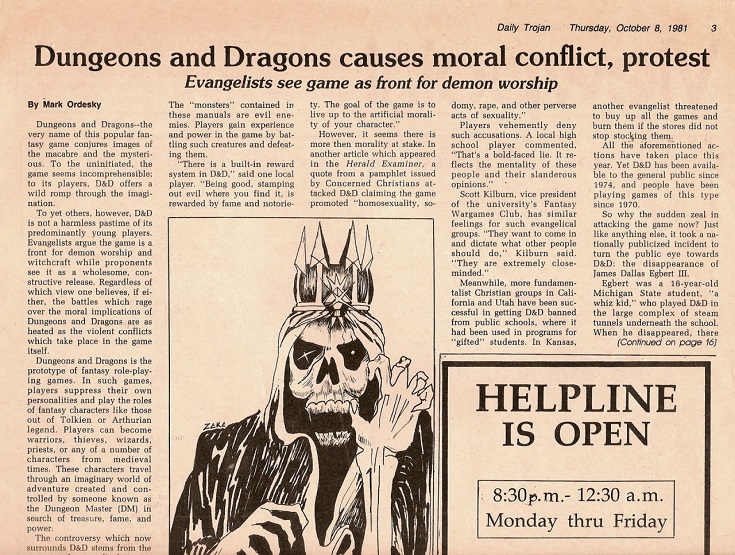
Video games continue to suffer from periodic demonization, accused of instigating violence in children. Harry Potter books are still banned by some schools and communities for spreading occult ideas. Not so long ago, one of my favorite pastimes — Dungeons & Dragons — was maligned as Satanic and damaging to young minds.

All of these panics were (and are) patently ridiculous. After all, you can go back through history and find other examples that are absolutely ludicrous in retrospect.

For example, check out this excerpt from The San Antonio Texan from August 26, 1858, about the dangers of overindulging in reading:

A whole family brought to destitution in England, has had all its misfortunes clearly traced by the authorities to an ungovernable passion for novel reading entertained by the wife and mother. The husband was sober and industrious, but his wife was indolent and addicted to reading everything procurable in the way of romance. This led her to utterly neglect her husband, herself and her eight children.

One daughter in despair, fled the parental home, and threw herself into the haunts of vice. Another was found by the police chained by the legs to prevent her from following her sister’s example. The house exhibited the most offensive appearance of filth and indigence. In the midst of this pollution, privation and poverty, the cause of it sat reading the last ‘sensation work’ of the season, and refused to allow herself to be disturbed in her entertainment.

That is proper nonsense.

And yet, it should come as no surprise to you, fellow puzzler, that crosswords also received this kind of treatment. Yes, crosswords were the focal point of a moral panic.

Arthur Wynne’s “word-cross” first appeared in The New York World in 1913. Simon & Schuster published The Cross-Word Puzzle Book, edited by Margaret Farrar, in 1924. 1924 also marked the first time a UK newspaper, The Sunday Express, would publish crosswords. By that point, crosswords were officially a fad, inspiring fashion trends (black and white patterns), hit songs, and musical revues on Broadway.

Ah, 1924. It was a strange year for crosswords. Because 1924 also saw some of the most inflammatory accusations hurled at the simple pencil-and-paper puzzles.

In November of that year, Canadian Forum referred to the spread of crosswords as an “epidemic obsession.”

The paper went on to psychoanalyze crossword solvers, claiming that crosswords were, at heart, a regressive and childish pursuit:

It is obvious from the similarity of the cross-word puzzle to the child’s letter blocks that it is primarily the unconscious which is expressing itself in the cross-word puzzle obsession.

The same year, The London Times went so far as to call America “enslaved” by the puzzle:

[The crossword] has grown from the pastime of a few ingenious idlers into a national institution: a menace because it is making devastating inroads on the working hours of every rank of society… [people were seen] cudgeling their brains for a four-letter word meaning ‘molten rock’ or a six-letter word meaning ‘idler,’ or what not: in trains and trams, or omnibuses, in subways, in private offices and counting-rooms, in factories and homes, and even — although as yet rarely — with hymnals for camouflage, in church.”

That church reference was particularly notable, as there were church sermons decrying the negative influence of crosswords on society. Sermons! Imagine crosswords being treated like heavy metal in the ’80s. It’s mind-boggling.

Much like that hyperbolic story about a family decimated by reading, newspapers published dubious tales of familial collapse sparked by crosswords:

Theodore Koerner of Brooklyn asked his wife for help in solving a crossword. She begged off, claiming exhaustion. Koerner shot her (superficially) and then shot himself (fatally).

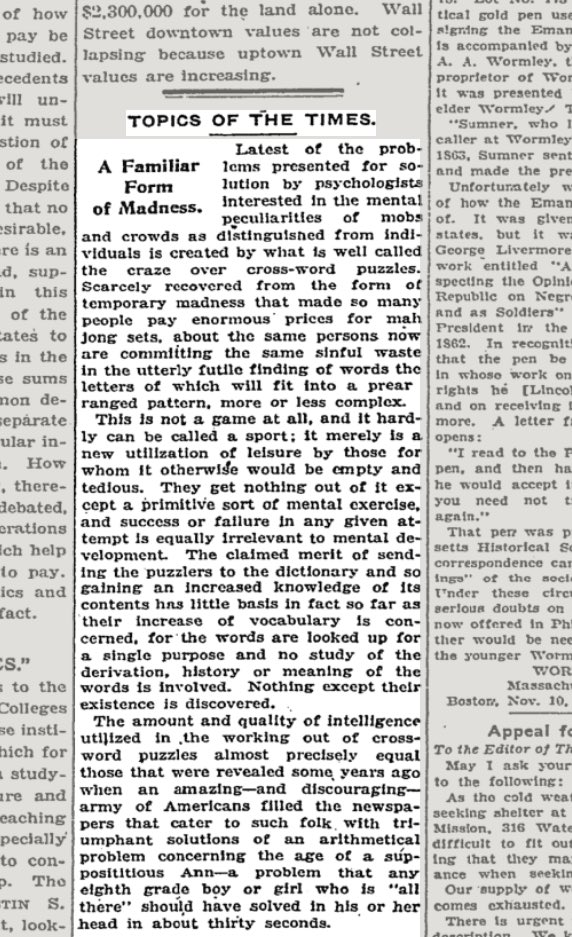
And The New York Times, bastion of puzzles for the last 75 years? Yes, even the Gray Lady had harsh things to say about crosswords:

Scarcely recovered from the form of temporary madness that made so many people pay enormous prices for mahjongg sets, about the same persons now are committing the same sinful waste in the utterly futile finding of words the letters of which will fit into a prearranged pattern, more or less complex.

The paper went on to call crosswords “a primitive form of mental exercise” and compare their value to that of so-called brain teasers that should be solved by schoolchildren in 30 seconds or less.

Crosswords wouldn’t debut in the New York Times until 1942.

But could there have been a hint of truth buried beneath all the sensationalism? Perhaps.

There were reports that overzealous solvers, desperate for an edge over other puzzlers, went so far as to desecrate books at the New York Public Library in order to prevent others from utilizing the same resources. A sign, circa 1937, firmly stated that “the use of library books in connection with contests and puzzles is prohibited.”

Those darn crossword addicts, always getting into trouble. Can’t trust ’em.

So, the next time someone tells you crosswords are boring and passe, you can tell them that crosswords were as cool and as dangerous as rock n’ roll, once upon a time.

Heck, they still are.

[Thanks to The Atlantic, The Senior Times, Historical Nonfiction on Tumblr, The 13th Floor, and CommuniCrossings for images and quotations.]


Thanks for visiting PuzzleNation Blog today! Be sure to sign up for our newsletter to stay up-to-date on everything PuzzleNation!

You can also share your pictures with us on Instagram, friend us on Facebook, check us out on TwitterPinterest, and Tumblr, and explore the always-expanding library of PuzzleNation apps and games on our website!
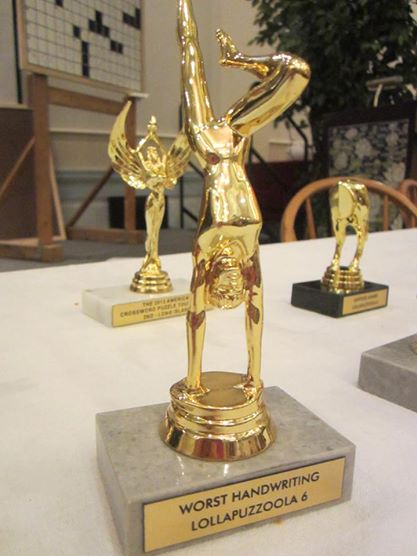
Lollapuzzoola 11 is near!

Saturday, August 18, marks the eleventh annual Lollapuzzoola!

The marvelous indie offspring of the American Crossword Puzzle Tournament, Lollapuzzoola is a favorite of both solvers and top constructors, all of whom descend upon New York City to enjoy what can only be described as “the best tournament held in New York on a Saturday in August.” (At least, that’s what they say on their website.)

The format is simple. Four divisions — Express (experienced solvers who have contended in or won tournaments before), Local (solvers with some experience), Rookies, and Pairs (allowing you to team up to solve) — pit their puzzly minds against clever clues and crafty constructors.

With seven tournament puzzles — designed with inimitable style, both fun and befuddling in how often they innovate classic crossword tropes — you’re guaranteed to get your money’s worth as you solve!

And for those who reach the top of mountain, “winners in each division are awarded prizes, which could range from a box of used pencils to a brand new car. So far, no one has ever won a car.

564470_572843946113519_105115358_n

But if you can’t make it to NYC that weekend, worry not! There’s an At-Home Division that will allow you to participate as if you were there! You’ll get your puzzles by email the day after the actual tournament for a very reasonable $15 fee! Not only that, but you’ll be able to submit your times (and your number of blank/wrong squares) to be officially ranked in the At-Home Division lineup!

It’s one of the highlights of the puzzle world each year, and I’m definitely looking forward to tackling the puzzles! They’re a diabolical treat each and every year! (For a full rundown of the event, check out this interview with Local Division winner and friend of the blog Patti Varol!)

Are you attending Lollapuzzoola or solving from home? Let us know! We’d love to hear from you!


Thanks for visiting PuzzleNation Blog today! Be sure to sign up for our newsletter to stay up-to-date on everything PuzzleNation!

You can also share your pictures with us on Instagram, friend us on Facebook, check us out on TwitterPinterest, and Tumblr, and explore the always-expanding library of PuzzleNation apps and games on our website!

Puzzles in Pop Culture: Garfield

Puzzles are ubiquitous. Once you start looking around for them, you’ll find them in every nook and cranny of popular culture.

Sometimes, they’re the basis for an entire episode of television, as in Brooklyn Nine-Nine or Parks and Rec. Sometimes, they serve as a linchpin metaphor, as they did in Sleepy Hollow. Other times, they’re good for a funny aside, as in Gilmore Girls, or as a prop to reveal deeper character insight, as on The West Wing.

Over the years, I’ve seen puzzles incorporated into storytelling in dozens of ways. So I shouldn’t have been surprised to stumble across puzzle references where I least expected them: the funny pages.

Yes, they’re such a part of the cultural fabric that they’ve even infiltrated comic strips.

The other day, I stumbled across this Garfield comic strip from last year:

Now, it’s meant to be funny, but I think any puzzler who has stood onstage in front of a whiteboard at ACPT, Lollapuzzoola, or another crossword tournament would agree with Jon over Garfield here.

That was one example. As it turns out, when you start digging, you find crossword gags strewn through the Garfield comics.

Like this one from November of 2005:

That’s a pretty simple gag, but it’s also a nice bonding moment for Jon and Garfield, as Jon’s rampant procrastination dovetails nicely with Garfield’s bottomless love for Italian food.

Jon has less luck making a puzzly connection in this comic from February of 1998:

If you ask me, a cookie and a crossword puzzle sounds like an excellent way to spend time with someone interesting. But I’m biased. I love cookies.

And as you can see in this comic from February of 1979, Jon’s crossword struggles have been an ongoing issue for decades now:

But it’s not just crosswords. Sudoku has gotten a fair amount of attention in the Garfield strip over the years. That’s understandable, as it’s one of the most recognizable pencil-and-paper puzzles in the world.

And as someone who isn’t the fastest Sudoku solver in the world, this series of comics from January of 2010 (an entire week’s worth!) speaks to me. I get it, Jon. I get it.

Honestly, it makes sense that Odie would have Sudoku wired. He’s a puzzle dog. He’s been appearing in crossword grids for years.

There’s a lovely callback to that previous crossword gag.

Finally, Jon triumphs! I admire both his resilience and his unwillingness to give up. Though, given that it took a week to complete a Sudoku, maybe Jon should stick to other puzzles.

Heck, our friends at Penny/Dell Puzzles have the perfect book for him to try out.

[All images are courtesy of Garfield.com.]


Thanks for visiting PuzzleNation Blog today! Be sure to sign up for our newsletter to stay up-to-date on everything PuzzleNation!

You can also share your pictures with us on Instagram, friend us on Facebook, check us out on TwitterPinterest, and Tumblr, and explore the always-expanding library of PuzzleNation apps and games on our website!