The Fun Side of Crosswordese

Crossword.

Anyone who solves crosswords is familiar with some aspect of crosswordese, even if they don’t know it by that name. Crosswordese consists of words that appear frequently in puzzles, but not nearly as often in conversation or common use. My favorite variation on that definition is “words that crop up a lot in grids but are otherwise pretty useless.”

Part of becoming a better solver is building a personal lexicon of crosswordese and common crossword words so you’re not getting tripped up by the same obscurities, peculiarities, and cruciverbalist celebrities that so often occupy those black-and-white grids we enjoy.

Some of these words seem destined to remain obscure. ETUI will most likely never become commonplace. Most people don’t fence, and couldn’t tell an EPEE from a foil or a saber.

Oona-Chaplin

[Image courtesy of Celebs.Infoseemedia.com.]

Others are cyclical. OONA was Chaplin’s wife, until her granddaughter of the same name become a featured player in the first few seasons of Game of Thrones. Similarly, both ELSAS Lancaster and the movie feline have Frozen to thank for that name gaining new life in puzzles these days.

(Here’s hoping there’s a crop of Eastern-European actresses that will storm TV and film soon and breathe new life into clues for ONA, UNA, UTA, and OSA.)

But, for the most part, crosswordese evokes negative feelings. It’s easy to come up with a list of the words that irk us — the ones we’ve never encountered in the real world, or the ones that we simply cannot remember, even after filling them into a dozen grids or more.

But today I’d like to focus on the ones I do enjoy, the strange words I’ve learned through crossword solving and construction that have broadened my vocabulary and sent my mind down unexpected tangents and pathways I would’ve never otherwise wandered through.
edsel

[Image courtesy of Driving.ca.]

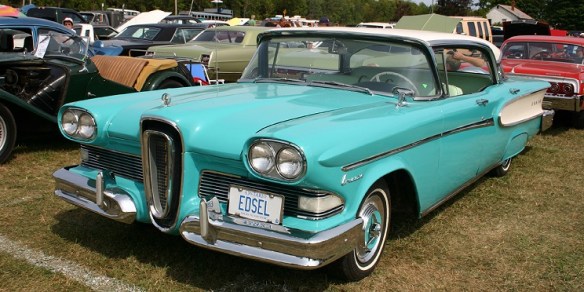
EDSEL

It’s amazing how a convenient letter pattern can keep an infamous failure in the minds of solvers decades and decades later. It was only manufactured for two years, and that was SIXTY years ago. And yet, whenever I see “Ford flop” or something similar as a clue, I always smile. It’s universal at this point.

NE’ER

There’s a lot of poetic license — see what I did there? — taken with poetry terms in crosswords, and most of them are well-and-truly overused. But for some reason, NEER ne’er bothers me. In fact, I enjoy seeing it. It probably has to do with “ne’er-do-well,” which is an incredibly fun term to throw around. It’s right up there with “deipnosophist” and “raconteur” as far as descriptive terms that need to make a comeback.
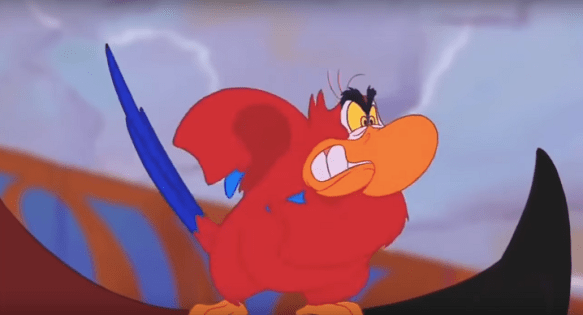
iago

[Image courtesy of Digital Spy.]

IAGO

He was first clued as a master manipulator from the works of Shakespeare, then as a conniving Disney sidekick who slowly turns toward the light over the course of the franchise. In either case, he’s a fascinating character whose handy combination of vowels ensures he’ll be a part of crosswords for years to come.
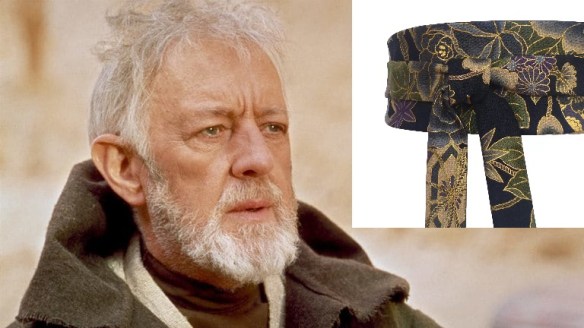
obiwanobi

[Images courtesy of StarWars.com and Polina Couture.]

OBI

As someone who is both a Star Wars fan and deeply interested in Japanese culture, I always enjoy when OBI makes an appearance in a grid. (More for the former reasons than the latter, if I’m being honest.)

In fact, this blog entry inspired me to search XWordInfo to see when OBI started being clued as part of Obi-Wan Kenobi’s name (twice, which is weird yet lyrical) and not just as a Japanese sash.

Although the character debuted in the first Star Wars film in 1977, his name wasn’t used in The New York Times crossword to clue OBI until 1990!

These are just the first common crossword entries that came to mind. There are a few others, not to mention all of the neat animals — mostly bird-related or African in origin — that crop up in crosswords. KEA and ROC, IBEX and ELAND, OKAPI and RATEL, just to name a few.

But now I turn the subject over to you, fellow puzzlers and PuzzleNationers. What are your favorite common crossword words or bits of crosswordese that appear in grids but don’t irk you? Let us know in the comments section below! We’d love to hear from you.


Thanks for visiting PuzzleNation Blog today! Be sure to sign up for our newsletter to stay up-to-date on everything PuzzleNation!

You can also share your pictures with us on Instagram, friend us on Facebook, check us out on TwitterPinterest, and Tumblr, and explore the always-expanding library of PuzzleNation apps and games on our website!
A Handful of Puzzly Resources for Constructors!

Crossword.

The internet has really grown the crossword community by leaps and bounds. Puzzlers can share favorite puzzles, reviews, opinions, and feedback with fellow solvers, constructors, editors, and publishers at the touch of a button. With downloadable puzzles, online solving, and puzzle apps (like Daily POP Crosswords!), access to puzzles has never been easier.

Entire forums dedicated to solving and sharing a love of puzzling are cultivating a new generation of solvers and encouraging ambitious new constructors. Twitter is a great place to start, there’s a growing community on r/crossword, and on Facebook, you’ve got both the American Crossword Puzzle Tournament group and the Crossword Puzzle Collaboration Directory to keep you informed and aware of all things crossword.

That’s to say nothing of the fact that both solvers and constructors have greater access to resources than ever before. There are reviewers breaking down the crosswords printed by the major outlets on a daily basis, and blogs like Wordplay exploring how to construct and what words solvers and constructors should know. With searchable databases like XWordInfo out there as well, you can hunt down clues, entries, themes, and a huge chunk of the history of crosswords with ease.

But sadly, not all resources have made their way online, so building a personal library of key volumes to peruse and refer to can help boost your solving and constructing efforts.

So today, I thought I’d share a few of my personal favorite resources that I use when constructing not only crosswords, but all sorts of other puzzles, in the hopes that you find them useful as well.

Your mileage may vary, but to me, these books have been invaluable.


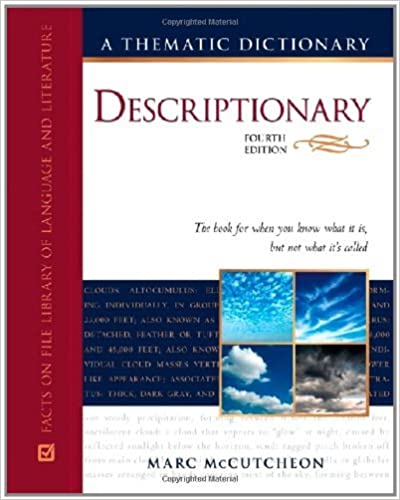
descriptionary

Descriptionary: A Thematic Dictionary (Fourth Edition) by Marc McCutcheon

Word Menu, in either book or online form, has long been the gold standard when it comes to building themed word lists that you can trust to be well-sourced and reliable. But when I need a theme idea, I have much greater luck flipping through the pages of the Descriptionary, a cross-cultural theme listing that covers everything from weather to fashion, medicine to crime.

Searchable by topic in the front and individual words in the index, it’s never difficult to find a list I’ve used before or to zero in on a topic as needed. I ended up buying my own copy after checking out the copy from my local library at least a half-dozen times, and I’ve never regretted it.

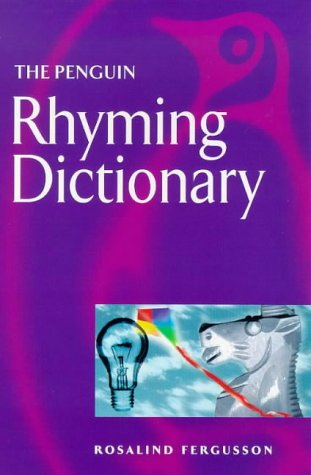
rhyming dictionary

The Penguin Rhyming Dictionary by Rosalind Fergusson

Whether I’m cluing, looking for rhymes to support a playful theme, or playing with pronunciation for a particular bit of wordplay, The Penguin Rhyming Dictionary is my go-to resource. It’s absolutely loaded with vocabulary, organized by individual rhyming syllables and patterns (as well as near-rhymes). Just look up your word to rhyme in the back index, and then go work.

cook's essential

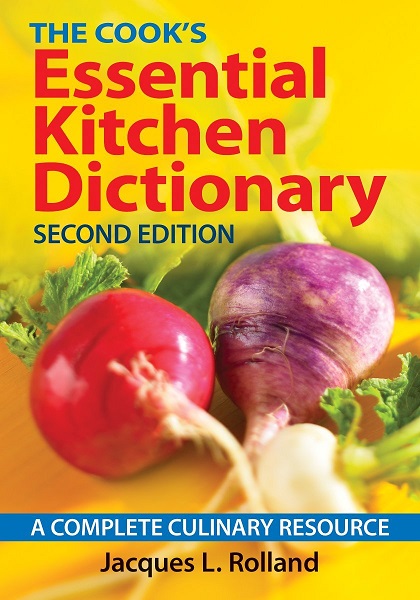
The Cook’s Essential Kitchen Dictionary: A Complete Culinary Resource by Jacques Rolland

This book is a tremendous resource, running the gamut from food and equipment to cooking styles and common vernacular. Not only are these definitions informative, complete with preparation instructions and suggested dishes for given ingredients, but they add little touches of culinary history to the mix, offering context and greater detail.

The book also features subsections listing varieties of apples, cheese, salt, pasta shapes, and other ingredients. Whenever I need food-related clues or theme entries, this is my first stop.

dictionaries

I’m a sucker for weird words and colorful vocabulary, so I thoroughly enjoy constructing any unthemed puzzle that allows me to play with language. And there’s any number of niche dictionaries out there to bolster your puzzle lexicon and spruce up any word list.

Here’s a list of some of my favorites:

  • Mrs. Byrne’s Dictionary of Unusual, Obscure, and Preposterous Words by Josefa Heifetz Byrne
  • Murfles and Wink-a-peeps: Funny Old Words for Kids by Susan Kelz Sperling
  • The Endangered English Dictionary by David Grambs
  • The Word Museum: The Most Remarkable English Words Ever Forgotten by Jeffrey Kacirk
  • Informal English: Puncture Ladies, Egg Harbors, Mississippi Marbles, and Other Curious Words and Phrases of North America by Jeffrey Kacirk
  • The Great Panjandrum (and 2,699 Other Rare, Useful, and Delightful Words and Expressions) by J.N. Hook
  • Stone the Crows: Oxford Dictionary of Modern Slang by John Ayto and John Simpson
  • I Love It When You Talk Retro: Hoochie Coochie, Double Whammy, Drop a Dime, and the Forgotten Origins of American Speech by Ralph Keyes
  • The Meaning of Tingo and Other Extraordinary Words from Around the World by Adam Jacot de Boinod
  • That’s Amore!: The Language of Love for Lovers of Language by Erin McKean
  • Much Ado About English: Up and Down the Bizarre Byways of a Fascinating Language by Richard Watson Todd
  • America in So Many Words: Words That Have Shaped America by David K. Barnhart and Allan A. Metcalf
  • The Highly Selective Dictionary of Golden Adjectives for the Extraordinarily Literate by Eugene Ehrlich
  • Word Catcher: An Odyssey Into the World of Weird and Wonderful Words by Phil Cousineau

(And, although this book isn’t a dictionary, it includes some terrific vocabulary along the way, so it’s worth checking out: Reading the OED: One Man, One Year, 21,730 Pages by Ammon Shea.)


Hopefully these resources can aid you in your puzzling endeavors as they’ve assisted me many times over. Are there any offline resources I’ve missed? Let me know in the comments section below! I’d love to hear from you.

Thanks for visiting PuzzleNation Blog today! Be sure to sign up for our newsletter to stay up-to-date on everything PuzzleNation!

You can also share your pictures with us on Instagram, friend us on Facebook, check us out on TwitterPinterest, and Tumblr, and explore the always-expanding library of PuzzleNation apps and games on our website!
Let’s Play Crossword Bingo!

Crossword.

If you solve enough crosswords, you’re bound to encounter some words more often than others.

Maybe the word has grid-friendly letters or a letter pattern that facilitates editing. Maybe it’s an otherwise obscure item that crosswords have kept in the zeitgeist.

Or maybe it’s a just three-letter word with vowels on either end, be it a female sheep, a tavern drink, a mine find, or fury, and that corner just won’t be completed without one of them.

Some solvers find fault with those words, the constructors who use them, or the outlets that publish puzzles featuring them. Other solvers, however, find fun ways to acknowledge their ubiquity.

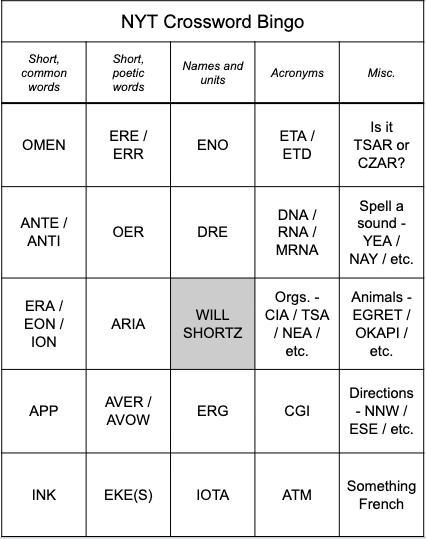
For instance, a reddit user under the handle “atleasttheresmusic” created a bingo card based on words that crop up regularly in The New York Times crossword:

xwd bingo 1

Not only did they hit some classic examples of crosswordese, but they even managed to categorize their entries, highlighting crossword tropes like “short, poetic words” and the frequent use of abbreviations.

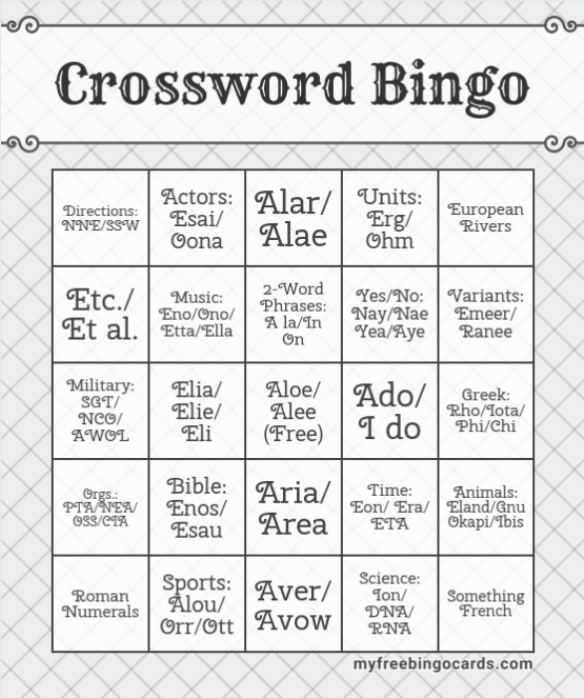
Between the bingo card itself and the many suggestions shared by fellow puzzlers in the comments, I couldn’t resist taking a crack at making a crossword bingo card of my own:

xwd bingo 2

As you can see, I’ve also organized the columns by category; from left to right, there’s abbreviations, names, vowel-heavy words, 3-letter entries, and non-U.S. terminology.

I couldn’t fit every entry I wanted to — EKE/IKE fell by the wayside, as did EWER — but I managed to jam a fair amount of crosswordese and personal pet peeves onto the card. Plus, given how often ALEE and ALOE appear, they’re basically a free space in the center of the card.

So how did I do, fellow puzzlers and PuzzleNationers? What words should I have included? Did the cleaner card created by “atleasttheresmusic” win out over mine, or did we both succeed in having some fun at the expense of crosswords?

And, most importantly, how quickly would you get BINGO if you used one of our cards? Let us know in the comments section below! We’d love to hear from you.


Thanks for visiting PuzzleNation Blog today! Be sure to sign up for our newsletter to stay up-to-date on everything PuzzleNation!

You can also share your pictures with us on Instagram, friend us on Facebook, check us out on TwitterPinterest, and Tumblr, and explore the always-expanding library of PuzzleNation apps and games on our website!
Crimes Against Crosswords!

688262

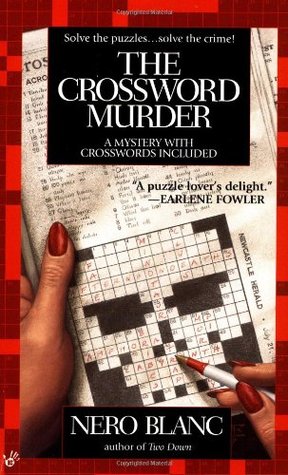
[Image courtesy of Goodreads.]

I know what you’re thinking. “Crimes against crosswords? Isn’t that a bit dramatic?”

Sure it is. You might think it’s over the top to shudder every time someone promises a crossword but publishes a crisscross instead.

But it’s true. There are numerous ways people can transgress against the noble crossword, harming both the body and the spirit of the crossword itself.

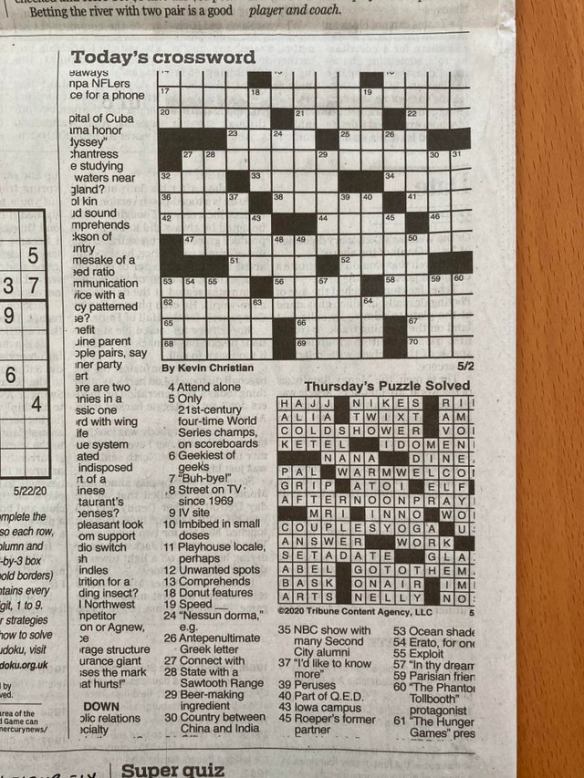
For instance, check out this picture of a crossword from The Los Angeles Times,  republished in a local newspaper, which was shared on reddit:

4i43bit52c051

Look at it! They cropped all four sides of the puzzle in order to fit the available space. Good luck figuring out which across word is clued by “mesake of a ed ratio” or one of the many other mangled clues along the left-hand side of the puzzle.

That is a crime against crosswords.

They’re not always so obvious and clumsy, though.

No, sometimes, a crossword is harmed by crummy fill or an abundance of nonsense abbreviations or numerous Naticks formed by crossing obscure words with other obscure words.

Granted, these are far rarer in the major outlets. (Unless you’re checking out r/crossword or reading Rex Parker’s blog, where they find so-called crossword indignities by the dozens. Good lord.)

But in reality, the vast majority of crossword venues won’t publish puzzles so undermined by careless choices.

evan 5

Yeah, you noticed I didn’t say “all crossword venues.”

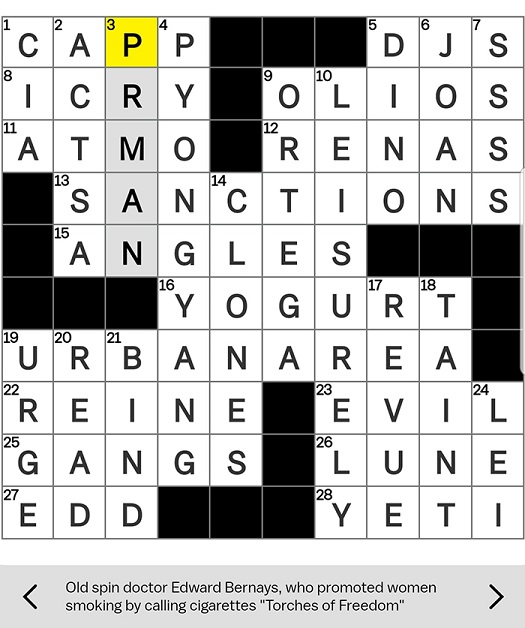
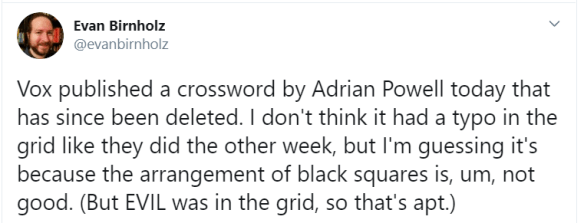
This unfortunate grid was published by Vox, but it was later deleted, as reported on Twitter by constructor Evan Birnholz:

evan 4 may 22

Evan is an avid follower of the Vox crossword, but not because he’s a fan. No, Evan has been dunking on the Vox crossword for what feels like forever. He’s not doing it to make his own puzzles look better by comparison; as a top-flight constructor, he doesn’t need to.

His criticisms are never unfair or mean-spirited; on the contrary, they’re founded in trying to make the puzzle better by pointing out poor choices.

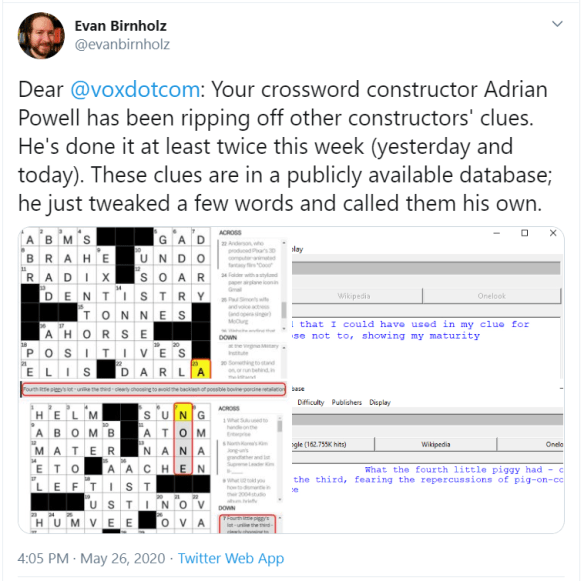
They’re also founded in defending the work of fellow constructors. Evan’s keen eye has caught more than a few questionable examples of clues that seem to have been pilfered wholesale or altered slightly by Vox constructors.

evan 1

Now, the first puzzle I posted was silly. Sure, it made the crossword nigh-unsolvable, but there’s no malice there. The second puzzle, the one with the unpleasant pattern, doesn’t deserve the same benefit of the doubt. It was a poor choice, and a puzzle that never should have made it to solvers.

But as for stolen clues, that’s something else entirely. If that’s what is happening here — and Evan makes a fairly compelling case — that’s not just a crime against crosswords, it’s a crime against fellow constructors. It’s a sign of disrespect.

I love shouting out smart clues by constructors, not only so other people can enjoy the wit and wordplay, but so that the right person gets the proper credit. The crossword community is a brilliant group of people; they’re clever and hardworking and constantly innovating.

And it sucks to see some members of the community take advantage of others. It hurts the community as a whole, far more than any bad cropping of a puzzle ever could.


Thanks for visiting PuzzleNation Blog today! Be sure to sign up for our newsletter to stay up-to-date on everything PuzzleNation!

You can also share your pictures with us on Instagram, friend us on Facebook, check us out on TwitterPinterest, and Tumblr, and explore the always-expanding library of PuzzleNation apps and games on our website!
The New York Times Crossword Now Accepts Online Submissions!

Photo by Matt MacGillivray, licensed via Creative Commons

There’s good news for aspiring and established crossword constructors out there, as The New York Times crossword is now accepting online submissions.

I could be cynical and say it’s about time for a change like this, given that The Los Angeles Times has been accepting online submissions for at least a decade now, and many of the other major outlets made the transition well before 2020.

But I won’t. This is a moment worth celebrating.

True, it was inevitable that the Times would move in this direction. I don’t know if the tipping point was the pandemic, given how many other companies and businesses have been forced to adapt to a paperless/lower-contact way of doing business, or if the department was simply following a directional shift the industry had already taken.

But I’m glad they have. This may seem like a relatively small change, but it’s significant for several reasons.

1.) It’s simply easier

People send emails, attach documents, and share files every day. How often do you hit the post office?

2.) Electronic submission encourages younger solvers to get involved

New blood is a necessity for any industry, crosswords included, and when the standard-bearer makes a shift toward inclusivity (even if it’s just a matter of technological familiarity), it’s a step in the right direction.

3.) Electronic submission helps level the playing field

Having to mail submissions has a price attached, through envelopes, paper, and postage, whereas electronic submissions don’t. Yes, the price of crossword construction programs is still a hindrance, limiting access to some, but again, this is a step in the right direction.

The submission page is loaded with information, including specs on puzzles, file formats for submission, and the submission form itself.

Plus NYT-savvy constructors and staff like Joel Fagliano have already posted answers online to Frequently Asked Questions in forums like the Crossword Puzzle Collaboration Directory, and have offered to answer any other questions constructors have.

Hopefully this change means not only an influx of new talent, but greater accessibility for underrepresented groups in crosswords.


Thanks for visiting PuzzleNation Blog today! Be sure to sign up for our newsletter to stay up-to-date on everything PuzzleNation!

You can also share your pictures with us on Instagram, friend us on Facebook, check us out on TwitterPinterest, and Tumblr, and explore the always-expanding library of PuzzleNation apps and games on our website!

A Cornucopia of Clever Clues

Problem-solving-crossword

Last month, in the afterglow of the Crossword Tournament From Your Couch event, I waxed nostalgic about some of the clever and tricky cluing that the constructors employed to keep the solvers on their toes.

I had so much fun poring over those puzzles and highlighting the clues that caught my eye that I’ve decided to do it again.

You see, I keep track of favorite clues from constructors as I solve various crosswords. Not only are they often witty, hilarious, and/or impressive, but they inspire me as a puzzler to always try to find entertaining, engaging new angles for clues.

So here are some favorites from my personal clue vault.

(And I’m crediting the constructor listed on the byline for each clue. These clues may have been created elsewhere and reused, created by the constructor, or changed by an editor, I have no way of knowing. So I’m just doing my best to give credit where credit is due.)


I’m a sucker for delicious wordplay, and thanks to a plethora of ingenious constructors, modern crosswords are rarely lacking in linguistic legerdemain.

One of my favorite cluing tropes is the old word-form switcheroo, when a constructor makes you think the clue is one word form (a verb, for instance) when it’s really a noun, or vice versa.

Erik Agard’s clue “Leaves from a club” certainly sounds like a verb, so it’s a fun surprise when you realize the answer is LETTUCE.

Similarly, the ability to utilize the multiple meanings of words can make for some seriously elusive clues. Mike Shenk’s “Volume setting?” has you thinking music or audio, but the answer SHELF also fits neatly.

Byron Walden is a master at this sort of cluing, as evidenced by his clue “Uruguayan uncle?” for the phrase NO MAS. Given how often TIO, TIA, MADRE, and other Spanish familial terms are used in crosswords, it’s a keen example of misdirection.

keep-right-misdirection

And playing with the tropes of crossword cluing creates opportunities for more wordplay.

“Trick or treat,” a clue from Aimee Lucido, masquerades as the common Halloween phrase when it’s really two examples cluing the answer VERB.

Similarly, “Jets or chargers starter” sounds like a sports reference, but the lowercase “chargers” reveals something else is afoot. The answer to this clue (which appeared in a puzzle constructed by Craig Mazan and Jeff Chen) is TURBO.

Erin Rhode’s “Drum, for some” sounds like a simple example-style clue, but the answer RHYME reveals how she hid her wordplay in plain sight.

Yes, these clues have a lot in common with wordplay clues, but they also play with the conventions of crossword cluing.

owl

Oh, and speaking of clues that hide their trickery in plain sight, I’ve got a few examples of that as well.

Kathy Weinberg once clued ROWS as “15 things in this puzzle,” which is the sort of clue that’s simultaneously so vague and so on-the-nose that it drives me insane.

Similarly, Steve Faiella uses modern slang to hide an answer in plain sight with the clue “Has beef with somebody, say.” That sure sounds like a vernacular use of “has beef with,” so you’re less likely to read the clue as a simple description of EATS, the actual answer. Very sly.

I’m going to close out today’s post with a clue that’s not only clever, it’s economical as well. Robyn Weintraub clued HOLE with two simple words — “Darn it!” — and it’s as hilarious as it is effective.

What are some of your favorite crossword clues, fellow puzzlers and PuzzleNationers? Let us know in the comments section below! We’d love to hear from you.


Thanks for visiting PuzzleNation Blog today! Be sure to sign up for our newsletter to stay up-to-date on everything PuzzleNation!

You can also share your pictures with us on Instagram, friend us on Facebook, check us out on TwitterPinterest, and Tumblr, and explore the always-expanding library of PuzzleNation apps and games on our website!