Raccoons Solving Puzzles For the Love of the Game!

f you’ve been reading this blog for any length of time, you’ve no doubt noticed that one of our favorite topics is puzzle-solving animals. In the past, we’ve discussed examples of puzzle solving in catsdogscrowscockatoosoctopuses, beespigs, squirrels, and wolves.

And today we’re excited to invite another critter into the pantheon of puzzle-capable creatures: Raccoons! ChatGPT might not be allowed to talk about raccoons anymore, but we at PuzzCulture sure can!

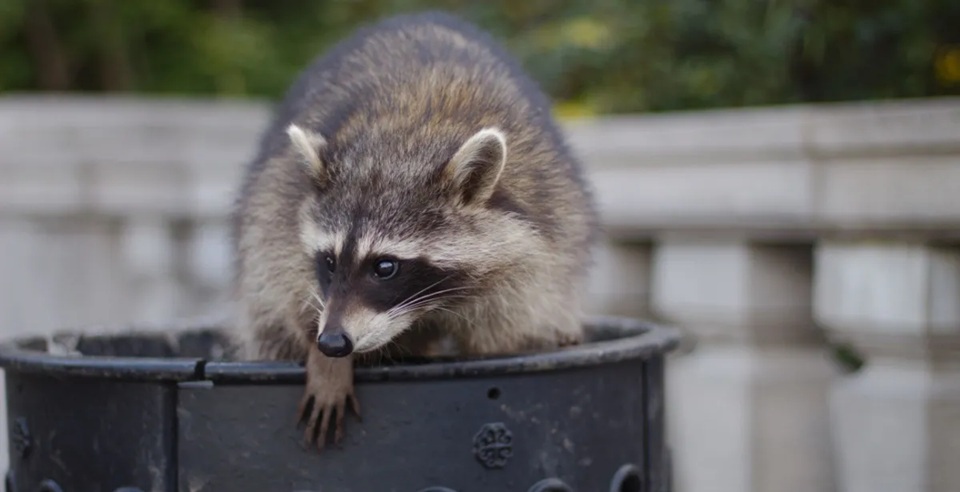
Raccoons have a reputation for being wily, particularly in folk tales, fables, and stories. They’re mischievous and sly, with forepaws advanced enough to allow them grab things and manipulate them. In suburban and urban environments, it’s hardly uncommon for raccoons to open garbage bins or find their way into other spaces in search of food.

So naturally, that raises some interesting questions: how far can their dexterity take them? What level of complexity can they unravel if properly incentivized?

In essence, how puzzly a challenge is too puzzly for a hungry, sufficiently-motivated raccoon?

As it turns out, raccoons will continue puzzling even when the food is gone!
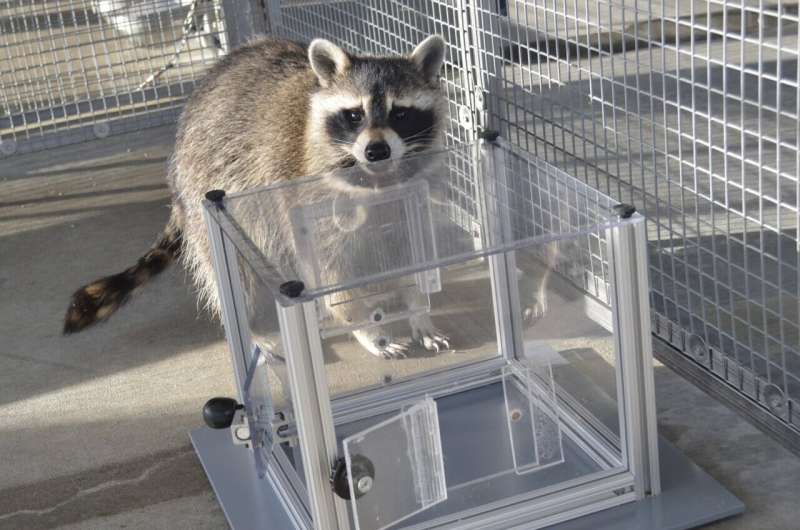
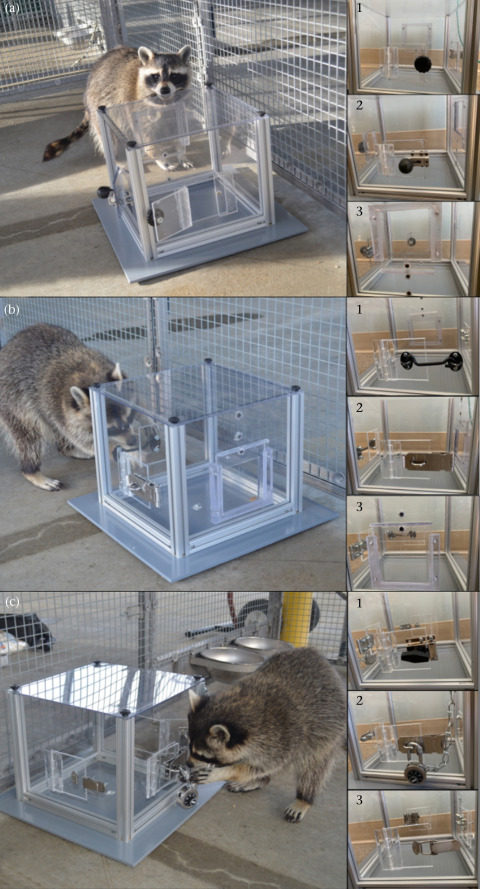
Researchers Hannah Griebling and Dr. Sarah Benson-Amram challenged a sample group of raccoons to deal with a custom puzzle box. It had nine different potential points of access, which required manipulating knobs, sliding doors, latches, and other mechanical obstacles. (These entry points were grouped by the researchers into easy, medium, and hard categories for the purposes of their study.)

The raccoons were given 20 minutes in each trial to find a way into the box in order to retrieve the single marshmallow inside.

The raccoons proved dexterous enough to unravel most of the challenges in front of them, and the researchers’ difficulty rankings didn’t seem to matter:

The time spent interacting with the puzzle box overall was similar for Easy and Hard solutions, rather than being a clear gradient from Easy to Medium to Hard. This result does not support an effect of presentation order of the difficulty conditions as we would expect the total interaction time with the puzzle box to decrease along an Easy to Hard gradient if this were the case and the raccoons were only learning the simple rule that the MAB [the puzzle box] only ever supplied one food reward.

Not only that, but the raccoons continued opening the other access points and solving the other mechanisms after eating the single prize inside. The raccoons kept puzzle-solving without food as a motivation.

“We weren’t expecting them to open all three solutions in a single trial,” said Griebling.

They were in it for the love of the game!
Well, sorta.

This behavior, this intrinsic motivation — the raccoons being driven to continue solving the various mechanisms in front of them WITHOUT hunger as the primary motivator — is known as “information foraging.”

Essentially, they’re practicing and learning to become better puzzle solvers.

As the researchers stated in their report:

Information foraging in raccoons increases the likelihood of raccoons finding and ‘solving’ novel raccoon exclusion devices, such as bungee cords used to strap down garbage bin lids. This could lead to a ‘cognitive arms race’ between humans and raccoons, as has been recently documented in urban-living, sulphur-crested cockatoos, Cacatua galerita.

Wild raccoons are likely to show similar patterns to the captive raccoons in this study, given that they have willingly engaged with and solved multiple novel problem-solving tasks in the field and showed similar results to captive raccoons on a previous MAB study.

Oh yes. Raccoons are engaged in Olympic-level training to be even sneakier and more efficient. Those adorable trash bandits are out in the field, putting in the work, learning and developing new strategies to nab your snacks and food stashes.
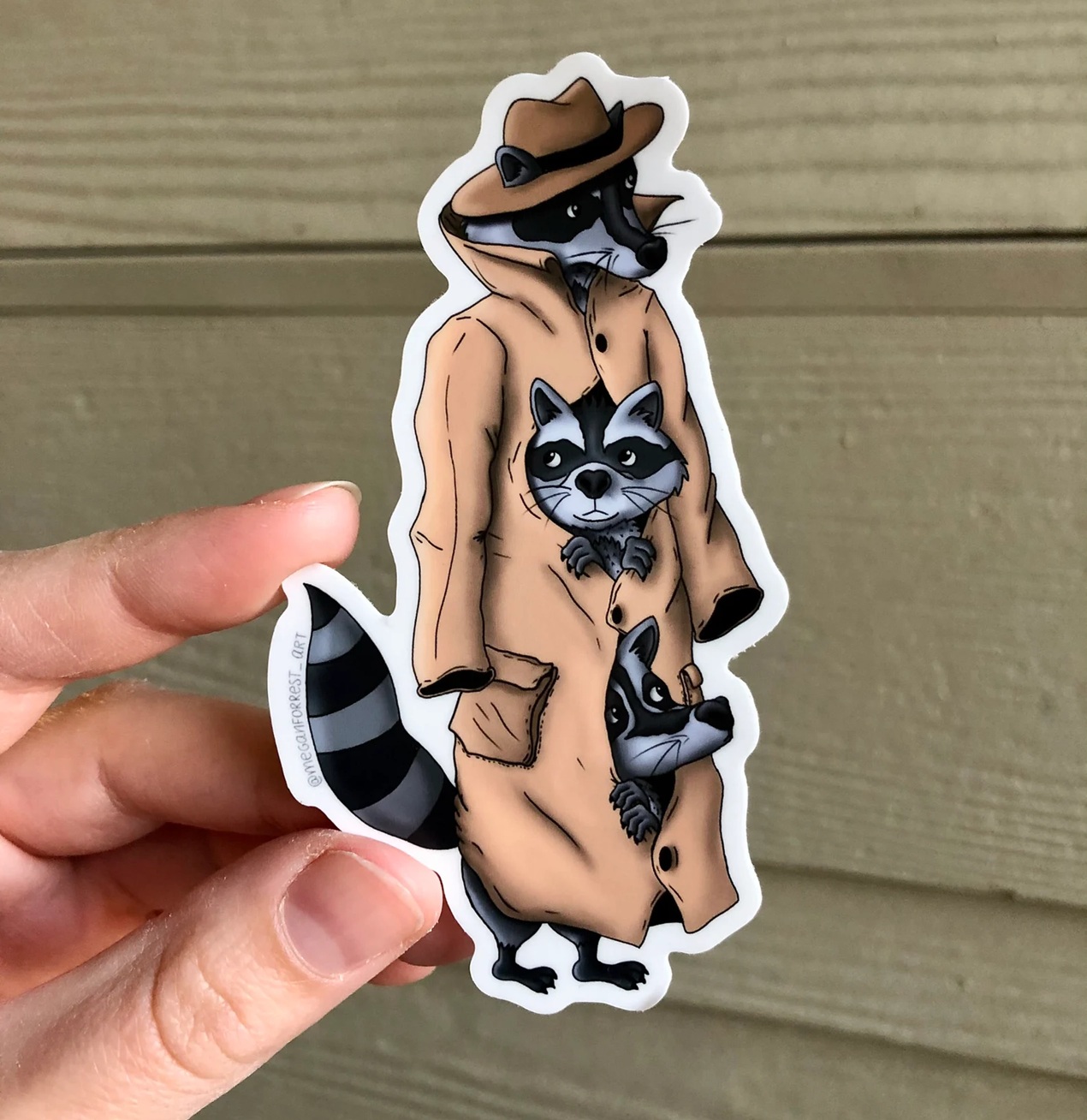
Image courtesy of MeganForrestArt.

Okay, it’s not as organized as all that. But yes, raccoons do solve puzzles they don’t have to, and appear to be learning from the experience.

The study determined that raccoons did prefer some of the easier, more reliable methods for accessing the box — in the same way that you would probably go with a tried-and-true solution to a problem, rather than trying out a new technique with an unknown success rate. This trade-off of curiosity versus risk mirrors decision-making frameworks in humans, as well as other animals, according to Griebling. This is known as an “exploration-exploitation trade-off.”

So, we have definitive data. Raccoons will puzzle-solve without food as a motivator. (I know many puzzle enthusiasts who are the same way. They’ll tackle a puzzle just to learn from it, to see if they can unravel it. Though I wonder if marshmallows would motivate them as well…)
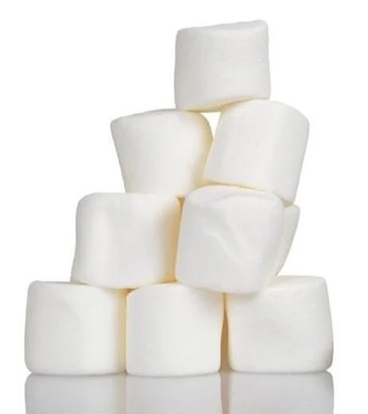
Are you hungry? Hungry enough to solve this acrostic?

But this does raise one last question: why test this at all?

As it turns out, the reasons are two-fold.

“Understanding the cognitive traits that help raccoons thrive can guide management of species that struggle, and inform strategies for other species, like bears, that use problem-solving to access human-made resources,” said Griebling.

Studies like this help us understand the development of already puzzle-savvy animals, but also helps us to understand what animals (both wild and captive) are capable of, making US better stewards of the environment and its many denizens.

And we get to add another species to the ever-growing list of creatures that are capable of puzzle solving.

Which brings me to my latest business venture: Raccoon escape room, anyone?


What’s your favorite puzzle-solving creature, fellow puzzlers? Let us know in the comments section below! We’d love to hear from you.
Birdbrains Are Starting to Look Pretty Good Right Now…

If you’ve been reading this blog for any length of time, you’ve no doubt noticed that one of our favorite topics is puzzle-solving animals. In the past, we’ve discussed examples of puzzle solving in catsdogscrowscockatoosoctopuses, bees, pigs, and squirrels.

You probably noticed we’ve got two types of birds on that list already. The more we learn about birds, the more they add to their puzzly resumes.

For instance, did you know that sulphur-crested cockatoo parrots in Australia are teaching each other how to open trash bin lids in order to grab snacks. It’s not all that different from the birds that raided milk containers in Britain a century ago. Many birds learned quickly from their more clever brethren.

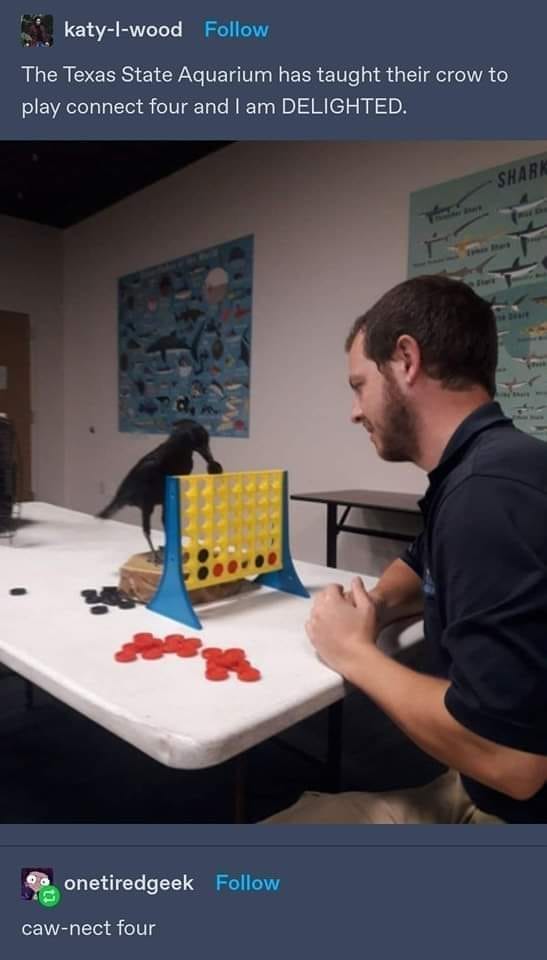
As for crows, they’re probably the puzzly kings of birddom.

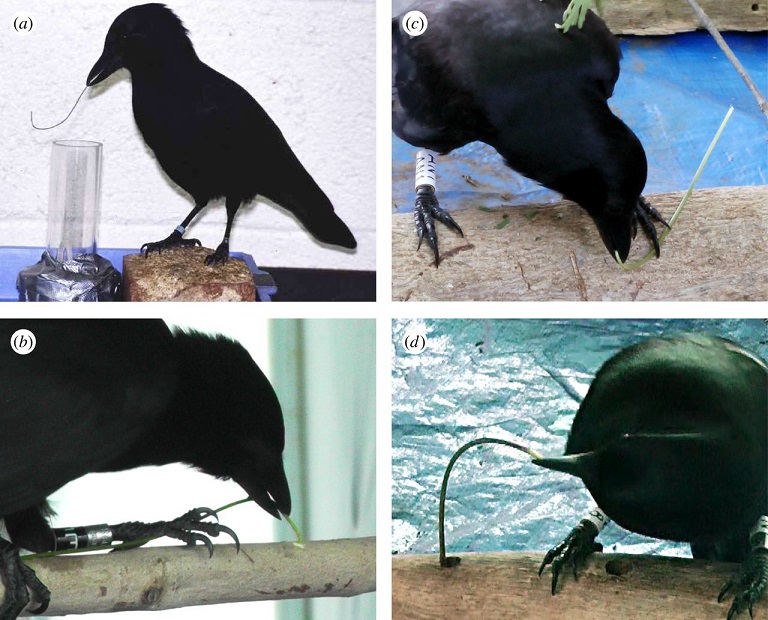
There was a famous study about a crow named Betty, who would bend pieces of wire in order to obtain food.

Originally, Betty was treated as a genius, only for scientists to later discover that many other crows also have a penchant for making tools and figuring out innovative solutions to problems.

The story of Betty no doubt inspired another study, which tested both the puzzle solving wits and social skills of crows.

There were two crows gathered from different locations with no discernable previous connection. On a table, the scientists placed two pieces of wire — a hooked piece of wire and a straight piece of wire. Each crow had a bottle with meat inside. The crows could see each other, but each had to solve the problem separately. Each crow grabbed one of the two wires.

There are differing accounts of this study, and I couldn’t track down the original. Some say the straight wire was the only way to get the food out, others the hooked wire.

[Image courtesy of Royal Society Publishing.]

In the end, the result was the same. During the first test, only one crow could get the food.

Scientists ran the test a second time, expecting the crows to fight for the one wire that allowed the victor to acquire their food.

And yes, both crows went for the same wire.

But not as competitors.

One held the wire in place, the other bent it. They cooperated, without language, so that both could get food.

That is some solid puzzly thinking.

Factor in other studies about crow cooperation (crooperation?) and stories from Japan about crows building decoy nests to distract patrols intended to remove their real nests from city power grids, and you start to wonder whether crows will join Dr. Fill at the next edition of the American Crossword Puzzle Tournament.

Now, if you’ll excuse me, I’ve heard some stories about puzzle-solving raccoons that I need to follow up on. The menagerie of puzzly animals just grows and grows.

Have you heard any stories about clever creatures that belong on the list of puzzle-solving animals, fellow puzzlers? Let us know in the comments section below! We’d love to hear from you


dailypopwsicon

Have you checked out our special summer deals yet? You can find them on the Home Screen for Daily POP Crosswords and Daily POP Word Search! Check them out!

Thanks for visiting PuzzleNation Blog today! Be sure to sign up for our newsletter to stay up-to-date on everything PuzzleNation!

Squirreling Away Puzzle-Solving Skills?

squirrel puzzle wood

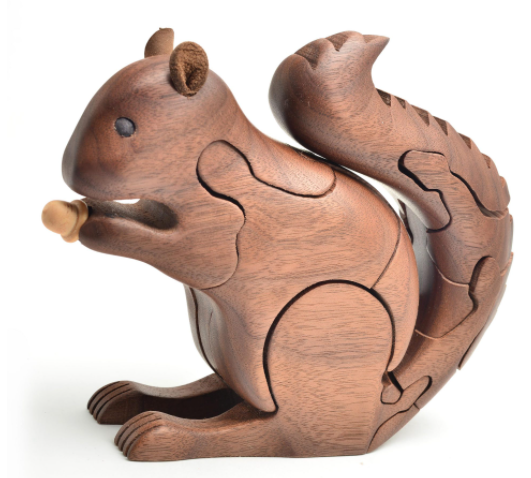
[Image courtesy of Southern Highland Guild.]

It was less than two months ago that we discussed whether the problem-solving puzzly skills of pigs were enough to grant them membership in the puzzle-solving creatures club, alongside catsdogscrowscockatoosoctopuses, and bees.

As it turns out, scientists have been studying “can animal x solve puzzles?” for longer than I thought. One academic paper, entitled “How to stay perfect: the role of memory and behavioural traits in an experienced problem and a similar problem,” was published back in July of 2017.

And they concluded that squirrels might be a worthy addition to the pantheon of puzzle solvers.

img_2511

According to the scientists involved:

A neophobia test in the generalisation task suggested squirrels perceived the different apparatus as a different problem, but they quickly came to apply the same effective tactics as before to solve the task… Squirrels remembered and emitted task-effective tactics more than ineffective tactics. As a result, they consistently changed from ineffective to effective behaviours after failed attempts at problem-solving.

They went on to cite previous studies involving creatures as varied as monitor lizards, Atlantic cod, spotted hyenas, lions, and goats:

With regard to returning to previously experienced task, selectivity appears to be an important factor in the success of captive lions, Panthera leo, in solving a suspended puzzle box up to 7 months after experiencing it (Borrego and Dowling 2016), in the success of goats, Capra hircus, in solving a two-step food box challenge 10 months after first experiencing it (Briefer et al. 2014)

squirrel 2

One of the main questions they were trying to answer was what role memory was playing in this puzzle-solving. Were they remembering their previous puzzly experience OR re-learning the same tactics a second time, separate from the first test? These were the parameters:

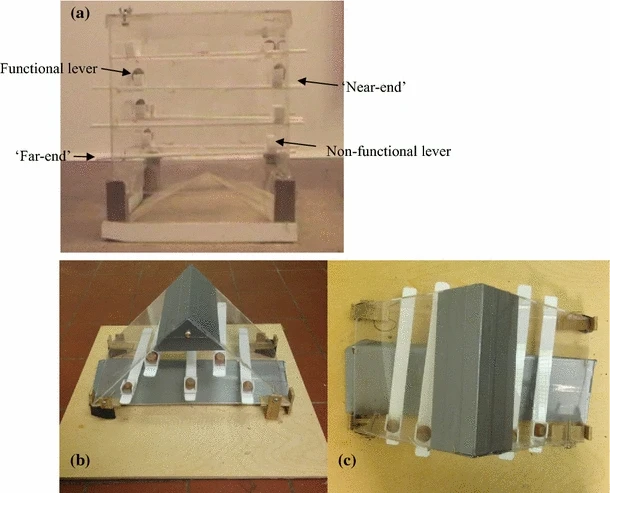
Here, we examined how memory, alongside behavioural traits, contributes to enhance problem-solving efficiency by giving five grey squirrels, firstly a previously experienced task 22 months after they had last experienced it (hereafter, the ‘recall task’), and secondly a task requiring a previously successful action to be performed in a physically different apparatus (hereafter, the ‘generalisation task’).

Nearly two years between the initial solve and the secondary test! That’s a huge chunk of time. As Dan said in the Room Escape Artist article about this study, “22 months! I could probably replay an entire escape room after 22 months and not even notice.”

But that length of time was intentional, given the test subjects involved:

Grey squirrels are also known to have good long-term memory, at least in the spatial domain: they are scatter hoarders that cache thousands of nuts during the autumn (Thompson and Thompson 1980), and they are able to relocate their own caches (Jacobs and Liman 1991) and artificial caches (Macdonald 1997) after long intervals of time.

squirrel puzzle

So, what did they find when they tested Arnold, Leonard, Sarah, Simon, and Suzy in the lab?

In our case, squirrels may pay attention to cues such as the levers that contain hazelnuts to locate which lever to solve. But unlike what has been found in tool-use studies, the use of cues did not develop with increased experience during problem-solving. Squirrels showed an immediate strong preference to contact functional levers rather than non-functional levers, both when they first encountered this puzzle box 22 months prior to this study (Chow et al. 2016) and in the first trial of the recall task. These results imply that squirrels quickly focused their attention on the reward and reward-related components of the apparatus (levers) from their first encounter with the puzzle box.

In short, applying previously learned knowledge makes them far more effective problem-solvers!

Sounds like it’s time to add squirrels to the list.

Now, if you’ll excuse me, I have to start researching lions, hyenas, cod, monitor lizards, and any other animal studies cited in the footnotes. Clearly I have catching up to do!


Thanks for visiting PuzzleNation Blog today! Be sure to sign up for our newsletter to stay up-to-date on everything PuzzleNation!

You can also share your pictures with us on Instagram, friend us on Facebook, check us out on TwitterPinterest, and Tumblr, and explore the always-expanding library of PuzzleNation apps and games on our website!

The Fun Side of Crosswordese

Crossword.

Anyone who solves crosswords is familiar with some aspect of crosswordese, even if they don’t know it by that name. Crosswordese consists of words that appear frequently in puzzles, but not nearly as often in conversation or common use. My favorite variation on that definition is “words that crop up a lot in grids but are otherwise pretty useless.”

Part of becoming a better solver is building a personal lexicon of crosswordese and common crossword words so you’re not getting tripped up by the same obscurities, peculiarities, and cruciverbalist celebrities that so often occupy those black-and-white grids we enjoy.

Some of these words seem destined to remain obscure. ETUI will most likely never become commonplace. Most people don’t fence, and couldn’t tell an EPEE from a foil or a saber.

Oona-Chaplin

[Image courtesy of Celebs.Infoseemedia.com.]

Others are cyclical. OONA was Chaplin’s wife, until her granddaughter of the same name become a featured player in the first few seasons of Game of Thrones. Similarly, both ELSAS Lancaster and the movie feline have Frozen to thank for that name gaining new life in puzzles these days.

(Here’s hoping there’s a crop of Eastern-European actresses that will storm TV and film soon and breathe new life into clues for ONA, UNA, UTA, and OSA.)

But, for the most part, crosswordese evokes negative feelings. It’s easy to come up with a list of the words that irk us — the ones we’ve never encountered in the real world, or the ones that we simply cannot remember, even after filling them into a dozen grids or more.

But today I’d like to focus on the ones I do enjoy, the strange words I’ve learned through crossword solving and construction that have broadened my vocabulary and sent my mind down unexpected tangents and pathways I would’ve never otherwise wandered through.

edsel

[Image courtesy of Driving.ca.]

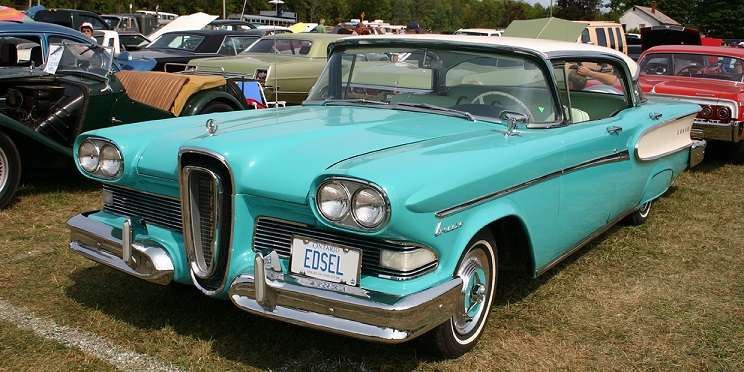
EDSEL

It’s amazing how a convenient letter pattern can keep an infamous failure in the minds of solvers decades and decades later. It was only manufactured for two years, and that was SIXTY years ago. And yet, whenever I see “Ford flop” or something similar as a clue, I always smile. It’s universal at this point.

NE’ER

There’s a lot of poetic license — see what I did there? — taken with poetry terms in crosswords, and most of them are well-and-truly overused. But for some reason, NEER ne’er bothers me. In fact, I enjoy seeing it. It probably has to do with “ne’er-do-well,” which is an incredibly fun term to throw around. It’s right up there with “deipnosophist” and “raconteur” as far as descriptive terms that need to make a comeback.

iago

[Image courtesy of Digital Spy.]

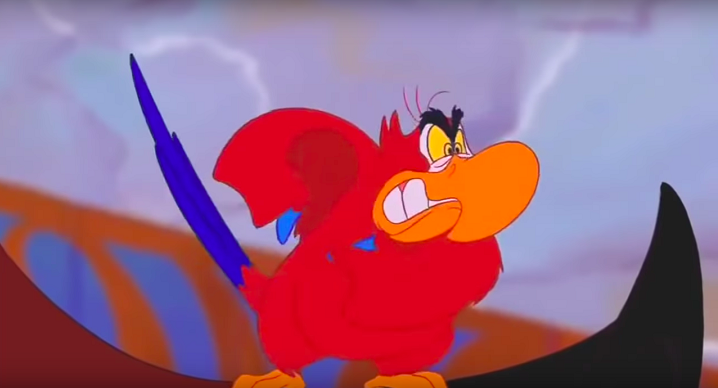
IAGO

He was first clued as a master manipulator from the works of Shakespeare, then as a conniving Disney sidekick who slowly turns toward the light over the course of the franchise. In either case, he’s a fascinating character whose handy combination of vowels ensures he’ll be a part of crosswords for years to come.

obiwanobi

[Images courtesy of StarWars.com and Polina Couture.]

OBI

As someone who is both a Star Wars fan and deeply interested in Japanese culture, I always enjoy when OBI makes an appearance in a grid. (More for the former reasons than the latter, if I’m being honest.)

In fact, this blog entry inspired me to search XWordInfo to see when OBI started being clued as part of Obi-Wan Kenobi’s name (twice, which is weird yet lyrical) and not just as a Japanese sash.

Although the character debuted in the first Star Wars film in 1977, his name wasn’t used in The New York Times crossword to clue OBI until 1990!

These are just the first common crossword entries that came to mind. There are a few others, not to mention all of the neat animals — mostly bird-related or African in origin — that crop up in crosswords. KEA and ROC, IBEX and ELAND, OKAPI and RATEL, just to name a few.

But now I turn the subject over to you, fellow puzzlers and PuzzleNationers. What are your favorite common crossword words or bits of crosswordese that appear in grids but don’t irk you? Let us know in the comments section below! We’d love to hear from you.


Thanks for visiting PuzzleNation Blog today! Be sure to sign up for our newsletter to stay up-to-date on everything PuzzleNation!

You can also share your pictures with us on Instagram, friend us on Facebook, check us out on TwitterPinterest, and Tumblr, and explore the always-expanding library of PuzzleNation apps and games on our website!