
f you’ve been reading this blog for any length of time, you’ve no doubt noticed that one of our favorite topics is puzzle-solving animals. In the past, we’ve discussed examples of puzzle solving in cats, dogs, crows, cockatoos, octopuses, bees, pigs, squirrels, and wolves.
And today we’re excited to invite another critter into the pantheon of puzzle-capable creatures: Raccoons! ChatGPT might not be allowed to talk about raccoons anymore, but we at PuzzCulture sure can!
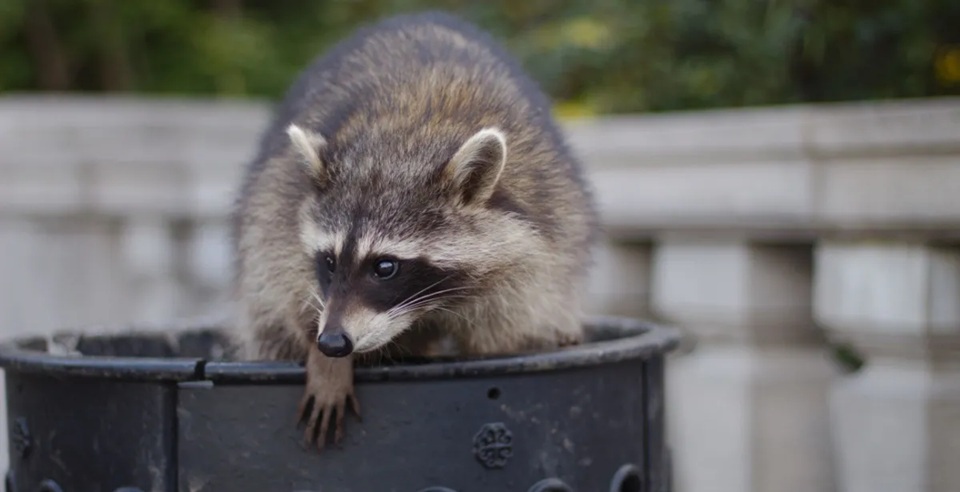
Raccoons have a reputation for being wily, particularly in folk tales, fables, and stories. They’re mischievous and sly, with forepaws advanced enough to allow them grab things and manipulate them. In suburban and urban environments, it’s hardly uncommon for raccoons to open garbage bins or find their way into other spaces in search of food.
So naturally, that raises some interesting questions: how far can their dexterity take them? What level of complexity can they unravel if properly incentivized?
In essence, how puzzly a challenge is too puzzly for a hungry, sufficiently-motivated raccoon?
As it turns out, raccoons will continue puzzling even when the food is gone!
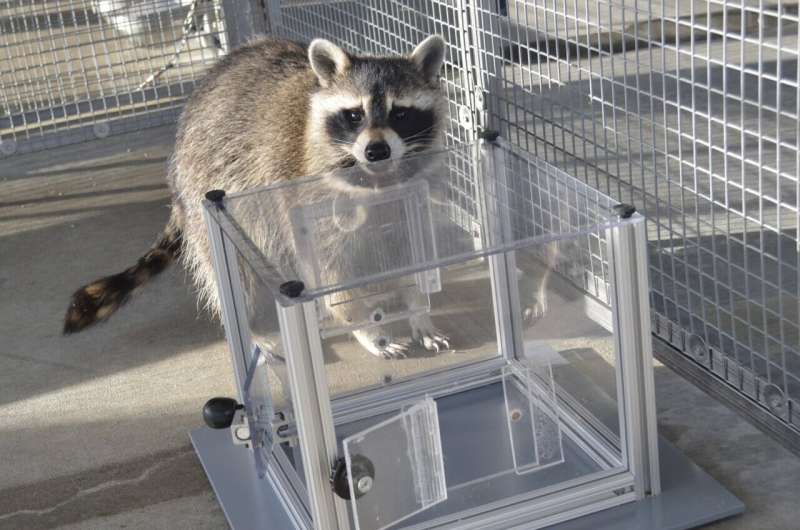
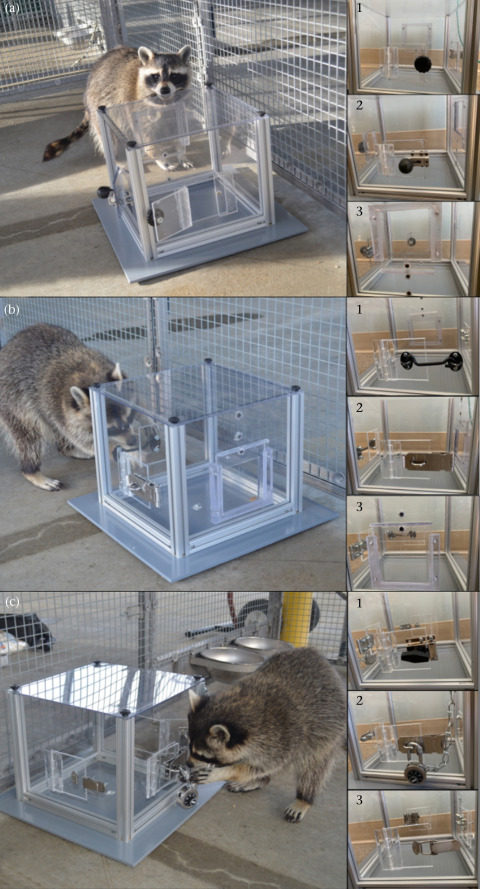
Researchers Hannah Griebling and Dr. Sarah Benson-Amram challenged a sample group of raccoons to deal with a custom puzzle box. It had nine different potential points of access, which required manipulating knobs, sliding doors, latches, and other mechanical obstacles. (These entry points were grouped by the researchers into easy, medium, and hard categories for the purposes of their study.)
The raccoons were given 20 minutes in each trial to find a way into the box in order to retrieve the single marshmallow inside.
The raccoons proved dexterous enough to unravel most of the challenges in front of them, and the researchers’ difficulty rankings didn’t seem to matter:
The time spent interacting with the puzzle box overall was similar for Easy and Hard solutions, rather than being a clear gradient from Easy to Medium to Hard. This result does not support an effect of presentation order of the difficulty conditions as we would expect the total interaction time with the puzzle box to decrease along an Easy to Hard gradient if this were the case and the raccoons were only learning the simple rule that the MAB [the puzzle box] only ever supplied one food reward.
Not only that, but the raccoons continued opening the other access points and solving the other mechanisms after eating the single prize inside. The raccoons kept puzzle-solving without food as a motivation.
“We weren’t expecting them to open all three solutions in a single trial,” said Griebling.
They were in it for the love of the game!
Well, sorta.
This behavior, this intrinsic motivation — the raccoons being driven to continue solving the various mechanisms in front of them WITHOUT hunger as the primary motivator — is known as “information foraging.”
Essentially, they’re practicing and learning to become better puzzle solvers.
As the researchers stated in their report:
Information foraging in raccoons increases the likelihood of raccoons finding and ‘solving’ novel raccoon exclusion devices, such as bungee cords used to strap down garbage bin lids. This could lead to a ‘cognitive arms race’ between humans and raccoons, as has been recently documented in urban-living, sulphur-crested cockatoos, Cacatua galerita.
…
Wild raccoons are likely to show similar patterns to the captive raccoons in this study, given that they have willingly engaged with and solved multiple novel problem-solving tasks in the field and showed similar results to captive raccoons on a previous MAB study.
Oh yes. Raccoons are engaged in Olympic-level training to be even sneakier and more efficient. Those adorable trash bandits are out in the field, putting in the work, learning and developing new strategies to nab your snacks and food stashes.
Okay, it’s not as organized as all that. But yes, raccoons do solve puzzles they don’t have to, and appear to be learning from the experience.
The study determined that raccoons did prefer some of the easier, more reliable methods for accessing the box — in the same way that you would probably go with a tried-and-true solution to a problem, rather than trying out a new technique with an unknown success rate. This trade-off of curiosity versus risk mirrors decision-making frameworks in humans, as well as other animals, according to Griebling. This is known as an “exploration-exploitation trade-off.”
So, we have definitive data. Raccoons will puzzle-solve without food as a motivator. (I know many puzzle enthusiasts who are the same way. They’ll tackle a puzzle just to learn from it, to see if they can unravel it. Though I wonder if marshmallows would motivate them as well…)

But this does raise one last question: why test this at all?
As it turns out, the reasons are two-fold.
“Understanding the cognitive traits that help raccoons thrive can guide management of species that struggle, and inform strategies for other species, like bears, that use problem-solving to access human-made resources,” said Griebling.
Studies like this help us understand the development of already puzzle-savvy animals, but also helps us to understand what animals (both wild and captive) are capable of, making US better stewards of the environment and its many denizens.
And we get to add another species to the ever-growing list of creatures that are capable of puzzle solving.
Which brings me to my latest business venture: Raccoon escape room, anyone?
What’s your favorite puzzle-solving creature, fellow puzzlers? Let us know in the comments section below! We’d love to hear from you.

