PuzzleNation Product Review: Chroma Cube

[Note: I received a free copy of this game in exchange for a fair, unbiased review. Due diligence, full disclosure, and all that. And this concludes the disclaimer.]

As longtime readers know, puzzle games centering around logic and deduction can come in many different forms, from cats milling around a living room to abstract shapes interacting in curious ways. They often have many moving parts and solving mechanics to keep in mind.

But other logic puzzles strip away flashy trappings and overly elaborate designs and take a minimalistic approach to puzzling. The subject of today’s product review, Chroma Cube, falls neatly into the latter category.

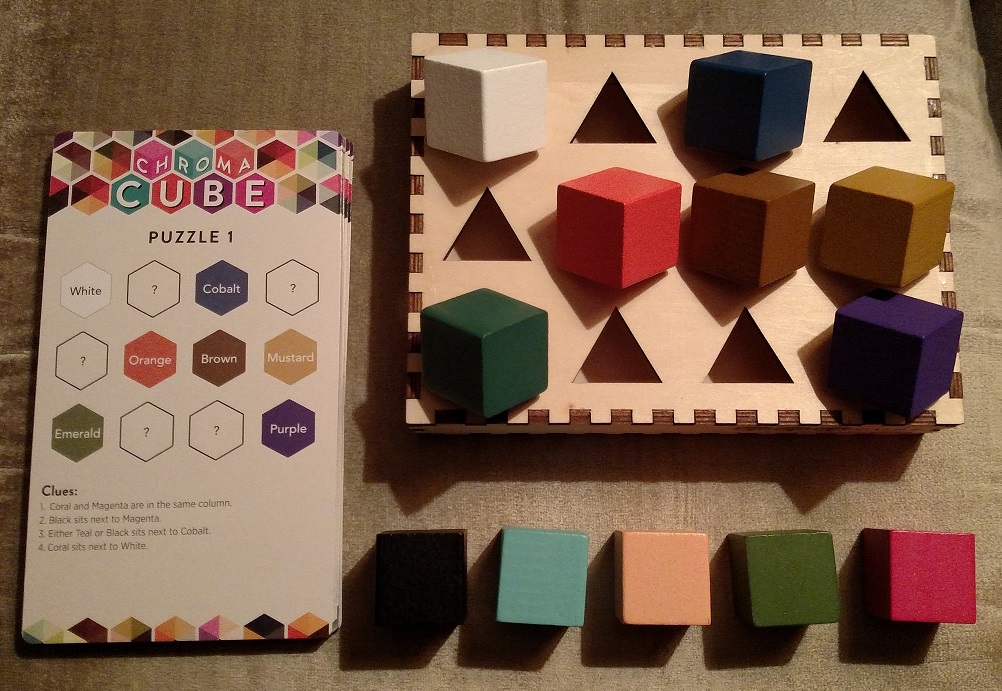
Chroma Cube boils a deduction puzzle down to its essentials, employing pleasing design that seems basic, but allows for great depth and challenge nonetheless. All you need to tackle Chroma Cube is a game board, twelve colored cubes, and your challenge cards.

The object of the puzzle is simple: complete each challenge card by placing all 12 cubes in the correct positions on the board.

Most of the challenge cards place some of the colored cubes for you to get your started. Once you’ve set up your board to match the starting pattern on the card, it’s up to you to use the clues provided to figure out how to place the remaining cubes.

The challenge cards ease the solver into the puzzle at first, relying mostly on clues about positioning on the board, referring to rows, columns, and neighboring cubes.

As you might expect, with each new challenge card, the puzzles increase in difficulty, and the clues grow more complex and inventive. Some refer to colors only by the first letters — leaving you to ponder whether it applies to Brown or Black, for instance) — while others offer contextual clues, like a rule that the cubes in each row should be in alphabetical order from the left to right.

A few even rely on knowledge outside the puzzle game itself, like knowing the colors in the Irish flag. These clues are rarer, but add a nice bit of crossword-style flavor to an otherwise Sudoku-like solving experience.

The team at Project Genius did an excellent job of keeping the clues fresh and interesting, constantly introducing new rules and wrinkles to the puzzles. By the time you’re encountering puzzles with no set cubes, or ones that require you to swap set cubes with newly placed cubes — a very clever twist on the idea of “set” pieces — you realize that no matter how many tricks you’ve figured out, the challenge cards have new ones waiting for you.

(Naturally, these are only some of the clue mechanics you’ll encounter. I don’t want to spoil some of the really inventive and challenging ones.)
Chroma Cube’s later challenge cards offer plenty of difficulty and cluing craftiness to keep established puzzlers coming back for more, but without alienating new solvers that have developed and honed their deductive talents by playing through the game’s earlier scenarios.

I was thoroughly impressed by how much the creative team at Project Genius got out of 12 colored cubes and a wooden board to place them on.

Not only that, but the game is beautiful, eye-catching in its presentation. The wooden pieces have a weight to them, and solving is a delightfully tactile experience. (The challenge cards can be tucked away in a slot within the board, making it a breeze to move around the house.

Heck, you could easily leave it on your coffee table as a puzzly conversation piece and it wouldn’t look out of place.

Chroma Cube is a wonderfully visual take on classic deduction-style solving, one that will keep you on your toes from the first challenge card to the last.

Chroma Cube, distributed by Project Genius, is available at Barnes & Noble and other participating retailers.


Thanks for visiting PuzzleNation Blog today! Be sure to sign up for our newsletter to stay up-to-date on everything PuzzleNation!

You can also share your pictures with us on Instagram, friend us on Facebook, check us out on TwitterPinterest, and Tumblr, and explore the always-expanding library of PuzzleNation apps and games on our website!

A Logic Puzzle Mystery, Brought to Life!

Halloween might be over and done with, but there’s still plenty of spooky puzzling to be found if you know where to look.

For instance, if you’re looking for a game that takes the traditional logic puzzle in a new direction, let’s talk about Return of the Obra Dinn, a PC game that has received some rave reviews recently.

In 1802, the merchant ship “Obra Dinn” set out from London for the Orient with over 200 tons of trade goods. Six months later it hadn’t met its rendezvous point at the Cape of Good Hope and was declared lost at sea.

Early this morning of October 14th, 1807, the Obra Dinn drifted into port with sails damaged and no visible crew. As insurance adjustor for the East India Company’s London Office, find means to board the ship and recover the Crew Muster Roll book for assessment.

With that intense historical premise to work with, you know you’re in for a few scares and some sinister storytelling.

So the game centers around a first-person perspective of this ship as you explore what happened to the crew. You’re armed with two items: a book that contains the ship’s manifest and other documents, and a pocketwatch that, when worn near a corpse, magically reveals what happened at the moment of the character’s death.

The book works like a standard logic problem’s puzzle grid, where you can fill in the information you know and deduce, say, the last names of five people in a marching band, their ages, and what instrument they play. Except, in the case of the Obra Dinn, instead of the details of a fictional marching band, you need to uncover the identity of every person on the ship, how they died, and who killed them.

The pocketwatch sequences are the centerpiece of the puzzle, giving you a static scene of the moment of death, the characters frozen in place, along with the sounds and dialogue that accompanied the person’s demise. You can walk around the frozen scene and examine details, using the book to help document what you discover and slowly eliminate possibilities from the list.

It’s a bit like a scene from Sherlock or Hannibal, as you play the detective walking through the death scene, trying to tease out the key information lurking within.

So the book is both a solving tool and the main body of the puzzle itself, a place for storing information, making guesses, and confirming when you have the correct chain of events for a given character’s death.

The Obra Dinn is one giant, interconnected puzzle, built out of many little moments like this, and only when you’ve taken the time to examine all of it, exploring the ship and the crew from all angles, can you fill in the story of what happened.

It’s essentially a murder mystery novel, but only the first chapter and the finale are in place; it is up to you as you piece together disparate fragments and assemble the narrative. In the end, it’s a simple story, but one told backward, forward, and out of order.

Return of the Obra Dinn is the kind of storytelling that takes puzzles off the page and plants them smack-dab in the center of your imagination. And that’s pretty cool.

If you’d like to try out the game for yourself, Return of the Obra Dinn is out now on PC and macOS for $19.99.

[For more information, check out these reviews from Kotaku and Screen Rant, as well as the creator’s homepage.]


Thanks for visiting PuzzleNation Blog today! Be sure to sign up for our newsletter to stay up-to-date on everything PuzzleNation!

You can also share your pictures with us on Instagram, friend us on Facebook, check us out on TwitterPinterest, and Tumblr, and explore the always-expanding library of PuzzleNation apps and games on our website!

Brain Teaser: A Curious Way to Tell Time

We love tackling brain teasers, riddles, math puzzles, and mind ticklers here at PuzzleNation Blog.

Our friends at Penny Dell Puzzles also enjoy putting their puzzly skills to work by posting various brain teasers..

And one of our mutual readers was hoping we could explain how to solve a puzzle that recently made the rounds on Penny’s social media accounts.

We’d be happy to!

Today, let’s take a look at a brain teaser all about time.

So, where do we begin?

Let’s start by breaking that sentence down to make it easier to parse: “The number of hours left today is half of the number of hours already passed.”

Well, a simpler way of saying that is “the number of hours already passed is twice the number of hours left.”

So if you have the number of hours left — let’s call that X — then the number of hours already passed is twice X, or 2X. Between X and 2X, that’s your entire day covered.

Sorting that out gives us the simple formula of X + 2X = 24, since there are 24 hours in a day.

That easily becomes 3X = 24, and simple division tells us that X = 8.

So X, the number of hours left today, is 8. Which means that twice X, or 16, is the number of hours already passed.

And if there are 8 hours left in the day (or 16 hours already passed), that means it’s 4 PM.


Most of the time, brain teasers are all about efficiently organizing the information we have.

That allows us to figure out how best to use that information to move forward and solve the puzzle. This is just as true with a relatively straightforward brain teaser like this as it is with a complicated logic puzzle with all sorts of pieces to put together.

It’s all about figuring out what we know, what we don’t, and how what we DO know can lead us to what we don’t.

That’s just part of the fun.


Thanks for visiting PuzzleNation Blog today! Be sure to sign up for our newsletter to stay up-to-date on everything PuzzleNation!

You can also share your pictures with us on Instagram, friend us on Facebook, check us out on TwitterPinterest, and Tumblr, and explore the always-expanding library of PuzzleNation apps and games on our website!

The Diabolical Art of Bar Bets

We discuss all sorts of time-honored puzzles and brain teasers here on the blog, but it’s not often that those discussions wander into the arena known as bar bets.

Simply put, bar bets are contests between two parties wherein money or free drinks are wagered on one’s ability to accomplish a given task. Sometimes, that task is answering a bit of trivia, or engaging in a feat of strength.

But more often than not, bar bets are brain teasers designed to separate a fool from his money.

And if you approach them like brain teasers, you have a better chance of holding onto your hard-earned dough.

You see, many of these bar bets are designed more like carnival games than fair wagers; there’s usually a trick involved, and your opponent is wagering on you playing by the rules, rather than out-thinking the game itself.

Example: the wager seems simple. There is a drink placed completely beneath a hat. You must drink the drink without touching the hat.

It seems impossible, but that’s where you must get creative. You can crouch down near the hat and make a slurping noise, and then declare that you’ve succeeded in drinking the drink. Your curious opponent is forced to lift the hat to check, and at that moment, grab the drink, down it, and you’ve won.

You adhered to the letter of the wager, but not the spirit. But that’s the name of the game.

Be careful, because some bar bets are based solely on wordplay.

Example: Tell your opponent to get a coin out of their pocket and set it under a drink coaster, ensuring that you don’t see it. The wager? That you’ll be able to tell them the date.

As you wave your hand over the coaster, as if doing a magic trick, simply announce today’s date. After all, you weren’t specific. You just said you’d tell them the date, not necessarily the date on the coin.

A similar one involves wagering that you can stay underwater for any particular length of time. Once you make the wager, simply hold a glass of water over your head for that amount of time.

A little cheap? Sure. But hey, a bar bet is a bet. And the devil is in the details.

Some bar bets, though, come down to technique. You present a seemingly impossible task, and then accomplish it in a clever way.

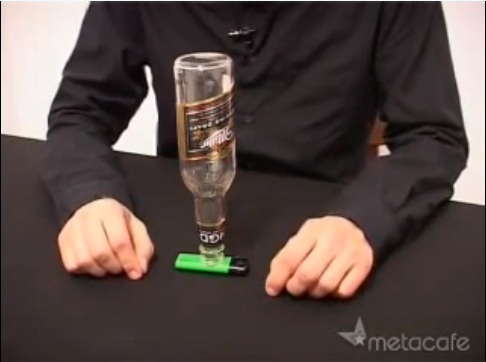
For example, my favorite bar bet: You have a glass (a wine glass, a shot glass, whatever), with a coaster (or business card) on top of it. Atop the coaster is a cigarette, standing on end. And atop the cigarette is a coin.

The wager? Put the coin into the glass without touching the glass, coaster, cigarette, or coin.

There’s no wordplay, no trickery, and no deceit here. This one is all about gravity.

You see, the coaster and the cigarette are light, while the coin is not. If you crouch down below the glass and blow upward, you’ll be able to push aside the coaster and cigarette, leaving the coin to fall straight down into the now-open glass.

Easy. Once you know how it’s done, that is.


What’s your favorite puzzly wager, fellow puzzlers and PuzzleNationers? Do you have a favorite bar bet, trick, or crafty challenge up your sleeve that leaves others befuddled?

Let us know in the comments below! We’d love to hear from you.


Thanks for visiting PuzzleNation Blog today! Be sure to sign up for our newsletter to stay up-to-date on everything PuzzleNation!

You can also share your pictures with us on Instagram, friend us on Facebook, check us out on TwitterPinterest, and Tumblr, and explore the always-expanding library of PuzzleNation apps and games on our website!

The October PN/Escape 101 Promotion Starts Today!

A few weeks ago, we featured local escape room company Escape 101 in our latest edition of Citizen Shoutout!

And the crew at Escape 101 offered an awesome deal to all PuzzleNation users!

For the entire month of October, if you make a reservation for a room at Escape 101 and you have one of the PuzzleNation puzzle apps on your phone, you can show it to them at the door and they’ll give you a 10% discount on the entire booking!

That’s right, whether it’s Daily POP Crosswords, Penny Dell Crosswords, Penny Dell Sudoku, or Penny Dell Crosswords Jumbo 1, 2, or 3, being a PuzzleNation solver will give you a discount on a terrific solving experience.

You can call or email Escape 101 to reserve a room, or book a room through their website. (It’s always best to do so at least a few days out from your desired date and time, just to give them the best chance to meet your expectations.)

You can check out more of the Escape 101 experience in our Citizen Shoutout post or on the Escape 101 website.

They’ve got something for all skill levels. If you’ve never done an escape room before, the Ice Cream Truck room is the perfect introduction. And if you’re looking for a serious challenge, the Doomsday room will test your puzzly mettle.

With those and two other rooms to choose from, you’re guaranteed to find the right fit for you and your fellow solvers!

Enjoy! And let us know when you do! We’d love to hear from you!

Heck, we might even see you there!


Thanks for visiting PuzzleNation Blog today! Be sure to sign up for our newsletter to stay up-to-date on everything PuzzleNation!

You can also share your pictures with us on Instagram, friend us on Facebook, check us out on TwitterPinterest, and Tumblr, and explore the always-expanding library of PuzzleNation apps and games on our website!
This Puzzle Solves Itself!

The slow, steady march of technological advancement in all fields continues to progress, and the world of puzzles is no exception. In previous blog posts, we’ve discussed not only technological leaps forward in making puzzles (like 3-D printers), but also new developments in solving puzzles.

We’ve joked that robots are coming for our puzzles, thanks to advanced machines and AI programs that can play games like chess, Go, and Scrabble on par with — and sometimes, far better than — human experts.

It’s the same with Rubik’s Cubes and other twisty puzzles. Even though speed solvers continue to break new ground in terms of sheer speed and efficiency, we can’t compete with robots that solve cubes in the blink of an eye.

And now, it seems we’ve reached the natural end of this journey…

A self-solving Rubik’s Cube.

Check it out:

The creation of a Japanese technician and self-styled “hardware hacker,” this Rubik’s Cube is the same size as the traditional cube, but the similarities end there.

Instead of the traditional plastic network of connections that allows you to twist and turn the cube every which way, this cube is packed to the gills with electronics, wiring, a series of motors, and the interconnected pieces that give the Rubik’s Cube its signature movement and flexibility.

A marvel of miniaturization and design, this self-solving Rubik’s Cube clearly has its own built-in solving algorithm. It doesn’t simply memorize the twists employed to scramble the cube and then reverse them; the solution and scrambling are completely different chains of events.

All in all, it’s a thoroughly impressive creation. Of course, if I’d known there were going to be self-solving Rubik’s Cubes, I wouldn’t have wasted so much time trying to solve one myself!


Thanks for visiting PuzzleNation Blog today! Be sure to sign up for our newsletter to stay up-to-date on everything PuzzleNation!

You can also share your pictures with us on Instagram, friend us on Facebook, check us out on TwitterPinterest, and Tumblr, and explore the always-expanding library of PuzzleNation apps and games on our website!