

Puzzly minds are often analytical minds, so I’m no stranger to wild attempts at puzzle-inspired calculation.
Puzzle people have previously calculated the human limit for solving a Rubik’s Cube, as well as the fastest known mechanical solve of a Rubik’s Cube. Years ago, I myself tried to figure out how many years it would take to use every unique Sudoku grid possible.
But optimization is something altogether different, and it’s a intriguing way to look at the potential of puzzles.
A Redditor by the name of AntiqueRevolution5 posed the following question a few days ago, and it absolutely fits the bill of both puzzly calculation and optimization:
What would a Boggle grid look like that contained every word in the English language?

Well, there are somewhere between 1 million and 1.5 million words in the English language, so I imagine it would be pretty big.
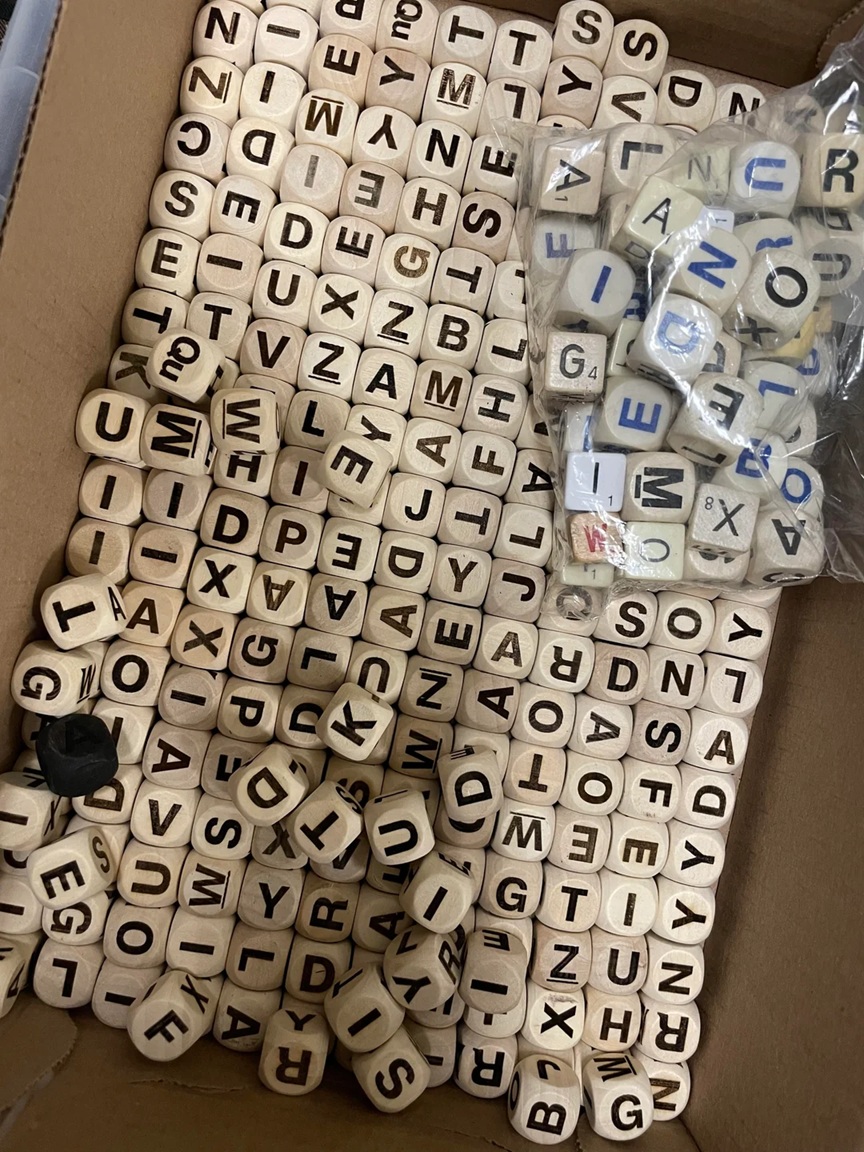
The redditor is an artist, and their goal is to make a sculpture composed of Boggle dice. And their concept is fascinating:
The idea for the piece is that it’s a linguistic Rorschach that conveys someone could find whatever they want in it. But it would be even cooler if it literally contained any word someone might reasonable want to say or write.
So, where do you start with something like this? Our artist has a suggestion:
To simplify, we could scope it to the 3000 most important words according to Oxford. True to the nature of Boggle, a cluster of letters could contain multiple words. For instance, a 2 x 2 grid of letter dice T-R-A-E could spell the words EAT, ATE, TEA, RATE, TEAR, ART, EAR, ARE, RAT, TAR, ERA. Depending on the location, adding an H would expand this to HEART, EARTH, HATE, HEAT, and THE...
What would be the process for figuring out the smallest configuration of Boggle dice that would let you spell those 3k words linked above? What if the grid doesn’t have to be a square but could be a rectangle of any size?
Naturally, creative minds accepted the challenge.
One user claimed that an online Boggle website called Squaredle has two 10×10 boards with just under 900 words of 4 or more letters.
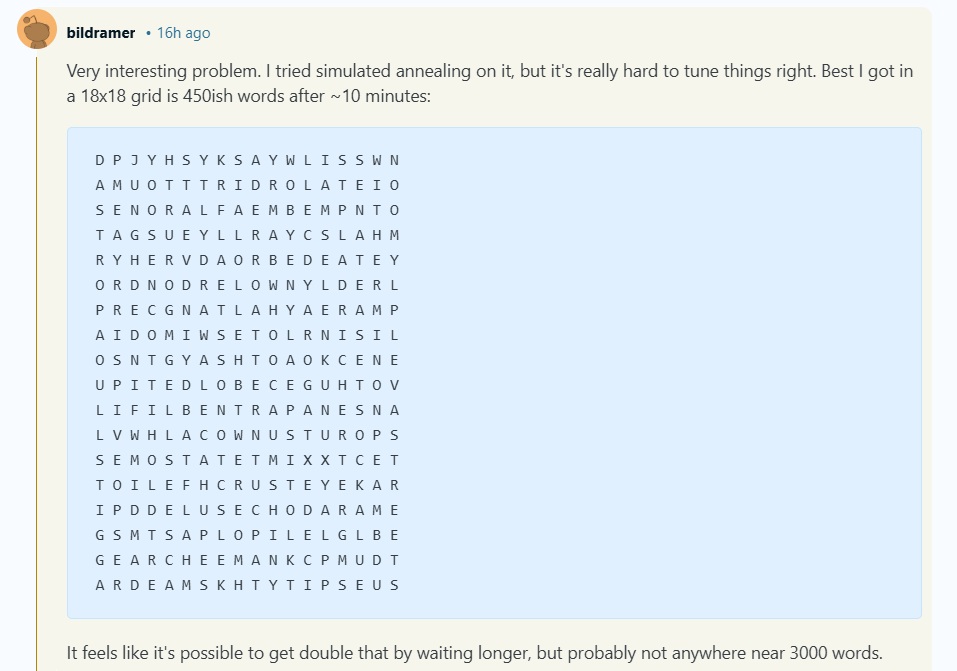
Another user, a programmer, was able to create an 18×18 grid with approximately 450 words in under 10 minutes.
As you might expect, I was unable to resist diving into this one. But I’m not a programmer, so let’s do some meatball mathematics to get a sense of the scope of the puzzly conundrum before us.
We can extrapolate that if we get 450 words in an 18×18 grid, we’d need seven 18×18 grids connected to approach 3,000 words, assuming there’s some consistency in letter efficiency.
If we stick to the rectangular suggestion of the original post, a 63×36 rectangle (six 18×18 grids in a 2×3 arrangement, plus a 9×36 grid attached at the bottom) should allow for those 3,000 words.
Now, I can’t verify that. But 63×36 means 2,268 letters in the grid. Which, with a 3,000 word goal (including two- and three-letter words) kinda feels possible.
Of course, this is just to cover that 3,000 word list. Remember that the English language is estimated to contain between 1 million and 1.5 million words total.
That’s 333-and-a-third times more, if we use a million words. It’s 500 times more words if we assume 1.5 million words.

So, that’s 2,268 letters in our 3,000 word grid. Multiply that by 500 and you get 1,134,000 letters in the grid.
That means we’d need a grid that’s 1,065 x 1,065 to cover the entire English language.
So what does that mean in Boggle terms?
A standard six-sided die is 16 millimeters. That’s 17,040 millimeters, or 17.04 meters. That’s 67.09 inches. We’re talking about a Boggle game that’s FIVE AND A HALF FEET ACROSS.
That’s one heck of a Boggle grid.
Now, of course, these numbers are all estimates, and dubious ones at that. But I couldn’t resist TRYING to find an answer, even if it’s just a ballpark number.
You see, fellow puzzlers, this brand of puzzle efficiency tickles something in my brain, as there are several Penny Press puzzles I quite enjoy that employ a similar idea.
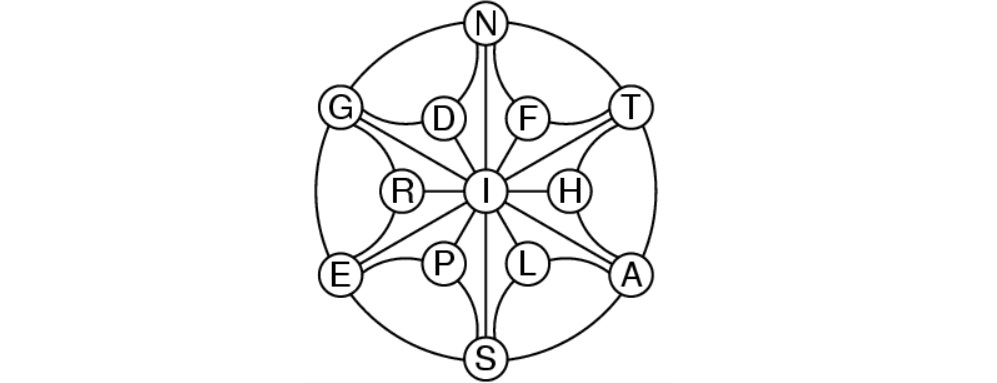
Starspell (pictured above) involves finding words in a star-shaped grid, except unlike Boggle, you can reuse letters. So you could bounce back and forth from A to N and spell BANANA, for instance.
Word Maze involves a small grid with many words hidden inside Boggle-style (though it’s actually a themed word list, meaning it’s not optimized to just cram as many words inside as possible).
Letter Perfect is a reversal of the idea, seeing if the solver can arrange letters in a mostly-empty 4×4 grid to fit every word in a given wordlist. It’s excellent training for a challenge like this, since you learn about efficiency of letter placement and how many words can spell out with neighboring letters if you’re clever.
I don’t know if any programmers will figure out how to build a language-spanning Boggle grid, but I look forward to seeing them try!
Happy puzzling, everyone.












 PuzzCulture