Delving into the ACPT puzzles!

One of the highlights of the puzzle year is the American Crossword Puzzle Tournament, and the impressive, challenging, and well-constructed puzzles awaiting solvers there rank among the craftiest you’ll ever see.

So let’s put them under the microscope and see how I did!


Puzzle 1: For Cooler Heads by Kristian House

The opening puzzle was an excellent introduction to tournament solving, well-constructed but not too challenging. The grid featured two shaded 2×2 blocks within the fill (containing the word CELL), as well as three themed entries and a revealer for those shaded squares (CELL BLOCKS). The theme entries themselves were jail-themed phrases punnily clued, and they were very accessible.

Interesting grid entries included SCOPE OUT, BILOXI, GAUSS, and my favorite clues were “Something done by a prisoner” for TIME, “Spade doing a lot of digging” for SAM, and “Place to find a spare tire?” for ABDOMEN. This was a very solid Puzzle 1.

Puzzle 2: “T” TIME by Patrick Blindauer

Patrick is a top name in puzzles, and he set himself quite a constructing challenge with Puzzle 2. Not only did every clue start with the letter T, but every entry, both across and down, included a T. Very impressive.

If you read my recap of the tournament, you’ll recognize this as the puzzle with the diabolical crossing of CONTE and CORTANA that flummoxed so many competitors, but honestly, I found the entire upper-right corner to be tough. Much tougher than the rest of the puzzle, comparatively. Otherwise it was a very accessible grid, but one that asked a bit more from solvers than Puzzle 1.

Interesting grid entries included SPIN ART, SANTANA, and CORONET, and my favorite clues were “‘That’s all folks,’ for Mel Blanc” for EPITAPH and “Trojan material” for LATEX.

Puzzle 3: Series Cancellations by Mike Shenk

This time around, each of the theme entries was a television show with one letter missing. For instance, “TV series about a driver rear-ending another motorist” clued BRAKING BAD. Together, the missing letters from each entry spelled the word CENSOR reading down in the lower-right corner. This was very clever construction, and the puzzle offered some fun wordplay with the “new” shows as clued.

But there was something else lurking in the grid. The lower-right corner featured a pretty diabolical crossing that could’ve misled solvers. The correct entries were ROMANI crossing CRIER at the I, but a solver could easily fill in those entries as ROMANY crossing CRYER. Pretty sneaky.

Interesting grid entries included BOSWELL, NO MAYO, and A TO Z (as well as the way-too-hard for this puzzle AZUSA), and my favorite clues from the puzzle were “River past Memphis” for NILE, “Sch. for fathers-to-be” for SEM, “Focus on the road” for CAR, and quite appropriately for the tournament, “Didn’t get the 150-point solving bonus, say” for ERRED.

Puzzle 4: Symbology by Zhouqin Burnikel

This was the toughest puzzle thus far, as some of the entries were simply clued with a symbol like “/” or “[ ]” and you had to come up with the theme answer that fit the symbol or symbols. For instance, CUT SHARPLY (slash) and TAX LEVELS (brackets) were the answers to the above clues. Very crafty.

Given the challenge level, this felt like a good warm up for the infamous Puzzle 5, which was looming next.

Interesting grid entries included C’EST LA VIE and NO FEAR ACT, and my favorite clues were “Set in stone, say” for ETCH, “Fails to finish a sentence?” for ESCAPES, and “Pound note?” for ARF.

Puzzle 5: Changing Lanes by Patrick Berry

There are two sounds I’ll always associate with the tournament. The first is the whoosh of everyone turning over their puzzles and beginning at the same time. The second is the groan that accompanies the timer running out during Puzzle 5.

Puzzle 5 is always a beast, and this year’s puzzle did not disappoint. (Well, it probably disappointed a few people, but not with the craftsmanship of the puzzle itself.)

I admit, this one melted my brain. I got that some of the entries would shift from reading down to reading across and back again (in a zigzag pattern), but it took me a long while to realize that those “lane changing” entries would share those unclued lines reading across, but in the other direction. Had I been competing in the tournament, there’s no way I would have completed this one within the 30-minute tournament deadline. Brutal.

Interesting grid entries included CAR TALK, BOB VILA, TOLTEC, and LION CUB, and my favorite clues were “Drawing room?” for ART STUDIO and “Block lettering?” for LEGO.

Puzzle 6: I’ll Be There by Joel Fagliano

Rounding out Saturday’s competition was a nice mental palate cleanser after the diabolical Puzzle 5. In Joel Fagliano’s contribution to the tournament, the letter “I” added to standard phrases to make them comparative (like “Quaker State” becoming QUAKIER STATE comparing California to Nebraska). It’s a neat hook, one easily gettable for solvers already rundown by Puzzle 5.

Interesting grid entries included BBQ PIT, I RAISE, FOOD COMA, and RAZZIE, and my favorite clue was easily “Girl who’s coming back with something valuable?” for TESSA (asset backwards).

Puzzle 7: Page-Turners by Lynn Lempel

Sunday started off strong with this well-read entry by Lynn Lempel. As indicated by the title, the themed entries were novels with the last word in the title anagrammed. For instance, “Lord of the Flies” becomes LORD OF THE FILES and “Tender is the Night” becomes TENDER IS THE THING.

A solid closer with lots of accessible crosswordese, this puzzle was perfect for easing solvers out of tournament mode right before the big championship showdown.

Interesting grid entries included ALVIN AILEY, GANGSTA, ACOLYTE, and STEPS ON IT, and my favorite clues were “Soprano not known for music” for CARMELA and “Manhattan spot” for BAR.

Puzzle 8: The Low-Down (And Across) by Mark Diehl

And then, we were down to one. The final puzzle of the tournament offered three sets of clue difficulties (A for the top performers, B for the solid performers, C for everyone else). And there were a lot of longer entries crossing in this grid, so there were fewer giveaway words to get you started.

I found the solve to be pretty challenging, and I’m constantly amazed at how fast the finalists solve these puzzles. (For context, tournament winner Howard Barkin solved it in 8 minutes, using the A clues.)

I solved it with the B clues, and still with some difficulty. Interesting grid entries included PARLANCE, TOOK A HINT, and RARIN’ TO GO, and my favorite clue was easily “They have wings but never leave the ground” for SNOW ANGELS.


Overall, I was impressed with the quality and ingenuity of puzzles we saw in the tournament, and as always, it reminded me of just how quick, how cunning, and how clever many of the tournament solvers are. These puzzles were a real treat.

Thanks for visiting PuzzleNation Blog today! Be sure to sign up for our newsletter to stay up-to-date on everything PuzzleNation!

You can also share your pictures with us on Instagram, friend us on Facebook, check us out on TwitterPinterest, and Tumblr, and explore the always-expanding library of PuzzleNation apps and games on our website!

5 Questions with Author Elizabeth Singer Hunt!

Welcome to 5 Questions, our recurring interview series where we reach out to puzzle constructors, game designers, writers, filmmakers, musicians, artists, and puzzle enthusiasts from all walks of life!

It’s all about exploring the vast and intriguing puzzle community by talking to those who make puzzles and those who enjoy them! (Click here to check out previous editions of 5 Questions!)

And I’m excited to welcome Elizabeth Singer Hunt as our latest 5 Questions interviewee!

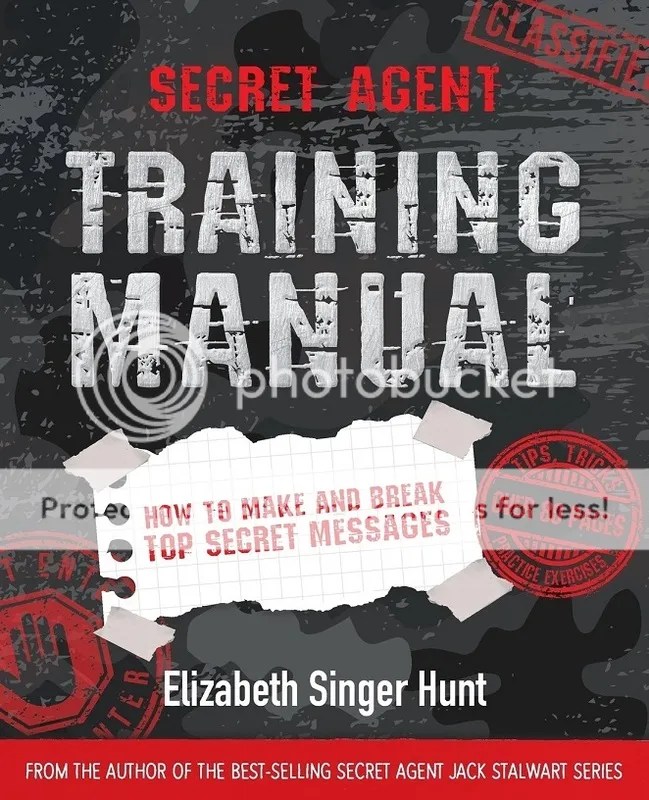
Elizabeth Singer Hunt is the author behind the globe-spanning Jack Stalwart books, a young adult series featuring a nine-year-old secret agent, with over two million books sold to her credit! She’s recently expanded into the world of puzzles with the publication of the Secret Agent Training Manual, a terrific introductory guide to codecracking and concealment.

Anagrams, ciphers, scytales, and encoding with other letters, numbers, or symbols are all explained with easy-to-understand instructions and plenty of examples. She even provides sample encryptions to crack, letting readers practice their newfound skills and techniques, giving young readers the chance to become their own Jack Stalwart-style secret agents!

Elizabeth was gracious enough to take some time out to talk to us, so without further ado, let’s get to the interview!


5 Questions for Elizabeth Singer Hunt

1. What inspired the adventures of Jack Stalwart?

As a young girl, I struggled to read. It wasn’t so much that reading was a problem for me. I couldn’t find any books that I identified with. I grew up in a small town in Louisiana, and spent most of my weekends fishing, crabbing, playing with frogs and tossing around footballs. Basically, I was a tomboy. It was difficult to find books that I could relate to since most of the ‘girl’ books were about friendship issues, horses and fairies.

At around that same time, Raiders of the Lost Ark opened in theatres. That movie introduced me to archaeology and adventure, and showed me that there was a world outside of Louisiana. As a southern girl, I had no idea that places like ‘Nepal’ and ‘Peru’ even existed!

When I was in my late twenties, I decided to take a crack at writing a children’s book series. I drew upon my childhood experiences and inspirations to create the series’ main character, nine-year-old Jack Stalwart. Jack moonlights as a junior secret agent for the Global Protection Force, or GPF. In every book, he’s sent on a mission to an exotic locale in order to protect one of the world’s most precious treasures.

Millions of children around the world have fallen in love with Jack, largely because they identify with him and want to be like him. He’s like a pint-size Indiana Jones, sprinkled with a bit of James Bond and written for the nine-year-old ‘reluctant reader’ me.

Did they, in turn, inspire the Secret Agent Training Manual, or was that meant to be a standalone creation?

Over the years, I have received thousands of emails from children asking how they can become a secret agent like Jack. So I thought it would be fun to create a series that introduced them to basic secret agent/spy skills. Code-breaking seemed a natural place to start! The first book in the series is called How to Make and Break Top Secret Messages. Subsequent books will discuss basic spy craft and the history of intelligence gathering.

2. Are you a puzzle fan yourself, or did your aptitude with encryption and codebreaking puzzles come out of your research and work as a writer?

A little bit of both! I have always had an affinity and aptitude for word puzzles. My favorite game growing up was Boggle and to this day, I am the family Boggle Champion! Recently, my children and I discovered Bananagrams.

It’s right up my alley, since it relies on the ability to quickly arrange and re-arrange letter tiles into words. That being said, I didn’t know too much about the world of cryptography (except for some of the basics) until I began researching for this book.

Do you have a favorite method of encryption or one that didn’t make it into the SATM?

I am fascinated by all of the methods of encryption featured in the book because each has its use depending upon the situation. I suppose my favorite is the ‘cipher’ because it’s ever-changing and difficult for the average person to solve without a key.

3. Let’s talk a little bit about your writing process, since composing a novel is a puzzle in itself. Do you start with characters, plot, certain scenes in your head already? How do you approach the process of writing a book?

Good question! It depends upon the type of book that I am writing.

For my (fiction) Jack Stalwart chapter book series, I have a fairly unorthodox way of writing. I establish the setting, mission and villain and then I start writing! Everything is free-flowing, and little is planned. I love movies and am extremely influenced by film, so in a way I am writing as though I am watching a film play out before my eyes.

For the (non-fiction) Secret Agent Training Manual book, things needed to be a lot more structured. Research was done, notes were taken and the book was organized from the most basic cryptographic methods to those that took a bit more time and thought to decode. Most of this book was handwritten, while many of my fiction books are typed onto a computer screen from the get-go.

4. What’s next for Elizabeth Singer Hunt?

I’m excited to say that Costco is planning an exclusive nationwide launch of the Jack Stalwart series in volume form next month, i.e. in April of 2016. That means that children across the country will be able to enjoy the Jack Stalwart series four books at a time in a specially produced keepsake volume.

Besides this news and the launch of the Secret Agent Training Manual book, I’ve also recently published the first book in a new middle grade series called Swamp Mysteries: The Treasure of Jean Lafitte. The series chronicles the adventures of four twelve-year-old friends as they solve paranormal mysteries in the swamps and bayous of Louisiana. It’s a bit like Scooby-Doo with a southern twist.

5. If you could give the readers, writers, and puzzle fans in the audience one piece of advice, what would it be?

As my mother always says, “There’s always a solution to everything. Persevere!”

When I first had the idea for the Jack Stalwart series, I shopped it around to various agents and publishers and they promptly rejected it. I could have felt sorry for myself and given up. But I believed in the idea and in myself. So, I found a solution to the problem. I published it myself, i.e. hired an editor, illustrator, designer and found a local printer to produce the books. I printed thousands of Jack Stalwart books, and sold them personally to as many booksellers as I could find.

After five months of hard work, the series caught the attention of an agent and the head of children’s fiction at Random House UK. (I was living in England at the time). Random House acquired the Jack Stalwart series, and commissioned me to write a total of fourteen books.

The rest as they say is history. Had I listened to the naysayers, Jack Stalwart never would have existed and I never would have had a career as an author. Thankfully, I took my mother’s advice. It’s the same advice that I would give to anyone with a dream. Never give up. Be resourceful, and persevere.


A huge thank you to Elizabeth for her time. Be sure to visit her website for updates on her latest projects. I cannot wait to see what she has in store for us next!

Thanks for visiting PuzzleNation Blog today! Be sure to sign up for our newsletter to stay up-to-date on everything PuzzleNation!

You can also share your pictures with us on Instagram, friend us on Facebook, check us out on TwitterPinterest, and Tumblr, and explore the always-expanding library of PuzzleNation apps and games on our website!

Cracking the GCHQ Christmas Card!

As you may recall, my fellow puzzlers and PuzzleNationers, a few months ago, a government organization in England called the GCHQ — Government Communications Headquarters — released a puzzly Christmas card designed to tax even the savviest puzzle solvers.

They’ve finally released the answers to this mind-blowing series of puzzles, and I’d like to go over some of them with you. Partly to marvel at the puzzle wizardry necessary to solve this challenging holiday gift, and partly to gloat about the parts I managed to solve.

So let’s get to it!


Part 1 was a logic art puzzle where you have to deduce where to place black squares on an open grid in order to form a picture.

Each column and row has a series of numbers in it. These numbers represent runs of black squares in a row, so a 1 means there’s one black square followed by a blank square on either side and a 7 means 7 black squares together with a blank square on either side.

This is mostly a deduction puzzle — figuring out how to place all the strings of black squares with white spaces between them within the space allotted — but no image immediately emerged, which was frustrating. Once the three corner squares started to form though, I realized the answer was a QR code, and the puzzle started to come together nicely.


Part 2 was a series of six multiple-choice brain teasers. I’ll give you the first three questions, along with answers.

Q1. Which of these is not the odd one out?

A. STARLET
B. SONNET
C. SAFFRON
D. SHALLOT
E. TORRENT
F. SUGGEST

Now, if you stare at a list of words long enough, you can form your own patterns easily. Here’s the rationale the GCHQ used to eliminate the odd ones out:

STARLET is an odd one out because it does not contain a double letter.
SONNET is an odd one out because it has 6 letters rather than 7.
SAFFRON is an odd one out because it ends in N rather than T.
TORRENT is an odd one out because it starts with T rather than S.
SUGGEST is an odd one out because it is a verb rather than a noun.

SHALLOT is our answer.

Q2. What comes after GREEN, RED, BROWN, RED, BLUE, -, YELLOW, PINK?
A. RED
B. YELLOW
C. GREEN
D. BROWN
E. BLUE
F. PINK

After playing around with some associative patterns for a while, I realized that somehow these colors must equate to numbers. First I tried word lengths, but 5-3-5-3-4-___-6-4 didn’t make any sense to me. But then, it hit me: another time where colors and numbers mix.

Pool balls. Of course, the colors and numbers didn’t match, because this is a British puzzle, and they don’t play pool, they play snooker.

So the colored balls in snooker become the numbers 3, 1, 4, 1, 5, -, 2, 6. The numbers of Pi. And now the blank makes sense, because Pi reads 3.1415926, and there’s no 9 ball in snooker.

So the next number in the chain is 5, and 5 is the color BLUE.

Q3. Which is the odd one out?
A. MATURE
B. LOVE
C. WILDE
D. BUCKET
E. BECKHAM
F. SHAKA

This one came pretty quickly to me, as the names Oscar Wilde and Charlie Bucket leapt out. And if you follow the phonetic alphabet, you also get Victor Mature, Romeo Beckham, and Shaka Zulu. (I didn’t get Mike Love, however.)

Since Shaka Zulu was the only one where the phonetic alphabet word was the surname, not the first name, SHAKA is the odd one out.

(The other three questions included an encryption puzzle, a number pattern (or progressions puzzle), and a single-letter puzzle.)

Granted, since you could retake this part as many times as you wanted, you could luck your way through or brute force the game by trying every permutation. But managing to solve most of them made this part go much faster.


Part 3 consisted of word puzzles, and was easily my favorite section, because it played to some strengths of mine.

A. Complete the sequence:

Buck, Cod, Dahlia, Rook, Cuckoo, Rail, Haddock, ?

This sequence is a palindrome, so the missing word is CUB.

B. Sum:

pest + √(unfixed – riots) = ?

This one is a little more involved. To complete the formula, you need to figure out what numbers the words represent. And each word is an anagram of a French number. Which gives you:

sept + √(dix-neuf – trois) = ?

Dix-neuf is nineteen and trois is three, so that’s sixteen beneath a square root sign, which equals four. And sept (seven) plus four is eleven.

The French word for eleven is onze, and ZONE is the only anagram word that fits.

C. Samuel says: if agony is the opposite of denial, and witty is the opposite of tepid, then what is the opposite of smart?

This is a terrific brain teaser, because at first blush, it reads like nonsense, until suddenly it clicks. Samuel is Samuel Morse, so you need to use Morse Code to solve this one. I translated “agony” and tried reversing the pattern of dots and dashes, but that didn’t work.

As it turns out, you need to swap the dots and dashes, and that’s what makes “denial” read out. This also worked with “witty” and “tepid,” so when I tried it with “smart,” the opposite was OFTEN.

D. The answers to the following cryptic crossword clues are all words of the same length. We have provided the first four clues only. What is the seventh and last answer?

1. Withdraw as sailors hold festive sing-song
2. It receives a worker and returns a queen
3. Try and sing medley of violin parts
4. Fit for capture
5.
6.
7. ?

Now, I’m not a strong cryptic crossword solver, so this part took FOREVER. Let’s work through it one clue at a time.

1. Withdraw as sailors hold festive sing-song

The word WASSAIL both reads out in “withdraw as sailors hold” and means “festive sing-song.”

2. It receives a worker and returns a queen

The word ANTENNA both “receives” and is formed by “a worker” (ANT) and “returns a queen” (ANNE, reading backward).

3. Try and sing medley of violin parts

The word STRINGY is both an anagram of “try” and “sing” and a violin part (STRING).

4. Fit for capture

The word SEIZURE means both “fit” and “capture.”

Those four answers read out like this:

WASSAIL
ANTENNA
STRINGY
SEIZURE

And with three more answers to go, it seemed only natural that three more seven-letter answers were forthcoming. Plus, when you read the words spelling out downward, you notice that the first four letters of WASSAIL, ANTENNA, STRINGY, and SEIZURE were spelling out.

If you follow that thought, you end up with the start of a 7×7 word square:

 WASSAIL
ANTENNA
STRINGY
SEIZURE
ANNU___
INGR___
LAYE___

And the only seven-letter word starting with INGR that I could think of was INGRATE.

WASSAIL
ANTENNA
STRINGY
SEIZURE
ANNU_A_
INGRATE
LAYE_E_

And if the last word is LAYERED…

WASSAIL
ANTENNA
STRINGY
SEIZURE
ANNU_AR
INGRATE
LAYERED

Then the missing word must be ANNULAR. The original question asked for the last word though, so our answer is LAYERED.


This brings us to Part 4, Number Puzzles, where I must confess that I finally tapped out, because I could only figure out the first of the three progressions involved.

Fill in the missing numbers.

A. 2, 4, 8, 1, 3, 6, 18, 26, ?, 12, 24, 49, 89, 134, 378, 656, 117, 224, 548, 1456, 2912, 4934, 8868, 1771, 3543, …

B. -101250000, -1728000, -4900, 360, 675, 200, ?, …

C. 321, 444, 675, 680, 370, 268, 949, 206, 851, ?, …

In the first one, you’re simply multiplying by 2 as you go.

2, 4, 8, 16, 32, 64, 128, 256, 512, 1024, 2048, 4096, 8192, 16384, 32768, 65536, 131072, 262144, and so on.

But you begin to exclude every other number as you move into double-digits, triple-digits, quadruple-digits, and beyond.

2, 4, 8, 16, 32, 64, 128, 256, 512, 1024, 2048, 4096, 8192, 16384, 32768, 65536, 131072, 262144, and so on.

So the answer, 512, becomes the real answer, 52.

But, as I said, I couldn’t crack the other two, and I’m already exhausted just running through these four sections!

And, based on the answers they released recently, Part 5 only got more mindbending from there.

As a matter of fact, not a single entrant managed to get every answer in Part 5 correct. Prizes were awarded to the three people who came closest however, and it turns out a staggering 30,000+ people made it to Part 5. Color me impressed!

This was, without a doubt, the most challenging puzzle suite I have ever seen, and I offer heartfelt kudos to anyone in the PuzzleNation Blog readership who even attempted it!

You’re welcome to try it out for yourself, though. I highly recommend using this link from The Telegraph, which allows you to skip to the next part if you get stumped.


Thanks for visiting PuzzleNation Blog today! Be sure to sign up for our newsletter to stay up-to-date on everything PuzzleNation!

You can also share your pictures with us on Instagram, friend us on Facebook, check us out on TwitterPinterest, and Tumblr, and explore the always-expanding library of PuzzleNation apps and games on our website!
DIY Wordplay!

[The word “wordplay” presented as an ambigram, meaning it can be read in more than one direction.]

Wordplay has been an integral part of puzzles since the very beginning. Over the last few years, I’ve written about wordplay in the blog numerous times, whether we’re discussing clever crossword cluing, how rebus and cryptograms hide messages in plain sight, or how palindromes were once used as magical incantations to ward off threats.

I mentioned several forms of wordplay in my Yogi Berra post earlier this year, like mondegreens, Wellerisms, and Spoonerisms, and today I’d like to explore a few more. And none of these require anything more than a creative mind, something to write with, and something to write on.


Palindromes

Palindromes are a classic — and challenging — form of wordplay. Essentially, you’re trying to come up with phrases or entire sentences that read the same backwards and forwards.

Perhaps the most famous palindrome is “a man, a plan, a canal… Panama!” But I suspect it was a game of palindromic one-upsmanship that led to this ambitious expansion:

A man, a plan, a canoe, pasta, heros, rajahs, a coloratura, maps, snipe, percale, macaroni, a gag, a banana bag, a tan, a tag, a banana bag again (or a camel), a crepe, pins, Spam, a rut, a Rolo, cash, a jar, sore hats, a peon, a canal — Panama!

A fun way to make a game of these is to see if you can incorporate a friend’s name into a palindrome. For instance, this one I concocted for a buddy is a particular favorite of mine:

My friend Sean has a really weird last name: Emantsaldriewyllaerasahnaesdnierfym.

Heck, there are even awards now for impressive acts of palindromic wordplay: The SymmyS Awards.


Acronyms

Acronyms are abbreviations where each letter represents a full word in a phrase or sentence, and the acronym is pronounced like its own word. NATO, laser, MoMa, ALF… these are all fairly well-known acronyms.

(Acronyms are often confused with initialisms, where each letter of the abbreviated word is pronounced, like ATM, MVP, and CEO.)

But there’s a simple wordplay game lurking here. Pick a word (or better yet, someone’s name) and see if you can come up with what it means.

For example, if your friend Dwayne enjoys sailing, you might create the acronym “Doesn’t Work, Always Yachting, No Exceptions.”


Portmanteaus

Much like the namesake bag with dual functions, portmanteau words combine two words in one, like smog for “smoke” and “fog” or spork for “fork” and “spoon.”

One game fellow puzzlers and I have played with portmanteaus is describing a situation that has no word to summarize it, then seeing if there’s a portmanteau that can sum it up succinctly and humorously.

(A common variation of this is coming up with one-word names for celebrity couples or fictional pairings in TV shows. Brangelina is perhaps the most famous example.)

Let me give you an example. My friend has started a blog where she reviews the made-for-TV Christmas movies they do on the Hallmark Channel, and she asked for suggestions for what to call the project. So, being the portmanteau enthusiast that I am, I suggested Christmasterpiece Theater.


Tom Swifties

My favorite pun-delivery system by far is the Tom Swifty. You describe a scene or offer a statement, and then use a punny adjective, adverb, or verb to close out the joke. Examples:

  • “I have to keep this fire lit,” Tom bellowed.
  • “I dropped the toothpaste,” said Tom, crestfallen.
  • “I have a BA in social work,” said Tom with a degree of concern.
  • “I used to command a battalion of German ants,” said Tom exuberantly.

Coming up with new ones can be great puzzly fun, or you can create a game by giving someone the quotation and seeing if they can complete the joke, as we did in a live game a while back.


Kangaroo words

How many times have you looked at a word and seen the smaller words spelled out lurking inside it? Plenty, I’d bet. Well, these words are known as kangaroo words (or marsupial words), and finding the words hidden inside can be a puzzly game in itself.

Let’s look at a word like ANATOMICAL. This is definitely a kangaroo word, since you can see ATOM, MIC, and MICA reading out in order, as well as other words like ANT, ANTI, AMI, TOIL, and NAIL reading out by skipping the occasional letter.

Just imagine how many you could find in SUPERCALIFRAGILISTICEXPIALIDOCIOUS!


Anagrams, Aptigrams, and Antigrams

Finally, you can’t have a post about wordplay without talking about anagrams. An anagram rearranges the letters in a word or phrase to make other words or phrases. LEAST anagrams into STEAL, STALE, SLATE, TALES, TESLA, and others, for instance.

But there are more ambitious variations of anagrams out there for enterprising puzzlers to uncover. Two diabolical ones are aptigrams and antigrams.

Aptigrams, as you might expect if you’re a portmanteau pro, are anagrams that are particularly apt descriptions of a given word or phrase.

For instance, CLINT EASTWOOD anagrams into OLD WEST ACTION and ALEC GUINNESS anagrams into GENUINE CLASS. Both are terrific examples of aptigrams. (Friend of the blog Keith Yarbrough conjured up another good one: GEORGE BUSH anagrams into HE BUGS GORE.)

Antigrams can be a bit more challenging, since these anagrams bear the opposite meaning of the original word. FUNERAL, for instance, becomes REAL FUN and ANTAGONIST becomes NOT AGAINST.


What are your favorite forms of wordplay, fellow puzzlers and PuzzleNationers? Let us know and they might become the subject of a future post or puzzle game on the blog!

Thanks for visiting PuzzleNation Blog today! Be sure to sign up for our newsletter to stay up-to-date on everything PuzzleNation!

You can also share your pictures with us on Instagram, friend us on Facebook, check us out on TwitterPinterest, and Tumblr, and explore the always-expanding library of PuzzleNation apps and games on our website!

Goodbye, Merl.

[Picture courtesy of crosswordfiend.com.]

The puzzle world was stunned this weekend by the sudden passing of a true crossword legend: Merl Reagle.

Merl has been one of the biggest names in puzzles for a long time now, one of the few crossword constructors who was successful and prolific enough to work on puzzles full-time.

Between his appearance in the Wordplay documentary and a cameo on The Simpsons alongside New York Times crossword editor Will Shortz, he proudly represented both the love of puzzles so many solvers share AND stood as a standard-bearer for crossword construction and quality puzzling.

Merl sold his first crossword to the New York Times at age 16 — ten years after he started constructing puzzles, amazingly enough! In a career spanning five decades, his contributions to the world of puzzles were myriad. Nearly every year, one of his puzzles appears at the American Crossword Puzzle Tournament. The crossword he constructed for the 100th Anniversary of the Crossword was turned into a Google Doodle, and, based on my research, is the most solved crossword puzzle in history.

A craftsman with humor and heart (and no small amount of anagram skill), Merl was truly one of a kind.

[Picture courtesy of tucson.com.]

I had the privilege of meeting him at the American Crossword Puzzle Tournament this year. It was only for a few minutes while the tournament participants were tackling one of the early puzzles and the vendor’s floor was pretty empty. (Otherwise, there were always puzzlers crowded around Merl’s table between tournament puzzles. He was the center of gravity around which many fellow puzzle fans orbited, a master of ceremonies wherever he went.)

He was friendly and gracious, one of those people who can strike an instant rapport with virtually anyone. He put me at ease immediately as I checked out his latest puzzly offerings and we briefly chatted about the tournament itself. (I didn’t get the chance to challenge his legendary anagramming talents, sadly.)

Fellow puzzler and friend of the blog Keith Yarbrough was kind enough to share one of this experiences with Merl:

Merl gave me his philosophy of puzzle construction at the ACPT one year. His goal, he said, was to make the solver smile. Coming up with a funny theme was the main thing. His test when he came up with an idea was to run it past his wife, who is not a puzzler. If it made her smile, it was a keeper.

He wasn’t out to frustrate the solver with obscurities or unnecessary crosswordese, so he used common entries as much as possible. His mantra was that the fill should not be overly difficult.

[Picture courtesy of cltampa.com.]

The dozens of tributes I’ve seen online are a testament to how many friends and admirers Merl earned over the years. There are too many to link to here, but I want to highlight a few from fellow puzzlers Brendan Emmett Quigley, Deb Amlen, and David Steinberg.

Merl, you will be missed. Thank you, for the laughs, for the tough crossings, the trickiest-of-tricky clues, and the many unexpected delights you managed to spring on so many solvers.

You can check out Merl’s work on his Sunday Crosswords website as well as some of his collections on Amazon. Click the links. You won’t regret it.

Thanks for visiting PuzzleNation Blog today! You can share your pictures with us on Instagram, friend us on Facebook, check us out on TwitterPinterest, and Tumblr, and be sure to check out the growing library of PuzzleNation apps and games!

PuzzleNation wordplay = Now radiant puzzle ploy

[Alternate anagrams include “Puzzle patron, now daily” and “Plow into any rad puzzle.”]

Anagrams are a cornerstone of modern pen-and-paper puzzling.

They make frequent appearances in cryptic (or British-style) crossword clues, and many puzzles and puzzle games — from Anagram Magic Square and Text Twist to Secret Word and Bananagrams — rely heavily on anagrams as an integral part of the solve.

I’ve written about them several times in the past, but for the uninitiated, an anagram is a reordering of the letters in a word to form a new word or phrase. PEALS anagrams into LEAPS, PALES, LAPSE, SEPAL, and PLEAS.

As the old joke goes, “stifle” is an anagram of itself.

But the best anagrams rearrange the letters in a word into something related to that word. Fans of The Simpsons may recall that Alec Guinness anagrams into “genuine class.”

There are numerous examples of great anagrams all over the Internet. Here are a few classics:

  • The eyes = they see
  • Clint Eastwood = Old West action
  • Eleven plus two = Twelve plus one
  • Dormitory = Dirty room
  • A decimal point = I’m a dot in place
  • A gentleman = Elegant man

One of the best online anagram programs out there is hosted by wordsmith.org, and at the top of their page, they remind us that “internet anagram server” anagrams into “I, rearrangement servant.”

You can find some unexpected surprises when you play with anagrams. Did you know that William Shakespeare anagrams into both “I am a weakish speller” and “I’ll make a wise phrase”?

There are entire forums online dedicated to terrific anagrams, some fiendishly clever, others impressively insightful. (Of course, sometimes crafty punctuation makes all the difference.)

Madame Curie becomes “Me? Radium Ace.”

Monty Python’s Flying Circus becomes “Strongly psychotic, I’m funny.”

The possibilities seem endless when you delve into longer phrases. I’m going to close out this tribute to anagrams with two of the most amazing ones I’ve encountered during my time as a puzzler.

The first involves the iconic line as humanity took its first steps onto the surface of the Moon:

Neil Armstrong: That’s one small step for (a) man, one giant leap for mankind

anagrams into…

Thin man ran; makes (a) large stride, left planet, pins flag on moon! On to Mars!

[I’ve included both what Neil said and what was broadcast back to Earth. Hence, the A in parentheses in both versions.]

The second takes one of Shakespeare’s best known lines and offers some engagingly meta commentary on the play itself:

To be or not to be, that is the question, whether tis nobler in the mind to suffer the slings and arrows of outrageous fortune…

anagrams into…

In one of the Bard’s best-thought-of-tragedies, our insistent hero, Hamlet, queries on two fronts about how life turns rotten.

So whether you’re playing Scrabble or tackling David L. Hoyt‘s Jumble, anagramming is a worthwhile tool that belongs in every puzzler’s skillset.

Do you have any favorite anagrams, fellow puzzlers and PuzzleNationers? Let me know! I’d love to see them!

Thanks for visiting PuzzleNation Blog today! You can share your pictures with us on Instagram, friend us on Facebook, check us out on TwitterPinterest, and Tumblr, and be sure to check out the growing library of PuzzleNation apps and games!