The Search for the Greatest Palindrome

[Palindrome, written as an ambigram.]

Palindromes are a classic — and challenging — form of wordplay. Essentially, you’re trying to come up with phrases or entire sentences that read the same backwards and forwards.

Although palindromes have been around for a very long time — dating back to magic squares — they’ve gained additional prominence in recent years. The 2017 World Palindrome Championship was determined alongside the American Crossword Puzzle Tournament the same year. They have their own awards ceremony: The SymmyS Awards. There was even a documentary on the subject.

Palindrome creation was a popular pastime in Bletchley Park during the off-time of the codebreakers and staff. And those palindromic magic squares we referenced earlier? It was once believed that they held magical properties and served as incantations to ward off threats both spiritual and physical.

Musician, parodist, and wordsmith “Weird Al” Yankovic, no stranger to palindromes himself, once said that “the writing of a brilliant palindrome is a small miracle, and that, I think, deserves to be honored more than a lot of the stupid and inconsequential things we often celebrate in our culture.”

They’re an integral part of puzzle history.

But why do I have palindromes on the brain today? Because I’ve been trying to figure out which one is the best one ever created.

It’s a tricky topic, extremely subjective. What parameters do I use to choose the palindrome in the top spot?

The most famous one is either “Madam, I’m Adam” or “a man, a plan, a canal… Panama!”

I prefer the latter. It’s not just thematically appropriate to its subject, but it’s also a univocalic, a sentence using only one vowel. There’s a lot of linguistic legerdemain going on here.

It has been expanded upon, of course. I’ve seen this wordier version around:

A man, a plan, a canoe, pasta, heros, rajahs, a coloratura, maps, snipe, percale, macaroni, a gag, a banana bag, a tan, a tag, a banana bag again (or a camel), a crepe, pins, Spam, a rut, a Rolo, cash, a jar, sore hats, a peon, a canal — Panama!

Do I go by sheer length? Some palindromes are incredibly long, but are mostly nonsense.

My friend Troy recently shared this lengthy palindrome with me:

Dennis, Nell, Edna, Leon, Nedra, Anita, Rolf, Nora, Alice, Carol, Leo, Jane, Reed, Dena, Dale, Basil, Rae, Penny, Lana, Dave, Denny, Lena, Ida, Bernadette, Ben, Ray, Lila, Nina, Jo, Ira, Mara, Sara, Mario, Jan, Ina, Lily, Arne, Bette, Dan, Reba, Diane, Lynn, Ed, Eva, Dana, Lynne, Pearl, Isabel, Ada, Ned, Dee, Rena, Joel, Lora, Cecil, Aaron, Flora, Tina, Arden, Noel, and Ellen sinned.

It makes more sense than the Panama one, but just barely. It’s a thinly disguised list, that’s all.
So, is narrative coherence a necessity for the best palindrome ever?

World Champion Palindromist Mark Saltveit claims that his first palindrome was “Resoled in Saratoga, riveting in a wide wale suit, I use law, Ed. I, wan, ignite virago, tar a snide loser.”

It’s lengthy, and it mostly makes sense. But Saltveit rarely worries about that. One of his most famous creations is this borderline nonsensical concoction:

Devil Kay fixes trapeze part; sex if yak lived.

Sure, it manages to use Xs and a Z, but it’s gibberish. I much prefer his winner from the First World Palindrome Championship in 2012:

I tan. I mull. In a way, Obama, I am a boy, a wan Illuminati.

The Bletchley Park palindromists demanded some level of coherence. One of the most impressive produced there was “Doc, note, I dissent. A fast never prevents a fatness. I diet on cod.”

It’s certainly impressive, and feels like it could be spoken casually.

Maybe the ideal palindrome walks the tightrope of cleverness, innovation, length, and coherence.

Although it’s quite short, I do enjoy this existential one from the 2018 SymmyS Awards: “Am I man-made? Damn! Am I, Ma?”

I’ve pored over dozens and dozens of palindromes, trying to find one that best represents the wordplay and the art form. And I’ve made my choice.

In my humble, puzzly opinion as a self-appointed adjudicator of palindromic magnificence, I choose Anthony Etherin’s “The Failed Cartographer” as the best palindrome I’ve ever seen.

Please enjoy this wistful, almost operatic bit of wordplay:

Demand a hill, at solid nadir…. Damn it! One morn I saw I was in Rome,
not in Madrid, and I lost all I had named…

Magical.

Can you think of a palindrome that better epitomizes the genre? Please share in the comments section below. We’d love to hear from you!

Oh, and as for my favorite palindrome? That’s easy. It’s a stupid one I wrote for a friend.

“My friend Sean has a really weird last name: Emantsaldriewyllaerasahnaesdnierfym.”


Thanks for visiting PuzzleNation Blog today! Be sure to sign up for our newsletter to stay up-to-date on everything PuzzleNation!

You can also share your pictures with us on Instagram, friend us on Facebook, check us out on TwitterPinterest, and Tumblr, and explore the always-expanding library of PuzzleNation apps and games on our website!

A New Weekly Crossword League Coming Soon!

boswords new

The internet puzzle community has done an impressive job over the last six months of adapting to the social distancing restrictions of the current COVID-19 crisis, with tournaments like Crossword Tournament From Your Couch, Lollapuzzoola, and Boswords successfully going virtual in 2020.

And now John Lieb and Andrew Kingsley, the creative team behind Boswords, have announced a new tournament-inspired online puzzle project to keep crossword fans engaged for the next few months!

It’s called The Boswords 2020 Fall Themeless League, and every Monday night in October and November, a new themeless crossword will be posted for competitors to solve. That’s eight puzzles (plus a championship round to follow), along with a preseason puzzle to get people used to the format.

Although each week’s puzzle only has one grid, there will be three sets of clues, each representing a different difficulty level for solvers. When you register to participate, you’ll choose the difficulty level for your clues.

From least challenging to most challenging, the ranks are called Smooth, Choppy, and Stormy. (Quite appropriate, given that we’re heading into unfamiliar waters here!)

120718_crossword_L

Each week’s puzzle will be accompanied by a Twitch stream where participants can follow along and discuss all things puzzly with their fellow crossword enthusiasts!

You can compete as an individual or as part of a pair, and with a one-time registration fee of $25 — or $5 for students and those in need — that’s very reasonable indeed!

Not only that, but they’ve already announced the team of constructors assembled for the League, and it is a stacked roster of talent.

Nate Cardin, Emily Carroll, Tracy Gray, David Quarfoot, Amanda Rafkin, Claire Rimkus, Sid Sivakumar, Yacob Yonas, and Stella Zawistowski are all contributing puzzles, and you won’t know ahead of time which constructor’s puzzle you’ll get on a given week, which keeps things interesting.

With experienced crossword constructor and editor Brad Wilber as the League’s puzzle editor and the dynamic duo of Lieb and Kingsley as assistant editors and League directors, I have high hopes for this project going forward.

Check out the full informational video on the Boswords homepage, as well as links for further info and registration! (Register by September 28th to participate!)

I think this is an incredibly cool and ambitious project, and a really neat way to bring tournament-style solving in a bite-size format to as many puzzlers as possible.

Will you be taking part in this exciting new puzzle challenge, fellow puzzlers? Let us know in the comments section below! We’d love to hear from you.


Thanks for visiting PuzzleNation Blog today! Be sure to sign up for our newsletter to stay up-to-date on everything PuzzleNation!

You can also share your pictures with us on Instagram, friend us on Facebook, check us out on TwitterPinterest, and Tumblr, and explore the always-expanding library of PuzzleNation apps and games on our website!
Farewell, Forrest.

For fans of Forrest Fenn’s “The Thrill of the Chase” treasure hunt, it’s been a strange and frustrating year.

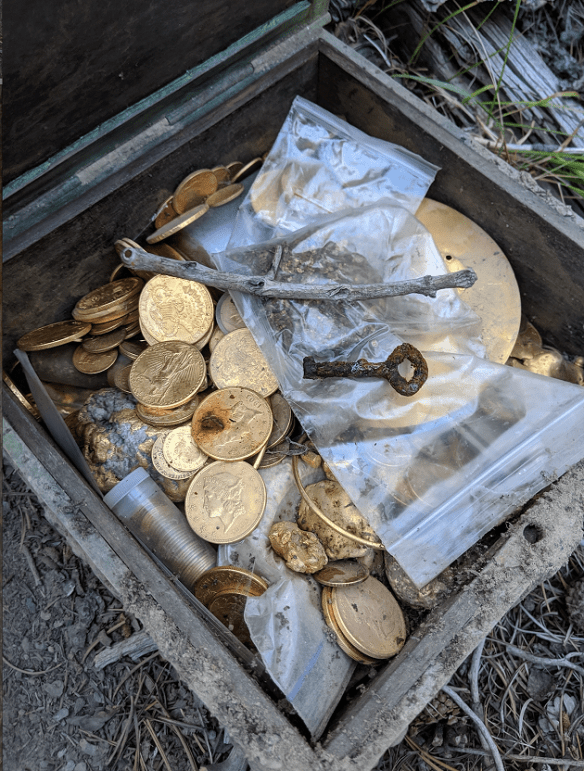
In 2010, Forrest Fenn hid a treasure chest full of gold and diamonds, purported to be worth millions, somewhere in the Rocky Mountains. The only clues offered — nine, to be specific — were hidden in his poem, “The Thrill of the Chase.”

After a decade of dissecting his poem, searching across a half-dozen states, engaging in hundreds (if not thousands!) of hours of brainstorming, deliberating, planning, and exploring, no one had found a thing.

And then, seemingly out of nowhere during the pandemic, Fenn announced on his website on June 6th that the treasure has been found. The hunt was over.

But there were no details. No revelation of the treasure’s location, no hint as to the lucky treasure hunter’s identity, nothing. The best we got was that he was from “back East.”

As you might expect, many would-be treasure hunters were disappointed, and more than a few cried foul, believing that either the announcement was a hoax, or the entire hunt had been a hoax. Doubters couldn’t decide if the treasure was never buried at all, was buried and then recovered later, or if the finder was an accomplice.

fennfound3

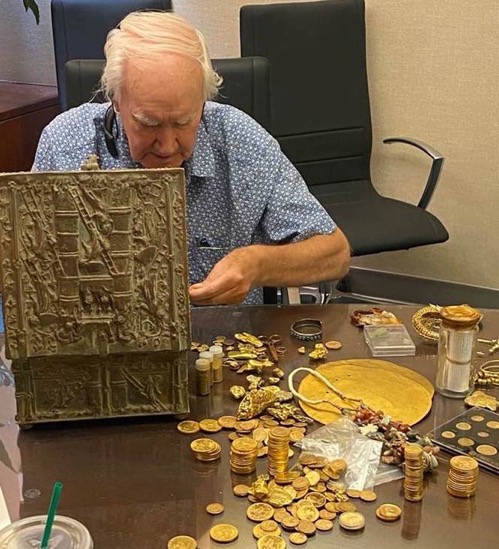
Weeks later, Fenn offered some photos — two of him examining the treasure and one of the treasure chest supposedly in situ, long exposed to the elements — which proved unconvincing to the doubters. If the photos of Fenn handling the treasure were taken after it was found, why did the finder bring the chest and treasure back to him?

It was all very confusing and more than a little suspicious.

Finally, more than a month after announcing that the treasure had been found, in response to many cries for him to reveal the solution and end the mystery for so many, Fenn revealed… the state in which the treasure had been found: Wyoming.

That answer satisfied some, particularly those whose solutions had pointed to other states, like New Mexico, Colorado, or Montana. But others remained upset. Understandably so. Wyoming is a pretty big state, after all.

Unfortunately, the hunt may truly be over, as Forrest Fenn passed away this week at the age of 90.

fennfound6

Fenn leaves behind a complicated legacy. Five deaths have been attributed to the treasure hunt, as well as numerous costly search-and-rescue operations (including one in the Grand Canyon!), several court cases, and even a break-in at Fenn’s house.

Beyond the treasure hunt, Fenn was also associated with federal investigations regarding antiquities and artifacts. In 2009, his home was raided by federal agents and several items seized. Fenn escaped charges, however.

Regardless, many hunters and admirers are in mourning, sending heartfelt messages in celebration of the man who enriched their lives with this curious endeavor.

But, once again, solvers have been left without a definitive solution. In an interview, Fenn claimed there is a way to verify that the chest was found even after he’d gone, but he didn’t specify how.

And now, his passing has reignited the doubters, who find the timing of everything all the more suspect. Exactly ten years after it was first hidden, the treasure is found by an unidentified seeker, a virtual ghost. Then a few months later, Fenn passes away.

forrest fenn

[Image courtesy of The Santa Fe New Mexican.]

The idea that he wanted to end the hunt (or the hoax) before his passing does seem more plausible, given the timing. It’s especially notable given that he claimed on more than one occasion that his dream was to pass away BESIDE the treasure, and achieve immortality by being found with the treasure, as if we were an Egyptian pharaoh or something.

We don’t know if this is truly the end for “The Thrill of the Chase” and all those treasure hunters over the last decade.

What we do know is that an inventive and captivating figure brought his love of nature, the outdoors, and adventure to thousands of strangers through his treasure hunt. And whether it was real or fake, the magic of that puzzle, and the good times they had trying to solve it, can never be taken away from them.

Farewell, Forrest. Thank you for the mystery.


Thanks for visiting PuzzleNation Blog today! Be sure to sign up for our newsletter to stay up-to-date on everything PuzzleNation!

You can also share your pictures with us on Instagram, friend us on Facebook, check us out on TwitterPinterest, and Tumblr, and explore the always-expanding library of PuzzleNation apps and games on our website!

The WORST Puzzle Solvers in Pop Culture

We celebrate puzzles here at PuzzleNation, and for the most part, we really try to keep the mood light and the overall tone a positive one. Because puzzles are great, and the people who make them are creative, brilliant, innovative, funny wordsmiths who labor for hours just to bring us some delightful challenges in black-and-white grid form.

As part of the general spirit of PuzzleNation Blog, we’ve been doing a series of posts where we shout-out the best puzzle solvers from the realms of fiction, be it horror movies, classic literature, television, YA novels, and children’s books.

But in all fairness, for some reason, a lot of not-so-great puzzle solvers have also been featured in pop culture. Sometimes, a crossword puzzle is the perfect prop for a bit of comic relief. Other times, the crossword serves as a lens for the character, providing valuable insight into their personality.

And if it’s true that you can’t truly enjoy the sunshine without having experienced a little bit of rain now and then, well, let’s rain on a few characters for the sake of fun, shall we?

Here’s a quick look at some of the worst puzzlers in pop culture.


President Jed Bartlet, The West Wing

Bartlet is an incredibly intelligent and well-read individual, which makes it all the more entertaining to watch him struggle with a crossword during the third-season episode “Dead Irish Writers.” He overthinks one entry, is outwitted by another — coming up with TEA for the clue “It may be bitter” instead of END — and even coloring in a square when an answer doesn’t fit the grid.

That’s not the point of the scene, of course. It’s a showcase of Bartlet’s relationship with his wife and how they’re both confronting a crisis in different ways.

But still… Jed, you’re bad at crosswords.

Bertram Cooper (Robert Morse) – Mad Men _ Season 7, Gallery – Photo Credit: Frank Ockenfels 3/AMC

Bert Cooper, Mad Men

I haven’t seen all of Mad Men, so I can’t be certain, but I only recall one character with a deft hand when it comes to crosswords: Don Draper’s secretary Miss Blankenship. And she serves as the perfect foil for Mad Men‘s worst puzzle solver, Bert Cooper.

One of the top brass at advertising agency Sterling Cooper, Bert is solving a crossword and asks for “a three-letter word for a flightless bird.” Anyone with crossword experience will answer as Miss Blankenship does, with “emu.” Cooper replies, “Nope, it starts with an L,” to which Miss Blankenship responds, “The hell it does.” Clearly Mr. Cooper has already gone astray with this solve.

It’s a funny juxtaposition to have someone in a lower position speak so bluntly to a higher-up, and it also fits perfectly with Miss Blankenship’s abrupt style.

[Image courtesy of SyFy Wire.]

Marjory the Trash Heap, Fraggle Rock

Also known as Madame Trash Heap, this sentient compost heap claims to have all wisdom, and serves as a strange oracle for the nearby Fraggles. Although she possesses some magical powers and her advice usually turns out okay, this doesn’t prevent her from making some pretty silly mistakes. And that includes working on crosswords.

In one episode, Marjory needed an 11-letter word for “life of the party.” Proving both her faulty reasoning and her egocentric view of the world, she confidently claims the answer is her uncle, MAXIMILIAN. (It’s spelled with a silent Q, of course.)

Yes, this is a kids show, and yes, it’s not meant to be taken seriously, but it does make you question her view of the world, no matter how good her intentions are.

[Image courtesy of Screenrant.]

Eugene H. Krabs, Spongebob Squarepants

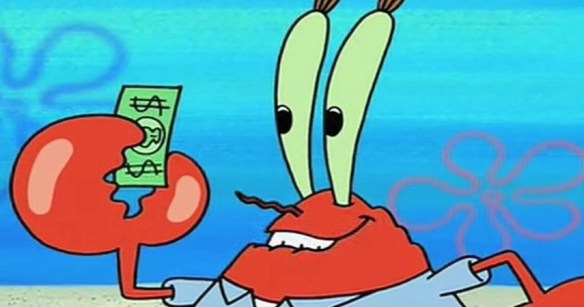
Mr. Krabs, owner of the Krusty Krab restaurant, is obsessed with money and views pretty much everyone and everything around him in terms of monetary value. This even extends to his recreational activities, as we see in one episode of the show where he is solving a crossword puzzle — well, a crisscross, but this happens in TV all the time — and puts the word “money” as the answer to every single five-letter space in the grid.

Unfortunately for Mr. Krabs, there’s one place in the grid where it wouldn’t work, spoiling the solve. (It is convenient for him that MONEY fits in so many of the five-letter spaces in the grid, though.)

I’m fairly certain Mr. Krabs doesn’t care, but hey, if you’re solving a crossword or a crisscross, you should care. A little. (At least he doesn’t color in grid squares like Jed Bartlet.)

[Image courtesy of Bill Watterson.]

Calvin, Calvin and Hobbes

There’s no denying that Calvin is a very clever boy. He creates games like Calvinball, builds some hilariously morbid snowmen, examines the world with a unique perspective that flummoxes and surprises in equal measure. But one Calvin and Hobbes comic strip reveals that he’s not necessarily a good crossword solver.

In response to the incredibly vague clue “bird,” Calvin says, “I’ve got it! ‘Yellow-bellied sapsucker!'” When Hobbes points out that there are only five boxes, Calvin brushes him off with a casual, “I know. These idiots make you write real small.”

On the one hand, Calvin would have no problem with rebus-style crosswords that put more than one letter into the grid. But on the other hand, no sane constructor would jam twenty letters into five boxes. (Hopefully.)

Walt Tenor, Stuck on You

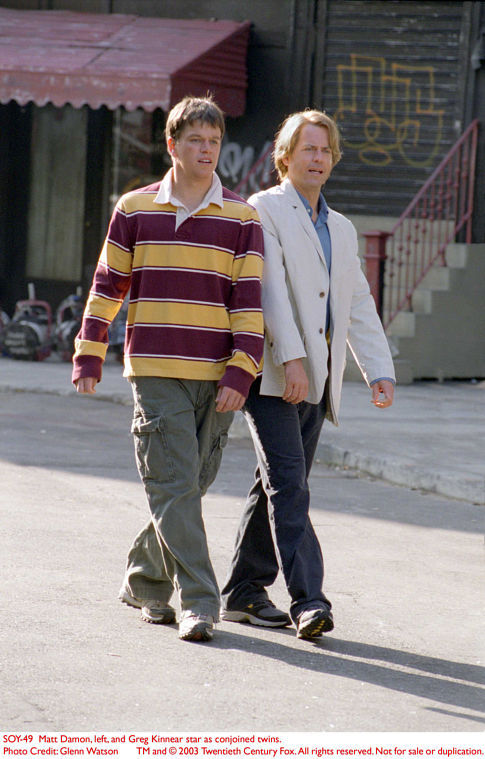
A pair of conjoined twins in this comedy film from 2003, Bob is the quiet shy brother and Walt is the outgoing one driven to seek success in Hollywood. To further illustrate the differences between the two brothers and the central personality conflict between them, crosswords are mentioned twice in the film.

In both cases, the obvious correct answer — provided by the more timid and thoughtful Bob — comes as a surprise to Walt, who has come up with more inappropriate potential answers. I can’t share either of them with you, fellow puzzler, because we try to keep it family-friendly here on PN Blog, but sufficed to say, the answers tell you what’s on Walt’s mind most of the time, to the detriment of both his relationship with his brother and his ability to actually complete a crossword.

By ignoring the common sense answers and always twisting the clues to suit what he’s thinking about, Walt shares several of the bad qualities seen in other people on this list. He might just be the worst puzzle solver in pop culture.

Can you think of any bad solvers in popular culture that we missed? Let us know in the comments section below. We’d love to hear from you!


Thanks for visiting PuzzleNation Blog today! Be sure to sign up for our newsletter to stay up-to-date on everything PuzzleNation!

You can also share your pictures with us on Instagram, friend us on Facebook, check us out on TwitterPinterest, and Tumblr, and explore the always-expanding library of PuzzleNation apps and games on our website!
What makes a great riddle?

[Image courtesy of PNG Find.]

I have always suspected that riddles were our first experiments with puzzles and puzzly thinking. Long before crosswords, Sudoku, codebreaking, and magic squares, the potential for wordplay and outside-the-box thinking would have appealed to storytellers, teachers, philosophers, and other deep thinkers.

Who doesn’t enjoy unraveling a riddle, parsing the carefully constructed sentences for every hint and nuance lurking within, and then extracting that tiny purest nugget of a solution from the ether?

Riddles appeal to our love of story and adventure, of heroes with wits as sharp as their swords. Riddles are the domain of gatekeepers and tricksters, monsters and trap rooms from the best Dungeons & Dragons quests.

And so, for centuries upon centuries, even up to the modern day, riddles have been a challenging and intriguing part of the world of puzzling.

We can trace them back to the Greeks, to Ancient Sumeria, to the Bible through Samson, and to mythology through the Sphinx. Riddles abound in literature; we find riddles in Shakespeare, in the works of Joyce, Carroll, and Austen, all the way up to the modern day with The Hobbit and Harry Potter. Every locked room mystery and impossible crime is a riddle to be unraveled.

[Image courtesy of Campbell County Public Library.]

But this raises a crucial question: what makes a good riddle?

At first glance, it should be confusing or elusive. But after some thought, there should be enough information within the riddle to provide a solution, either through wordplay/punnery OR through looking at the problem from a different perspective.

Let’s look at an example. In this instance, we’ll examine the riddle from Jane Austen’s Emma, which is posed to the title character by a potential suitor:

My first displays the wealth and pomp of kings,
Lords of the earth! their luxury and ease.
Another view of man, my second brings,
Behold him there, the monarch of the seas!

The answer is “courtship.”

The first half of the riddle refers to the playground of royalty — court — and the second half to the domain of her suitor — ship — and when combined they form the suitor’s desire. This riddle is confusingly worded, to be sure, but it makes sense when analyzed and it’s totally reasonable when the clever Emma figures out the answer… and turns down the suitor’s attempt at riddly courtship.

[Image courtesy of Yale.edu.]

So, what’s an example of a bad riddle? Well, unfortunately, we don’t have to look too hard for an example of one. Let’s examine Samson’s riddle from The Book of Judges in the Old Testament, which he poses to his dinner guests (with a wager attached):

Out of the eater,
something to eat;
out of the strong,
something sweet.

The answer, bafflingly, is “bees making a honeycomb inside the carcass of a lion.”

This is borderline nonsense unless Samson actually told you the story of killing a lion with his bare hands and later returning to the corpse to find bees building a hive inside. So, basically, this riddle not only screws over his dinner guests — who lost a wager to buy fine clothing if they couldn’t solve the rigged riddle — and serves as an excuse to brag about killing a lion. Samson is a jerk.

This is a bad riddle, because it’s designed to be confusing, but does not offer enough information to get to the desired solution. It’s purposely unsolvable, and that sucks. Riddles shouldn’t be arbitrary or nonsensical.

James Joyce pulled this in Ulysses. Lewis Carroll pulled it in Alice’s Adventures in Wonderland. And each of these examples give riddles a bad name. (Even if they do serve a literary purpose, as scholars claim they do in the Joyce and Carroll examples.)

Even if you want the hero to seem (or be) smarter than the reader, the riddle should still make sense. When confronted with five riddles by Gollum in The Hobbit, Bilbo Baggins solves four of them (and answers the fifth through charmingly dumb luck). It doesn’t hurt his character or make the reader feel like they’re being cheated when these riddles are resolved.

That’s another quality of a great riddle. Even if you don’t solve it, when you DO find the answer, it should feel like you were outwitted and you learned something, not that you were involved in a rigged game.

Oh, and speaking of learning, that reminds me of another example of a challenging yet fair riddle, one that comes from Ancient Sumeria (now, modern-day Iraq):

There is a house. One enters it blind and comes out seeing. What is it?

The answer, as you might have puzzled out, is “a school.”

Riddles can be devious or tricky; they can rely on misdirection, our own assumptions and biases, or careful word choice to befuddle the reader. But they should always be learning experiences, like the house you enter blind and leave seeing.

What are some of your favorite riddles, fellow puzzlers? Let us know in the comments section below. We’d love to hear from you!


Thanks for visiting PuzzleNation Blog today! Be sure to sign up for our newsletter to stay up-to-date on everything PuzzleNation!

You can also share your pictures with us on Instagram, friend us on Facebook, check us out on TwitterPinterest, and Tumblr, and explore the always-expanding library of PuzzleNation apps and games on our website!
The Hunt for New Crossword-Friendly Vocabulary!

crossword1

Epee. Etui. Acai. Amie. Anoa. Oleo. Iota.

We’ve seen a lot of curious words in crosswords over the years. Some of them are blips on the radar, appearing for a bit then vanishing without a trace. Others become part of the fabric of crosswords, forever synonymous with those enigmatic black-and-white grids under the banner of “crosswordese.”

It does make me wonder, though. What words haven’t we seen yet? What curious combinations of vowels and consonants await solvers in the future? Will they be blips or will they be the stuff of legends?

So I decided to try out different words that were either heavy on vowels or had strange letter patterns to see which ones had appeared in The New York Times crossword and when, according to the database on XWordInfo. And I turned up some curious results.

COOEE hasn’t appeared since April 1996. FLYBY hasn’t been in since 2007. QWERTY has only appeared twice, and not in almost a decade.

And yet, equally strange words like VORPAL and CRWTH haven’t appeared at all.

It’s hard to predict what odd vocabulary will strike a chord with constructors.

obiwanobi

I mean, sure, there’s a whiff of disdain surrounding crosswordese, but surely as former obscurities become more familiar, crosswordese must evolve and move forward as well. What will be the new crosswordese?

It’s not like we’re going to have new rivers, mountains, bays, or other geographical areas, for the most part. (True, the Aral Sea is pretty much the Aralkum Desert now, but that hasn’t stopped constructors from continuing to reference it.)

But I’m getting off-topic. Where would we find this new potential grid fill?

There are some delightful nuggets of linguistic oddness lurking in old dictionaries that have promise as part of a new generation of crosswordese. I mean, ECHO and OCHO are all well and good, but what about OCHE?

That’s the line behind which a darts player must stand, by the way. Zero hits in XWordInfo.

You need peculiar letter combinations to help fill your grid? How about BADAUD, UGHTEN, YERK, CAGG, and BORT? I could easily see these weird words getting constructors out of some jams when it comes to grid construction.

Sure, we’d have to educate solvers on these words, but if we can make ETUI a well-known form of crosswordese, why not these?

(Yes, I know, you want definitions. Don’t worry, I’ve got you covered. A badaud is a dimwitted gossip-spreader who believes just about anything. Ughten is morning twilight, the light that appears in the sky before the sun rises. To yerk is to beat someone vigorously and with rapid efficiency. A bort is a poor-quality diamond or a fragment of such a diamond (as well as a license plate that commonly runs out at Itchy and Scratchy Land). A cagg is a solemn vow not to drink for a certain amount of time.)

None of those words have appeared in the Times according to XWordInfo. Except BORT, but even that hasn’t appeared since 1993. Which is amazing, because the BORT joke on The Simpsons I referenced above happened in October of 1994. Come on, constructors, don’t leave us hanging. BORT did not have to lapse into irrelevance.

Speaking of words that have fallen by the wayside, I decided to try lost positives next.

Lost positives are words that were previously commonplace, but have been lost to time, while words with negative connotations based on them have survived. You know inept, inert, disheveled, uncouth, unkempt, and inane, but how often do you see ept, ert, sheveled, couth, kempt, pecunious, or ane?

Thus, lost positives.

So what happened when I checked them against the XWordInfo database?

EPT has appeared in the Times — as slang or a joking reference — but ERT hasn’t (except as a Scottish word). Nor has SHEVELED. KEMPT isn’t exactly common, but it has appeared in the last five years. COUTH hasn’t since 2003.

ANE, meanwhile, has hundreds of appearances, but as a hydrocarbon suffix, a Wheel of Fortune reference (“an e”), or as part of Sue Ane Langdon’s name.

So there’s some potential here.

frenchenglishwords

[Image courtesy of A Date With An Amateur.]

Hey, ERT gives me an idea. If we’re really going to discover some exciting, strange, and unexpected new grid fill, I think we have to look toward other languages.

All sorts of words that originate in other languages end up as part of the expansive English vocabulary. As James Nicoll once said, “We don’t just borrow words; on occasion, English has pursued other languages down alleyways to beat them unconscious and rifle their pockets for new vocabulary.”

Why not continue on in that fine tradition and add to the potential puzzle word lexicon?

In the last few years, the concept of hygge has grown in popularity. Hygge is a Danish and Norwegian word for a mood of coziness and comfortable conviviality with feelings of wellness and contentment. You can see how people would latch onto the concept for themselves.

So I was surprised to discover that hygge hadn’t appeared in the NYT. That’s a letter pattern begging for crossings.

Personally, I think we should start with words like hygge. A word that exists in another language to describe a concept that there simply isn’t a word for in English.

Saudade, while a bit long for casual grid use, is another word that has started making the transition into English vernacular. Saudade is a deep emotional state of nostalgic or profound melancholic longing for an absent something or someone that one cares for and/or loves.

There is a world of vocabulary out there waiting to be harnessed for crossword obscurity, and there’s even a website dedicated to it.

If you check out Eunoia, you’ll find hundreds of foreign words to encapsulate moods and ideas, feelings and expressions that can plug holes both in your vocabulary and your grids.

Crossword.

Here’s a small sampling of words I found on the site that might help cruciverbalists who have constructed themselves into a corner:

Resfeber is a Swedish word for “the feeling of excitement and nervousness experienced by a traveler before undertaking a journey.”

Ubuntu is a Zulu word for “a quality that includes the essential human virtues, a combination of compassion and humility.”

Mångata is a Swedish word for “the road-like reflection of moonlight on water.”

Wegbier is a German word for “a beer you’re having on your way somewhere (i.e. a party).”

Karelu is a Tulu word for “the mark left on the skin by wearing something tight.”

Rauxa is a Catalan word for “sudden determination or action.”

Umay is a Tagalog word for “getting tired of a certain food.”

To Fernweh is to have a yearning to see distant places (in German).

Either half of wabi-sabi, a Japanese word meaning “finding beauty within the imperfections of life and peacefully accepting the natural cycle of growth and decay” could prove handy in a grid.

So I put the question to you, fellow puzzlers and PuzzleNationers. What words would you like to see appear in crosswords more? Where do you think we should look for fresh, new, peculiar crosswordese? Let us know in the comments section below. We’d love to hear from you!


Thanks for visiting PuzzleNation Blog today! Be sure to sign up for our newsletter to stay up-to-date on everything PuzzleNation!

You can also share your pictures with us on Instagram, friend us on Facebook, check us out on TwitterPinterest, and Tumblr, and explore the always-expanding library of PuzzleNation apps and games on our website!