Candyland: Pastime or Past Its Prime?

If you ask the average person to name five board games off the top of their head, you can pretty readily guess some of their replies. Monopoly is always there, Scrabble is often second, and then you’ll get a smattering of Candyland, Chutes & Ladders, Sorry, and the like, and then a few outliers like Mouse Trap, Trouble, The Game of Life, and so on.

Candyland is a perennial name on that list, but if you look around the Internet where modern board game enthusiasts congregate, Candyland often appears on lists of the worst board games.

Why is that? Does Candyland get a bad rap?

Well, yes and no.

Strangely enough, the reason that causes so many game fans to put it on “worst” lists is the same reason it is celebrated as a good intro game for children: lack of choice.

Candyland isn’t really a game. There are no moves to make, no strategy to employ. Nothing you say or do will make you the winner. The game is purely one of chance. Once the deck is shuffled, the game is essentially over. (Chutes & Ladders and the card game War suffer from the same problem.)
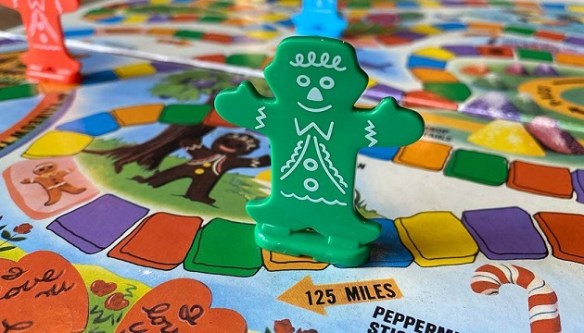
Defenders of Candyland say that this is intentional… which is true. The game was designed to entertain and distract children either suffering from polio or trapped inside because of polio.

But defenders also argue that the game teaches children about reading instructions, learning to take turns, pattern-recognition, and more, all without the “complication” of actual tasks to complete.

But this is a weak argument, because virtually ANY game can teach these things and still offer children choices to make that affect the game.

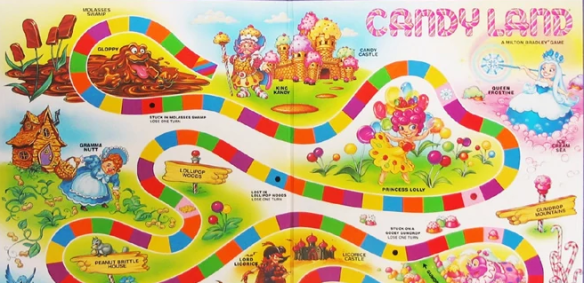
Still, kids absolutely love Candyland. It’s bright and simple and silly, and the characters are charming.

So, what can we do to make the game engaging for solvers who actually want to do something, but won’t alienate the simplicity factor that makes it appealing to the youngest board game fans among us?

We institute some house rules!
1. Pick a card

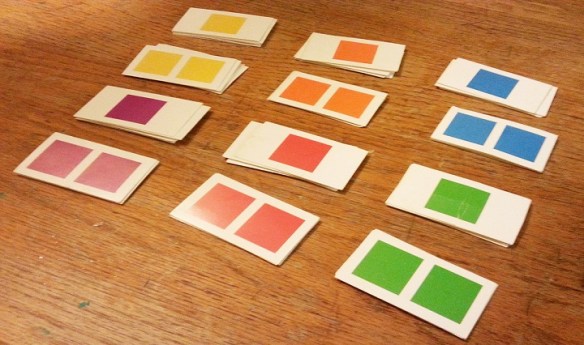
Give the players two, three, or four cards to choose from. By allowing them to actually choose a card, there’s some level of strategy involved, even if it’s still a race to the end.

A variation on this idea is the push-your-luck house rule. In a regular game of Candyland, after you draw your card, you can ditch it for a second random draw. If you choose the second card, you must play it. This is a simple modification, but one that still allows players to affect the game in a meaningful way. Do you press your luck or accept the card you know you have?

2. Spot the color

One house rule suggested that a child should have to look around the room and point out an object that’s the same color as the card before they can move forward. While this doesn’t affect the gameplay, it does reinforce the idea that you can use Candyland to teach pattern recognition.
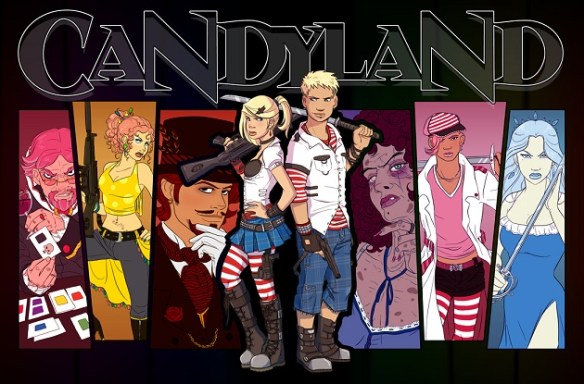
[A gritty reboot of Candyland by artist Shira-Chan.]

3. Deception

Now, it’s probably not a great idea to teach your kids about lying through board games. (After all, you’ll never be able to trust them in a game of Battleship ever again.) But adding a deception element can turn Candyland into an introductory poker game.

Basically, you draw your card, and announce your move without showing the card. If someone thinks you’re lying, they can call you out.

If you are lying, you don’t move AND you lose your next turn. But if you’re not lying, the player who accused you loses a turn.

4. Add trivia

This was a variation in my house on more than one occasion. Since there are six colors on the game board — and six categories in Trivial Pursuit — we combined the two.

When you draw a color card, you must answer a question of the corresponding color. Get it right, and you move on. Get it wrong, you stay where you are.

There are all sorts of terrific ideas out there to make Candyland more enjoyable for players of all ages — for instance, we found some good suggestions listed here which we didn’t cover — and with a little creativity, you can resurrect a classic and make it new again.

And we’ll leave it to you to decide if it’s a good or bad game after that.


Thanks for visiting PuzzleNation Blog today! Be sure to sign up for our newsletter to stay up-to-date on everything PuzzleNation!

You can also share your pictures with us on Instagram, friend us on Facebook, check us out on TwitterPinterest, and Tumblr, and explore the always-expanding library of PuzzleNation apps and games on our website!

The 2021 Boswords Spring Themeless League: Looking Back

boswords new

After two months of challenging, engaging, and thoroughly enjoyable weekly solving, the Boswords 2021 Spring Themeless League came to a close a few weeks ago.

If you’re unfamiliar, the Boswords 2021 Spring Themeless League spreads out a tournament-style solving experience over nine weeks, one themeless crossword per week. Each puzzle is scored based on your answer accuracy (incorrect letters, empty squares, etc.) and how quickly you complete the grid.

While each week’s puzzle only had one solution, there were three sets of clues, each representing a different difficulty level for solvers. Smooth was the least challenging, Choppy was the middle ground, and Stormy was the most challenging. (When solvers registered to participate, they chose the difficulty level that suited them best.)

Hundreds of solvers signed up for the challenge of two months of themeless puzzle solving and a bit of friendly competition, and now that it’s over, I’d like to share a few thoughts about my experience in the League.

exercise-brain-crossword-670x335

When I participated in the 2020 Fall Themeless League, I didn’t really know what to expect. I didn’t have much experience with themeless puzzles, and I rarely solve online, so even though I’m very familiar with crosswords, it felt like a new experience.

But with last season’s league under my belt, I went into the 2021 Spring Themeless League excited to again test my skills with some top-flight puzzles, a touch more confident in my themeless solving than last time.

As you might expect, being freed from the shackles of themed puzzle building allows constructors to really flex their creative muscle, indulging all sorts of curious and unexpected vocabulary as they cross long entries and employ staggeringly few black squares in these impressive grids.

tumblr_nnl5c43Ov61qd4fqho1_500

Aimee Lucido opened up week one with three 13-letter entries across the center of the grid, giving new solvers a taste of just what constructors can do with a themeless grid, and offering established solvers some terrific crossings and fun vocabulary.

Peter Wentz’s week two puzzle and the week three offering from Brynn Diehl and Mark Diehl continued to set the tone for the season, mixing some clever wordplay in their cluing with ambitious grid construction. (Week three’s puzzle had stacks of 10-letter entries in every corner, which was impressive.)

Rachel Fabi provided week four’s puzzle — which really tickled me by having “advice column” as a down entry, i.e. a column — and Ryan McCarty’s week five puzzle was one of my smoothest solves of the tournament. Plus, he had “doggos” in the grid, and I am fully onboard with “doggo” becoming crosswordese.

I stupidly submitted my grid with an empty square in Patti Varol’s week six, which hurt my score somewhat. I still enjoyed the puzzle, though. Crossing SPANKED with BUCKNAKED was certainly a style choice. Also, Patti always teaches me new words with her puzzles. This time around, it was “vaporetto.”

Week seven’s offering by Ricky Cruz really impressed me with some difficult letter placements — particularly the plethora of Xs in the lower-left corner. (Unfortunately, I missed the submission deadline for this one, so I got a zero for this puzzle.)

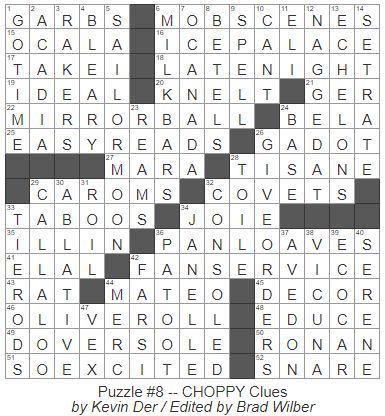
That was followed by Kevin Der’s amazing week eight grid. This one took me ten minutes longer than my average time for the rest of the tournament puzzles.

I mean, look at this grid:

kevin der grid

Week nine’s championship puzzle was constructed by Brooke Husic, and it was the perfect closer to two months of solving. It was sharp and well-constructed, sending everyone home happy.

All in all, I enjoyed the Spring Themeless League more than the Fall League because I felt much more comfortable with the solving interface and I had a better handle on themeless solving overall. My times were stronger — although far from the blistering pace set by many of the top solvers — and I felt like I was making smarter choices in my solving. It’s always nice to both see and feel improvement in your puzzling.

I ended up placing 262nd out of around 600 competitors — had I actually gotten puzzle seven submitted, I would’ve been closer to 115th or so — which is about on pace for how I did in the Fall Themeless League.

But the tournament experience was delightful. Having a new challenge awaiting you every week is a treat, especially with the fantastic roster of talent they assembled in this season’s constructors.

And with the promise of future Boswords-hosted events in 2021 like the Summer Tournament on July 25th and the Fall Themeless League in October and November, it’s nice to have exciting puzzle events to look forward to in the near future.

Kudos to everyone who helped bring this marvelous project together, and kudos to everyone who participated. It was so much fun.


Thanks for visiting PuzzleNation Blog today! Be sure to sign up for our newsletter to stay up-to-date on everything PuzzleNation!

You can also share your pictures with us on Instagram, friend us on Facebook, check us out on TwitterPinterest, and Tumblr, and explore the always-expanding library of PuzzleNation apps and games on our website!
Vague Cluing: Yea or Nay?

vague

When is vagueness in crossword cluing a bad thing?

That’s kind of a loaded question, because I think it depends on the clue and the solver’s knowledge base. But there are definitely good vague clues and bad vague clues.

Someone on Reddit’s r/crossword forum mentioned the clue “Son of Zeus,” which got a laugh from folks who remember their Greek mythology and just how… prolific Zeus was.

But to me, this isn’t necessarily a bad clue. You know the number of letters (4 in this particular case), which helps narrow down the field a lot.

There are some synonym-style clues that do lend themselves to multiple answers, which can be frustrating for solvers.

Problem-solving-crossword

For instance, if you have a 5-letter word and the clue is “Kingly,” you could have REGAL or ROYAL, and those shared letters add a level of uncertainty and challenge to the grid. Similarly, if you have a 5-letter word and the clue is “Escape” or “Sidestep,” you’ve got EVADE, ELUDE, AVOID, and DODGE all as possibilities. That’s a little tougher.

But all of these clues seem fair to me. The vague cluing style that really irks me is “Certain [blank]”.

“Certain cat,” for example, might as well just be “Cat.” The word “certain” adds literally NOTHING to the clue. “Type of [blank]” and “Kind of [blank]” clues can also fall into this trap, but there are a fair number of cases where those clues point toward a category, not just an example of that particular group, so “Type of” and “Kind of” still provide some context.

But “certain” is a waste of typing. You could have given me a helpful adjective, or a misleading one, or a funny one. Instead, it’s the least helpful addition possible.

That sort of vague cluing is infuriating, because there’s no cleverness or art to it. Obviously, the only exception here would be some sort of wordplay involving the definition of “certain.” Something like “Certain thing?” for LOCK or GIVEN. But those are pretty rare.

In the end, vagueness can be a tool for clever cluing or a bit of filler in a long-overused clue. It’s all up to the constructor.

Are there are any vague clues or cluing tropes that get your goat, fellow puzzlers and PuzzleNationers? Let us know in the comments section below! We’d love to hear from you.


Thanks for visiting PuzzleNation Blog today! Be sure to sign up for our newsletter to stay up-to-date on everything PuzzleNation!

You can also share your pictures with us on Instagram, friend us on Facebook, check us out on TwitterPinterest, and Tumblr, and explore the always-expanding library of PuzzleNation apps and games on our website!
May the Fourth Be With You!

Hello fellow puzzlers and PuzzleNationers! It’s Star Wars Day, and what better way to celebrate than with a puzzly Star Wars brain teaser!

Yes, we’ve created a Jedi-themed logic puzzle for you to unravel! Can you crack this Star Wars-inspired mystery?


On a small planet in the Mid Rim, a group of Jedi dispatched several squads of battle droids. Reporters had a hard time piecing together descriptions of the five Jedi who saved the day, even after interviewing many witnesses.

The only thing the reporters were sure of? The names of the five Jedi:

  • Drosco Wrs
  • Ko Duus
  • Pramyt Gorc
  • Wendo Grars
  • Seredwok

Each of the Jedi wielded a different color lightsaber (green, yellow, blue, orange, or purple). Each held a different title within the Jedi Order (Padawan, Knight, Master, Instructor, or Council Member). And each of them was a different species (Barabel, Bith, Nautolan, Twi’lek, or Wookiee).

Based on the information gathered below, can you figure out which lightsaber color, title, and species belongs with which Jedi?

1. Drosco Wrs (whose lightsaber is either orange or green) is neither the padawan nor the knight.

2. Either Ko Duus or the Bith is the council member, and the other has the yellow lightsaber.

3. The Jedi has the blue lightsaber (who isn’t on the council) is either the Twi’lek or the Wookiee; if Twi’lek, then Drosco Wrs is the instructor, but if Wookiee, then Seredwok is the instructor.

4. The padawan (who has neither the blue lightsaber nor the green lightsaber) is not Seredwok.

5. Wendo Grars (who isn’t the knight) doesn’t have the yellow lightsaber or the blue lightsaber.

6. The Barabel (who is either Pramyt or Seredwok) isn’t the Jedi with the purple lightsaber.

7. The master has either the purple lightsaber or the yellow lightsaber. Neither the purple lightsaber nor the yellow lightsaber are wielded by the Nautolan.

Good luck, fellow puzzlers! This puzzle requires NO actual knowledge of Star Wars to solve. All you need are your puzzly wits!

Let us know if you solved it in the comments below! And May the Fourth Be With You!


Thanks for visiting PuzzleNation Blog today! Be sure to sign up for our newsletter to stay up-to-date on everything PuzzleNation!

You can also share your pictures with us on Instagram, friend us on Facebook, check us out on TwitterPinterest, and Tumblr, and explore the always-expanding library of PuzzleNation apps and games on our website!
The Robots Have Come For Our Crosswords!

robo-machine---puzzler-robot---crossword-p-image-262284-grande

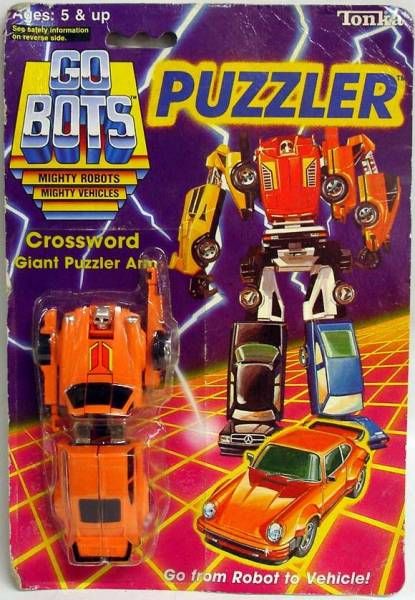
Well, it was bound to happen. We’ve seen it in chess, and Go, and Scrabble. Now, crosswords are the latest pastime to fall to the inevitable machine takeover of civilization.

Okay, I’m being a tad hyperbolic here. Robots aren’t snatching crossword puzzles out of peoples’ hands and solving them, after all.

But we have reached a peculiar milestone in AI and crossword history: a computer program won the American Crossword Puzzle Tournament. Sorta.

Dr. Fill, the crossword-solving creation of Matt Ginsberg, was able to balance the occasional solving mistake with a blistering solving speed in order to overtake any human competitors in its total tournament score.

But not by much. Former ACPT champion Erik Agard was only 15 points behind Dr. Fill on the seven tournament puzzles. Dr. Fill then went on to solve the championship puzzle in 49 seconds (while actual winner Tyler Hinman did so in three minutes).

acptlogo

But, as it turns out, this isn’t the old Dr. Fill that has been competing in the ACPT for years. No, this year’s Dr. Fill is a curious hybrid of the original programming and a neural network known as the Berkeley Crossword Solver.

And this Frankenstein’s monster of puzzle-solving machinery is what toppled the competition in the first-ever virtual edition of the tournament.

According to an article on Slate:

An alliance came naturally. Ginsberg and the Berkeley crew started working together just two weeks before the tournament, plugging the latter system into the former, and the centaur program finally ran with just days to go.

The result, hastily constructed though it was, was a marvel, its pieces working hand in glove to solve crosswords. Ginsberg’s system handled the grid and the colder, mathematical side of things, searching and placing answers, while the Berkeley team’s system unriddled the hazier, “human” side of the language of the clues, crosswords’ music.

You know, it’s kind of reassuring that it took TWO computer programs working in tandem to best the top puzzle solvers.

Also, it’s not like Dr. Fill can actually win a tournament. Not until it can hold a marker and solve in person in front of everybody while Greg Pliska and Ophira Eisenberg crack wise about it, at least.

It does make next year’s tournament more intriguing. Will Dr. Fill perform as well “in person”? Or will the master cruciverbalists retake the title?

And hey, if anyone is building a body for Dr. Fill, please stop. Stop, rewatch every sci-fi movie about AI and robots, and then rethink your life choices.


Thanks for visiting PuzzleNation Blog today! Be sure to sign up for our newsletter to stay up-to-date on everything PuzzleNation!

You can also share your pictures with us on Instagram, friend us on Facebook, check us out on TwitterPinterest, and Tumblr, and explore the always-expanding library of PuzzleNation apps and games on our website!
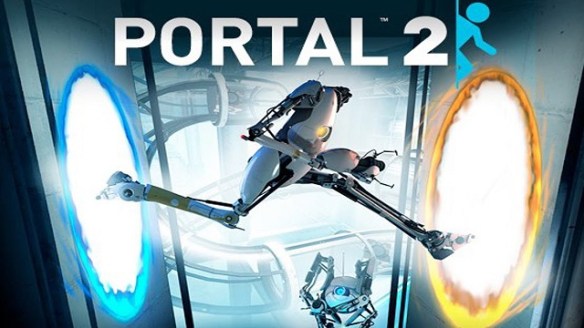
Portal 2 Celebrates 10 Years with Time Travel!

portal 2

Last week, one of the most iconic puzzle games in the history of video games turned ten years old.

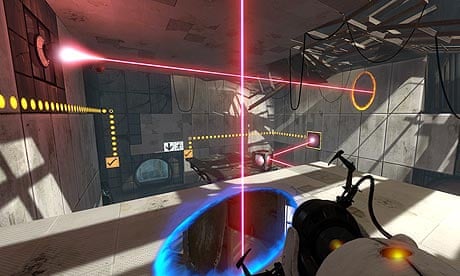
Portal 2 is the beloved sequel to the groundbreaking (and mind-bending) game about a gun that creates portals through which you can leap, fall, and maneuver your way past increasingly complex puzzles and locked rooms. You can make portals — blue or orange, one to enter, the other to exit — with the famous portal gun.

Whether there are buttons to be pressed, lasers to be re-directed, or inaccessible platforms to access, your portal gun is the only tool you need to finish the job… if you’re clever enough.

I reached out to some of my video game-savvy friends to ask their thoughts on ten years of Portal 2, and the feedback was unanimously positive:

Each puzzle taught a lesson, building upon your knowledge of the game’s “rules” and “tricks.” By the end of the game, your brain has been re-wired to solve some of the most brutal possible puzzles. It definitely felt like my brain was running at max capacity playing the portal games.

Portal-2-007

The best puzzle games teach us lessons and allow us to build on those lessons to get better. The more crosswords you solve, the more experience you have unraveling clues and filling in grids. It’s the same thing with Portal.

Another video game enthusiast shared this:

It (along with Portal 1) is one of the only puzzle games that managed to complete from start to finish without resorting to an online hint guide of some sort. It was difficult enough that I felt challenged, but intuitive and logical enough that I was eventually able to figure everything out, which to me is the hallmark of a fun game.

Might also be the first time I ever felt genuine sympathy for a robot in a game. (Or at least the… well, I don’t want to spoil it for anyone who has yet to play through it.)

Oh yeah, it’s also the only first-person puzzle game I can think of where I don’t want to spoil anything for people.

It’s a rare puzzle (and rarer game) indeed where failure doesn’t feel like failure, and instead feels like a learning experience that pushes you to try again with what you’ve learned. Some puzzles and games make that a crushing experience… but Portal makes it fun. Portal makes it compelling. And Portal makes it all so satisfying when you figure it all out.

And now, as fans mark a decade of brain-melting Portal 2 puzzles, a fan-designed free mod known as Portal Reloaded is set to challenge Portal 2 fans all over again.

Portal2-Reloaded-Mod-Valve

How? By adding time travel to the mix.

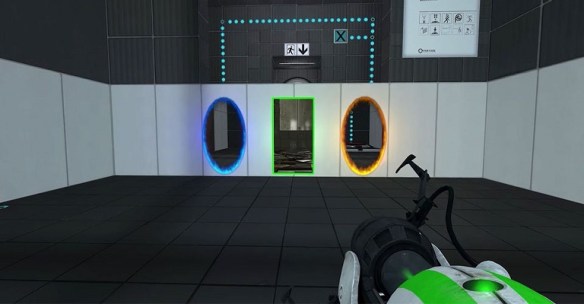
Yes, your portal gun isn’t just allowing you to manipulate space… it’s allowing you to manipulate time as well.

From the Kotaku article about Portal Reloaded:

Portal Reloaded is a mod, released just in time for Portal 2‘s 10th birthday, that introduces a new set of test chambers and, more importantly, a new portal colour. You’ll still be using the old blue and orange ones, but the green one you’ll also get will let you move through time, as you set up puzzles in one timeline and then move them along/solve them across two different eras, set 20 years apart.

When a game that already lets you bend space to your whim with some clever positioning, the possibility of bending time the same way is practically irresistible.

But will people be talking about Portal Reloaded in ten years the same way they do about Portal 2? Unfortunately, there’s no green portals to tell us the answer. We’ll just have to wait and see.


Thanks for visiting PuzzleNation Blog today! Be sure to sign up for our newsletter to stay up-to-date on everything PuzzleNation!

You can also share your pictures with us on Instagram, friend us on Facebook, check us out on TwitterPinterest, and Tumblr, and explore the always-expanding library of PuzzleNation apps and games on our website!