Vague Cluing: Yea or Nay?

vague

When is vagueness in crossword cluing a bad thing?

That’s kind of a loaded question, because I think it depends on the clue and the solver’s knowledge base. But there are definitely good vague clues and bad vague clues.

Someone on Reddit’s r/crossword forum mentioned the clue “Son of Zeus,” which got a laugh from folks who remember their Greek mythology and just how… prolific Zeus was.

But to me, this isn’t necessarily a bad clue. You know the number of letters (4 in this particular case), which helps narrow down the field a lot.

There are some synonym-style clues that do lend themselves to multiple answers, which can be frustrating for solvers.

Problem-solving-crossword

For instance, if you have a 5-letter word and the clue is “Kingly,” you could have REGAL or ROYAL, and those shared letters add a level of uncertainty and challenge to the grid. Similarly, if you have a 5-letter word and the clue is “Escape” or “Sidestep,” you’ve got EVADE, ELUDE, AVOID, and DODGE all as possibilities. That’s a little tougher.

But all of these clues seem fair to me. The vague cluing style that really irks me is “Certain [blank]”.

“Certain cat,” for example, might as well just be “Cat.” The word “certain” adds literally NOTHING to the clue. “Type of [blank]” and “Kind of [blank]” clues can also fall into this trap, but there are a fair number of cases where those clues point toward a category, not just an example of that particular group, so “Type of” and “Kind of” still provide some context.

But “certain” is a waste of typing. You could have given me a helpful adjective, or a misleading one, or a funny one. Instead, it’s the least helpful addition possible.

That sort of vague cluing is infuriating, because there’s no cleverness or art to it. Obviously, the only exception here would be some sort of wordplay involving the definition of “certain.” Something like “Certain thing?” for LOCK or GIVEN. But those are pretty rare.

In the end, vagueness can be a tool for clever cluing or a bit of filler in a long-overused clue. It’s all up to the constructor.

Are there are any vague clues or cluing tropes that get your goat, fellow puzzlers and PuzzleNationers? Let us know in the comments section below! We’d love to hear from you.


Thanks for visiting PuzzleNation Blog today! Be sure to sign up for our newsletter to stay up-to-date on everything PuzzleNation!

You can also share your pictures with us on Instagram, friend us on Facebook, check us out on TwitterPinterest, and Tumblr, and explore the always-expanding library of PuzzleNation apps and games on our website!

May the Fourth Be With You!

Hello fellow puzzlers and PuzzleNationers! It’s Star Wars Day, and what better way to celebrate than with a puzzly Star Wars brain teaser!

Yes, we’ve created a Jedi-themed logic puzzle for you to unravel! Can you crack this Star Wars-inspired mystery?


On a small planet in the Mid Rim, a group of Jedi dispatched several squads of battle droids. Reporters had a hard time piecing together descriptions of the five Jedi who saved the day, even after interviewing many witnesses.

The only thing the reporters were sure of? The names of the five Jedi:

  • Drosco Wrs
  • Ko Duus
  • Pramyt Gorc
  • Wendo Grars
  • Seredwok

Each of the Jedi wielded a different color lightsaber (green, yellow, blue, orange, or purple). Each held a different title within the Jedi Order (Padawan, Knight, Master, Instructor, or Council Member). And each of them was a different species (Barabel, Bith, Nautolan, Twi’lek, or Wookiee).

Based on the information gathered below, can you figure out which lightsaber color, title, and species belongs with which Jedi?

1. Drosco Wrs (whose lightsaber is either orange or green) is neither the padawan nor the knight.

2. Either Ko Duus or the Bith is the council member, and the other has the yellow lightsaber.

3. The Jedi has the blue lightsaber (who isn’t on the council) is either the Twi’lek or the Wookiee; if Twi’lek, then Drosco Wrs is the instructor, but if Wookiee, then Seredwok is the instructor.

4. The padawan (who has neither the blue lightsaber nor the green lightsaber) is not Seredwok.

5. Wendo Grars (who isn’t the knight) doesn’t have the yellow lightsaber or the blue lightsaber.

6. The Barabel (who is either Pramyt or Seredwok) isn’t the Jedi with the purple lightsaber.

7. The master has either the purple lightsaber or the yellow lightsaber. Neither the purple lightsaber nor the yellow lightsaber are wielded by the Nautolan.

Good luck, fellow puzzlers! This puzzle requires NO actual knowledge of Star Wars to solve. All you need are your puzzly wits!

Let us know if you solved it in the comments below! And May the Fourth Be With You!


Thanks for visiting PuzzleNation Blog today! Be sure to sign up for our newsletter to stay up-to-date on everything PuzzleNation!

You can also share your pictures with us on Instagram, friend us on Facebook, check us out on TwitterPinterest, and Tumblr, and explore the always-expanding library of PuzzleNation apps and games on our website!

The Robots Have Come For Our Crosswords!

robo-machine---puzzler-robot---crossword-p-image-262284-grande

Well, it was bound to happen. We’ve seen it in chess, and Go, and Scrabble. Now, crosswords are the latest pastime to fall to the inevitable machine takeover of civilization.

Okay, I’m being a tad hyperbolic here. Robots aren’t snatching crossword puzzles out of peoples’ hands and solving them, after all.

But we have reached a peculiar milestone in AI and crossword history: a computer program won the American Crossword Puzzle Tournament. Sorta.

Dr. Fill, the crossword-solving creation of Matt Ginsberg, was able to balance the occasional solving mistake with a blistering solving speed in order to overtake any human competitors in its total tournament score.

But not by much. Former ACPT champion Erik Agard was only 15 points behind Dr. Fill on the seven tournament puzzles. Dr. Fill then went on to solve the championship puzzle in 49 seconds (while actual winner Tyler Hinman did so in three minutes).

acptlogo

But, as it turns out, this isn’t the old Dr. Fill that has been competing in the ACPT for years. No, this year’s Dr. Fill is a curious hybrid of the original programming and a neural network known as the Berkeley Crossword Solver.

And this Frankenstein’s monster of puzzle-solving machinery is what toppled the competition in the first-ever virtual edition of the tournament.

According to an article on Slate:

An alliance came naturally. Ginsberg and the Berkeley crew started working together just two weeks before the tournament, plugging the latter system into the former, and the centaur program finally ran with just days to go.

The result, hastily constructed though it was, was a marvel, its pieces working hand in glove to solve crosswords. Ginsberg’s system handled the grid and the colder, mathematical side of things, searching and placing answers, while the Berkeley team’s system unriddled the hazier, “human” side of the language of the clues, crosswords’ music.

You know, it’s kind of reassuring that it took TWO computer programs working in tandem to best the top puzzle solvers.

Also, it’s not like Dr. Fill can actually win a tournament. Not until it can hold a marker and solve in person in front of everybody while Greg Pliska and Ophira Eisenberg crack wise about it, at least.

It does make next year’s tournament more intriguing. Will Dr. Fill perform as well “in person”? Or will the master cruciverbalists retake the title?

And hey, if anyone is building a body for Dr. Fill, please stop. Stop, rewatch every sci-fi movie about AI and robots, and then rethink your life choices.


Thanks for visiting PuzzleNation Blog today! Be sure to sign up for our newsletter to stay up-to-date on everything PuzzleNation!

You can also share your pictures with us on Instagram, friend us on Facebook, check us out on TwitterPinterest, and Tumblr, and explore the always-expanding library of PuzzleNation apps and games on our website!

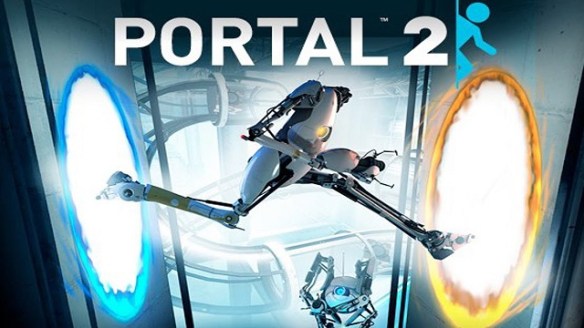
Portal 2 Celebrates 10 Years with Time Travel!

portal 2

Last week, one of the most iconic puzzle games in the history of video games turned ten years old.

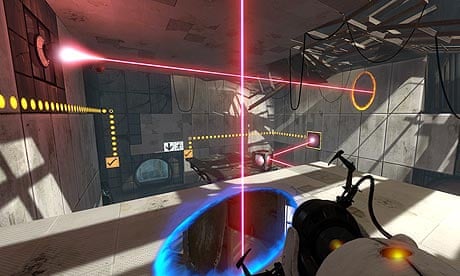
Portal 2 is the beloved sequel to the groundbreaking (and mind-bending) game about a gun that creates portals through which you can leap, fall, and maneuver your way past increasingly complex puzzles and locked rooms. You can make portals — blue or orange, one to enter, the other to exit — with the famous portal gun.

Whether there are buttons to be pressed, lasers to be re-directed, or inaccessible platforms to access, your portal gun is the only tool you need to finish the job… if you’re clever enough.

I reached out to some of my video game-savvy friends to ask their thoughts on ten years of Portal 2, and the feedback was unanimously positive:

Each puzzle taught a lesson, building upon your knowledge of the game’s “rules” and “tricks.” By the end of the game, your brain has been re-wired to solve some of the most brutal possible puzzles. It definitely felt like my brain was running at max capacity playing the portal games.

Portal-2-007

The best puzzle games teach us lessons and allow us to build on those lessons to get better. The more crosswords you solve, the more experience you have unraveling clues and filling in grids. It’s the same thing with Portal.

Another video game enthusiast shared this:

It (along with Portal 1) is one of the only puzzle games that managed to complete from start to finish without resorting to an online hint guide of some sort. It was difficult enough that I felt challenged, but intuitive and logical enough that I was eventually able to figure everything out, which to me is the hallmark of a fun game.

Might also be the first time I ever felt genuine sympathy for a robot in a game. (Or at least the… well, I don’t want to spoil it for anyone who has yet to play through it.)

Oh yeah, it’s also the only first-person puzzle game I can think of where I don’t want to spoil anything for people.

It’s a rare puzzle (and rarer game) indeed where failure doesn’t feel like failure, and instead feels like a learning experience that pushes you to try again with what you’ve learned. Some puzzles and games make that a crushing experience… but Portal makes it fun. Portal makes it compelling. And Portal makes it all so satisfying when you figure it all out.

And now, as fans mark a decade of brain-melting Portal 2 puzzles, a fan-designed free mod known as Portal Reloaded is set to challenge Portal 2 fans all over again.

Portal2-Reloaded-Mod-Valve

How? By adding time travel to the mix.

Yes, your portal gun isn’t just allowing you to manipulate space… it’s allowing you to manipulate time as well.

From the Kotaku article about Portal Reloaded:

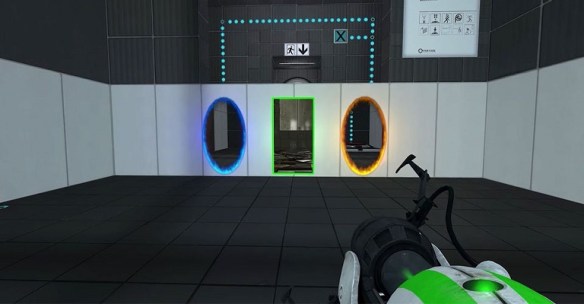
Portal Reloaded is a mod, released just in time for Portal 2‘s 10th birthday, that introduces a new set of test chambers and, more importantly, a new portal colour. You’ll still be using the old blue and orange ones, but the green one you’ll also get will let you move through time, as you set up puzzles in one timeline and then move them along/solve them across two different eras, set 20 years apart.

When a game that already lets you bend space to your whim with some clever positioning, the possibility of bending time the same way is practically irresistible.

But will people be talking about Portal Reloaded in ten years the same way they do about Portal 2? Unfortunately, there’s no green portals to tell us the answer. We’ll just have to wait and see.


Thanks for visiting PuzzleNation Blog today! Be sure to sign up for our newsletter to stay up-to-date on everything PuzzleNation!

You can also share your pictures with us on Instagram, friend us on Facebook, check us out on TwitterPinterest, and Tumblr, and explore the always-expanding library of PuzzleNation apps and games on our website!

A Mysterious Message, Inscribed on a Sword, Found in a River

_103722388_d0c23635-6379-4bf7-bac8-478493c2d1c7

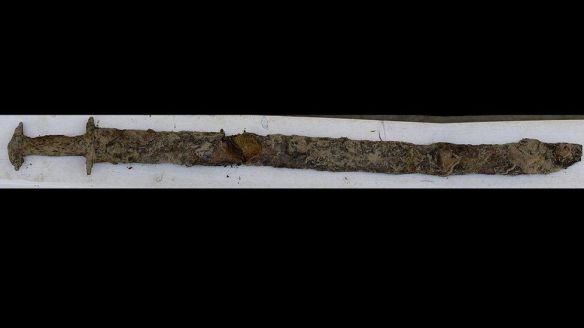
A few years ago, a very curious news story broke about an 8-year-old girl pulling a thousand-year-old sword out of a lake in Sweden.

Saga Vanecek — which sounds like the heroine of a YA novel series begging for a Netflix adaptation — discovered the sword while playing in the lake. The Jönköpings Läns Museum estimated that the sword is at least a thousand years old, and could be as old as 5th or 6th century.

No one is sure how it got there, but everyone agrees it’s an amazing find. (And many agree that Saga should now be queen. Hey, there are worse ways to choose a ruler.)

But there’s another story about a sword found in a body of water with an even stranger mystery attached: the River Witham sword.
river witham sword 1

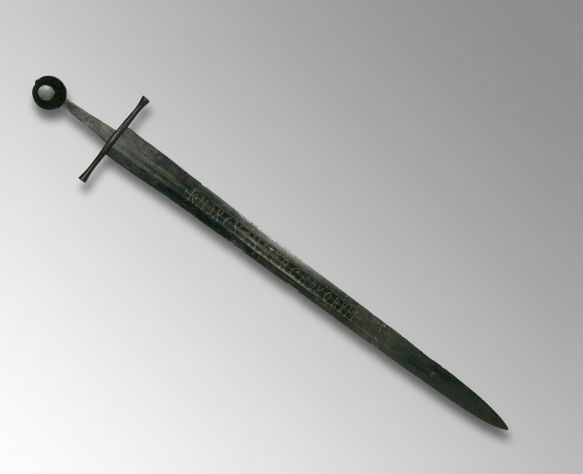
There are actually two River Witham swords — it’s just the right river to go sword-hunting in, I suppose — but we’re talking about what’s known as the River Witham “knightly sword.”

It was discovered in the river in 1825 and turned over to the Royal Archaeological Institute. It is now in the hands of the British Library.

And for more than two centuries, the meaning of the inscription has remained a mystery.

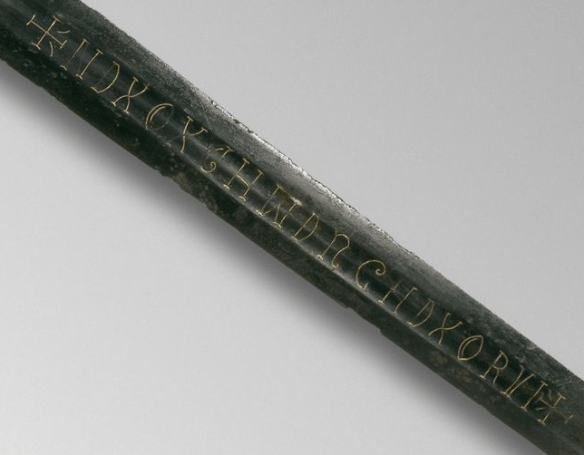
Inlaid along one of the sword’s edges, spelled out in gold wire, curious eyes find the following chain of letters:

+NDXOXCHWDRGHDXORVI+

Is it an abbreviation? An encryption? Or simply patterning in the shape of letters? No solid answers emerged during decades of study.

Eventually, the British Library decided to crowdsource the puzzle in the hopes of finding a solution. In 2015, officials from the library officially reached out to the public to finally crack the code detailed along the blade.

All sorts of amateurs and professionals weighed in, exploring possibilities in Latin, Welsh, German, Irish, Sicilian, and others. They compared it to the medal of St. Benedict and other medieval engravings in search of patterns.

And the British Library shared one contributor’s thoughts as an addendum to their original post about the River Witham sword.
alphen blade

[The Alphen aan den Rijn sword-blade.]

Historian Marc van Hasselt compared the sword to others from the same time period, roughly around the year 1200, and believed it was safe to assume the language was Latin.

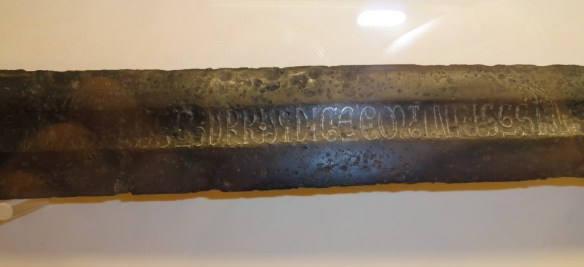
He compared the inscription from the River Witham sword — +NDXOXCHWDRGHDXORVI+ — with an inscription on a Dutch sword-blade found in Alphen aan den Rijn, the Netherlands. That blade was inscribed on both sides:

+BENEDOXOFTISSCSDRRISCDICECMTINIUSCSDNI+

+DIOXMTINIUSESDIOMTINIUSCSDICCCMTDICIIZISI+

He explains his thought process:

To elaborate, let’s compare the River Witham sword to the sword from Alphen: both start with some sort of invocation. On the River Witham sword, it is NDXOX, possibly standing for Nostrum Dominus (our Lord) or Nomine Domini (name of the Lord) followed by XOX.

On the sword from Alphen, the starting letters read BENEDOXO. Quite likely, this reads as Benedicat (A blessing), followed by OXO. Perhaps these letter combinations – XOX and OXO – refer to the Holy Trinity. On the sword from Alphen, one letter combination is then repeated three times: MTINIUSCS, which I interpret as Martinius Sanctus – Saint Martin. Perhaps a saint is being invoked on the River Witham sword as well?

Unfortunately, the British Library’s investigation seems to have stopped there after the intriguing contributions of van Hasselt.

But, thankfully, there is always SOMEONE on the Internet trying to solve a seemingly unsolvable mystery. I did a bit of sleuthing and found a post on medium.com, originally posted in February of 2017, with a very through breakdown of a potential solution to the River Witham sword!
river witham sword 2

[A closer look at the River Witham sword inscription.]

The author of the piece, Stieg Hedlund, started by focusing on the W in the inscription, since the classical Latin alphabet didn’t have a W. Surmising that the inscription was an initialism — which is common for Latin inscriptions — he started looking for an aristocratic name starting with W.

Why aristocratic? Well, not just anyone in the 1200s or 1300s could afford a sword with gold wire inscriptions.

He quickly settled on some variation of William for the W, and then narrowed his search to Willem II of Holland, a count, and the initialism CHW on the sword could mean Comes Hollandia Willelmus, his name and title in Latin.

william of holland

Following that line of thought and digging into the history of Willem II revealed that he ruled not only Germany, but the southern Belgian region of Hainault as well.

This gives him “Comes Hollandia Willelmus Dei gratia, Rex Germania et Hainault Dei nutu” to cover CHWDRGHD in the inscription.

When he turned his attention to the first five letters, he agreed with the supposition of Marc van Hasselt and others that it referenced “in Nomine Domini” and the XOX represented the Holy Trinity.

So that covers NDXOXCHWDRGHD, approximately two-thirds of the inscription. What about XORVI?

Well, Hedlund believes the solution lies in Laudes Regiæ, a Catholic hymn most famous for its opening words: Christus vincit! Christus regnat! Christus imperat! (In English: Christ conquers, Christ reigns, Christ commands.)

Abbreviated versions of these words were often used by kings and royalty to solidify their position by tying themselves to the church. On a coin issued by Holy Roman Emperor Charles VI in 1384, you can read one rendition of the phrase: XPiσtoC VinCIT XPiσtoC RegnAT XPiσtoC InPERAT.

He believes XORVI is an abbreviated version, reading “XpiσtOσ Regnat! (xpiσtoσ) Vincit! (xpiσtoσ) Imperat!” where the capital letters form the inscribed message.

So, the completed message would read:

(in) Nomine Domini
Comes Hollandia Willelmus Dei (gratia), Rex Germania et Hainault Dei (nutu)
XpiσtOσ Regnat! (xpiσtoσ) Vincit! (xpiσtoσ) Imperat!

Or, in English:

In the Name of the Lord; of the Father and of the Son, and of the Holy Ghost
Count of Holland Willem by the grace of God, King of Germany and Hainault by the will of God
Christ reigns! Christ conquers! Christ commands!

It’s a compelling case, and certainly the most complete interpretation and explanation I’ve been able to find.

Imagine. All of that in that brief, beautiful, confusing inscription. It’s fascinating, and makes the mind positively whirl with possibilities.

Oh, and if you find any centuries-old swords while you’re perusing the nearby waterways, let me know! We might have a new mystery to solve.


Thanks for visiting PuzzleNation Blog today! Be sure to sign up for our newsletter to stay up-to-date on everything PuzzleNation!

You can also share your pictures with us on Instagram, friend us on Facebook, check us out on TwitterPinterest, and Tumblr, and explore the always-expanding library of PuzzleNation apps and games on our website!

Puzzly Ways to Manage Stress!

stress ball

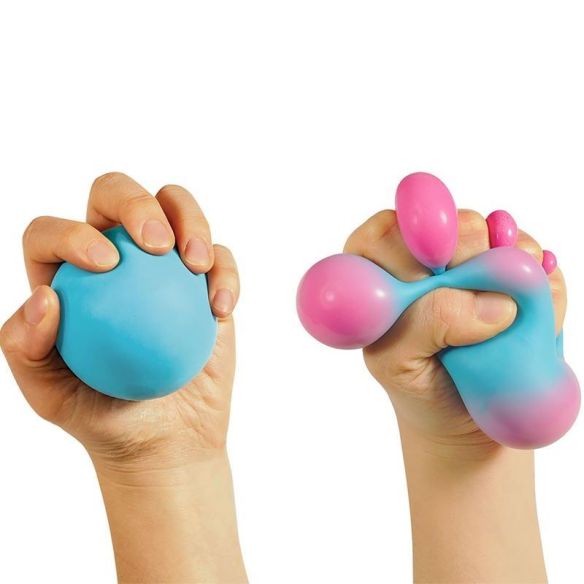
Stress is a killer, no doubt about it. Everyone needs ways to escape it, to mitigate it, and to give their mind and body a break from the pressures of stressful situations.

There are all sorts of products out there and suggestions for how to manage stress, but in the last few years, there has been a marked increase in what are known as “stress toys” or “fidget widgets.” Sure, stress balls have been around for years, but now we have things like fidget spinners, fidget cubes, tangle toys, and more. These items are specifically designed to be played with, but they have no actual GOAL built in. Often, these items are played with while the person focuses on other thoughts.

And that’s the key. Many people find puzzles and games relaxing and distracting, but the fact that there is a goal attached — solving the puzzle, completing or winning the game — means the item is less effective at managing stress than other items where there is no inherent goal beyond play.

As reported by The Atlantic, a study by the Polytechnic Institute of New York University stated that playing with small toys can help relieve stress, enhance productivity, and aid in memory. Yes, that person doodling during the meeting might retain more information from it than the person intently staring at the speaker. Who knew?

Some folks suggest Play-Doh, paperclips, magnetic balls, or pipe cleaners as reliable fidget widgets. Today, we thought we would offer some puzzly options for small, stress-relieving puzzly items that could help you get through the day.


I’ve seen Rubik’s Cubes and other twisty puzzles suggested for something like this, but again, the implied goal of the Rubik’s Cube – solving it – disqualifies it from this list. Although the mini Rubik’s Cube keychains are sometimes cited as good stress toys, we’re going to focus on things with less of a reputation or mental association for being challenging.

For instance, let’s look at Knot Dice.

knot dice

These beautiful patterned dice can obviously be used for puzzling or gaming, but many of the folks I’ve introduced to Knot Dice simply enjoy the experience of playing with them and observing what patterns emerge. There is no end goal, just the joy of watching paths form and seeing beautiful knot-like designs appear.

I know several people who keep Knot Dice close at hand as a tool for distraction or letting their minds work on other things in the background while they play with the dice.

block chain 4

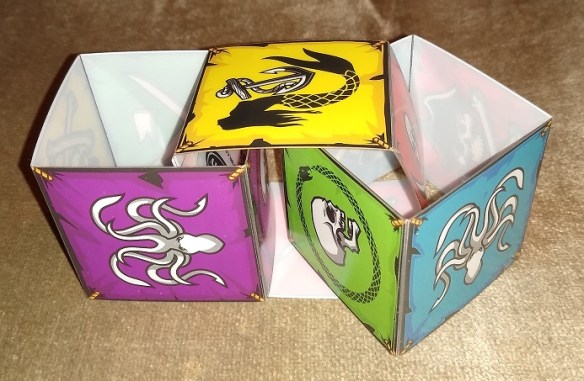
Our friends at ThinkFun have several puzzly games that would make good stress toys. While Fidgitz and Backspin come to mind, I think Block Chain is the best current example. These linked cubes can twist and turn and fold over each other to create cubes, but that feels secondary to the idle joy of simply watching how many patterns you can make with simple movements.

The design of the cube changes wildly based on your choices, and just fiddling with it and then folding it up is terrific fun. Plus the wild and varied imagery offers a nice change from the static colors and designs of many brain teasers, twisty puzzles, and other fiddly items.

lightbox3

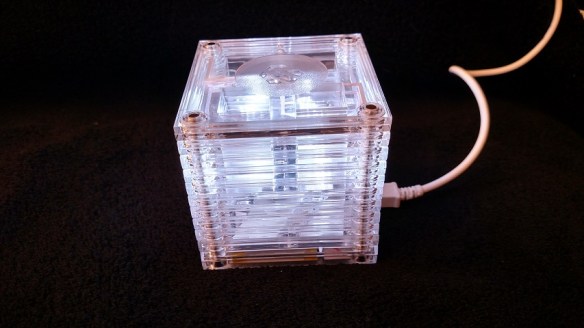
But the puzzly item I find myself returning to most, something to keep my hands occupied while I puzzle over a problem in my head, is Lightbox. The simple action of lifting, twisting, and reconnecting the many stacked plates in different combinations — then seeing what pattern of light is created — has a certain associative aspect that really pushes my brain in positive directions.

Seeing the cube light up in different ways feels like getting that metaphorical lightbulb to appear over my head, and rarely do I need to spend more than a few minutes fiddling with this delightful device before some little burst of motivation, inspiration, or reinvigoration is unlocked inside me, and I can get back to being productive.


What are your go-to items when it comes to stress toys or other items you find yourself idly playing with during the workday, fellow puzzlers? Let us know in the comments section below! We’d love to hear from you.

Thanks for visiting PuzzleNation Blog today! Be sure to sign up for our newsletter to stay up-to-date on everything PuzzleNation!

You can also share your pictures with us on Instagram, friend us on Facebook, check us out on TwitterPinterest, and Tumblr, and explore the always-expanding library of PuzzleNation apps and games on our website!