That’s right, it’s a bonus blog post today because we’ve got some exciting news!
We’ve got two new puzzle sets available for both the Android AND iOS versions of the Penny Dell Crossword App!
Just in time for TableTop Day, we’ve got our April 2016 Deluxe Set! You get 30 easy, medium, and hard puzzles, plus 5 themed bonus puzzles!
And if you’re looking for something a touch less seasonal, we’ve got you covered with the Deluxe Fun Set, also loaded with 30 easy, medium, and hard puzzles, plus 5 bonus puzzles!
Wait, there’s more!
For our iOS solvers, we’ve also got a new collection available:
Collection 13 not only offers a complement of topnotch puzzles, but it features a 5 puzzle sampler!
And that’s not all!
That’s right, an iOS app loaded to the brim with great puzzles! In the fine tradition of the first Jumbo app releases, Penny Dell Crosswords Jumbo 3 offers a fleet of great puzzles (150 of them!) in one easy-to-access package!
It’s a certified puzzle bonanza all across the board!
All this, plus a new edition of the PuzzleNation Newsletter hitting inboxes today! How can you go wrong?
By this time, you know the drill. Follow-Up Friday is a chance for us to revisit the subjects of previous posts and bring the PuzzleNation audience up to speed on all things puzzly.
And today, I’d like to return to the subject of puzzly holidays!
Saturday, April 30, is the fourth annual International TableTop Day, a day that has been set aside for family and friends to get together and play games. Board games, card games, role-playing games, puzzles…anything that involves gathering in person and having fun around a table fits the bill!
Although the actual holiday is tomorrow — making today TableTop Day Eve — we celebrated early! The PuzzleNation Crew got together with our friends from Penny Dell Puzzles for a few hours of TableTop Day fun on Tuesday! Games were played, snacks were consumed, and fellow puzzlers and PuzzleNationers were introduced to some terrific games.
[The spread of games available for the event. Can you name them all?]
As usual, the event started with people picking out their favorites and introducing new players to the game. This was the case with Just Desserts (a card game all about serving desserts to hungry customers; guaranteed to make you hungry) and Timeline (a card game about history where you don’t need to know what year things happened, just if they happened before or after other important moments).
One attendee opted to tackle the challenge of Puzzometry (a diabolical jigsaw puzzle) while I played a few rounds of Geek Out! and tested the pop culture and trivia knowledge of my fellow puzzlers.
[The conference room is abuzz with TableTop Day energy and fun, players strategizing deeply.]
I started recommending some new games to the players at this point, and the hit of the day was easily Red Flags, a Cards Against Humanity-style game all about building the perfect dates for other players.
The uproarious laughter inspired by the game was constant background noise while I explained the ever-changing rules of Fluxx to some curious players.
[Forgive the lack of further photos. I was so busy explaining games that I neglected to take more pictures. As a small gesture of apology, please accept this picture of me beneath a half-collapsed puzzle fort.]
We then closed out the event with two terrific card games for smaller groups: 12 Days and Loonacy. (12 Days is a lowest-card-wins wagering game based on the 12 Days of Christmas, and it has the most beautiful cards I’ve ever seen; Loonacy is a pattern-matching card game that rewards quick reflexes.)
The day was a total success, and it was a wonderful break in the middle of the day, allowing for a fun way to interact and recharge before returning to a thoroughly puzzly workday.
But that wasn’t all! To include fellow puzzlers who couldn’t attend the event in person, we had our own in-house session of Schmovie running all day.
I gave participants five What? cards (Undercover, Magical, Teenage, Flying, The Last) and five Who? cards (Barista, Chef, Princess, Pro Wrestler, Spy) to combine as they saw fit, and then challenged them to come up with the funniest Schmovie titles for those subjects.
Here are a few of my favorites:
Undercover chef: The Tsai Who Loved Me
Teenage barista: Latte to Class
Magical barista: Starbucks: The Foam Awakens
Teenage princess: Medieval Times at Ridgemont High
Flying spy: The Airborne Identity
Undercover princess: Leia Confidential
Are you celebrating TableTop Day? Let us know your plans in the comments! We’d love to hear about it, see photos, and share in the fun!
Thanks for visiting PuzzleNation Blog today! Be sure to sign up for our newsletter to stay up-to-date on everything PuzzleNation!
Most of the time, if I’m writing a blog post centered around a certain video, I explain the story of the video first, laying out all the necessary exposition so you as a reader will go into the video properly informed. Then I’ll share the video, share a few parting thoughts, and wrap things up.
I’m not going to do that today, though. Today, I’d like you to watch this video first and allow me to explain its significance afterward:
In all likelihood, that’s the first time you’ve heard this song. And there’s good reason for that. Until it was performed on April 23, it hadn’t been heard in a thousand years.
It has taken two decades of masterful puzzle solving, diligent research, and careful extrapolation to allow Sam Barrett of Cambridge University to reconstruct these melodies.
The task of performing such ancient works today is not as simple as reading and playing the music in front of you. 1,000 years ago, music was written in a way that recorded melodic outlines, but not ‘notes’ as today’s musicians would recognise them; relying on aural traditions and the memory of musicians to keep them alive. Because these aural traditions died out in the 12th century, it has often been thought impossible to reconstruct ‘lost’ music from this era – precisely because the pitches are unknown.
Akin to decrypting an encoded poem, Barnett had to identify what are known as neumes (symbols representing a form of musical notation employed during the Middle Ages, specifically the 11th century), and then puzzle out how to translate those neumes into actual notes for musicians to perform.
The discovery of a missing manuscript leaf proved to be the key to unlocking what are now known as the Cambridge Songs:
“After rediscovering the leaf from the Cambridge Songs, what remained was the final leap into sound,” he said. “Neumes indicate melodic direction and details of vocal delivery without specifying every pitch and this poses a major problem.
“The traces of lost song repertoires survive, but not the aural memory that once supported them. We know the contours of the melodies and many details about how they were sung, but not the precise pitches that made up the tunes.”
This remarkable accomplishment marks the latest in a series of transformations the work has gone through since its creation in the sixth century as a poetic treatise on philosophy by Boethius.
His work was translated, then set to music, and then lost to the ages before being reconstructed and reimagined by Barnett and the three-piece group known as Sequentia, who perform a snippet of it in the video.
There have been times while I’ve been working on this that I have thought I’m in the 11th century, when the music has been so close it was almost touchable. And it’s those moments that make the last 20 years of work so worthwhile.
This is the sort of tenacity, creativity, and resolve I have come to expect from puzzle-minded people over the years, and it’s one more example of how seemingly nothing is beyond the reach of people willing to put in the time and effort to discover (and rediscover) what was once believed lost.
International TableTop Day is this Saturday, a day where we celebrate getting together with family and friends to play games! Board games, card games, role-playing games, puzzles…anything that involves gathering in person and having fun around a table fits the bill!
But we simply can’t wait until Saturday — plus the office is closed that day — so we’re hosting our PuzzleNation’s TableTop Day event in-house TODAY! And I figured what better day could there be for a round-up of puzzly crowdfunding campaigns marking some of the newest and most intriguing projects in the puzzle-game industry today!
I’ve covered various campaigns for board games, card games, and puzzle projects across the Kickstarter and Indiegogo crowdfunding platforms over the years, and today I’d like to share three more that could use your attention.
Tak is a collaboration between game designer James Ernest, head honcho of Cheapass Games and Hip Pocket Games, and author Patrick Rothfuss, creator of the Kingkiller Chronicle series, to bring to life a game featured in Rothfuss’s novel The Wise Man’s Fear.
The premise sounds simple: build a road of pieces connecting opposite sides of the board. By using some pieces as parts of your road and others as walls to block your opponent, this mix of chess, Stratego, and Go is all about strategy. Plus, the game is adaptable, playable on square boards as small as 3×3 and as large as 8×8.
This is a new pub game that feels like a timeless classic, and it looks perfect for puzzlers of all ages.
Now let’s move from the pub to outer space with another Kickstarter campaign, Avoid the Void.
This is a different sort of strategy game, since it’s all about outlasting your opponents, not completing a task first. In Avoid the Void, whole sectors of space are being replaced with black holes, and everyone is scrambling to gather resources and elude these hungry death traps.
You’ve got an ever-changing gameboard, intriguing alien races (including one resembling a piece of cake), and all the reason in the world to deceive, outmaneuver, and betray your fellow players, just so you can stay in the universe a little while longer.
This is a game designed for replayability, allowing you to indulge in all of the diabolical selfishness of games like Monopoly, but without the huge time commitment. After all, the universe is collapsing and there’s no time to waste!
And speaking of replayability, the makers of this last Kickstarter campaign are known for puzzle games with high replay factor. Let’s talk about Pyramid Arcade from Looney Labs.
We normally talk about Looney Labs card games like Fluxx or Loonacy, but their original product line revolved around the Looney Pyramids system: various games you can play with their signature colored pyramids.
Now, they’re launching Pyramid Arcade, covering TWENTY-TWO different games and encompassing 90 pyramids of various colors. It’s their largest release ever, and with all the variants and mini-games they’ve created for these game pieces over the years, this promises to be a game set with endless possibilities.
Pattern-matching games, chess- and Tic-Tac-Toe-inspired games, bluffing games, strategy games, and even a tower-building game…Pyramid Arcade literally has something for everyone.
These are three intriguing and very worthy projects, and I hope you contribute to one or more of them. As someone who has become a regular donor to various Kickstarter and Indiegogo campaigns, I am proud to have funded some marvelous new ideas and watched them take shape over the months that followed.
Thanks for visiting PuzzleNation Blog today! Be sure to sign up for our newsletter to stay up-to-date on everything PuzzleNation!
By this time, you know the drill. Follow-Up Friday is a chance for us to revisit the subjects of previous posts and bring the PuzzleNation audience up to speed on all things puzzly.
[Click here or on the image for a larger version.]
For the uninitiated, a Rube Goldberg machine is an intentionally overcomplicated device that uses multiple steps to accomplish a simple task. It’s an exercise in creative inefficiency, and a delightful one at that.
But some Rube Goldberg machines are designed to give those odd intermediate steps greater meaning, so that instead of an elaborate series of domino-style mechanical events leading to one minor accomplishment, several things are accomplished along the way.
And every once in a while, a Rube Goldberg machine tells a story, using those intermediate steps to depict meaningful events along the way. It’s a colorful and inventive way to teach, one that definitely grabs your attention.
The Jewish festival of Passover begins tonight, and I recently stumbled across a Rube Goldberg device that presents the story of Passover, including the liberation from slavery in Egypt, the plagues, and Moses leading the Exodus.
Enjoy:
You know, if other important historical events were told in Rube Goldberg fashion, I think history classes would be far more popular. Just saying.
Thanks for visiting PuzzleNation Blog today! Be sure to sign up for our newsletter to stay up-to-date on everything PuzzleNation!
[Note: I received a free copy of this game in exchange for a fair, unbiased review. Due diligence, full disclosure, and all that.]
There are a lot of puzzly games where wordplay is key. In Scrabble, Bananagrams, or Words with Friends, it’s all about forming words and fitting them into grids. In Taboo, it’s all about communicating without using certain words. In Balderdash, it’s all about crafting the perfect definition, either to mislead other players or to demonstrate your mastery of language and vocabulary.
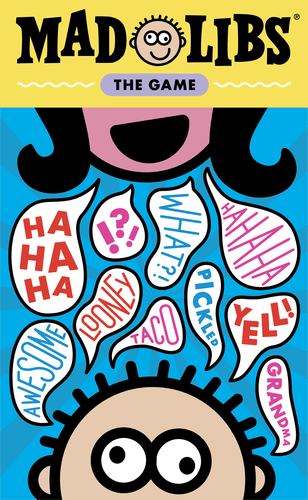
Mad Libs: The Game follows in that grand tradition of wordplay, but instead of forming words, avoiding them, or defining them, this game is about using them to their utmost in order to entertain your fellow players.
Each player starts with 7 Word cards. Each card depicts a word in noun, verb, adjective, or adverb form (or multiple forms, for adaptable words), and these cards are the ingredients for cooking up funny, weird, entertaining sentences in the game.
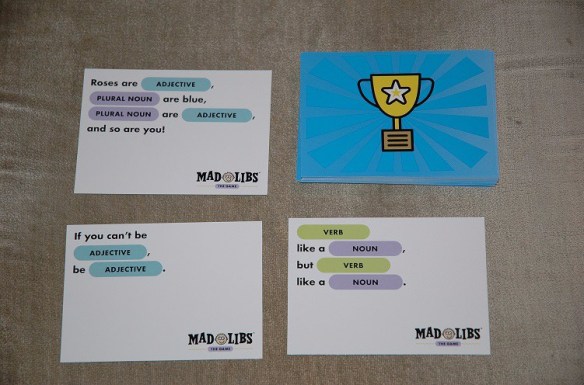
But what do you do with those cards? Easy! Just like the original fill-in-the-blank stories, you’re going to use those cards to conjure up the best ways to fill the blanks in our Sentence cards.
So each round begins with a new Sentence card and the players choosing Word cards from their hand in order to come up with the most entertaining words to fill in the blanks for this round’s Sentence card. Then everyone reads their completed sentence aloud, and a vote is held where players point to the player with the best completed sentence. That player then wins a point.
The first player to earn three points wins.
Now, this style of gameplay won’t seem revolutionary to anyone who has played with magnetic poetry or indulged in the much-raunchier Cards Against Humanity or one of the many other games in that vein.
But whereas those games tend to traffic in shock value for their humor, Mad Libs: The Game is all about silliness. This is a game that encourages that same level of creativity, wordplay, and surprise, but in a way that’s appropriate for family gameplay. For example, unlike the very adult themes found in CAH, the harshest words in this game are more along the lines of “pierce” or “heartless,” nothing that would raise a parent’s eyebrow.
[Example of a completed sentence:
“Puppies may make the world go ’round,
but it’s flowergirls that pay the bills.”]
This is a terrific gateway game for younger puzzlers to get them to not only think about words, but to explore how to use them effectively. It combines humor, storytelling, silliness, and craft to make a good, clean, and most importantly, fun time.
Looney Labs is usually the home of gleefully chaotic games like Fluxx and Loonacy, but they always manage to couch their products in family replayability, and Mad Libs: The Game is no exception.
You can pick up Mad Libs: The Game here, and to check out all of our reviews of Looney Labs games and products, click here!
Thanks for visiting PuzzleNation Blog today! Be sure to sign up for our newsletter to stay up-to-date on everything PuzzleNation!




 PuzzCulture