A Relaxing Game Night!

The world can be a very stressful place. We live under a constant deluge of news and information, and it’s so easy to get overwhelmed by it all. And while games can be a wonderful escape, you need the right games to restore your spirits and put you in a good mood.

As much fun as co-op games like Forbidden Island, The Oregon Trail Card Game, and Castle Panic! can be, they can also be a little stressful. And if you’re looking to relax, or to chill out after a long week, those might not be the games for you.

So today, I thought we could turn our attention to games that are as tranquil as they are tactical, in the hopes of helping my fellow PuzzleNationers enjoy a calm gameplay experience.
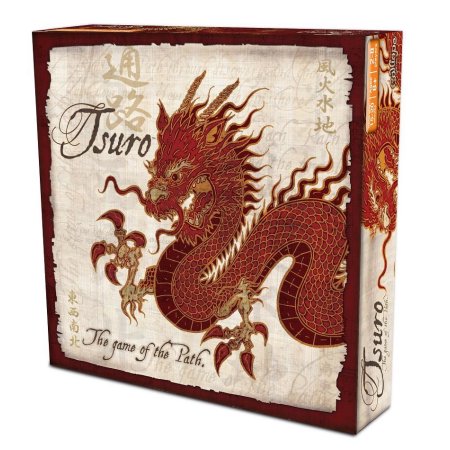

When I asked fellow game enthusiasts for games that are mellow and relaxing, the first one that always comes to mind is Tsuro.

In Tsuro, up to 8 players adopt the role of flying dragons soaring through the sky. Each player chooses from the tiles in their hands in order to build paths on the board, representing their paths through the sky. Naturally, these paths will eventually intersect, and you need to be careful to avoid colliding with another dragon or following a path right off the edge of the board. (Both of those scenarios cause you to lose.)

Despite the potential for competition, most Tsuro games are peaceful affairs as everyone enjoys watching their dragon token loop and swirl across various intersecting paths, hoping to be the last dragon standing on the board. It’s a beautiful, simple game that only takes about twenty minutes to play, and it’s the perfect palate cleanser after a more stressful round of some other game.

[Image courtesy of Starlit Citadel.]

Tokaido is another game about movement, but in a very different vein. Players in this game are all travelers, journeying across Japan’s famed East Sea Road from Kyoto to Edo. Whereas most travel-based games are about reaching a destination first, Tokaido is about reaching a destination with the widest array of meaningful experiences.

Along the way, your character can meet new people, enjoy new cuisines, collect souvenirs, visit hot springs, and visit scenic locales. You add experience points for these events (and acquire achievement cards) to represent your traveler partaking of these experiences.

This elegant game bypasses traditional competition entirely, building a unique game mechanic out of living your best life.

[Image courtesy of Board Game Quest.]

Sagrada is another wonderfully visual game about individual accomplishment. In this game, each player is building a stained glass window using different colored dice. No dice of the same color can neighbor each other, so you need to be strategic about how you place the dice you roll.

Each window is different, and has certain rules for maximizing points. (A certain pane can only be a certain color, or a certain die value, etc.) The players can boost their scores by selecting cards that reward them with points if they create certain patterns within their stained glass window.

Except for competing for the best point total at the end, there’s virtually no interaction between players. You’re all simply working simultaneously on the best window, which is a gameplay style that breeds camaraderie more than competitiveness. It’s genuinely encouraging to see fellow players make good choices in dice placement to create the most beautiful, elegant window patterns.

[Image courtesy of Starlit Citadel.]

For a change of pace, let’s look at a game that’s more about interaction with other players. Dixit is a gorgeous card game where each player is given a handful of cards, each depicting a different, unique, evocative piece of art.

Player 1 will choose a card from their hand and say a word or phrase to the other players that has some connection to that card. It could reference color, or part of the imagery. It could be a joke, or an idiom, or a song lyric. The goal is to be vague, but not too vague. The other players will then each select a card from their hand that could also be described by Player 1’s statement, and the cards are all shuffled face down so no one can see who submitted what card.

The cards are then all placed face up, and each player (except Player 1) votes on which piece of art they think Player 1 chose. Player 1 gets points if some (but not ALL) players chose his card. (If every player chooses it, the clue was too easy, and Player 1 gets no points.) And any other player’s card that earns votes also earns that player points.

This sort of associative gameplay really encourages your imagination and teaches you about how the other players think. There’s no other game quite like it on the market today, and it makes for an intriguing, low-key gaming experience.
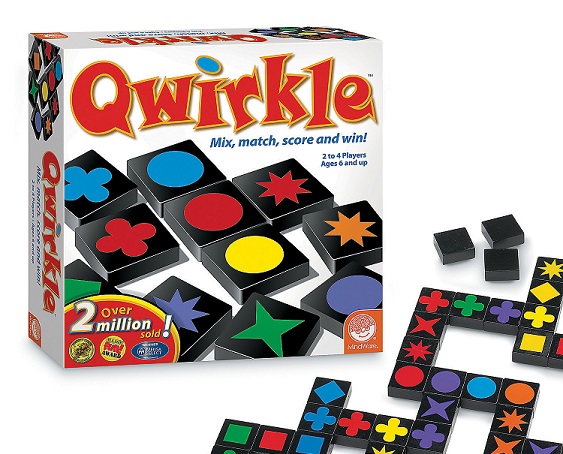
Finally, let’s close out today’s post with a classic tile game that mixes Uno-style color- and pattern-matching with Mexican Train Dominoes-style gameplay. Qwirkle is a bit more competitive than the other games on today’s list, but it’s still a game more about collaborating than outdoing your opponents.

By placing different tiles onto a shared play area — either by matching colors or matching symbols — players earn points. If you complete a Qwirkle — a pattern of all six colors for a given shape or all six shapes in the same color — you earn bonus points.

The lighthearted gameplay style lends itself to friendly competition rather than the cutthroat mien evoked by games like Monopoly. Qwirkle’s not about grinding the other players down, it’s about adding to a colorful world in interesting, inventive new ways.


Hopefully these suggestions will make your game nights a little more mellow. And if you’re looking for puzzlier ideas for a tranquil game night, check out our reviews for ThinkFun’s Kaleidoscope Puzzle and Looney Labs’ Zendo, both of which might scratch your puzzly itch in a relaxing fashion.

Thanks for visiting PuzzleNation Blog today! Be sure to sign up for our newsletter to stay up-to-date on everything PuzzleNation!

You can also share your pictures with us on Instagram, friend us on Facebook, check us out on TwitterPinterest, and Tumblr, and explore the always-expanding library of PuzzleNation apps and games on our website!
The Tetris Effect: Unleashed!

When alarmists talk about the negative effects of video games on players, they’re usually referring to first-person shooters, like Call of Duty, or games that encourage immoral acts, like Grand Theft Auto.

They’re not usually talking about Tetris.

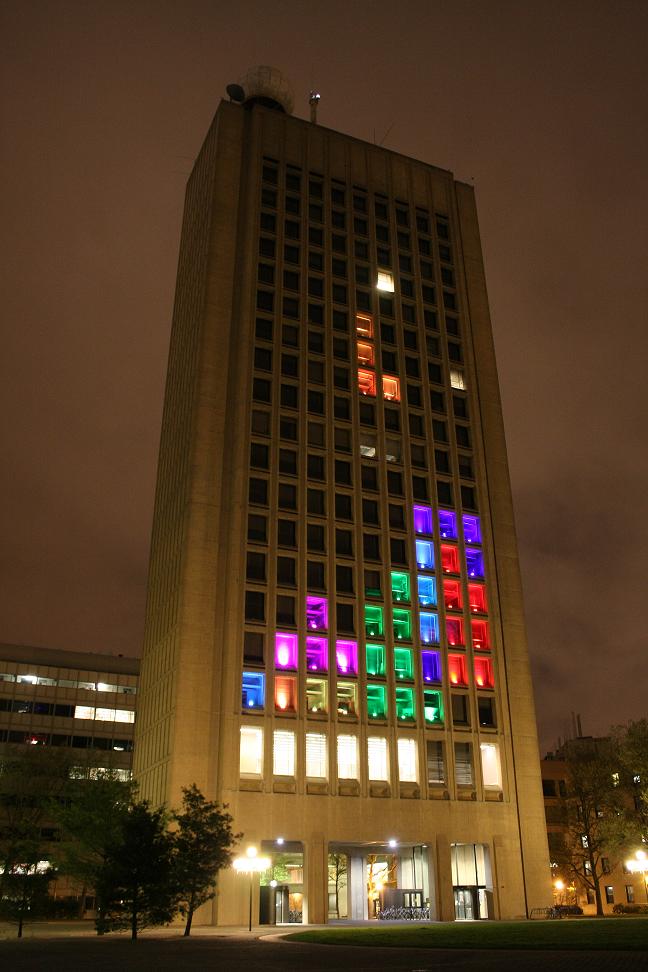
But as it turns out, playing Tetris can have curious side effects. Some folks who play for prolonged periods of time report seeing the iconic tetromino shapes falling as they drift off to sleep, or when they close their eyes. (This has also been reported by jigsaw puzzle solvers, who see curved lines, and Rubik’s Cube solvers, who continue to see the constantly shifting colors of the cube.)

There are additional anecdotal stories of people viewing the world in a Tetris-y way after solving, fixating on how shapes could fit together.

It’s common enough, in fact, that it has its own term: The Tetris Effect.

It has also inspired a Tetris game of the same name, which is releasing later this year for the Playstation 4. Tetris Effect enhances the Tetris experience by tying musical themes and imagery to the traditional gameplay.

One player describes the play experience in an article for Kotaku:

I played the game in VR, though that is optional. The first time I landed a Tetris, the screen exploded in a beautiful display of particle effects, sea life swam around me, the controller vibrated and the music swelled in a way that sent chills down my spine — I’ve done this a million times before but not like this.

[Image courtesy of Eurogamer.]

The game also boasts a new solving trick — the Zone mechanic — which allows you to stop time and place several blocks at one time, meaning you could line up multiple pieces to drop at once and clear more lines. The previous limit was four lines, but now, with the Zone mechanic, it’s possible to clear out up to sixteen lines at once! (Naturally, there’s a term for that as well. It’s a decahexatris.)

This is an excitingly immersive evolution of the classic puzzle game, and I can’t wait to check it out.


Thanks for visiting PuzzleNation Blog today! Be sure to sign up for our newsletter to stay up-to-date on everything PuzzleNation!

You can also share your pictures with us on Instagram, friend us on Facebook, check us out on TwitterPinterest, and Tumblr, and explore the always-expanding library of PuzzleNation apps and games on our website!

This Weekend: Puzzly Tournaments and Film Debuts!

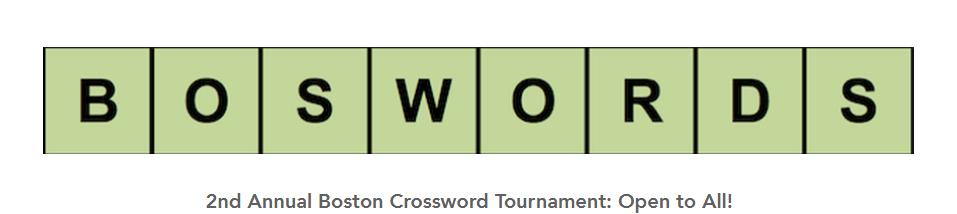
This Sunday, July 29, from noon to 5 PM, puzzlers from all over will gather at The Roxbury Latin School in West Roxbury, Massachusetts for the second annual BosWords Tournament!

With three divisions to choose from — Expert, Amateur, and Pairs — puzzlers of all ages and experience levels will have the opportunity to test their puzzly wits.

The four themed puzzles in regular competition have been constructed by Laura Braunstein, Andrew Kingsley, John Lieb, Joon Pahk, and Brendan Emmett Quigley, and after the scores from those puzzles are tabulated, a championship themeless crossword by David Quarfoot awaits the top three solvers in each division!

BosWords is asking for $20 for adults, $20 for pairs, and $10 for students to attend and compete, which is a real bargain!.

You can check out their Facebook page for full details!

But that’s not all that’s happening in the world of puzzles this weekend!

Yes, the film Puzzle opens today in select theaters!

The film stars Kelly MacDonald (who you might know from Brave, Boardwalk Empire, Gosford Park, or Trainspotting), Irrfan Khan (Life of Pi, Slumdog Millionaire, In Treatment, and Jurassic World), and David Denman (The Office, Angel, 13 Hours, and Logan Lucky).

The plot focuses on Agnes, a suburban mother taken for granted by her husband and family, who discovers a passion for solving jigsaw puzzles. This newfound passion unexpectedly draws her into a new world – where her life unfolds in ways she could never have imagined.

The trailer below hints at the beautiful cinematography and engaging performances of all involved, and I suspect this film will be something special:

Will you be attending the BosWords tournament or hitting the theaters to watch Puzzle, fellow puzzlers and PuzzleNationers? Let us know! We’d love to hear from you!


Thanks for visiting PuzzleNation Blog today! Be sure to sign up for our newsletter to stay up-to-date on everything PuzzleNation!

You can also share your pictures with us on Instagram, friend us on Facebook, check us out on TwitterPinterest, and Tumblr, and explore the always-expanding library of PuzzleNation apps and games on our website!
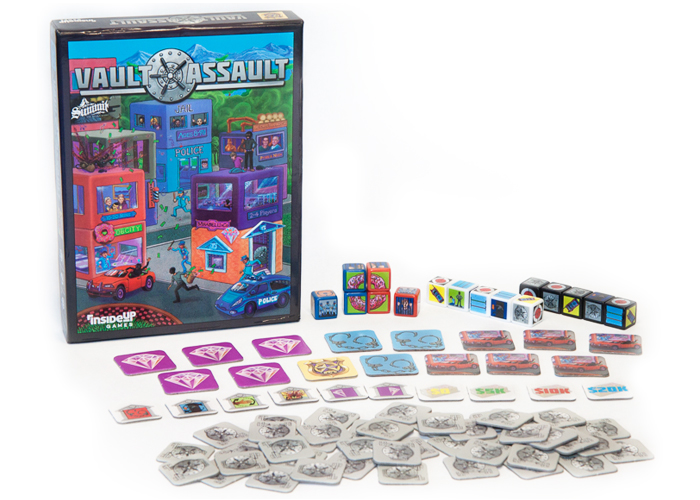
PuzzleNation Product Review: Vault Assault

There is no rivalry in the world of make-believe more iconic than cops versus robbers, and rarely has that classic dynamic been as frenetic and as fast-paced as it is in the dice game we’re reviewing today, Vault Assault.

The goal of the robbers is to acquire as much wealth as possible and then escape before the cops arrive. The goal of the cops is to minimize the amount the robbers acquire/get away with and capture the robbers before they can escape.

Each round, the players will portray both the cops and the robbers, allowing players opportunities to both rack up lots of ill-gotten gains and minimize the loot captured by the other players.

Each round consists of two phases: the Diamond Heist and the Vault Assault.

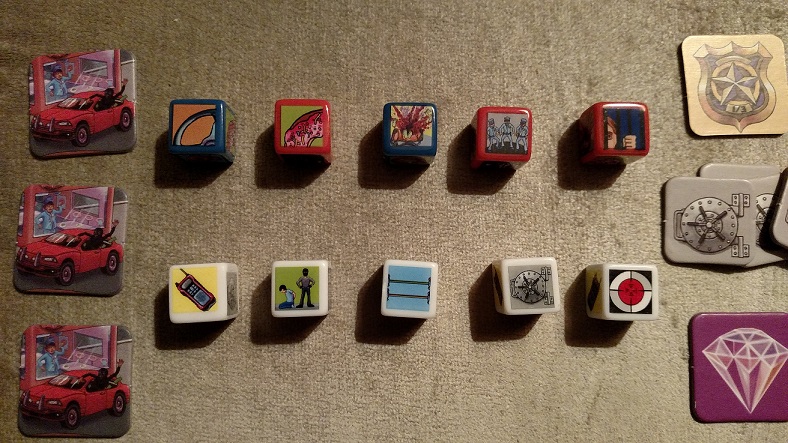
In the Diamond Heist phase, the cops and robbers each line up five of their dice. (The cops do so secretly, laying out an arrangement of three alarm symbols, one dye-pack symbol, and one diamond symbol in any order they choose.) The robbers lay out five wire symbols, and then choose one to flip, trying to match the one they flip to the diamond symbol the cops have secretly chosen.

Essentially, the Diamond Heist is part strategy, part luck as the robbers try to steal the diamond by cutting wires to the security system, while the cops lay dye-pack traps to ensnare the robbers. Either the cops will begin the Vault Assault with an advantage or the robbers capture a diamond tile as part of their loot.

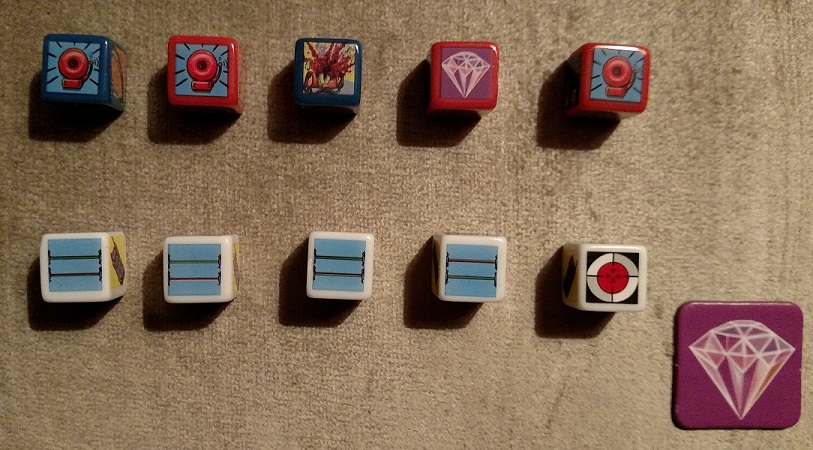
[In this scenario, the robbers chose poorly, and triggered the alarm, meaning that the cops will start with one die already rolled when the Vault Assault starts. The robbers could have opted to flip another die in the hopes of finding the diamond, but in the end, they opted not to risk giving the cops a greater advantage.]

Once the Diamond Heist phase is concluded, the Vault Assault begins, and the game kicks into another gear.

Tenzi- or Yahtzee-style dice rolling and quick decision-making become crucial as both cops and robbers try to roll specific patterns in order to complete tasks. As the robbers roll to steal from the vault (or each other), to interfere with the cops, or to escape, the cops are trying to complete rolls in order to fuel up, arrive at the crime scene, engage the robbers, and arrest them.

Both sides roll their dice at the same time, making for an incredibly chaotic and fun play experience that simulates the kind of stress you might be under if you were really robbing a bank and trying to get out before the cops arrived. Between robbers filling their coffers (and forcing the cops to reroll their dice) while the cops confiscate some of the stolen loot while trying to arrest the bad guys, it’s a very competitive and adrenaline-inducing sequence of events.

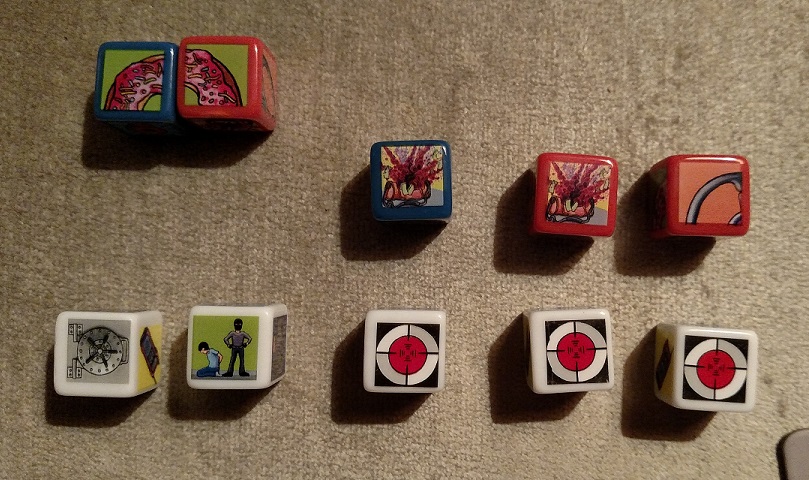
In this scenario, the cops have two out of the four doughnut symbols up (meaning they’re halfway to completing the first task en route to arresting the robbers). But they also have two dye-packs up, and two more dye-packs would allow them to remove several Vault Tiles from the robber’s stacks, meaning the robbers would have less loot. Would you choose to keep rolling for doughnuts or to hamper the robbers with dye-packs?

On the robber side, they have three targets, meaning they’re one away from stealing a Vault Tile from another player and adding to their loot. But they also have a green hostage symbol up, which they can put aside in order to make the cops immediately reroll all of their dice. Would you choose to go for the steal or to disrupt the cops’ efforts?

In addition to all that interplay, some of the vault tiles also trigger actions that can hamper your gameplay. A handcuffs symbol, for instance, means you have to roll your dice with your wrists together until the end of the turn (as if you’re handcuffed). These little roleplay-centric details add a playful edge to the game, injecting a bit of silliness into gameplay that could otherwise turn somewhat cutthroat.

One several rounds have elapsed, the players (both cops and robbers) total up the value of the loot in their getaway cars, and the player with the highest total wins. Oh, and those Diamond Heist tiles? They’re worth $40,000 apiece!

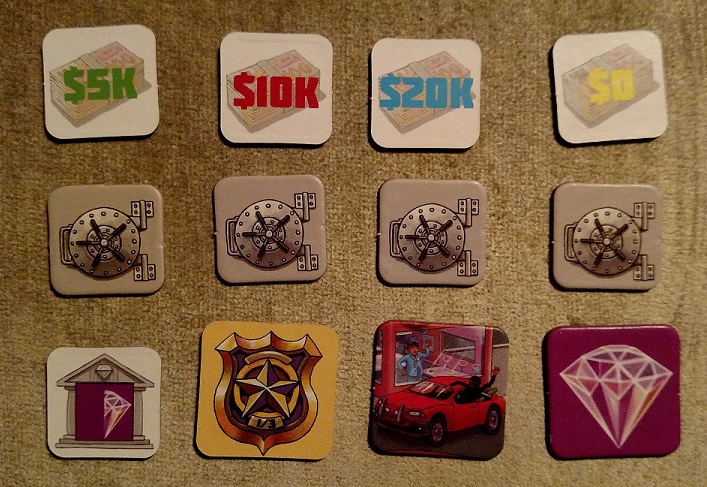
[With Vault Tiles ranging in value from 0 to $20,000, a diamond tile could be a real game-changer for your loot total at the end of the game.]

Vault Assault is less about long-term strategy and more about being able to make good decisions in the heat of the moment. If you’re able to put your puzzly mind to work making the most of the dice rolls in front of you — both to increase your profits and hamper your opponents, whether you’re a cop or a robber at the time — then you’ll probably come out ahead.

Of course, that’s more of a one-on-one mindset. And with three-player and four-player/team rules to allow for different combinations of players, you can implement some wider strategic gameplay. In three-player games (1 cop and 2 robbers), have one robber focus on hampering the cops while the other raids the vault (and then switching, so both robbers can cash in). In four-player/team games (two cops, two robbers), one cop can focus on recovering stolen goods while the other works on arresting players. There’s plenty of fun to be had with the format.

Can you cash in, hold the cops at bay, and make your escape, or will the cops nab you and all your ill-gotten goods before you make it out the door? And in the end, will you make a better cop or a robber?

[Vault Assault, published by Inside Up Games, is available through their website, as well as certain online retailers.]


Thanks for visiting PuzzleNation Blog today! Be sure to sign up for our newsletter to stay up-to-date on everything PuzzleNation!

You can also share your pictures with us on Instagram, friend us on Facebook, check us out on TwitterPinterest, and Tumblr, and explore the always-expanding library of PuzzleNation apps and games on our website!

Puzzles in Pop Culture: Comic Strips

Two weeks ago, we took a puzzly detour into the world of comic strips and explored all the puzzly references we could find in the annals of Garfield publishing history.

In the course of compiling those comics, I stumbled across many others that referenced crosswords and other puzzles. As it turns out, plenty of iconic comic strips have had something to say about puzzles. It makes sense, really, given that crosswords and comic strips are both synonymous with reading the newspaper every day.

So naturally, I couldn’t resist putting some comic strips aside for the PuzzleNation readership to enjoy.


We start off today with this Fred Basset comic strip, wherein a mischievous dog saves the most important part of the paper for his owner.

In this Beetle Bailey strip, we’re not only reminded of the true power behind the General, but of the power of crosswords to eat up your free time.

In the Peanuts comics, many of Snoopy’s best jokes are visual gags, given that most of the other characters can’t understand him. In this case, the joke is on us, as Snoopy and Woodstock crack a curious crossword entry together.

Calvin and Hobbes also had their fun with filling in crosswords, as Calvin takes his usual outside-the-box approach and applies it to our favorite puzzles. (He’d clearly be a whiz at Double Trouble and other crossword variants.)

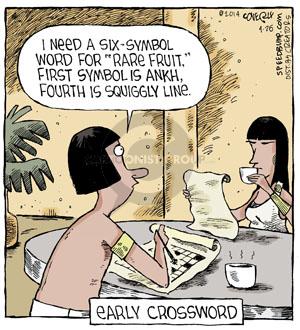
In this strip by artist Dave Coverly, he reimagines crosswords in an earlier era. (And makes me wonder what an all-symbol crossword would be like.)

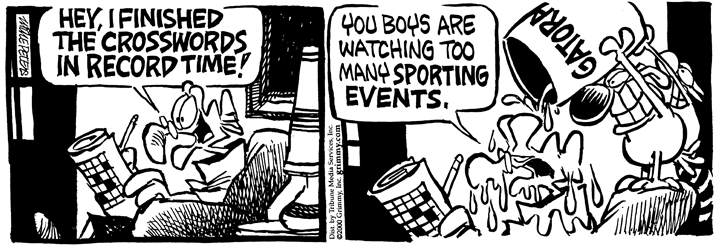
There’s a marvelous sense of accomplishment that comes with solving your first crossword. In this comic from Mother Goose and Grimm, the celebration is a bit more enthusiastic.

Many comic strips have fun with the difficulty of crosswords or the wordplay involved in the cluing. But this one by J. Gravelle presents the trouble you can get into by making assumptions while letters are still missing.

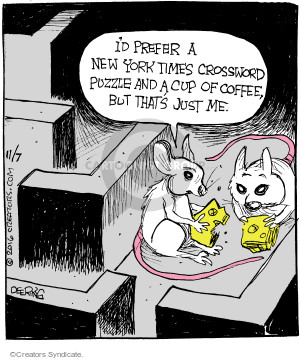
In this comic from John Deering’s Strange Brew, the human condition — and the rat condition — are summed up in one poignant quote.

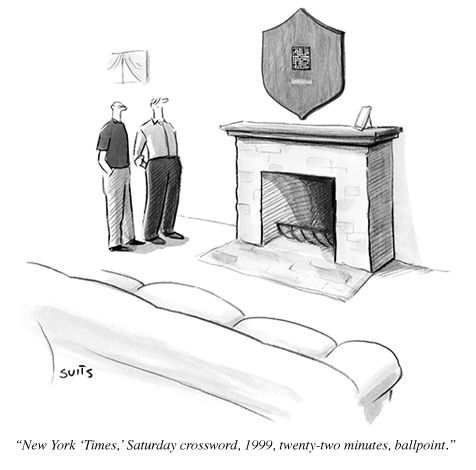
And speaking of The New York Times crossword… we’ve all felt like this at one point or another.

Finally, we get a little meta with this one. But it makes sense, given that the funnies page and the daily crossword are usually in close proximity.

I hope you enjoyed this brief sojourn into comic strip — and puzzle — history. Do you have any comic strips mentioning puzzles that we missed? Let us know! We’d love to hear from you!


Thanks for visiting PuzzleNation Blog today! Be sure to sign up for our newsletter to stay up-to-date on everything PuzzleNation!

You can also share your pictures with us on Instagram, friend us on Facebook, check us out on TwitterPinterest, and Tumblr, and explore the always-expanding library of PuzzleNation apps and games on our website!
When (Cross)Worlds Collide: This Month’s Hashtag Game!

You may be familiar with the board game Schmovie, hashtag games on Twitter, or @midnight’s Hashtag Wars segment on Comedy Central.

For years now, we’ve been collaborating on puzzle-themed hashtag games with our pals at Penny Dell Puzzles, and this month’s hook was #PennyDellSpacePuzzles, mashing up Penny Dell puzzles with planets, astronauts, constellations, celestial objects, and more!

Examples include: World Seeks, Buzz All-Four-One-drin, and Tossing & Saturning.

So, without further ado, check out what the puzzlers at PuzzleNation and Penny Dell Puzzles came up with!


Chess Solartaire

Triangle Suns

Diamond Rings of Saturn

Cosmic Sunrays

Space Battleships

Comet Combos

Bookwormholes / Blackout holes

All-Star Worm Seek Hole

Orbits and Pieces

Word Spiral-arm Galaxy

Nebulabyrinth

Nebula Square

Meteorite of Milky Way

Spaces, Please

Places, Pleides

Planets, Please

Polaris, Please

Point the Way Polaris

Point the Milky Way

Bits and Pisces

Hub-ble-caps

How Spaceman-y Triangles

Libra Tiles

Diagonal Orion’s

Penumbra Sleuth

Southern Cross Arithmetic

Scorpiusmaster

Quoteballs of Fire

Space Odysseys and Evens

End of the Karman Line

The Moon’s Shadow

Easy Plutoku

Exploraworld / Explorer 1 Words

A to Z Mars

Mars-bles

Marbles Rover

Four-fit the mission

Michio Kakuro / Michisu Doku

All Foursnax

Antilagrams

Countdown and Pair-blast-off / Pair LiftOff

The Disco-very mission

Headings for space

Alphabetics Centauri / Alpha Centauri Soup

Mission Dominoes / Missioning Dominoes

“Houston we have a Plug-Ins” / “Houston, we have a Deduction Problem!”

“Houston: the Crozzle has landed.”

Pulling-Strings theory

Board the space Shuffle

Lucky Rover

Lucky Shooting Star

Sputnik Satellites

Bull’s-Eye Spiral Galaxy

Scramble Across the Universe

Planet in the Round

Around the Sun

In and Around the World

World Ways

Mystery World

A Few Choice Worlds

Star Worlds

Battlestarships Galactica

“Not so expert and the Challenger crosswords”

“GROUND CONTROL TO MAJOR STEPHEN HAWKING’S BRAIN BOOSTER PACK”


Naturally, the intrepid puzzlers who submitted these marvelous puns couldn’t resist taking a crack at Neil Armstrong’s iconic words:

  • Two for One small step for man; one giant leap for mankind.
  • One small Step by Step for man; one giant leap for mankind.
  • One small Step by Step for man; one giant leap for Three of a Kind.
  • One small Step by Step for man; one Puzzler’s Giant leap for mankind.

And to close out today’s entry, a special shout-out to several sci-fi savvy puzzlers!

The first offered a delightful take on a famous TV monologue:

Space: the final Mind Tickler. This is the Grand Tour of the Lucky Star-ship Penny. Its Five-Alive mission: to Explora-strange-new-worlds, to Word Seek out new Face-to-Face Puzzlers and new Cryptobotanies, to Bowl Game where no solver has Word Gamed before.

The second, more movie-minded contributor said: All I could think about when I read the theme was space was the Spaceballs theme song…

If you’re livin’ in a Build-a-Pyramid and you haven’t got a Connection
Well, you’re gonna be in Double Trouble cause we’re gonna Split & Splice your air
‘Cause what you Give is what we Take and all we do is dirty Decisions
We’re the Spaceballs, What’s Next! cause we’re the Spaceballs
We’re the Mixmaster of space
Hey, Don’t mess Around the Block with the Spaceballs!


Have you come up with any Penny Dell Space Puzzles entries of your own? Let us know! We’d love to see them!

Thanks for visiting PuzzleNation Blog today! Be sure to sign up for our newsletter to stay up-to-date on everything PuzzleNation!

You can also share your pictures with us on Instagram, friend us on Facebook, check us out on TwitterPinterest, and Tumblr, and explore the always-expanding library of PuzzleNation apps and games on our website!