And… Repeat

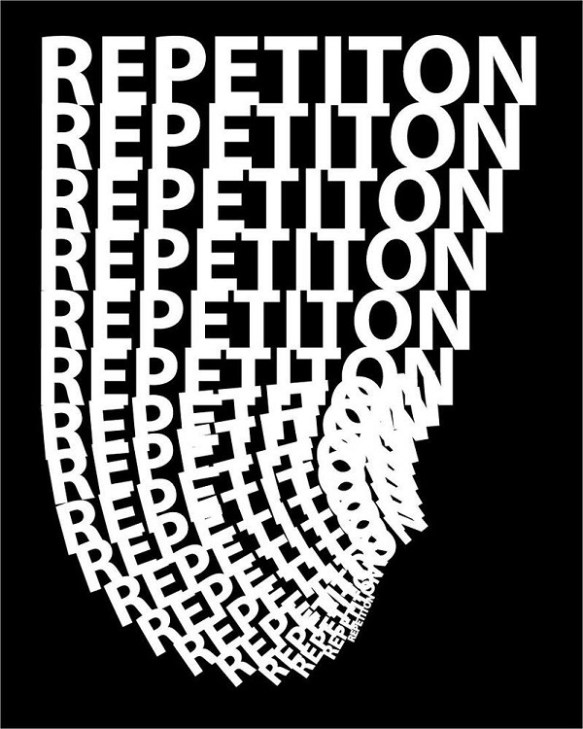
repetition

[Image courtesy of Pinterest.]

I’ve had repetition on the brain lately. Repeatedly. How apropos.

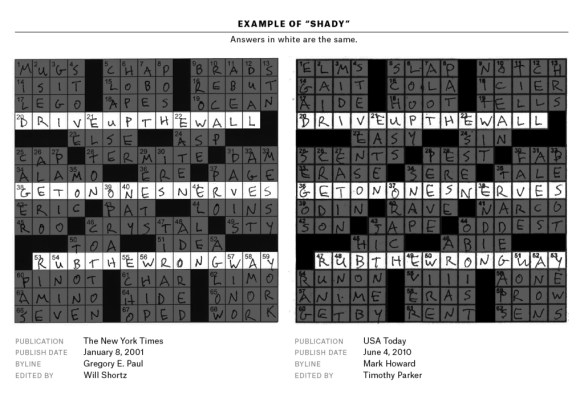
I was talking about plagiarism with a friend of mine recently — a teacher who has dealt with her fair share of plagiarized essays from students — and I quickly summarized the USA Today/Universal Uclick crossword plagiarism scandal from 2016 for her.

She was understandably surprised that plagiarism was a thing in the crossword world — a thankfully rare one — and it got me thinking about intentional repetition vs. unintentional repetition.

When it comes to the Uclick scandal, it was pretty obviously intentional repetition.
crossword-finals-shady

But unintentional repetition happens more often than you’d think. The very rules for creating a traditional themed crossword lend themselves toward duplication, unintentional and otherwise.

Grid layouts, for instance, get reused all the time. When I started constructing, I actually assembled a stack of different grid patterns for 13x and 15x puzzles that I could use, organized by how the theme entries were arranged on the page: 9-13-9, 11-15-11, etc.

Despite the virtually infinite number of ways you could build a 15x grid, you see, when it comes to theme entries — particularly grids with diagonal symmetry and theme entries of matching length — there’s a finite number of ways to build a functioning grid.

So, we know that grids can easily be similar, but what about themes?

There are all sorts of ways that wordplay can inspire crossword themes — anagrams, sound-alike puns, entries reading backwards or being mixed up in a grid, portmanteaus, letters being removed from common phrases (and sometimes placed elsewhere in the grid), etc. — and if more than one constructor comes up with the same idea, you could have repeated entries with no malice or plagiarism involved.

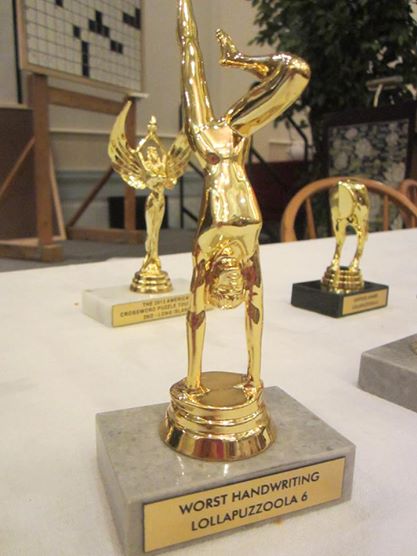
Let’s say multiple constructors are working on puzzles with a similar theme, as they would for some of the tournaments hosted throughout the year, like Lollapuzzoola or the Indie 500. If the tournament had a time theme, it’s reasonable that more than one constructor could come up with a hook like “Time Flies” and look for entries that combine travel and time, coming up with NONSTOPWATCH or LAYOVERDUE.
raven

[Image courtesy of DnD Beyond.]

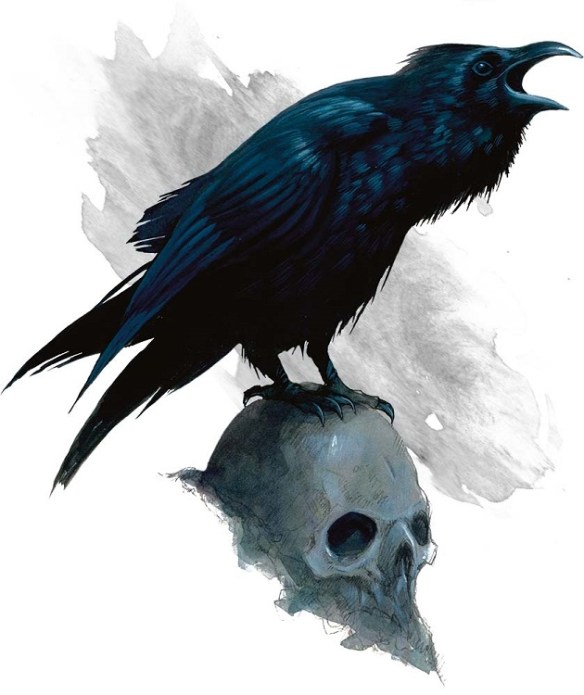
Constructor Matt Gaffney actually wrote about a case of unintentional theme repetition for Slate years ago, discussing how he and Mike Shenk independently came up with puzzles where the word RAVEN was hidden in longer entries, and four of the five theme entries in the puzzles were the same AND placed similarly in the grid.

It’s a fascinating read that reveals a lot about grid construction, theme design, and puzzle mechanics. It’s the ultimate puzzly example of “great minds think alike.”

So, how do you avoid repeating a theme? Well, a little due diligence can go a long way. Sites like Xwordinfo and Crossword Fiend are great resources for searching theme answers to see if they’ve been done before.

Constructor Patrick Blindauer also offered some advice for coming up with new themes: solve more puzzles. He said, “Solving other puzzles is a good source of theme ideas for me. I try to guess the theme early, sometimes based only on the title; if I turn out to be wrong, I’ve got a new idea to play with.”

In this case, he avoids repetition through imagination. It’s a cool idea, one that will no doubt lead to some terrific new puzzles.


Thanks for visiting PuzzleNation Blog today! Be sure to sign up for our newsletter to stay up-to-date on everything PuzzleNation!

You can also share your pictures with us on Instagram, friend us on Facebook, check us out on TwitterPinterest, and Tumblr, and explore the always-expanding library of PuzzleNation apps and games on our website!

The Human Limit of Speed-Puzzling?

stopwatch

When you think about achieving the impossible, what comes to mind? For runners, there’s beating the 4-minute mile. For the 100-meter sprint, it’s topping 10 seconds.

What do you suppose the puzzle equivalent would be? Solving puzzle #1 at the American Crossword Puzzle Tournament in under 2 minutes? We’ve seen Dan Feyer do that, and it was seriously impressive.

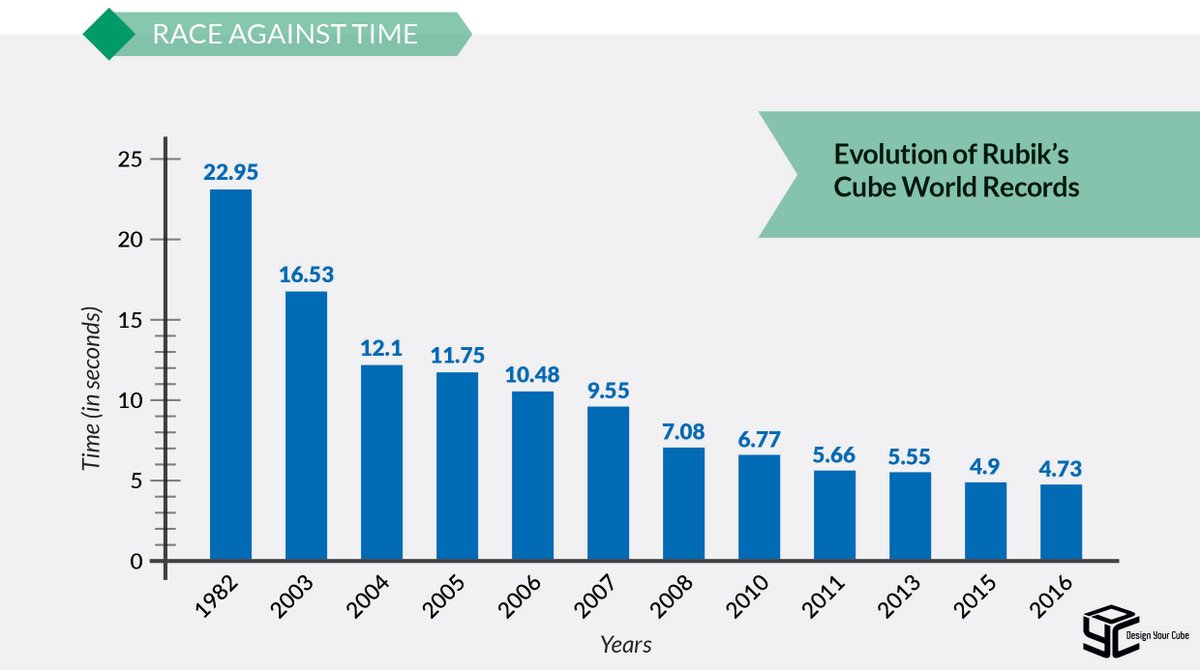
For Rubik’s Cube enthusiasts — especially the competitors known as speed-solvers or speed-cubers — that benchmark is a sub-3 second solve.

The current verified world record for speed-solving a Rubik’s Cube stands at 3.4 seconds, which shattered the previous record by almost a second.

(That record is for a single solve. Many Rubik’s Cube competitions involve an average time across five solved cubes, and the speed record for that hovers somewhere around 5 seconds.)

A lot goes into achieving a 3.4 second solve. There are specially designed cubes that allow for easier, quicker, smoother twisting and turning, so you can solve faster. I’m sure anyone who has solved a classic Rubik’s Cube found it at least a little bit clunky.

There’s also technique. Top solvers not only memorize solving patterns known as algorithms, but they have preferred combinations of moves.

It has been mathematically proven that no matter how complicated a scramble gets, you’re never more than 20 moves away from the solve. Now, of course a computer can analyze a cube and figure out those 20 moves. The human mind doesn’t work that way, so even top speed-solvers would require many more moves to solve the cube, even if they’re still lightning fast.

Which brings us to the next aspect of speed-solving: efficiency. Sometimes the fewest number of moves isn’t the fastest solve. For instance, if you have to rotate the cube in order to execute a turn, you’re wasting time you could otherwise spend twisting and turning toward the solution. So some solvers will avoid a slower rotational move by doing two turns instead, which ends up being faster overall. The trade-off of speed vs. efficiency is another way speed-solvers are whittling down time and approaching that 3-second threshold.

Top solvers can execute ten turns or moves per second. Based on the idea that no Rubik’s Cube is more than 20 moves away from being solved, that mathematically implies that a 2-second solve should be possible, if not probable.

In fairness, we’ve seen a solve take less than a second, but that involved a computer program and a robot solver.

So where do we currently stand? Well, there’s the 3.4 second official record, but former champion Feliks Zemdegs claims that, in training, he has achieved a 3.01 second solve.

Another speed-solver, Patrick Ponce, claims that he has solved a 3×3 cube in 2.99 seconds, but again, this is an unofficial time.

That being said, it certainly seems like the 3-second threshold, like the 4-minute mile before it, will eventually fall.

How fast is the human limit? Only time will tell.

[Sources: Rubik’s WCA World Championship, World Cube Association, Wired.]


Thanks for visiting PuzzleNation Blog today! Be sure to sign up for our newsletter to stay up-to-date on everything PuzzleNation!

You can also share your pictures with us on Instagram, friend us on Facebook, check us out on TwitterPinterest, and Tumblr, and explore the always-expanding library of PuzzleNation apps and games on our website!

Two Upcoming Crossword Tournaments for Summer 2019!

boswords3

If you’re a crossword solver, the next few weeks will have loads of opportunities for you to show off your puzzly chops and meet some fellow cruciverbalists!

Next weekend, the third annual edition of the BosWords crossword tournament will be running on Sunday, July 28th from noon to 5 PM!

With three divisions to choose from — Red Sox (Expert), Paw Sox (Amateur), and Pairs — puzzlers of all ages and experience levels will have the opportunity to test their puzzly wits.

Tournament organizers Andrew Kingsley and John Lieb have gathered a murderer’s row of talented constructors for this year’s puzzles. The five themed puzzles in regular competition (as well as the championship final) will be constructed by Laura Braunstein, Claire Rimkus, Finn Vigeland, Ross Trudeau, Paolo Pasco, Joon Pahk, and David Quarfoot.

You can click here for more information!

But that’s not all…

Just a few weeks later, the twelfth edition of Lollapuzzoola will be held in New York City on Saturday, August 17th from 10 AM to 4 PM!

Yes, the greatest crossword puzzle tournament ever held on a Saturday in August returns once again to challenge solvers with some of the most innovative and creative crosswords of the year.

Tickets for solo competitors (Express for top solvers, Local for average solvers, and Rookie for newcomers) and Pairs Division are available here (as well as the at-home division for solvers who cannot attend).

And for those who reach the top of mountain, “winners in each division are awarded prizes, which could range from a box of used pencils to a brand new car. So far, no one has ever won a car.”

Are you planning on attending either BosWords or Lollapuzzoola (or maybe both)? Or will you be solving either from home? Let us know in the comments section below! I’d love to hear from you!


Thanks for visiting PuzzleNation Blog today! Be sure to sign up for our newsletter to stay up-to-date on everything PuzzleNation!

You can also share your pictures with us on Instagram, friend us on Facebook, check us out on TwitterPinterest, and Tumblr, and explore the always-expanding library of PuzzleNation apps and games on our website!
“Infinity Train” Arrives Soon With Some Puzzly Ideas (and Viral Marketing)

infinitytrainpuzzle2

Puzzles pop up all over the television landscape, whether you’re expecting them or not. For instance, while watching an old episode of The Sopranos the other day, I was surprised to see a Crostic puzzle from our friends at Penny Dell Puzzles in the hands of an FBI agent on the show.

You never know where puzzly ideas will show up, though thanks to a recent viral campaign, we do have some details on the latest Cartoon Network show with a puzzle element.

Infinity Train.

infinitytrainpic1

[Image courtesy of Gizmodo.]

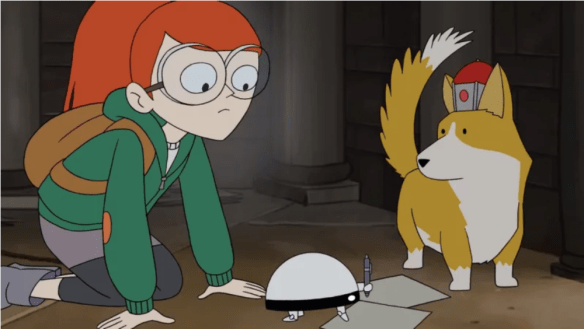
Based on an 8-minute short film by Owen Dennis — who worked as both writer and storyboard editor for Regular ShowInfinity Train is an adventure/mystery series featuring a student named Tulip who has a knack for coding and solving puzzles. Tulip ends up on the titular train, discovering not only endless strange worlds inside the train, but dangerous foes and a puzzly mystery to solve.

The folks at Cartoon Network even whipped up a puzzle-fueled challenge for interested viewers.

It started with this brief teaser trailer for the show:

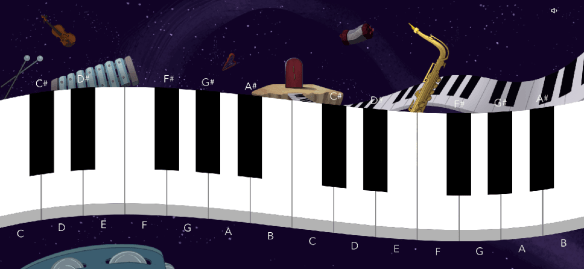
A link in the description box on YouTube directed folks to this website, where a piano puzzle — similar to the one from The Goonies — awaits:

infinitytrainpuzzle

Intrepid solvers quickly figured out that the solution to the puzzle is to play that brief melody you heard in the teaser. If you press (in order) D, B, G, and F#, a full trailer plays as your reward, revealing more scenes from the upcoming TV show.

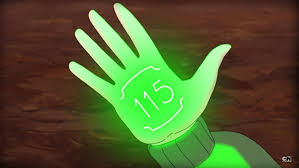
It’s a cool piece of viral marketing that definitely sparked greater interest in the show, and even before the first episode has aired, fans are already speculating about the infinite train, the strange number on Tulip’s hand that changes depending on her actions, and the sinister characters that want her to “return to her seat.”

infinitytrainpic2

[Image courtesy of Infinity Train Fans.]

There is an intriguing mix of danger and excitement to the proceedings, as Tulip and her companions seem eager to unravel the train’s many mysteries, but never forget that they are in peril. It’s a tough tightrope to walk narratively, but if done correctly, it will add tension and drama to the show’s puzzly premise.

Given how much fun — and how challenging — solvers found some of the puzzles connected to Gravity Falls, there’s real potential for those same solvers to find new joys with Infinity Train.

Only time will tell.

Oh, and hey, here’s the full trailer in case you couldn’t crack the piano puzzle:


Thanks for visiting PuzzleNation Blog today! Be sure to sign up for our newsletter to stay up-to-date on everything PuzzleNation!

You can also share your pictures with us on Instagram, friend us on Facebook, check us out on TwitterPinterest, and Tumblr, and explore the always-expanding library of PuzzleNation apps and games on our website!

How Puzzles and Games Evolve to Reach New Audiences

evolution

I am always intrigued when a puzzle, puzzle game, or board game makes the leap to a different medium. What changes will need to be made in order to adapt the puzzle/game to this new style? Does the puzzle lose something in the translation, or become something entirely different? Or does moving into this new medium prove to be a renaissance, a revitalization, for a puzzle or game that had grown stale?

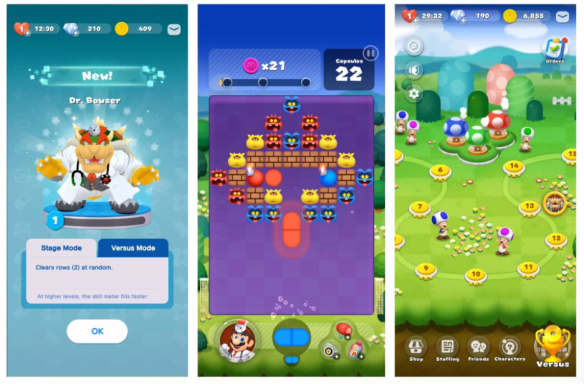
The classic Nintendo puzzle game Dr. Mario recently made the leap to mobile apps as Dr. Mario World, for example, and the transition left the game relatively unscathed.

For the uninitiated, Dr. Mario is all about clearing your screen of virus characters in various colors by lining up pills of the same color to eliminate them. Much like Tetris, the pills fall from the top of the screen, and successfully clearing parts of your screen can cause headaches for your opponent in head-to-head battles.

drmarioworld

[Image courtesy of CNET.]

Sure, the mobile version changed some aspects of the game. You only have a certain number of pills available to clear a given stage (unless you buy more with real-world cash) as opposed to the never-ending supply of the original. And Dr. Mario isn’t the only playable character, as other Mario characters are also doctors in this game (Dr. Peach, Dr. Bowser) with different abilities.

Time will tell if this translation is a success for Nintendo. But naturally, they’re not the only ones experimenting with new ways of bringing their puzzles and games to market.

Our friends at Looney Labs currently have two new projects underway, both of which are reinventing familiar styles of gameplay in fresh exciting ways.

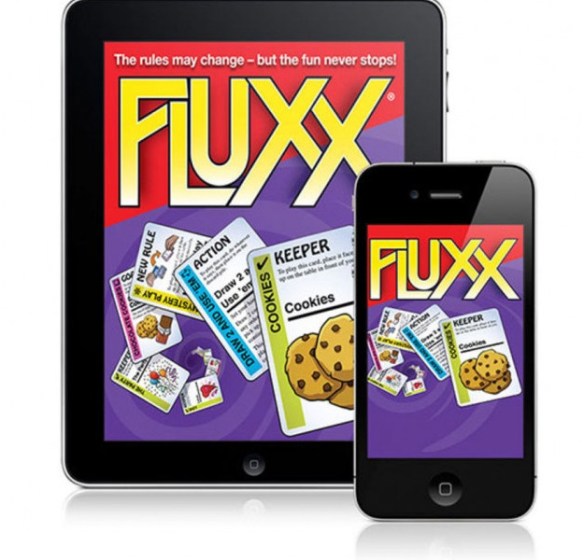
Readers of the blog are familiar with the card game Fluxx, which is one of Looney Labs’ flagship products. The card game with the ever-shifting rules is coming to iOS and Android phones with Playdek’s Digital Fluxx!

fluxx-mobile

[Image courtesy of Pocket Tactics.]

Launching in the next few days, Digital Fluxx promises both offline play and online play for 2-4 players (including human and AI opponents) and multiple language options for international players.

It’s apropos that a game where the rules and goals are constantly changing would continue to adapt in new and exciting ways, and I look forward to seeing how a digital version of the now-classic card game brings new eyes to the Looney Labs library of games.

But that’s not all.

Looney Labs has also teamed up with the game-publishing resource The Game Crafter to allow fans of the card-matching game Loonacy to create their very own custom Loonacy decks!

You can pick and choose from their library of possible card images or upload your own and create a truly unique Loonacy deck for yourself. I think it’s an awesome idea, one that makes a perfect gift for fellow game fans, and I can’t wait to see what sorts of clever creations Loonacy fans come up with through The Game Crafter.

Between a DIY design template for a fast-paced relative newcomer and a digital version of one of the mainstays in modern card games, Looney Labs is demonstrating two ways that puzzlers and game companies can find new, enticing ways to keep their products accessible.

I can’t wait to see what other companies and puzzlemakers come up with next.


Thanks for visiting PuzzleNation Blog today! Be sure to sign up for our newsletter to stay up-to-date on everything PuzzleNation!

You can also share your pictures with us on Instagram, friend us on Facebook, check us out on TwitterPinterest, and Tumblr, and explore the always-expanding library of PuzzleNation apps and games on our website!

Answers to our Fourth of July Deduction Puzzle!

13starflag

[Image courtesy of Amazon.]

Last week, we celebrated America’s birthday in puzzly fashion by offering a custom-made Pair Off-style deduction puzzle for our fellow PuzzleNationers to solve!

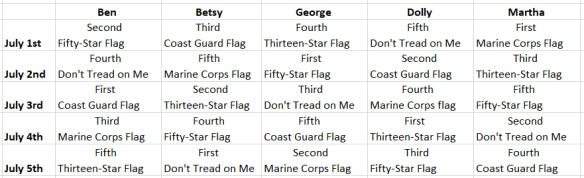
Our setup was simple: a group of five enthusiastic vexillologists — devotees of the study of flags — decided to stage five days of presentations about different flags from American history.

Each person presented a different flag’s history each day (the thirteen-star flag, the fifty-star flag, the Don’t Tread on Me flag, the Marine Corps flag, or the Coast Guard flag), and the presentations were performed in a different order each day (first, second, third, fourth, or fifth).

Each vexillologist presented one flag per day, and none of them repeated a flag presentation across the five days. Similarly, none of the flag presentations happened in the same order each day. So, for instance, if a flag was first in the order on July 3rd, it wouldn’t be first in the order any other day.

And we challenged our solvers to complete the schedule of flag presentations.

If you want to try the puzzle for yourself, this is your last chance.

.

..

….

….. you’ve been warned…

….

..

.

Okay! Let’s take a look at the solution grid:

7-4pairoffans

How did you fare in our Independence Day puzzle challenge? Did you enjoy any other puzzles or games over the holiday? Let us know in the comments section below! We’d love to her from you.


Thanks for visiting PuzzleNation Blog today! Be sure to sign up for our newsletter to stay up-to-date on everything PuzzleNation!

You can also share your pictures with us on Instagram, friend us on Facebook, check us out on TwitterPinterest, and Tumblr, and explore the always-expanding library of PuzzleNation apps and games on our website!