One of the best things about Halloween is guessing what people’s costumes are. Clever costumes can be great fun, and I’m a huge fan of costumes that only cost a few bucks to put together, because they really let your creativity shine through.
Punny costumes lend themselves to the low-budget costume genre brilliantly. So it’s only appropriate that we celebrate Halloween in the puzzliest way possible — by looking at some punny costumes!
It’s simple. I post a picture, and you guess what the costume is.
For example:
She’s the family breadwinner!
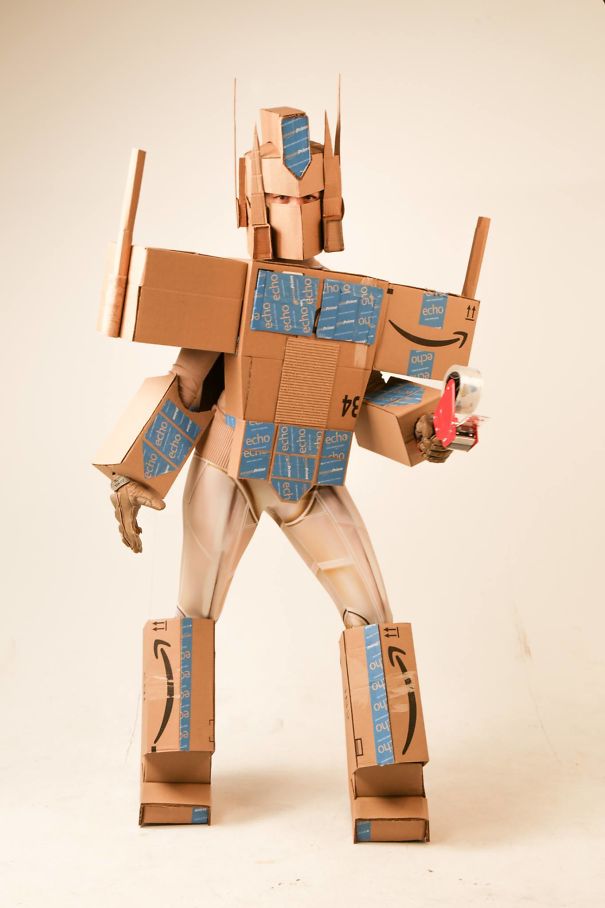
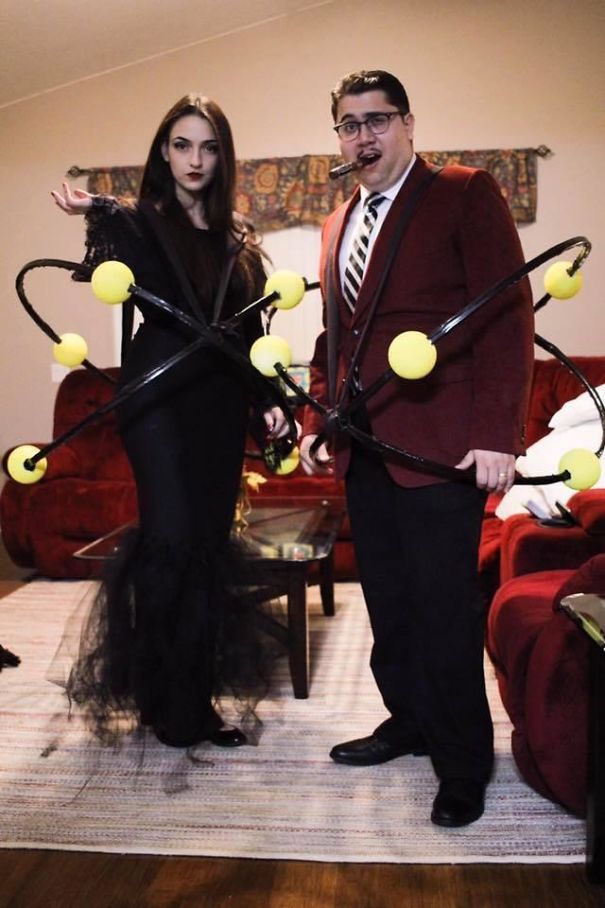
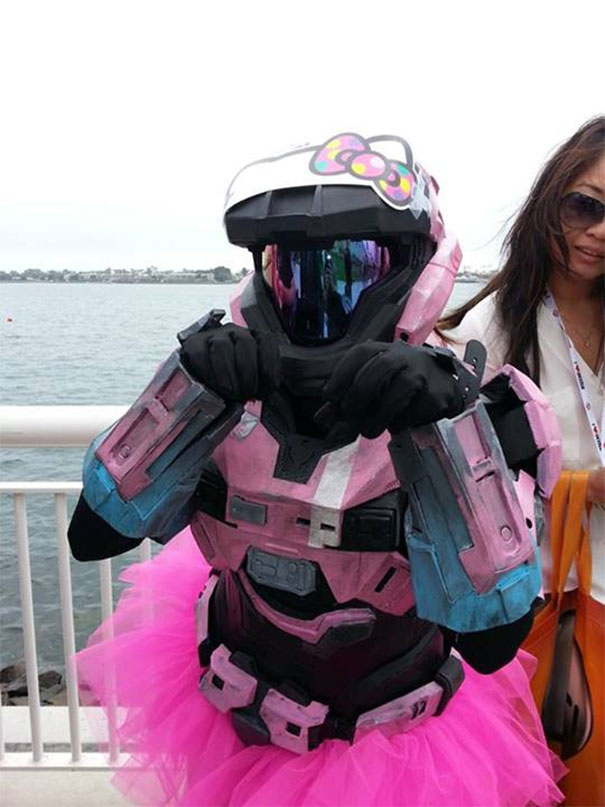
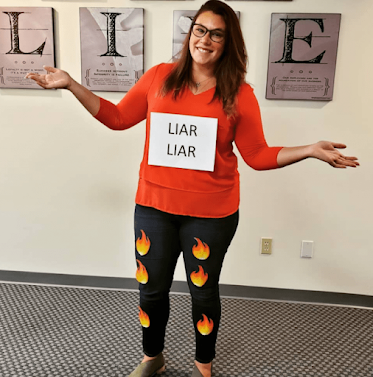
I’ve compiled ten costumes for you to figure out. Some are mashups, some are straightforward puns. Let’s see how many you can get!
PuzzCulture’s Punderful Halloween Costume Game!
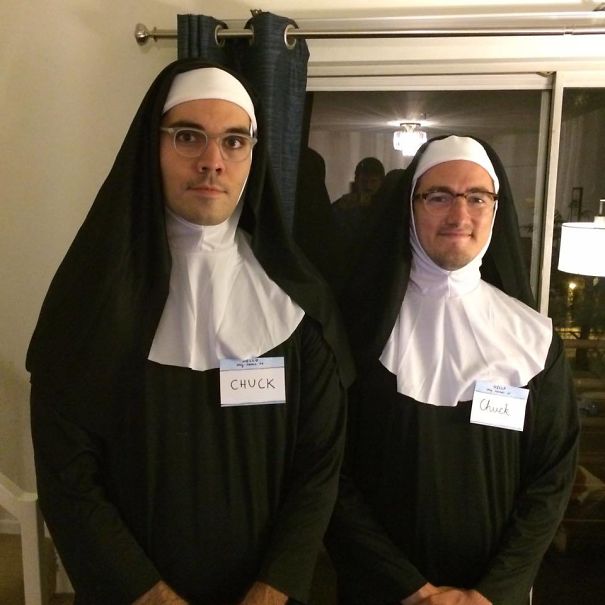
#1
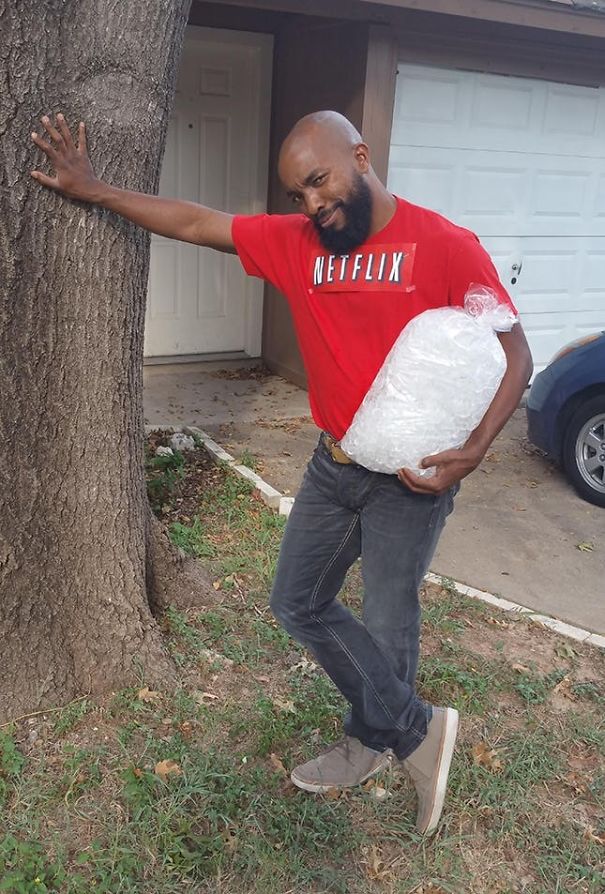
#2
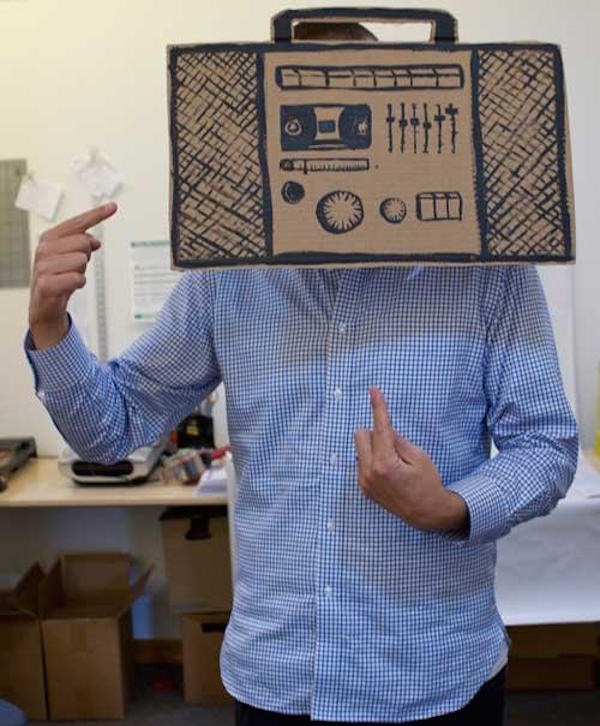
#3
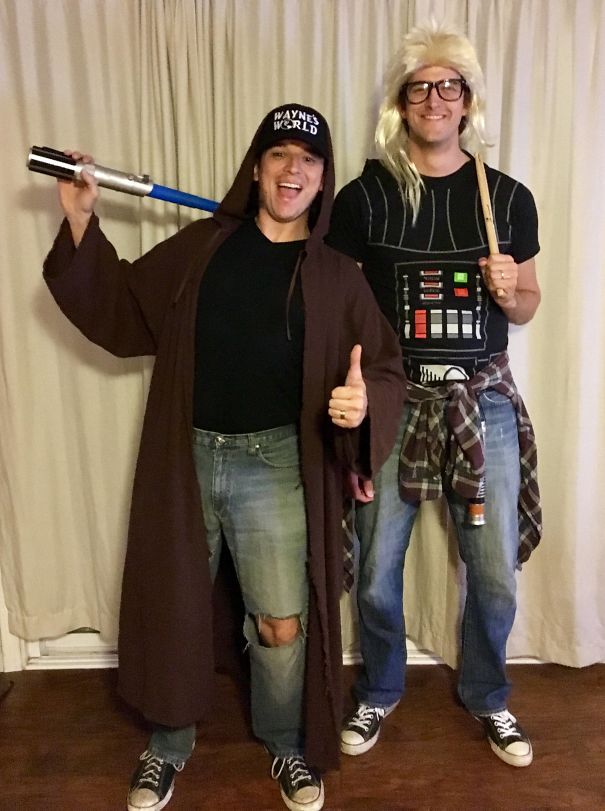
#4
#5
#6
#7
#8
#9
#10
How many did you get? Have you seen any great punny costumes we missed? Let us know in the comments section below. We’d love to hear from you. And Happy Halloween!
With Halloween fast approaching, I couldn’t resist putting together a Logic Puzzle for my fellow solvers to enjoy!
At the yearly monster Halloween party, everyone looks forward to the dance contest the most.
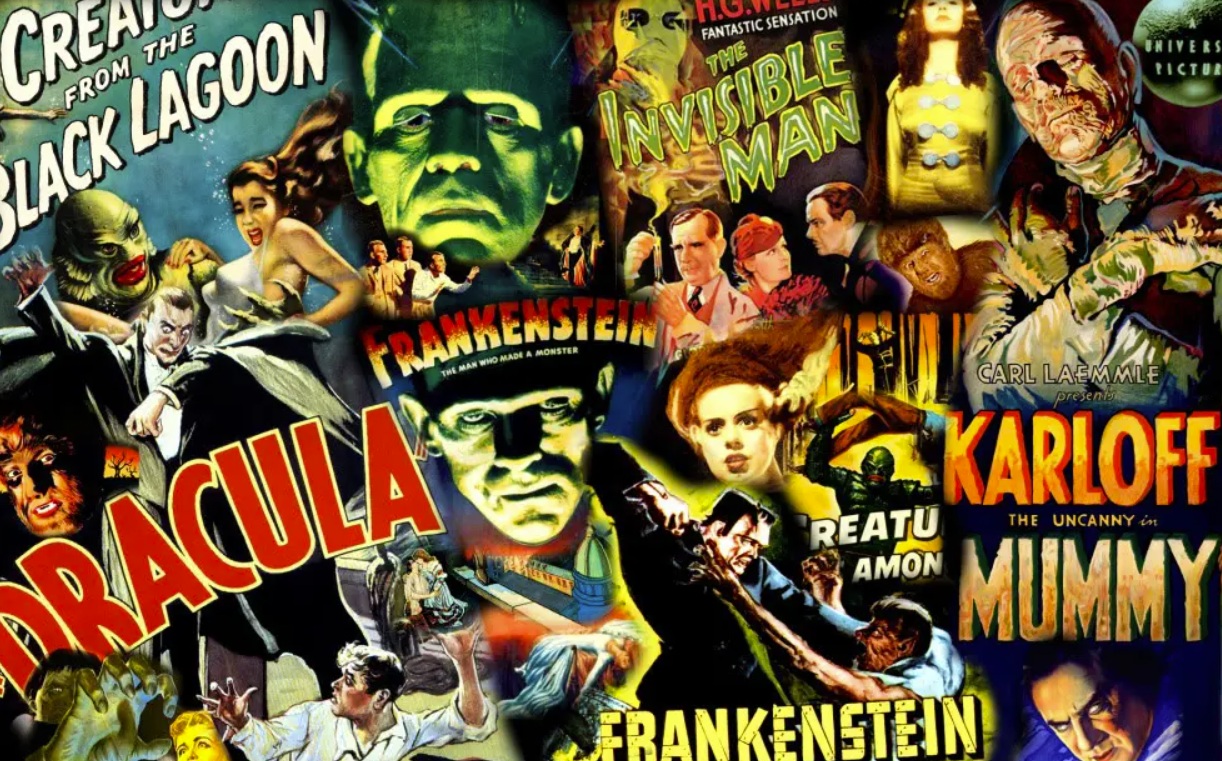
Five classic Universal monsters — Frankenstein’s Monster, Dracula, The Wolfman, The Creature from the Black Lagoon, and The Mummy — have created a routine with a different partner to a different song (one is “Season of the Witch”) with a different Halloween treat afterward (including Dead Velvet Cake).
From the information provided, can you figure out all of the monster pairings (one of the dance partners is The Bride of Frankenstein), as well as each pair’s song and Halloween treat?
Frankenstein’s Monster chose the song “I Put a Spell on You.”
The Wolfman and Mr. Hyde didn’t choose Charlie Brownies as their Halloween treat.
The Phantom of the Opera (who danced to “The Time Warp”) didn’t partner with The Creature From the Black Lagoon.
Dracula (who chose “Black Magic Woman”) didn’t choose The Babadook as a dance partner, but The Babadook enjoyed Boo-Scotti as a Halloween treat.
The Invisible Man’s Halloween treat was the Scare-amel Apples.
The Creature from the Black Lagoon (who didn’t dance to “Thriller”) enjoyed the Black Cat Cookies.
Did you solve the puzzle and pair up these monstrous dance partners? Let us know in the comments below. We’d love to hear from you!
Godzilla has been a cultural icon for seventy years.
Across dozens of films, in a film market with hundreds of behemoths, leviathans, and titans to watch, Godzilla is still the King of the Monsters. Godzilla has battled humanity, aliens, robotic duplicates, and other kaiju, bringing joy and wonder to millions of moviegoers. Godzilla has evolved from personifying the specter of nuclear annihilation to representing the spirit of a proud nation against threats like pollution, environmental catastrophe, and war.
The cultural influence of Godzilla cannot be overstated. So you shouldn’t be surprised to see that it extends into the world of puzzles and games as well.
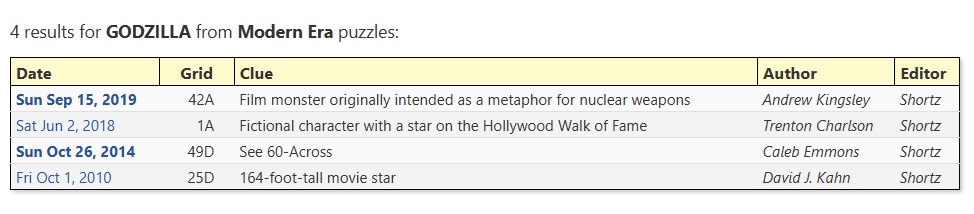
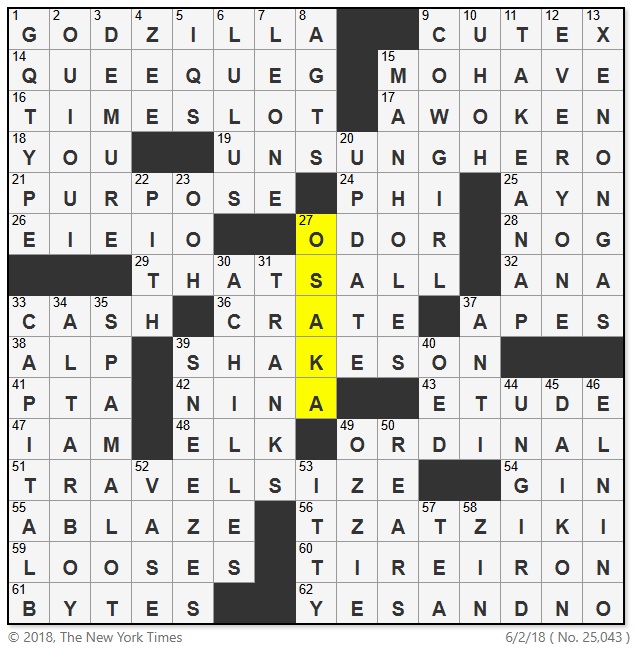
Now, sure, Godzilla isn’t popping up in crosswords on the reg. Xwordinfo tells us that Osaka has been clued a half-dozen times in relation to Godzilla (and Tokyo nearly as many times).
Godzilla has appeared in New York Times crossword grids four times (including one where they cross paths with King Kong). In comparison, fellow Kaiju Mothra has appeared in New York Times crosswords five times.
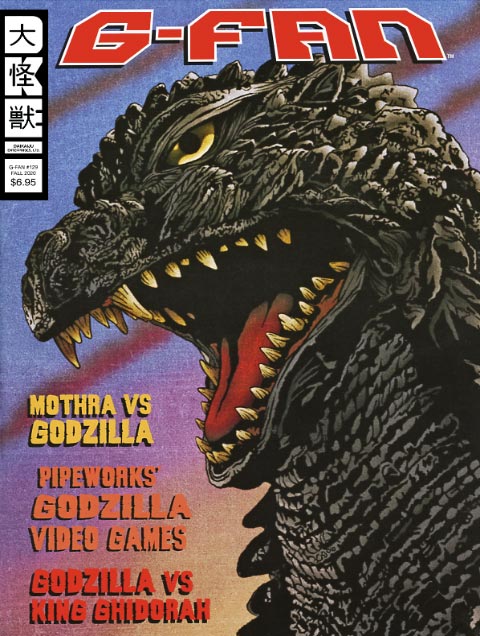
But The New York Times isn’t the only publication worth discussing here. No, to truly appreciate the puzzly legacy of Godzilla, we have to discuss G-Fan magazine.
The art for this cover (and a half-dozen others) was done by my marvelous friend Matt Harris!
G-Fan is the premiere magazine for all things kaiju, especially Godzilla, and it was flipping through an old copy of the magazine that inspired this post. (It’s amazing what you unearth when you’re packing up your whole life to move.)
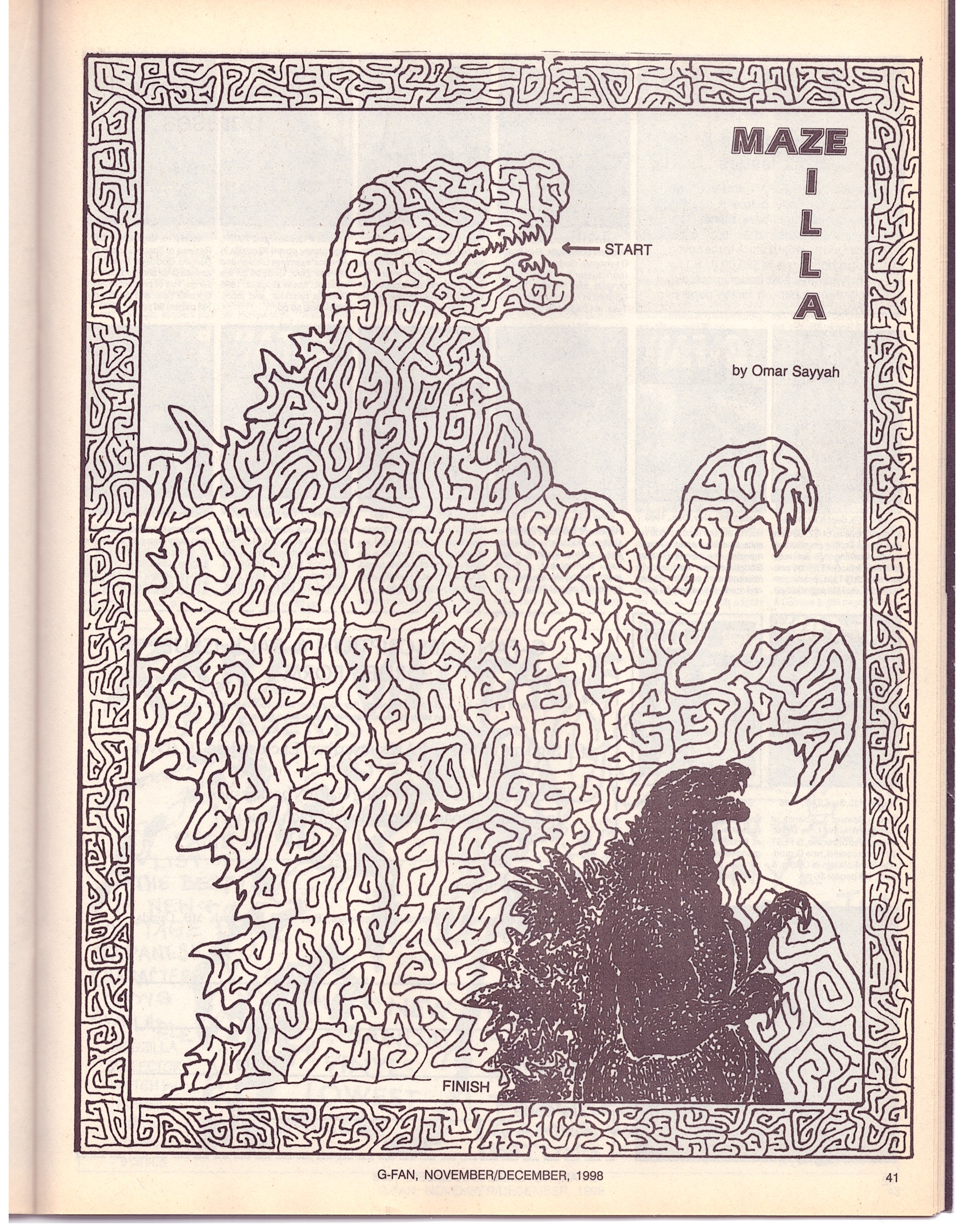
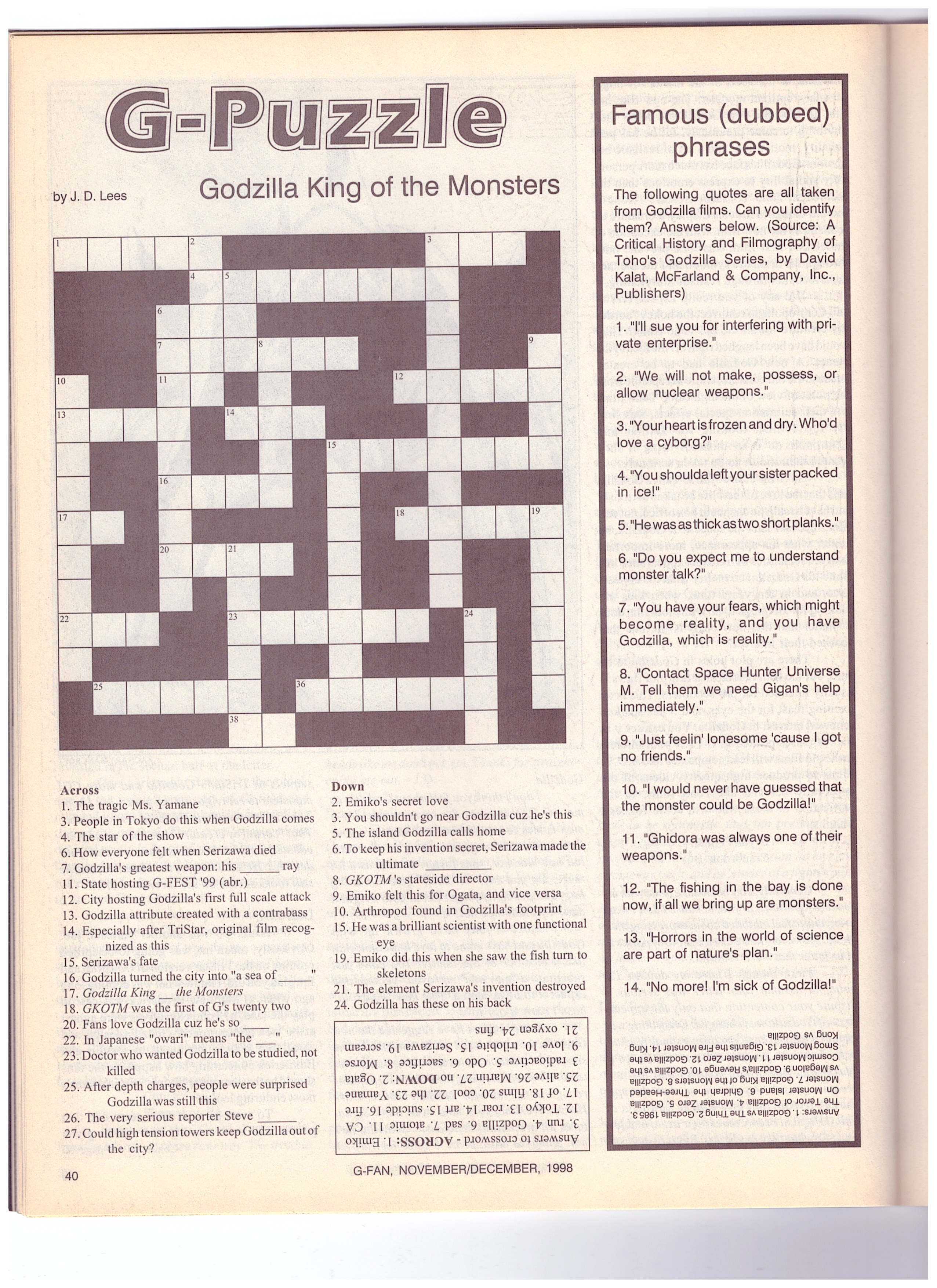
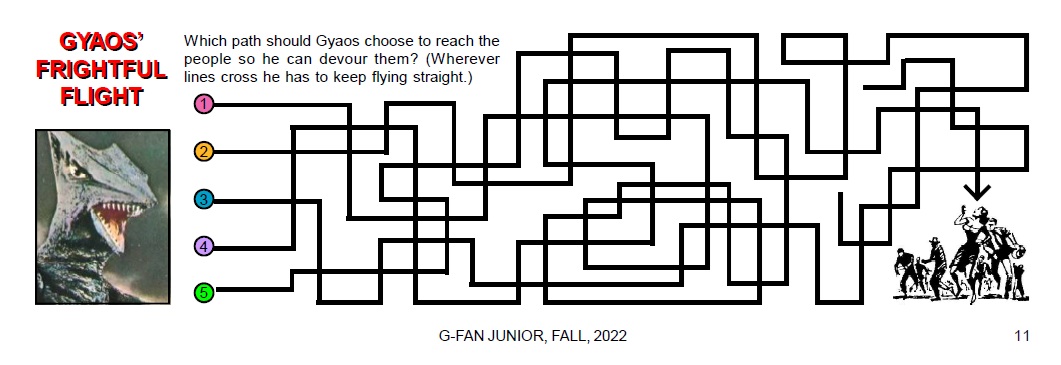
Among interviews, movie reviews, and wonderfully nerdy deep dives into various monster-centric topics, I stumbled across not only a Godzilla-shaped maze (pictured at the start of this post), but a crisscross all about my favorite skyscraper-sized monster.
So, naturally once I started, I kept digging, delving into the G-Fan archives and reaching out to JD Lees, the man behind not only G-Fan, but the annual G-CON / G-FEST convention!
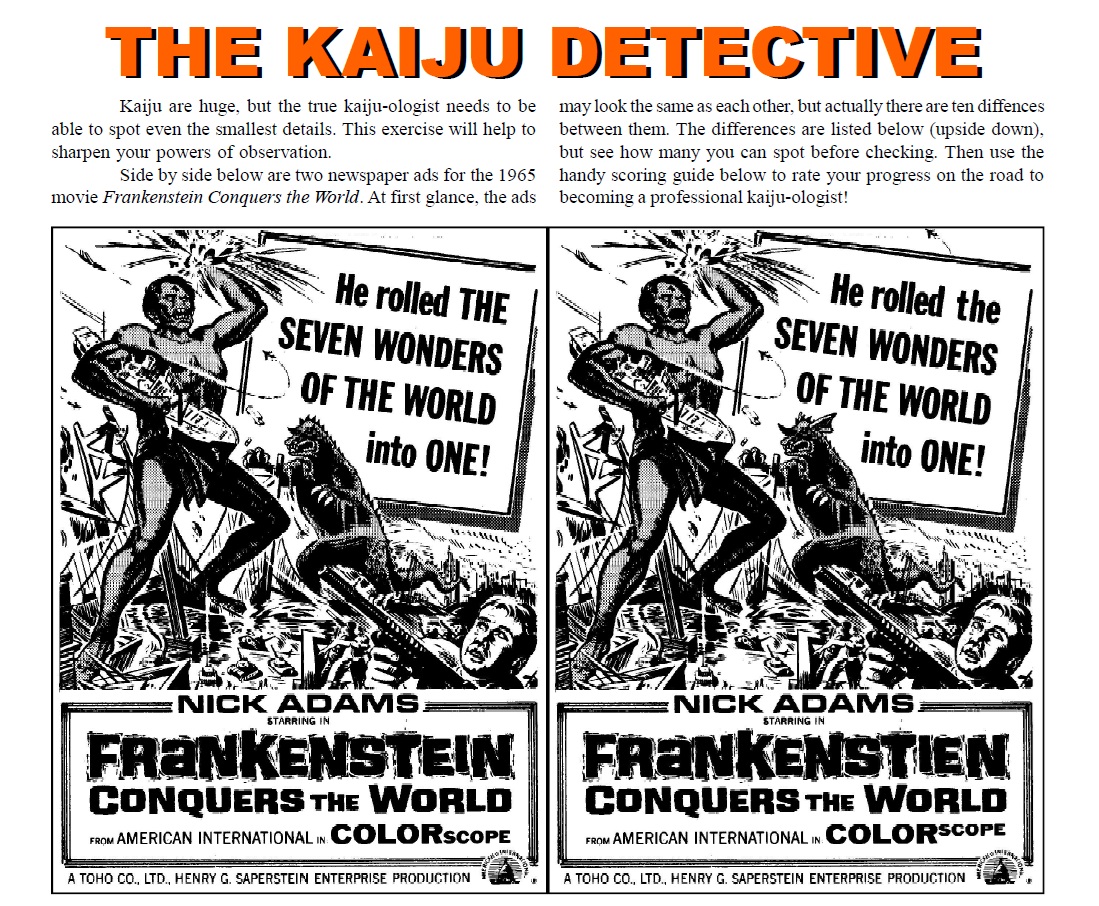
He was kind enough to take some time out to discuss the puzzles periodically appearing in the pages of G-Fan.
What inspired you to start putting puzzles into G-Fan?
When I was a teacher, I would often include puzzles in the worksheets I created for students. I figured it was a way to increase engagement that was a bit fun and different for the kids. I found I enjoyed making them, so when I was creating G-FAN Junior, puzzles seemed a natural thing to include to break up the articles, add variety, and fill space!
Do you have a favorite puzzle (either in terms of topic or overall execution) from over the years?
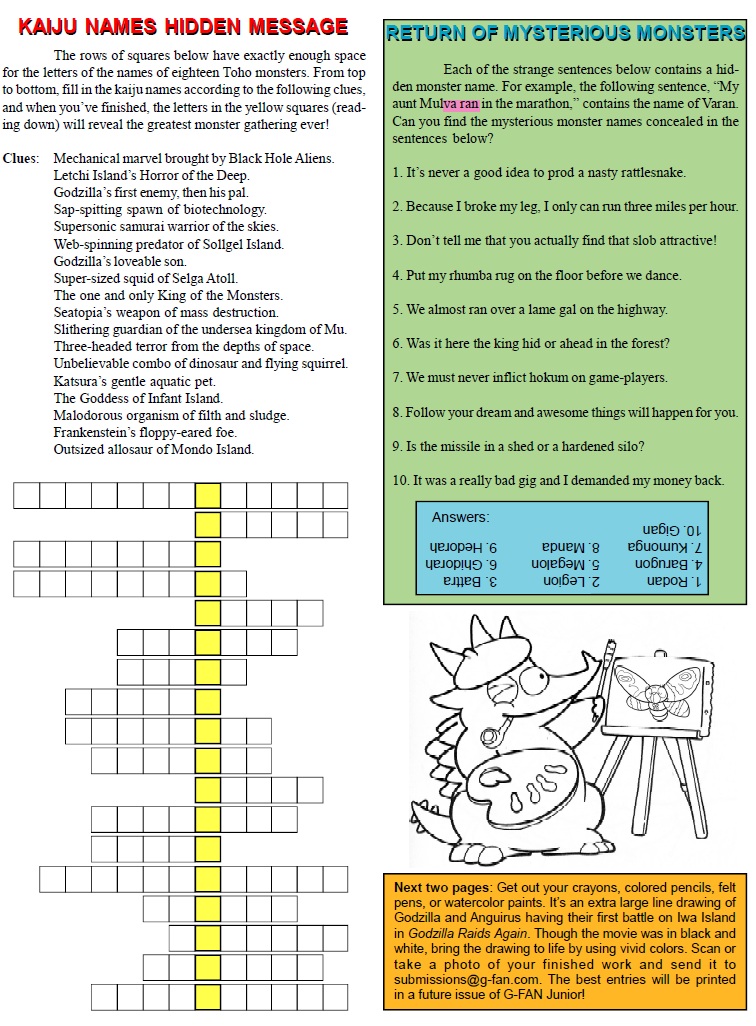
I have a lot of fun creating the puzzles where a monster’s name is hidden in an unrelated sentence. I first saw this done with the names of the U.S. states and their capitals. I think it was in a puzzle book I used in my Grade 10 math class.
There’s a Godzilla Monopoly game. Is your affection for Godzilla potent enough to make you endure a game of Monopoly through to the end?
Ha ha! I look back and marvel at those long-ago times when my friends and I used to enjoy playing Monopoly. Maybe I’m just getting old. (Actually, no maybe about it!) However, I did buy the Godzilla version of Monopoly for the Gaming Room at G-FEST, and it was used. The second year someone stole all the kaiju tokens, so I replaced them with generic monster figures. Overall, G-fans are very honest, but thousands attend the convention, so I guess there will be a few bad apples.
Although he’s currently taking a break from G-Fan, JD did say he expects to construct more puzzles in the future (though they might not be so kaiju-focused.)
Speaking of the Godzilla edition of Monopoly, that brings me to the other half of today’s post: the legacy of Godzilla in board games.
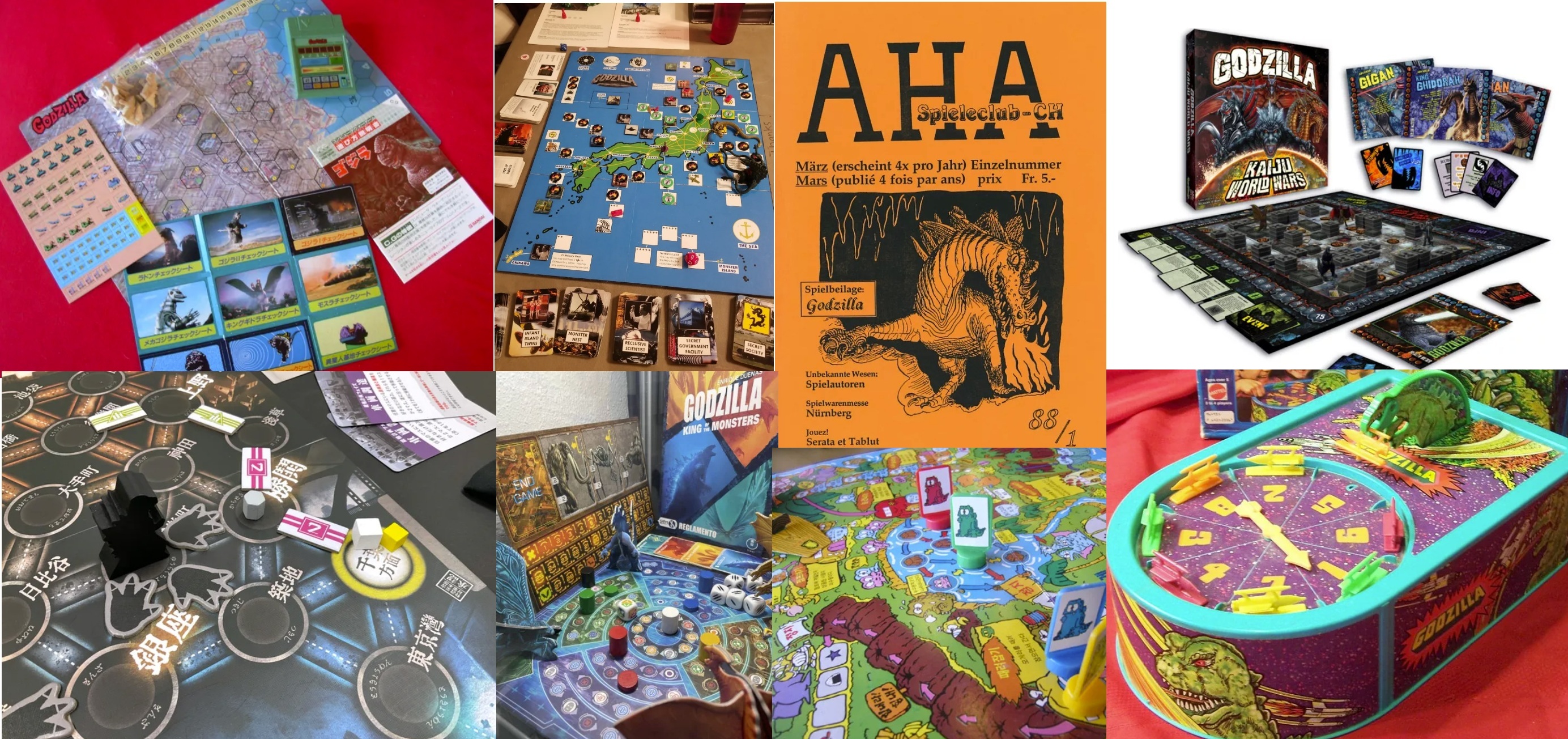
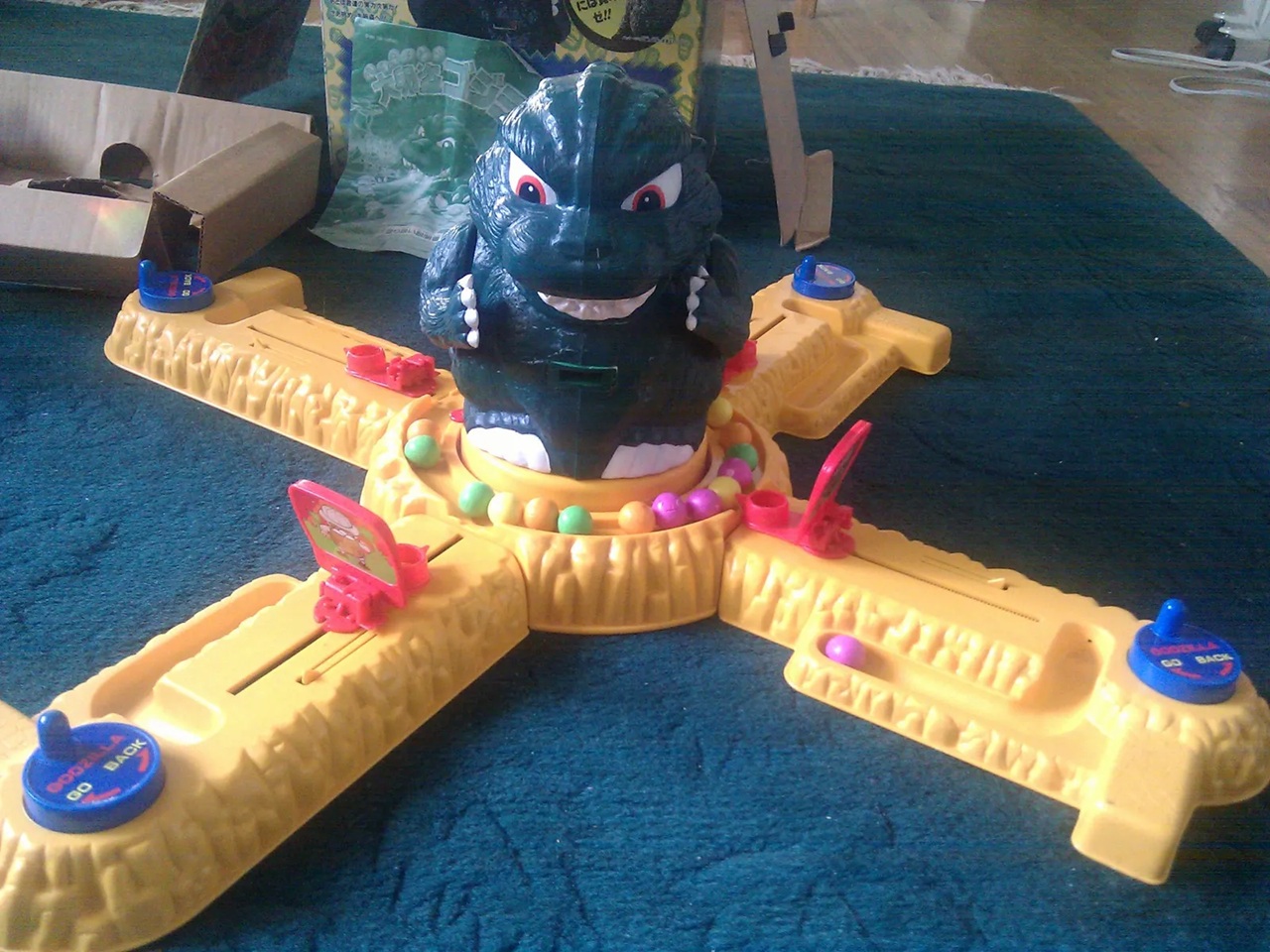
The many ways Godzilla has been translated to board games. Clockwise from upper left: Godzilla Electronic Wargame (1984), Godzilla: Monsters Attack! (2008), Godzilla pen and paper game (1988), Godzilla: Kaiju World Wars (2011), Godzilla Game (1978), Super Godzilla Tempest (1990), Godzilla: King of the Monsters (2020), Godzilla: Kaiju on the Earth LEGENDS (2022).
There are literally DOZENS of board games inspired by Godzilla and the many kaiju that followed in those monstrous footsteps.
Alongside the aforementioned official Monopoly version, there’s an official Godzilla Jenga, a Godzilla version of The Incredible Hulk Smash (one of several dismal tie-ins promoting the atrocious Fox 1998 Godzilla film), as well as expansions for Cthulhu: Death May Die and an upcoming reimagining of the game Battle Masters called Battle Monsters.
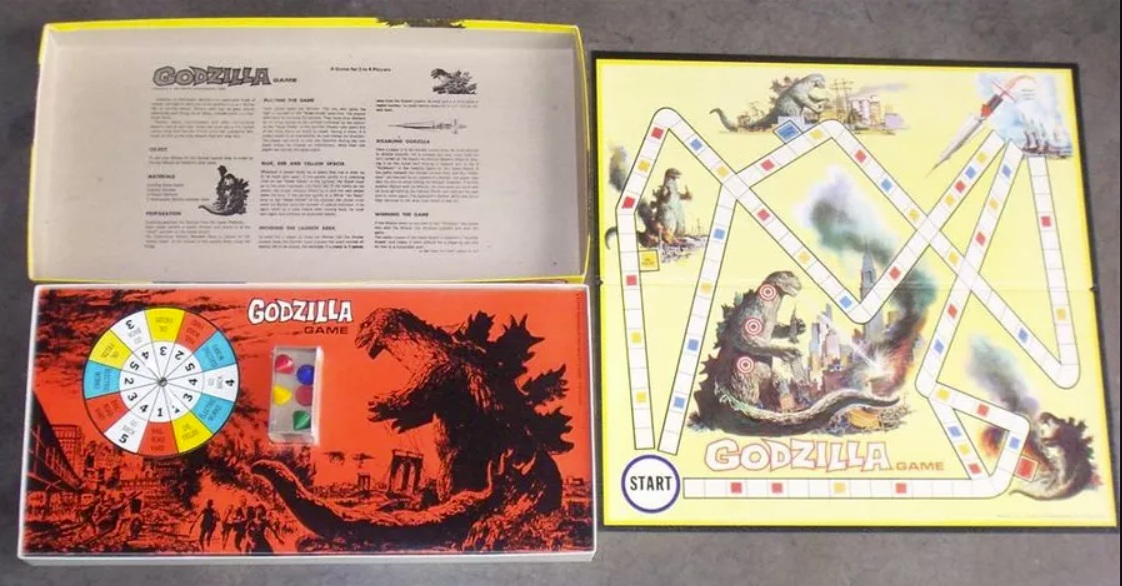
Godzilla-inspired board games date all the way back to 1963, when the imaginatively titled Godzilla Game was released. It was actually the first Godzilla toy produced in the US and only the second Godzilla toy ever made.
In 1978, another Godzilla Game was released, followed by a Mothra vs. Godzilla game in 1982. There have been strategy games (like a pen-and-paper game in Swiss gaming zine AHA in 1988), dice games like Godzilla VS Kong from 2022, and loads of, quite frankly, fairly disappointing board games.
This trend has only reversed in the last fifteen years or so with releases like my all-time favorite Godzilla game, Godzilla: Tokyo Clash from 2020.
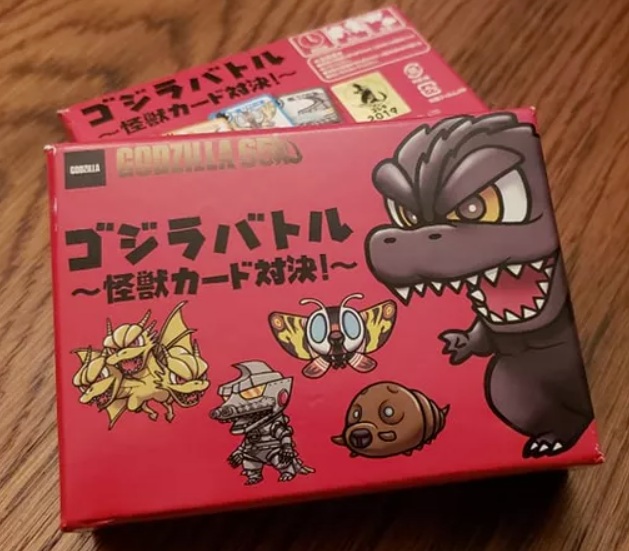
There’s also a curious pattern of Godzilla card games with names that go unnecessarily hard, but I respect the manic energy they bring to game shelves. These names include Godzilla: Stomp! (2011), the delightfully named Godzilla Boom (2012), and Godzilla Total War (2019).
Confusingly, there seem to be both a board game AND a card game called Godzilla Rampage, and they both have supplements adding other monster/monster-fighting icons like Ultraman, Gamera, and Daimajin to the mix.
From cutesy to vicious, from the pages of fanzines to coffee tables across the world, Godzilla has moved far past the silver screen and become part of the cultural language. People who have never seen a Godzilla film — yes, they exist, and we pity them — still know the name.
Bridezillas the world over owe their monstrous reputations to our beloved atomic-breathed kaiju. We know dozens of other monsters because of Godzilla. Rodan, Mothra, King Ghidorah… heck, even King Kong rides those enormous coattails from time to time.
And it’s fun to remember that even the world of puzzles and games is not immune to the mighty roar or the deep, deep shadow of the King of the Monsters.
Thank you to JD Lees, Matt Harris, and several chums from the Board Game Geek forums for helping me with this post. Be sure to check out the G-Fan website for all things Godzilla, and enjoy this not-at-all-exhaustive list of G-Fan issues with some of JD’s puzzles:
Issue #110, Fall 2015
Issue #109, Summer 2015
Issue #108, Jan/Feb 2015
Issue #97, Fall 2011
Issue #49, Jan/Feb 2001
Issue #42, Nov/Dec 1999
Issue #39, May/June 1999
Issue #37, Jan/Feb 1999
Issue #36, Nov/Dec 1998
Issue #33, May/June 1998
Issue #32, March/April 1998
Do you have a favorite Godzilla film, Godzilla game, or Godzilla pop culture moment, fellow puzzlers? Let us know in the comments section below. We’d love to hear from you!
One of my favorite go-to trivia games is Overlaps. Basically, the answer to the trivia question is a combination of two titles. You can use movies, celebrity names, anything really.
And I thought I’d share one of my Overlaps games with you today, fellow puzzler.
Here’s an example to get you started:
A hardworking midwestern mom is mistaken for an 11 year old orphan girl and goes to Avonlea.
And the answer is: Roseanne of Green Gables
Can you unravel these descriptions that overlap a TV show title and a book title?
Let’s find out!
A look at the day-to-day work lives of Thought Police working for Big Apple Brother.
A love quadrangle and an amateur play performance cross paths with a popular shape-named game show involving getting a partner to say the right word.
A talking horse says one thing and means his mother in this curious tale of trying to avoid fate.
Firemen, police, and EMTs in Los Angeles find themselves in a mental institution under the thumb of a tyrannical nurse.
Time and relative dimensions in space are bent by a curious visitor to a disfunctional middle-aged couple’s home after a university faculty party.
456 players compete for a grand prize as the political climate of Westeros changes forever.
With a sword and chakram in hand, a former marauder shares her story of balancing life in high school and her new royal duties.
Wacky hijinks ensue as a man shares the story of courting a famous author of fairy tales and nursery rhymes.
A high schooler with grand ambitions and a habit of stopping time to talk to the camera endures struggles with mental health after her aspiring post-college writing career fails to materialize.
Piloting giant mechanical battle suits to battle angels, the Pevensie children liberate a magical land from the White Witch.
A programming startup company deals with funding issues and a dependence on drugs to navigate turbulent personal and professional relationships in New York City after World War II.
A video diary to a newborn baby from her older sibling serves as the golden ticket to a peculiar candymaker’s legacy.
The misadventures of a young man and his scuffling siblings in a fictional Midlands town in the 1800s as issues of women’s rights, marriage, and political reform are explored.
Two secret service agents seek dangerous magical artifacts while listening to audio tapes recorded by a young woman who committed suicide.
Travel to a curious locale where dreams can come true, particularly for the one woman who lives there, waiting for her people to return for her.
A sharp-tongued and satirical look at the news is presented by a two-inch boy who looks just like a mouse.
How many did you unravel? Let us know in the comments section below! We’d love to hear from you.
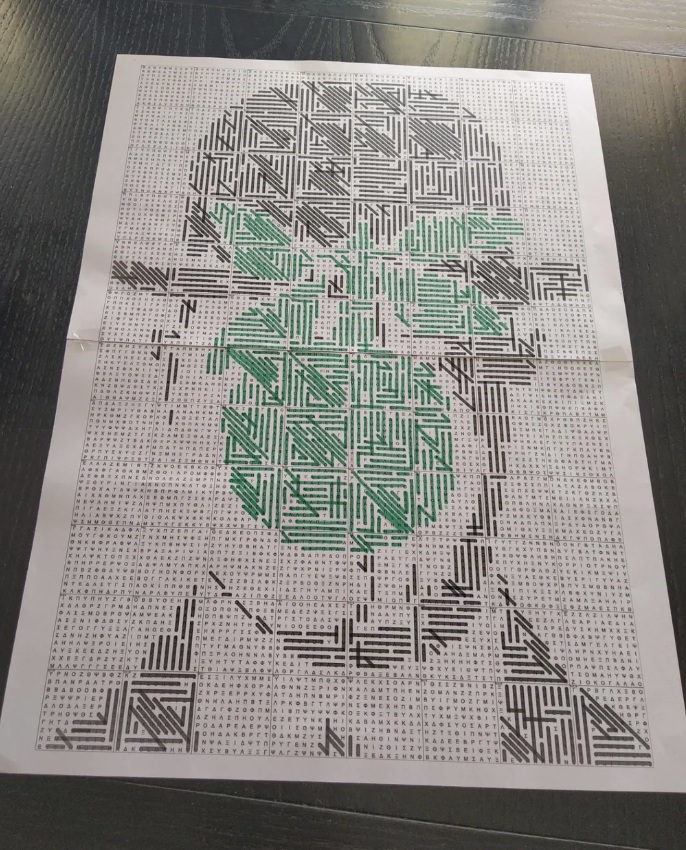
You’ve heard of Logic Art, but let me ask you, fellow puzzler… have you heard of Word Seek Art?
Please allow me to introduce you to the world of LexaPics.
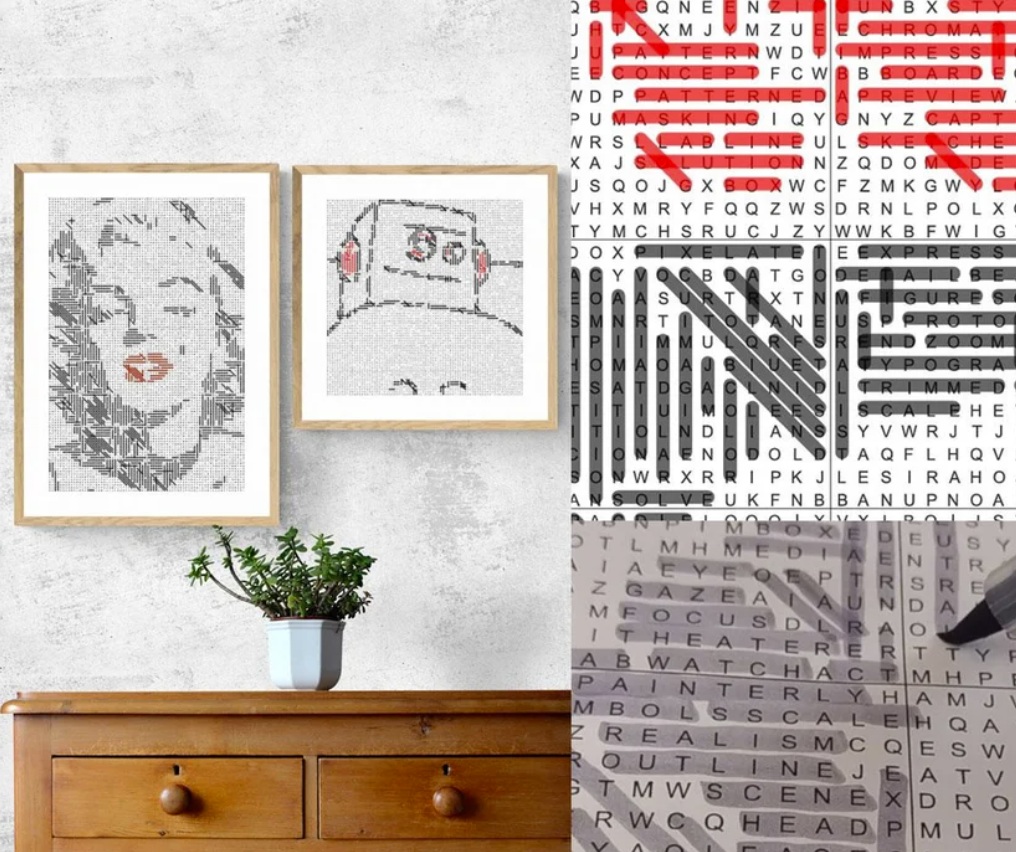
LexaPics are the creation of Vasiliki Papadopoulou, who designs specially curated word seek grids and sorted word lists to create works of art when solved!
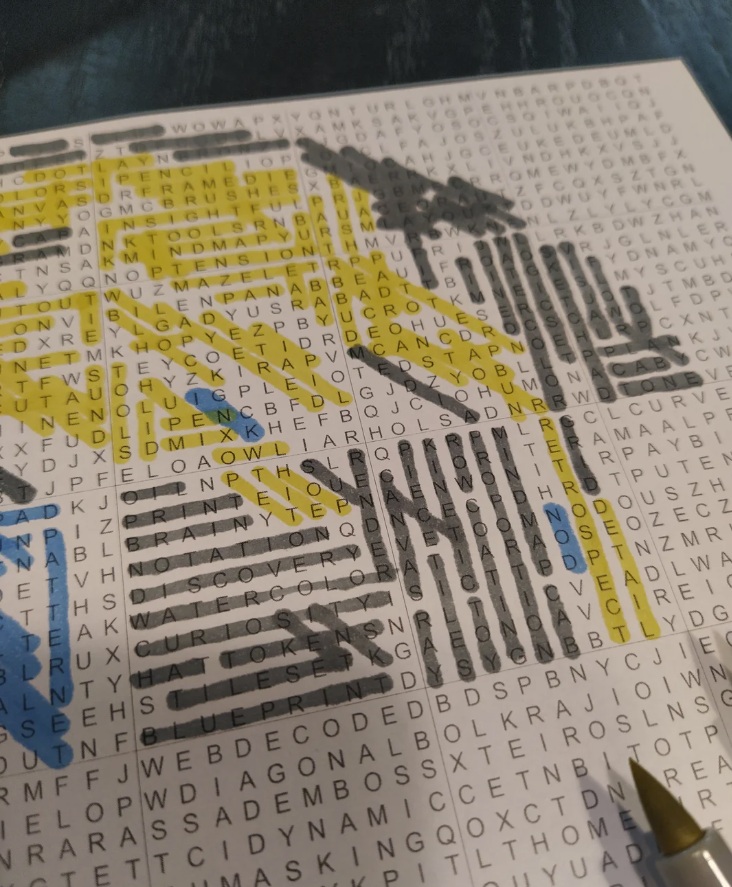
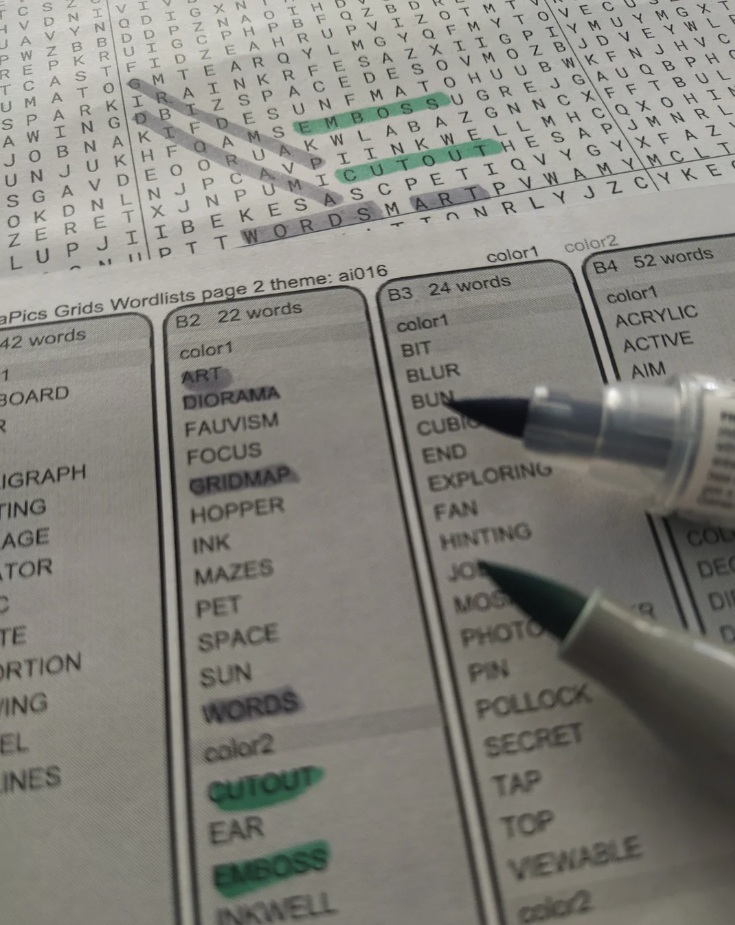
The grid is divided into different cells, and you get a word list for each cell, with different parts of the word list organized by color.
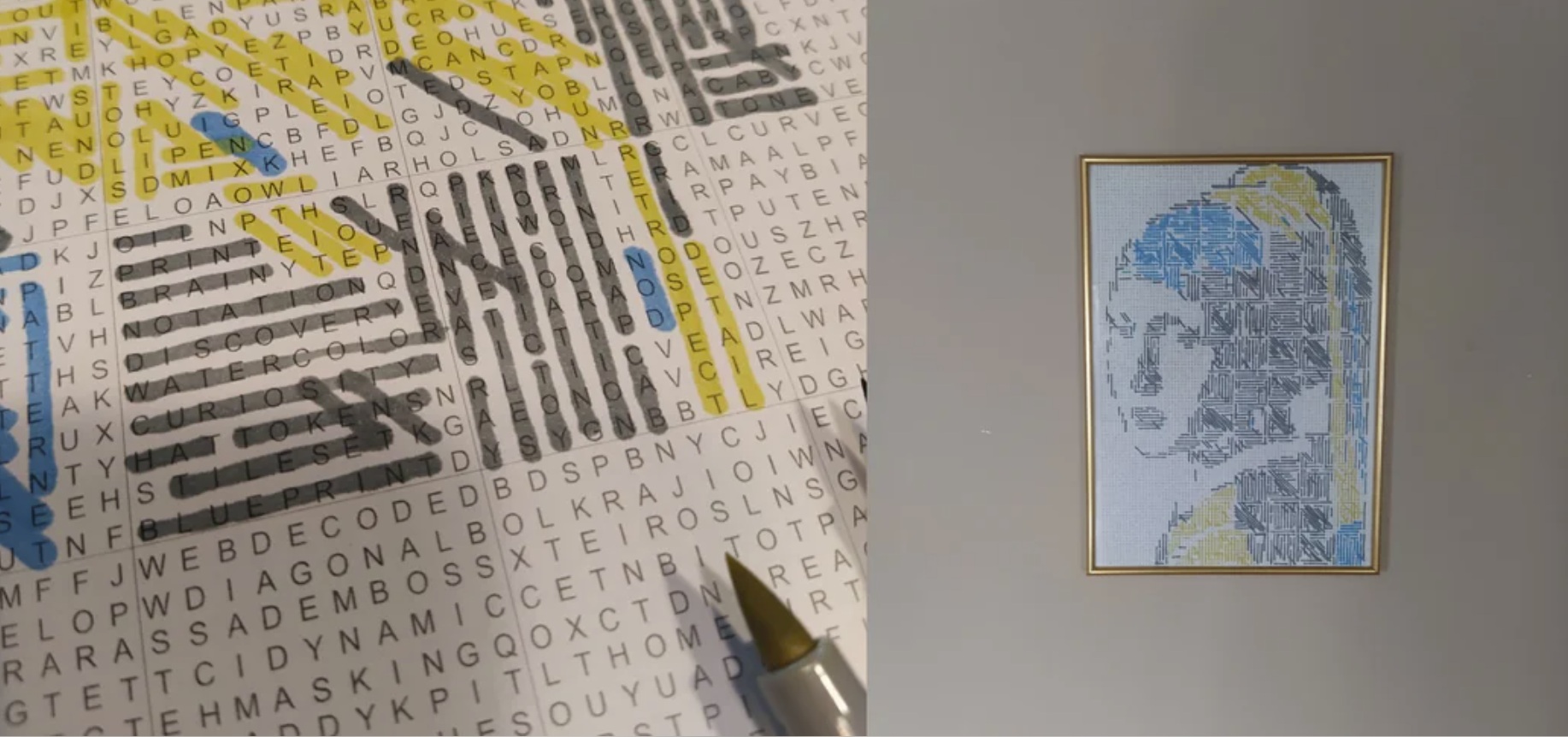
And as you find your words, the work of art slowly emerges line by line.
As you can see, Vasiliki has created grids inspired by Vermeer and Magritte, as well as grids inspired by iconic celebrities like Marilyn Monroe.
Lexa comes from Greek word Lexis λέξη (since i am from Greece) that means word and Pics as pictures, but also a playful nod to “pixels” — the building blocks of modern digital art.
Not only does he have a Kickstarter campaign for LexaPics launching soon, but he’s actually created an Instructables page for anyone who would like to make their own LexaPic!
I love seeing the creative ways people put new spins on classic puzzles, and this is both beautiful and so cleverly accessible.
After our one-year anniversary post, some of the readers have been asking about my puzzle credentials. How did I become a puzzler? What strange, meandering road led me to the hallowed halls of puzzlesmithery? Could aspiring puzzlers follow the same path to puzzlewonderful adventures?
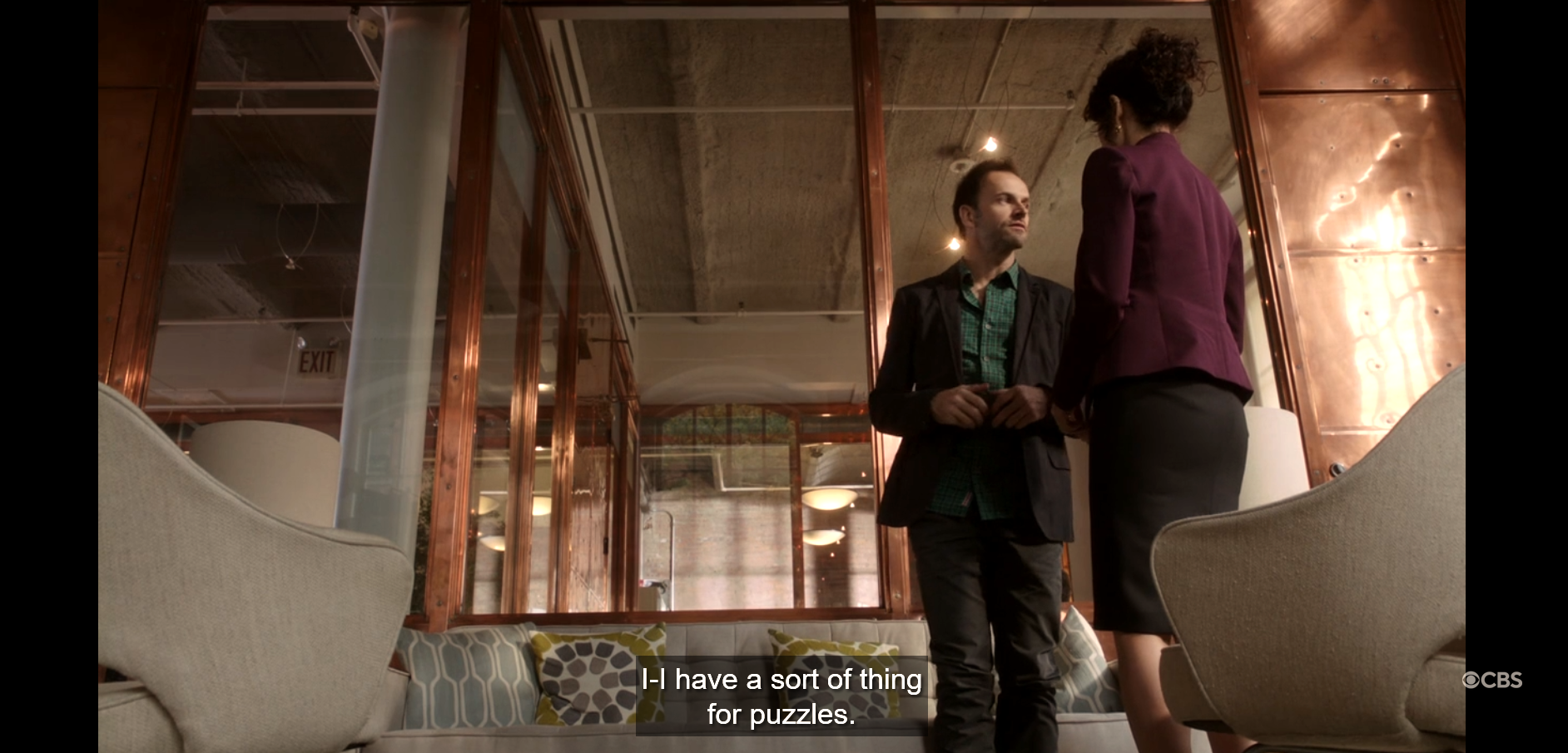
There’s no single path to puzzlerhood. Sure, there are some fairly universal commonalities. Do you have a great vocabulary? Mad trivia skills? Are you a whiz with palindromes, anagrams, or other forms of wordplay? These can all help. Also, a background or degree in English doesn’t hurt.
But every puzzler I know took a different route. It’s not as if we all awoke one day to a knock at the door, only to discover a small basket left on the doorstep, and tiny elfin footprints leading back toward the enchanted forest down the street.
Though, admittedly, that would have been awesome.
Here, let me take you through some of the highlights in my puzzle resume, and we’ll see if my experiences offer some guidance or inspiration for those with puzzletastic aspirations.
Unrecognized Wheel of Fortune Grand Champion, USA, 1988-present
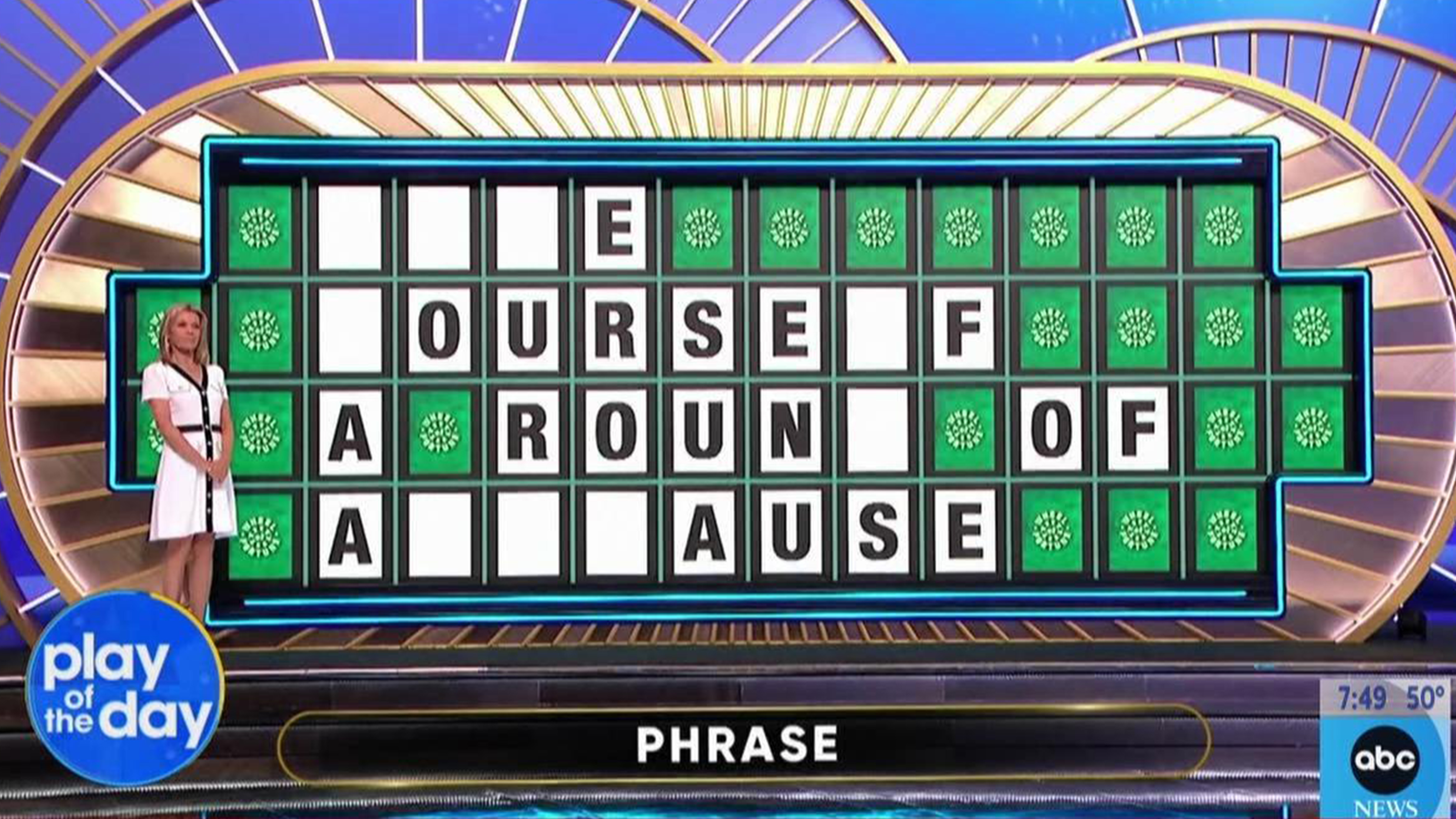
Since I was about seven years old, family members have called me into the family room to see who can puzzle out the quotes, phrases, and punny answers behind the lovely Vanna White, and I regularly school both contestants and kin with ease.
While Mr. Sajak refused to recognize my decades-long reign as Wheel of Fortune Grand Champion (Stay-at-Home Division), and Mr. Seacrest has yet to return my calls, that doesn’t make it any less noteworthy.
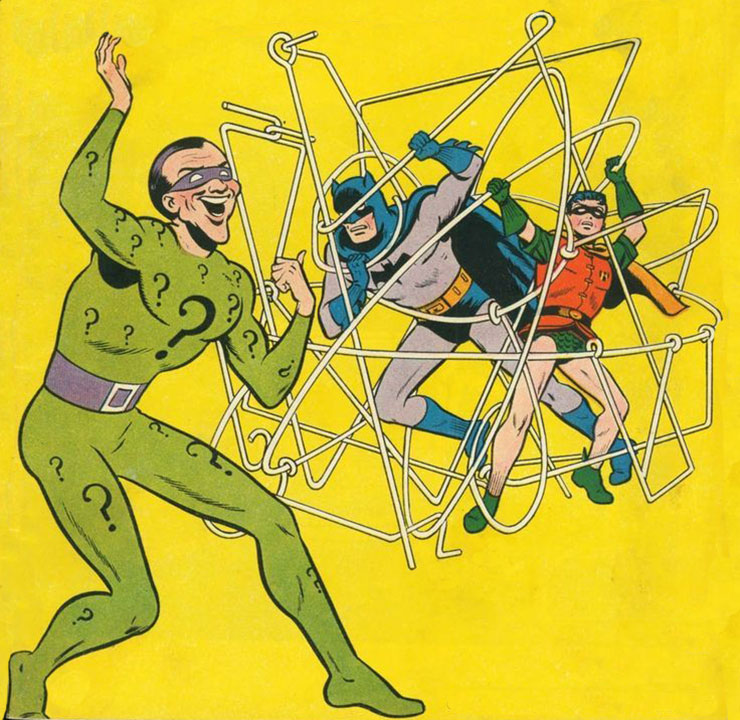
Internship with the Riddler, Gotham City, 2000-2001
There are few puzzle personalities in the world with the flair, cachet, and renown of Edward Nygma, otherwise known as freelance detective and occasional criminal mastermind The Riddler. So when I had the opportunity to sit in with him and learn from his decades of riddle-centric shenaniganry, I leapt at the chance.
I studied the intricacies of mechanical puzzles, wordplay, and punsmithery while under Nygma’s wing. Although I frequently found myself in legal and moral gray areas — and on the receiving end of more than a few POW!s and BIFF!s — the experience was well worth it.
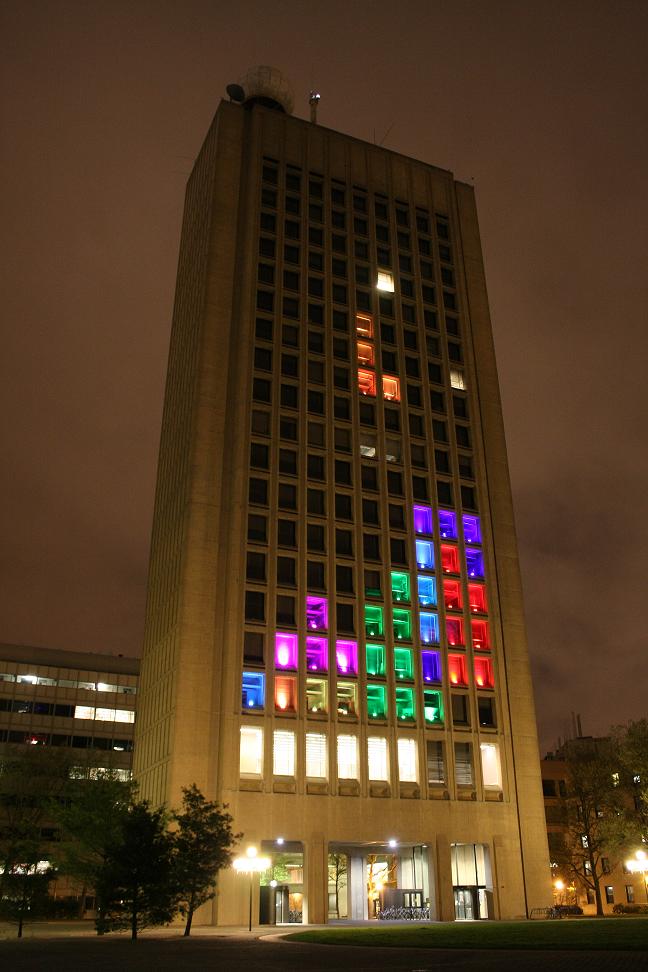
Tetris Foreign Exchange Program, St. Petersberg, 2002
There’s no better spatial awareness training than Tetris. I can feng shui the packages in the back of a UPS truck like nobody’s business, and don’t get me started on my legendary vacation-packing skills. And with the added pressure of that horrendous tension-inducing “you’re near the top!” music, I’m cool as Siberia under pressure.
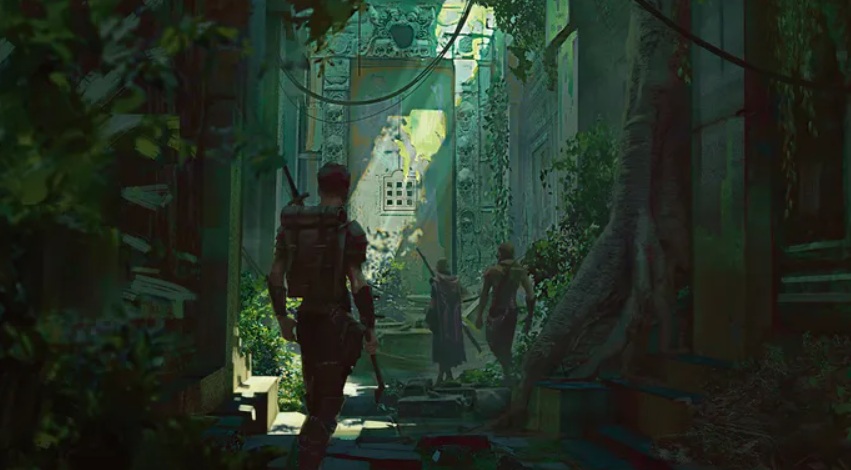
Dungeon Tester, various, 2003-present
Is your Tomb of Horrors not horrorful enough? Is your Tomb of Elemental Evil lacking in some evil elements? Is your Ghost Tower of Inverness feeling a little inver-less?
I’ve ventured through some of the deadliest, trickiest, player-decimating-est dungeons in all of roleplaying, and my quality control and suggestions have made them even deadlier-ier!
That trick with the secret escape door in the third pitfall trap? Yeah, that was me.
You’re welcome, dungeon masters!
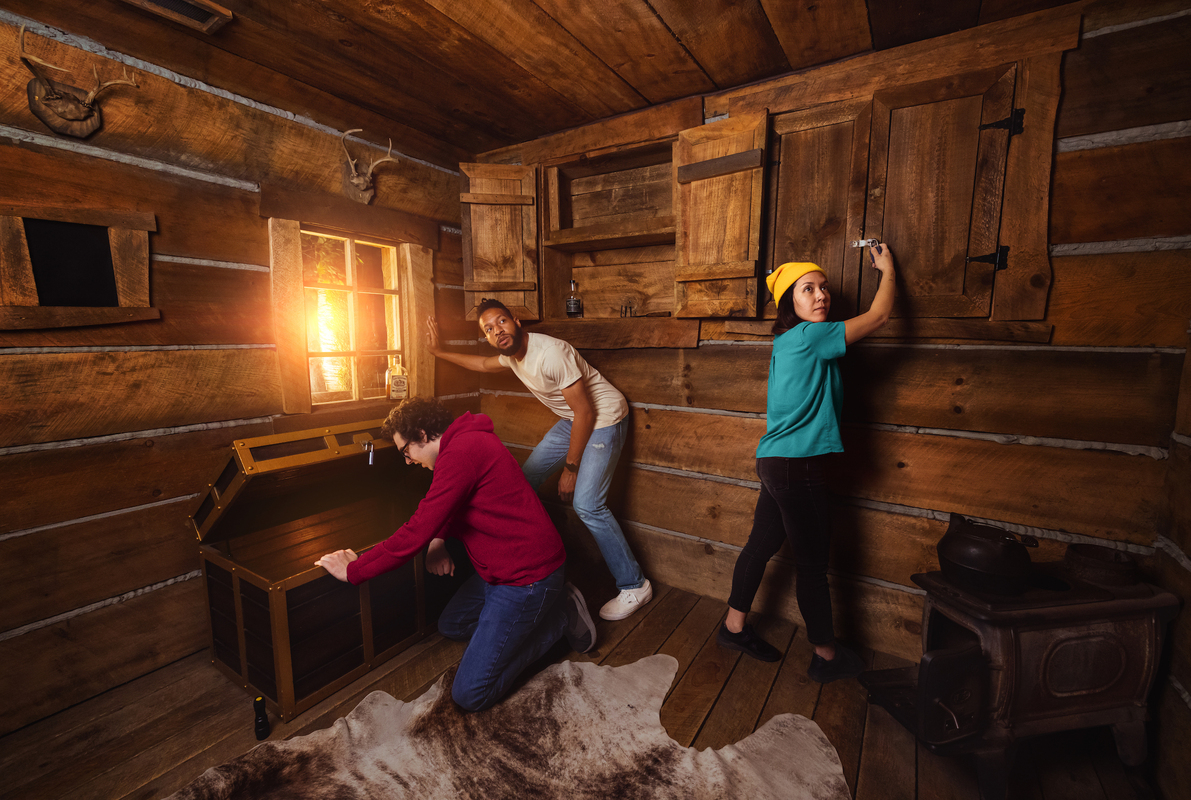
Escape Room Entrepreneur, Scranton, PA, 2006
Yes, the first official escape room opened in Japan in 2007, but I actually pioneered the genre when I accidentally tripped into a display at the Houdini Museum in Scranton just before closing time. Somehow the staff missed the clanking of chains and my totally-manly-and-not-at-all-shrill cries for help, and I found myself plunged into darkness, trapped haphazardly in several of Houdini’s most famous devices.
Thankfully my previous training with the Riddler had prepared me for this sort of dilemma. After several hours of maneuvering (and some unpleasant chafing marks from all the chains and manacles), I managed to extricate myself from all the Houdiniana around me and slip out the front door… and into the waiting arms of the police responding to all the motion sensor alarms I’d tripped with my heroic flailings.
Puzzle Summit with Will Shortz, New York City, 2007
Okay, it wasn’t so much a historic meeting of the minds as it was me yelling puzzle ideas at him with a megaphone as I chased him down the street.
But that totally counts.
Freelance Puzzle Historian, Self-Appointed, USA, 2009-present
Oh yes, puzzle history is a rich and varied field of study, one to which I have devoted a great deal of time and effort, unearthing some fascinating and surprising discoveries. For instance, did you know that Nero did not, in fact, fiddle while Rome burned? He was far too busy being frustrated by the extreme Sudoku puzzle he’d picked up in the agora.
Well, there you have it. A brief glimpse in my particular puzzle experiences and how they’ve shaped me. Here’s hoping you can blaze your own puzzlerific trail, be it through decoding Linear B with Cryptogram-ingrained proficiency or anagramming your friends’ names to your heart’s content.







 PuzzCulture