Intuitive vs. Non-Intuitive Puzzles

littlegirlatgrandmas

[Image courtesy of The Spruce Crafts.]

Sometimes, when you look at a puzzle, you know immediately what to do and how to solve. In my opinion, a great deal of Sudoku’s success is due to its intuitive nature. You see the grid, the numbers, and you know how to proceed.

Crosswords are similarly straightforward, with numbered clues and grid squares to guide new solvers. (The “across” and “down” directions also help immensely.)

That’s not to say that these puzzles can’t be off-putting to new solvers, despite their intuitive nature. I know plenty of people who are put off by crosswords simply by reputation, while others avoid Sudoku because they’re accustomed to avoiding ANY puzzle that involves numbers, assuming that some math is involved. (I suspect that KenKen, despite its successes, failed to replicate the wild popularity of Sudoku for similar reasons.)
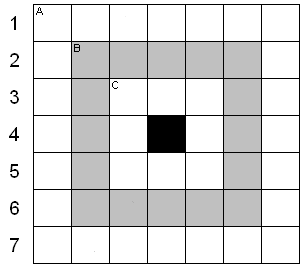
But plenty of other puzzles require some explanation before you can dive in. A Marching Bands or Rows Garden puzzle, for instance, isn’t immediately obvious, even if the puzzle makes plenty of sense once you’ve read the instructions or solved one yourself.

The lion’s share of pen-and-paper puzzles fall into this category. No matter how eye-catching the grid or familiar the solving style, a solver can’t simply leap right into solving.

Thankfully, this won’t deter most solvers, who gleefully accept new challenges as they come, so long as they are fair and make sense after a minute or so of thought. Cryptic crossword-style cluing is a terrific example of this. At first glance, the clues might appear to be gibberish. But within each clue lurks the necessary tools to unlock it and find the answer word.

Brain teasers often function the same way. You’re presented with a problem — a light bulb you can’t see and three possible switches for it, for instance — and you need to figure out a way to solve it. It might involve deduction, wordplay, or some clever outside-the-box thinking, but once you find the answer, it rarely feels unfair or unreasonable.
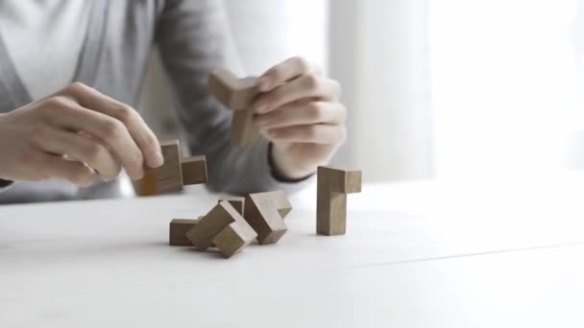
solvingwoodenbrainteaser

[Image courtesy of Deposit Photos.]

But, then again, there are also puzzles that can baffle you even once you’ve read the instructions and stared at the layout for a few minutes. Either the rules are complex or the solving style so unfamiliar or alien that the solver simply can’t find a way in.

In short, puzzles as a whole operate on a spectrum that spans from intuitive to non-intuitive.

Want an example of baffling or non-intuitive? You got it.

GAMES Magazine once ran a puzzle entitled “Escape from the Dungeon,” where the solver had to locate a weapon in a D&D-style dungeon. A very small crossword puzzle was found in one room on a paper scroll.

But the solution had nothing to do with solving the crossword.

The actual solution was to take the crossword to a magician who removed letters from the fronts of words. Removing the C-R-O-S left you with a sword, completing the overall puzzle.

That sort of thinking is so outside the box that it might as well be in a different store entirely. Video games, particularly ones from the point-and-click era, have more than their fair share of non-intuitive puzzles like this. You can check out these lists for numerous examples.

3122

And as escape rooms grow in popularity, more of them seem to be succumbing to less intuitive puzzling as a result of trying to challenge solvers.

For example, in one escape room I tried, various fellow participants uncovered two stars, a picture of the three blind mice, and four different items that represented the seasons. Amidst all the locks to open, puzzles to unravel, and secrets to find, it never occurred to any of us that these three unconnected numbers would have to be assembled as a combination to a lock. By asking for a hint, we were able to figure out to put them together and open the lock, but it’s not a terribly intuitive puzzle.

Perhaps the greatest challenge for a puzzle constructor — be it a pen-and-paper puzzle, an escape room scenario, or a puzzle hunt dilemma — is not creating a dynamite, unique puzzle, but ensuring that finding the solution is fair, even if it’s difficult or mind-boggling.

This sort of thinking informs not only my work as a puzzlesmith, but the designs for my roleplaying games as well. If my players encounter a gap, there’s some way across. If there’s a locked door, there’s a way through it. Oftentimes, there’s more than one, because my players frequently come up with a solution that eluded me.

In the end, that’s the point. All puzzles, no matter how difficult, exist for one reason: to be solved. To provide that rush, that a-ha moment, that satisfaction that comes with overcoming the clever, devious creation of another sharp mind.

And non-intuitive puzzles are tantamount to rigging the game.


Thanks for visiting PuzzleNation Blog today! Be sure to sign up for our newsletter to stay up-to-date on everything PuzzleNation!

You can also share your pictures with us on Instagram, friend us on Facebook, check us out on TwitterPinterest, and Tumblr, and explore the always-expanding library of PuzzleNation apps and games on our website!

Requiem for a Game Shop

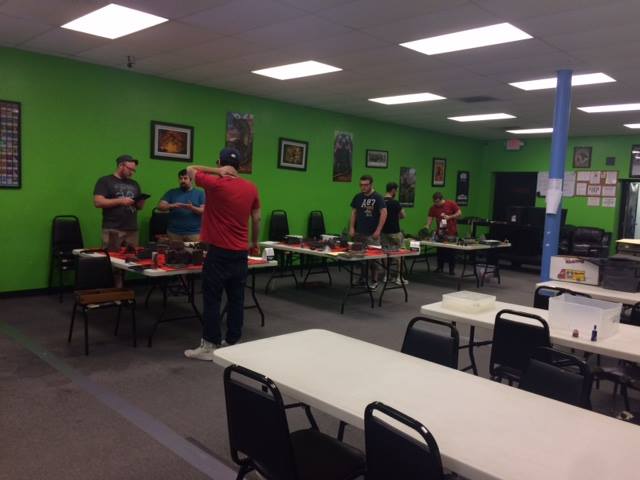
A friendly local game shop (FLGS) can fill a lot of roles. A laboratory to try out unfamiliar games. A sample size to poll potential customers and test new products. A gathering place to share puzzly experiences. A social center to make new friends.

Sadly, there’s one fewer place to enjoy those simple pleasures now, as my friendly local game shop is closing this month.

I don’t know why, precisely. Maybe the 2019 financials weren’t as rosy as they’d hoped. Maybe the landlord raised the rent to unreasonable levels. Maybe the omnipresent threat of cheaper online purchases won out. (I certainly didn’t mind paying a little more for a game there, because I knew who the money was going to. But not everyone feels that way.)

I’m not entirely surprised. Last year, they cleaned out their comics section to focus more directly on games, RPGs, and miniatures. It opened up some space in the store and generally made for a cleaner, more accessible floorplan, which was a plus. But I guess it wasn’t enough.

It’s a bummer.

Sure, there are decent game selections at stores like Target and Barnes & Noble, but nothing as varied or extensive as the spread at the FLGS. I can’t tell you how many games I stumbled across there that I’d never even heard of, whether by wandering the stacks or seeing a play-through of a new acquisition demonstrated by the staff.

It was the perfect place to discover games, often serving to inspire gift ideas for friends. (Similarly, I miss Toys R Us, as simply browsing the selection there led to plenty of spot-on purchases for nieces and nephews.)

I usually stopped in a few times a month. I didn’t always buy something — my game library is pretty beefy already — but I liked to see what was new, what was moving a lot of copies, and what the locals were playing. I even got to meet local designers who were showing off their wares, which was always a treat.

I’ve been back twice since the announcement, and it’s nice to see how loved the place was, even if that couldn’t ensure its long-term success. Regulars have already snapped up tablecloths and other materials with the shop’s logo, and I know at least one person offered to buy the sign outside. I’ve heard several customers lament that they didn’t know where they’d go now for game tournaments, RPG events, and other game-centric fun.

57473-coop3

The back tables — usually reserved for trying out new games, hosting tournaments and launch events, or serving as gathering places (charged by the hour) for roleplaying groups to indulge in some social storytelling — are instead full of games, equipment, snacks, promotional materials, and everything else they can slap a tag on and price to move as they liquidate their stock.

But, for the most part, the energy there is good. Games are vanishing from stacks of in-store inventory, as are displays, signs, neon lights, and other trappings of the store. The staff is in decent spirits.

I’m not sure if I’ll go back again before it’s all said and done. But it was nice while it lasted.


Thanks for visiting PuzzleNation Blog today! Be sure to sign up for our newsletter to stay up-to-date on everything PuzzleNation!

You can also share your pictures with us on Instagram, friend us on Facebook, check us out on TwitterPinterest, and Tumblr, and explore the always-expanding library of PuzzleNation apps and games on our website!
Forget 3-D Chess and Try 4-Directional Tetris!

[Image courtesy of Eurogamer.]

Tetris is the ultimate puzzle game. If you somehow haven’t played it, you’ve at least heard of it. The brainchild of Alexey Pajitnov conquered the world, not only making Nintendo’s Game Boy a bestselling video game platform, but turning millions of puzzlers into gamers and gamers into puzzlers as well.

Those iconic little Tetromino shapes are instantly recognizable, and the music can still induce panic and nervousness in players decades after the first time they heard those infamous notes.

And it serves as a brilliant template for ambitious game designers and puzzlers to add their own twists to the Tetris formula.

The basic concept is simple: try to arrange the constantly falling Tetromino blocks so that they make complete lines in the play area. If they do, that line disappears.

Of course, just because the concept is simple, that doesn’t mean the game is. As your play area fills up with Tetrominos, the music speeds up, amping up the tension. And as you progress through different levels, the pieces fall faster and faster. You need quick reflexes and ice in your veins to handle the higher difficulty levels.

Thankfully, you only need to worry about the blocks falling from one direction.

But a new variation on Tetris quadruples the gameplay area in a very devious way.

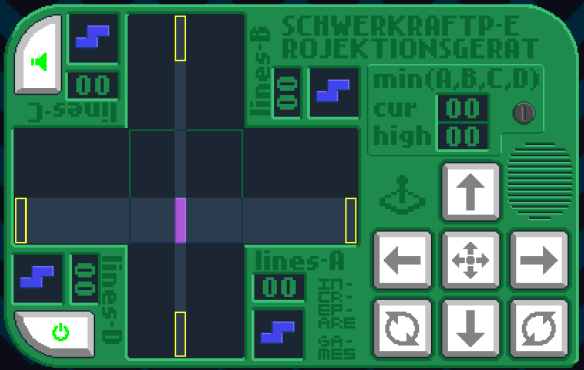
Say hello to Schwerkraftprojektionsgerät, Stephen Lavelle’s take on Tetris. In Schwerkraftprojektionsgerät, Tetromino blocks appear in the center of the play area, and you control where the piece is placed in each of the four directions.

No, the blocks do not fall automatically, nor is there a time limit that forces you to place the blocks quickly. Yes, you can spin each piece before placing it.

But each block goes into all four play areas simultaneously, and in the same position on the opposing sides.

schwerk1

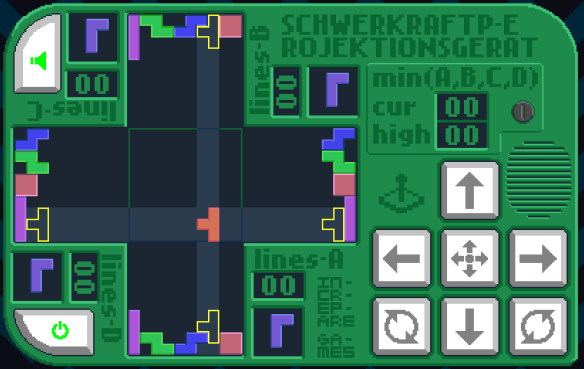
As you can see, the straight piece lands flat in the east and west grid spaces, but standing upright in the north and south grid spaces. You have to work along each axis to find the best case scenario for all four of your play areas.

Yes, you’re trying to complete lines in four different directions at the same time. The T-shaped Tetromino will land in four different arrangements (flat, on one side of the T-bar, on the other side of the T-bar, and on the long end of the T-bar) with a single keystroke.

schwerk2

It’s mind-blowing how challenging this makes the game, but it’s challenging in a good way.

I mean, in a regular game of Tetris, you need several dozen completed lines to conclude a level and feel like a champion. In Schwerkraftprojektionsgerät, you feel like a genius if you can get two completed lines in each of the four play areas before the game is over!

Just as addictive as the original, yet offering a totally new twist on the familiar style of puzzling, I foresee a lot of office hours being lost to this engaging four-directional experiment in space efficiency.

You can try Schwerkraftprojektionsgerät for yourself here, and check out all of Stephen’s games here. (He also has a YouTube channel featuring some of his creations.)

After 35 years, it’s cool to see there are still new ways to make Tetris feel fresh again.


Thanks for visiting PuzzleNation Blog today! Be sure to sign up for our newsletter to stay up-to-date on everything PuzzleNation!

You can also share your pictures with us on Instagram, friend us on Facebook, check us out on TwitterPinterest, and Tumblr, and explore the always-expanding library of PuzzleNation apps and games on our website!

Puzzle Tournaments Loom Near!

[Solvers gather for the American Crossword Puzzle Tournament.]

Tomorrow is the 21st annual Westport Library Annual Puzzle Contest, and I consider Westport the unofficial start of the year’s crossword-y festivities.

Sure, the obvious start is the weekend of March 20-22, when the American Crossword Puzzle Tournament descends upon Stamford, CT, and puzzlers from all over test their puzzly mettle against some devious and delightful crosswords.

Then, after the big event in March, it’s a few months’ wait until summer, when there’s at least one proper tournament every month. We’ve got the Indie 500 in June, BosWords at the end of July, Lollapuzzoola on a Saturday in August, and Bryant Park in September.

But that ignores all the smaller tournaments and events in between. Libraries and rec centers all over the country host puzzly events that get less press than the famous ones.

For instance, did you know that on March 14th, you can attend the Eighth Annual Finger Lakes Crossword Competition?

I bet you didn’t.

So, in case you’re not traveling to one of the more well-known tournaments, keep your eyes peeled for smaller, but no less enjoyable, puzzle events happening throughout the year.

And good luck to all those headed to Westport for some Will Shortz-fueled cruciverbal adventures! Happy puzzling!

Are you attending any puzzle events this year, big or small? Let us know in the comments section below! We’d love to hear from you!


Thanks for visiting PuzzleNation Blog today! Be sure to sign up for our newsletter to stay up-to-date on everything PuzzleNation!

You can also share your pictures with us on Instagram, friend us on Facebook, check us out on TwitterPinterest, and Tumblr, and explore the always-expanding library of PuzzleNation apps and games on our website!

PuzzleNation Product Review: Astronomy Fluxx

astrofluxx0

[Note: I received a free copy of this game in exchange for a fair, unbiased review. Due diligence, full disclosure, and all that.]

There are plenty of games that center around space, whether you’re forming constellations, repairing your ship, traveling the galaxy, escaping a black hole, or building a civilization. But while you’re worrying about air supply, celestial objects, or other aspects of life in space, you’re rarely reminded of the incredible wonders that can be found beyond the Earth.

It’s unusual indeed for a game to evoke that sense of awe, no matter how fun the actual gameplay may be. Which makes Astronomy Fluxx, the latest offering from the crew at Looney Labs, such a delight.

astrofluxx1

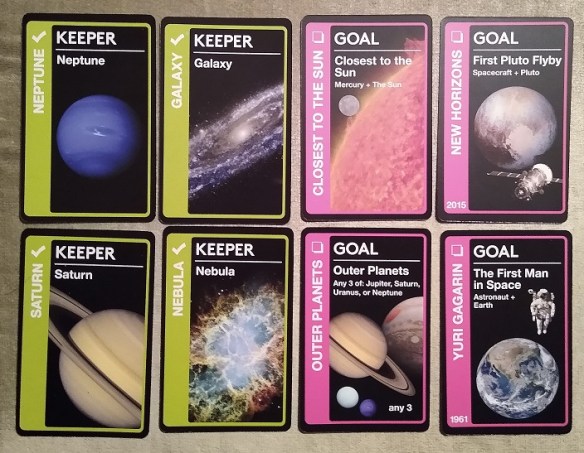
For the uninitiated, Fluxx is a card game where you collect keeper cards and put them into play. Different combinations of keeper cards complete different goals, and each player has the chance to put different keeper cards and goal cards into play in order to win. So you might find yourself working toward completing the goal at hand when suddenly somebody plays a new goal, and the object of the game changes.

Along the way, players affect how the game is played by utilizing action cards and new rule cards which alter what players can and can’t do. Suddenly, you’ll have to trade your hand with another player, or start drawing three cards each turn instead of one.

In Astronomy Fluxx, the gameplay is simplified from previous editions of the game — there are no ungoals or creepers complicating play this time around — but the gameplay doesn’t suffer in the slightest.

astrofluxx2

Before I get into the rule cards and other ephemera of the game, I have to mention how blown away I was by the art. Using NASA images as photographic source material (instead of the usual charming drawings usually seen in Fluxx games) really infuses the theme of the game into every aspect of the gameplay. The planets burst to life in every keeper card, and the goal cards are eye-catchingly gorgeous.

Some of the goal cards reference specific events from the history of space exploration — from the first man in space and the moon landing to more recent endeavors like the New Horizons spacecraft flyby of Pluto — which certainly brings a smile to this astronomy buff’s face each time I play.

astrofluxx3

In addition to the usual rule change cards regarding how many cards to draw, how many to play, hand limits, and so forth, they’ve introduced rules to make use of bonus educational information at the bottom of each keeper card. One card allows you to draw additional cards if you can name the year certain events happened, and another offers a bonus card per turn for a constellation you can name. These cards continue the tradition of Math Fluxx, Chemistry Fluxx, and Anatomy Fluxx of rewarding players for learning about the subject of the game.

Astronomy Fluxx also incorporates the planets into the gameplay in a unique way with certain rule cards that involve planetary orbits and centers of gravity that move from player to player during the game. Each adds an intriguing mechanic that I’ve never really seen before in a Fluxx game, and it really creates a fresh challenge, even for experienced Fluxx players.


All in all, I was absolutely wowed by the depth of creativity that went into the latest offering from Looney Labs. This is a game that lives up to the chaotic, replayable spirit of Fluxx, but with innovative gameplay, solid educational information, and a game-changing shift in artistic style. Their educational Fluxx series continues to impress.

Astronomy Fluxx is available now from Looney Labs and select retailers!


Thanks for visiting PuzzleNation Blog today! Be sure to sign up for our newsletter to stay up-to-date on everything PuzzleNation!

You can also share your pictures with us on Instagram, friend us on Facebook, check us out on TwitterPinterest, and Tumblr, and explore the always-expanding library of PuzzleNation apps and games on our website!

PuzzleNation Product Review: Minecraft Magnetic Travel Puzzle

tfmine1

[Note: I received a free copy of this product in exchange for a fair, unbiased review. Due diligence, full disclosure, and all that.]

Minecraft is one of the biggest indie video game success stories of the last twenty years. A simple block-style game about building things (and destroying things) is now a multimedia empire, complete with toys, LEGOs, and of course, video games across numerous platforms.

It was only a matter of time before it made the leap to puzzles, and as it turns out, the clever folks at ThinkFun were just the designers to bring Minecraft into a puzzlier world.

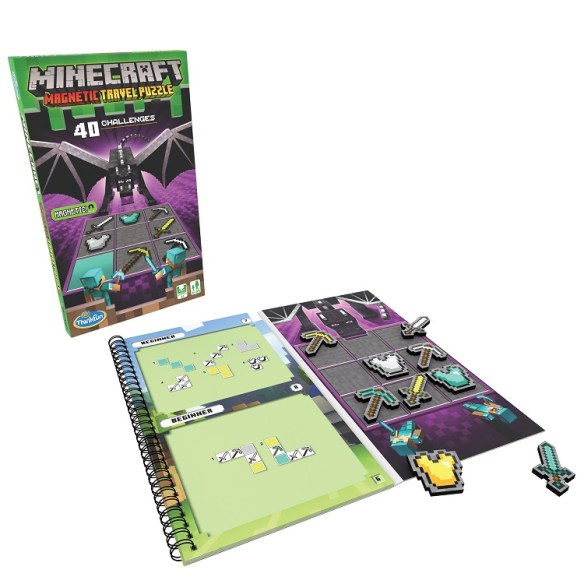
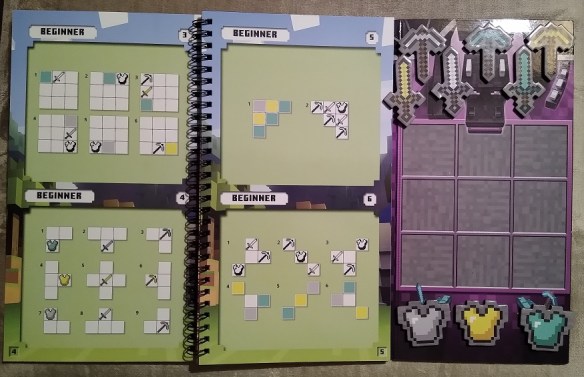
Minecraft Magnetic Travel Puzzle pits the player against devious deduction puzzles with elements of the Minecraft universe included. By using the clues provided on each challenge card, the player must arrange three swords, pickaxes, and pieces of armor (all different colors, making nine unique game pieces) on the 3×3 crafting table in a particular pattern.

tfmine2

Completing the grid is the only way to bypass the ender dragon (who is placing these challenge obstacles in your path) and continue onto the next world in your journey.

The instructions, puzzles, solutions, game board, and pieces are all contained within the single spiral-bound game book, making this one of ThinkFun’s most portable products yet. The magnetic pieces are fairly sturdy, as is the game board, so it will hold up nicely to the rigors of travel (and being stuffed into various carry-on bags).

tfmine3

The gameplay itself is all about interpreting the clues provided with each challenge card. Some clues offer hints on where to place pieces according to color, others according to shape. Additional clues center around a given piece’s location on the grid or in relation to another piece.

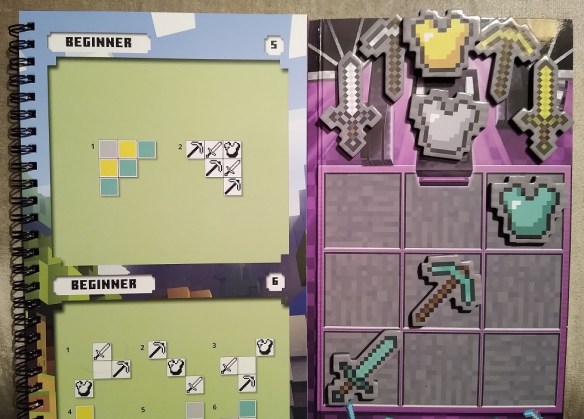
For instance, in Beginner Challenge #5 in the image below, the solver gets two hints: one about color and the other about the game pieces.

All three of the blue pieces will be placed along the diagonal, according to the first hint. And according to the second hint, a piece of armor will be in the upper right corner and a pickaxe will be in the middle square. Combining these two hints tells us where to place the blue armor and blue pickaxe. And since only one blue gamepiece is left, the blue sword goes in the lower left corner.

tfmine4

Similarly, the combination of the yellow square in the center of the top row in the first hint and the sword image in the center of the top row in the second hint tells us where to place the yellow sword. Once that’s in place, we look at the remaining sword image on the second hint and know where to place the gray sword.

The gray square in the upper left corner of the first hint and the pickaxe image in the upper left corner of the second hint point to where to play the gray pickaxe (and the yellow pickaxe by process of elimination).

tfmine5

With two game pieces left and one unoccupied yellow square in the first hint, the solver can easily complete this challenge, besting the ender dragon’s latest obstacle and moving forward.

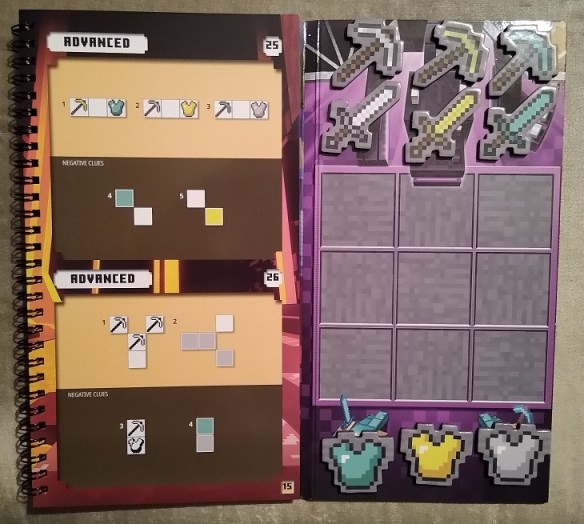
Once you graduate from the Beginner and Intermediate difficulty levels, you’ll face a new wrinkle: negative clues. Negative clues are layouts that must be avoided, so instead of telling you where to place a piece, they tell you expressly where NOT to place a piece, ratcheting up the difficulty.

For instance, in Advanced Challenge #25, the negative hints tell us that a gray gamepiece can never be directly below and to the right of a blue gamepiece, or above and to the left of a yellow gamepiece.

tfmine6

These restrictions will prove to be valuable hints going forward, often telling a savvy solver more about the layout of the crafting table than the regular clues!

By gradually teaching deductive reasoning — slowly introducing new ways to provide information and eliminate possibilities — the solver quickly grasps a key component of strategy and planning: “If this, then that” thinking.

This sort of cause-and-effect observation allows a solver to hold several pieces of information in your head at once, eliminating red herrings and unhelpful possibilities until you’re left with one solution that fits all the requirements. (Just as every Sudoku puzzle is an exercise in deduction, so is every challenge card in Minecraft Magnetic Travel Puzzle.)

Fun for younger solvers and older alike, ThinkFun’s latest deduction puzzle game turns Minecraft into Mindcraft, adding a valuable puzzly tool to the arsenal of every solver.

Minecraft Magnetic Travel Puzzle is available from ThinkFun and certain online retailers.


Thanks for visiting PuzzleNation Blog today! Be sure to sign up for our newsletter to stay up-to-date on everything PuzzleNation!

You can also share your pictures with us on Instagram, friend us on Facebook, check us out on TwitterPinterest, and Tumblr, and explore the always-expanding library of PuzzleNation apps and games on our website!