PuzzleNation Product Review: ThinkFun’s Brain Fitness line

The folks at ThinkFun are always trying to raise the bar when it comes to puzzly games that keep the mind in fighting trim. (You may remember them from our review of Laser Maze over the summer.)

In that vein, they’ve unleashed the Brain Fitness line of puzzle games, offering all sorts of exercises to challenge you one-on-one and put your puzzly skills to the test.

They sent us copies of three Brain Fitness games to review, each with its own distinct flavor.
solitairechess

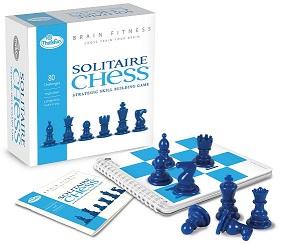
Brain Fitness Solitaire Chess

Solitaire Chess presents you with various layouts of pieces on a 4×4 grid, challenging you to clear the board of all but one piece. Every single move must eliminate a piece until only one remains.

Even the beginner puzzles gave me pause at first, because the need to knock out a piece with every move is a very different style of chess than I’m accustomed to. But I very quickly got into the groove of plotting out the chain of moves necessary to clear each board. With two pawns, two knights, two bishops, two rooks, a queen and a king, there are myriad layouts of varying complexity to solve, and some of them were serious brain melters.

Oddly enough, I found some of the expert-level grids easier than the advanced-level puzzles, though you could easily spend five or ten minutes on a single crafty puzzle.

Not only is it a terrific mental exercise, but it just might make you a better chess player in the long run.

Brain Fitness Chocolate Fix

Chocolate Fix is a marvelous variation on the Sudoku model, offering nine sweets of varying shape and color, and tasking you with deducing the intended position of each in a 3×3 baking sheet.

The beginner-level puzzles are child’s play, and would actually be a terrific introduction for younger puzzlers. But as soon as you reach the intermediate-level challenges, the difficulty begins ratcheting skyward. Some clues give you colors only, others shapes only, and the occasional clue is centered around a given piece’s location on the baking sheet.

Midway through the advanced-level challenges, they stop referencing specific sweets at all, leaving you to do some serious deductive work with shapes and colors alone.

By the time you reach the expert puzzles (which abandon any clues providing all nine squares, leaving you to mentally assemble Tetris-like pieces with shape and color symbols), it becomes a serious mental workout that banishes any false confidence and bravado that the easy early rounds might’ve sparked.

Victory may be sweet, but Chocolate Fix’s later challenges will make you earn it.

Brain Fitness Rush Hour

Rush Hour is a variation on the classic sliding-tile game, except instead of tiles, you’re sliding cars and trucks back and forth in order to clear a path for your heroic little red car to escape the traffic jam.

Rush Hour (in various forms) has been a great success for ThinkFun over the years, and the Brain Fitness version is a brilliantly simple adaptation. Self-contained and perfect for puzzling-on-the-go, Rush Hour takes the chain-move thinking of Chess Solitaire to the next level.

The jump from beginner-level to intermediate-level challenges is a sobering one, if only because the playing grid seems absolutely packed with cars! But you quickly realize that a packed grid means fewer possible moves, which helps to point you toward the solution.

The grid thins out again when you reach the advanced-level puzzles, but greater movement only leads to tougher challenges, since so many more moves are available to you, requiring chains of increasing complexity in order to rescue your little red car.

Having thoroughly tested all three games, I found Rush Hour the most difficult of the three (though Solitaire Chess wasn’t far behind), but I must admit, the multilayered colors / shapes / positioning clue style of Chocolate Fix provided the most unexpected challenge.

As an experienced puzzler, I was thoroughly impressed by the scalability of each idea. The easy puzzles were terrific introductions to the game, and the expert puzzles were challenges quite worthy of your time.

ThinkFun recommends 15 minutes of puzzling time a day with any of their Brain Fitness products in order to give your brain a proper workout, but I suspect you’ll have a hard time stopping there. If only physical workouts were as much fun as these mental ones!

Thanks for visiting the PuzzleNation blog today! You can like us on Facebook, follow us on Twitter, cruise our boards on Pinterest, check out our Classic Word Search iBook (recently featured by Apple in the Made for iBooks category!), play our games at PuzzleNation.com, or contact us here at the blog!

PuzzleNation Product Reviews: Veritas

Here at PuzzleNation Blog, we’re constantly on the lookout for any and all things puzzly, happy to spread the word on anything that will appeal to puzzle solvers.

And we think Cheapass Games’ board game Veritas fits the bill nicely.

Veritas is a strategy game in the same vein as Risk and other map-based board games, but with a much quicker pace and a delightfully wicked sense of humor.

The game is set in France during the Dark Ages, and each player represents some version of the Truth, printed in a few books at a random monastery. As you make more copies of the Truth and spread the word to other monasteries and cities, your fellow players are doing the same with their own versions of the Truth, as each of you tries to become the prevailing Truth in the country.

Sounds like a pretty straightforward strategy game, right? But that’s where the element of luck comes in.

Every round, each player pulls from a set of tiles, each tile representing a monastery that will burn down that turn. As monasteries burn, the books they contain are scattered, and the map becomes a little smaller, a little more claustrophobic, and one player’s Truth begins supplanting that of others.

Veritas is a marvelous mix of chance and skill, encouraging both short-term and long-term strategizing (skills that puzzle solvers and puzzle gamers have in spades).

The element of randomness is key in separating Veritas from games with similar territorial stakes. There’s a fun element of the unknown as you pick your tile, and since books are scattered instead of destroyed, there’s significantly less chance of hard feelings when one player burns down another player’s monastery.

(Plus it’s always fun to explain to coworkers in the lunchroom what you’re doing. “Burning down French monasteries” is never the answer they expect. *laughs*)

(Confession: We were so involved in the gameplay that I forgot to take pictures of the board. Please enjoy this dramatic recreation.)

The Cheapass Games rationale is simple, but elegant. They know you’ve got board games at home, so why jack up the price of their games by making you buy another set of dice, another set of chips, another set of tokens and supplemental pieces?

Cheapass Games arrive in a slim white box — as our complimentary review copy did — containing exactly what you need to play the game, and describing precisely what you’ll need from other games to play.

In the case of Veritas, you receive the game board (split into 8 well-rendered cards), the monastery tiles (for randomized burning), and instructions. Simple and elegant. All you need are chips to represent books filled with your truth.

Dime-sized ones will work best, especially since they need to be stackable. Monasteries in key positions can start to resemble miniature games of Jenga, as opposing players keep adding to the stack.

We used Rolco plastic chips in our playtesting, but they didn’t stack particularly well. (The game’s designers highly recommend using smaller poker chips like the ones featured here, since they’re designed to be stacked and won’t take up too much space on the game board.)

The game’s setup is a snap, though you’ll want to give the instructions a thorough read before starting, since the multiple actions available to players on a given turn can take a minute or two to suss out completely. (Any rules we were fuzzy on became instantly clear after a round or two of play.)

Veritas is a terrific strategy game that will appeal to plenty of puzzle solvers and gamers of all ages, continuing the Cheapass Games tradition of clever games with their signature sense of humor.

After all, what’s a little monastery burning between friends? =)

[You can find more information on Veritas (or pick up a copy of your own) by clicking here.]

Thanks for visiting the PuzzleNation blog today! You can like us on Facebook, follow us on Twitter, cruise our boards on Pinterest, check out our Classic Word Search iBook (recently featured by Apple in the Made for iBooks category!), play our games at PuzzleNation.com, or contact us here at the blog!

PuzzleNation Book Review: You

Welcome to the seventh installment of PuzzleNation Book Reviews!

All of the books discussed and/or reviewed in PNBR articles are either directly or indirectly related to the world of puzzling, and hopefully you’ll find something to tickle your literary fancy in this entry or the entries to come.

Let’s get started!

Our book review post this time around features Austin Grossman’s novel You.

It’s 1997 when Russell arrives at Black Arts, accepting an offer to help relaunch the successful video game franchise he and former friends started years ago. But with their enigmatic, socially challenged lead designer Simon dead, motivational juggernaut Darren jumping ship to start his own company, and Russell woefully unprepared for the job, that’s easier said than done.

As Russell brainstorms the relaunch, he decides to replay the entire Realms of Gold series from beginning to end, hoping to strike creative gold. Reminiscing about the long journey that brought him back to Black Arts, he discovers a programming bug that could have devastating consequences for the entire company.

I thoroughly enjoyed Grossman’s previous novel, the superhero-skewing Soon I Will Be Invincible, but I didn’t know what to expect from his follow-up novel.

You at its core is a book about misfits. Yes, there’s an epic quest for the heroes to conquer — an epic quest ABOUT an epic quest, in fact — which definitely appeals to readers of a puzzly nature. (Especially when you start unraveling clever references to earlier iterations of the Realms of Gold series.)

There’s also a charming time capsule aspect of the narrative — which cagily evokes the warm fuzzies of early gaming) — but the centerpiece of the novel is how these people came together and then splintered apart.

Occupying that nebulous disheartening space between creativity and economics, Black Arts proves to be a fertile setting for Russell’s slow-burn understanding of the industry, what became of his old friends, and how he’s changed. (Black Arts is a thinly veiled recreation of Looking Glass Studios, a video game company that employed Grossman years ago.)

While the book’s plot staggers a bit under the weight of Simon’s back door biography (presented through Russell’s replay through the RoG series), Grossman does an impressive job making the most of his multilayered narrative, creating a novel that’s far more than the sum of its parts.

[To check out all of our PuzzleNation Book Review posts, click here!]

Thanks for visiting the PuzzleNation blog today! You can like us on Facebook, follow us on Twitter, cruise our boards on Pinterest, check out our Classic Word Search iBook (recently featured by Apple in the Made for iBooks category!), play our games at PuzzleNation.com, or contact us here at the blog!

Answers to the PuzzleNation Punderful Halloween Costume Game!

Happy Day-After-Halloween, puzzlers and PuzzleNationers! (Also known as Candy Coma Day…)

It’s time for the answers to our PuzzleNation Punderful Halloween Costume Game! How did you do? Let’s find out!


PuzzleNation’s Punderful Halloween Costume Game: Answers!

#1

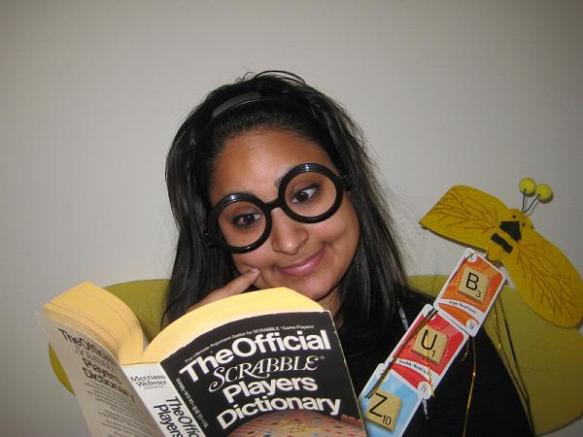
halloween1

She’s a spelling bee!

#2

halloween2

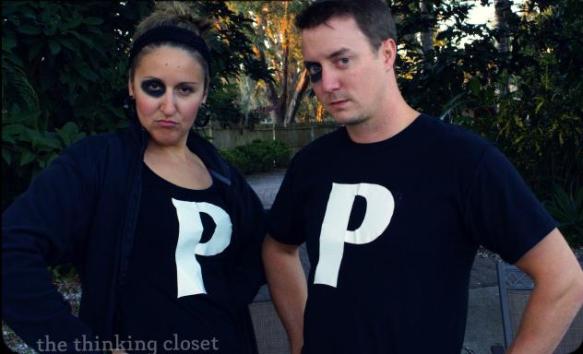
They’re the Black-Eyed P’s! [picture courtesy of ThinkingCloset.com]

#3

halloween3

Why, it’s a lovely Mail-Order Bride!

#4

halloween4

Dunkin’ Donuts!

#5

halloween5

French kiss!

#6

halloween6

It’s fantasy football for all to enjoy!

#7

halloween7

He’s a ceiling fan!

#8

halloween8

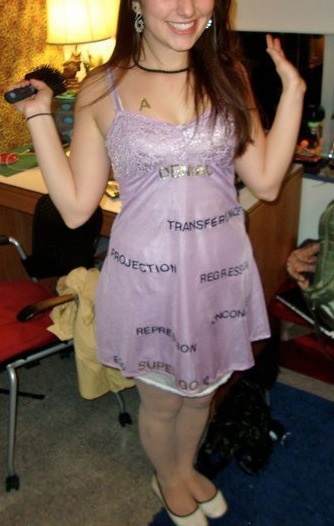
What a lovely Freudian slip!

#9

halloween9

It’s the Grapes of Wrath!

#10

SONY DSC

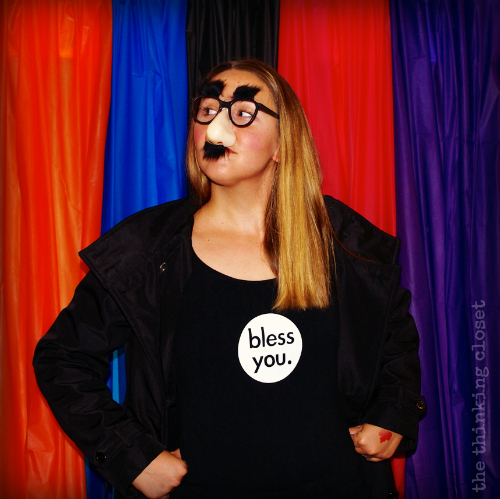
She’s a blessing in disguise! [picture courtesy of ThinkingCloset.com]

So how did you do, PuzzleNationers? I hope you enjoyed our little Halloween Costume challenge. Has this inspired you to create a punny costume of your own for next year? Let us know!

Thanks for visiting the PuzzleNation blog today! You can like us on Facebook, follow us on Twitter, cruise our boards on Pinterest, check out our Classic Word Search iBook (recently featured by Apple in the Made for iBooks category!), play our games at PuzzleNation.com, or contact us here at the blog!

PuzzleNation’s Punderful Halloween Costume Game!

Happy Halloween, puzzlers and PuzzleNationers!

One of the best things about Halloween is guessing what people’s costumes are. Clever costumes can be great fun — like these puzzle-themed costumes we featured last year! — and I’m a particular fan of costumes that only cost a few bucks to put together, because they really let your creativity shine through.

Punny costumes lend themselves to the low-budget costume style brilliantly. For instance, this year I’m gathering three pals with flashlights, magnifying glasses, hawaiian leis and party hats, because we’re a Search Party.

And I figured that punny costumes would make for a perfect Halloween game for my fellow puzzlers!

It’s simple. I post a picture, and you guess what the costume is.

For example:

halloweenexample

Did you get it? He’s a chick magnet!

I’ve compiled ten costumes for you to figure out. Let’s see how many you can get!

PuzzleNation’s Punderful Halloween Costume Game!

#1

halloween1

#2

halloween2

#3

halloween3

#4

halloween4

#5

halloween5

#6

halloween6

#7

halloween7

#8

halloween8

#9

halloween9

#10

SONY DSC

So how did you do, PuzzleNationers? I hope you enjoyed our little Halloween Costume challenge. Were there any great punny costumes we missed? Let us know! And happy Halloween to you!

[We’ll be posting the answers tomorrow! Many thanks to our photo sources: Buzzfeed, The Thinking Closet, So Much Pun, and Tim Helbig.]

Thanks for visiting the PuzzleNation blog today! You can like us on Facebook, follow us on Twitter, cruise our boards on Pinterest, check out our Classic Word Search iBook (recently featured by Apple in the Made for iBooks category!), play our games at PuzzleNation.com, or contact us here at the blog!
PuzzleNation Book Review: World Peace and Other 4th-Grade Achievements

Welcome to the sixth installment of PuzzleNation Book Reviews!

All of the books discussed and/or reviewed in PNBR articles are either directly or indirectly related to the world of puzzling, and hopefully you’ll find something to tickle your literary fancy in this entry or the entries to come.

Let’s get started!

Our book review post this time around features John Hunter’s World Peace and Other 4th-Grade Achievements.

What did you do in fourth grade, fellow puzzlers? Did you master long division, or delve into the history of the Civil War, or expand your vocabulary skills? The kids in John Hunter’s fourth-grade class negotiated lucrative trade agreements, solved global warming, and saved the world.

Yeah, I know. I feel like a slacker now too.

I frequently post articles that reinforce my heartfelt belief that puzzles and the skills we develop solving puzzles make the world a better, more interesting place. And the World Peace Game, John Hunter’s marvelous brainchild, takes empty-space learning to a whole new level.

Instead of regimented, test-based education, empty-space learning encourages students to learn and fail by doing, developing social skills, a deeper sense of the world’s complexity, and an appreciation for hard questions.

The World Peace Game is a fantastic example of what empty-space learning can do. A weeks-long interactive experiment wherein students try to solve real-world problems in a complex, multitiered simulation, kids will tackle poverty, war, environmental cataclysm, terrorism, ethical dilemmas, and more as they manage their imaginary nations.

World Peace and Other 4th-Grade Achievements chronicles the lessons Hunter has learned from developing and running the World Peace Game for groups of all ages, offering dozens of examples of problems encountered — and circumvented — by young minds, each with a core lesson and something to celebrate.

This is pure puzzle-solving at work on a massive, cooperative scale, and just reading this book gave me hope for the future. World Peace and Other 4th-Grade Achievements is a warm, funny, utterly optimistic testament to what creativity and innovative problem solving can accomplish.

[For further information on the World Peace Game, as well as World Peace and Other 4th-Grade Achievements, click here.]

Thanks for visiting the PuzzleNation blog today! You can like us on Facebook, follow us on Twitter, cruise our boards on Pinterest, check out our Classic Word Search iBook (recently featured by Apple in the Made for iBooks category!), play our games at PuzzleNation.com, or contact us here at the blog!