5 Questions with Laser and Aubrey, The Doubleclicks

Welcome to a marvelously musical edition of PuzzleNation Blog’s interview feature, 5 Questions!

We’re reaching out to puzzle constructors, video game writers and designers, writers, filmmakers, and puzzle enthusiasts from all walks of life, talking to people who make puzzles and people who enjoy them in the hopes of exploring the puzzle community as a whole.

And I’m overjoyed to have The Doubleclicks as our latest 5 Questions interviewees!
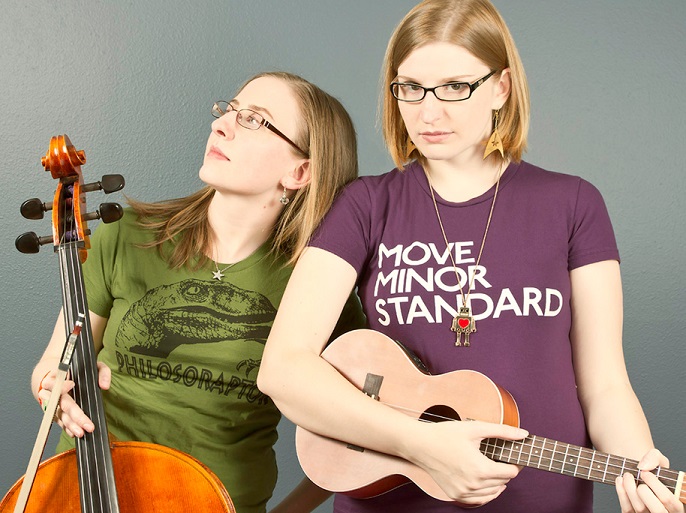
The Doubleclicks are Laser and Aubrey Webber, two Portland-based siblings who spin musical magic with cellos, guitars, and catboards (keyboards that meow). Advocates for science education, geeky self-esteem (especially for girl geeks), and the joyful fusion of cats and Netflix, their relentless charm has made them a favorite at conventions and game stores alike.

On the heels of their phenomenally successful Kickstarter campaign, they’re preparing for a flurry of upcoming tour dates, and that’s just the beginning of all the Doubleclicks goodness you can expect in 2014.

Laser and Aubrey were gracious enough to take some time out to talk to us, so without further ado, let’s get to the interview!

5 Questions for The Doubleclicks

1.) You’ve created marvelous and charming songs about Agent Coulson of S.H.I.E.L.D., dinosaurs, teddy bears, and the guy who yells “Freebird” at concerts. Can you tell us a little bit about how you choose what instruments and arrangements you’ll use for a given song? That seems like a puzzly endeavor in itself.

Great question! Some choices are obvious when it comes to arrangement: if we write a Christmas song, for example, it’s likely there will be some jingle bells. We try to mix up our style, and fortunately with a cello there are a lot of options: from a Tango to a rock song, depending on whether we are trying to go for a parody of style (like the Freebird song) or a genuine take (like our lullaby).

2.) You have a strong connection to the board game community, with your signature dice, your collaborations with creators like James Ernest, and your recent appearance on Wil Wheaton’s internet board game show TableTop. Since music and board games are both very cooperative endeavors, are they worlds that mesh well together, or is there something in particular about the Doubleclicks that invites such synergy?

Shortly after starting our band, we released a music video for our song about Dungeons & Dragons, and after that we started being invited to play at conventions. We’ve always been game fans, but going to these cons as performers afforded us a new opportunity: to actually meet the people who make these games, which is really, really, super, awesome. I think the subject matter of the songs and the content of our hearts makes us want to hang with game designers. And we are super serious about making a Doubleclicks card or board game sometime soon.

(Check out this fun Doubleclicks song about playing board games
to prepare for their appearance on Tabletop!)

3.) During your recent Google Hangout when you discussed your Kickstarter campaign, you mentioned you don’t have a lot of time for puzzles, but you enjoy them. On the rare occasion you do get to indulge in some puzzle fun, what are your favorites?

We were introduced to the puzzling word properly thanks to Team Snout, puzzle creators of amazing quality here in Portland. They’re involved in an event called Puzzled Pint which is like EXTREME pub trivia (except puzzles), and that is just a huge awesome fun time. They also involved us in a big event called WarTron a couple years ago in which they actually embedded a puzzle in our setlist, which was awesome.

4.) What’s next for the Doubleclicks?

We just wrapped up a Kickstarter that will keep us busy for at least a year. We’ll be releasing an album this spring as well as new songs and videos every month all year, and we’ll have a season of weekly songs during the summer. It’s going to be a really busy year and we are excited.

5.) If you could give the readers, writers, aspiring musicians, and puzzle fans in the audience one piece of advice, what would it be?

Make great friends and be involved in interesting things: if you’re a musician, play games. If you’re a game designer, get super into cooking.

Also, the LEGO movie is really good.
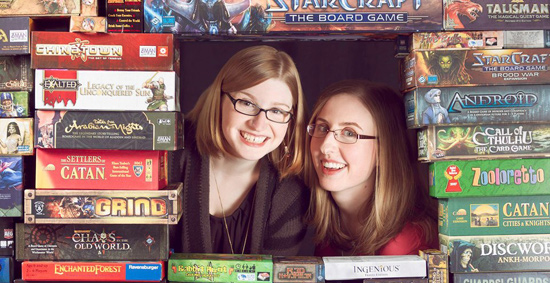
Many thanks to Laser and Aubrey for their time. Check out their website for all things Doubleclicks, and be sure to follow them on Twitter (@thedoubleclicks) and Facebook, sample their music on Bandcamp, and subscribe to their YouTube channel for videos and other treats! I cannot wait to see what they create over the coming year.

Thanks for visiting the PuzzleNation blog today! You can like us on Facebook, follow us on Twitter, cruise our boards on Pinterest, check out our Tumblr, download our puzzle apps and iBooks, play our games at PuzzleNation.com, or contact us here at the blog!

App announcement time!

Hello puzzlers and PuzzleNationers!

One of the most exciting developments for PuzzleNation has been our move into the mobile puzzle-game market with our apps and iBooks. You can take PuzzleNation puzzles with you wherever you go!

And we’re proud to introduce the latest addition to our mobile lineup: the Penny/Dell Jumbo Crosswords App!

Featuring 150 all-new crosswords, Penny/Dell Jumbo Crosswords has several difficulty levels and all the topnotch features in the original Penny/Dell Crossword app!

There’s also the original Penny/Dell Crossword App, available for iPad and iPhone. It features smart navigation to move you to partially filled-in entries and an alternate-clue option to help you solve!

And of course, we have our marvelous Classic Word Search iBooks! Volume 1, Volume 2, and Volume 3 are all available for the iPad! With plenty of puzzles to keep you busy, Classic Word Search is a terrific way to pass the time!

Classic Word Search is also available for Kindle Fire through the Amazon App Store!

And stay tuned, fellow puzzle fiends. Coming soon, a certain number-based puzzle will also be available for your mobile devices!

Thanks for visiting the PuzzleNation blog today! You can like us on Facebook, follow us on Twitter, cruise our boards on Pinterest, check out our Tumblr, download our puzzle iBooks and apps, play our games at PuzzleNation.com, or contact us here at the blog!

PuzzleNation App Reviews: Glyph Quest

Welcome to the latest edition of PuzzleNation Reviews! Today will be the first installment of a new review series: PuzzleNation App Reviews! That’s right, we’re delving into the world of games and apps for your tablet or smartphone!

Not only that, but we’re also introducing a new member of the PuzzleNation Crew. Please welcome our resident App player and puzzle fiend, Sherri!

Sherri will be giving you the lowdown on puzzle games and apps of all sorts, including both new and well-known games. So, without further ado, let’s explore Sherri’s first PuzzleNation App Review: Glyph Quest!


Glyph Quest is an iOS game app that combines elements of a fantasy role-playing game with a simple matching game.

I am a big RPG fan, so this game sounded right up my alley. I found it to be really very enjoyable, a terrific way to pass the time and much more than simply matching items. The simple 2D animation is cute and has a retro feel to it. You are able to choose your own character, a male or female spellcaster, and as that character, you go on quests to defeat monsters simply by matching 2 or more glyphs.

However, the game isn’t quite that easy. The glyphs represent six elements: earth, air, fire, water, dark, and light. There is some strategy involved. Making chains of matches, i.e. matching earth glyphs more than two times in a row, increases the power of the earth spell, but if you cast an air spell (its opposite) after an earth chain, that air spell is much more powerful! You also have to pay attention to the monsters you fight, as some are resistant to certain types of spells but weakened by others.

Beyond the matching element is the RPG element. Your character levels up as he or she defeats monsters and completes quests. You also have a health meter that you need to keep an eye on. Your spells get upgraded the more you use them, and you can use the money you earn from the quests to make upgrades to your knapsack, among other things. With the sack you have the ability to carry health potions and some offensive weapons.

This is a really cute and fun game. It is a great way to pass time when you want something that will engage your brain but won’t overtax it.

Ratings for Glyph Quest:

  • Enjoyability: 4/5
  • How well puzzles are incorporated: 4/5
  • Graphics: 2/5 (for the retro feel; the graphics aren’t great but fit the retro feel)
  • Gameplay: 3/5 (it can get a bit repetitive but there is enough variety with the monsters to keep it fresh)

Thanks for visiting the PuzzleNation blog today! You can like us on Facebook, follow us on Twitter, cruise our boards on Pinterest, check out our Tumblr, download our puzzle iBooks and apps, play our games at PuzzleNation.com, or contact us here at the blog!

Let’s get this party (kick)started!

The newest tool in the arsenal of big thinkers and big dreamers is crowdfunding, wherein creators take their ideas directly to the people in the hopes that a lot of small donations will add up into capital to make their ideas reality.

Websites like Kickstarter and Indiegogo have literally made dreams come true, and that’s as true for puzzle entrepreneurs as anyone else. Many top-tier constructors are going straight to the fanbase with their puzzles, and with marvelous results. Constructors like Trip Payne, Eric Berlin, and Matt Gaffney have all had success on Kickstarter and Indiegogo with previous campaigns.

And I wanted to spread the world about some other puzzly endeavors that might interest the PuzzleNation readership.

There’s only a few hours left in the kickstarter campaign for musical duo the Doubleclicks.

This marvelous musical duo has not only written songs about numerous nerdy subjects — board games, Dungeons & Dragons, and dinosaurs among them — but they’re also champions of self-expression and self-confidence, especially among the geek girl community. (Their song “Nothing to Prove” served as the buoyant soundtrack of a video decrying “fake geek girl” nonsense.)

Pairs, a card game for two to eight players, was just launched yesterday by the folks at Cheapass Games. A 5-minute card game where the goal is to NOT gain points, Pairs is designed to be easy to learn and easy to play.

[Click here to check out our session of 5 Questions with Cheapass Games president and game designer James Ernest.]

Apps and online games have also gotten into crowdfunding. There’s Colorino, a color-matching strategy app that would appeal to the Candy Crush crowd, as well as Puzzle Nuts 2. A sequel to the physics-based puzzle game Puzzle Nuts, Puzzle Nuts 2 challenges players to negotiate different contraptions and figure out how to transport all of their acorns from one end of the screen to the other. Fans of Angry Birds, Cut the Rope, and other mechanical-style puzzles could find plenty to enjoy here.

A master maze designer with several successful Kickstarter campaigns under his belt has already reached his primary goal, and is now striving to reach a major stretch goal. (Stretch goals are additional finish lines that creators can make available if their initial goal is met. Stretch goals often include more puzzles, finer artwork, additional game pieces, and other details that allow for a richer play experience.)

And then there’s Steam-Donkey, a card game where you try to attract visitors to your steampunk beachside resort. With ne’er-do-wells all around, it’s a game with emphasis on art and characters with a curiously distinct flair all its own.

High Heavens is a combination board game/card game/miniatures game that places the player in a battle between the gods. Right now, creator Ryan Lesser is on his second Kickstarter campaign, an expansion that will offer new gameplay options, miniatures, and characters to the original High Heavens set. (The original High Heavens was also funded through Kickstarter contributions.)

Sweet Escape is a platformer strategy app where you try to lead walking bits of candy to safety while dealing with all sorts of obstacles and threats inside a bizarre factory.

Finally, over on indiegogo, we have PuzzleFix, a photo jigsaw puzzle game actually encourages people to submit their own photographs to become new puzzles.

The amazing thing about all of these projects is that the audience, the potential fans, have an enormous role to play in not only sharing their thoughts with game and puzzle creators, but they can show their support for designers and projects they believe in, and do so in a meaningful way.

I’ve contributed to several of these campaigns with high hopes, and I can’t wait to see how they turn out.

Thanks for visiting the PuzzleNation blog today! You can like us on Facebook, follow us on Twitter, cruise our boards on Pinterest, check out our Tumblr, download our puzzle iBooks and apps, play our games at PuzzleNation.com, or contact us here at the blog!

26 letter tiles, endless possibilities…

On Tuesday, we delved into tile puzzles and games, exploring dominoes, mahjong, and sliding-tile variations. Letter-tile games may not have the centuries of history behind them that those listed above do, but you simply cannot talk about tile games without discussing one of the world’s most popular and recognizable brands: Scrabble.

Scrabble was created in 1938 by an architect named Alfred Mosher Butts, and was adapted from a word game he’d invented previously, known as Lexiko. His second attempt at the game — delightfully titled “Criss-Crosswords” — combined the letter tiles and values of Lexiko with the gameboard and playing style that we’ve all come to know.

A decade later, Butts sold the rights to manufacture the game, and James Brunot renamed it Scrabble. (Some sources also cite that Brunot simplified the rules and shifted the locations of the double- and triple-value squares, but I was unable to verify these claims.)

The game wouldn’t become a household name until years later when it was marketed and sold by Milton-Bradley. Nowadays, of course, the brand is not only known worldwide, but in myriad forms.

Our friends at Hammacher-Schlemmer not only sell an extended version allowing for longer words, but a magnetic version and a giant version, dubbed the World’s Largest (with good reason). Several Penny/Dell puzzles are based on the Scrabble model, and those signature tiles have appeared in game-show form and made an impact in the pop culture lexicon, offering more than a few magical moments to author Joe Hill’s thrilling horror novel NOS4A2.

And then there are the electronic versions. From Wordfeud and Words with Friends to Scrabulous (later known as Lexulous after several lawsuits), Scrabble and other letter-tile games (like Dabble and David L. Hoyt’s puzzle-game Word Winder) are ubiquitous in app stores and all over the Internet.

I was recently introduced to Bookworm, a very addictive puzzle game that deftly mixes the pattern-busting appeal of Candy Crush and other games with the Scrabble aesthetic of assigning point values to various words, encouraging you to find longer and more complex letter chains in order to score more points.

But there are board game variations as well. A particular favorite is Upwords, which is basically Scrabble, except the tiles are designed to allow you to stack them atop each other, spelling new words as you use your opponent’s moves against them. For instance, if your opponent played HENCE, you could place an F atop the H and an I atop the E, and then add other letters to the end, creating the word FENCING.

This additional wrinkle creates opportunities for outside-the-box thinking that Scrabble doesn’t, opportunities easily exploitable for any puzzler who’s adept at Changawords, Word Chains, and other letter-shifting puzzles. (Imagine the tile towers you could build, shifting SPARK to SPARS to SOARS to SOAKS to SOCKS to ROCKS!)

All of these letter-tile games and puzzles encourage anagramming skills, strategy, and a dab hand at quick math — being able to tell if you’ll get more out of a double-word short word or a triple-letter longer word, for instance — but there’s another letter-tile treat that adds a bit of speed to the mix: Bananagrams.

Bananagrams works on the same principle of adaptability as Upwords, encouraging anagramming in order to use up every letter tile in your hand. Launched in 2006 as the brainchild of Abraham Nathanson, it breaks free of the board game aspect of Scrabble and Upwords, allowing you to play anywhere, trying to out-anagram and out-grid-build your opponents in the shortest amount of time possible.

I had the opportunity to chat with Lesley Singleton, the UK PR Manager for Bananagrams, after a YouTube acquaintance posted a picture on her Instagram of a Bananagrams game she’d just played in French:

Lesley told me that, much like Scrabble, there are Bananagrams products for multiple languages (in case any Francophiles out there looking for the best possible chance to exercise their multisyllabic linguistic chops).

Although, as it turns out, they don’t add extra u’s to the UK edition. I made sure to ask, just in case. *laughs*

In the end, I doubt there’s a better vocabulary-building tool on the market today than any of these letter-tile games and puzzles. Whether you’re reaching for a banana-shaped bag full of tiles, a magnetic strip of letters, or the app on your iPhone, you’re sure to learn new words, big and small, the more you play.

(Though be wary of Words with Friends. I don’t know where their word database comes from, but I’ve played words I KNOW are words, and they’ve been rejected. Games like that give me headaches, and make me more and more thankful for go-to guides like the Official Scrabble Players Dictionary.)

Thanks for visiting the PuzzleNation blog today! You can like us on Facebook, follow us on Twitter, cruise our boards on Pinterest, check out our Tumblr, download our puzzle iBooks and apps, play our games at PuzzleNation.com, or contact us here at the blog!

Tile style puzzling!

Tile puzzles and tile games have been with us for centuries, but I daresay they’ve never been as prominent in our game/puzzle culture as they are these days.

Let’s start with the basics: dominoes.

Chinese Dominoes, which are slightly longer than the regular ones pictured above (not to mention black with white pips), can be traced back to writings of the Song Dynasty, nearly a thousand years ago. Dominoes as we know them first appeared in Italy during the 1800s, and some historians theorize they were brought to Europe from China by traveling missionaries.

The most common form of playing dominoes — building long trains or layouts and trying to empty your hand of tiles before your opponent does — also forms the core gameplay of other tile-based games, like the colorful Qwirkle, a game that combines dominoes and Uno by encouraging you to create runs of the same shape or color.

A tile game with similarly murky origins is Mahjong, the Chinese tile game that plays more like a card game than a domino game. (Mahjong is commonly compared to Rummy for that very reason.)

Mahjong has been around for centuries, but there are several different origin stories for the game, one tracing back to the Ming Dynasty (1368-1644), another to the days of Confucius (500 BC). The gameplay itself is about matching tiles (called melds) to build winning hands.

Rummikub, another tile game (but with numbers instead of characters on the tiles) also resembles card games in its gameplay, and anyone who has played Texas Rummy or Go Fish will instantly recognize the gameplay of building runs (1, 2, 3, 4 of the same color, for instance) and sets (three 1s of different colors, for instance).

All of these games employ pattern matching and chain thinking skills that are right in the puzzler’s wheelhouse, but some more modern tile games and puzzles challenge solvers in different ways.

The game Carcassonne is a world-building game wherein players add tiles to an ever-growing landscape, connecting roads and cities while placing followers on the map in order to gain points. Here, the tiles form just one part of a grander strategic puzzle, one encouraging deeper plotting and planning than some other tile games.

The Settlers of Catan also involves tile placement, but as more of a game starter, not as an integral part of the gameplay. Both Fluxx: The Board Game and The Stars Are Right employ tile shifting as a terrific puzzly wrinkle to their gameplay.

Our friends at Penny/Dell Puzzles have a puzzle combining crosswords and tiles, Brick by Brick, which encourages the solver to place the “bricks” on the grid and fill in the answers.

And, of course, I’d be remiss if I didn’t mention the most popular electronic tile game in modern memory, Tetris.

Tetris — which turns 30 this year! — requires quick thinking, good spatial recognition, and an ability to plan ahead (especially for those elusive four-block pieces that can eliminate four rows at once!). There are plenty of puzzles that employ similar tiles — Blokus, tangrams, and pentominoes come to mind — but none that have engendered the loyalty of Tetris.

Last but not least, there are the sliding-tile puzzles. These puzzles take all the challenge of tile placement games like Dominoes and add a further complication: the tiles are locked into a frame, so you can only move one tile at a time.

Frequently called the Fifteen Puzzle because the goal is to shift all 15 numbered tiles until they read out in ascending order, sliding-tile puzzles are chain solving at its best. Whether you’re building a pattern or forming a picture (or even helping a car escape a traffic jam, as in ThinkFun’s Rush Hour sliding-tile game), you’re participating in a long history of tile-based puzzling that has spanned the centuries.

Heck, even the Rubik’s Cube is really a sliding-tile game played along six sides at once!

[Be sure to tune in on Thursday, when I explore tile-based word games like Scrabble!]

Thanks for visiting the PuzzleNation blog today! You can like us on Facebook, follow us on Twitter, cruise our boards on Pinterest, check out our Tumblr, download our puzzle iBooks and apps, play our games at PuzzleNation.com, or contact us here at the blog!