5 Questions with constructor Patrick Blindauer!

Welcome to another edition of PuzzleNation Blog’s interview feature, 5 Questions!

We’re reaching out to puzzle constructors, video game writers and designers, board game creators, writers, filmmakers, musicians, and puzzle enthusiasts from all walks of life, talking to people who make puzzles and people who enjoy them in the hopes of exploring the puzzle community as a whole. (Click here to check out previous editions of 5 Questions!)

And I’m excited to have Patrick Blindauer as our latest 5 Questions interviewee!

Any list of the top constructors in crosswords today simply has to include Patrick Blindauer. His puzzles have appeared in the New York Times, the Los Angeles Times, the American Values Club Crossword, GAMES Magazine, and numerous other outlets, and Patrick is known for his devilishly clever themes and challenging puzzle grids.

As a regular contributor to the American Crossword Puzzle Tournament and co-host of this year’s Lollapuzzoola, Patrick represents both classic crossword traditions and the enterprising spirit of today’s most innovative constructors, pushing boundaries and continuing to explore just how devious and delightful crosswords can be.

Patrick was gracious enough to take some time out to talk to us, so without further ado, let’s get to the interview!

5 Questions for Patrick Blindauer

1.) How did you get started with puzzles?

My parents instilled my love of puzzles and games from an early age. I remember my mom got me an educational toy called Mr. Light, and my dad had a subscription to GAMES Magazine, which I would flip through when he was done with it. I loved the visual puzzles and the contests, but I didn’t get into crosswords until many years later when I decided to give up cigarettes and take up solving.

It was one of the best decisions I ever made, simultaneously improving my health and leading me to a new hobby and eventually to a new career. After a year of solving I tried constructing, and after a year of constructing something clicked and I made my first sale (a Thursday for the NYT, which ran on 7/21/05).

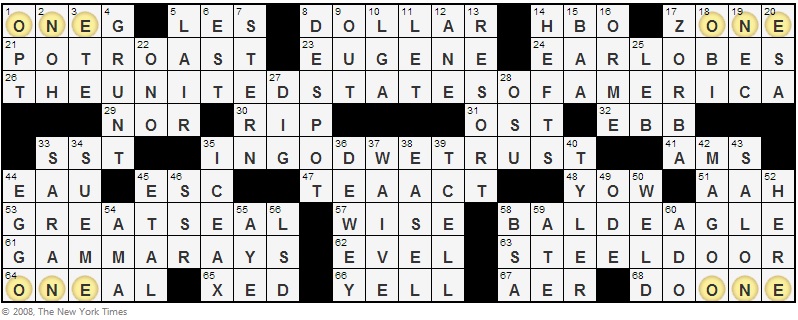
2.) Whether it’s the New York Times or the American Values Club Crossword, you’ve created some truly innovative and diabolical puzzles, like your famous dollar-bill-shaped crossword (featured above) or the New York Times puzzle from last year where multiple movie titles shared boxes. Do you have any favorite puzzles or clues, either your own or constructed by others? And on the flip side, what’s your least favorite example of crosswordese?

Thanks! Those are certainly the 2 New York Times crosswords which have gotten the most attention. Other favorites which spring to mind are my 7/4/07 New York Times puzzle*, the 12/17/09 New York Times puzzle I made with Francis Heaney, and the stuff I wrote for the NY Sun when I started out, which are collected in the book Patricks’ Puzzle Pandemonium: A Cavalcade of Crossword Craziness.

[*Glenn’s note: The 7/4/07 crossword was designed so that the letters “USA” could be found when certain boxes were shaded. It was no doubt a beast to construct. The 12/17/09 crossword was Noah’s Ark-themed, and animal names appeared side-by-side in the grid.]

I’m also the proud poppa of 5 Puzzlefests (interconnected xword suites with a final answer), which I offer through my website, and I’ve written a bunch of puzzle books (“Crossword Word Search” and “Wide-Screen Crosswords” are two of my favorites).

There are lots of other constructors whose work I enjoy, especially those who devise novel gimmicks that really push the envelope.

blindauer beard

My least favorite xwordese is probably LST, though I try to avoid all xwordese when I can. Coming up with a fresh SST clue is tough too, so I just avoid putting it in the grid in the first place.

[Glenn’s note: LST is an abbreviation for an amphibious military craft, short for Landing Ship Tank. SST is an abbreviation for supersonic transport, like the former Concorde.]

3.) You’re also a musician, and both the best puzzles and enjoyable musical performances often have a sense of flow and elegance about them. Do you ever find yourself relying on your more puzzly skills while performing, conducting, or teaching?

Not consciously, no, but maybe I should!

4.) What’s next for Patrick Blindauer?

I actually have something very exciting to announce: I’ve been commissioned to write a 6-puzzle set for the New York Times! It will run Monday-Saturday sometime this fall, and the plan is to make it a contest, as well. I’m thrilled and honored to have the opportunity to do something like this. Wish me luck!

5.) If you could give the readers, writers, and puzzle fans in the audience one piece of advice, what would it be?

Keep your pencil sharp and your mind even sharper.


Many thanks to Patrick for his time. You can check out his PuzzleFests and other puzzly works on his website, and be sure to follow him on Twitter (@pblindauer) to keep up on all things Patrick. (You can also learn more about the Lollapuzzoola tournament at BeMoreSmarter.com.) No doubt, Patrick will have something fiendishly fun for solvers soon.

Thanks for visiting PuzzleNation Blog today! You can share your pictures with us on Instagram, friend us on Facebook, check us out on TwitterPinterest, and Tumblr, and be sure to check out the growing library of PuzzleNation apps and games!

Meet a pious puzzler!

It’s always nice (and far less common) to read a news story that reveals a pleasant secret about someone famous. It seems like so much of our media coverage of celebrities is fixated on dirty little secrets, scandals, and unpleasantness of all sorts. It’s rare to discover something new about people in the public eye that enhances their reputations instead of demeaning them.

So when I stumbled across this article about a religious figure who secretly created puzzles for the masses, I knew I had to share such delightfulness with the PuzzleNation readership.

Yes, Europe once had its very own Puzzly Pope: Leo XIII!

Serving as Pontiff from 1878 to 1903, Pope Leo XIII occasionally published long, poetic riddles known as “charades” in a Rome newspaper called Vox Urbis, under the pseudonym “X.”

Pope Leo XIII’s charades were descriptions that solvers would decode by identifying certain words that were also syllables of a hidden answer word.

From the article:

One example of the pope’s Latin riddles talked of a “little boat nimbly dancing,” that sprung a leak as it “welcomed the shore so near advancing.”

“The whole your eyes have known, your pallid cheeks have shown; for oh! the swelling tide no bravest heart could hide, when your dear mother died,” continues the translation of part of the riddle-poem.

The answer, “lacrima,” (“teardrop”) merges clues elsewhere in the poem for “lac” (“milk”) and “rima” (“leak” or “fissure”).

Only eight of the Pope’s charades appeared in Vox Urbis, and despite His Holiness’s attempts to remain anonymous, the identity of “X” was uncovered a year after the first charade appeared in the Latin-language paper.

But an impressive 26 of Pope Leo XIII’s puzzles (many of which never seen before) were recently collected into a book, Aenigmata: The Charades of Pope Leo XIII, by students of the Italian middle school named in Pope Leo’s honor. (Sadly, the book doesn’t appear to be available for sale.)

While it’s fun to picture world leaders like President Clinton and pop culture superstars like Katy Perry and Jon Stewart solving crosswords, I must admit that it’s even more fun picturing Pope Leo XIII toiling over a perfect puzzle to entertain the masses.

And so, we welcome another intrepid puzzle constructor into the hallowed halls of puzzledom. Pope Leo XIII, anonymous riddlesmith and rebus master, we salute you!

Thanks for visiting PuzzleNation Blog today! You can share your pictures with us on Instagram, friend us on Facebook, check us out on TwitterPinterest, and Tumblr, and be sure to check out our library of PuzzleNation apps and games!

It’s Follow-Up Friday: That Has a Name?! edition

Welcome to Follow-Up Friday!

For those new to PuzzleNation Blog, Follow-Up Friday is a chance for us to revisit the subjects of previous posts and update the PuzzleNation audience on how these projects are doing and what these people have been up to in the meantime.

And today, I’d like to revisit crosswords for a moment.

We’ve explored crosswords a lot in this blog. From great cluing to the curse of crosswordese, from advice for constructing quality puzzles to tips for solving them, crosswords have been the centerpiece for many PuzzleNation Blog posts.

But friend of the blog Cathy Quinn recently passed along an article with an interesting bit of crossword trivia attached.

Have you encountered a difficult crossing in a crossword that left you baffled? This happens with proper names, archaic terms, and other more difficult grid entries, and when two of them cross, you might find yourself guessing instead of solving.

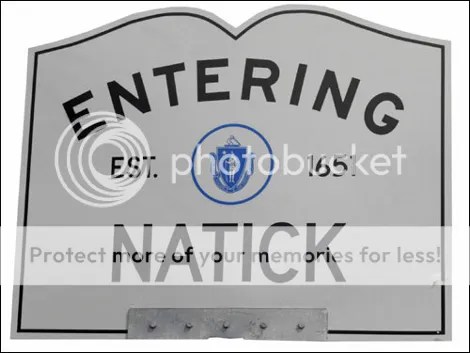
As it turns out, that difficult crossing, that unfillable square, that unsolvable spot, has a name, and it’s “Natick”.

From the article:

Back in 2008, The New York Times crossword puzzle featured a crossing of NATICK (“Town at the eighth mile of the Boston Marathon”) with N.C.WYETH (“Treasure Island” illustrator, 1911). If you weren’t from ’round these parts and were unfamiliar with the less-well-known Wyeth, it was a tough intersection.

Readers were not happy, and the term “a Natick” became shorthand for what is basically an unsolvable part of the crossword grid. (You can check out constructor Brendan Emmett Quigley’s take on the Natick here!)

So, if you’re ever flummoxed by a challenging crossing or an obscure intersection of terms, at least now you know what to call it.

Thanks for visiting PuzzleNation Blog today! You can share your pictures with us on Instagram, friend us on Facebook, check us out on TwitterPinterest, and Tumblr, and be sure to check out our library of PuzzleNation apps and games!

5 Questions: Alumni Edition!

Welcome to a special edition of PuzzleNation Blog’s interview feature, 5 Questions!

Normally, I’d be posting a new interview with a puzzle constructor, game designer, puzzle enthusiast, or a member of any other creative field that enriches the world in a puzzly way.

But instead, today I thought I’d reach out to our 5 Questions alumni and bring you news on what they’ve been up to since their sessions of 5 Questions.

First off, puzzle constructor Trip Payne’s new Puzzle Extravaganza launches tomorrow, August 1! You can still sign up through the end of August, and the extravaganza is only $10 (a little more for bonus puzzles).

Put your puzzly skills to the test against a topnotch constructor who has contributed to dozens of newspapers, outlets, and puzzle books, including Will Shortz’s WordPlay!

[To check out Trip’s session of 5 Questions, click here!]

Next up, the dynamic duo of Aubrey and Angela, better known as The Doubleclicks, are continuing to fulfill all the promises made in the Kickstarter fundraising campaign for their newest album, Dimetrodon!

And they’re currently touring across the Midwest and East Coast! Their ambitious schedule of venues includes Toronto, Boston, Brooklyn, and plenty of other cities, many that will experience the Doubleclicks live for the very first time!

In addition, they’ve just completed their Weekly Song Wednesday project, where they posted a new song and video every Wednesday for ten weeks. You can visit their YouTube page to explore all sorts of delightful content fit for puzzlers and game fans of all ages.

[To check out Angela and Aubrey’s session of 5 Questions, click here!]

And lastly, I have some exciting updates from BaffleDazzle founder Rachel Happen.

After launching a tremendous Kickstarter campaign to fund BaffleDazzle’s first line of jigsaw-inspired puzzles, Rachel recently sent her Kickstarter backers an update on how the production phase is going.

So far, she’s on target to deliver all of her promised puzzles by the end of August!

As a one-woman puzzle-making machine, Rachel is exceeding expectations on all fronts, not only redesigning and improving every aspect of the looming delivery process, but designing brand new bonuses to include.

Just take a gander at these stacks of Codebreakers puzzles, freshly produced and awaiting happy homes and eager puzzlers:

[To check out Rachel’s session of 5 Questions, click here! And for a spoiler-light review of the BaffleDazzle puzzle Cirkusu, click here!]

These are just a few examples of puzzly people doing amazing, entertaining, fascinating things, and I’m glad I’m lucky enough to share their work with you, my fellow puzzlers.

Thanks for visiting PuzzleNation Blog today! You can share your pictures with us on Instagram, friend us on Facebook, check us out on TwitterPinterest, and Tumblr, and be sure to check out our library of PuzzleNation apps and games!

Wait a Minute, Mr. Postman…

With subscriptions to puzzle magazines like Will Shortz’s WordPlay and GAMES Magazine, as well as puzzle-by-mail services like The Uptown Puzzle Club and The Crosswords Club, there are plenty of ways to get puzzles by mail.

But one particular puzzler in the UK has put an intriguing twist on the idea of puzzles-by-mail: he’s challenged the carriers of the Royal Mail postal service to solve puzzles in order to deliver his mail.

A graphic designer by trade, James Addison was impressed by the diligence of the postmen of the Royal Mail, and he playfully decided to test their mettle with different challenges, including maps, word searches, pictograms, and other befuddling methods to conceal the intended destination of the letter.

From an article on The Telegraph website:

Although he enjoys solving puzzles himself, he said his hobby was fuelled by a desire partly to test the Royal Mail’s ingenuity and partly to honour old-fashioned letter-writing, following his mother’s advice that a handwritten thank-you note showed you had made an effort.

Well, Mr. Addison is certainly taking his mother’s words to heart. And it seems the postmen of the Royal Mail quite enjoy the spirited challenges his letters offer.

[To try your hand at solving some of Jim’s letters, including those pictured in this post, click here!]

Thanks for visiting PuzzleNation Blog today! You can share your pictures with us on Instagram, friend us on Facebook, check us out on TwitterPinterest, and Tumblr, and be sure to check out our library of PuzzleNation apps and games!
A revolution in puzzles?

Crosswords have certainly changed the world. They’re the most popular puzzles in history, challenging the minds of millions every day and kickstarting a pencil-and-paper puzzle revolution in the process. Heck, they’ve even been used in England as part of the recruitment process for code breakers and other puzzly government positions!

But did you know that some constructors have been accused of trying to bring about actual revolutions with crosswords?

Oh yes! The Venezuelan newspaper El Aragueno has been accused on several occasions of hiding encrypted messages within their daily crossword puzzles in order to incite revolt against the government. (And a year ago, another Venezuelan newspaper, Ultimas Noticias, was accused of concealing messages ordering the assassination of a public official!)

While there are no details on what the incendiary message secretly contained within El Aragueno’s puzzle might have said, this isn’t the only time crosswords and constructors have run afoul of the powers that be.

Back in June of 1944, physics teacher and crossword constructor Leonard Dawe was questioned by authorities after several words coinciding with D-Day invasion plans appeared in London’s Daily Telegraph.

The words Omaha (codename for one of Normandy’s beaches), Utah (another Normandy beach codename), Overlord (the name for the plan to land at Normandy on June 6th), mulberry (nickname for a portable harbor built for D-Day), and Neptune (name for the naval portion of the invasion) all appeared in Daily Telegraph crosswords during the month preceding the D-Day landing.

So it was possible (though highly improbable) that Dawe was purposely trying to inform the enemy of Allied plans, and the powers that be acted accordingly. (In the end, no definitive link could be found, and consensus is that Dawe either overheard these words, possibly slipped by soldiers stationed nearby, and slipped them into his grids unwittingly, or this is simply an incredible coincidence.)

Either way, it just goes to show you how influential crosswords have been (and could be!) over the last hundred years.

Thanks for visiting PuzzleNation Blog today! You can share your pictures with us on Instagram, friend us on Facebook, check us out on TwitterPinterest, and Tumblr, and be sure to check out our library of PuzzleNation apps and games!