We’ve got two quick updates for you today from the world of crosswords. And both of them involve opportunities for you to get out there and show off your cruciverbalist talents!
On Monday night’s Boswords broadcast, Will Shortz joined Andrew Kingsley and John Lieb to announce some changes for the American Crossword Puzzle Tournament.
In 2026, the ACPT will be held at the Stamford Marriott, possibly for the last time.
No, worry not, the ACPT is still going strong. So strong, in fact, that it will be moving to Philadelphia for the 2027 tournament! The new space will be able to accommodate up to 1,250 solvers.
It’s a sad moment for Stamford, but not entirely unexpected. Attendance has been pushing the Marriott’s limits for years, and registration for this year’s tournament closed more than a month early because of high demand.
It’s also not the first time Stamford has said goodbye to the tournament. From 2008 until its return in 2015, the ACPT was held outside Stamford.
You can check out the full announcement here:
Will Shortz joined us on our Boswords broadcast tonight to share news about a future location for the American Crossword Puzzle Tournament (ACPT). You can watch the interview at https://t.co/b2iKNr7ExMpic.twitter.com/8Uv6oq6Hz0
Overall, I think this is a great move for the tournament. There’s greater opportunity to attend the tournament, plus a ballroom space fit for voracious solvers of all ages.
I can’t wait to see what 2016 and 2017 bring for the American Crossword Puzzle Tournament.
Remember that registration opens on January 1st for former contestants and on January 8th for rookies!
Reminder: Puzzmo Open Submission Week is Fast Approaching!
From the mecca of in-person crossword solving to one of its most ambitious and welcoming online platforms, we move from one impactful puzzly institution to another that has very quickly made its mark on the world of puzzles.
Puzzmo is holding their next Crossword Open Submission Week from December 29th to January 5th, 2026, with new and established constructors all welcome to submit their puzzly creations.
Themed and themeless puzzles are welcome, as long as they fit Puzzmo’s specs, and the Puzzmo team has created an impressively thorough document to assist aspiring constructors with their efforts. Grid specs, examples of previously published puzzles, and more await anyone hoping to see their work pop up on Puzzmo.
It’s a very cool opportunity to test your puzzly mettle in a creative space known for strong crossword fundamentals as well as playfulness with language and themes (particularly their signature “apt pairs”).
I would highly recommend checking out Puzzmo, whether you’re planning to submit puzzles or not. The minis, midis, and big crosswords are all great fun to solve, and new constructors are bound to learn a thing or two from the terrific names on Puzzmo’s roster of puzzlesmiths.
Will you be attending next year’s ACPT or submitting to this year’s Puzzmo Open Submission Week? Let us know in the comments section below. We’d love to hear from you!
After our one-year anniversary post, some of the readers have been asking about my puzzle credentials. How did I become a puzzler? What strange, meandering road led me to the hallowed halls of puzzlesmithery? Could aspiring puzzlers follow the same path to puzzlewonderful adventures?
There’s no single path to puzzlerhood. Sure, there are some fairly universal commonalities. Do you have a great vocabulary? Mad trivia skills? Are you a whiz with palindromes, anagrams, or other forms of wordplay? These can all help. Also, a background or degree in English doesn’t hurt.
But every puzzler I know took a different route. It’s not as if we all awoke one day to a knock at the door, only to discover a small basket left on the doorstep, and tiny elfin footprints leading back toward the enchanted forest down the street.
Though, admittedly, that would have been awesome.
Here, let me take you through some of the highlights in my puzzle resume, and we’ll see if my experiences offer some guidance or inspiration for those with puzzletastic aspirations.
Unrecognized Wheel of Fortune Grand Champion, USA, 1988-present
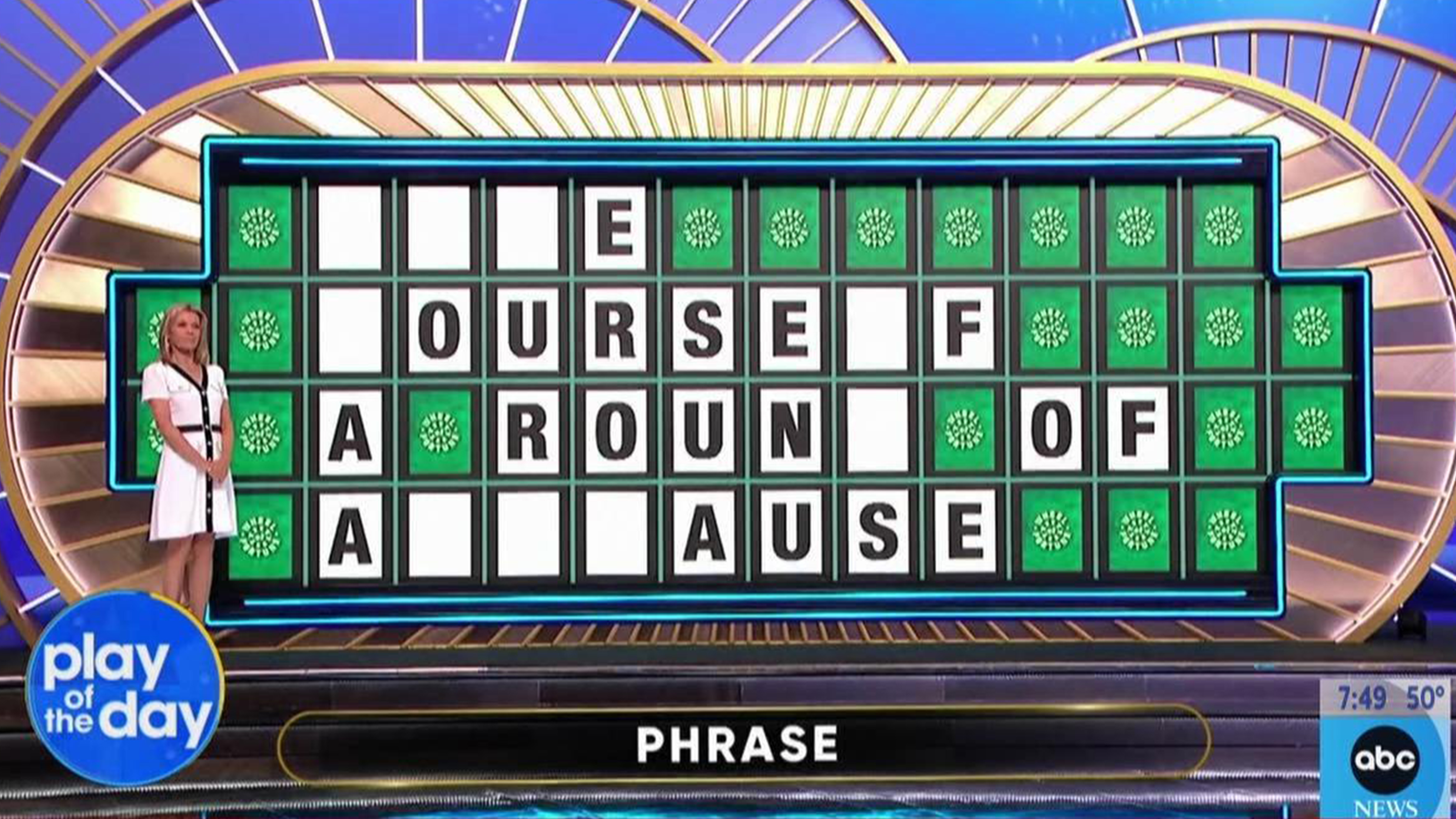
Since I was about seven years old, family members have called me into the family room to see who can puzzle out the quotes, phrases, and punny answers behind the lovely Vanna White, and I regularly school both contestants and kin with ease.
While Mr. Sajak refused to recognize my decades-long reign as Wheel of Fortune Grand Champion (Stay-at-Home Division), and Mr. Seacrest has yet to return my calls, that doesn’t make it any less noteworthy.
Internship with the Riddler, Gotham City, 2000-2001
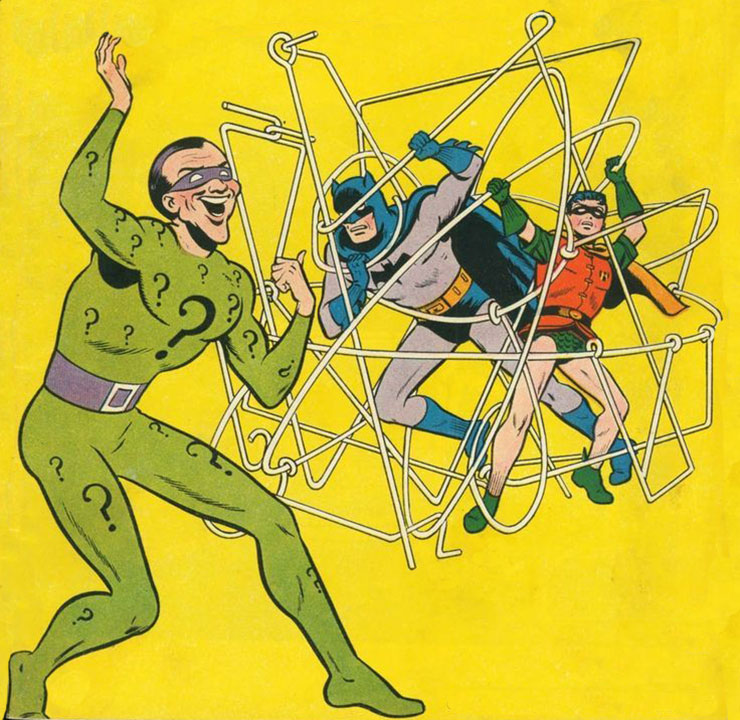
There are few puzzle personalities in the world with the flair, cachet, and renown of Edward Nygma, otherwise known as freelance detective and occasional criminal mastermind The Riddler. So when I had the opportunity to sit in with him and learn from his decades of riddle-centric shenaniganry, I leapt at the chance.
I studied the intricacies of mechanical puzzles, wordplay, and punsmithery while under Nygma’s wing. Although I frequently found myself in legal and moral gray areas — and on the receiving end of more than a few POW!s and BIFF!s — the experience was well worth it.
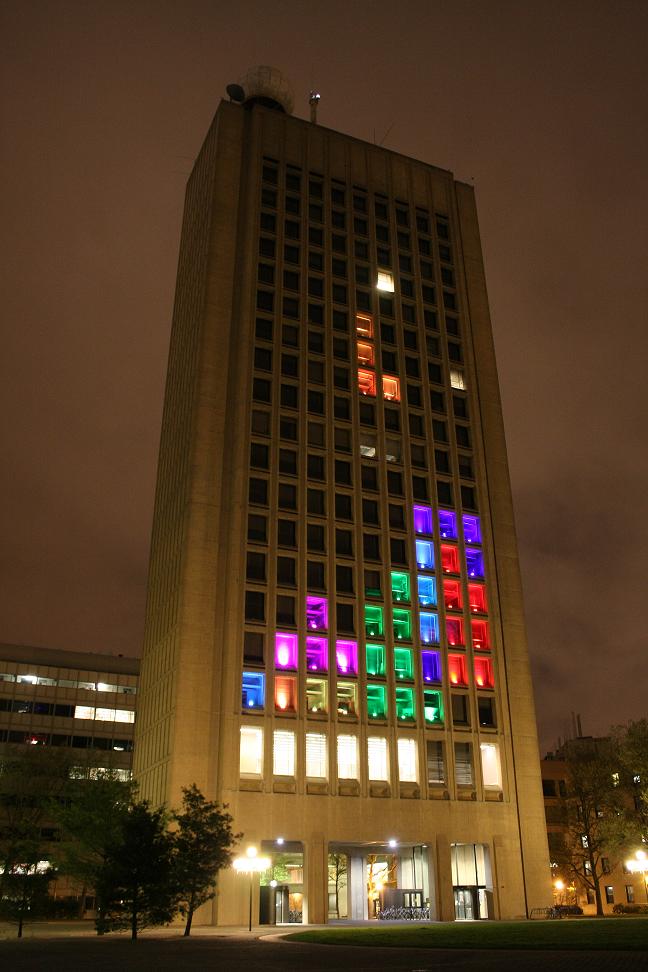
Tetris Foreign Exchange Program, St. Petersberg, 2002
There’s no better spatial awareness training than Tetris. I can feng shui the packages in the back of a UPS truck like nobody’s business, and don’t get me started on my legendary vacation-packing skills. And with the added pressure of that horrendous tension-inducing “you’re near the top!” music, I’m cool as Siberia under pressure.
Dungeon Tester, various, 2003-present
Is your Tomb of Horrors not horrorful enough? Is your Tomb of Elemental Evil lacking in some evil elements? Is your Ghost Tower of Inverness feeling a little inver-less?
I’ve ventured through some of the deadliest, trickiest, player-decimating-est dungeons in all of roleplaying, and my quality control and suggestions have made them even deadlier-ier!
That trick with the secret escape door in the third pitfall trap? Yeah, that was me.
You’re welcome, dungeon masters!
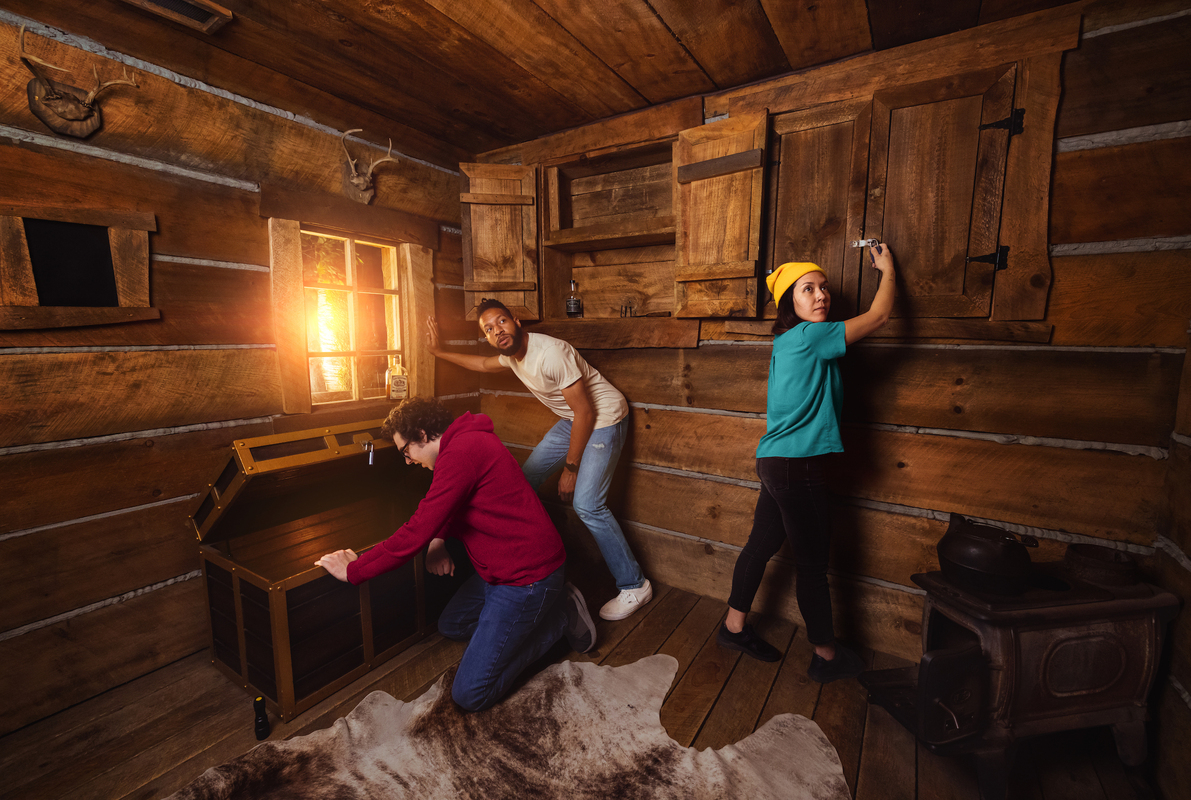
Escape Room Entrepreneur, Scranton, PA, 2006
Yes, the first official escape room opened in Japan in 2007, but I actually pioneered the genre when I accidentally tripped into a display at the Houdini Museum in Scranton just before closing time. Somehow the staff missed the clanking of chains and my totally-manly-and-not-at-all-shrill cries for help, and I found myself plunged into darkness, trapped haphazardly in several of Houdini’s most famous devices.
Thankfully my previous training with the Riddler had prepared me for this sort of dilemma. After several hours of maneuvering (and some unpleasant chafing marks from all the chains and manacles), I managed to extricate myself from all the Houdiniana around me and slip out the front door… and into the waiting arms of the police responding to all the motion sensor alarms I’d tripped with my heroic flailings.
Puzzle Summit with Will Shortz, New York City, 2007
Okay, it wasn’t so much a historic meeting of the minds as it was me yelling puzzle ideas at him with a megaphone as I chased him down the street.
But that totally counts.
Freelance Puzzle Historian, Self-Appointed, USA, 2009-present
Oh yes, puzzle history is a rich and varied field of study, one to which I have devoted a great deal of time and effort, unearthing some fascinating and surprising discoveries. For instance, did you know that Nero did not, in fact, fiddle while Rome burned? He was far too busy being frustrated by the extreme Sudoku puzzle he’d picked up in the agora.
Well, there you have it. A brief glimpse in my particular puzzle experiences and how they’ve shaped me. Here’s hoping you can blaze your own puzzlerific trail, be it through decoding Linear B with Cryptogram-ingrained proficiency or anagramming your friends’ names to your heart’s content.
One of the first women I mentioned was Richard Simon’s aunt. According to the lore of Simon & Schuster, she was the one who inspired Simon to publish a limited release book — the first crossword puzzle book — that launched their publishing empire.
While I was writing that post, I spent a little time researching, and I never came across her actual name. Everywhere I looked, it was simply Richard Simon’s aunt.
And that question festered in my brain for a while.
So, one day, I reached out to Simon & Schuster directly, asking for more information on Simon’s influential aunt. I heard back from Hannah Brattesani, their backlist manager, who not only volunteered to comb through the various company histories, but also suggested a book for my research (Turning the Pages by Peter Schwed).
While Hannah investigated from the S&S side of things, I decided to pursue what was publicly available about the Simon family tree. Perhaps I could look up his aunt directly and find a name that way.
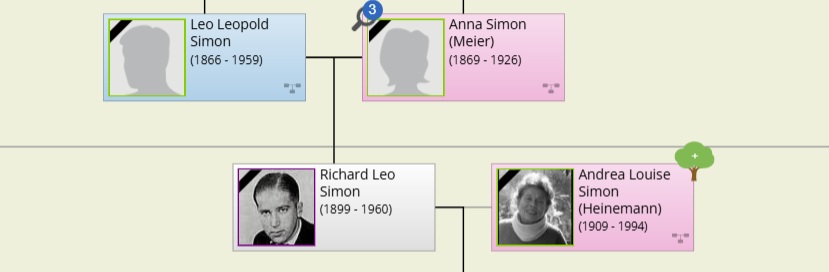
I found that Richard L. Simon was the son of Leo Leopold Simon and Anna Simon (nee Mayer). Leo apparently only had brothers, while Anna’s only sister, Julia, died young.
Okay, that was a dead-end. Ah! But what about women who married into the family?
Anna’s brother Max Reinhard Meyer married a woman named Harriet and Leo’s brother Alfred Leopold Simon married a woman named Hedwig.
So we have two possibilities, but nothing concrete tying either of them to crosswords or S&S’s early days.
I heard back from Hannah, who unfortunately came up empty while searching the S&S archives. The closest we got was a reference from a book celebrating S&S’s 75th anniversary, mentioning “Mr. Simon’s strong-willed aunt.”
Sadly, not an actual picture of Richard Simon’s aunt…
Before I continue, I want to take a moment to ponder all the different permutations of the Richard Simon’s aunt story. For a casual anecdote that adds charm to a business’s first success story, there are a surprising number of variations.
In Turning the Pages and The Centenary of the Crossword, the story goes that Dick Simon had been asked by his aunt for a little help with a crossword puzzle to which she had become addicted. She considered there should be a book of these published.
In an article in Pressreader, she asked him where she could buy a book of crosswords like the ones in her favorite newspaper.
In What’s Gnu?: A History of the Crossword Puzzle by Michelle Arnot, she wants a collection of crossword puzzles for her daughter, an avid fan of the weekly puzzle in The World. In The Crossword Century and Thinking Inside the Box, Simon goes to dinner with his aunt, whose niece was addicted to crosswords.
So the only common threads are Simon, his aunt, and crosswords. Sometimes it’s for her (described as “puzzle mad” or, as we’ve already seen, “strong-willed”), or her daughter, or her niece, or a friend. Sometimes he notices her solving crosswords, sometimes she tells him. Sometimes it’s at her house, or over tea, or at dinner.
Sure, lots of anecdotes evolve over the decades. Any story from your family probably has a number of variations, depending on who tells the tale.
But it’s fascinating that such a fundamental moment in S&S’s history doesn’t really have an official version as part of the narrative.
So, we have Richard Simon, his aunt, and crosswords. Those were the common threads.
And it was the third one in that list that finally led me to her name. Not crosswords per se, but crossword history.
There are several marvelous books about the history of crosswords — I’ll post a list of my sources at the bottom of today’s post — and wouldn’t you know it, several of them include a name for Simon’s aunt!
Well, not a name. A nickname.
Wixie.
Yes, it’s somehow so brilliantly fitting that the woman who launched crossword publishing (for herself, a daughter, a niece, whomever) would have a whimsical nickname like that.
Aunt Wixie.
As it turns out, this nickname was sort of an open secret in the annals of crossword history and I’d managed to miss it in my previous searches across the internet. My grand mystery would have been solved much faster if I’d simply asked some of my fellow puzzlers and puzzle historians.
But I wasn’t disappointed to learn that I was late to the table. On the contrary, I was excited to add “Wixie” to the search parameters and see what I came up with.
A few more online sources were revealed, but sadly, not much else about Aunt Wixie herself.
Now, sharp-eyed readers, you’ve probably come to the same conclusion I did at this point.
Thinking back to what I’d learned about the Simon family tree, I had two possible aunts who had married into the family who could be our crossword-loving inspiration.
One was Harriet and one was Hedwig.
It seems like a natural conclusion that Aunt Wixie and Aunt Hedwig would be one and the same. But none of the sources, paper or digital, ever mentioned her real name.
I could’ve called it here, and written my blog post, and gone on my merry way.
But I wanted that last piece of puzzle that I could definitively point to and say, this, this is her.
In all those Google Books links and online articles, there was one source I couldn’t view publicly, because it was behind a paywall. Naturally, it was also the oldest source I could find online that came up using “Wixie” as a keyword: an issue of Publisher’s Weekly from 1954.
And I could read it… for a fee.
You may find it funny that I balked at spending twenty bucks for access to an article. But I did. I mean, none of the other sources told me more than her nickname and some variation on the crossword book creation myth. Would this one be any different?
As it turns out, yes, yes it would.
From the writeup in Publisher’s Weekly:
Among the devotees of the World’s crosswords was a New York Lady, Mrs. Alfred L. Simon. She had a nephew named Richard L. Simon to whom she was known as Aunt Wixie.
It is so perfectly typical that the smoking gun in my search for Richard Simon’s aunt’s name STILL doesn’t directly mention her by name, using her husband’s name instead. What an insanely fitting denouement.
Nonetheless, I finally had the connective tissue to tie the whole story together. From my deep dive into the Simon family tree, I knew that Mrs. Alfred L. Simon was none other than Hedwig Simon (nee Meier), our elusive Aunt Wixie.
So what do we know about Hedwig?
Sadly, very little. She was born in Frankfurt Am Main, Regierungsbezirk Darmstadt, HE, Germany on February 27, 1868. She had two children, Robert and Helen (hopefully a puzzle lover like her mother, depending on the story), and she died in May 26, 1932 in Manhattan.
That’s it. Several Hedwig Simons come up when you search the name, but unfortunately, I wasn’t able to find anything else I could verify was truly about Aunt Wixie.
Date of birth. Names of her children. Date of death. That’s all we know.
Oh, we actually do know one other thing.
We know that she, in some way, influenced the creation of the very first crossword puzzle book, helping to launch a literary dynasty that lasts to this very day.
But did she though?
It turns out… there’s an asterisk on the historical record that’s worth mentioning.
There is a chance that this entire story is apocryphal, and the influential hand of Aunt Wixie in Simon & Schuster’s earliest days was not as influential as the story makes it seem.
Michelle Arnot reported in her book that Margaret Farrar, first crossword puzzle editor for The New York Times, had her doubts about Aunt Wixie’s role in the creation of S&S’s first crossword book.
In the foreword to Eugene T. Maleska’s 1984 book Across and Down: The Crossword Puzzle World, Farrar herself wrote:
There had never been a book of crosswords and Dick Simon’s aunt had suggested one. (Dick later admitted to me that this was all a joke, even unto the framed memo up on the office wall noting this earth-shaking idea.)
Could Aunt Wixie’s role in the history of crosswords simply be Richard Simon’s invention to help sell crossword books and add some whimsy and down-home family charm to Simon & Schuster’s first of many success story?
Margaret Farrar seemed to think so, and she was one of the most respected names in puzzles.
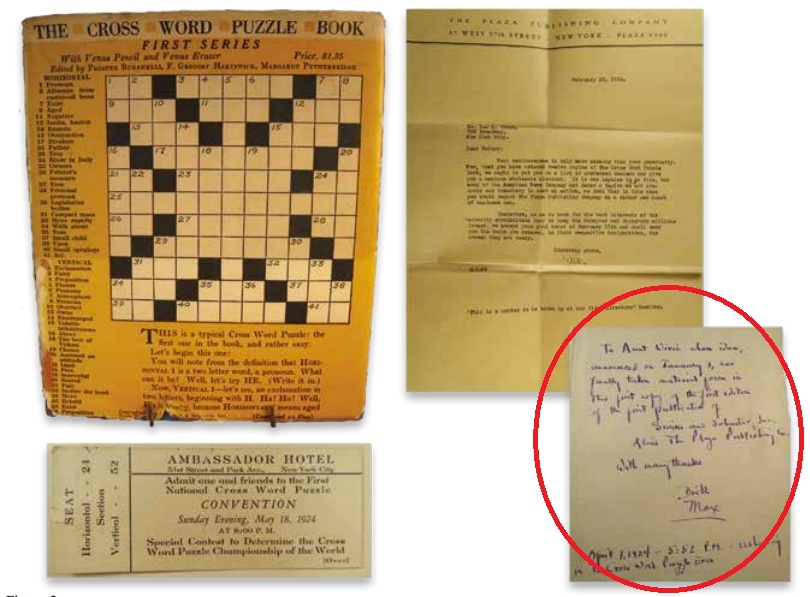
If this IS the case, Simon seemed to go out of his way to sell the story. He had a framed memo on his wall, as Farrar mentioned. He had a presentation copy of the first crossword puzzle book inscribed by both himself and Max Schuster to Aunt Wixie (the note pictured above), which was returned to Richard Simon upon her death, and which now resides in Will Shortz’s private collection.
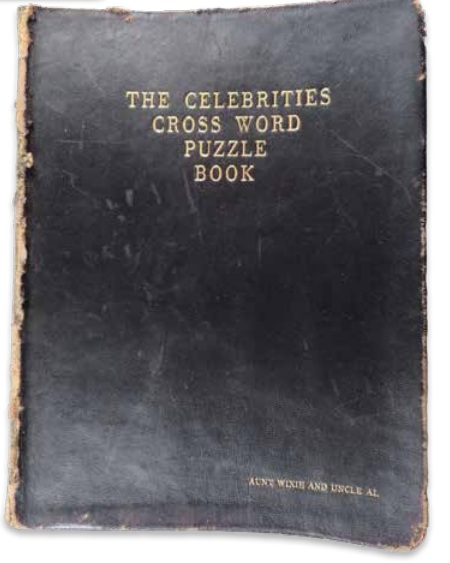
Will’s collection also includes a copy of 1925’s Celebrities’ Cross Word Puzzle Book, a collection by S&S featuring puzzles created by (you guessed it) celebrities. It’s a leatherbound presentation copy specially printed for “Aunt Wixie.”
By the end of 1924, S&S already had four bestselling crossword compilations on the shelves. By the time The Celebrities’ Cross Word Puzzle Book was published in 1925, would Simon still have bothered with perpetuating the Aunt Wixie story, given the runaway success of S&S’s crossword puzzle books?
It seems a tad unnecessary.
The many variations on how Aunt Wixie, Simon, and crosswords influenced that first puzzle book could mean the story was made up, taking on a life of its own as it was shared anecdotally. Or it could mean that it’s true, as many stories from a hundred years ago have variations from being shared over and over again, retold many times. It’s hard to say either way.
That first book sparked a long, successful series…
I choose to believe that Hedwig Simon was in fact the impetus behind that first book. Maybe it’s naive to want her to be a true crossword enthusiast (or the mother of one, or the aunt of one), and not simply one more corporate invention to sell something to someone.
But I’m okay with that.
I’m happy to have spent this time and energy trying to unearth her name and learn a bit more about her, and I’m hoping that I might have the opportunity in the future to continue learning about her.
And I’m happy that this post, in some small way, might bend search algorithms and lead more people to associate the name Hedwig Simon with Simon & Schuster’s successes.
Narratively, I probably shot myself in the foot a little by putting her name in the title of the blog post. But this entire endeavor has been about learning more about her, learning her name, and it would be the height of selfishness to bury it in hundreds of words of text just for a ta-da moment.
So, in closing, let me just say, thanks Aunt Wixie, and it was nice to meet you, albeit very briefly, Hedwig.
My sincere thanks to Hannah Brattesani of Simon & Schuster, Rebecca Rego Barry of finebooksmagazine.com, and especially Ben Zimmer, who provided several key sources and links (and confirmed that the Publisher’s Weekly was the earliest source on the subject).
Sources:
-Turning the Pages: An Insider’s Story of Simon & Schuster 1924-1984 by Peter Schwed -What’s Gnu?: A History of the Crossword Puzzle by Michelle Arnot -The Centenary of the Crossword by John Halpern -The Crossword Century by Alan Connor -Thinking Inside the Box: Adventures with Crosswords and the Puzzling People Who Can’t Live Without Them by Adrienne Raphel -Publishers Weekly (April 17, 1954, Volume 165, Issue 16)
For instance, Jacob Reed debuts in today’s puzzle, and his Shortz Number is 1373.
Peter Gordon is 1. Merl Reagle is 26. Bernice Gordon is 77. Matt Gaffney is 97. Nancy Salomon is 143. Patrick Berry is 257. Deb Amlen is 378. Doug Peterson is 431. Patti Varol is 1000.
It’s an incredible insight into an ever-evolving roster of constructors.
According to a cursory Google Search, this seems to be the most legitimate definition of a Shortz Number.
But there are others.
The second and most specious definition seems to be a Shortzian take on the Salomon Number, connecting constructors to Shortz through a Kevin Bacon-like system of collaborations.
I only found a few references to this interpretation, so it seems more like a coincidence than actual cultural permeation.
But that still leaves one more version of a Shortz Number, and it’s my favorite one.
But in this instance, a Shortz is a unit of measurement for fame. More specifically, it’s the number of times a person’s name has appeared in The New York Times crossword as either a clue or a solution.
The brief post then goes on to state that Shortz himself is 1 Shortz famous. (I was unable to verify this through XWordInfo, either through SHORTZ, WILLSHORTZ, or WILL as grid entries.)
But as someone who enjoys weird statistics, I was definitely intrigued by this one. What’s the Shortz Number for common crosswordese and frequent fill?
I mean, RIPTORN only has a 6, but that’s an impressive number of times to get your first AND last name in a crossword.
So let’s dig in.
First things first, I’m jettisoning the clue aspect of the definition. Let’s stick to grid entries.
I’m also doing my best to eliminate shared names or ones with multiple definitions. ETTA has 241 uses in the Shortz Era, but I don’t want to parse between James and Jones. Same for ELLA (249), ANA (342), and ALOU (150).
Second, let’s stick to real people. It’s cool that SMEE has 114, ODIE 145, and ASTA a staggering 183. But the Bacon, Erdos, and Salomon Numbers rely on real people, so our Shortz Number will too.
So allow me to present the people with the 8 highest Shortz Numbers I could find:
#8 ENYA – 149 #7 ALDA – 152 #6 UMA – 162 #5 OTT – 188 #4 ONO – 196 (minus a half-dozen or so fish references) #3 ESAU – 226 (hard to stat out other biblical figures like Adam, Eve, Enos, because of other uses) #2 ASHE – 264
and, as you might expect…
#1 ENO – 268!
It’s certainly a close race, and one that could easily change in the future!
Let’s add one more wrinkle before we go.
Because it’s interesting to track all the Shortz Era uses… but there are decades of puzzles before that, and XWordInfo has stats on them too.
So do the rankings change when you factor those puzzles in?
Absolutely.
Let’s call these Farrar Numbers and see how things shake out.
I mentioned ETTA earlier. The pre-Shortz puzzles cause their Farrar Number to be more than double, vaulting up to 516. Similarly, ELLA leaps to 688 and ANA to 758!
Some of our fictional friends also prosper, with SMEE moving from 114 to 332 and ASTA rocketing from 183 to 533! But ODIE only adds a handful more, moving from 145 to 156.
So how did our top 8 do?
ENYA (149) stayed in the exact same place. There were NO pre-Shortzian references.
UMA (167) drops from 6th to 7th, only gaining 5 more references. She swaps places with ALDA (270), who adds a lot of references (discounting the hundred or so mentioning his father or opera star Frances Alda).
Sadly, ENO (280) plummets from the #1 spot all the way to 5th, only adding another dozen or so references to make his Farrar Number.
ONO (390) stays in 4th despite nearly doubling the number of references, while OTT (432) leapfrogs over ONO, going from 5th to 3rd with an impressive pre-Shortzian showing.
ASHE (560) stays in 2nd despite more than doubling his references (and obviously disappearing from the pre-Shortzian rankings in the early 1960s).
This means ESAU (609) goes from 3rd to 1st in the Farrar Number rankings!
So, whether you prefer your Shortz Number to be chronological, Baconian, or grid-centric, you’ve got plenty of options.
But personally, I think the Farrar Number is gonna take the world by storm!
Okay… maybe not. But it’s certainly fun to think about.
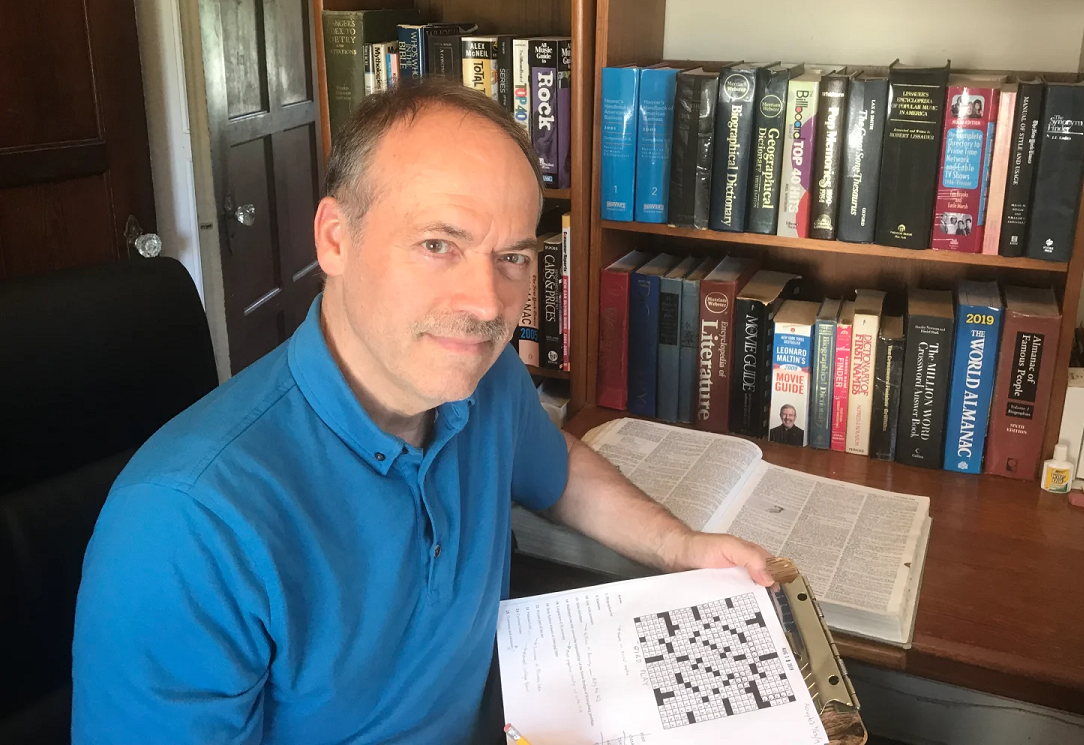
This is wonderful news, as Will had to step back from his editing work in February to attend to his recovery.
For those who were unaware, Will suffered a stroke that affected his mobility — he offered details on both the stroke and his recovery to Brain & Life magazine — but he is back to editing and playing table tennis.
From the NYT article:
In addition to completing hours of physical therapy and rehab, Will slowly returned to puzzle making and editing throughout the year. He directed the American Crossword Puzzle Tournament, returned as the creator of NPR’s Weekend Edition Sunday Puzzle in April and resumed choosing puzzles for The Times in May.
We wish Will all the best in his continued recovery and return to puzzling. I’ve had the pleasure of interacting with Will a number of times — mostly at the ACPT, though I did interview him for the blog years ago — and I’m very glad to hear that he’s well enough to enjoy both of his favorite pastimes again.
Once again being hosted in Stamford, CT, the ACPT is a weekend-long puzzle extravaganza of solving, puzzle-themed events, fun, and community.
This year’s tournament runs from April 4th through the 6th, and you can click here for more details (and to register for this year’s event, should the spirit move you).
Are you planning on competing this year? Let us know in the comments below! We’d love to hear from you.
Our last bit of crossword news was brought to our attention by friend-of-the-blog DGhandcrafted.
There is a crisscross grid featured on the site for the entire month of January, and the numbered answers correspond to what’s on sale that particular day!
There’s even a chance to win a bonus prize if you solve the entire puzzle early!
It’s a pretty clever way to bring solvers and crafters back to the site throughout the month, and hopefully it’s a success for both the customers and Lima Beads.
Your grid entries need to be interesting, yet accessible. You need to navigate long crossings and tight corners without resorting to too many abbreviations, too much crosswordese, or creating the dreaded Natick, a crossing of two obscure entries. Some solvers don’t like partial phrases, others don’t like proper names or brand names.
Your cluing has to be clever but not impenetrable. How much wordplay is too much? How many fill-in-the-blank clues before your clue section resembles your grid? The cluing must be fresh and vibrant yet timeless and not too of-its-era to make the cut for reprint and collection later.
No matter how you clue it, older solvers may decry newer names, slang, terminology, or pop culture references, while younger solvers will bemoan not just older references they consider passe, but long-established crossword-friendly words they quickly tire of seeing.
And that’s all without considering the difficulty in creating engaging, interesting themes or gimmicks for the puzzle.
That question of fresh entries and cluing vs. older/more familiar fare is a curious one. It raises further questions.
For instance, how much can you talk about what’s going on in the world?
By referring to unpleasant topics, however topical, will you alienate solvers who use the crossword as an escape? Or do you risk the puzzle feeling too sanitized and safe by NOT acknowledging the circumstances of the world at the time of the puzzle’s publication?
There are arguments for both sides. I mean, who wants to see ADOLF in a grid? (But then again, it’s not like IDI AMIN has a hard time finding his way into grid fill.)
Margaret Farrar believed that crosswords should avoid “death, disease, war and taxes.” Purposely avoiding unpleasant fill and cluing is informally known as the “Sunday Morning Breakfast Test.” (Our friends at Penny Press know plenty about this, as they shy away from unpleasant entries with diligence.)
But on the flip side, to ignore the unpleasantness of the world potentially ignores the people that unpleasantness affects.
As we continue to push for greater representation in crosswords in both editorial staff and constructors, you cannot deny that including the experiences of women, people of color, and members of the LGBTQIA+ community somewhat necessitates facing those unpleasant aspects of our history and our society.
To exclude them is to exclude potentially thought-provoking and important fill and cluing. (One could easily argue that the vast majority of our own Eyes Open crosswords would not pass the Sunday Morning Breakfast Test.)
Not everyone greets adding new cultural fill with open arms, of course. A few years ago, an LA Times crossword solver complained to us (on our holiday gift guide post, of all places) about “ignorant ghetto language” in the crossword. He referred specifically to innocuous entries like “sup,” “did,” and “street cred.”
Thankfully, he is an outlier.
But on the topic of excluding words from crosswords, when Will Shortz was asked about it, he had an interesting response:
If a word or term is used in the columns of The Times, or in cultured society in general, I think it’s probably O.K. for a crossword, even if it’s touchy or slightly unpleasant. I strive to have crosswords reflect real life as much as possible. … I don’t believe in banning words, except for the very worst. And I’d be happy to abolish the term ‘breakfast test’ completely.
I think this is a topic I’m going to ask crossword solvers about more often. I’d be curious to see where they stand on crossword content and topicality.
I suspect opinions will vary, but I also suspect that most solvers welcome new fill, new entries, and new references in clues. Every crossword is an opportunity to learn and expand one’s knowledge, and add to the mental lexicon of crossword knowledge we each build as we solve.
So where do you stand, fellow puzzlers? Do you prefer your crosswords as an escape or as a puzzly reflection of the world around us? Let us know in the comments section below! We’d love to hear from you.








 PuzzCulture