It’s Follow-Up Friday: More UK Puzzles edition!

Welcome to Follow-Up Friday!

By this time, you know the drill. Follow-Up Friday is a chance for us to revisit the subjects of previous posts and bring the PuzzleNation audience up to speed on all things puzzly.

And today, I’m returning to the subject of big international puzzle events!

A few weeks ago, the UK Puzzle Association hosted the 2016 UK Sudoku Championship. And this weekend, they’ve got another major puzzle event in store for puzzlers worldwide: The 2016 UK Puzzle Championship!

The event spans June 24 through June 27, and chairman Alan O’Donnell of the UK Puzzle Association sent out the Instruction Booklet for this year’s event a few days ago, continuing a string of major puzzle events in Europe and across the world.

Although the UK Puzzle Championship is only open to competitors from the UK — with the top two earning a place on the UK team for the 2016 World Puzzle Championship — international players are welcome to test their puzzly mettle as guest solvers.

But even if most PuzzleNationers aren’t eligible to compete, you can still enjoy the challenge of some topnotch puzzles. Let’s take a look at some of the diabolical puzzles they’ve cooked up for this year’s event!

This Banknotes puzzle sets the tone for much of the Instruction Booklet to come, offering a number-placement puzzle with clues outside the grid. In this case, you have different valued 3×1 “banknotes” to place in the grid, and their total values add up to the numbers outside a given row or column.

So this is a bit like the game Battleship, except with different valued ships instead of different sized ones.

Here we have a more traditional Fill-In puzzle, but with an nontraditional grid shape. This one is all about efficient word placement.

Instead of placing words into this grid, the Cloud puzzle asks you to fill in which squares are covered by “clouds,” based on the total number of cloud-covered cells given on the outside of the grid. This is essentially a small Logic Art puzzle.

This Hidoku turns the usual Sudoku-solving on its ear by requiring you to place the numbers 1 through 25 into the following grid so that they form an unbroken chain. Consecutive numbers must touch, either horizontally, vertically, or diagonally.

For fans of Penny Dell Puzzles, this is like Sudoku and Word Maze had a diabolical little baby.

[I left the solution in with this one to help illustrate the solving style.]

Hashi is an intriguing deduction puzzle that follows the same cluing mentality as Blackout! or Minesweeper. Each circle contains a number indicating how many “bridges” connect that “island” to the other islands either vertical or horizontal to that island.

You’re essentially building your own Word Trails puzzle with Hashi, except you’re using numbers instead of the letters in a famous saying.

This is probably my favorite of the puzzles I’ve encountered in this Instruction Booklet, and I’m definitely looking forward to solving it this weekend.


These puzzles are just a sampling of the numerous puzzles you’ll tackle if you accept the UK Puzzle Championship challenge.

Not only are Kakuro and Sum-Doku (or Killer Sudoku) included, but also other twists on classic solving styles like Fill-Ins, Deduction puzzles, and Logic Problems.

You can check out the full Instruction Booklet here, and remember, you’ll have two and a half hours to solve as many of the 29 puzzles in the packet as possible, so good luck on June 24!


Thanks for visiting PuzzleNation Blog today! Be sure to sign up for our newsletter to stay up-to-date on everything PuzzleNation!

You can also share your pictures with us on Instagram, friend us on Facebook, check us out on Twitter, Pinterest, and Tumblr, and explore the always-expanding library of PuzzleNation apps and games on our website!

The UK Sudoku Championship: The Aftermath

This weekend, I sat down at my desk with a few sharpened pencils and a copy of the UK Sudoku Championship puzzles, ready to pit my puzzly skills against sixteen Sudoku and Sudoku variant puzzles.

According to UK Puzzle Association rules, I had two hours to complete as many puzzles as I could.

And let me tell you, my fellow puzzlers and PuzzleNationers, I don’t think I could have completed this entire packet in twice that time. The UK must feature some seriously impressive and speedy Sudoku solvers.

[If only I could puzzle with both hands like this brilliant youngster.
Image courtesy of Deccan Herald.]

Now, I’m by no means a weak Sudoku solver — deduction puzzles don’t faze me — but I’m not a fast Sudoku solver, so I knew the two-hour time limit was, at best, a pipe dream. Nonetheless, I set my timer, determined to give it my all.

The packet opened with a Linked 6×6 Sudoku, which was a pleasant starter. The two grids complemented each other nicely, and only needing the numbers one through six once per 2×3 box kept the solve quick.

That was not the case for puzzle #2, a Deficit Sudoku. In the Linked 6×6, you knew that the 2×3 boxes within the grid would contain the numbers one through six, which made it easy. In the Deficit Sudoku, the 2×3 boxes contained six numbers, but the options were numbers one through seven, so that certainly that came with puzzle #1 vanished instantly.

The Deficit Sudoku was certainly hard, and given that those two puzzles were only page one, my progress thus far didn’t bode well for the rest of the championship experience.

[A sample Deficit Sudoku.]

Puzzle #3 ratcheted up the difficulty with a Surplus Sudoku, one that featured boxes of eight squares in various shapes. Each box featured the numbers 1 through 7, plus one of the numbers again. If the design was to overwhelm the solver with possibilities, mission accomplished!

After laboring over the puzzle for a good twenty minutes or so, I had to move on without completing it. This would become a recurring theme in this puzzle packet.

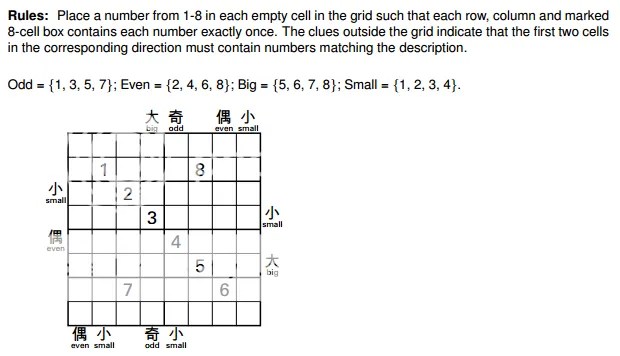
Puzzle #4 was the elaboratedly named Odd-Even-Big-Small Sudoku, and although I got farther with this one than the Surplus Sudoku, I also had to bow out and move on after hitting the wall. This was page 2 of the championship, and it was a brutal step-up in challenge from page 1.

[A Sudoku loaded with numbers and adjectives.]

Puzzle #5 was a Classic Sudoku, obviously designed to restore a solver’s confidence after the one-two punch of Surplus Sudoku and Odd-Even-Big-Small Sudoku, and I knocked it out quickly. Huzzah! Back on track!

Puzzle #6 was also a Classic Sudoku, but one with desperately few set numbers. The upper-right 3×3 box and the lower-left 3×3 had NONE, and the upper-left 3×3 box and the lower-right 3×3 box only had two apiece.

Although I was able to fill the body of the grid quickly, those four corners had me stymied. For the third time in just over an hour, I put a puzzle aside unfinished.

That lack of set numbers was a recurring theme in the championship packet, making Puzzle #7 (a diagonal Sudoku) and Puzzle #8 (a Jigsaw Sudoku), much tougher solves than I expected. By this point, I put aside the timed aspect of the solve entirely (my two hours was nearly up, and I’d been interrupted a few times anyway), and just focused on doing my best to complete as many puzzles as possible.

This was about puzzly pride at this point. *laughs*

The next four puzzles — an Extra Regions Sudoku (where the shaded-in areas also contained the numbers 1 through 9), a Sum-Doku (or Killer Sudoku) with no set numbers, a Consecutive Pairs Sudoku with only eight set numbers, and an Odd Sudoku (with the shaded boxes requiring odd numbers only) — I’d categorize as tough, but fair.

I can see how a championship packet like this would separately the very good solvers from the truly great.

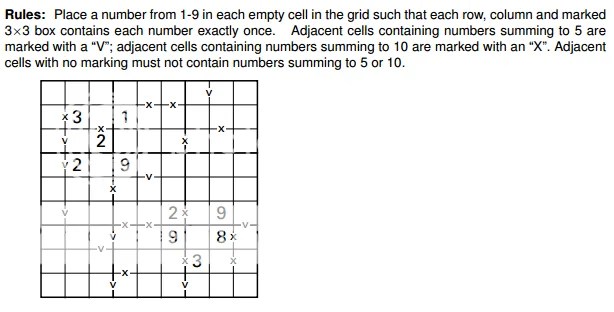
[A diabolical XV Sudoku.]

That was clearly the goal of puzzles #13 and #14. A Thermo Sudoku with only nine set numbers taxed me to my limit, and the XV Sudoku that followed was the hardest puzzle in the entire set. Admittedly, I was a little burnt out at this point, but it remains the toughest Sudoku puzzle I’ve ever attempted.

The final two puzzles, a Palindrome Sudoku and an Eliminate Sudoku, felt like a cakewalk compared to the gauntlet of challenging puzzles that preceded them. It was nice to close out my solving experience strong, nearly four hours into the challenge.

I fully intend to go back and take another crack at all the puzzles that bested me, but for now, I need a little break from these devious little grids.

Kudos to everyone who tackled the UK Sudoku Championship, and to some of the world-class contenders I saw on the final results board, I tip my hat to you all. The top nine finished all 16 with perfect scores in under an hour and a half! That is a blistering speed!

I may not have what it takes to be a UK Sudoku Champion, but I’m glad I accepted the challenge. It was a satisfying, intriguing, and occasionally humbling way to pass a few hours.

You can give the 2016 UK Sudoku Championship puzzles a shot yourself by clicking here. Good luck!


Thanks for visiting PuzzleNation Blog today! Be sure to sign up for our newsletter to stay up-to-date on everything PuzzleNation!

You can also share your pictures with us on Instagram, friend us on Facebook, check us out on Twitter, Pinterest, and Tumblr, and explore the always-expanding library of PuzzleNation apps and games on our website!

The UK Sudoku Championship! (Or should that be Sudo-UK?)

Hot on the heels of The Indie 500 crossword tournament last weekend, the UK is also gearing up for a major puzzle event: The UK Sudoku Championship!

The event spans June 10 through June 13, and chairman Alan O’Donnell of the UK Puzzle Association sent out the Instruction Booklet for this year’s event a few days ago, which kicks off a string of major puzzle events in Europe and across the world, including the UK Puzzle Championship in a few weeks.

Although the UK Sudoku Championship is only open to competitors from the UK — with the top two earning a place on the UK team for the 2016 World Sudoku Championship — international players are welcome to test their puzzly mettle as guest solvers.

But even if most PuzzleNationers aren’t eligible to compete, you can still enjoy the challenge of some topnotch Sudoku puzzles. Let’s take a look at some of the diabolical puzzles they’ve cooked up for this year’s event!

[An Extra Regions puzzle, a variation on Classic Sudoku.]

In addition to some Classic Sudoku, Extreme Sudoku, Sum-Doku (or Killer Sudoku), Jigsaw Sudoku (or Geometric Sudoku), and Thermo Sudoku — all of which I explored in detail in my Wide World of Sudoku post — there are some variants I’ve never seen before, like this Linked 6×6 Sudoku.

In this puzzle, you have two grids to complete, but with the additional wrinkle that no number placed in the left 6×6 grid will occupy the same square in the right 6×6 grid. So you have more solving information than expected, but it’s spread out across two grids.

This Deficit Sudoku puzzle also uses the 2×3 box format, but arrayed in a 7×7 grid. This means that any of the numbers 1 through 7 can be in each 2×3 grid, which makes it slightly harder than if you were only using the numbers 1 through 6.

(Plus you have no information on what number goes in that solo square in the center of the grid.)

The curiously named Odd-Even-Big-Small Sudoku employs clues outside the grid to help you fill in some of the squares along the perimeter of the grid, telling you that two odd numbers, two even numbers, two small numbers, or two big numbers will occupy the nearest two spaces in that row or column.

This is a solving mechanic I’ve never encountered before in Sudoku, and I can see it posing an impressive challenge to the average Sudoku solver.

That unconventional style of cluing sets the tone for the rest of the unusual puzzles that competitors and solvers will encounter here. In the above grid, a Consecutive Pairs puzzle, those dots indicate that the neighboring numbers connected by those dots are consecutive numbers, like 5 and 6 or 2 and 1.

(You can also try Consecutive Pairs Sudoku in Will Shortz’s Sudoku and Sudoku Spectacular, both published by our friends at Penny Dell Puzzles.)

XV Sudoku works in similar fashion, with x’s and v’s instead of those little dots. The x’s mean the neighboring numbers add up to 10, and the v’s mean the neighboring numbers add up to 5.

This Eliminate Sudoku uses arrows to indicate that the number in the arrow box will not be repeated in any of the boxes that follow that arrow. So, for instance, if you place a 3 in that arrow box next to the 2 in the upper-right 3×3 grid, none of the boxes that arrow points at along that diagonal will contain a 3.

Like the dual grids in the Linked 6×6 Sudoku, this puzzle is interesting in offering more information on what’s NOT in a square than what IS.

The final new puzzle in the Instruction Booklet is my favorite, but that’s because I’m a sucker for palindromes in puzzles. This Palindrome Sudoku features gray lines that indicates spots where — you guessed it! — the chain of numbers reads the same backwards and forwards.

Similar to Thermo Sudoku in its solving style, Palindrome Sudoku takes advantage in the restrictive nature of Sudoku solving by adding a neat little twist.

You can check out the full Instruction Booklet here, and remember to keep your eyes peeled on June 10 when the actual puzzles go live!


Thanks for visiting PuzzleNation Blog today! Be sure to sign up for our newsletter to stay up-to-date on everything PuzzleNation!

You can also share your pictures with us on Instagram, friend us on Facebook, check us out on Twitter, Pinterest, and Tumblr, and explore the always-expanding library of PuzzleNation apps and games on our website!

The end of Sudoku?

I recently read in Owen O’Shea’s book The Call of the Primes that there are 5,472,730,538 unique solutions for a 9×9 Sudoku grid.

Yes, five billion is a very big number, but these days, billions aren’t what they used to be. I mean, think about how many newspapers, magazines, and puzzle books feature Sudoku puzzles. It’s a huge amount of material every year.

So, the thought occurs to me…how long before those 5,472,730,538 unique solutions run out?

To be fair, it’s not like reaching Peak Oil or a point of no return. I’ve solved a lot of Sudoku puzzles, and never once have I felt like I was re-solving a grid I’ve seen before, even if I was. This is purely a matter of mathematical curiosity. How long would it take for us to use up every last possible 9×9 grid?

Man, where do I begin?

Well, if I’m going to talk Sudoku puzzles, it makes sense to start with our friends at Penny Dell Puzzles.

Across seventeen Sudoku titles, they publish approximately 23,236 Sudoku puzzles a year, and probably an additional 350 per year across their Crossword/Variety and Variety titles for a total of 23,586 puzzles in a calendar year.

Now, Penny Dell Puzzles is the top puzzle publisher in North America — #humblebrag — and let’s assume there are another half-dozen publishers worldwide matching their output. That gives us a ballpark of 165,100 Sudoku puzzles published worldwide.

But what about newspapers?

According to the Newspaper Association of America, there were 1,331 daily newspapers in 2014, and there were 1,450 daily newspapers in 2005, making an 8.2% decrease from a decade before. If we apply that percentage to the number of daily newspapers worldwide as of 2005, 6,580 titles, we get 6,040 daily newspapers worldwide. And although they may not ALL have a daily Sudoku, this will help cover some of the major magazines that also carry Sudoku that I’ve excluded from my ballpark calculations.

That gives us 6,040 newspapers x 365 puzzles a year for a total of 2,204,600 puzzles a year.

Now, for other publishing efforts regarding Sudoku, Amazon.com lists 20,718 results for Sudoku, and if we apply an average of 217 puzzles per title — which seems a fair approximation, based on the stats published by our friends at Penny Dell Puzzles, the fact that some books will have more puzzles, and some results will be ABOUT Sudoku and probably contain few to none actual puzzles — that’s 4,495,806 puzzles available right now in the world’s biggest bookstore. (Yes, obviously not all of them were published this year, but hey, this is meatball mathematics.)

Unfortunately, statistics on Sudoku are sketchy at best for the mobile app market, online puzzling, and downloadable puzzles through Playstation Network, Wii, and other gaming platforms, so I can’t factor those puzzles into my calculations.

But just with the numbers I’ve got here, we’re talking about 6,865,506 Sudoku puzzles worldwide. So, if each of those Sudoku puzzles is unique — which is possible, if unlikely — that barely makes a dent in our total of possible Sudoku grid layouts, which you recall is 5,472,730,538.

So, if we’re producing 6,865,506 unique Sudoku puzzles a year, it’ll take nearly 800 years to use every possible 9×9 grid! (For the folks at Penny Dell Puzzles, it would take nearly 232,033 years! So they’re in the clear. *laughs*)

I guess we won’t be running out anytime soon.


Thanks for visiting PuzzleNation Blog today! Be sure to sign up for our newsletter to stay up-to-date on everything PuzzleNation!

You can also share your pictures with us on Instagram, friend us on Facebook, check us out on Twitter, Pinterest, and Tumblr, and explore the always-expanding library of PuzzleNation apps and games on our website!

Other puzzles you might not know! (Volume 3)

In previous editions of this series, we’ve presented some new puzzles for crossword devotees and Fill-In fans to try out. Today, let’s turn our attention to Sudoku enthusiasts.

Now, before we talk about other types of puzzles, there are numerous Sudoku variants to choose from, if you’d like just a little twist on the familiar Sudoku formula. In fact, I did an entire blog post about them, as well as posts about new variants like Will Sudoku and Pentdoku Puzzles!

There are a few lesser-known number-placement puzzles out there that might scratch your puzzly itch if you’re a Sudoku fan: Futoshiki and Beehive Hidato.

[Futoshiki image courtesy of PuzzleMagazine.com.]

Futoshiki will seem fairly familiar, since the row and column rules of Sudoku are in effect. But you have an additional placement rule to consider: the less than/greater than signs in the grid, which indicate where to place lower or higher numbers in the grid. (Futoshiki translates to “not equal” in Japanese.)

[Hidato image courtesy of TheGuardian.com.]

Beehive Hidato eschews the traditional Sudoku row/column system of the deduction in favor of chain-placement of numbers in its hexagonal grid. Your goal is to fill every cell in the grid by filling in the missing numbers between 1 and the highest number. So, instead of placing the same numbers in every row and column, you’re placing a different number in each cell, forming a single chain from 1 to the last number.

The cell containing the number 1 must neighbor the cell containing the number 2, and the cell containing the number 2 must neighbor the cell containing the number 3, and so on, all the way around the grid.

If you’re looking to go a little farther afield and leave numbers behind, I’ve got you covered.

After all, some people tend to think of Sudoku as a math puzzle, but it’s really not; it’s more of a deduction and placement puzzle. You could check out not only Fill-Ins, but also all the puzzles I’ve previously recommended for Fill-In fans. That’s a great place to start.

You could also try your hand at Brick by Brick.

[Click here or on the grid for a larger version.]

Brick by Brick puzzles are a terrific bridge between placement puzzles and crosswords, using aspects of both. You’re given the complete first row of a crossword, and all of your clues, both across and down.

But, instead of the black squares you’d normally rely on to help guide you through answering those clues and placing your words, you’ve got 3×2 bricks filled with letters and black squares, a scrambled jigsaw puzzle to reassemble.

Here you can use your deductive Sudoku skills to place black squares and entire bricks into the grid as you apply crossword-solving skills toward answering the across and down clues, working back and forth between the two to complete your grid, assembling chunks of answer words as bricks fit neatly together.

And if you prefer quote puzzles to crossword puzzles, there’s always Quotefalls.

[Click here or on the grid for a full page of Quotefalls.]

Quotefalls gives you all of the letters in a given quote, plus the black squares that separate each word from the next. But it’s up to you to figure out where in each column to place the letters above so that the quotation reads out correctly.

Sometimes that’s easy, like in the fourth column of puzzle 2 above. Since there’s three black squares and only one open square, you know exactly where that E will go. Seedling letters like that can go a long way toward helping you fill each word, and eventually, the entire quote.

It’s a different form of deduction, but one not too terribly far from the number-placement solving of Sudoku.

Any one of these puzzles could add some welcome variety to your puzzle solving, while still honoring the style and play inherent in your favorite puzzle. Give them a shot, and let us know how you like them.


Next time, we’ll be tackling recommendations for Cryptogram fans, but if you’ve got puzzle recs for your fellow puzzlers in the meantime, please let us know in the comments!

Thanks for visiting PuzzleNation Blog today! Be sure to sign up for our newsletter to stay up-to-date on everything PuzzleNation!

You can also share your pictures with us on Instagram, friend us on Facebook, check us out on Twitter, Pinterest, and Tumblr, and explore the always-expanding library of PuzzleNation apps and games on our website!

It’s Follow-Up Friday: West Wing Wordplay edition!

Welcome to Follow-Up Friday!

By this time, you know the drill. Follow-Up Friday is a chance for us to revisit the subjects of previous posts and bring the PuzzleNation audience up to speed on all things puzzly.

And today, I’m posting the results of our #PennyDellPresidentPuzzles hashtag game!

You may be familiar with the board game Schmovie, hashtag games on Twitter, or @midnight’s Hashtag Wars segment on Comedy Central.

For much of 2015, we collaborated on puzzle-themed hashtag games with our pals at Penny Dell Puzzles, and we’re doing the same in 2016 (after a one-month hiatus to recharge our brains)!

We’re starting off with this month’s hook in honor of Presidents’ Day: Penny Dell President Puzzles! We’re mashing up Penny Dell puzzles and anything and everything having to do with the presidents, vice presidents, their campaigns, their accomplishments, whatever you can think of that’s puzzly and presidential!

Examples include: Baracks and Mortar, John Missing Tylers, and Crosswording the Delaware!

So, without further ado, check out what the puzzlers at PuzzleNation and Penny Dell Puzzles came up with!


Herbert Guess Hoover

Fore ‘n’ Taft / William How Many Triangles Taft

Dwight David Eisenhowmanytriangles?

Lucky Clover Cleveland

Millard Fill-Inmore

Franklin Pierce by Pierce / Franklin Piece by Piece

Tricky Dick Tock Word Seek

Ches-ter Games

Abraham Linkwords / Lincolnwords / Frame Lincolns / The Rail Split and Splicer / Honest ABC’s

Cartergories

Woodrow Boxes / Woodrows Garden Wilson

John Quincy Anagrams

Grant Tour

Loose Tyler

All Ford One

George “Dubya” Trouble Bush / George “Dubya” Crosser Bush

Dick Chain Words

Word Spiral Agnew

“Four Square and seven years ago…” / Four-Most and Seven-Up ago . . .

#SimonSaysVote

Mystery State of the Union

Secret Message Service

Feds and Tails / Heads & Tails to the Chief

Little Know Ye Who’s Calling? –or– Little Know Ye Who’s Coming and Going

Secretary of the Mystery State

Secretary of the Treasure Hunt

Quotefall of Berlin Wall

North American Free “Trade-Off” Agreement

Freedom of the (Penny) Press!

Tippecanoe and Tyler Two at a Time / Tippecanoe and Two by Two / Tippecanoe and Tiles, too.

Don’t Trade/Swap Horses in the Middle of the Road

Guess Who’s Calling But Hoover?

A Chicken in Everything’s Relative

Give ‘Em Sudoku, Harry!

In Your Heart, You Know He’s Right of Way!

In Your Guts, You Know the Odds Nuts!

A Leader, for a Change of Scene!

Putting People First and Last!

People Fighting Throwbacks

Oath of Trade-Office

Air Force One & Only

Inaugural Bowl Game

First and Last Lady

Democrat 6’s and 7’s

Presidential Medal of Foursomes

“I am not a Bookworms.”

“The only thing we have to fear is Here & There.”

“Ask not what your Mystery Country can do for You Know the Odds . . .”

Heal. Inspire. Ramble.

“I’m gonna Build-A-Quote and Mexico will pay for it.”


Have you come up with any Penny Dell President Puzzles of your own? Let us know! We’d love to see them!

Thanks for visiting PuzzleNation Blog today! Be sure to sign up for our newsletter to stay up-to-date on everything PuzzleNation!

You can also share your pictures with us on Instagram, friend us on Facebook, check us out on Twitter, Pinterest, and Tumblr, and explore the always-expanding library of PuzzleNation apps and games on our website!