A New Dimension of Puzzles

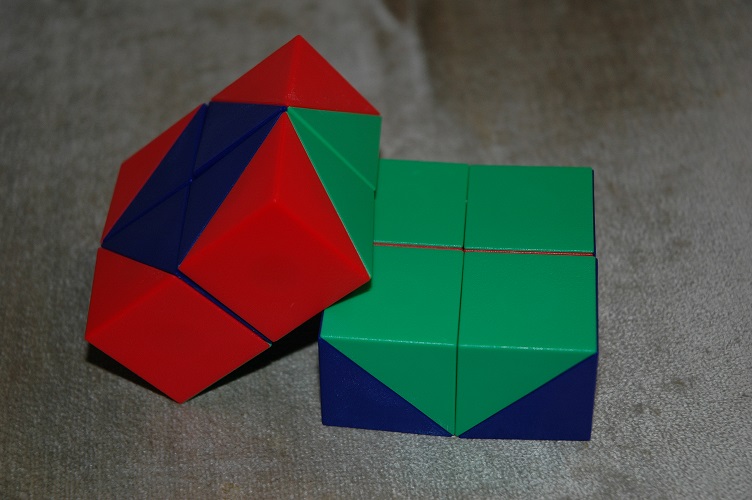
[A 3-D printed puzzle from Instructables.com.]

3-D printing is the next big technological leap forward, and although the technology is only a few years old, it’s already responsible for some amazing advances.

You may have seen the story in the news recently that NASA “emailed” a new wrench to the International Space Station. For the first time, plans originating on Earth were sent electronically to the ISS and built in a 3-D printer, giving an astronaut the specific tool he needed while saving literally thousands upon thousands of dollars. That’s mind-blowing.

Every day, new stories are emerging from the medical field about the benefits of 3-D printing. A close friend of mine recently had brain surgery, and they used a 3-D printer to manufacture a new piece of skull specifically for her. That is a phenomenal thing.

And puzzles aren’t immune to the march of progress. Enterprising designers are creating new puzzles with increasing complexity, allowing them to build on existing models and add previously impossible variations and details into their designs.

I’ve previously featured the specialized twenty-sided die created by the folks at 64 Oz. Games, which were made with 3-D printers and feature braille renderings beneath every number.

One of the fastest growing fields in 3-D printed puzzles is known colloquially as the twisty puzzle, the numerous variations, expansions, and extrapolations from the Rubik’s Cube twisting/turning style of puzzles.

Check out this article about George Miller and Oskar van Deventer, who are pushing the envelope of twisty puzzles with some ingenious designs.

Meticulously designed and realized through 3-D printing, these puzzles have set world records — one is a 17x17x17 Rubik’s Cube with over 1,500 parts! — and taken twisty puzzles to unexpected places.

As 3-D printers become more affordable and more puzzlers embrace the technology, there’s no telling where puzzles will go next. But I cannot wait to find out.

Thanks for visiting PuzzleNation Blog today! You can share your pictures with us on Instagram, friend us on Facebook, check us out on TwitterPinterest, and Tumblr, and be sure to check out the growing library of PuzzleNation apps and games!

PuzzleNation Looks Back at 2014!

The year is quickly coming to a close, and as I look back on the past twelve months, I’m both proud of everything we at PuzzleNation accomplished and optimistic for the year ahead of us.

It’s been both a pleasure and a privilege to explore the world of puzzles and games with you, my fellow puzzle lovers and PuzzleNationers. I’m closing in on my 300th blog post, and I’m even more excited to write for you now than I was when I started.

Over the last year, we explored dice games and tile games, apps and pen-and-paper puzzles. We met designers, constructors, and creative types of all kinds. We cracked brain teasers and tackled mind-bending riddles.

We explored the different roles puzzles have played throughout history, from codebreaking during the American Revolution and the Civil War to Galileo’s anagrams and a Pope who crafted puzzles for the local paper.

We celebrated International TableTop Day, Star Wars Day, the 40th anniversary of the Rubik’s Cube, the 30th anniversary of Tetris, and the 75th anniversary of Batman, and we were happy to share so many remarkable puzzly landmark moments with you.

We spread the word about numerous worthwhile Kickstarters and Indiegogo campaigns, and along the way, we supported some fantastic causes, like saving a puzzle/game shop in Washington and donating to a campaign to adapt games for colorblind and visually-impaired puzzle/game fans.

And that’s just the blog. PuzzleNation’s good fortune and accomplishments in 2014 went well beyond that.

In February, we launched the Penny/Dell Jumbo Crossword App, our most successful puzzle app to date. In March, we launched Classic Sudoku for the iPad, and in May, we added Classic Word Search for the iPad.

With numerous new puzzle sets (including two launched in December!), we have proudly maintained a steady stream of topnotch puzzle content for our solvers, and we’ve got plenty more on the way in 2015.

Not only that, but in September we relaunched our website, gearing it entirely to providing you with the best mobile puzzle gaming experience around.

And your response has been terrific! We also amassed over a thousand followers for the blog and over 1600 followers of the PuzzleNation Facebook page in 2014, numbers that are both humbling and encouraging.

2014 was our most productive, most exciting, and most creatively fulfilling year to date, and 2015 promises to be even brighter.

Thank you for your enthusiasm, your support, and your feedback, PuzzleNationers. Have a fantastic New Year. We’ll see you in 2015!

Thanks for visiting PuzzleNation Blog today! You can share your pictures with us on Instagram, friend us on Facebook, check us out on TwitterPinterest, and Tumblr, and be sure to check out the growing library of PuzzleNation apps and games!

Puzzles from the Last Frontier

No matter where you go, you’re bound to find some form of puzzle, whether it’s a riddle, a mechanical puzzle, a pen-and-paper puzzle, or a strategy game. For me, that’s one of the most interesting aspects of puzzle culture: the curious wrinkles and variations on puzzles that a particular place or national identity inspires.

While on vacation in Alaska last week, I found a few examples of puzzles with a wonderful Alaskan twist, and I thought I’d share them with the PuzzleNation audience.

One of the first things I noticed is that many Alaskan museums and wildlife centers employ puzzles to teach visitors about Alaska’s diverse ecosystem.

The Alaska Sealife Center was a particular favorite of mine. Located in Seward (only a few hours from Anchorage by train or car), the Sealife Center not only incorporated games to explain different fishing techniques (and the dangers of overfishing), but the gift shop was a treasure trove of puzzle books with a decidedly educational bent.

Clueless in Alaska caught my eye with its mix of visual and classic pen-and-paper puzzles, all geared toward instilling greater understanding of the animals Alaska is famous for.

Of course, I encountered crosswords and Sudoku puzzles in the local paper, but I was on the lookout for something with a bit more local flair.

And wouldn’t you know it, I discovered the perfect souvenir at the local Fred Meyer:

An Alaska-themed Rubik’s Cube, featuring both a unique color scheme and silhouettes of bears, caribou, eagles, moose, and wolves. With the 40th anniversary of the Rubik’s Cube this year, how could I not pick this up?

But classic board game fans, don’t feel left out! Turns out, the most famous board game of all time also has its own Alaskan variant:

Alaska-Opoly! It might be hard to pronounce, but it’s overflowing with local color and style.

As a puzzle fan, spotting these little beauties made me feel right at home, even four thousand miles away.

Thanks for visiting PuzzleNation Blog today! You can share your pictures with us on Instagram, friend us on Facebook, check us out on TwitterPinterest, and Tumblr, and be sure to check out the growing library of PuzzleNation apps and games!

Twist and shout…

Invented in 1974, the Rubik’s Cube is probably the most famous puzzle toy in history. For four decades now, it has been an instantly recognizable symbol of one’s puzzly ambition. Whether you’ve mastered it or you have it sitting on a corner of your desk mid-solve, it shouts to the heavens “a puzzler resides here.”

Originally known as the Magic Cube or the Hungarian Magic Cube, the Rubik’s Cube is tied up with some truly staggering numbers. Hundreds of millions of Rubik’s Cubes have been sold, and that’s just a drop in the bucket compared the number of possible patterns you can make with the cube. According to Rubiks.com, there are 43 quintillion ways to scramble a Rubik’s Cube. (That’s 34 with eighteen zeroes after it.)

And yet, some truly tiny numbers are also associated with the tiny, sometimes frustrating puzzle cube. For instance, 6. The top speed cubers — people who compete in speed cubing competitions, complete with special techniques, lubricating oils for their cubes, and cubes designed especially for speed solving — have solved a Rubik’s Cube in under 6 seconds!

(10 years ago, the World Record time for solving a Rubik’s Cube was more than three times that, at 20.00 seconds. And I haven’t even mentioned the people who somehow manage to solve them blindfolded.)

It’s become a universal part of the pop culture lexicon. (I’ve featured Rubik’s Cube Halloween costumes here in the past.) There is even Rubik’s Cube art. Images made from patterns formed with numerous Rubik’s Cubes.

It boggles the mind.

Now available in 2×2, 4×4, and 5×5 permutations in addition to the classic 3×3 cube, plus speed cubes, customizable cubes, and other variants, this twisty, beguiling puzzle shows no signs of slipping in popularity anytime soon. (I have an Australian friend who collects different kinds of Rubik’s Cubes, including ones with different pictures, different shapes, keychains, and so on.)

“Solve a Rubik’s Cube” is actually on my bucket list. If I ever manage it, you’ll be the first to know, fellow solvers.

Thanks for visiting PuzzleNation Blog today! You can share your pictures with us on Instagram, friend us on Facebook, check us out on TwitterPinterest, and Tumblr, and be sure to check out the growing library of PuzzleNation apps and games!

PuzzleNation Product Reviews: Collide-O-Cube and Rudenko’s Disk

The folks at Brainwright specialize in puzzles intended for younger solvers, but with enough challenge and style to keep older solvers busy as well. From curiously cut jigsaws to color-based deduction puzzles, they take classic puzzle concepts and add their own curious spin to create new puzzle experiences.

They offered us the chance to try out two of their puzzles for the younger puzzling set, and we put them to the full PuzzleNation Blog test.

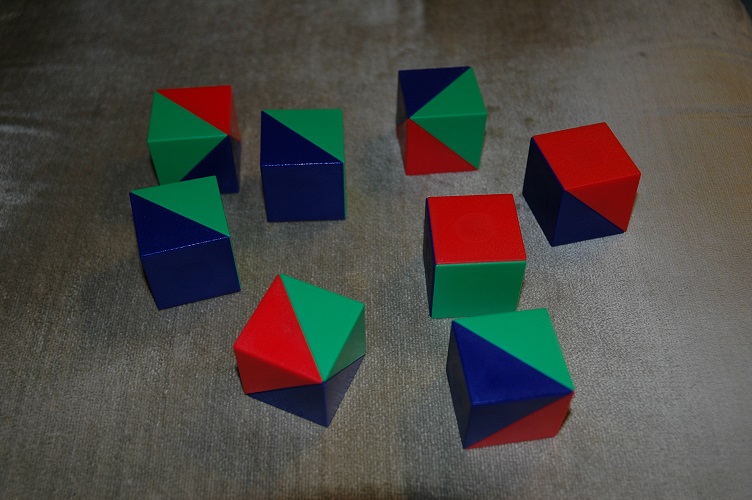
Collide-O-Cube looks simple — after all, it’s just eight identical multicolored blocks — but plenty of great puzzles appear simple, yet offer seemingly endless variation and challenges the more you tinker with them.

You see, the eight Collide-O-Cube blocks aren’t quite identical. Each one contains a unique pattern of magnets inside that offers another level to the solving process as you try to recreate the several dozen cube patterns in the challenge booklet included. This makes for a curious solving experience that combines pattern recognition, deduction, and patience as you play around with blocks until the solution snaps into place.

Although designed for kids ages 8 and up, adults will certainly enjoy fiddling with Collide-O-Cube, and I suspect kids will spend as much time creating their own puzzly patterns and shapes with the blocks as they will solving the various cube puzzles.

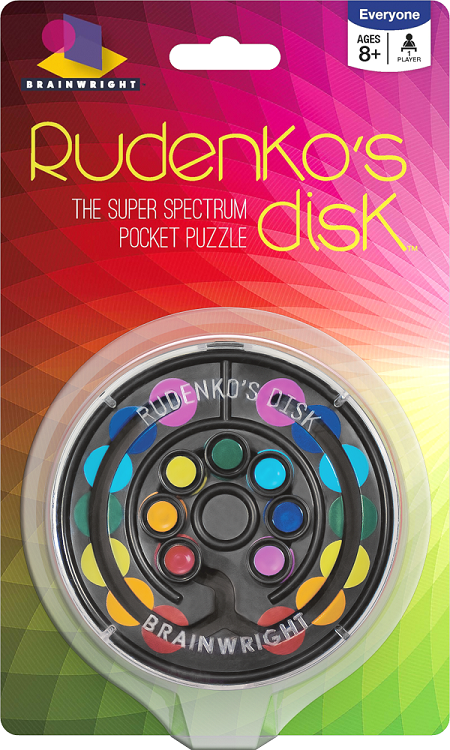
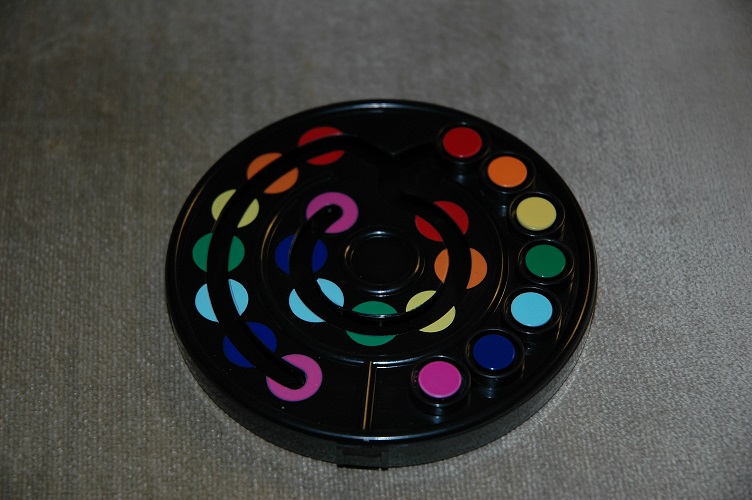
Rudenko’s Disk, on the other hand, is more in the vein of a sliding tile game; a marvelous, colorful, self-contained version of the classic Tower of Hanoi puzzle, Rudenko’s Disk challenges the solver to move various colored posts along the track in order to recreate the color pattern along the side of the disk.

Again, this seems simple enough, but Rudenko’s Disk includes a crafty wrinkle to the solving process: each colored post clicks into place when in a spot with a matching color.

So, for instance, the orange post can only go as far to the left, right, or center as the orange circle, and no further. You can’t place the orange post on the yellow, the green, the blues, or the purple. But you can place the dark blue post on any circle between dark blue and red. (Only the purple is off-limits for the dark blue post.) A strategic chain-solving puzzle lurks within the simple sliding mechanic.

Rudenko’s Disk could be a little off-putting or frustrating for the youngest solvers among us — similar to another color-based puzzle of some renown, Rubik’s Cube, but not nearly as daunting.

These are two intriguing examples of color-based puzzles, but they’re very different solving experiences. Collide-O-Cube’s hidden magnets add a delightful bit of unexpected randomness and chaos to what would otherwise be a simple pattern-matching game — making for a puzzle that encourages fiddling around the blocks in open play — while Rudenko’s Disk’s rigid mechanics require solvers to be a bit more tactical.

But both puzzles are immensely satisfying when the solution clicks into place.

I think Brainwright‘s formula of familiar puzzles with new touches and complications is a recipe for continued success and puzzly fun.

Thanks for visiting PuzzleNation Blog today! You can share your pictures with us on Instagram, friend us on Facebook, check us out on TwitterPinterest, and Tumblr, and be sure to check out the growing library of PuzzleNation apps and games!

We interrupt your regularly scheduled post for something wonderful…

I originally had our latest session of 5 Questions scheduled for today, but yesterday I stumbled upon a marvelous, time-sensitive story, and I really wanted to share it with the PuzzleNation audience, because it exemplifies the very best of the puzzly gaming community.

In last week’s Follow-Up Friday post, I briefly discussed Joe Michael MacDonald’s marvelous version of Qwirkle designed for colorblind players. And lo and behold, here is a Kickstarter campaign with even loftier goals.

The folks at 64 Oz. Games are in the final hours of a project called Board Games: Now Blind Accessible, wherein they produce specialty sleeves and other modifications for established board games and card games, allowing visually impaired players to play alongside their sighted pals.

Not only have they developed a touch-based game called Yoink! that is based on tactile gameplay, but a combination of Braille and clever use of QR codes has opened up games like Munchkin, King of Tokyo, and numerous roleplaying games to a previously excluded audience.

This inclusive spirit is brilliantly typical of the puzzle and game communities, since so many members — both designers and players/solvers — want nothing more than to share their love of games with the world.

And numerous board game, card game, and puzzle game companies are supporting the endeavor. Not only the folks at Cheapass Games, but also companies like Rio Grande Games, 9th Level, Living Worlds, and (hilariously, considering their reputation) Cards Against Humanity. (You can check out the full list of companies here.)

It’s an absolutely wonderful idea, and although there are only a few hours left to donate to this very worthy cause, I’m overjoyed to say that they’ve raised more than double their hoped-for campaign total!

This is Kickstarter and the puzzle and game communities at their best, and I’m glad I discovered it in time to share it with my fellow puzzlers.

Thanks for visiting PuzzleNation Blog today! You can share your pictures with us on Instagram, friend us on Facebook, check us out on TwitterPinterest, and Tumblr, and be sure to check out the growing library of PuzzleNation apps and games!