Riddles, Riddles Everywhere!

I’ve had riddles on the brain recently, because I keep seeing them everywhere. Over the last few weeks, they’ve popped up in games, TV shows, books, and even emails to the blog.

It all started with our twice-monthly office D&D game. Every other Thursday, a group of us commandeers one of the conference rooms at lunchtime and enjoys an hour of dice-fueled storytelling, adventure, and fun.

As is often the case with a fantasy-inspired game, there was a river to cross and a riddle to answer in order to pass.

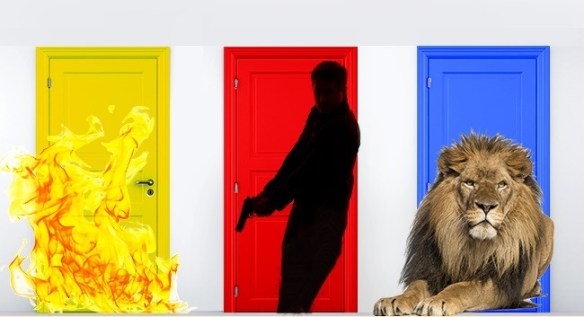
A murderer is condemned to death. He has to choose between three rooms. The first is full of raging fires, the second is full of assassins with loaded guns, and the third is full of lions that haven’t eaten in a year. Which room is safest for him?

This is a classic riddle, usually titled “Three Doors” or “The Murderer’s Riddle.”
lionriddle-1

And when you’ve got a team of puzzle solvers in your D&D group, this riddle is no challenge at all.

(If you’re curious about the solution, you pick door #3. After a year of not eating, the lions would be dead, so it would be safe to enter that room.)

Later on in the game, we again had to barter passage across a body of water, either answering a riddle or battling a demon to the death.

Naturally, we chose the riddle.

What is the creature that walks on four legs in the morning, two legs at noon and three in the evening?

This is another classic riddle — the Riddle of the Sphinx, most famously solved by Oedipus — and posed no challenge to our merry band of misfit adventurers.

(If you don’t know this one, the answer is “man,” since you walk on four legs as a child, aka crawling, two legs as an adult, and with a cane when you’re older. The day — morning, noon, and evening — represents a lifetime.)

We crossed the lake, and our adventure continued, and I thought I was done with riddles for a bit.

Then a few days later, I got caught up on the latest season of MTV’s The Challenge, a reality/competition game show. (I’ve written about some of their puzzly challenges in the past.)

And, wouldn’t you know it, this week’s challenge involved a riddle.

wotwriddle3

Both teams would start on this platform, sending pairs of swimmers out on a long swim to retrieve keys. Those four keys would then open both a chest full of letter tiles and a riddle to be solved. The first team to solve the riddle with the letters available would win the challenge.

Once all the drama of selecting partners — given that many of the players weren’t strong swimmers, and the slowest-swimming team would be eliminated from the game — there was plenty of tension to be had.

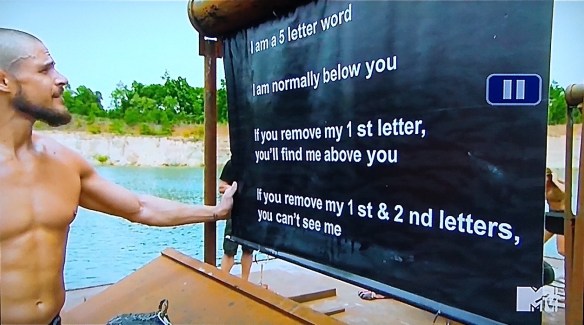
But finally, all four keys were retrieved by the teams, and the riddle revealed:
wotwriddle1

I am a 5 letter word.

I am normally below you.

If you remove my 1st letter, you’ll find me above you.

If you remove my 1st and 2nd letters, you can’t see me.

The teams were initially baffled, playing around with different words and various combinations of letter tiles in the hopes that it would spark something.

wotwriddle2

Eventually, competitor Ashley came up with a three-letter word that you couldn’t see — AIR — and her team quickly came up with the correct answer: CHAIR.

(A chair is normally below you, hair is above you (sorta), and air can’t be seen.)

So, three riddles in a matter of days. It’s officially a pattern. And so far, I’m three for three on solving these riddles.

A week or so later, though, yet another riddle arrived, this time by email. And I admit, I’m a little stumped.

What has a bell but isn’t a church. Is full of air but is not a balloon?

What do you think, fellow puzzlers and PuzzleNationers? Any ideas? Let me know in the comments section below. I have a few theories, but nothing that feels like a conclusive answer.


Thanks for visiting PuzzleNation Blog today! Be sure to sign up for our newsletter to stay up-to-date on everything PuzzleNation!

You can also share your pictures with us on Instagram, friend us on Facebook, check us out on TwitterPinterest, and Tumblr, and explore the always-expanding library of PuzzleNation apps and games on our website!
How to Get Started in Cryptic Crosswords

cryptic3

[Image courtesy of Amazon. The Times Cryptic Crossword Book.]

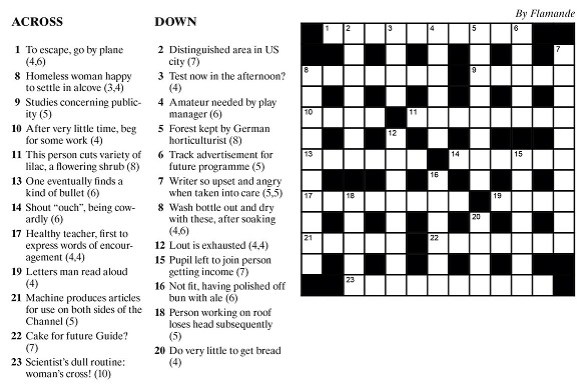
On Twitter yesterday, Oliver Roeder from FiveThirtyEight asked, “If one wanted to learn/practice solving cryptic crosswords, with what puzzles should one begin?”

Most of the replies mentioned different cryptic crossword outlets to try out, like The Nation, Harper’s Magazine, and The UK Times Quick Cryptic Crossword Book. The Nation in particular was recommended as a good starter cryptic.

Monthly offerings from constructors like Andrew Ries and Cox & Rathvon were also mentioned, though I would add Patrick Berry’s Son of the Crypt cryptic collection to the list of suggestions. (I would normally also recommend The Guardian because of their great cryptics, but they’re pretty tough, particularly for beginners.)

This, of course, presumes that Roeder meant which cryptic puzzles one should start with.

cryptic

[Image courtesy of The New European.]

It occurred to me that he might be asking what OTHER puzzles are good for beefing up your cryptic crossword solving game.

Given the different kinds of clues used in cryptic crosswords, I have a few suggestions.

1. Anagram puzzle

Anagrams are a staple of cryptic cluing, and any puzzler looking to get into cryptics should have some facility with them. There are plenty of ways to practice — the Jumble, Anagram Magic Square and other puzzles from our friends at Penny Dell Puzzles, and even Bananagrams, Words with Friends, or Scrabble will help build your anagram skills.

2. Rebus

Rebus puzzles are all about adding and subtracting letters to form words or phrases, and there’s plenty of that in cryptic cluing. This is a good way to get used to breaking down longer words into abbreviations, anagrams, and so on in order to puzzle out the answer to a cryptic clue.

3. Brain teaser/riddle

Many cryptic clues rely on words with multiple meanings, as well as words that serve as both instructions and hints. Brain teasers and riddles employ similar wordplay, and they can help you develop a proclivity for looking at words from a new point of view.

cryptic2

[Image courtesy of Eastern Daily Press.]

Of course, if you want help learning to decipher the many variations on cryptic crossword cluing that you’ll encounter, there are some great resources out there.

Penny Dell Puzzles has a PDF containing examples of the most common cluing tricks, and you can bolster that with similar insights from Wikipedia and The Nation.

If you’re looking for deeper dives into all sorts of cryptic cluing, my one-stop shop for insight is The Guardian’s crossword blog. They offer regular features breaking down various kinds of cryptic clues.

In the last few weeks alone, they’ve covered cycling clues, “stuttering” in clues, and how the points of the compass can be used in cluing, and there are dozens of similarly illuminating posts in their archive.

It’s a terrific resource for newbie cryptic solvers and established puzzlers alike.

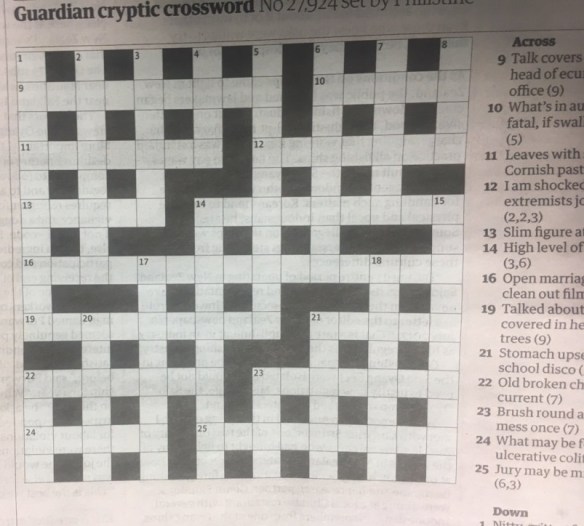
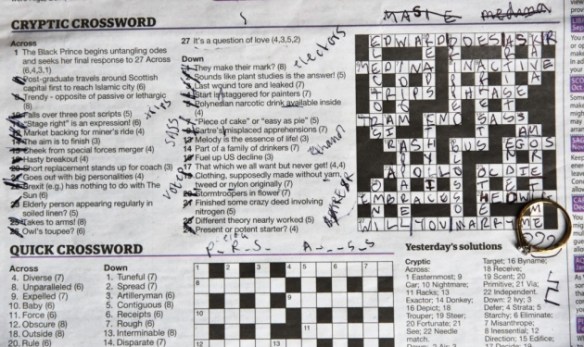
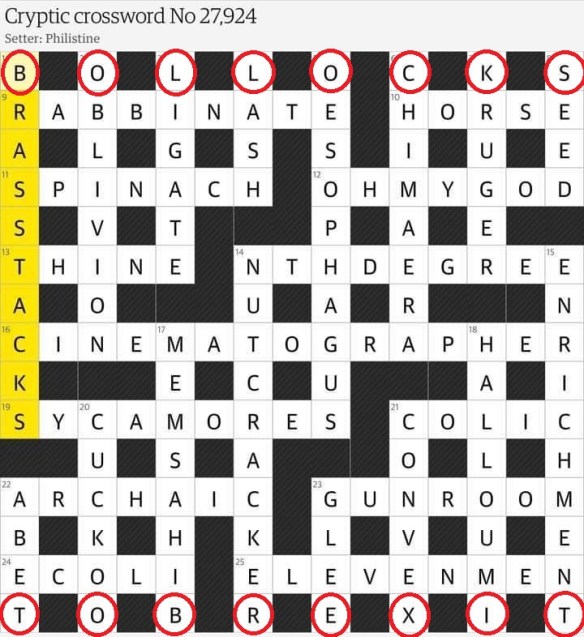
And it’s worth getting into cryptic crosswords, if only for the occasional subversive little Easter egg like this one from yesterday’s The Guardian cryptic:

brexit

Did I miss any resources or outlets for great cryptic crosswords? Let me know in the comments section below! I’d love to hear from you!


Thanks for visiting PuzzleNation Blog today! Be sure to sign up for our newsletter to stay up-to-date on everything PuzzleNation!

You can also share your pictures with us on Instagram, friend us on Facebook, check us out on TwitterPinterest, and Tumblr, and explore the always-expanding library of PuzzleNation apps and games on our website!
Brain Teaser Week: Answers Edition!

Did you enjoy Brain Teaser Week, fellow puzzlers and PuzzleNationers? We certainly hope so! It was a fun experiment in dedicating an entire week to a particular type of puzzle.

We gave you three puzzles to challenge your deductive, mathematical, and puzzly skills, and now it’s time to break them down and explain them.


Tuesday’s Puzzle:

A set of football games is to be organized in a “round-robin” fashion, i.e., every participating team plays a match against every other team once and only once.

If 105 matches in total are played, how many teams participated?

If every team plays every other team once, you can easily begin charting the matches and keeping count. With 2 teams (Team A and Team B), there’s 1 match: AB. With 3 teams (A, B, and C), there are 3 matches: AB, AC, BC. With 4 teams (A, B, C, and D), there are 6 matches: AB, AC, AD, BC, BD, CD. With 5 teams (A, B, C, D, and E), there are 10 matches: AB, AC, AD, AE, BC, BD, BE, CD, CE, DE.

Now, we could continue onward, writing out all the matches until we reach 105, but if you notice, a pattern is forming. With every team added, the number of potential matches increases by one.

With one team, 0 matches. With two teams, 1 match. With three teams, 2 more matches (making 3). With four teams, 3 more matches (making 6). With five teams, 4 more matches (making 10).

So, following that pattern, 6 teams gives us 15, 7 teams gives us 21, and so on. A little simple addition tells us that 15 teams equals 105 matches.


Thursday’s Puzzle:

You want to send a valuable object to a friend securely. You have a box which can be fitted with multiple locks, and you have several locks and their corresponding keys. However, your friend does not have any keys to your locks, and if you send a key in an unlocked box, the key could be copied en route.

How can you and your friend send the object securely?

(Here’s the simplest answer we could come up with. You may very well have come up with alternatives.)

The trick is to remember that you’re not the only one who can put locks on this box.

Put the valuable object into the box, secure it with one of your locks, and send the box to your friend.

Next, have your friend attach one of his own locks and return it. When you receive it again, remove your lock and send it back. Now your friend can unlock his own lock and retrieve the object.

Voila!


Friday’s Puzzle:

The owner of a winery recently passed away. In his will, he left 21 barrels to his three sons. Seven of them are filled with wine, seven are half full, and seven are empty.

However, the wine and barrels must be split so that each son has the same number of full barrels, the same number of half-full barrels, and the same number of empty barrels.

Note that there are no measuring devices handy. How can the barrels and wine be evenly divided?

For starters, you know your end goal here: You need each set of barrels to be evenly divisible by 3 for everything to work out. And you have 21 barrels, which is divisible by 3. So you just need to move the wine around so make a pattern where each grouping (full, half-full, and empty) is also divisible by 3.

Here’s what you start with:

  • 7 full barrels
  • 7 half-full barrels
  • 7 empty barrels

Pour one of the half-full barrels into another half-full barrel. That gives you:

  • 8 full barrels
  • 5 half-full barrels
  • 8 empty barrels

If you notice, the full and empty barrels increase by one as the half-full barrels decrease by two. (Naturally, the total number of barrels doesn’t change.)

So let’s do it again. Pour one of the half-full barrels into another half-full barrel. That gives you:

  • 9 full barrels
  • 3 half-full barrels
  • 9 empty barrels

And each of those numbers is divisible by 3! Now, each son gets three full barrels, one half-full barrel, and three empty barrels.


How did you do, fellow puzzlers? Did you enjoy Brain Teaser Week? If you did, let us know and we’ll try again with another puzzle genre!

Thanks for visiting PuzzleNation Blog today! Be sure to sign up for our newsletter to stay up-to-date on everything PuzzleNation!

You can also share your pictures with us on Instagram, friend us on Facebook, check us out on TwitterPinterest, and Tumblr, and explore the always-expanding library of PuzzleNation apps and games on our website!
The Conclusion of Brain Teaser Week!

It’s the third and final day of our celebration of all things brain-teasing, riddling, and word-tricky, and we’ve got one last devious challenge lined up for you.

Remember! On Tuesday, Thursday, and Friday of this week, a different brain teaser or word problem will be posted, and it’s up to you to unravel them. Contact us with the correct answer — either here on the blog through the comments, or on Twitter, Facebook, or Instagram through our messages — and you’ll be entered into a pool to win a prize!

And yes, you can enter more than once! Heck, if you solve Tuesday, Thursday, AND Friday’s puzzles, that’s three chances to win!

Let’s get started, shall we?


Here’s today’s brain teaser, which mixes the math of Tuesday’s puzzle with the deductive reasoning of Thursday’s puzzle:

The owner of a winery recently passed away. In his will, he left 21 barrels to his three sons. Seven of them are filled with wine, seven are half full, and seven are empty.

However, the wine and barrels must be split so that each son has the same number of full barrels, the same number of half-full barrels, and the same number of empty barrels.

Note that there are no measuring devices handy. How can the barrels and wine be evenly divided?


Good luck, fellow puzzlers! We’ll see you Tuesday with answers for all three brain teasers!

Thanks for visiting PuzzleNation Blog today! Be sure to sign up for our newsletter to stay up-to-date on everything PuzzleNation!

You can also share your pictures with us on Instagram, friend us on Facebook, check us out on TwitterPinterest, and Tumblr, and explore the always-expanding library of PuzzleNation apps and games on our website!
Brain Teaser Week Continues!

It’s Day 2 of our celebration of all things mind-tickling, and we’ve got another diabolical challenge lined up for you.

Remember! On Tuesday, Thursday, and Friday of this week, a different brain teaser or word problem will be posted, and it’s up to you to unravel them. Contact us with the correct answer — either here on the blog through the comments, or on Twitter, Facebook, or Instagram through our messages — and you’ll be entered into a pool to win a prize!

And yes, you can enter more than once! Heck, if you solve Tuesday, Thursday, AND Friday’s puzzles, that’s three chances to win!

Let’s get started, shall we?


Here’s today’s brain teaser, which is less mathematical than Tuesday’s and more logical or deductive:

You want to send a valuable object to a friend securely. You have a box which can be fitted with multiple locks, and you have several locks and their corresponding keys. However, your friend does not have any keys to your locks, and if you send a key in an unlocked box, the key could be copied en route.

How can you and your friend send the object securely?


Good luck, fellow puzzlers! We’ll see you Friday with our next brain teaser!

Thanks for visiting PuzzleNation Blog today! Be sure to sign up for our newsletter to stay up-to-date on everything PuzzleNation!

You can also share your pictures with us on Instagram, friend us on Facebook, check us out on TwitterPinterest, and Tumblr, and explore the always-expanding library of PuzzleNation apps and games on our website!

Welcome to Brain Teaser Week!

[Image courtesy of Bogoreducare.org.]

Hello puzzlers and PuzzleNationers!

This week I thought I would try something different and focus on a theme for the week’s posts, rather than posting about different topics on our usual days.

So, please join me in some puzzly challenges as we celebrate Brain Teasers Week here at PuzzleNation Blog.

On Tuesday, Thursday, and Friday of this week, a different brain teaser or word problem will be posted, and it’s up to you to unravel them. Contact us with the correct answer — either here on the blog through the comments, or on Twitter, Facebook, or Instagram through our messages, and you’ll be entered into a pool to win a prize!

And yes, you can enter more than once! Heck, if you solve Tuesday, Thursday, AND Friday’s puzzles, that’s three chances to win!

Let’s get started, shall we?


Here’s today’s brain teaser:

A set of football games is to be organized in a “round-robin” fashion, i.e., every participating team plays a match against every other team once and only once.

If 105 matches in total are played, how many teams participated?


Good luck, fellow puzzlers! We’ll see you Thursday with our next brain teaser!

Thanks for visiting PuzzleNation Blog today! Be sure to sign up for our newsletter to stay up-to-date on everything PuzzleNation!

You can also share your pictures with us on Instagram, friend us on Facebook, check us out on TwitterPinterest, and Tumblr, and explore the always-expanding library of PuzzleNation apps and games on our website!