The Boswords 2020 Fall Themeless League Has Come to a Close!

boswords new

After two months of delightful weekly solving, the Boswords 2020 Fall Themeless League has come to a close.

If you’re unfamiliar, the Boswords 2020 Fall Themeless League was a clever weekly spin on traditional crossword tournament-style solving. Instead of cracking through a number of puzzles in a single day (or two), the Fall Themeless League consisted of one themeless crossword each week, scored based on your accuracy and how fast you complete the grid.

Each week’s puzzle only had one grid, but there were three sets of clues, each representing a different difficulty level for solvers. Smooth was the least challenging, Choppy was the middle ground, and Stormy was the most challenging. (When solvers registered to participate, they chose the difficulty level that suited them best.)

Hundreds of solvers signed up for the challenge of two months of themeless puzzle solving and a bit of friendly competition, and now that it’s over, I’d like to share a few thoughts about my experience in the League.
questions-banner-860x280

I confess, I was skeptical about entering the league. No, it didn’t have anything to do with the puzzles themselves. I knew the constructing team was top-notch, and with John Lieb, Andrew Kingsley, and Brad Wilber running things, I knew the competitors were in excellent hands.

I simply don’t solve themeless puzzles that often. In fact, this tournament probably marks the most themeless puzzles I’ve ever solved in this short an amount of time. They’re simply not part of my usual solving rotation, save for championship themeless puzzles in various tournament packets, and the occasional puzzle here and there (like Doug Peterson and Patti Varol’s Friday NYT themeless last week, congrats on your debut, Patti!).

But I really enjoyed seeing what creative constructors could do with crosswords once freed from the shackles of a theme. The long, crossing entries can certainly be intimidating at the start — especially if you read three or four clues in a row and feel like your brain has gone blank — but the sheer inventiveness of the entries you get to see, often stacked close together, is really cool.
exercise-brain-crossword-670x335

And, like a jigsaw puzzle, the solving experience sneaks up on you. You get a few words here, a few letters there, and suddenly everything starts to fall into place. Clues that eluded you make total sense on a second or third reading, or the now-obvious wordplay punches you in the face.

Eventually, you’re left with a full grid and a real sense of accomplishment. (Not to mention a growing sense of wonder that the constructor managed to make all those crossings work.)

This tournament showed me how much I’d been missing by not solving themeless crosswords more often.

And with the promise of future Boswords-hosted events in 2021 like the Winter Wondersolve and the Spring Themeless League to come, it’s nice to have exciting puzzle events to look forward to in the near future.

I ended up placing 85th out of 400 or so competitors, which I am pretty pleased with! And now I’ll try to do better in the next one. It’s always good to have goals.

Kudos to everyone who helped bring this marvelous project together, and kudos to everyone who participated. It was a blast.


Thanks for visiting PuzzleNation Blog today! Be sure to sign up for our newsletter to stay up-to-date on everything PuzzleNation!

You can also share your pictures with us on Instagram, friend us on Facebook, check us out on TwitterPinterest, and Tumblr, and explore the always-expanding library of PuzzleNation apps and games on our website!
Answer to our Thanksgiving Logic Puzzle!

Last week, we celebrated Thanksgiving with a social distance-themed logic puzzle in honor of this time of year and the peculiar circumstances of 2020.

So let’s take a look at how to untangle this puzzle and sort things out so everyone enjoys the holiday, shall we?


First, a quick reminder about the puzzle, so the clues are fresh in our minds (and you have one last chance to solve it before we walk you through the solution).

On a curious Thanksgiving in 2020, five housemates were social distancing, each engaged in different activities throughout the day. (One was streaming Hulu.)

Each housemate (including Brian) wore a different outfit — one was wearing a tank top and shorts — and was doing their activity at a different time that day (1 PM, 2 PM, 2:30 PM, 3 PM, or 3:30 PM).

From the information provided, can you determine what time each housemate did which activity, as well as what outfit they were wearing?

1. The person doing Zoom trivia did so earlier than Alex but later than the one who wore a t-shirt and jeans.

2. Luke’s activity was earlier in the day than Denise’s, but later than that of the person who wore a Christmas sweater and pants.

3. Alex (who was wearing a Pokemon onesie) had her activity earlier than the person texting Grandma but later than Denise.

4. The person playing Among Us did so later than the person Facetiming their Mom, but earlier than the one wearing pajamas (who did their activity earlier than Adam).


Okay, first things first, let’s organize the information we have.

  • There are five housemates: Adam, Alex, Brian, Denise, Luke.
  • There are five activities: Facetiming Mom, playing Among Us, streaming Hulu, texting Grandma, doing Zoom trivia.
  • There are five outfits: Christmas sweater/pants, Pajamas, Pokemon onesie, Tanktop/shorts, T-shirt/jeans.

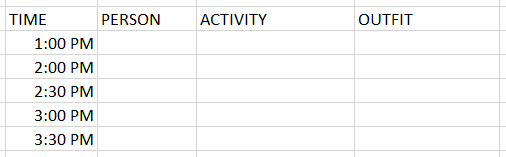
Since many of the clues reference who or what happened earlier or later than other events, it makes sense to use the times as our anchor points, so our starting grid should look like this:

turkey logic 1

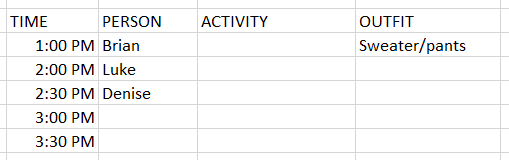
And we can immediately mark down who did the activity at 1 PM. In clue 1, the person doing Zoom trivia did their activity earlier than Alex, so Alex wasn’t the person at 1 PM. Clue 2 tells us that both Luke and Denise had someone doing activities before them, so it couldn’t be them at 1 PM. And Clue 4 tells us that the person in pajamas did their activity before Adam, so he couldn’t be the 1 PM person either. That leaves Brian as the 1 PM person.

That information tells us more as well. Alex can’t be the 2 PM person, because Clue 1 says both the Zoom trivia person and the person in t-shirt and jeans did activities before Alex. Denise can’t be the 2 PM person, because Clue 2 says both Luke and the person in the Christmas sweater did activities before Denise. And Adam can’t be the 2 PM person because Clue 4 says that both the person playing Among Us and the person wearing pajamas did activities before Adam. So Luke must be the 2 PM person.

Not only that, but since Luke did his activity after the person in a Christmas sweater and pants, that makes the sweater/pants Brian’s outfit.

We can fill in one person based on time as well. Clue 3 tells us that Alex’s activity was after Denise’s, so Alex can’t be the 2:30 PM person. And Clue 4 tells us that Adam’s activity happened after the person Facetiming Mom, the person playing Among Us, and the person in their pajamas, so Adam can’t be the 2:30 PM person. That leaves Denise as the 2:30 PM person.

So now our chart looks like this:

turkey logic 2

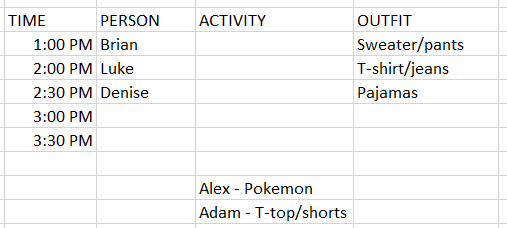
Let’s look at the outfits now. We know from Clue 3 that Alex is wearing the Pokemon onesie, but we’re not sure where to place Alex yet. But we can place the pajamas based on what we know.

In Clue 4, we’re told that the person wearing pajamas has their activity after the person Facetiming Mom and the person playing Among Us, and before Adam. So Adam is out. Alex and Brian are also out, because we know what they’re wearing. And Luke can’t be the person in pajamas, because his activity is second (2 PM) and at least two activities have to be done before the person wearing pajamas. That leaves Denise as the person in pajamas.

That leaves only two outfits unaccounted for: the tanktop/shorts and the t-shirt/jeans. But we can eliminate those as well. In Clue 1 we’re told that the person in t-shirt and jeans does their activity before both the person doing Zoom trivia and Alex. But Adam can’t be that person, because Adam’s activity happens after the person Facetiming Mom, the person playing Among Us, and the person wearing PJs. So Adam is wearing a tanktop and shorts, and Luke is wearing a t-shirt and jeans.

Let’s look at our chart now:

turkey logic 3

As you can see, I’ve added notes below for person/outfit combos we know that we can’t yet place.

But the information above does tell us something else.

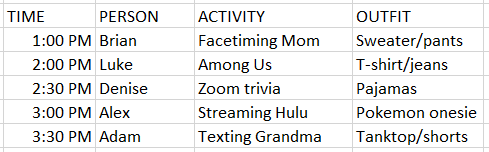
Clue 4 tells us that the person playing Among Us did so later than the person Facetiming Mom, but earlier than the person wearing pajamas. And we know the person wearing pajamas is Denise. So that means Luke is playing Among Us and Brian is Facetiming Mom.

This information also tells us what Alex is doing. Clue 1 tells us Alex is not doing Zoom trivia, and Clue 3 tells us that Alex is not texting Grandma. And since she can’t be playing Among Us or Facetiming Mom, the only remaining option is streaming Hulu.

This same process of elimination can tell us who did the last two activities. We know Denise isn’t playing Among Us, Facetiming Mom, or streaming Hulu. But Clue 3 tells us she wasn’t texting Grandma either, so she must have been doing Zoom trivia.

Which means Adam was the one texting Grandma.

And since Clue 3 tells us that Alex’s activity happened before the person texting Grandma, we can complete our grid:

turkey logic 4

How did you do? Did you manage to unravel this holiday puzzler? Let us know in the comments section below! We’d love to hear from you!


Thanks for visiting PuzzleNation Blog today! Be sure to sign up for our newsletter to stay up-to-date on everything PuzzleNation!

You can also share your pictures with us on Instagram, friend us on Facebook, check us out on TwitterPinterest, and Tumblr, and explore the always-expanding library of PuzzleNation apps and games on our website!
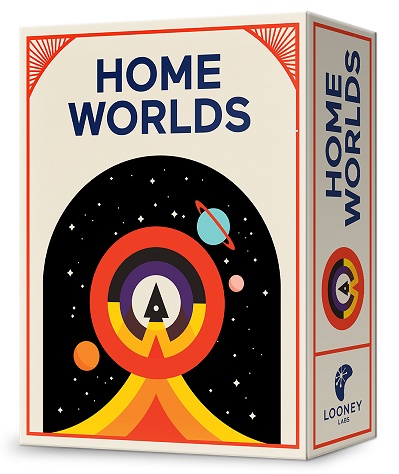
PuzzleNation Product Review: Homeworlds

[Note: I received a free copy of this game in exchange for a fair, unbiased review. Due diligence, full disclosure, and all that.]

One of the coolest moments in a board game player’s life comes when you’re immersed in a game, and someone walks by, stops, and simply must ask, “What is that?” Because you’re showing them something new.

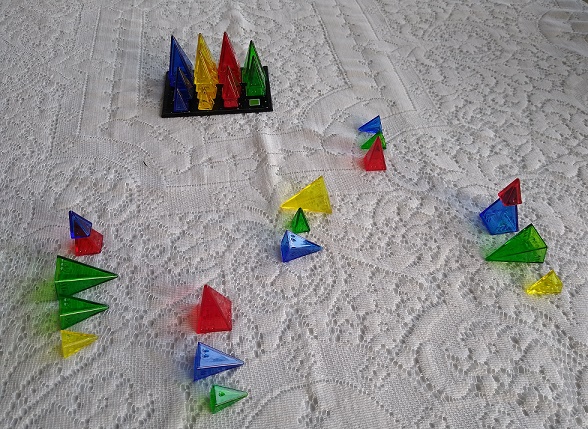
Homeworlds got that reaction the very first time I played it at the office. A coworker walked by, saw what is essentially an array of colorful triangles on the table, and asked the question. They didn’t know what it was, but they were intrigued.

Honest praise doesn’t come much higher than that, does it?

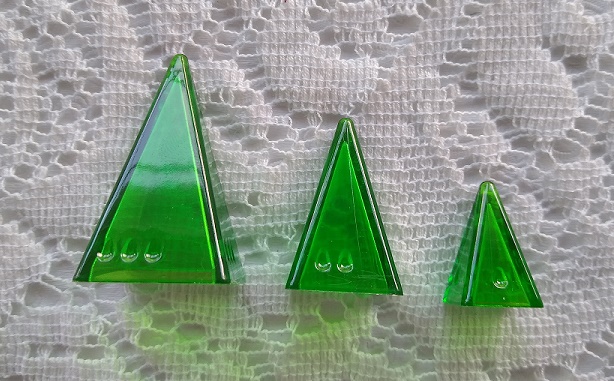
Homeworlds is a difficult game to review, because there’s so much to cover. The rules are expansive and complex, even though the elements are simple. It’s three sets of Looney Pyramids each in four different colors: red, blue, green, and yellow. And yet, it might be the most involved, complicated game we’ve ever reviewed on PN Blog.

And to be fair, we’re going to spend way less time than usual covering the rules. There’s simply too much to explore, and to be frank, throwing a novella of rules at you doesn’t tell you about the game and why it’s worth your time.

So let’s try it a little differently today.

Homeworlds is chess plus Risk set in space. But unlike those games — or basically any strategy games with territory control and resource management elements — which require lots of different pieces and a host of tabletop real estate to enjoy, Homeworlds can easily be toted around and played on any flat surface. And it still manages to encapsulate all the complexity, variety, and tactical planning of those games.

You and your opponent are both playing spacefaring races that are trying to wipe the other player’s influence from the universe. You can do so by eliminating their fleets (through capture or destruction), destroying their Homeworld, or forcing them to leave their Homeworld defenseless.

There are specific rules governing how you build your fleet, how you travel to different star systems, and what you can do when you arrive there. These are all dictated by the colors of the ships in your fleet, which allow you to build new ships, travel, attack, or transform ships (swapping them out for ones with different abilities).

Any pieces not currently in use by the players sit in a communal bank, waiting to be pulled and deployed as either new star systems or new ships. (I love this aspect of the game. It’s like every time you travel to a new star system, you pull that place out of the ether and place it onto the table in front of you. You essentially make each game space you need to use.)

The communal bank adds a third player of sorts to the table, since you must always keep an eye on the bank to not only manage your resources but prevent your opponent from capitalizing on your moves. For instance, you must pull the smallest sized pyramid available for a given color. But size of the pieces does matter. So if you impulsively pull the last small green pyramid, you’ve left the bank open for your opponent to grab a medium or a large pyramid, leaving them with a more powerful ship than you.

Trust me, it’s a lot to take in at once, like the first time you play chess and you’re overwhelmed trying to remember how the little horse-shaped ones move while all the other pieces are doing their own thing. Unless you watch a detailed how-to video, your first few games of Homeworlds are going to be a wash. Because, like chess or Risk, there are important steps you need to take first before you can really get into the game.

But those early learning sessions are still great fun. You slowly drink in all the rules. You figure out choosing your Homeworld can affect the entire scope of the game (by determining how many or how few spaces away your opponent’s homeworld is). You puzzle out devious little tricks like sacrificing one ship in order to take multiple actions, sometimes even undoing that sacrifice in the same term, like you’ve built a perpetual motion machine or found a loophole in the rules.

As the game progresses, what was an overwhelming jumble of complexity becomes an elegantly balanced logic tree of possible options unfolding in front of you.

Catastrophes you might have accidentally caused in earlier games — or studiously avoided in later ones — become tactical moves you intentionally inflict in order to tilt the battle in your favor. Any reader who has sacrificed a piece in chess in order to capture a more important piece from their opponent knows exactly what we mean here.

That fluidity of play, the endless potential to affect the game, makes Homeworlds as exciting and dynamic as possible. In Risk, for example, one country is always the same number of moves from another. But in Homeworlds, an aggressive play can make the trip from your Homeworld to your opponent’s Homeworld perilously quick.

This game will undoubtedly be daunting at first. The instructional booklet alone is two or three times bigger than that of any other Looney Labs game I can think of. But when you get past that, you’ll find a game that is endlessly rich, challenging, and satisfying, one where every new game feels like a positive step forward.

You get to look out at that same eye-catchingly baffling array of colors and shapes that made someone stop and ask you “what is that?” and in an instant, you see moves, countermoves, chances to be taken, and gambits to be foiled.

And that’s pretty cool.

I don’t think there’s another game in the expansive Looney Pyramids library that gets so much out every aspect of the pyramids. The color, size, and arrangement of each is absolutely essential to the gameplay, and choosing the wrong pyramid at the wrong moment could be the difference between victory and defeat.

Homeworlds perfectly captures everything great about strategy games, tosses aside extraneous game boards, tokens, and pieces, and delivers a killer play experience at a fraction of the price.

[Homeworlds is available from Looney Labs and select online vendors for $20, and is part of PuzzleNation’s 2020 Holiday Puzzly Gift Guide, so be sure to check out this game and other offerings from Looney Labs in this year’s edition of the Gift Guide!]


Thanks for visiting PuzzleNation Blog today! Be sure to sign up for our newsletter to stay up-to-date on everything PuzzleNation!

You can also share your pictures with us on Instagram, friend us on Facebook, check us out on TwitterPinterest, and Tumblr, and explore the always-expanding library of PuzzleNation apps and games on our website!
Kickstarter Alert! Check Out Fireball Newsflash Crosswords!

newsflash_header

One of the coolest parts about assembling each year’s Holiday Puzzly Gift Guide is reaching out to crossword constructors I admire and respect. Not only do I get to find out what projects they’ve been working on and would like to promote, but they’re also incredibly giving to fellow constructors, shouting out the subscriptions, puzzle books, and projects that they most enjoyed solving during the year.

The bulk of the puzzle books/subscriptions section of the Gift Guide comes from these constructor interactions and the praise they heap upon each other. Not only is it heartwarming to read, but it’s valuable information for me and the PuzzleNation readership. After all, who better to tell you about great puzzles out there than top-notch constructors who know puzzling inside and out?

There are a host of brilliant recommendations in the Gift Guide, but today I’d like to shout-out one of my favorite yearly puzzle subscriptions. It’s launching on Kickstarter today for a new “season” of topical puzzles, and you should definitely check it out.

It’s Peter Gordon’s 2021 edition of Fireball Newsflash Crosswords.

Now, most crossword solvers probably know Fireball Crosswords by reputation alone. The puzzles are challenging (equivalent to a Friday or Saturday NY Times puzzle), but incredibly fun, inventive, and cleverly clued. Several of my all-time favorite crosswords have been published through Fireball Crosswords.

Fireball Newsflash Crosswords, on the other hand, are not nearly as difficult, so puzzlers who might find traditional Fireball Crosswords daunting can breathe easy.

Plus Fireball Newsflash Crosswords carry their own unique flavor by being as up-to-date and fresh as possible. Each puzzle is absolutely peppered with current references. Important news events, pop culture happenings, celebrity passings, memes, buzzwords, and cultural fads have all appeared in these grids in the past.

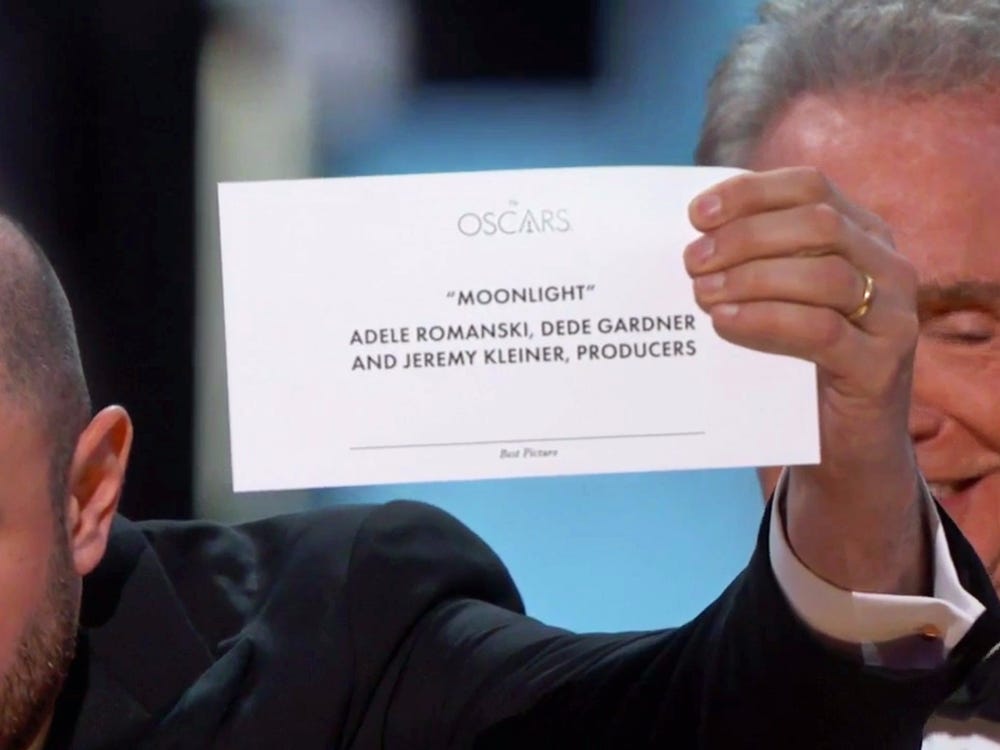
For example, after the 2017 Oscars had their snafu with the Best Picture award winner, Gordon mentioned LA LA LAND as Best Picture winner, then “corrected” himself later in the grid with the true winner MOONLIGHT. It was a lovely little playful jab at an awkward and noteworthy moment in time.

58b445f9c32d6b1c008b4c3f

And that sort of quick-turnaround puzzling and topicality simply cannot be matched by the major outlets.

For just $13, you’ll get 20 such puzzles delivered to you by email, one puzzle every 2 or 3 weeks.

And with this Kickstarter, you can pledge for not just the newest season of Fireball Newsflash Crosswords, but hats, keychains, additional puzzles and puzzle magazines, and more.

I cannot say enough good things about this project, and I’m happy to spread the word to my fellow puzzle lovers. Take a moment and check out this worthwhile project. There are even sample puzzles to try out, so you know exactly what you’re signing up for and supporting.

Good luck, Peter! Cannot wait to see what you cook up for us in the coming year!


Thanks for visiting PuzzleNation Blog today! Be sure to sign up for our newsletter to stay up-to-date on everything PuzzleNation!

You can also share your pictures with us on Instagram, friend us on Facebook, check us out on TwitterPinterest, and Tumblr, and explore the always-expanding library of PuzzleNation apps and games on our website!
Representation in Crosswords: A Fresh Look

Problem-solving-crossword

We live in a data-driven world these days. Everything is quantified, analyzed, charted, and graphed. Your social media use alone is an absolute treasure trove of data that tells businesses all sorts of information about your activities, spending habits, and more.

So it should come as no surprise to you that the world of crosswords is no different. In recent years, we have been able to analyze decades of crosswords like never before, drawing important conclusions and uncovering trends both intriguing and shocking.

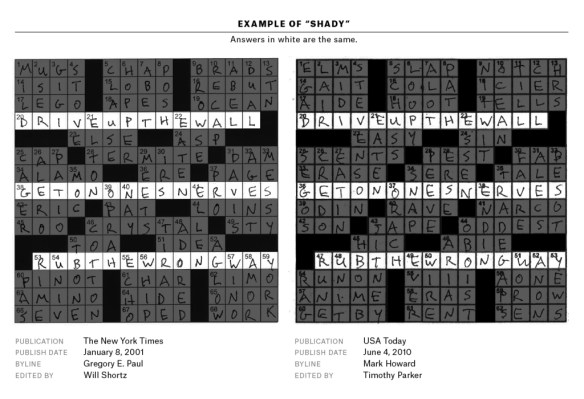
Back in 2016, the data analysis of programmer Saul Pwanson and constructor Ben Tausig uncovered a pattern of unlikely repeated entries in the USA Today and Universal crosswords, both of which were then edited by Timothy Parker. Eventually, more than 65 puzzles were determined to feature “suspicious instances of repetition” with previously published puzzles in the New York Times and other outlets, with hundreds more showing some level of repetition.

crossword-finals-shady

This led to Parker’s removal from both the USA Today and Universal crosswords.

But the impact of data analysis in crosswords doesn’t stop there. In 2018, Erik Agard compiled stats on how often the work of female constructors appeared in the major crossword outlets across the first four months of that year. It was an eye-opening piece about gender disparity among published constructors, backed up by smart research.

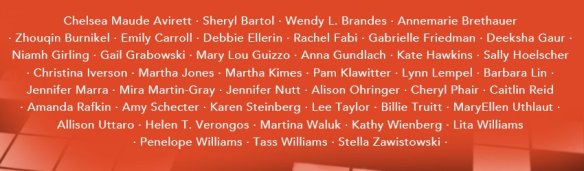
And there has been a greater push for inclusion on the construction side of crosswords. Back in March, at the urging of constructor Rebecca Falcon, several outlets participated in Women’s March, a concentrated effort in the puzzle community to support, foster, and cultivate more minority voices in crosswords.

(It comes as no surprise that two of the voices encouraging female puzzle creators are Erik Agard and David Steinberg, both of whom stepped up massively in the wake of the Timothy Parker scandal and have been advocates for greater inclusiveness in crosswords.)

womensmarch

[The list of all of the female constructors involved in Universal’s Women’s March project.]

This does raise the question, however, of inclusiveness when it comes to cluing and crossword entries.

And that question has been tackled quite brilliantly by Michelle McGhee in an article for The Pudding.

Striving to “better understand who is being referenced in crossword puzzles,” McGhee made a strong point about the influence crosswords have as a reflection on society:

Crosswords tell us something about what we think is worth knowing. A puzzle that subtly promotes the idea that white men are the standard, the people everyone should know about, is a problem for all of us (yes, even the white men).

A less homogenous puzzle would be an opportunity for many solvers to expand their worldviews. But more importantly, if you’re a solver like me, it’s meaningful to see yourself and your experiences in the puzzle, especially if they are often unseen or underappreciated. When I see black women engineers, or powerful athletes, or queer couples centered in a puzzle, it makes me feel seen and significant. It’s a reminder that I can be the standard, not just the deviant.

And she put the data to work to prove her point.

hloq2v535n061

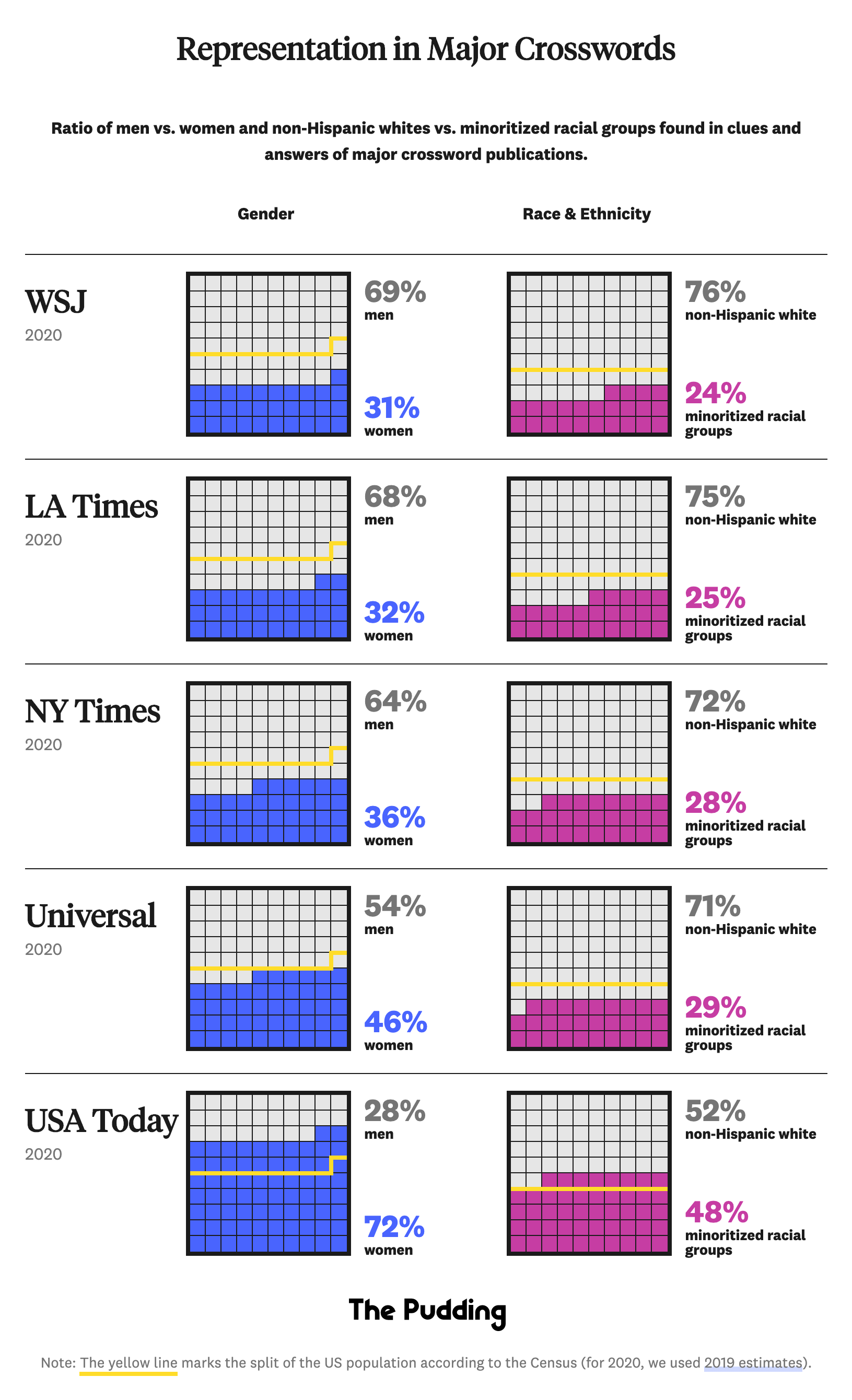
Sampling tens of thousands of crosswords from Saul Pwanson’s puzzle database, she and her fellow researchers sorted people mentioned in crossword clues and used as crossword answers by race and gender according to US Census categories.

And their conclusion, sadly, was hardly unexpected:

We recognize that this is an imperfect method, but it does not change our finding: crossword puzzles are dominated by men of European descent, reserving little space for everyone else.

Not only did they chart the percentages of representation, but they also created charts illustrating the most commonly referenced people in crossword answers in the New York Times puzzle.

The goal? They wanted to quantify the concept of “common knowledge” in crosswords in the hopes of redefining it in a way that better reflects a true common knowledge, one that represents everyone.

I’m only scratching the surface of this article, which is a fascinating exploration of the history of crosswords, what they say about society, and what they COULD say about society. I encourage you wholeheartedly to read McGhee’s full piece here.

It’s the sort of journalism, commentary, and data analysis that helps push a problematic aspect of crosswords into the spotlight and keep it there. Yes, there have been great steps forward for representation in crosswords, both within the puzzles and in the realm of constructors, but we can do better. We must do better.

And work by folks like Michelle McGhee and her graph-savvy data miners is a valuable part of the process.


Thanks for visiting PuzzleNation Blog today! Be sure to sign up for our newsletter to stay up-to-date on everything PuzzleNation!

You can also share your pictures with us on Instagram, friend us on Facebook, check us out on TwitterPinterest, and Tumblr, and explore the always-expanding library of PuzzleNation apps and games on our website!
A Puzzle for Thanksgiving!

Happy Thanksgiving, PuzzleNationers!

Today is a day for celebrating with family and friends (although that’s harder this year), and giving thanks for all the good things in our lives.

We here at PuzzleNation want to thank you, our fellow puzzlers and PuzzleNationers, because you help make PuzzleNation one of the greatest puzzle communities in the world.

And when it comes to saying thanks, a Thanksgiving puzzle seems like the perfect offering. So we’ve cooked up a little Thanksgiving logic puzzle for you to enjoy!

Can you unravel this holiday puzzler?


On a curious Thanksgiving in 2020, five housemates were social distancing, each engaged in different activities throughout the day. (One was streaming Hulu.)

Each housemate (including Brian) wore a different outfit — one was wearing a tank top and shorts — and was doing their activity at a different time that day (1 PM, 2 PM, 2:30 PM, 3 PM, or 3:30 PM).

From the information provided, can you determine what time each housemate did which activity, as well as what outfit they were wearing?

1. The person doing Zoom trivia did so earlier than Alex but later than the one who wore a t-shirt and jeans.

2. Luke’s activity was earlier in the day than Denise’s, but later than that of the person who wore a Christmas sweater and pants.

3. Alex (who was wearing a Pokemon onesie) had her activity earlier than the person texting Grandma but later than Denise.

4. The person playing Among Us did so later than the person Facetiming their Mom, but earlier than the one wearing pajamas (who did their activity earlier than Adam).


Did you unravel this holiday puzzler? Let us know in the comments section below! We’d love to hear from you!

Thanks for visiting PuzzleNation Blog today! Be sure to sign up for our newsletter to stay up-to-date on everything PuzzleNation!

You can also share your pictures with us on Instagram, friend us on Facebook, check us out on TwitterPinterest, and Tumblr, and explore the always-expanding library of PuzzleNation apps and games on our website!