Other times, a major portion of an episode revolves around them. We’ve seen this countless times from shows as diverse as The Simpsons and NCIS: New Orleans.
But I didn’t realize an entire plot for world domination once hinged on a puzzle.
Pinky and the Brain was a spinoff of a recurring series of animated shorts from the show Animaniacs, and the concept was simple.
Two mice plotted to take over the world from their lab cage, and their plans were invariably foiled by either Pinky’s idiocy or Brain’s almost magical ability to snatch defeat from the jaws of victory.
The schemes ranged from time travel and mind control to hypnotic songs and (my personal favorite) a papier mache duplicate of Earth.
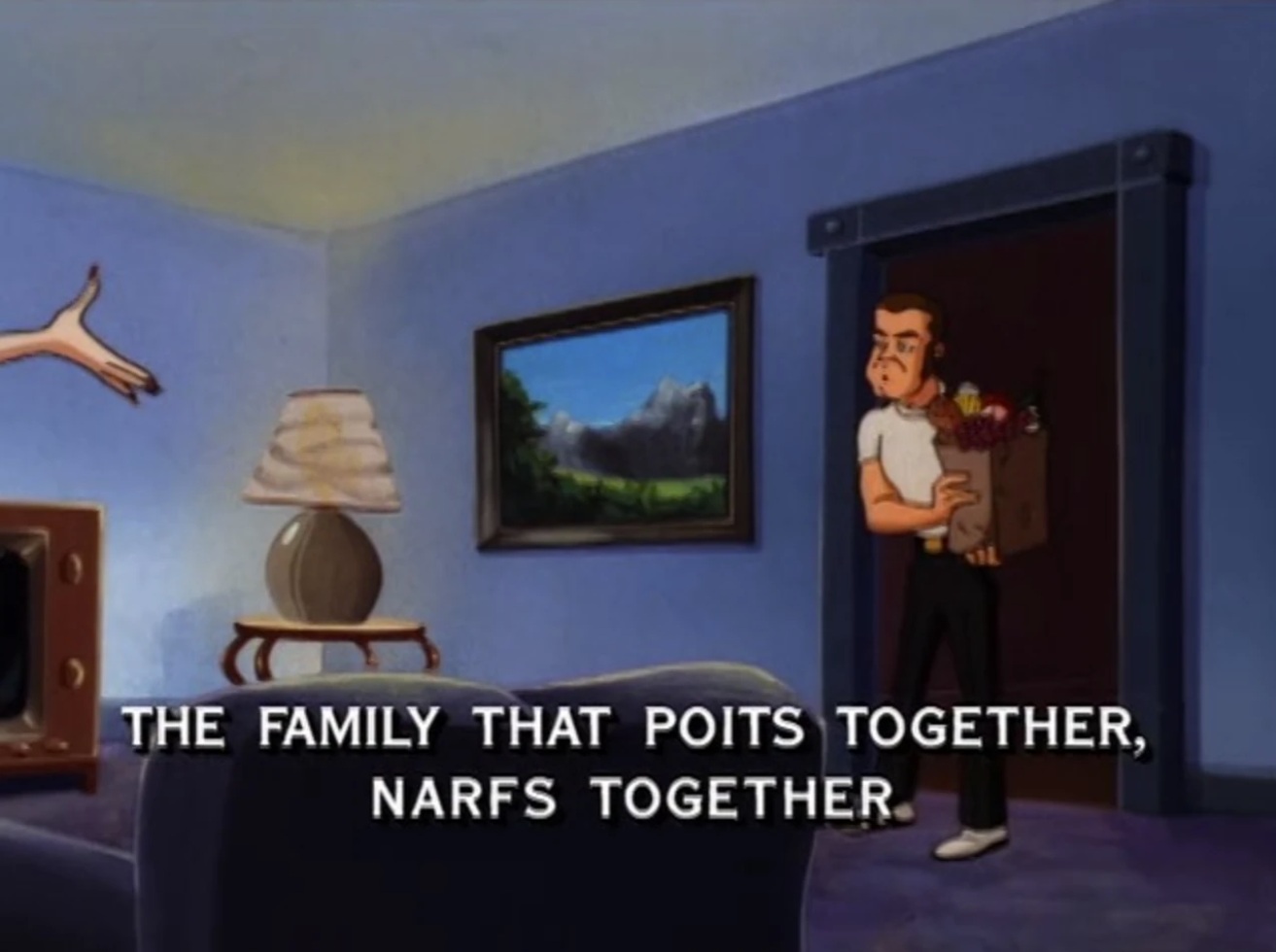
But on February 21st, 1998, the show aired its 53rd episode, The Family That Poits Together, Narfs Together.
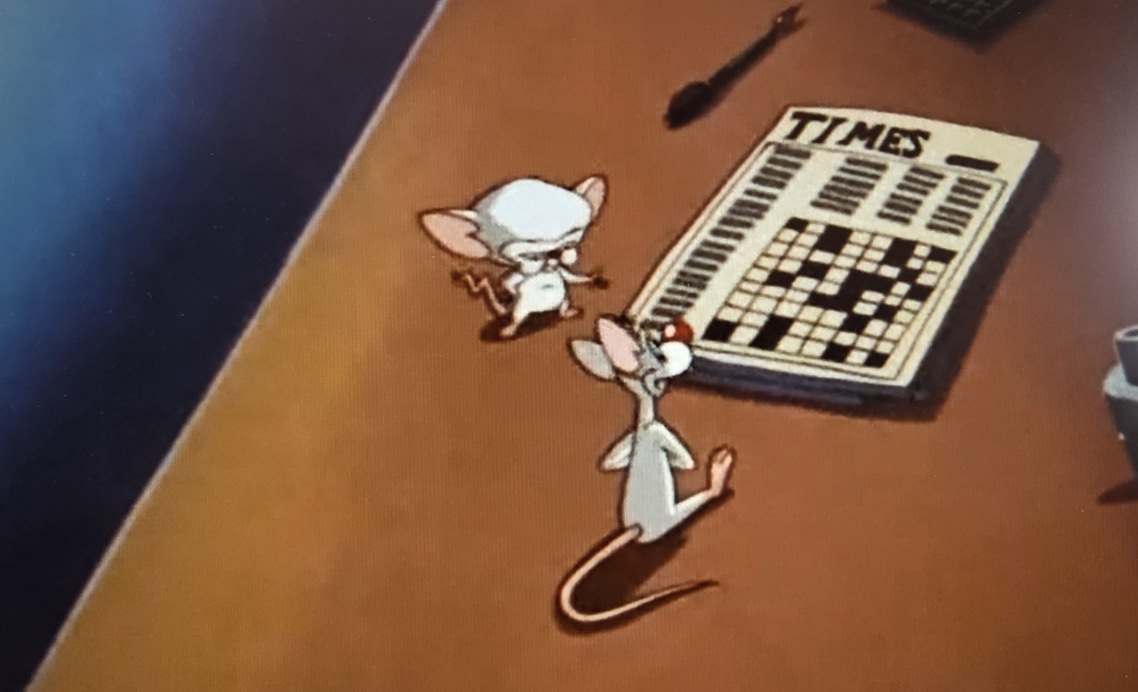
The Brain’s latest plan for global domination targeted the intellectual elite by sabotaging the daily crossword in every newspaper in the world.
Here, I’ll let The Brain explain his diabolical endeavor:
This is the Sunday crossword puzzle. The most educated people all around the world spend hours each weekend deciphering its complex web of interlocking verbiage. But change just one clue, and the whole puzzle becomes impossible to solve…
I will change one clue in the crossword puzzle in every newspaper around the globe, throwing the intelligentsia into a hopeless dither. While they frantically ripple through their dictionaries and thesauri, I will step into the breach, and take over the world!
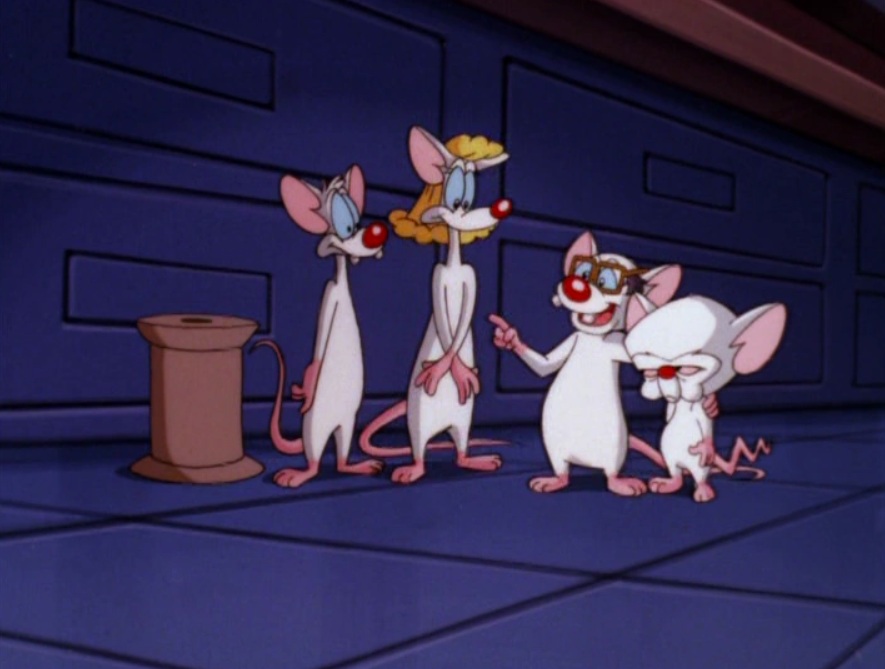
Unfortunately, he needs $25,000 to fund this operation (including the cost of bagels with cream cheese), so he plans to reunite Pinky’s family and put them on a talk show to win the prize for the world’s most perfect family.
Naturally, shenanigans ensue — and Eric Idle plays both Pinky’s mom AND dad, which is very entertaining — but the family actually wins the prize!
A trip around the world valued at $25,000.
The Brain’s dastardly plans have been scuttled once more.
But that does raise the question…
Would it have worked?
(Let’s ignore for the moment the fact that the intelligentsia for the most part aren’t currently in positions of power, especially in the United States.)
In a world before resources like Xwordinfo and online forums where solvers can share their grievances, it could have given the puzzle solvers of the world pause.
Especially on a Sunday, where you’d think at least some of them would be at home and not at their various important duties.
So there could have been a window.
But was The Brain equipped to seize that opportunity? Did he have the manpower to be in all those places? To snatch up those resources and reins of power for himself?
I don’t think so. Not on a budget of $25,000 (which again, covered the crossword modification and snacks, NOT the ensuing power grab). That’s barely gonna cover a few henchmen, even at 1998 prices.
So, sadly, I think the plan would have failed.
BUT!
He would have had the personal victory of denying that moment of solving satisfaction to puzzlers around the world.
Which is arguably even more villainous.
What do you think, fellow solver? Would it have worked? You can watch the episode for free here on Dailymotion.
And to close out today’s post, let’s enjoy an earworm together and listen to that marvelous theme song:
Five years ago, I wrote my first (and until then, only) post about horror movies in this blog. It was part of a series of posts about the best puzzle solvers across various genres, media properties, and franchises. And I really liked that post.
However, at the time, I felt like I had to avoid certain film franchises and subjects to keep the post as family friendly as possible.
But PuzzCulture is a different animal from its predecessor, so let’s push the boundaries a little bit and make the most comprehensive and accurate list possible, shall we? Let’s honor Halloween right by celebrating the sharpest and most cunning characters to ever elude those relentless meat grinders known as horror films and horror video games.
These are the characters you want on your side, because they’re clever, decisive, and immensely capable. After all, most horror movies and games are populated with idiots who are destined to perish before the film’s conclusion.
So instead, these are the characters who break the mold.
When you’re confronted with a monster who hunts people through their dreams, you have to be pretty clever to survive. After all, you have to sleep at some point. When it comes to the Elm Street franchise, they don’t come more clever than young Nancy Thompson.
Nancy discovers she has the ability to pull things from the dreamworld into the real world, and plans to use this ability to stop Freddy Krueger once and for all. She not only sets an alarm to ensure she wakes up before falling victim to Freddy in the dreamworld, but sets numerous booby traps in her house to ensnare and hurt Freddy.
Nancy is a top-notch puzzler for not only figuring out how to use her incredible ability to her advantage, but devising a plan (and a backup plan!) to save herself.
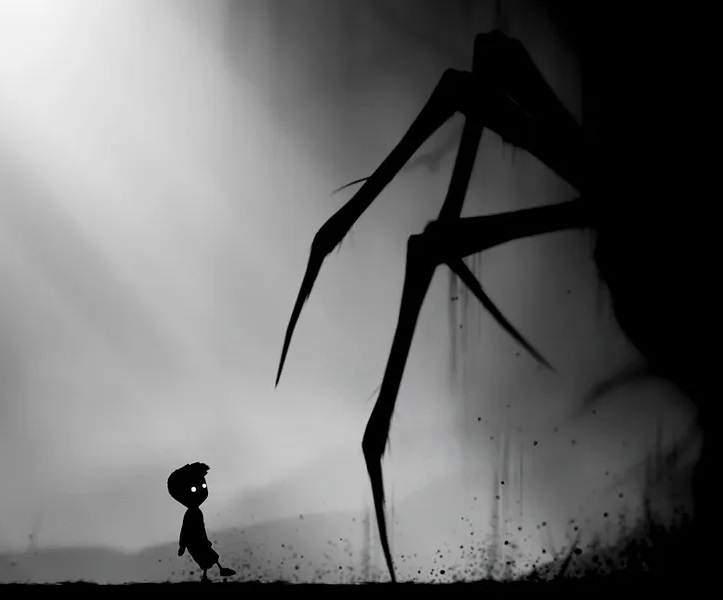
One of my all-time favorite video games, Limbo is a moody, atmospheric puzzle horror game where our silent protagonist ventures through dangerous mechanical traps and shadowy creatures in search of his missing sister.
Easily one of the most clever puzzle platform games of the last twenty years, Limbo allows players to climb, push and pull objects, and manipulate the environment to allow the boy to continue his search. Trial and error is the name of the game here, but it takes some serious puzzle-solving skills to survive to the end.
The Lament Configuration is a Rubik’s Cube-like puzzle box that opens a portal to another dimension, where monstrous beings called Cenobites promise untold delights in exchange for your soul. Unfortunately, Kirsty is a clever enough puzzler to solve the Lament Configuration and open the portal.
Thankfully, Kirsty is also clever enough to outmaneuver the Cenobites, buying herself time by realizing someone has escaped their clutches and working to save herself by finding the fugitive.
So Kirsty not only figures out the rules of monsters from another dimension and how to use them, but solves a difficult puzzle box (first opening it, then solving it in reverse to close it) in order to save herself. A pretty sharp cookie, to be sure.
A young FBI trainee who finds herself tangling with two serial killers — one on the loose, another in custody — Clarice Starling has to not only save a young woman kidnapped by Buffalo Bill, but do so while unraveling the word games and riddles of the devious and brilliant Dr. Hannibal Lecter.
Clarice is perhaps the most overtly puzzly of our heroes, solving anagrams and figuring out the double meaning behind many of Dr. Lecter’s riddles and clues in order to get closer to stopping Buffalo Bill. Along the way, she uncovers information missed by more seasoned investigators, even managing to survive an attack by Buffalo Bill (in the dark!) and saving the kidnapped girl in the process.
If you’re ever in danger, hope that Clarice Starling is on the trail.
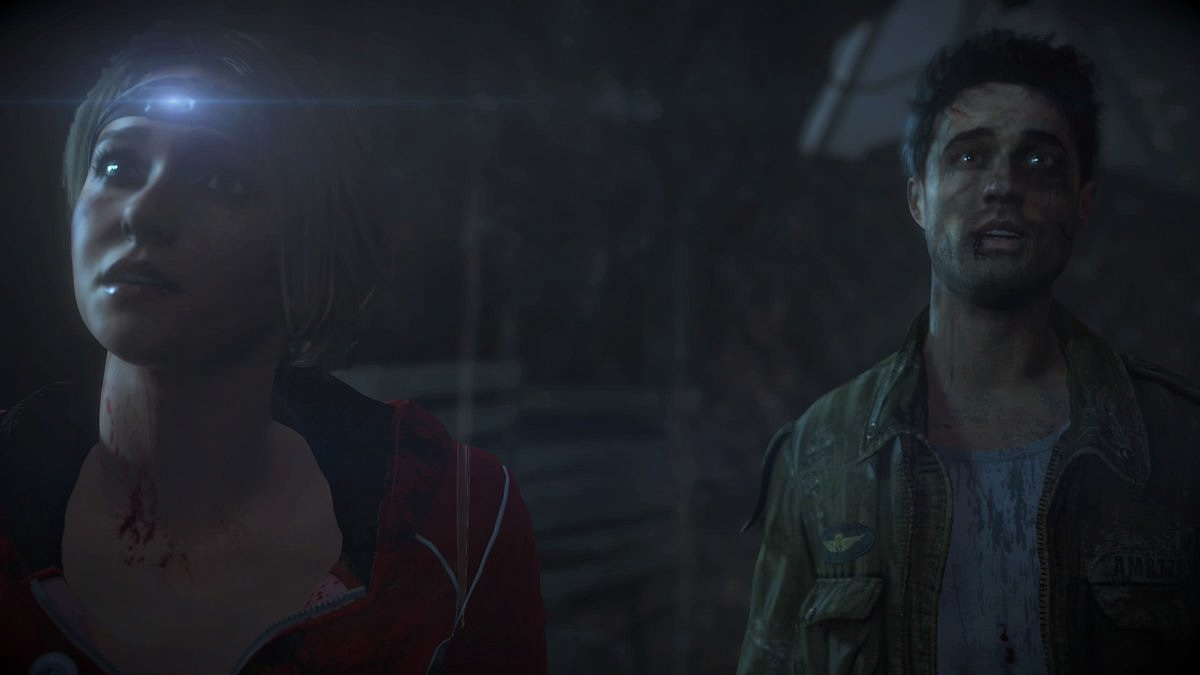
Mike and Sam, Until Dawn
In the interactive horror game Until Dawn, a group of high school pals return to a cabin on a snowy mountain to honor the disappearance of two friends a year earlier. Unfortunately, more tragedy awaits them as a maniac stalks the mountain and evil lurks behind every choice the players make.
Several characters get heroic moments in the game, but nobody more so than Sam and Mike, who manage to wordlessly communicate a plan to stop the dark forces hunting them. (A plan that iron-willed players can help execute, saving Mike and Sam and any other characters that managed to make it to dawn.)
In a game where both characters and players can make clever or clumsy decisions, Sam and Mike definitely stand head and shoulders above the rest.
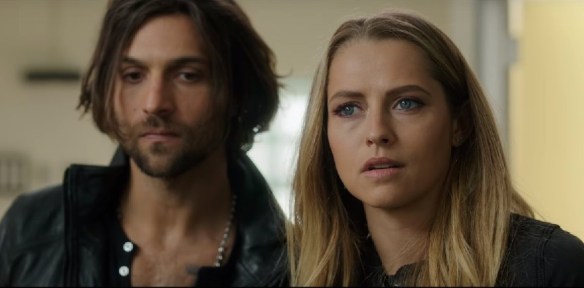
Imagine that you’re being hunted by a monster that lurks in the dark. It seems like an obvious solution to simply stay in the light, but when that monster is both intelligent and cunning, that’s a taller order than you think. Bret, along with his girlfriend Rebecca and Rebecca’s family, are being pursued by Diana, a creature who can only appear when it’s dark.
When Diana cuts power to the entire neighborhood, everyone must scramble for safety. Thankfully, the resourceful Bret is on their side, and he thwarts Diana’s attacks several times. When she knocks the flashlight from his hands and charges him, he banishes her momentarily with the brightness of his smartphone screen. As he runs for a car outside, she ambushes him from a shadow, but he escapes again by using the key fob in his pocket to activate the car’s headlights.
Effective puzzlers always make the most of the tools at their disposal, and Bret is a most effective puzzler.
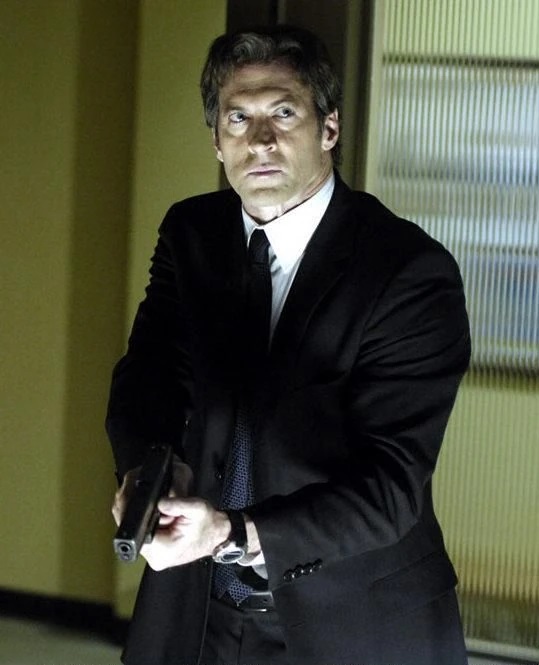
We meet many criminal investigators in the Saw franchise, but arguably none are more capable than Agent Peter Strahm. Strahm not only deduces important information about Jigsaw’s apprentice in Saw IV, but he actually outwits one of the apprentice’s traps in Saw V!
Using the same pen he would nervously click to relieve stress, Strahm manages to outlast the Water Trap, where his head was trapped in a cube that quickly filled with water. (I won’t go into detail, but anyone who has watched House, M*A*S*H, or Nobody can probably figure out how.)
Although Strahm doesn’t get to walk off into the sunset (very few do in Saw movies), he proved far more capable than many who chose to tangle with Jigsaw and his apprentices.
Sometimes, a good puzzler is plunked down in an unfamiliar situation and has to make sense of it all. (This is the premise of many an escape room or a video game, as well as the truth regarding many coded puzzles or puzzles with symbols.) The situation in Cube is like that times a thousand.
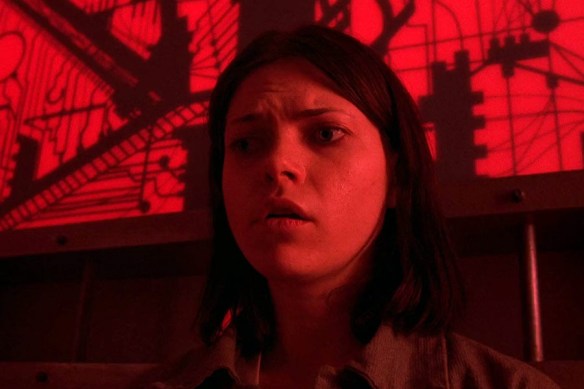
Leaven is one of six people trapped in a maze of interconnected cubical rooms, many of them booby-trapped in various ways. As a young mathematics student, Leaven is immediately intrigued by the numbers inscribed in the small passages that connect the various rooms. The group soon realizes that the rooms are shifting periodically, making the maze harder to solve.
After several theories don’t pan out, Leaven manages to unravel the pattern of the trapped rooms — realizing those rooms are related to prime numbers (specifically powers of prime numbers) — and navigates the group through the ever-shifting maze toward an exit.
The stakes may not always be as high as they were for Leaven, but she never gave up and always approached the puzzle from a fresh angle when thwarted. That’s a sign of a true puzzler.
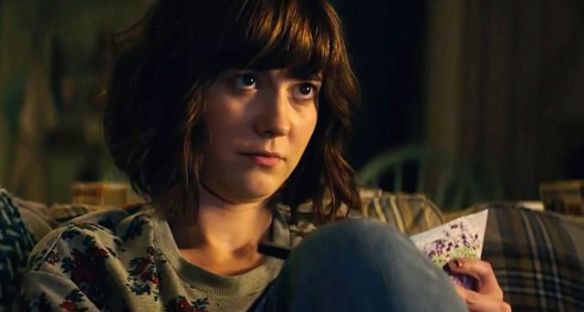
After being run off the road in an accident, Michelle wakes up in a well-stocked underground bunker. She’s been taken there by Howard, the bunker’s owner, who tells her the surface is uninhabitable and the air outside is poisoned. Michelle quickly realizes that Howard is unstable, but must bide her time before attempting to escape.
Michelle is another remarkably resourceful individual, mapping out the ventilation system in the bunker (while doing repairs), fashioning a hazmat suit out of found items, and outwitting Howard long enough to escape. (Once free, she even manages to whip up a Molotov cocktail and dispatch an unexpected threat.)
Some of the most devious puzzles are the ones where you have to figure out how to use what’s in front of you in creative ways to complete a task. Michelle has this skill in spades.
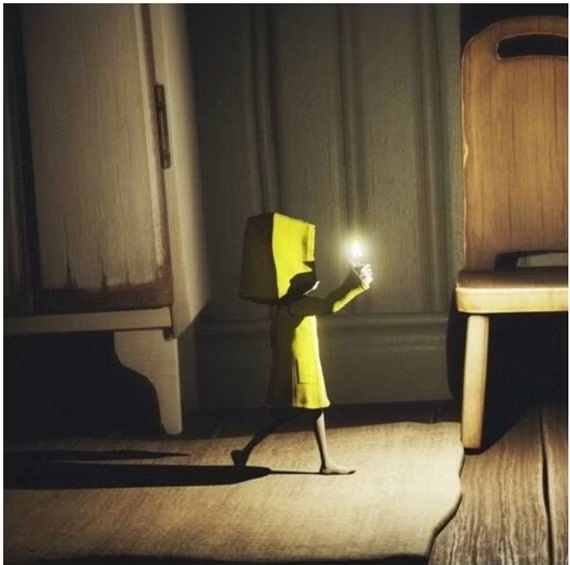
A hungry nine-year-old girl in a yellow raincoat, Six is the protagonist of Little Nightmares, a brilliant puzzle-platformer where the player must outmaneuver hulking monstrosities and sneak their sneakiest sneaky selves through treacherous scenarios.
Six is patient, resourceful, and pragmatic, carefully choosing when to be stealthy and when to be bold, as both are required to survive the game.
Through pattern identification, enemy observation, and learning from your mistakes, you and Six navigate the oversized horrors of the game. (While the puzzles in Limbo often require the player to die more than once before figuring out the correct path forward, Little Nightmares allows players chances to figure out the puzzle ahead of time, making for a different, but equally satisfying, solving experience.)
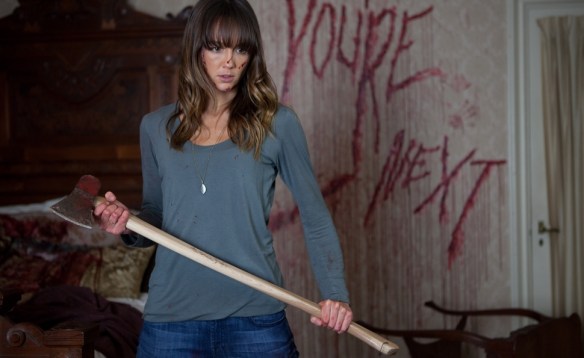
Erin joins her boyfriend at a family gathering, only for things to turn sour as masked invaders target the party’s guests. But they get more than they bargained for, as Erin quickly reveals herself as one of the most capable horror movie protagonists in the history of the genre.
Erin gathers information, sets traps, outwits the bad guys at seemingly every turn, and generally dazzles with her intelligence, tactical skill, and resourcefulness.
You know that puzzle where you have to connect all the dots in the square with only three lines, but to do so, you have to draw outside the square? That puzzle wouldn’t fool Erin for an instant. She is constantly thinking outside the box — and the house — in order to accomplish the most with the fewest moves.
Horror movies haven’t seen a puzzler like Erin before, and I almost feel bad for any bad guys who get in her way.
Did I miss any world-class puzzlers from horror movies? Let me know in the comments section below! I’d love to hear from you!
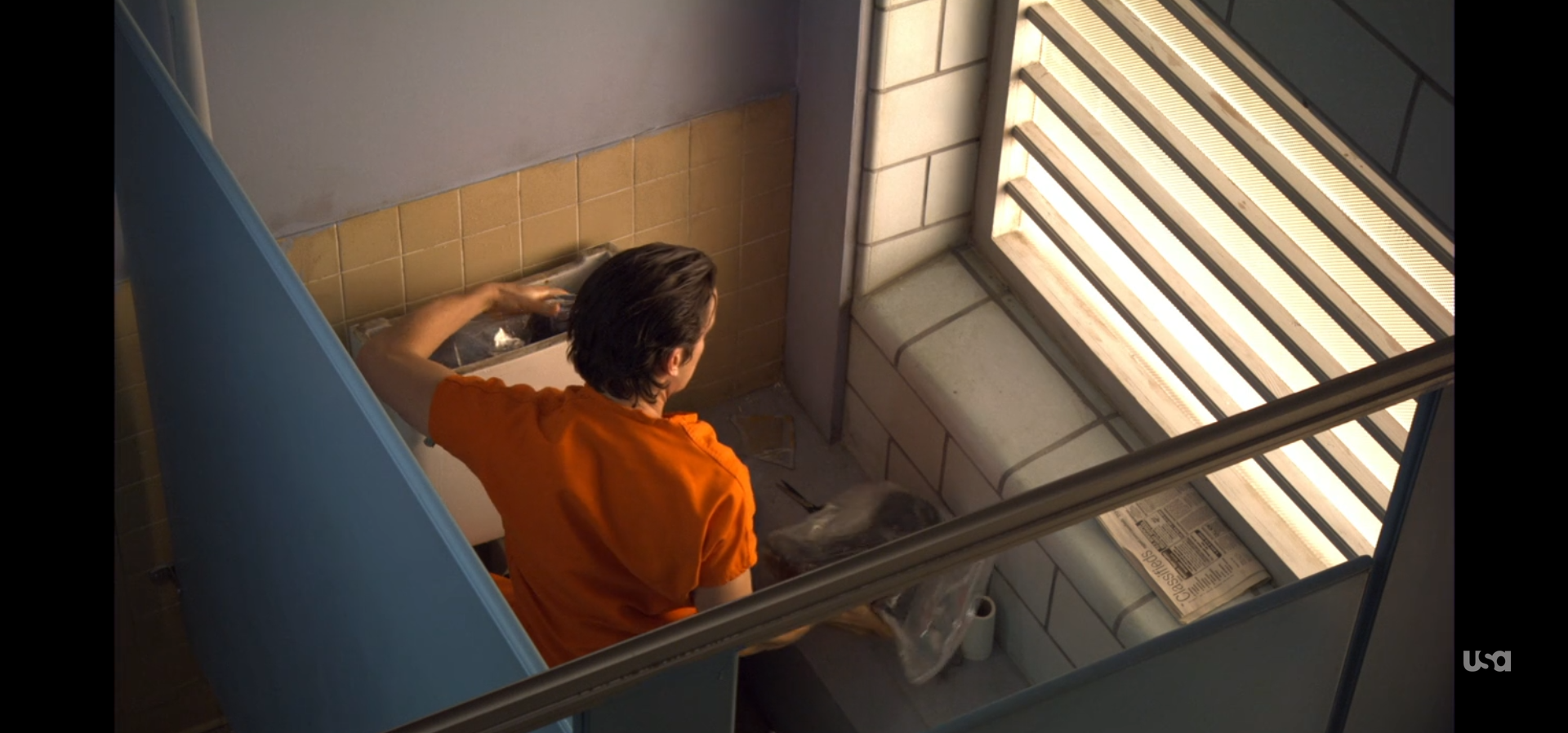
White Collar begins with an escape. Not from an escape room—the stakes are much higher; I’m talking about a prison break. Art thief, bond forger, and all-around con artist Neal Caffrey (played by Matt Bomer) has devised a plan to escape from his super-maximum security correctional facility. He changes his appearance rapidly by shaving, slicking his hair back, and donning a prison guard uniform stashed in a staff bathroom toilet tank. Accompanied by jaunty music, he strolls unrecognized past guards and fellow inmates. When he slides a key card through a gate’s reader, the light turns green. He’s free.
Four hours after Neal has disappeared into Manhattan, Peter Burke (Tim DeKay), the FBI agent who first arrested Neal, is called, and begins to interrogate the warden and marshals about the details of Neal’s escape on the way to Neal’s cell. Where did Neal get the guard uniform? Online uniform supply company. Where’d he get the credit card to buy the uniform? It belonged to the warden’s wife.
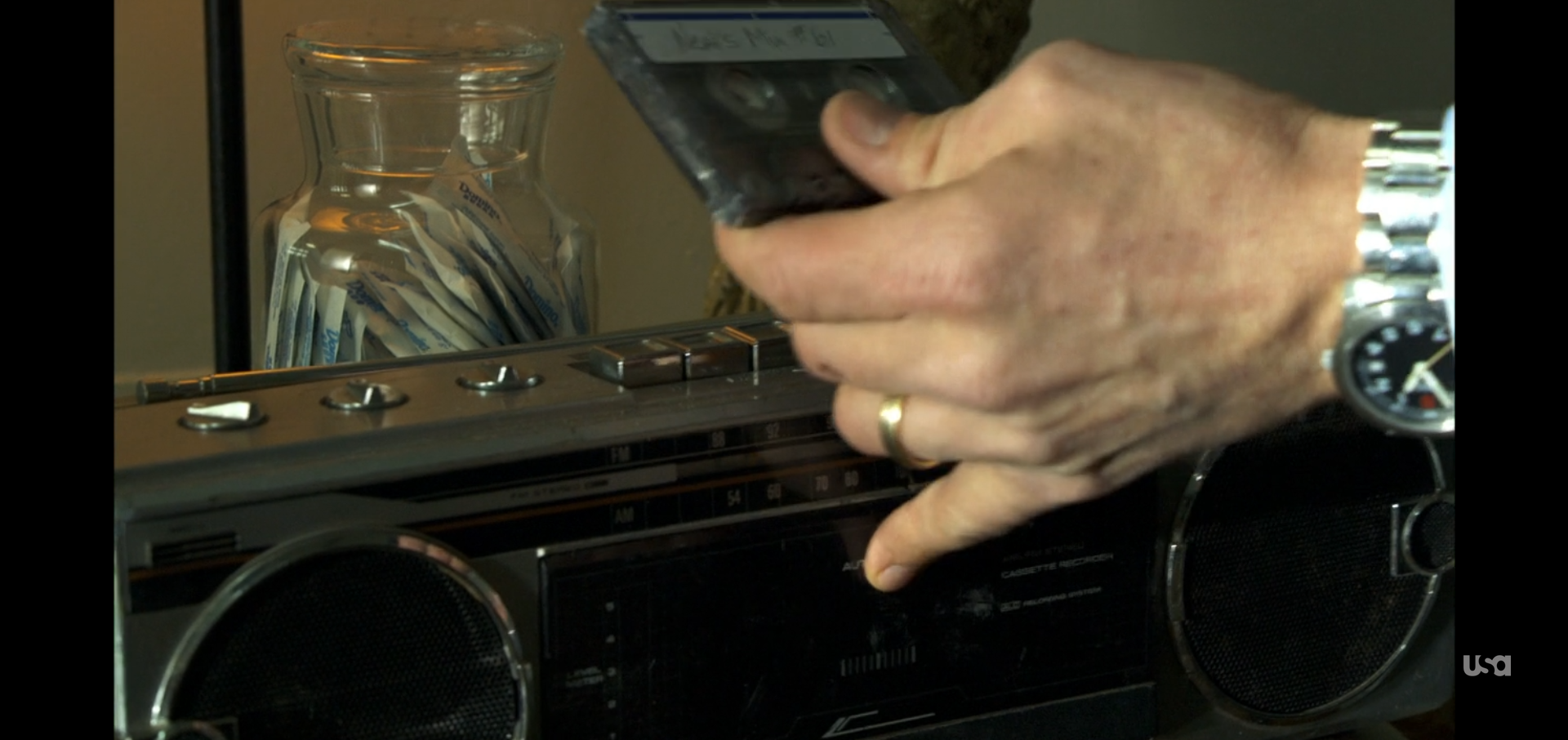
Neal’s cell is heavily decorated—with sketches, hash marks, poetry magnets. Where’d Neal get the key card for the gate? “We’re thinking he restriped a utility card using the record head on that,” the Warden says, nodding at the tape player. Peter examines the tape player, the wall decorations, the books and brochures on Neal’s bed. From all of the accumulated detritus of Neal’s imprisoned life, Peter begins to piece together where Neal would go and why. Neal’s escape was low on puzzles compared to an escape room, but the real puzzle comes now for Peter. Peter is an expert puzzler—his house is full of New York Puzzlethon trophies.
The solution is anticlimactic. Peter finds Neal on the floor of Neal’s ex-girlfriend’s emptied apartment, moping over her absence. Neal makes no further attempt to flee, but does make an opening gambit in the long game of securing his freedom; he asks Peter to meet with him back in prison if he can provide crucial intel on the elusive criminal Peter’s been chasing. What would have been four years in prison for running becomes four years released into Peter’s custody as an FBI consultant. With a GPS tracking device around his ankle, Neal walks into the sunlight once again. Thus, the show’s premise is established: Peter and Neal, FBI agent and con artist, taking down white collar crime together while going endlessly back and forth on whether they can trust one another.
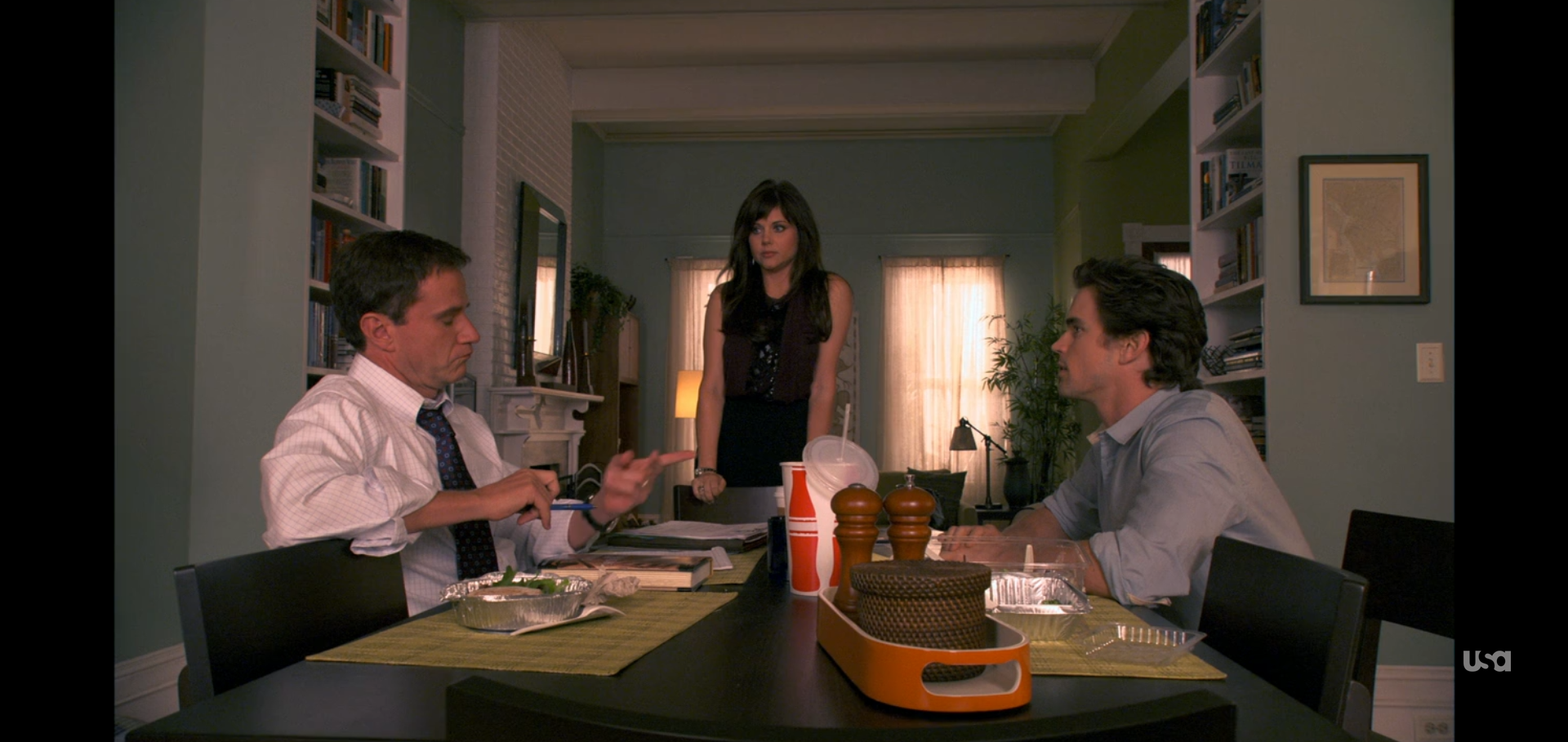
Peter, Elizabeth, and Neal congregate in the Burke home.
Though it has its moments of suspenseful intrigue and poignant drama, White Collar is more lighthearted than many crime procedurals. The mood is kept buoyant partially by Neal’s charm, and by the chemistry between the leads (including Tiffani Thiessen as Elizabeth Burke—Peter’s wife—and Marsha Thomason and Sharif Atkins as Peter’s fellow FBI agents). Beyond that, however, there is an infectious playfulness woven into the screenwriters’ approach to storytelling. Whether the characters are planning heists or solving crimes, it feels like the show is presenting us with a game.
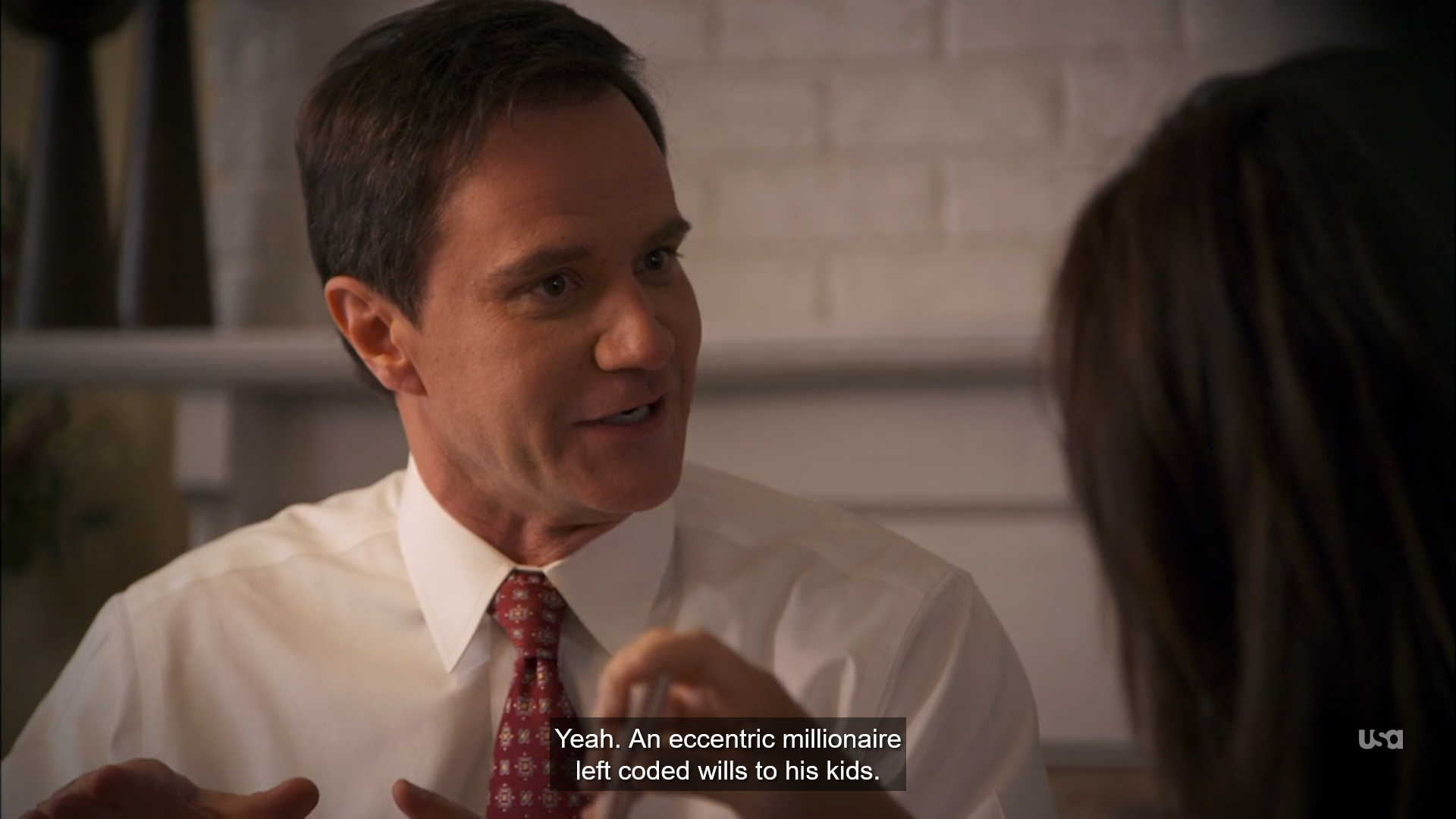
One episode draws out this undercurrent of playfulness, as Peter and Neal are literally presented with a game. The season three episode “Where There’s a Will” centers around a dispute over a $40 million inheritance. Brothers James (Danny Masterson) and Josh Roland (Christopher Masterson) each have a supposed copy of their father’s will, one with a relatively equitable distribution of funds, and one saying that James gets everything. Neal, as an expert forger, has been called in by the bureau to authenticate the wills.
Neal, noticing that the same person is responsible for all of the signatures on both wills, determines that both are forged, but it gets weirder. Handwriting analysis concludes that the deceased himself forged all of the signatures on his own wills. Weirder still, the witness names are anagrams of one another. Peter and Neal get to work puzzling out what other names might be hidden in those letters, and come to the same conclusion: Tycho Brahe, a 16th century Danish astronomer.
Then comes the biggest surprise thus far. Holding the stacked wills up to the sunlight, Neal realizes that, when overlaid, the wills include a drawing that resolves into what look like streets and a compass rose. “This isn’t a message,” Neal says. “This is a map.” The Roland sons have a slightly different take, recognizing the “compass rose” as actually “the sundial in La Monde Garden” (a fictitious location). The sons go on to imply that treasure hunts are an activity their dad once engaged in often, but neither seems interested, even when Neal posits that the real will is likely at the end of the hunt.
Peter is happy to return the wills to evidence. Neal, however, is still intrigued, trying his hardest to entice Peter into joining him at the sundial. Peter won’t bite, so Neal meets up at La Monde Garden with his criminal accomplice and best friend, Mozzie (Willie Garson). They notice faint numbers along the bottom of the wills’ pages, probable times, but those times on the sundial don’t seem to point to anything. Alternatively, they theorize that maybe something will happen when the sun hits 4:30—four hours from now.
Neal texts Peter, who’s at home with Elizabeth, for help, and Peter and Elizabeth dive into the puzzling readily. When Peter spots a little drawing of a tulip next to the times, Elizabeth supplies that tulips stand for spring and rebirth, and Peter’s inspiration is sparked. It isn’t spring now, but with the use of a sextant and a couple of mirrors, they can recreate the shadow that the angle of the springtime sun would cast at 4:30. Each of the times, in fact, have a different seasonal symbol associated with them.
Elizabeth and Peter join Peter and Mozzie to create the necessary shadows. Each shadow they cast points to a different letter on the sundial, spelling out “BSH,” an acronym that means nothing to any of them. Their stumped wondering is interrupted by a call with a startling revelation; James Roland’s young daughter has been kidnapped, and the kidnapper demands $6.4 million. This is enough motivation for Josh Roland to get involved in the treasure hunt, since the real will should give him the ability to pay his niece’s ransom. He knows what “BSH” stands for: Big Sky Hunting, what his dad always called going to the planetarium. Peter and Neal are off to their next destination.
I’ll refrain from spoiling the second half of the episode, but rest assured, even as the mood should have darkened with the girl’s kidnapping, an undampened spirit of playfulness remains threaded throughout. We’re back in the realm of the high-stakes escape room. Now, though, rather than orchestrating his own escape, Neal is playing a game for someone else’s freedom. Rather than scheming by himself, he’s relying on a gaggle of allies to help him each step of the way. The show may have started with Neal and Peter each as independent figures facing off against one another, but as I said, that form of game-play only leads to anticlimactic reveals. Real satisfying drama, in the world of White Collar, comes from games played together, absent self-reliance and self-interest.
With the GPS tracker around his ankle, Neal might not be as free as he was the moment he first stepped out of prison in the pilot. With friends on his side, however he’s much better equipped to mastermind a real escape. A real win.
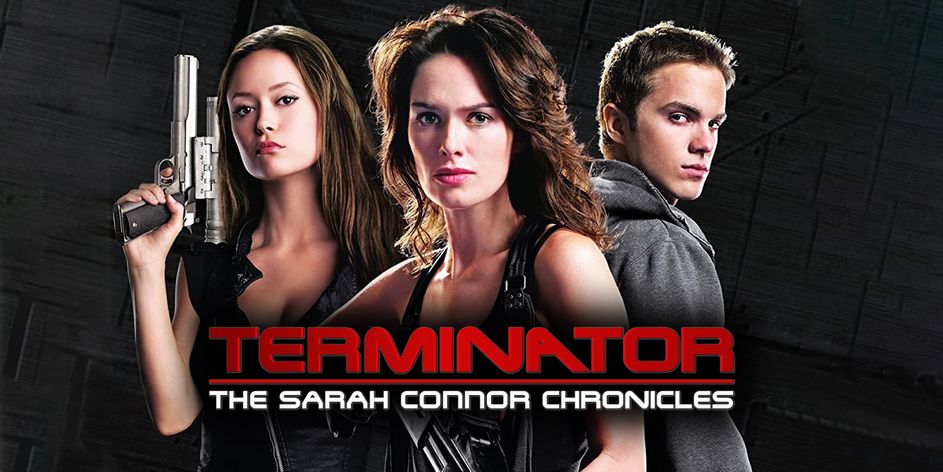
“Strange things happen at the one-two point,” is a proverb based on the ancient East Asian board game Go. As summarized by cybernetic Cameron (played by Summer Glau) in Terminator: The Sarah Connor Chronicles,“It means the usual rules don’t always apply.” More specifically, the proverb refers to the strategic idiosyncrasies of certain playing positions on the Go board; “the heuristic principles of fighting along the sides or in the [center] often fail in the corner,” Go wiki Sensei’s Library clarifies. When we fight our way into tight corners, the laws of reality that we previously knew shimmer and warp. The more boxed-in we become, the more we need to expect the unexpected.
This is a fitting sentiment to feature in Terminator: The Sarah Connor Chronicles, the fourth installment in a media property dealing with time travel and its resultant paradoxes and alternate timelines. The show depicts its characters having fought their way deep into tight, reality-bending corners in their attempts to prevent apocalypse. By the second-season episode titled for the Go proverb, the rules established in 1984’s The Terminator—what we can expect from time travel, who’s an ally and who’s an enemy, what to do if you want to live—have been thoroughly warped.
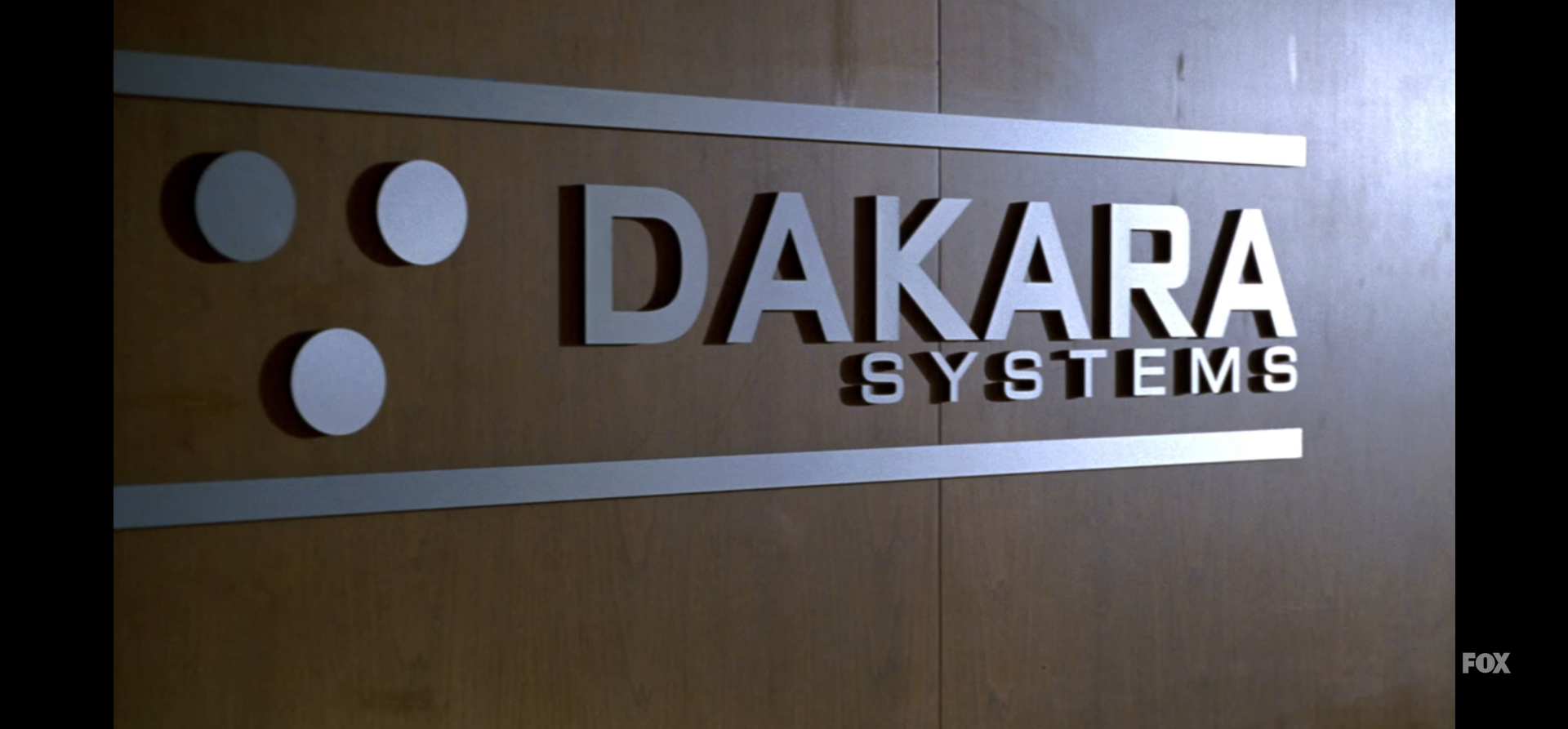
In the episode “Strange Things Happen at the One Two Point,” Sarah Connor (Lena Headey) is deeply fixated on a pattern of three dots. Earlier in the series, another time traveler left her a message in blood on a safe house wall: a list of important names with three dots next to it. Seeing these dots in her dreams, Sarah is convinced that there’s more to them then the smeared fingerprints of a dying comrade; her investigation leads her to Dakara Systems, a tech start-up with a logo of three dots. She and Derek (Brian Austin Green) break in late at night, stealing all of the computers’ hard drives and bringing them back to Sarah’s teenage son, John (Thomas Dekker), an accomplished hacker.
On the hard drives, John discovers designs for an artificial intelligence system, a find that sets off Sarah’s internal alarms, but John explains that the designs are useless in light of Dakara Systems’ lack of processing power. Derek calls it a dead end, accusing Sarah of instigating a wild goose chase, an accusation she rebuts with, “Artificial intelligence, the company logo, the three dots—”
“Are fingerprints,” Derek says. “It’s just blood.”
“Everything on that wall has meant something,” Sarah argues. “It’s all blood.”
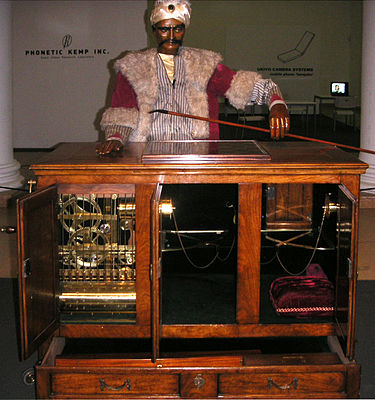
Sarah is sure that The Turk, the chess-playing AI that she’s been hunting for since it was stolen from inventor Andy Goode, can be traced to Dakara Systems. Derek has lost faith. While John initially has his doubts too, by the next morning, he’s made Sarah and Cameron an appointment to meet with the heads of Dakara Systems. He explains his change of heart: “Andy Goode was building a chess program . . . It always starts small.”
A 1980s reconstruction of the original chess-playing Mechanical Turk.
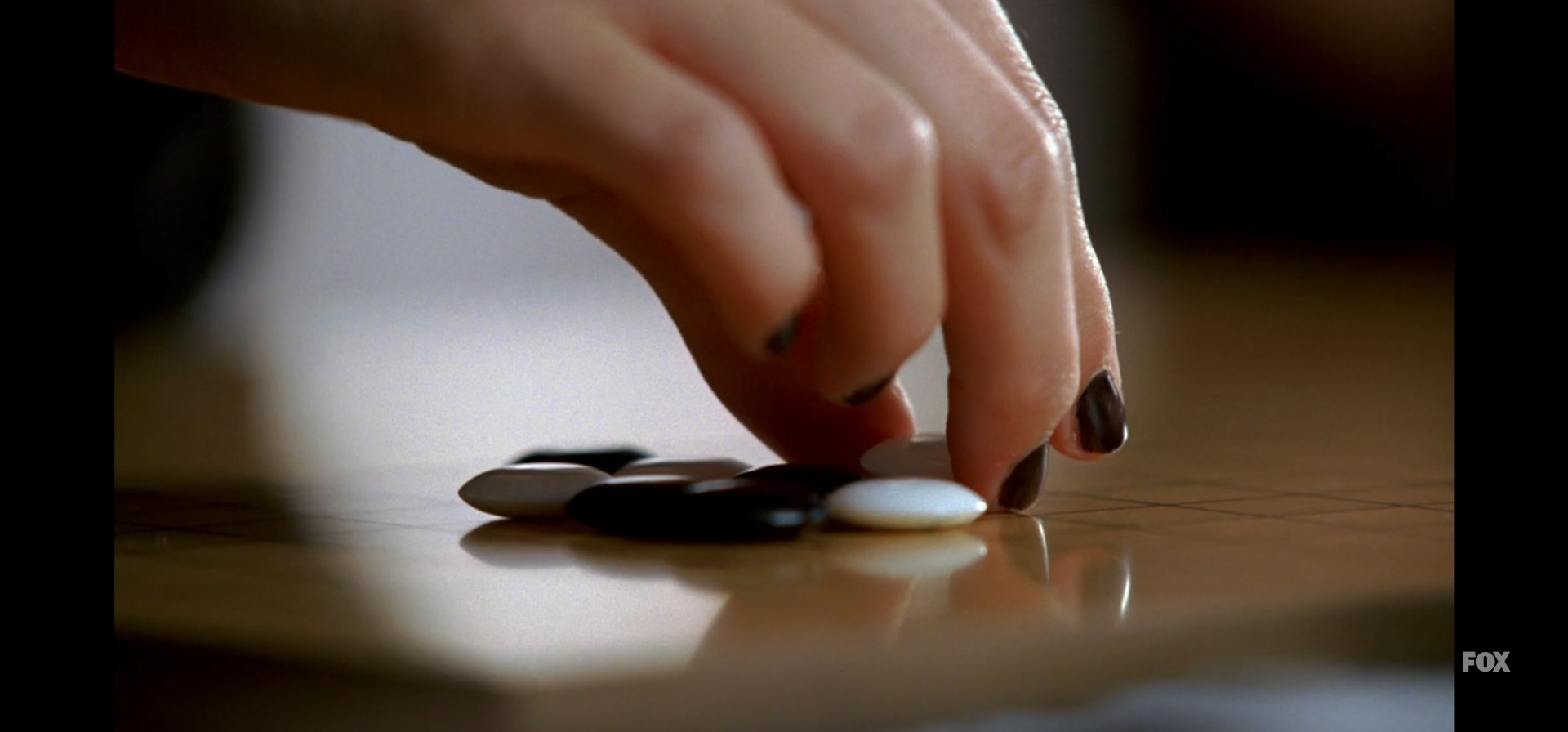
Dressed up in their best wealthy-investor chic, Sarah and Cameron meet with father-and-son team Alex (Eric Steinberg) and Xander (Eddie Shin) Akagi of Dakara Systems. Probing for connections to The Turk, Cameron poses a crucial question to Xander while Sarah and Alex grab coffee: “Do you like chess?” Later, when Sarah asks her what all of the evidence is adding up to, Cameron says, “Not The Turk. Xander doesn’t play chess. He prefers Go.” She pulls out a folding wooden board inscribed with a grid. “Xander said it’s been calculated that there are more possible Go games than atoms in the universe,” she continues, laying out black-and-white discs in the board’s center. “He’s offered to teach me how to play.”
Sarah counters, “Did he offer to tell you about his AI?” and when Cameron reiterates that Xander’s AI is not The Turk, Sarah says, “But it could be a piece of the puzzle. We’ve seen that before.”
Cameron responds, “Strange things happen at the one-two point.”
I won’t spoil for you which strange things happen here, at this point where Sarah Connor and her allies have boxed themselves in strategically by changing reality countless times in an effort to stave off nuclear apocalypse. Instead, let’s dwell together on the beauty of that phrasing, the “strange things,” as a way of describing action in a game so deceptively simple: black and white stones laid out on a grid. They don’t seem like they should stack up next to the strange things that happen in a work of science fiction—the way the air crackles and sparks with blue light whenever a new time traveler tears a hole through the decades; how a Terminator’s robotic skeleton designs a chemical bath for itself that allows its flesh and skin to regrow; the liquid metal CEO played by Garbage lead singer Shirley Manson, whose arms extend at will into gleaming daggers.
By placing Go on the same playing field as these miraculous, speculative sights, Terminator: The Sarah Connor Chronicles reminds us that games needn’t be elaborate to be magical, needn’t be novel to be surprising. As long as each player is an elaborate, novel human being, an ancient game like Go can continue to startle and move, to belong meaningfully alongside us in the twenty-first century—and further onward still.
In 2011, speculative CBS thriller Person of Interest began with the premise that a computer genius named Finch (played by Michael Emerson) had built an AI that could tell when acts of violence were about to occur in New York City. In order to intervene, he hired a former special operative named Reese (Jim Caviezel). The only information that the AI ever provides is a social security number; each episode, this leaves Finch and Reese to solve the central question: does this SSN belong to a victim of an impending crime, or a perpetrator? Do they need to be stopped, or saved?
Solving this question typically involves a veritable cornucopia of guesswork, research, hacking, plot twists, and pieces of paper taped to walls and connected by webs of string (one of my favorite TV tropes, featured in Supernatural and It’s Always Sunny in Philadelphia). Chess also features prominently, as do various secretive systems of communication. No episode is quite as likely to appeal to your inner solver, though, as season four, episode two, “Nautilus,” which aired on September 30th, 2014.
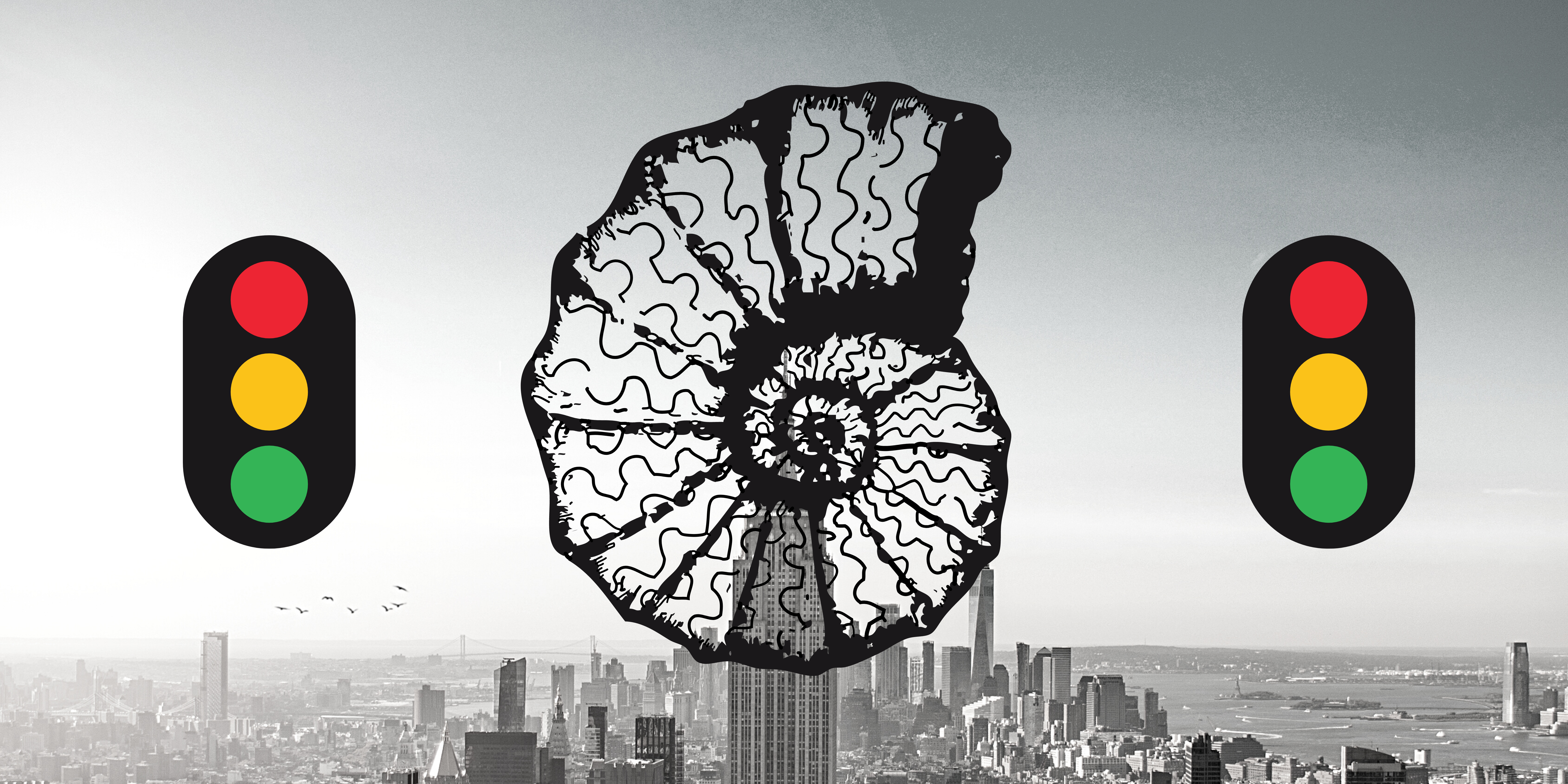
In this episode named for its chambered nautilus shell motif, Finch and Reese receive the SSN for chess grand master and college student Claire Mahoney (Quinn Shephard). She’s AWOL from school and chess in pursuit of a mysterious game’s prize. The game began with a post on an obscure message board: an image of a nautilus, captioned, “If you seek enlightenment, be the first to walk through the chambers.” There was data hidden in the image of a nautilus, and it sent Claire off down the rabbit hole.
Following her, Finch watches as she pulls a tab of paper from a lost dog sign, with a nautilus watermarked behind the numbers. After calling the number leads to nothing, Finch realizes: “It’s not a phone number . . . it’s multiplication.” Multiplying produces GPS coordinates, pointing to a location in Harlem.
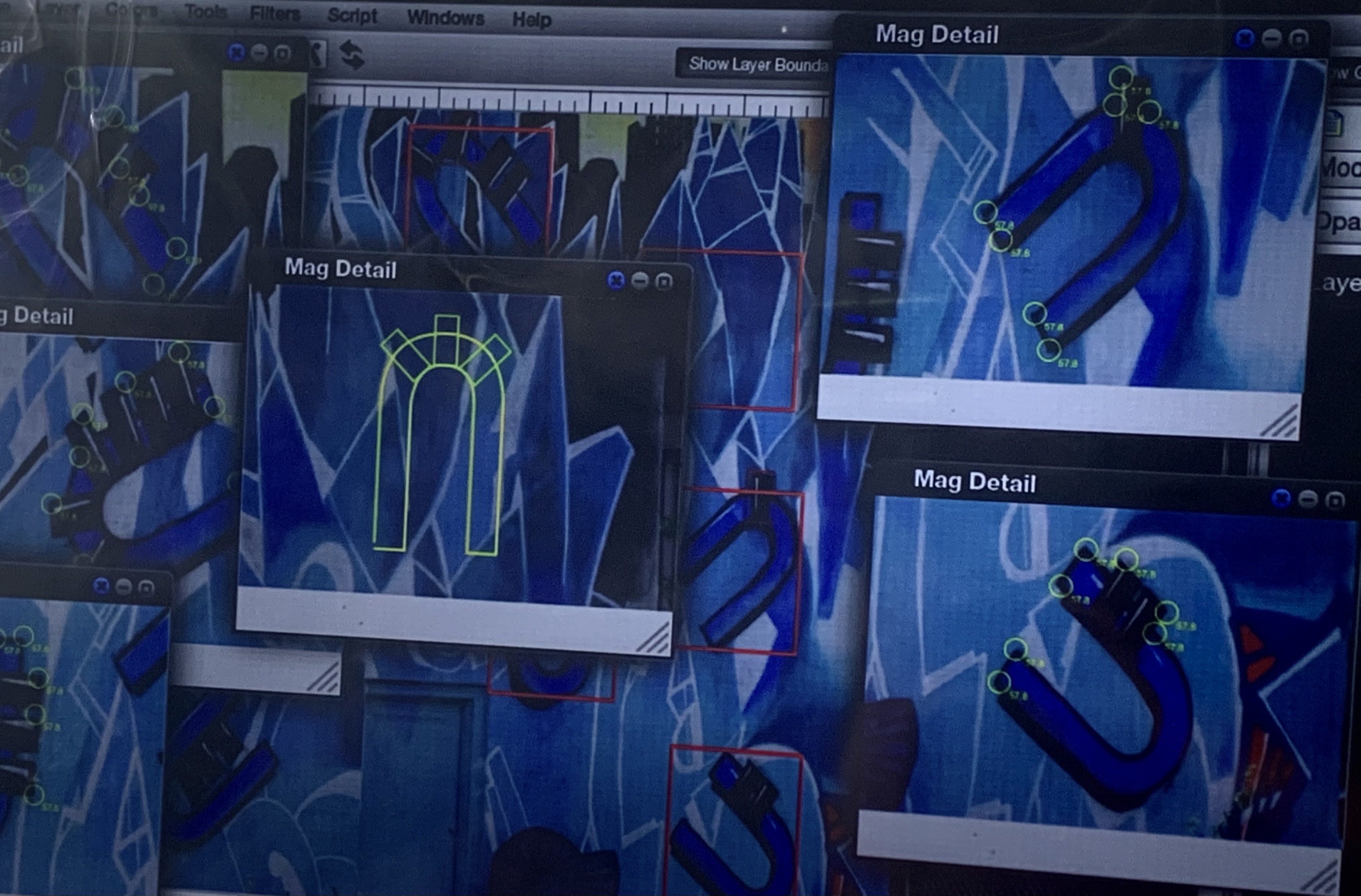
There, a mural of seemingly random shapes (painted by artist Apache Gonzalez) covers a wall. Once again, there’s the nautilus. Back in his office, Finch studies a photo of the mural, finally recognizing it as a variation on a Bongard Problem. He explains, “This particular type of puzzle presents two sets of diagrams. The diagrams in the first set share a common feature. The blocks never overlap with the curved lines. Conversely, in the second set, the blocks do touch the curves, but there’s another common element.”
Reese interjects, “There’s a different number of blocks in each diagram.”
“Using this pattern,” Finch continues, “I can fill in the blank space with the only number of blocks left out, which is three, thus solving the puzzle, creating a sort of three-pronged arch.” Googling, Reese finds a matching photo of an arch in Central Park.
That night, Claire is near the arch, standing in traffic. When Reese interrogates her about her apparent death wish, they’re interrupted, but later, the answer comes to light. If you stand at the right point in the street, banners for “motorcycle safety month” visually blend together to show the faint image of a nautilus. Beneath the nautilus: pictures of traffic lights that Finch correctly identifies as the equivalent of Braille dots. They spell out, “184th and 3rd.”
Claire’s next found in a biker bar at 184th and 3rd, staring at a bulletin board decorated in gang logos. One features a skull with nautiluses for eyes; letters surround the skull in a seemingly random arrangement. At an otherwise dead end, Reese sits at his desk, rewriting the letters over and over, seeking a scrambled word, until Fusco (Kevin Chapman) determines that the letters refer to musical notes, forming the tune to “New York, New York.” Reese is able to deduce a location: the Empire State Building’s observation deck.
Here on out, the puzzles become simpler, less compelling; from a Doylist standpoint (referring to author Sir Arthur Conan Doyle’s perspective, as opposed to fictional character John Watson’s), we might assume that the writers have decided that it’s time for the plot to dominate, turning the puzzles into mere perfunctory means to an end. I’m convinced, however, by the Watsonian explanation, that Claire has sufficiently proven herself, and the AI game-master is content now to lead her by the hand.
But why the nautilus shell? In the episode, computer hacker Root (Amy Acker) refers to the nautilus as one of nature’s examples of a logarithmic spiral. It’s commonly also referred to as an example of the golden ratio, but as explained in “Math as Myth: What looks like the golden ratio is sometimes just fool’s gold,” that’s not so true. Is that they key—that the prize Claire seeks is fool’s gold?
The episode’s primary puzzles have been solved, and the series has come to an end (though it can be streamed on HBO Max). Still, this one question of the nautilus’ significance remains. What is the symbolic connection between a nautilus shell’s chambers and the “enlightenment” the game promises? Is enlightenment encoded in the logarithmic spiral, or in something more particular to the mollusk itself? I don’t have the answers, but as the nineteenth-century poem “The Chambered Nautilus” by Oliver Wendell Holmes Sr. shows, Person of Interest’s screenwriters were not the first to see something spiritual in the nautilus, and I doubt they’ll be the last.
In closing, I offer the following excerpt from Melissa Febos’ Body Work: The Radical Power of Personal Narrative to mull over in your own pursuit of the nautilus shell’s deeper meaning:
The spiral does not belong to the nautilus shell, unless it also belongs to the whirlpool, the hurricane, the galaxy, the double helix of DNA, the tendrils of a common vine. If there are golden ratios that govern the structures of our bodies and our world, then of course there must be such shapes among the less measurable aspects of existence.
Part of the challenge for many crossword solvers is that you can’t adjust the difficulty of the cluing on a given day. The clues you get are the clues you get.
New York Times crossword solvers are intimately familiar with this, talking about Tuesday puzzles and Saturday puzzles and understanding what each means in terms of expected puzzle difficulty.
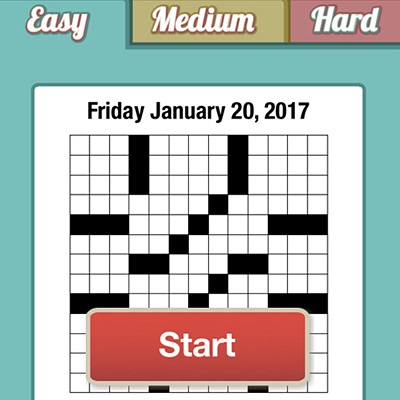
Our own Penny Dell Crosswords App offers free puzzles across three difficulty levels each day, but those are three distinct puzzles, not three different clue sets for one particular puzzle.
Having options for more than one set of clues is fairly rare. Lollapuzzoola has two difficulty-levels for their final tournament puzzle, Local and Express. GAMES Magazine previously offered two sets of clues for their themeless crossword, entitled The World’s Most Ornery Crossword.
The tournament final of the American Crossword Puzzle Tournament offers different clue difficulties for three separate divisions. The Boswords Spring and Fall Themeless Leagues work in a similar manner, offering three levels of clue difficulty — Smooth, Choppy, and Stormy — for competitors to choose from.
The concept of Easy and Hard clues is not unheard of… it’s just rare.
And it’s only natural that someone, eventually, was going to take this concept and dial it up to a Spinal Tap 11.
The pair of someones in question are Megan Amram and Paolo Pasco.
Paolo is fairly well-known around crossword circles, having contributed puzzles to the American Values Club crossword, The New York Times, The Los Angeles Times, The Wall Street Journal, and other outlets, while also serving as associate crossword editor for TheAtlantic.
And Megan is an incredibly talented television and film writer who has written for Parks and Rec, The Simpsons, and The Good Place. Anytime you saw a hilariously shameless punny name for a store in The Good Place, it was undoubtedly one of Megan’s.
The instructions are simple: This crossword contains two sets of clues to the same answers. Toggle to the set labelled “Hard” to impress people looking over your shoulder. (And toggle to “Easy” when they look away.)
This 9×9 crossword’s Easy clues were fair and accessible, but the Hard clues were the real stars. They ricocheted between immensely clever, wildly obscure, and hilarious parodies of themselves.
For instance, the word JEST was clued on the Easy side as “Infinite ____” but received the brilliantly condescending add-on “Infinite ____” (novel that’s very easy to read and understand) in the Hard clues as a reference to the famously dense and impenetrable nature of the novel.
For the word APPS, the Easy clue was “Programs designed to run on mobile devices,” while the Hard clue was “Amuse-gueules, colloquially.”
(I had to look that one up. An amuse-gueule is “a small savory item of food served as an appetizer before a meal.”)
And those are just two examples.
When you finally finish the puzzle, this is your reward:
“You’re a genius! You can tell your mom to get off your case about going to law school.”
All at once, The Impossible Crossword manages to be a fun puzzle to solve on its own, a riotously fun gimmick that lampoons clue difficulty in general, and the most meta puzzle I’ve solved all year.
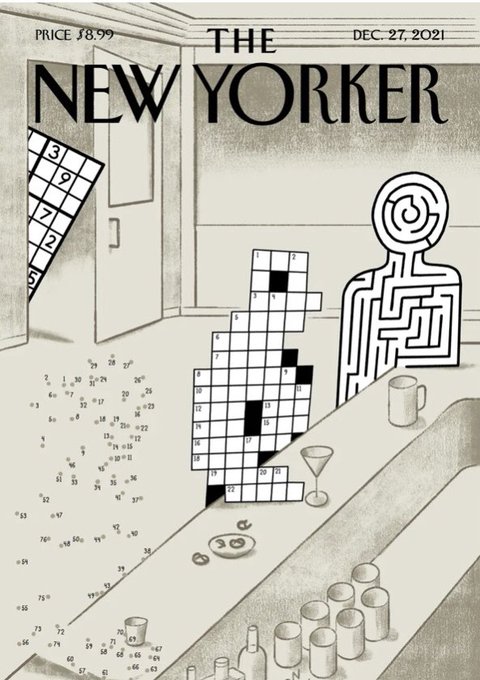
Kudos to Megan and Paolo for pulling it off. What a way to welcome the Cartoons & Puzzles era of The New Yorker while the rest of us close out another year of puzzling.













 PuzzCulture