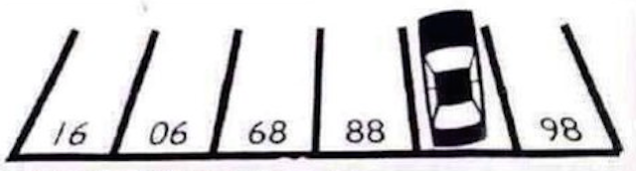
It’s Follow-Up Friday: Parking Lot edition!

Welcome to Follow-Up Friday!

For those new to PuzzleNation Blog, Follow-Up Friday is a chance for us to revisit the subjects of previous posts and update the PuzzleNation audience on how these projects are doing and what these people have been up to in the meantime.

And today, in the spirit of yesterday’s post about The Riddler, I’d like to post a brain teaser for you to solve!

Can you explain the numbering system in this parking lot?

Also, do you have any favorite riddles or brain teasers? Let us know and we might feature them in a future post!

Thanks for visiting PuzzleNation Blog today! You can share your pictures with us on Instagram, friend us on Facebook, check us out on TwitterPinterest, and Tumblr, and be sure to check out the growing library of PuzzleNation apps and games!

Wait a Minute, Mr. Postman…

With subscriptions to puzzle magazines like Will Shortz’s WordPlay and GAMES Magazine, as well as puzzle-by-mail services like The Uptown Puzzle Club and The Crosswords Club, there are plenty of ways to get puzzles by mail.

But one particular puzzler in the UK has put an intriguing twist on the idea of puzzles-by-mail: he’s challenged the carriers of the Royal Mail postal service to solve puzzles in order to deliver his mail.

A graphic designer by trade, James Addison was impressed by the diligence of the postmen of the Royal Mail, and he playfully decided to test their mettle with different challenges, including maps, word searches, pictograms, and other befuddling methods to conceal the intended destination of the letter.

From an article on The Telegraph website:

Although he enjoys solving puzzles himself, he said his hobby was fuelled by a desire partly to test the Royal Mail’s ingenuity and partly to honour old-fashioned letter-writing, following his mother’s advice that a handwritten thank-you note showed you had made an effort.

Well, Mr. Addison is certainly taking his mother’s words to heart. And it seems the postmen of the Royal Mail quite enjoy the spirited challenges his letters offer.

[To try your hand at solving some of Jim’s letters, including those pictured in this post, click here!]

Thanks for visiting PuzzleNation Blog today! You can share your pictures with us on Instagram, friend us on Facebook, check us out on TwitterPinterest, and Tumblr, and be sure to check out our library of PuzzleNation apps and games!

On the hunt… for treasure!

We’re well into summer, and you’re probably looking for great puzzly summer activities to share with the kids. And I have just the thing for you. Have you considered a treasure hunt? (And I’m not talking about spotting a chest at the bottom of your fish tank.)

You could organize one yourself! My friend told me a story about a treasure hunt her uncle masterminded for her and her siblings one year. He went out at low tide with a small chest of fake jewels (plus her mother’s actual pearl necklace, which she tossed in for fun), and buried it, prepared to bring the kids back a day or two later with a treasure map and let them “discover” it.

Naturally, a storm came through the next day, so they couldn’t dig it up. It was a few days before they could organize the treasure hunt, and when low tide came, the storm had so changed the landmarks and sandbars that they never found the treasure chest.

I don’t want to discourage you from embarking on your own treasure hunt adventures… just make sure it’s a place you have maximum control over.

Of course, you could always pursue one of the real-life treasure hunts lurking out there for the industrious amateur adventurer. We’ve written about a few of them in the past, but they’re hardly the only examples. For an aspiring Indiana Jones or lost member of the Goonies, real treasure awaits you.

One, surrounding a bronze statue of an owl, requires a trip to France, though. A man named Max Valentin buried it, and whomever unravels eleven clues and finds it can exchange it for a second statue valued at one million francs. (As long as you don’t get too overzealous and blow up a chapel in your quest to find it, as one amateur treasure hunter did.)

For one with an American twist, you could try to solve the mystery of the Beale ciphers. Three encrypted texts from the 1800s detail the location of a hidden cache of gold, silver, and jewels, and astonishingly enough, The Declaration of Independence is supposed to be the key to cracking the code!

While the ciphers and the story might be a hoax, you could still be the one to solve the mystery! (One group of treasure hunters stumbled upon Civil War artifacts while digging in the wrong place.)

Whether it’s a Dead Sea Scroll or the last missing treasure from a brilliant tie-in to a book, treasure could be yours this summer, even in your own backyard.

[Thanks to IO9 for inspiring this post.]

Thanks for visiting PuzzleNation Blog today! You can share your pictures with us on Instagram, friend us on Facebook, check us out on TwitterPinterest, and Tumblr, and be sure to check out our library of PuzzleNation apps and games!

Puzzles from Across the Sea

A fellow puzzler passed me a copy of a Spanish puzzle book, and I thought I would share its intriguing visual and linguistic stylings with the PuzzleNation audience. (I’ve done this once before with a German puzzle book, and I hope to obtain more from other countries to really give PuzzleNation a PuzzleInternational flavor!)

Now, my Spanish isn’t as sharp as it used to be — any facility I once had with the language, I credit to years spent selling hot dogs outside a Home Depot, rather than six years of classes across middle school and high school — but I should be able to muddle through enough to explain the variations in these puzzles from ones you might be more familiar with.

In any case, let’s get to the puzzles! [Click on each for a larger version.]

The first thing you notice about these clued grids is that there’s none of the diagonal symmetry that defines traditional crosswords. Instead, there’s a curious singlet-letter arrangement along the top and left side. (It’s almost like a kakuro puzzle, with shared clue boxes offering across and down hints.)

Here the across and down clues offer hints for overlapping letters, like a Brick by Brick mixed with a Camouflage puzzle.

This puzzle works by isolating syllables in each hexagon cell, and creating words by reading these syllables in the direction indicated by the arrows next to each clue.

In this “sopa de letras” — a word search, but literally translated as “soup of letters” — the solver must identify each of the 12 drawings around the grid and find those words in the grid.

This one is pretty self-explanatory, as the solver places letters to form five-letter words according to the set letters and the arrows provided. (Interestingly enough, the title translates as “Noughts and Crosses.”)

Ah, here’s something familar! A logic puzzle is a logic puzzle no matter where you travel.

This wonderful spread of variety puzzles offers an array of challenges, with puzzles involving encryption, letter-shifting, deduction, and brain teasers!

It’s always a treat to explore puzzles from another culture’s perspective. Thanks for taking this journey with us today.

Thanks for visiting PuzzleNation Blog today! You can share your pictures with us on Instagram, friend us on Facebook, check us out on TwitterPinterest, and Tumblr, and be sure to check out the growing library of PuzzleNation apps and games!

5 Questions with Constructor Matt Gaffney!

Welcome to another edition of PuzzleNation Blog’s interview feature, 5 Questions!

We’re reaching out to puzzle constructors, video game writers and designers, board game creators, writers, filmmakers, musicians, and puzzle enthusiasts from all walks of life, talking to people who make puzzles and people who enjoy them in the hopes of exploring the puzzle community as a whole.

And I’m overjoyed to have Matt Gaffney as our latest 5 Questions interviewee!

Matt Gaffney is a puzzle constructor, and over the last twenty-five years — fifteen as a full-time constructor! — he has made a name for himself as one of the most innovative names in crosswords. Whether it’s his signature Weekly Crossword Contest puzzles or the crossword murder mystery he launched on Kickstarter, he’s become synonymous with puzzles that contain a little something extra.

In addition to puzzle books and books about puzzles, he’s been published in The New York Times, The Washington Post, Slate Magazine, and GAMES Magazine, among numerous others. All told, he estimates he’s created more than 4,000 puzzles in his career!

Matt was gracious enough to take some time out to talk to us, so without further ado, let’s get to the interview!

5 Questions for Matt Gaffney

1.) How did you get started with puzzles?

My older sister starting bringing home Dell and Penny Press puzzle magazines when I was about 8 or 9. I have a hypercompetitive personality with certain things, and puzzles turned out to be one of them, so I starting submitting crosswords to Dell Champion. They ran my first two published puzzles when I was 13.

2.) In addition to your daily crossword puzzles, you host a Weekly Crossword Contest, featuring crosswords with a puzzle-within-a-puzzle lurking inside. These “metapuzzles” have grown in popularity over the years. What separates a quality metapuzzle from a bonus answer that simply feels tacked on? What are some of your favorite past metapuzzles?

Ideally a metapuzzle is like a good hiding place in hide-and-go-seek. The seeker shouldn’t find you right away; they should overlook you a couple of times, walk past you a couple of times, and only later say, “Ah, I should’ve found you sooner.”

My favorite meta that I myself wrote in the past year is called “Corporate Structure” and can be found here.

My favorite meta that someone else wrote is called “Seasonal Staff” by Francis Heaney and you can buy it for $1 here (under “Puzzle” scroll down to 2013-12-18).

[Just one of many puzzle-themed titles Matt has authored.]

3.) When you celebrated 5 years of your Weekly Crossword Contest, you stated that MGWCC will run for 1,000 weeks, which would put the final edition around August 6, 2027. Do you have any predictions for how crosswords might have changed by then?

I think by then individual crossword writers will be more brandable than we are now. With a few exceptions like Merl Reagle, familiar crossword brands are still usually publications or, in the case of Will Shortz, an editor.

The Web has allowed constructors like myself, Brendan Quigley, Liz Gorski, Erik Agard, and many others to get our work out independently, so I think solvers will move more towards seeking out their favorite individual constructors rather than solving newspaper puzzles. Sort of like how you can buy an album by your favorite artist instead of waiting for them to play on the radio.

4.) What’s next for Matt Gaffney?

I’m going to market my Daily Crossword this summer. I’ve been too busy to find a good home for it but the number of hits it gets, with zero marketing on my part, is amazing to me.

5.) If you could give the readers, writers, puzzle fans, and aspiring constructors in the audience one piece of advice, what would it be?

I would encourage people to explore the indie crosswords. If the newspaper dailies are ABC, NBC, and CBS, then the independent puzzle writers are HBO and Showtime. Go here and click on any of the names on the bottom-left sidebar and see what’s good.

Not all of them are indie crossword sites (some are crossword critique sites, some are other crossword-related stuff) but about half of them are personal sites of independent crossword writers.


Many thanks to Matt for his time. Check out his Daily Crossword, his Weekly Crossword Contest, his blog about crosswords, and his website, and be sure to follow him on Twitter (@metabymatt) for the latest updates on all his projects. I can’t wait to see what other puzzly tricks he has up his sleeve.

Thanks for visiting PuzzleNation Blog today! You can share your pictures with us on Instagram, friend us on Facebook, check us out on TwitterPinterest, and Tumblr, and be sure to check out the growing library of PuzzleNation apps and games!

Let’s crack some Confederate codes!

[A table for cracking Vigenere ciphers.]

Cryptography is probably the only puzzly skill in history upon which lives have depended. The movements of troops, plans for invasion, locations of key officers, spies, and personnel… all of these vital pieces of information have been encoded numerous times across numerous conflicts, all in the hopes of keeping that data from prying eyes.

It’s not as if anyone has to solve a crossword to prevent a Dennis Hopper-esque madman from wreaking havoc on Los Angeles, or the outcome of a pivotal battle hinged on someone finding all the words in a word seek faster than the enemy.

But cryptography is both a delightful diversion and deadly serious, depending on the context.

Which makes it all the more curious that it took more than a hundred years for a Confederate message from the Civil War to be decoded.

The coded message was first displayed in The Museum of the Confederacy in Richmond, Virginia in 1896, after being donated by Captain William A. Smith, a member of Walker’s Greyhounds, a division of Texans fighting for the Confederacy.

The actual message was unknown. The rolled-up slip of paper was tied with a linen thread and placed in a small glass vial along with a .36-caliber lead pistol bullet, and stoppered shut. (The bullet was included in order to make the vial heavy enough to be tossed into the river and sink if the scout carrying it was in danger of being captured.)

The mysterious message was meant for General John C. Pemberton, the Confederate general attempting to protect and defend Vicksburg from the army of Union Major General Ulysses S Grant. The same general who would surrender Vicksburg to Grant on July 4, 1863 after 47 days under siege.

But the message never got to Pemberton. Instead, it ended up as part of a Civil War museum, its message undelivered, its code unbroken.

Until 2008, when curiosity among museum staff led to an unveiling a century later than intended. The message was photographed and then returned to the glass vial, which itself was then returned to its display.

And the message intended for General Pemberton?

SEAN WIEUIIZH DTG CNP LBNXGK OZ BJQB FEQT FEQT XZBW JJOA TK FHR TPZWK PBW RYSQ VOWPZXGG OEPF EK UASFKIPW PLVO JKZ HMN NVAEUD XYE DWRJ BOYPA SX MLV FYYRDE LVPL MEYSIN XY FQEO NPK M OBPC FYXJFHOHT AS ETOV B OCAJDSVQU M ZTZV TPJY DAW FQTI WTTJ J DQGOAIA FLWHTXTI QMTR SEA LVLFLXFO.

Unlike many simple coding techniques, this is not a Caesar cipher where each letter is simply another letter of the alphabet in disguise. (Every E is actually an L, every F an M, etc.)

This is a Vigenere cipher, where a key word or phrase is required to unlock the letter substitution involved. For centuries, this cipher was considered unbreakable, though this was no longer the case by the time of the Civil War. (The Union regularly cracked coded Confederate messages.)

By 2008, Vigenere ciphers were easily cracked by amateur and professional cryptographers alike, and the Confederate message was finally revealed to the world:

Gen’l Pemberton, you can expect no help from this side of the river. Let Gen’l Johnston know, if possible, when you can attack the same point on the enemy’s line. Inform me also and I will endeavor to make a diversion. I have sent some caps. I subjoin despatch from Gen. Johnston.

Essentially, the message means that the reinforcements Pemberton was hoping for to shore up Vicksburg’s defenses weren’t coming.

But the message never got to the general, because before the scout arrived with the bad news, Vicksburg had already fallen, and Pemberton had surrendered.

So instead, the scout, having somehow realized from afar that Vicksburg was lost, returned to his camp and handed the unopened message to a Captain Smith, the same man who would later donate the message to the Museum.

And an enduring mystery was born.

[I learned of this story in the book Hidden Treasures: What Museums Can’t or Won’t Show You by Harriet Baskas, which also inspired my post a few weeks ago about the Morris Museum music box.]

Thanks for visiting PuzzleNation Blog today! You can share your pictures with us on Instagram, friend us on Facebook, check us out on TwitterPinterest, and Tumblr, and be sure to check out the growing library of PuzzleNation apps and games!